
Disciplinary Literacy experts read their respective texts quite



- Slides: 58
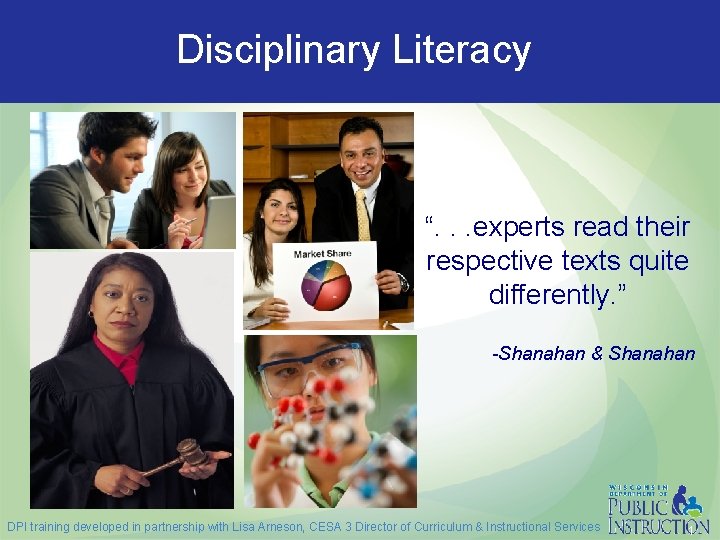
Disciplinary Literacy “. . . experts read their respective texts quite differently. ” -Shanahan & Shanahan DPI training developed in partnership with Lisa Arneson, CESA 3 Director of Curriculum & Instructional Services 1
Agenda 2017 Standards & Instruction – What and how should kids learn? Assessments and Data Systems – How do we know if they learned it? School and Educator Effectiveness – How do we ensure that students have highly effective teachers and schools? School Finance Reform – How should we pay for schools?
Target Goals By 2017, we need to reach target goals that prepare our students for success in further education and career: ü Further increase graduation rate from 85. 7 percent to 92 percent. ü Increase career and college readiness from 32 percent to 67 percent. ü Close graduation and career and college readiness gaps by 50 percent. ü Increase the percentage of students scoring proficient in third-grade reading and eighth-grade mathematics. ü Adopt the Fair Funding for Our Future plan to make school finance more equitable and transparent.
I N W ISCONSIN. . . disciplinary literacy is defined as the confluence of content knowledge, experiences, and skills merged with the ability to read, write, listen, speak and think critically in a way that is meaningful within the context of a given field. 4
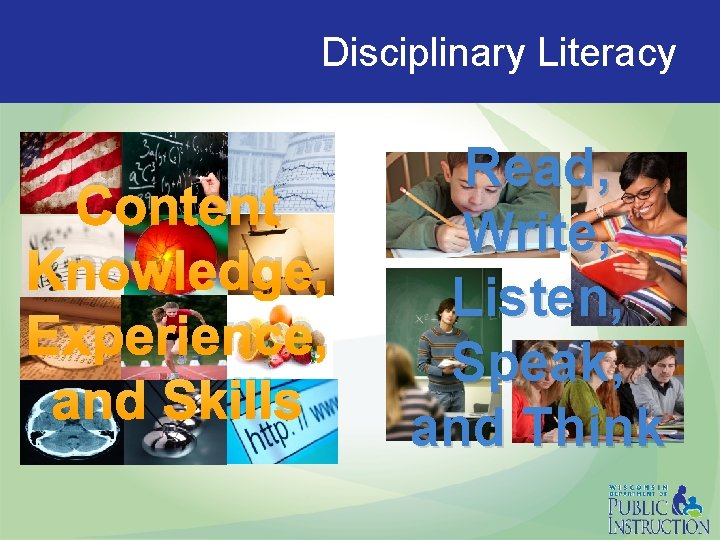
Disciplinary Literacy Content Knowledge, Experience, and Skills Read, Write, Listen, Speak, and Think
D ISCIPLINARY L ITERACY “Literacy… becomes an essential aspect of disciplinary practice, rather than a set of strategies or tools brought into the disciplines to improve reading and writing of subject-matter texts. ” - Elizabeth Birr Moje “Foregrounding the Disciplines in Secondary Literacy Teaching and Learning: A Call for Change. ” Journal of Adolescent & Adult Literacy. Oct. 2008. 6
Generic Reading Strategies Disciplinary-Specific Reading Strategies Monitor comprehension Build prior knowledge Pre-read Build specialized vocabulary Set goals Think about what one already knows Ask questions Make predictions Test predictions against the text Re-read Summarize Learn to deconstruct complex sentences Use knowledge of text structures and genres to predict main and subordinate ideas Map graphic (and mathematical) representations against explanations in the text Pose discipline relevant questions Compare claims and propositions across texts Use norms for reasoning within the discipline (i. e. , what counts as evidence) to evaluate claims 7
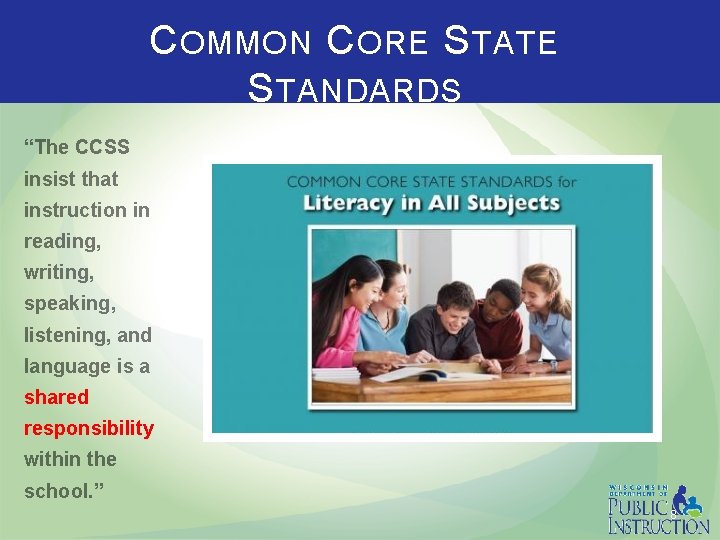
C OMMON C ORE S TATE S TANDARDS “The CCSS insist that instruction in reading, writing, speaking, listening, and language is a shared responsibility within the school. ” 8
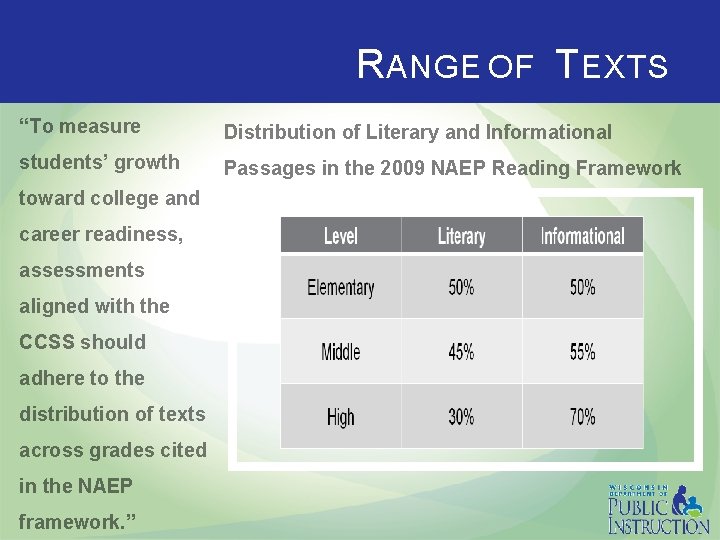
R ANGE OF T EXTS “To measure Distribution of Literary and Informational students’ growth Passages in the 2009 NAEP Reading Framework toward college and career readiness, assessments aligned with the CCSS should adhere to the distribution of texts across grades cited in the NAEP framework. ”
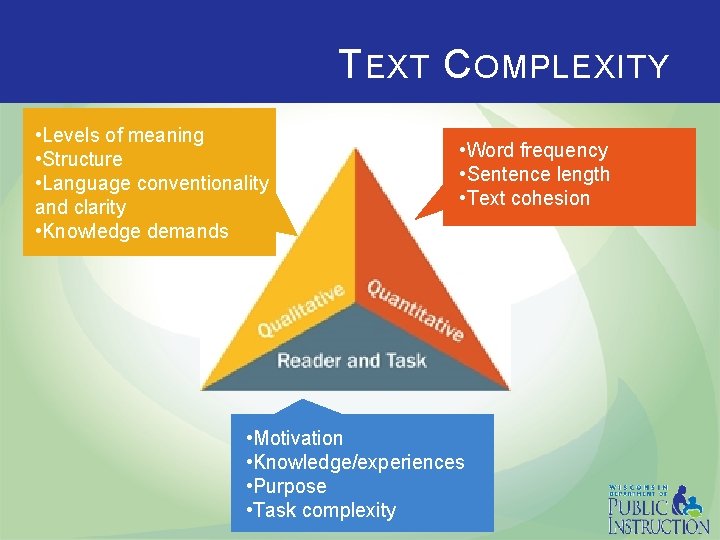
T EXT C OMPLEXITY • Levels of meaning • Structure • Language conventionality and clarity • Knowledge demands • Word frequency • Sentence length • Text cohesion • Motivation • Knowledge/experiences • Purpose • Task complexity
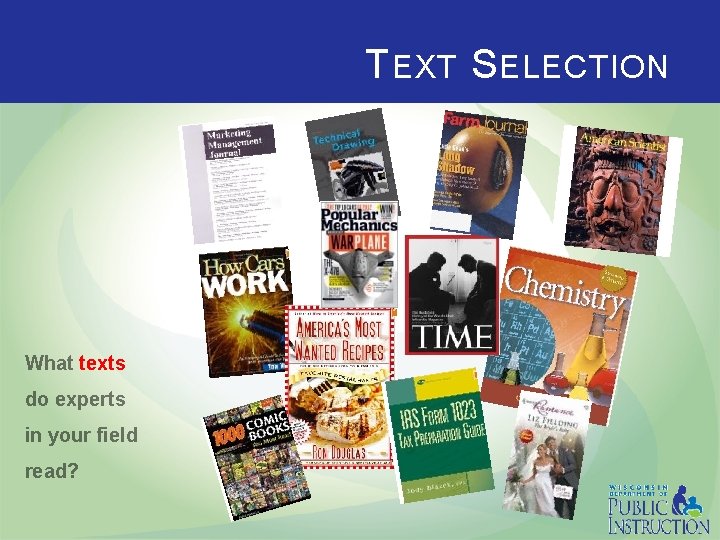
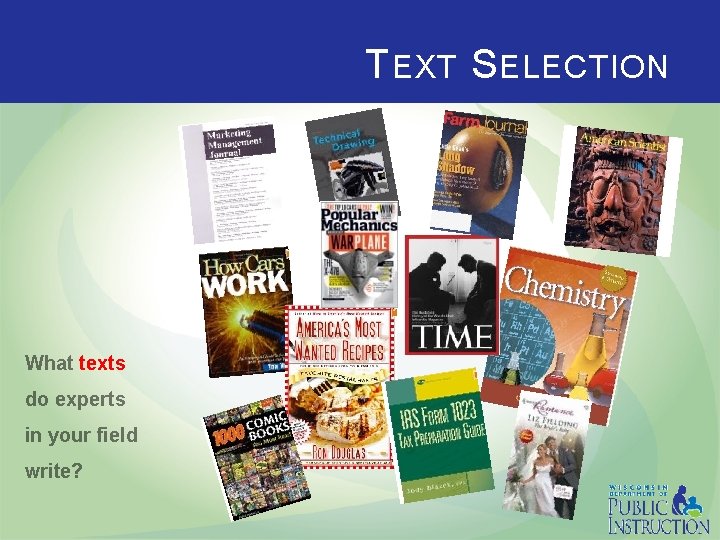
T EXT S ELECTION What texts do experts in your field read?
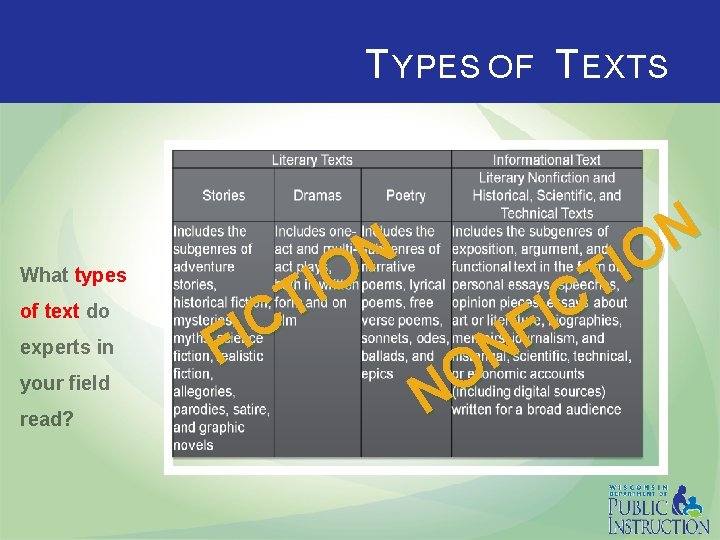
T YPES OF T EXTS What types of text do experts in your field read? N N O I O T I T C I F F N O N
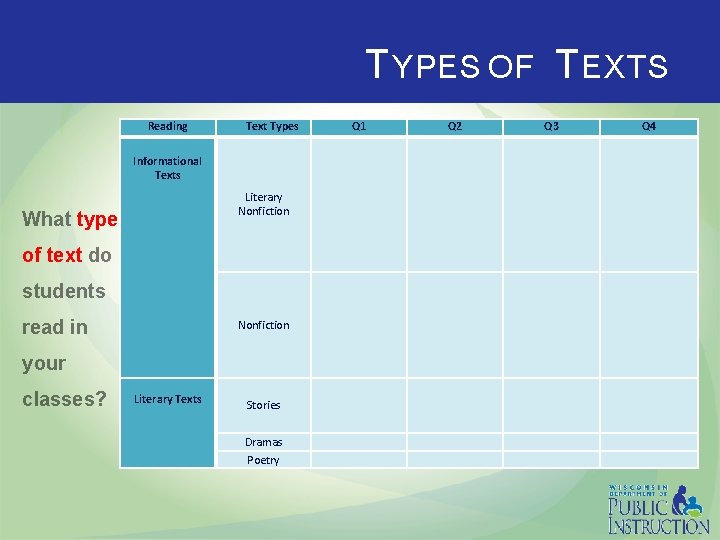
T YPES OF T EXTS Reading Text Types Informational Texts Literary Nonfiction What types of text do students read in Nonfiction your classes? Literary Texts Stories Dramas Poetry Q 1 Q 2 Q 3 Q 4
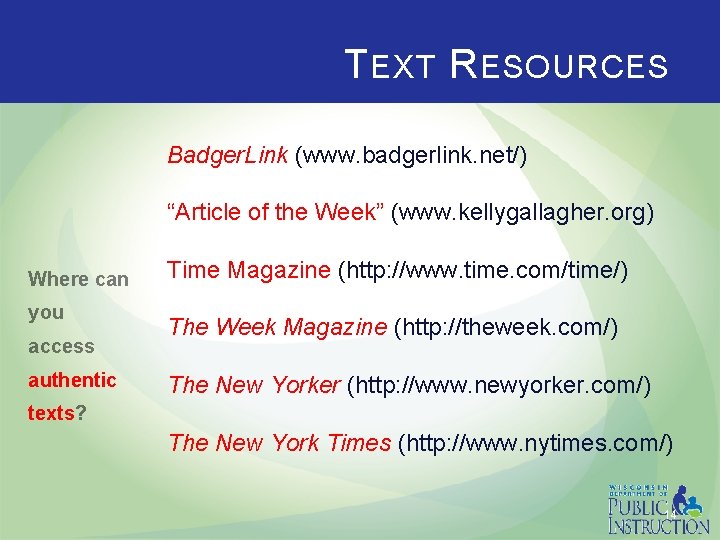
T EXT R ESOURCES Badger. Link (www. badgerlink. net/) “Article of the Week” (www. kellygallagher. org) Where can you access authentic Time Magazine (http: //www. time. com/time/) The Week Magazine (http: //theweek. com/) The New Yorker (http: //www. newyorker. com/) texts? The New York Times (http: //www. nytimes. com/) 14
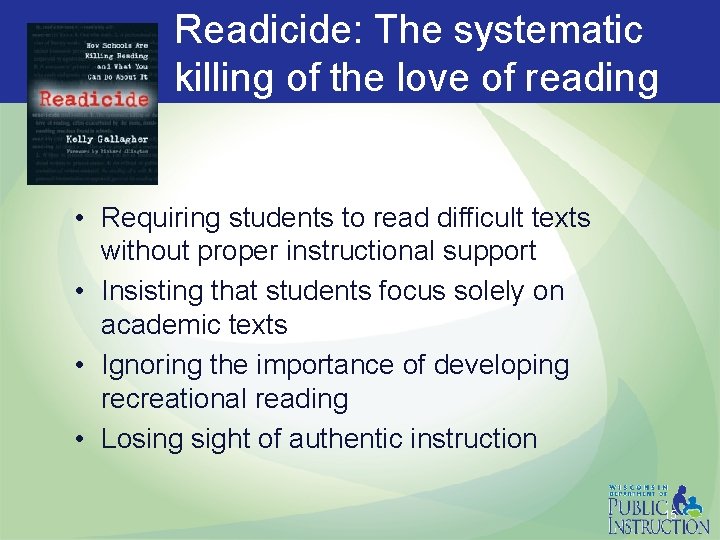
Readicide: The systematic killing of the love of reading • Requiring students to read difficult texts without proper instructional support • Insisting that students focus solely on academic texts • Ignoring the importance of developing recreational reading • Losing sight of authentic instruction 15
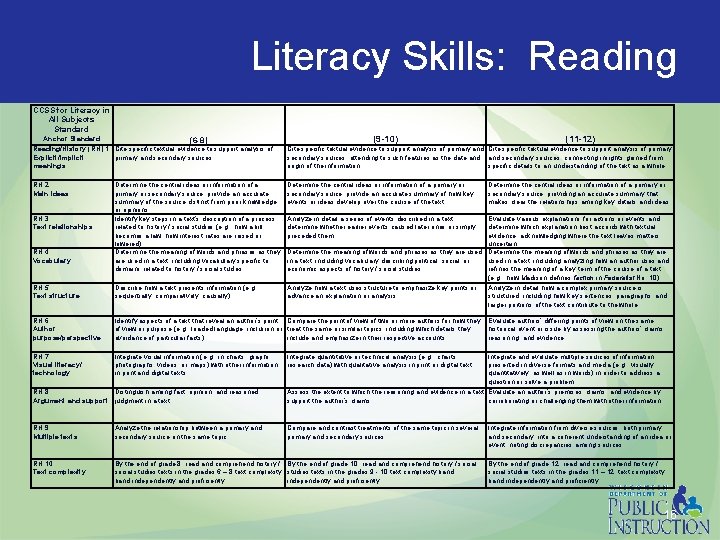
Literacy Skills: Reading CCSS for Literacy in All Subjects Standard Anchor Standard (6 -8) (9 -10) (11 -12) Reading/History (RH) 1 Cite specific textual evidence to support analysis of Explicit/implicit primary and secondary sources. meanings Cite specific textual evidence to support analysis of primary and Cite specific textual evidence to support analysis of primary secondary sources, attending to such features as the date and secondary sources, connecting insights gained from origin of the information. specific details to an understanding of the text as a whole. RH 2 Main ideas Determine the central ideas or information of a primary or secondary source; provide an accurate summary of how key events or ideas develop over the course of the text. RH 3 Text relationships RH 4 Vocabulary Determine the central ideas or information of a primary or secondary source; provide an accurate summary of the source distinct from prior knowledge or opinions. Identify key steps in a text’s description of a process related to history / social studies (e. g. , how a bill becomes a law, how interest rates are raised or lowered). Determine the meaning of words and phrases as they are used in a text, including vocabulary specific to domains related to history / social studies. Determine the central ideas or information of a primary or secondary source; providing an accurate summary that makes clear the relationships among key details and ideas. Analyze in detail a series of events described in a text; determine whether earlier events caused later ones or simply preceded them. Evaluate various explanations for actions or events and determine which explanation best accords with textual evidence, acknowledging where the text leaves matters uncertain. Determine the meaning of words and phrases as they are used Determine the meaning of words and phrases as they are in a text, including vocabulary describing political, social, or used in a text, including analyzing how an author uses and economic aspects of history / social studies refines the meaning of a key term of the course of a text (e. g. , how Madison defines faction in Federalist No. 10). Analyze how a text uses structure to emphasize key points or Analyze in detail how a complex primary source is advance an explanation or analysis. structured, including how key sentences, paragraphs, and larger portions of the text contribute to the whole. RH 5 Text structure Describe how a text presents information (e. g. , sequentially, comparatively, causally). RH 6 Author purpose/perspective Identify aspects of a text that reveal an author’s point Compare the point of view of two or more authors for how they of view or purpose (e. g. , loaded language, inclusion or treat the same or similar topics, including which details they avoidance of particular facts). include and emphasize in their respective accounts. RH 7 Visual literacy/ technology Integrate visual information (e. g. , in charts, graphs, photographs, videos, or maps) with other information in print and digital texts. Evaluate authors’ differing points of view on the same historical event or issue by assessing the authors’ claims, reasoning, and evidence. Integrate quantitative or technical analysis (e. g. , charts, research data) with qualitative analysis in print or digital text. RH 8 Distinguish among fact, opinion, and reasoned Argument and support judgment in a text. Integrate and evaluate multiple sources of information presented in diverse formats and media (e. g. , visually, quantitatively, as well as in words) in order to address a question or solve a problem. Assess the extent to which the reasoning and evidence in a text Evaluate an author’s premises, claims, and evidence by support the author’s claims. corroborating or challenging them with other information. RH 9 Multiple texts Analyze the relationship between a primary and secondary source on the same topic. Compare and contrast treatments of the same topic in several primary and secondary sources. RH 10 Text complexity By the end of grade 8, read and comprehend history / By the end of grade 10, read and comprehend history / social studies texts in the grades 6 – 8 text complexity studies texts in the grades 9 - 10 text complexity band independently and proficiently. Integrate information from diverse sources, both primary and secondary, into a coherent understanding of an idea or event, noting discrepancies among sources. By the end of grade 12, read and comprehend history / social studies texts in the grades 11 – 12 text complexity band independently and proficiently. 16
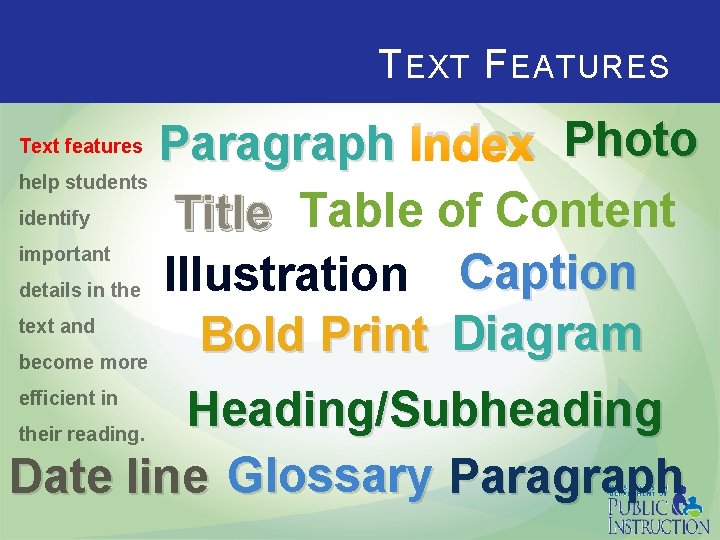
T EXT F EATURES Paragraph Index Photo help students identify Title Table of Content important Caption details in the Illustration text and Diagram Bold Print become more Text features Heading/Subheading their reading. Date line Glossary Paragraph efficient in
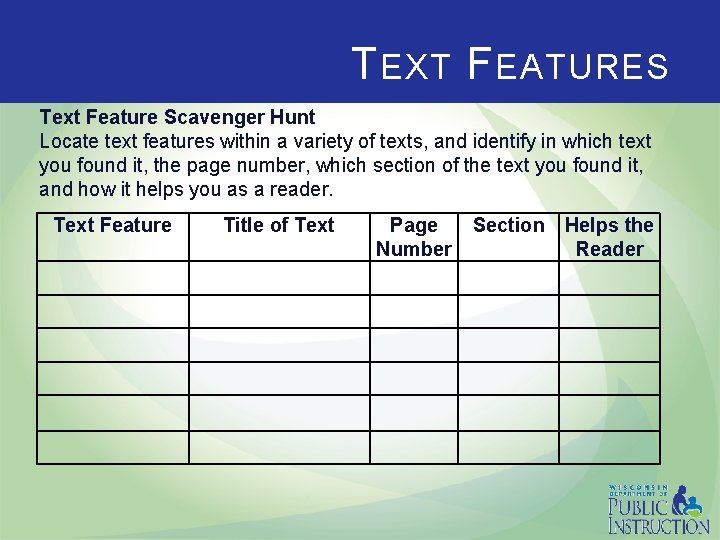
T EXT F EATURES Text Feature Scavenger Hunt Locate text features within a variety of texts, and identify in which text you found it, the page number, which section of the text you found it, and how it helps you as a reader. Text Feature Title of Text Page Number Section Helps the Reader
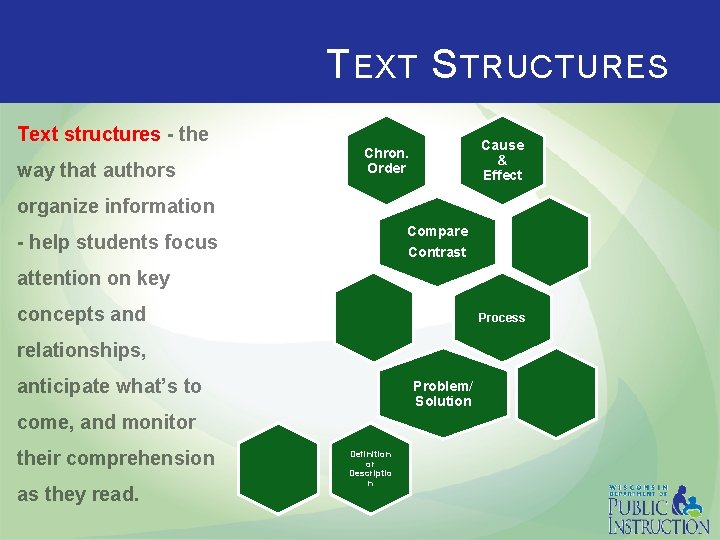
T EXT S TRUCTURES Text structures - the way that authors Cause & Effect Chron. Order organize information Compare - help students focus Contrast attention on key concepts and Process relationships, anticipate what’s to Problem/ Solution come, and monitor their comprehension as they read. Definition or Descriptio n
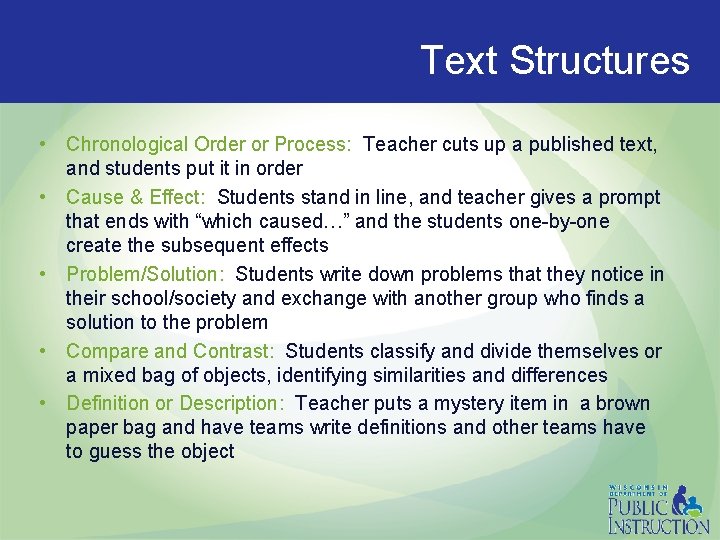
Text Structures • Chronological Order or Process: Teacher cuts up a published text, and students put it in order • Cause & Effect: Students stand in line, and teacher gives a prompt that ends with “which caused…” and the students one-by-one create the subsequent effects • Problem/Solution: Students write down problems that they notice in their school/society and exchange with another group who finds a solution to the problem • Compare and Contrast: Students classify and divide themselves or a mixed bag of objects, identifying similarities and differences • Definition or Description: Teacher puts a mystery item in a brown paper bag and have teams write definitions and other teams have to guess the object
V OCABULARY “Words are not just words. They are the nexus – the interface – between communication and thought. ” - Marilyn Jager Adams
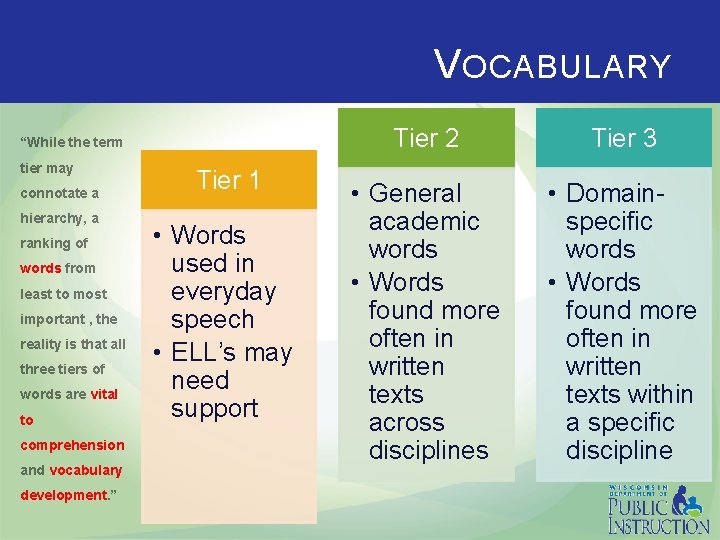
V OCABULARY “While the term tier may connotate a hierarchy, a ranking of words from least to most important , the reality is that all three tiers of words are vital to comprehension and vocabulary development. ” Tier 1 • Words used in everyday speech • ELL’s may need support Tier 2 Tier 3 • General academic words • Words found more often in written texts across disciplines • Domainspecific words • Words found more often in written texts within a specific discipline
I NTEGRATED M ODEL OF L ITERACY Knowledge builds on knowledge. 23
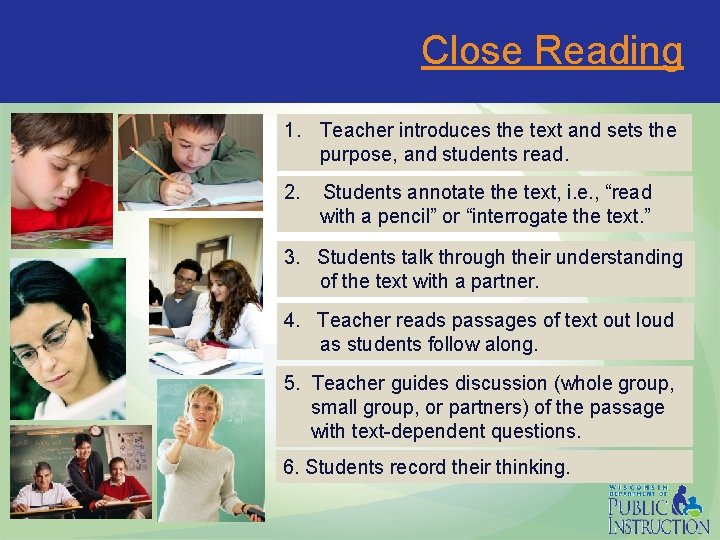
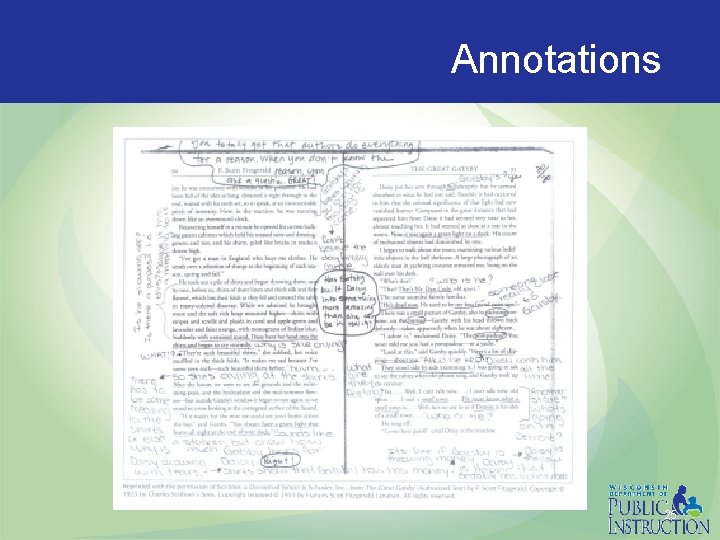
Close Reading 1. Teacher introduces the text and sets the purpose, and students read. 2. Students annotate the text, i. e. , “read with a pencil” or “interrogate the text. ” 3. Students talk through their understanding of the text with a partner. 4. Teacher reads passages of text out loud as students follow along. 5. Teacher guides discussion (whole group, small group, or partners) of the passage with text-dependent questions. 6. Students record their thinking.
Annotations 25
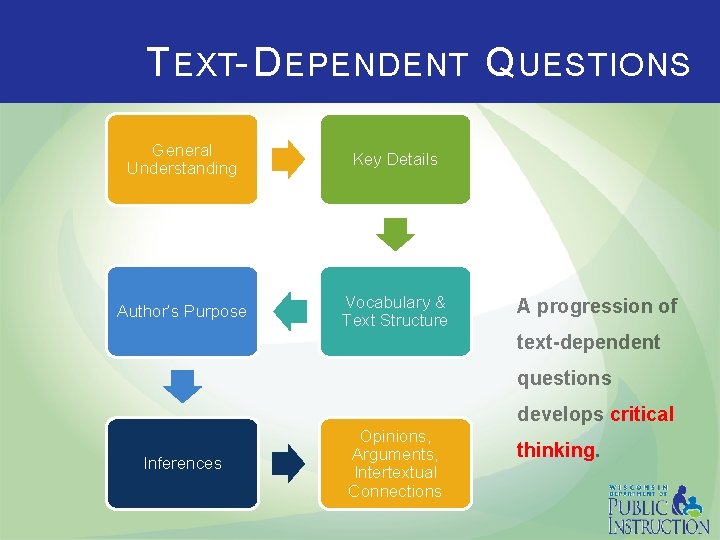
T EXT- D EPENDENT Q UESTIONS Text-dependent questions require students to return to the text to formulate responses.
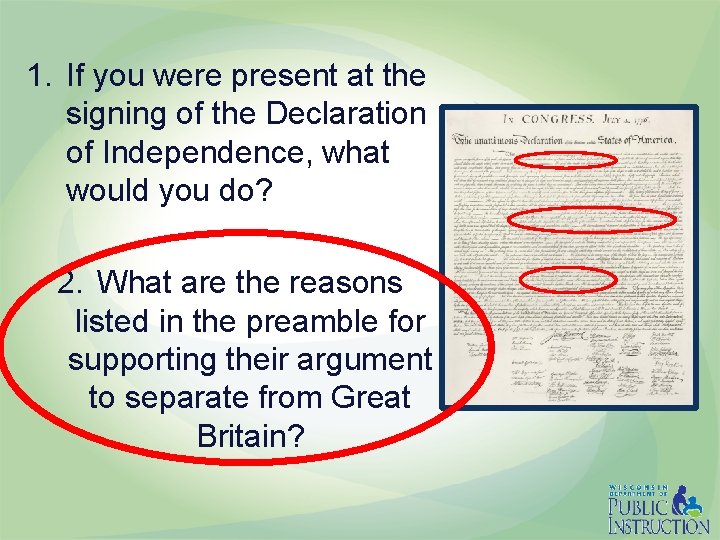
Which of the following questions require students to read the text closely? 1. If you were present at the signing of the Declaration of Independence, what would you do? 2. What are the reasons listed in the preamble for supporting their argument to separate from Great Britain?
1. If you were present at the signing of the Declaration of Independence, what would you do? 2. What are the reasons listed in the preamble for supporting their argument to separate from Great Britain?
T EXT- D EPENDENT Q UESTIONS General Understanding Key Details Author’s Purpose Vocabulary & Text Structure A progression of text-dependent questions develops critical Inferences Opinions, Arguments, Intertextual Connections thinking.
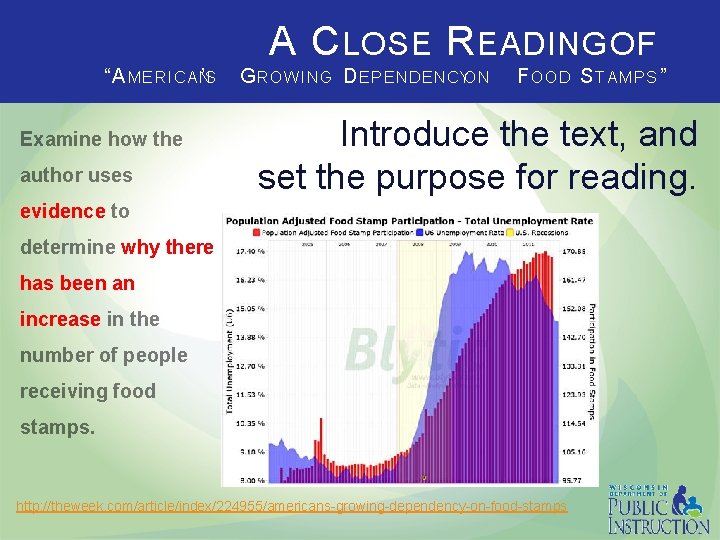
A C LOSE R EADING OF “ A ME RI C AN’S Examine how the author uses G R OWI N G D E P E N D E N C YON F OOD S TAMPS ” Introduce the text, and set the purpose for reading. evidence to determine why there has been an increase in the number of people receiving food stamps. http: //theweek. com/article/index/224955/americans-growing-dependency-on-food-stamps
A C LOSE R EADING OF A M E RI C AN’S Annotate: Circle powerful words or phrases that affect you. Underline that G RO WI NG D E P E N D E N C YON Students annotate the text, i. e. , “read with a pencil” or “interrogate the text. ” which confuses you. Quick-write: General Understanding • Main idea of the text • Overall organization of the text Describe your impression of food stamps. F OOD S T AMPS”
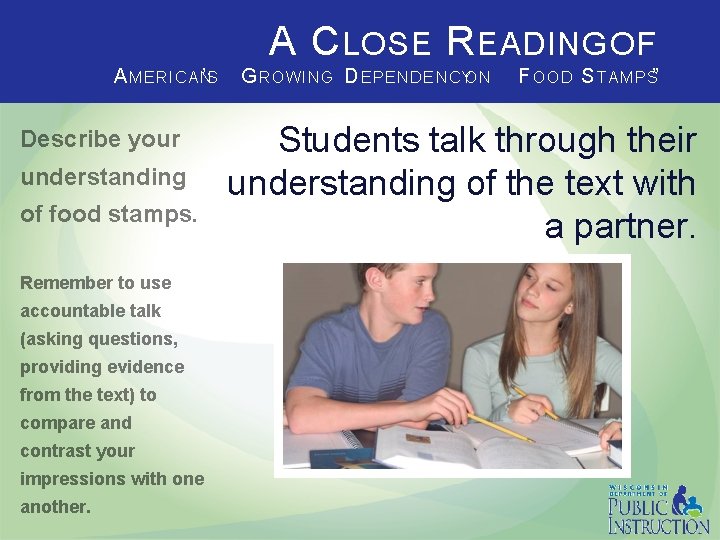
A C LOSE R EADING OF A M E RI C AN’S Describe your understanding of food stamps. Remember to use accountable talk (asking questions, providing evidence from the text) to compare and contrast your impressions with one another. G RO WI NG D E P E N D E N C YON F OOD S T AMPS” Students talk through their understanding of the text with a partner.
A C LOSE R EADING OF “ A ME RIC A N’S Orient students to the text, and ask them to follow along. Read the passage aloud without interruption. G RO WI NG D E P E N D E N C YON F OOD S T AMPS” Read a passage of text out loud as students follow along.
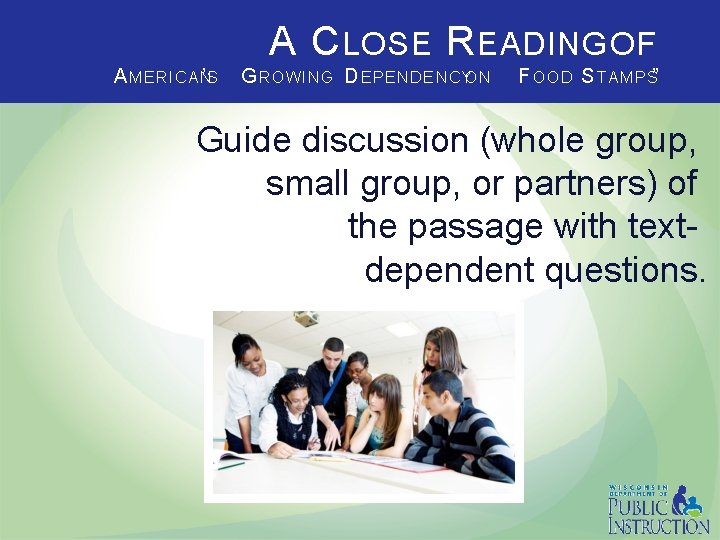
A C LOSE R EADING OF A M E RI C AN’S G RO WI NG D E P E N D E N C YON F OOD S T AMPS” Guide discussion (whole group, small group, or partners) of the passage with textdependent questions.
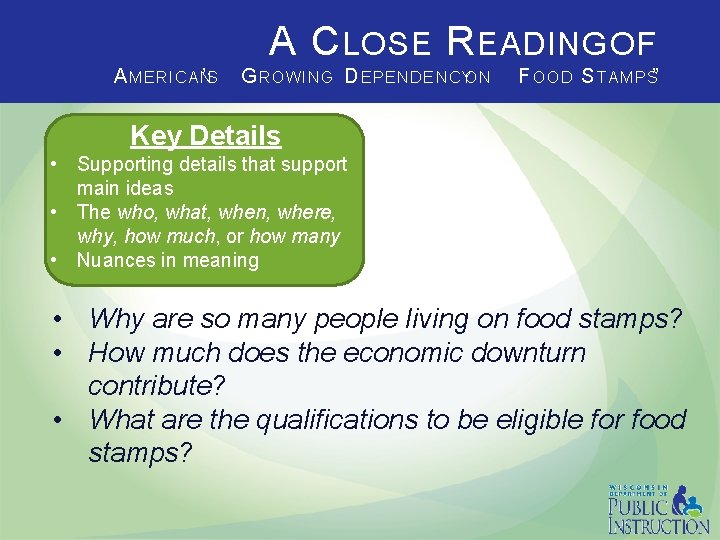
A C LOSE R EADING OF A M E RI C AN’S G RO WI NG D E P E N D E N C YON F OOD S T AMPS” Key Details • Supporting details that support main ideas • The who, what, when, where, why, how much, or how many • Nuances in meaning • Why are so many people living on food stamps? • How much does the economic downturn contribute? • What are the qualifications to be eligible for food stamps?
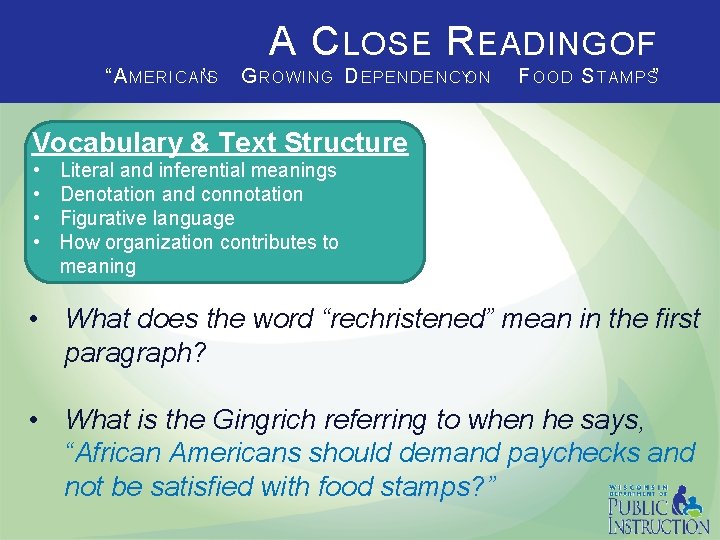
A C LOSE R EADING OF “ A ME RIC A N’S G RO WI NG D E P E N D E N C YON F OOD S T AMPS” Vocabulary & Text Structure • • Literal and inferential meanings Denotation and connotation Figurative language How organization contributes to meaning • What does the word “rechristened” mean in the first paragraph? • What is the Gingrich referring to when he says, “African Americans should demand paychecks and not be satisfied with food stamps? ”
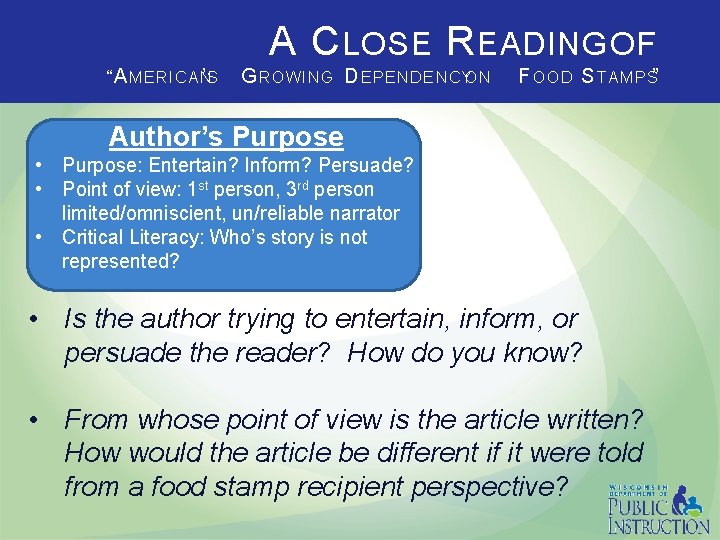
A C LOSE R EADING OF “ A ME RIC A N ’S G RO WI NG D E P E N D E N C YON F OOD S T AMPS” Author’s Purpose • Purpose: Entertain? Inform? Persuade? • Point of view: 1 st person, 3 rd person limited/omniscient, un/reliable narrator • Critical Literacy: Who’s story is not represented? • Is the author trying to entertain, inform, or persuade the reader? How do you know? • From whose point of view is the article written? How would the article be different if it were told from a food stamp recipient perspective?
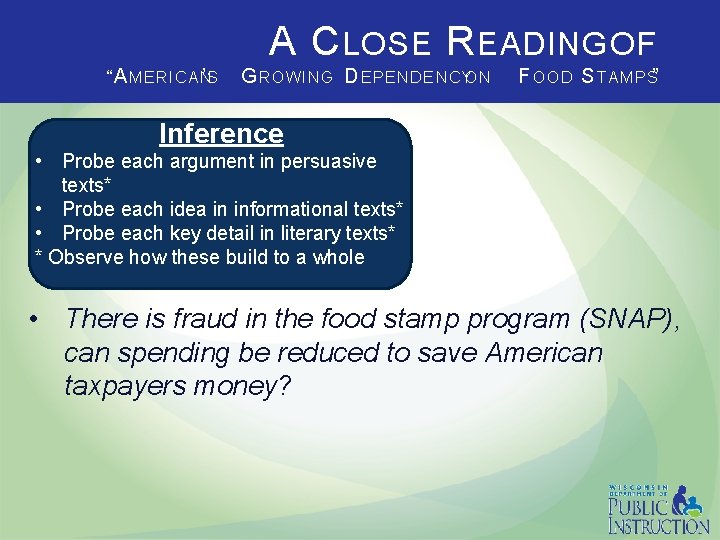
A C LOSE R EADING OF “ A ME RIC A N ’S G RO WI NG D E P E N D E N C YON F OOD S T AMPS” Inference • Probe each argument in persuasive texts* • Probe each idea in informational texts* • Probe each key detail in literary texts* * Observe how these build to a whole • There is fraud in the food stamp program (SNAP), can spending be reduced to save American taxpayers money?
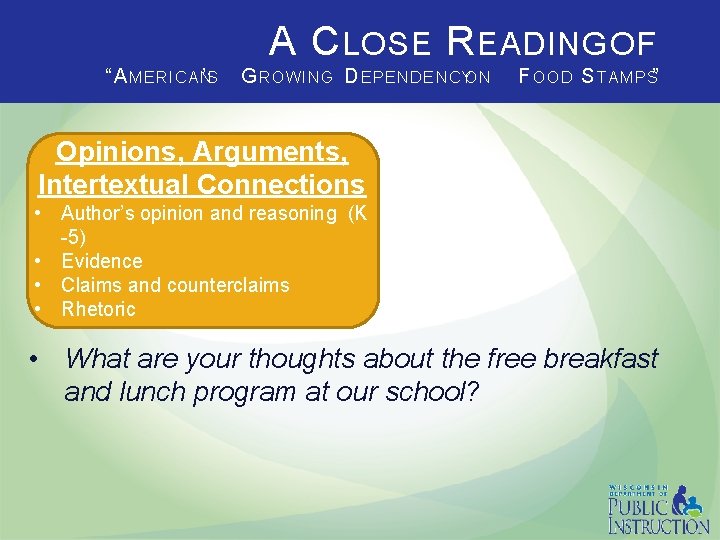
A C LOSE R EADING OF “ A ME RIC A N’S G RO WI NG D E P E N D E N C YON F OOD S T AMPS” Opinions, Arguments, Intertextual Connections • Author’s opinion and reasoning (K -5) • Evidence • Claims and counterclaims • Rhetoric • What are your thoughts about the free breakfast and lunch program at our school?
A C LOSE R EADING OF “ A ME RIC A N’S In the article, “American’s Growing Dependency on Food Stamps” determine and defend if we are feeding the hungry, breeding dependency or both? Ask students to write an essay. G RO WI NG D E P E N D E N C YON F OOD S T AMPS” Students record their thinking.
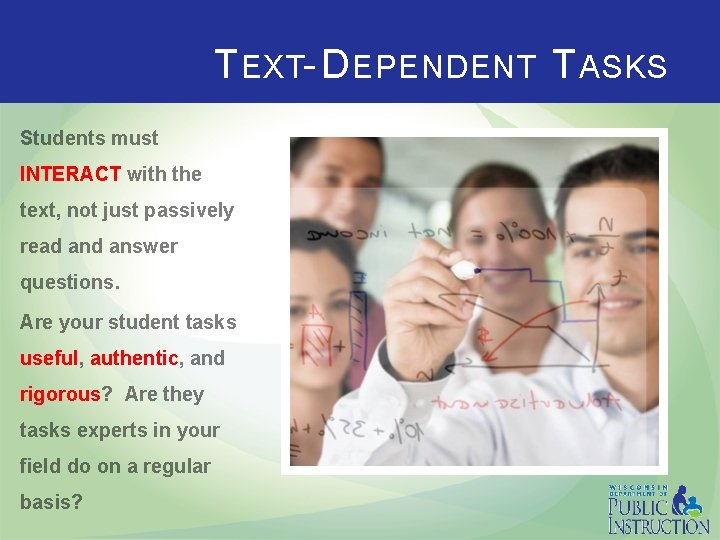
T EXT- D EPENDENT T ASKS Students must INTERACT with the text, not just passively read answer questions. Are your student tasks useful, authentic, and rigorous? Are they tasks experts in your field do on a regular basis?
I NTEGRATED M ODEL OF L ITERACY Knowledge builds on knowledge. 42
CCSS S AMPLE P ERFORMANCE T ASKS What content knowledge is Students determine the central ideas found in the assessed in this Declaration of Sentiments by the Seneca Falls performance Conference, noting the parallels between it and the task? Declaration of Independence and providing a Which literacy summary that makes clear the relationships among standards are the key details and ideas of each text and between embedded within the texts. this performance task?
CCSS S AMPLE P ERFORMANCE T ASKS What content knowledge is Students integrate the information provided by Mary assessed in this C. Daly, vice president at the Federal Reserve Bank performance of San Francisco, with the data presented visually in task? the Fed. Views report. In their analysis of these Which literacy sources of information presented in diverse formats, standards are students frame and address a question or solve a embedded within problem raised by their evaluation of the evidence. this performance task?
CCSS S AMPLE P ERFORMANCE T ASKS What content knowledge is Students analyze the hierarchical relationships assessed in this between phrase searches and searches that use performance basic Boolean operators in Tara Calishain and Rael task? Dornfest’s Google Hacks: Tips & Tools for Smarter Which literacy Searching, 2 nd Edition. standards are embedded within this performance task?
CCSS S AMPLE P ERFORMANCE T ASKS What content knowledge is assessed in this performance task? Which literacy standards are embedded within this performance task? Students analyze the concept of mass based on their close reading of Gordon Kane’s “The Mysteries of Mass” and cite specific textual evidence from the text to answer the question of why elementary particles have mass at all. Students explain important distinctions the author makes regarding the Higgs field and the Higgs boson and their relationship to the concept of mass.
CCSS S AMPLE P ERFORMANCE T ASKS What content knowledge is assessed in this Students determine the meaning of key terms such as hydraulic, trajectory, and torque as well as other performance domain-specific words and phrases such as task? actuators, antilock brakes, and traction control used Which literacy standards are embedded within this performance task? in Mark Fischetti’s “Working Knowledge: Electronic Stability Control. ”
T EXT- D EPENDENT T ASKS Students must INTERACT with the text, not just passively read answer questions. Are your student tasks useful, authentic, and rigorous? Are they tasks experts in your field do on a regular basis?
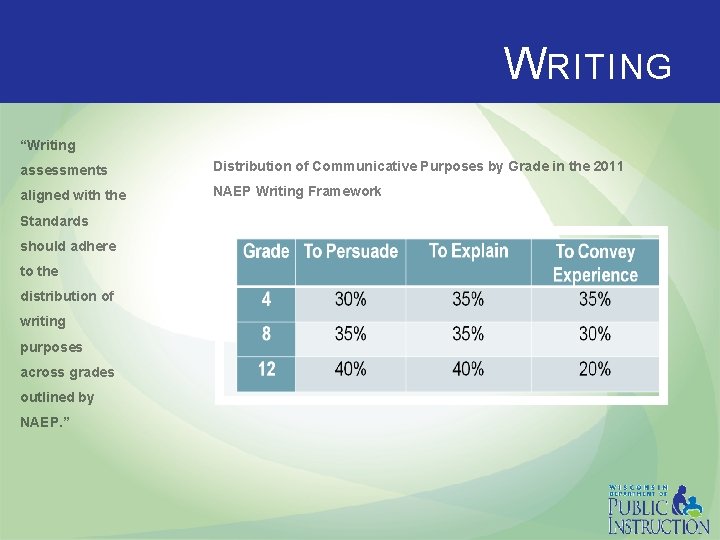
W RITING “Writing assessments Distribution of Communicative Purposes by Grade in the 2011 aligned with the NAEP Writing Framework Standards should adhere to the distribution of writing purposes across grades outlined by NAEP. ”
T EXT S ELECTION What texts do experts in your field write?
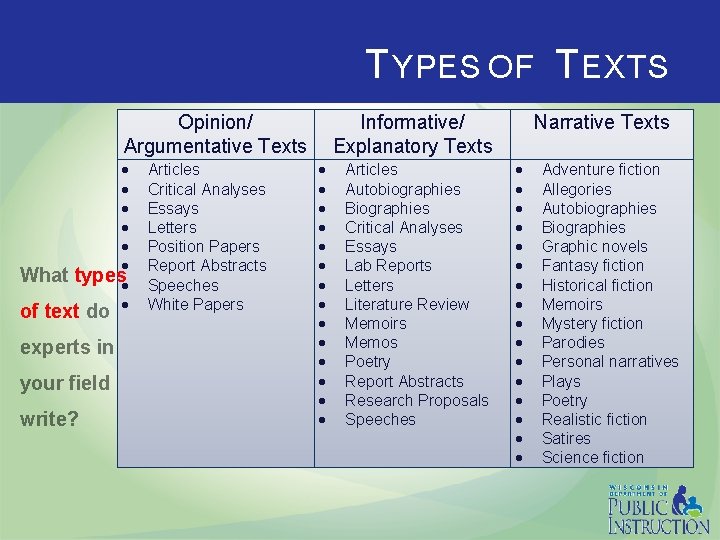
T YPES OF T EXTS Opinion/ Argumentative Texts What types of text do experts in your field write? Articles Critical Analyses Essays Letters Position Papers Report Abstracts Speeches White Papers Informative/ Explanatory Texts Articles Autobiographies Biographies Critical Analyses Essays Lab Reports Letters Literature Review Memoirs Memos Poetry Report Abstracts Research Proposals Speeches Narrative Texts Adventure fiction Allegories Autobiographies Biographies Graphic novels Fantasy fiction Historical fiction Memoirs Mystery fiction Parodies Personal narratives Plays Poetry Realistic fiction Satires Science fiction
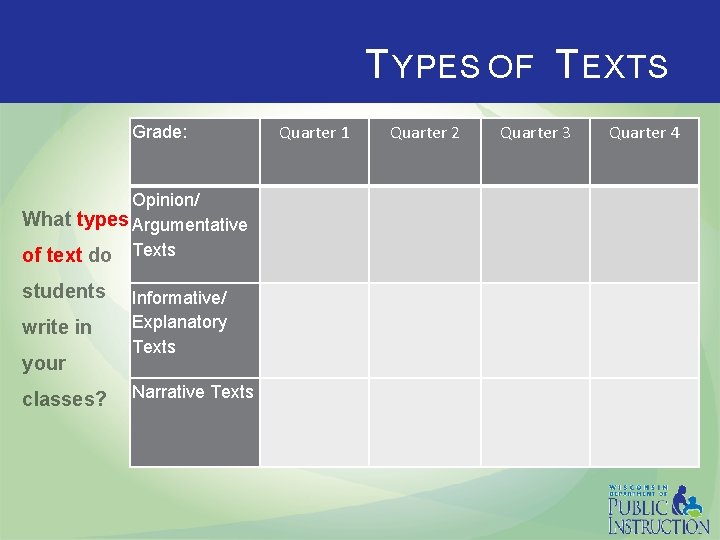
T YPES OF T EXTS Grade: Opinion/ What types Argumentative of text do Texts students write in your classes? Informative/ Explanatory Texts Narrative Texts Quarter 1 Quarter 2 Quarter 3 Quarter 4
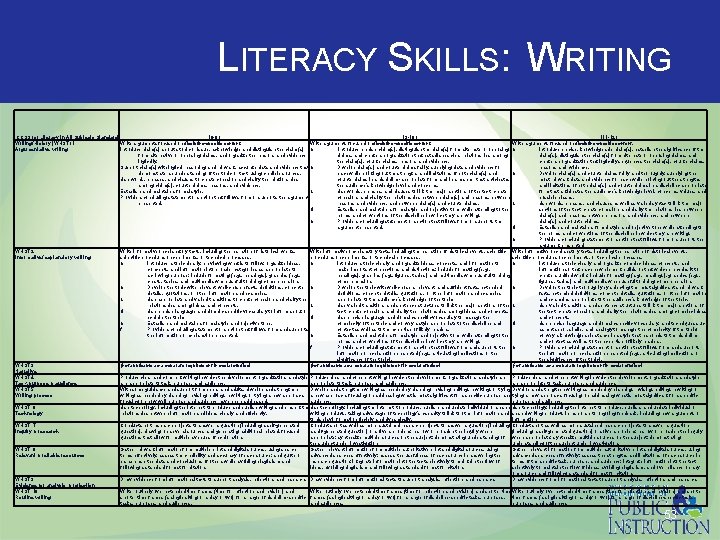
LITERACY SKILLS: WRITING CCSS for Literacy in All Subjects Standard (6 -8) (9 -10) Writing/History (WHST) 1 Write arguments focused on discipline-specific content. Argumentative writing Introduce claim(s) about a topic or issue, acknowledge and distinguish the claim (s) a. Introduce precise claim(s), distinguish the claim(s) from alternate or opposing from alternative or opposing claims, and organize the reasons and evidence claims, and create an organization that establishes clear relationships among logically. the claim(s), counterclaims, reasons and evidence. Support claim(s) with logical reasoning and relevant, accurate data and evidence that b. Develop claim(s) and counterclaims fairly, supplying data and evidence for demonstrate an understanding of the topic or text, using credible sources. each while pointing out the strengths and limitations of both claim(s) and Use words, phrases, and clauses to create cohesion and clarify the relationships counterclaims in a discipline-appropriate form and in a manner that anticipates among claim(s), counterclaims, reasons, and evidence. the audience’s knowledge level and concerns. Establish and maintain a formal style. c. Use words, phrases, and clauses to link the major sections of the text, create Provide a concluding statement or section that follows from or supports the argument cohesion, and clarify the relationships between claim(s) and reasons, between presented. reasons and evidence, and between claim(s) and counterclaims. d. Establish and maintain a formal style and objective tone while attending to the norms and conventions of the discipline in which they are writing. e. Provide a concluding statement or section that follows from or supports the argument presented. WHST 2 Informative/ explanatory writing WHST 3 Narrative WHST 4 Task, purpose & audience WHST 5 Writing process WHST 6 Technology WHST 7 Inquiry & research WHST 8 Relevant & reliable resources WHST 9 Evidence for analysis & reflection WHST 10 Routine writing (11 -12) Write arguments focused on discipline-specific content. a. Introduce precise, knowledgeable claim(s), establish the significance of the claim(s), distinguish the claim(s) from alternate or opposing claims, and create an organization that logically sequences the claim(s), counterclaims, reasons and evidence. b. Develop claim(s) and counterclaims fairly and thoroughly, supplying the most relevant data and evidence for each while pointing out the strengths and limitations of both claim(s) and counterclaims in a discipline-appropriate form that anticipates the audience’s knowledge level, concerns, values, and possible biases. c. Use words, phrases, and clauses as well as varied syntax to link the major sections of the text, create cohesion, and clarify the relationships between claim(s) and reasons, between reasons and evidence, and between claim(s) and counterclaims. d. Establish and maintain a formal style and objective tone while attending to the norms and conventions of the discipline in which they are writing. e. Provide a concluding statement or section that follows from or supports the argument presented. Write informative / explanatory texts, including the narration of historical events, scientific procedures / experiments, or technical processes. a. Introduce a topic clearly, previewing what is to follow; organize ideas, a. Introduce a topic clearly and organize ideas, concepts, and information to a. Introduce a topic clearly and organize complex ideas, concepts, and information into broader categories as appropriate to make important connections and distinctions; include formatting (e. g. , information so that each new element builds on that which precedes it to achieving purpose; include formatting (e. g. , headings), graphics (e. g. , figures, tables) and multimedia when useful to aiding create a unified whole; include formatting (e. g. , headings), graphics (e. g. , charts, tables, and multimedia when useful to aiding comprehension. figures, tables) and multimedia when useful to aiding comprehension. b. Develop the topic with relevant, well-chosen facts, definitions, concrete b. Develop the topic with well-chosen, relevant, and sufficient facts, extended b. Develop the topic thoroughly by selecting the most significant and relevant details, quotations, or other information and examples. definitions, concrete details, quotations, or other information and examples facts, extended definitions, concrete details, quotations, or other information c. Use appropriate and varied transitions to create cohesion and clarify the appropriate to the audience’s knowledge of the topic. and examples appropriate to the audience’s knowledge of the topic. relationships among ideas and concepts. c. Use varied transitions and sentence structures to link the major sections of the c. Use varied transitions and sentence structures to link the major sections of d. Use precise language and domain-specific vocabulary to inform about or text, create cohesion, and clarify the relationships among ideas and concepts. the text, create cohesion, and clarify the relationships among complex ideas explain the topic. d. Use precise language and domain-specific vocabulary to manage the and concepts. e. Establish and maintain a formal style and objective tone. complexity of the topic and convey a style appropriate to the discipline and d. Use precise language and domain-specific vocabulary, and techniques such f. Provide a concluding statement or section that follows from and supports context as well as to the expertise of likely readers. as metaphor, simile, and analogy to manage the complexity of the topic; the information or explanation presented. e. Establish and maintain a formal style and objective tone while attending to the convey a knowledgeable stance in a style that responds to the discipline norms and conventions of the discipline in which they are writing. and context as well as to the expertise of likely readers. f. Provide a concluding statement or section that follows from and supports the e. Provide a concluding statement or section that follows from and supports information or explanation presented (e. g. , articulating implications or the information or explanation presented (e. g. , articulating implications or significance of the topic). the significance of the topic). (not applicable as a separate requirement in social studies) Produce clear and coherent writing in which the development, organization, and style are appropriate to task, purpose, and audience. With some guidance and support from peers and adults, develop and strengthen Develop and strengthen writing as needed by planning, revising, editing, rewriting, or trying a new approach, focusing on addressing what is most significant for a specific purpose and trying a new approach, focusing on addressing what is most significant for a specific focusing on how well purpose and audience have been addressed. audience. purpose and audience. Use technology, including the Internet, to produce and publish writing and present the Use technology, including the Internet, to produce, publish, and update individual or shared Use technology, including the Internet, to produce, publish, and update individual or relationships between information and ideas clearly and efficiently. writing products, taking advantage of technology’s capacity to link to other information and shared writing products in response to ongoing feedback, including new arguments or to display information flexibly and dynamically. information. Conduct short research projects to answer a question (including a self-generated Conduct short as well as more sustained research projects to answer a question (including Conduct short as well as more sustained research projects to answer a question), drawing on several sources and generating additional related, focused a self-generated question) or solve a problem; narrow or broaden the inquiry when (including a self-generated question) or solve a problem; narrow or broaden the inquiry questions that allow for multiple avenues of exploration. appropriate; synthesize multiple sources on the subject; demonstrating understanding of when appropriate; synthesize multiple sources on the subject; demonstrating the subject under investigation. understanding of the subject under investigation. Gather relevant information from multiple print and digital sources, using search Gather relevant information from multiple authoritative print and digital sources, using terms effectively; assess the credibility and accuracy of each source; and quote or advanced searches effectively; assess the usefulness of each source in answering the advanced searches effectively; assess the strengths and limitations of each source in paraphrase the data and conclusions of others while avoiding plagiarism and research question; integrate information into the text selectively to maintain the flow of terms of the specific task, purpose, and audience; integrate information into the text following a standard format for citation. ideas, avoiding plagiarism and following a standard format for citation. selectively to maintain the flow of ideas, avoiding plagiarism, and overreliance on any one source and following a standard format for citation. Draw evidence from informational texts to support analysis, reflection, and research. Write routinely over extended time frames (time for reflection and revision) and shorter time frames (a single sitting or a day or two) for a range of discipline-specific tasks, purposes, time frames (a single sitting or a. day or two) for a range of discipline-specific tasks, purposes, and audiences 53
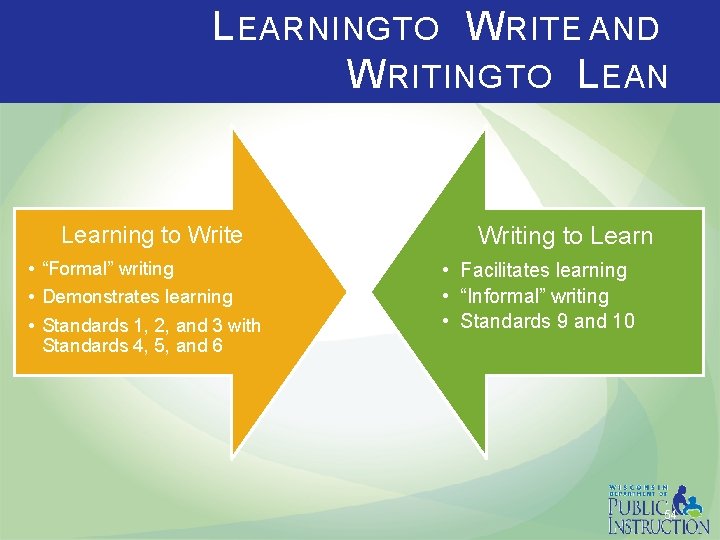
L EARNING TO W RITE AND W RITING TO L EAN Learning to Write • “Formal” writing • Demonstrates learning • Standards 1, 2, and 3 with Standards 4, 5, and 6 Writing to Learn • Facilitates learning • “Informal” writing • Standards 9 and 10 54
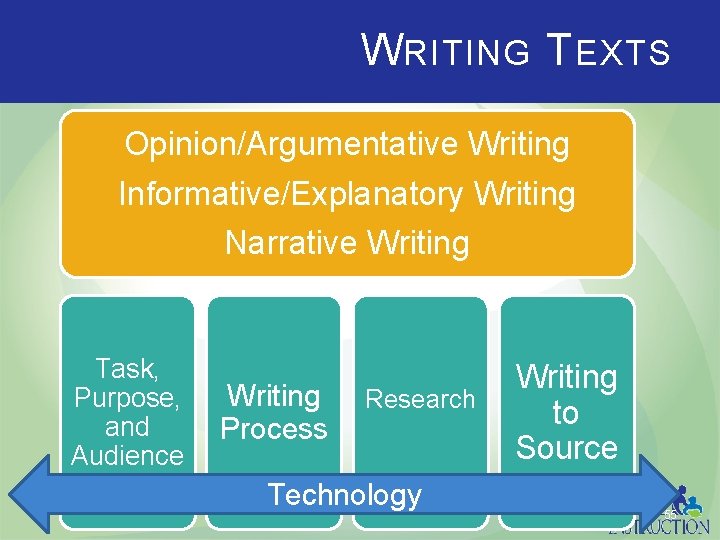
W RITING T EXTS Opinion/Argumentative Writing Informative/Explanatory Writing Narrative Writing Task, Purpose, and Audience Writing Process Research Technology Writing to Source 55
IMAGINE… IMAGINE … What could you do to incorporate more literacy into one unit that you are teaching? 56
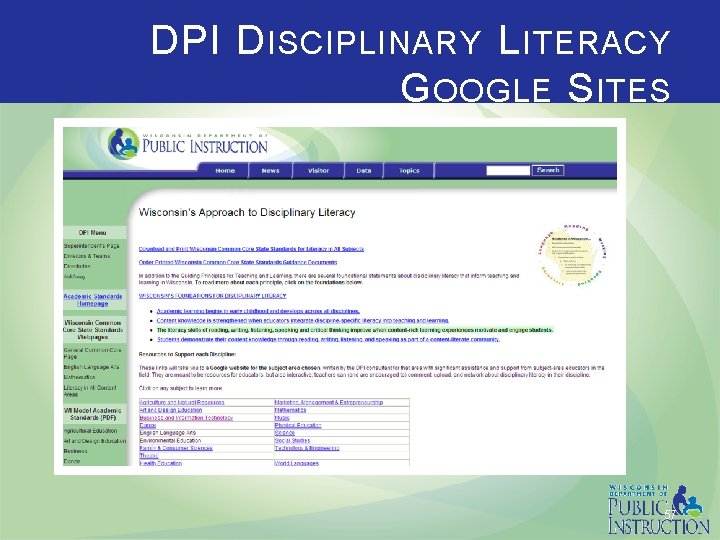
DPI D ISCIPLINARY L ITERACY G OOGLE S ITES 57
C LOSING T HOUGHTS Final words from CCSS author, David Coleman in The Hunt Institute’s video, “Literacy in Other Disciplines. ” 58