
Discharge of Oil and Gas Waste Tiffany Humberson
Discharge of Oil and Gas Waste Tiffany Humberson August 2017 Railroad Commission of Texas | June 27, 2016 (Change Date In First Master Slide)
Goal for Texas Waters It is the goal of Texas Railroad Commission to maintain and protect the quality of surface water and groundwater in the State. Policies shall be consistent with public health and welfare, and facilitate oil and gas industries, taking into consideration the economic development of the state. Railroad Commission of Texas | June 27, 2016 (Change Date In First Master Slide) 2
Disclaimer • This presentation is a quick overview and not intended to be a complete guide for filing the referenced applications • Each application is reviewed by an analyst and additional information and clarifications may be required • Please read the rules that are specific to your type of application • Contact Environmental Permits and Support for help should you have any questions (512 -4633840) Railroad Commission of Texas | June 27, 2016 (Change Date In First Master Slide) 3
Topics for Discussion • Laws and Rules • Federal and State Jurisdiction • Types of Discharges • Gas Plant • Inland Offshore • Minor Permits (MP) • Hydrostatic Tests (HT’s) • Domestic Wastewater (recycling) • Application Requirements for Discharges Railroad Commission of Texas | June 27, 2016 (Change Date In First Master Slide) 4
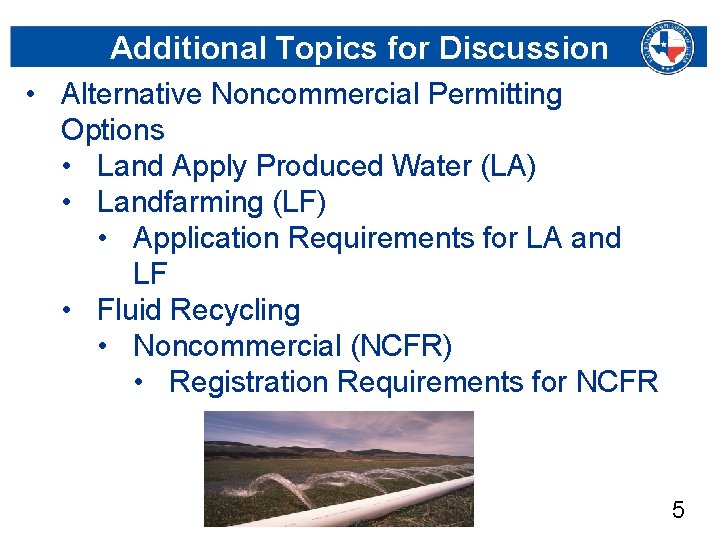
Additional Topics for Discussion • Alternative Noncommercial Permitting Options • Land Apply Produced Water (LA) • Landfarming (LF) • Application Requirements for LA and LF • Fluid Recycling • Noncommercial (NCFR) • Registration Requirements for NCFR Railroad Commission of Texas | June 27, 2016 (Change Date In First Master Slide) 5
Laws and Rules for Discharges • Federal • Clean Water Act (CWA) • State • Texas Commission of Environmental Quality (TCEQ) • Texas Surface Water Quality Standards (TSWQS) • General Land Office (GLO) • Railroad Commission of Texas (RRC) provides discharge permits for oil and gas activities. Railroad Commission of Texas | June 27, 2016 (Change Date In First Master Slide) 6
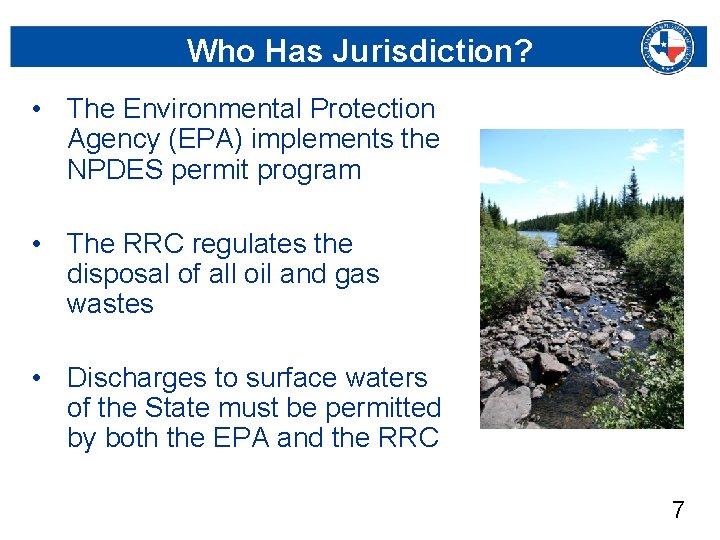
Who Has Jurisdiction? • The Environmental Protection Agency (EPA) implements the NPDES permit program • The RRC regulates the disposal of all oil and gas wastes • Discharges to surface waters of the State must be permitted by both the EPA and the RRC Railroad Commission of Texas | June 27, 2016 (Change Date In First Master Slide) 7
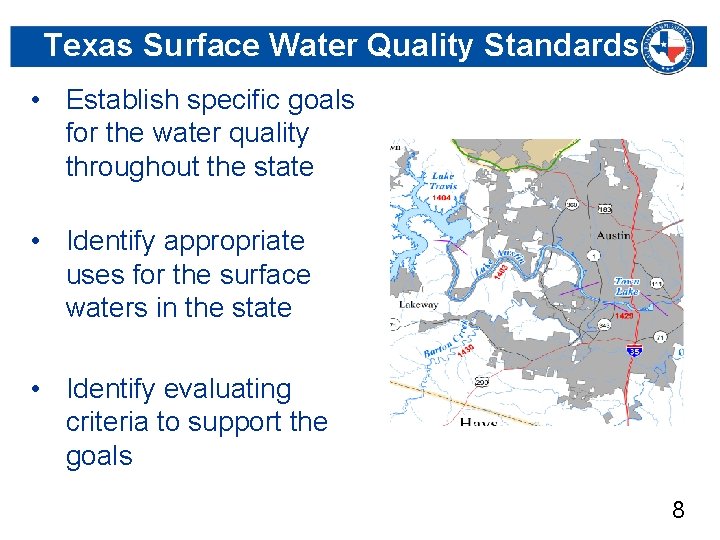
Texas Surface Water Quality Standards • Establish specific goals for the water quality throughout the state • Identify appropriate uses for the surface waters in the state • Identify evaluating criteria to support the goals Railroad Commission of Texas | June 27, 2016 (Change Date In First Master Slide) 8
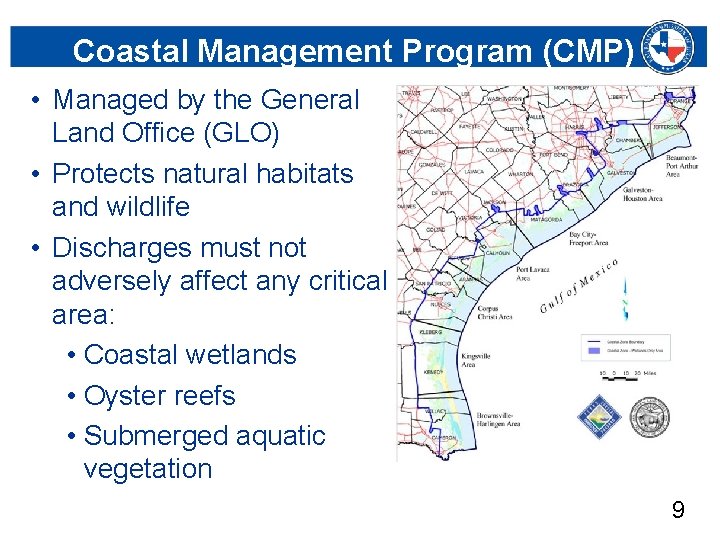
Coastal Management Program (CMP) • Managed by the General Land Office (GLO) • Protects natural habitats and wildlife • Discharges must not adversely affect any critical area: • Coastal wetlands • Oyster reefs • Submerged aquatic vegetation Railroad Commission of Texas | June 27, 2016 (Change Date In First Master Slide) 9
RRC Responsibility • Water Protection TAC Title 16, Part 1, Chapter § 3. 8 (Statewide Rule 8) • Pollution Control § 3. 8(d) (1) • No person may dispose of an oil and gas waste except as authorized or permitted by RRC • No person subject to RRC may cause or allow pollution of surface or subsurface water Railroad Commission of Texas | June 27, 2016 (Change Date In First Master Slide) 10
Types of Discharges A discharge may occur at the surface (to the ground) or be to surface waters. Three most common types of discharges: • Gas Plant Effluent (GPE) • Produced Water (Inland Offshore) • Minor permits – Hydrostatic Test Water (HT) – Domestic Wastewater Railroad Commission of Texas | June 27, 2016 (Change Date In First Master Slide) 11

Gas Plant Effluent Discharges • Common waste streams include: • Cooling tower blowdown • Reverse Osmosis (RO) reject wastewater • Compressor condensation • Requires Individual EPA permit http: //www. houstonchronicle. com/business/energy/a rticle/Two-more-gas-export-plants-proposed-for. Texas-6154035. php Railroad Commission of Texas | June 27, 2016 (Change Date In First Master Slide) 12
Gas Plant Requirements & Testing • Quarterly Monitoring and Reporting Requirements • Testing Parameters can include COD, BOD, Ammonia, Nitrates, TSS, WET testing • Multiple outfall locations • Each outfall has specific parameters and limitations • May utilize retention pits (Form H-11 required) • May require pretreatment of effluent Railroad Commission of Texas | June 27, 2016 (Change Date In First Master Slide) 13
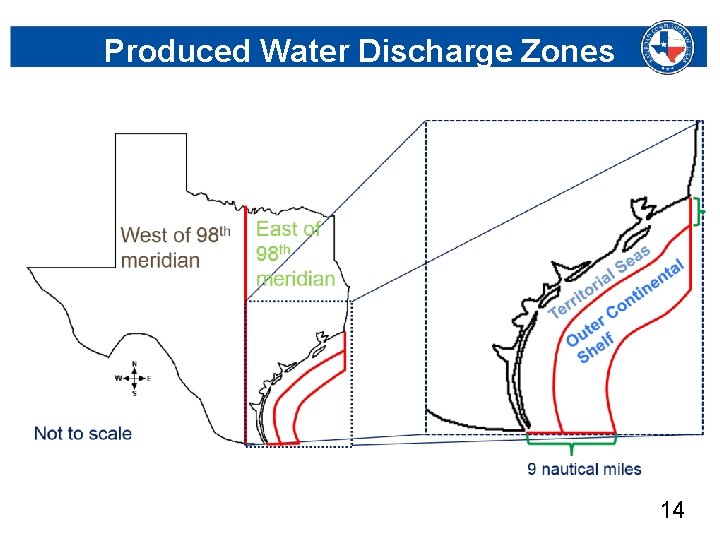
Produced Water Discharge Zones Railroad Commission of Texas | June 27, 2016 (Change Date In First Master Slide) 14
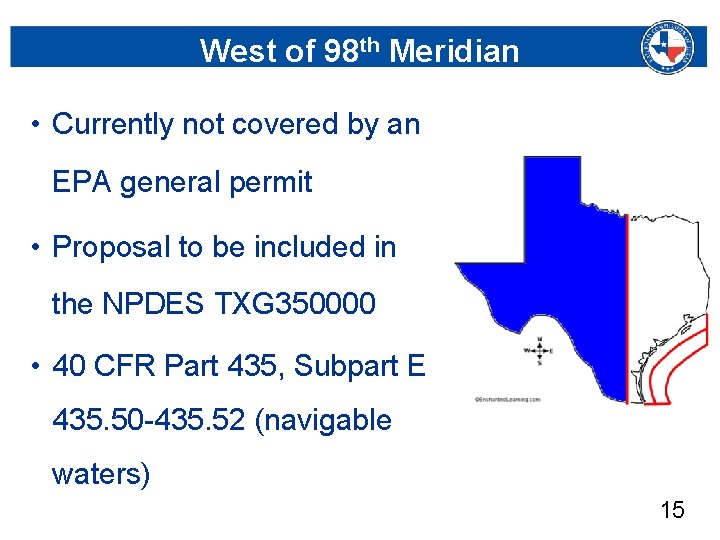
West of 98 th Meridian • Currently not covered by an EPA general permit • Proposal to be included in the NPDES TXG 350000 • 40 CFR Part 435, Subpart E 435. 50 -435. 52 (navigable waters) Railroad Commission of Texas | June 27, 2016 (Change Date In First Master Slide) 15
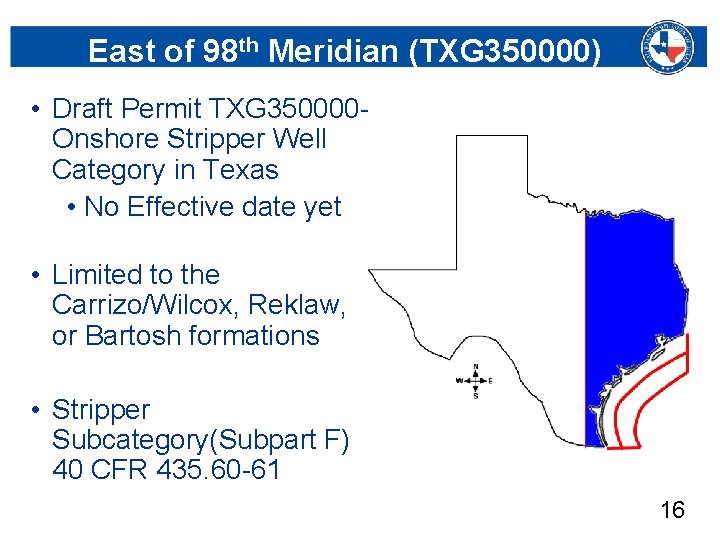
East of 98 th Meridian (TXG 350000) • Draft Permit TXG 350000 - Onshore Stripper Well Category in Texas • No Effective date yet • Limited to the Carrizo/Wilcox, Reklaw, or Bartosh formations • Stripper Subcategory(Subpart F) 40 CFR 435. 60 -61 Railroad Commission of Texas | June 27, 2016 (Change Date In First Master Slide) 16
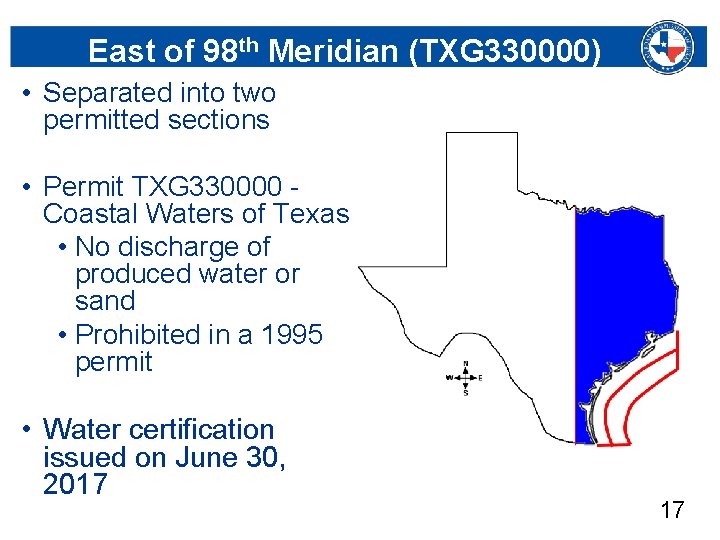
East of 98 th Meridian (TXG 330000) • Separated into two permitted sections • Permit TXG 330000 - Coastal Waters of Texas • No discharge of produced water or sand • Prohibited in a 1995 permit • Water certification issued on June 30, 2017 Railroad Commission of Texas | June 27, 2016 (Change Date In First Master Slide) 17
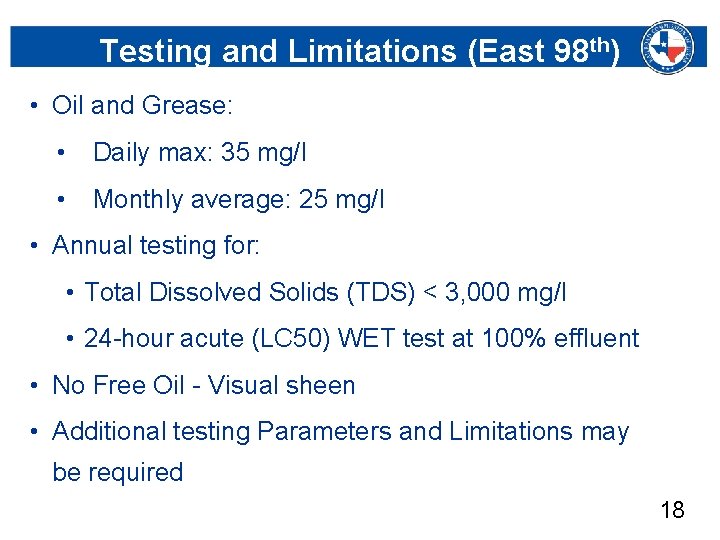
Testing and Limitations (East 98 th) • Oil and Grease: • Daily max: 35 mg/l • Monthly average: 25 mg/l • Annual testing for: • Total Dissolved Solids (TDS) < 3, 000 mg/l • 24 -hour acute (LC 50) WET test at 100% effluent • No Free Oil - Visual sheen • Additional testing Parameters and Limitations may be required Railroad Commission of Texas | June 27, 2016 (Change Date In First Master Slide) 18
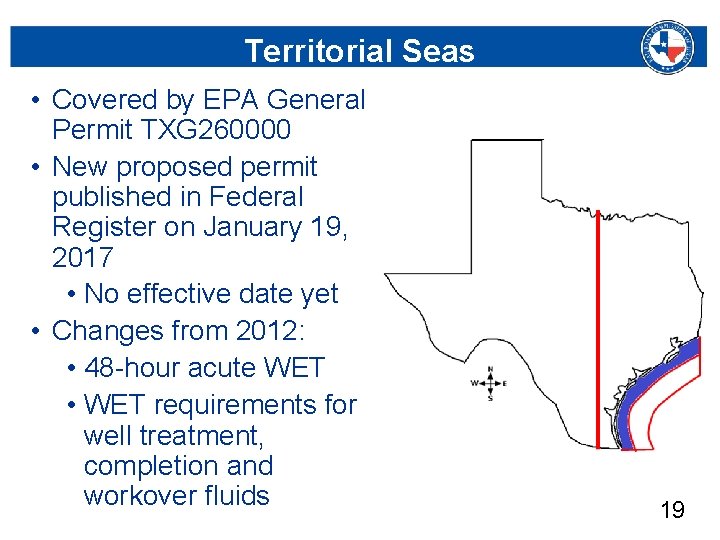
Territorial Seas • Covered by EPA General Permit TXG 260000 • New proposed permit published in Federal Register on January 19, 2017 • No effective date yet • Changes from 2012: • 48 -hour acute WET • WET requirements for well treatment, completion and workover fluids Railroad Commission of Texas | June 27, 2016 (Change Date In First Master Slide) 19
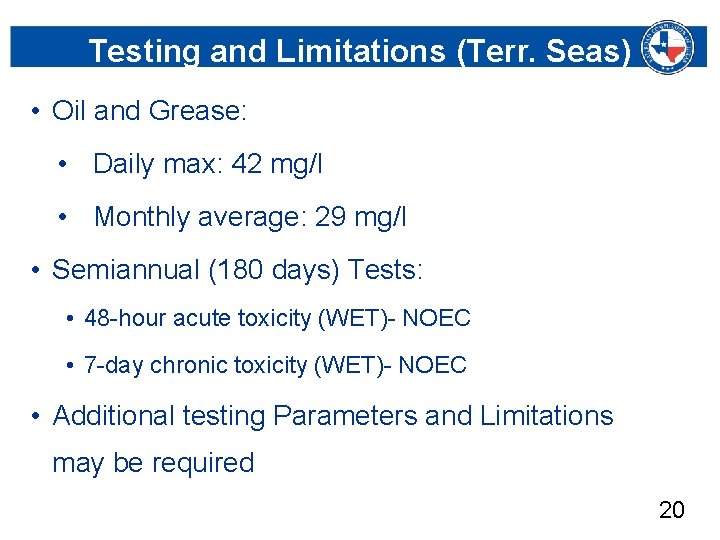
Testing and Limitations (Terr. Seas) • Oil and Grease: • Daily max: 42 mg/l • Monthly average: 29 mg/l • Semiannual (180 days) Tests: • 48 -hour acute toxicity (WET)- NOEC • 7 -day chronic toxicity (WET)- NOEC • Additional testing Parameters and Limitations may be required Railroad Commission of Texas | June 27, 2016 (Change Date In First Master Slide) 20
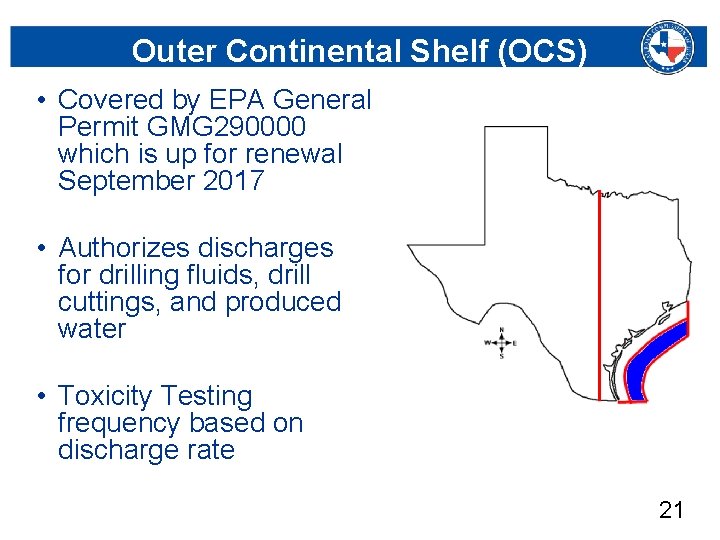
Outer Continental Shelf (OCS) • Covered by EPA General Permit GMG 290000 which is up for renewal September 2017 • Authorizes discharges for drilling fluids, drill cuttings, and produced water • Toxicity Testing frequency based on discharge rate Railroad Commission of Texas | June 27, 2016 (Change Date In First Master Slide) 21
Testing and Limitations (OCS) • Oil and Grease: • Daily max: 42 mg/l • Monthly average: 29 mg/l • 7 -day chronic toxicity (NOEC) test annually or quarterly • Additional testing Parameters and Limitations may be required Railroad Commission of Texas | June 27, 2016 (Change Date In First Master Slide) 22
Whole Effluent Toxicity (WET) Test • WET test measures the effluents effects on test organism’s (fresh or marine) ability to survive, grow, and reproduce • Measures the potential toxicity of all chemicals in the solution. Used to prevent the discharge of toxic amounts of pollutants to surface waters • Test organisms include vertebrates and invertebrates and are either fresh or marine species Railroad Commission of Texas | June 27, 2016 (Change Date In First Master Slide) 23
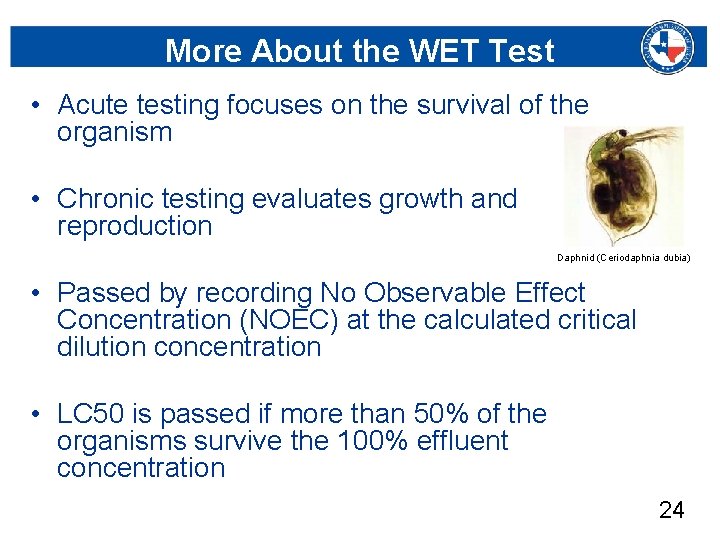
More About the WET Test • Acute testing focuses on the survival of the organism • Chronic testing evaluates growth and reproduction Daphnid (Ceriodaphnia dubia) • Passed by recording No Observable Effect Concentration (NOEC) at the calculated critical dilution concentration • LC 50 is passed if more than 50% of the organisms survive the 100% effluent concentration Railroad Commission of Texas | June 27, 2016 (Change Date In First Master Slide) 24
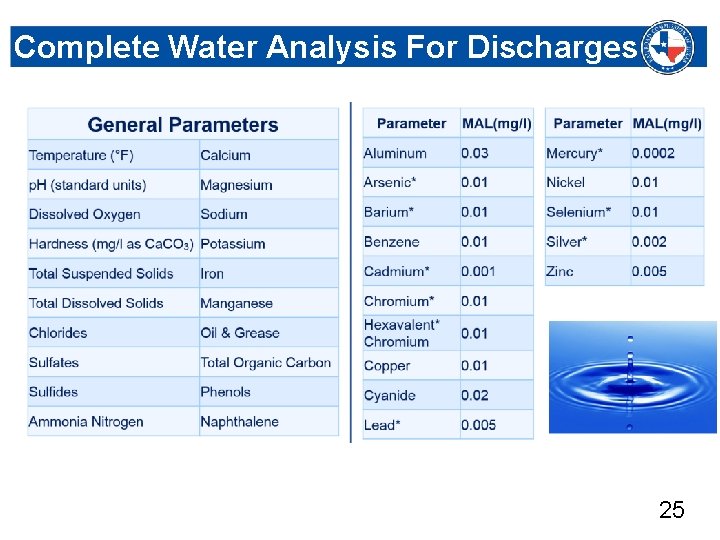
Complete Water Analysis For Discharges Railroad Commission of Texas | June 27, 2016 (Change Date In First Master Slide) 25
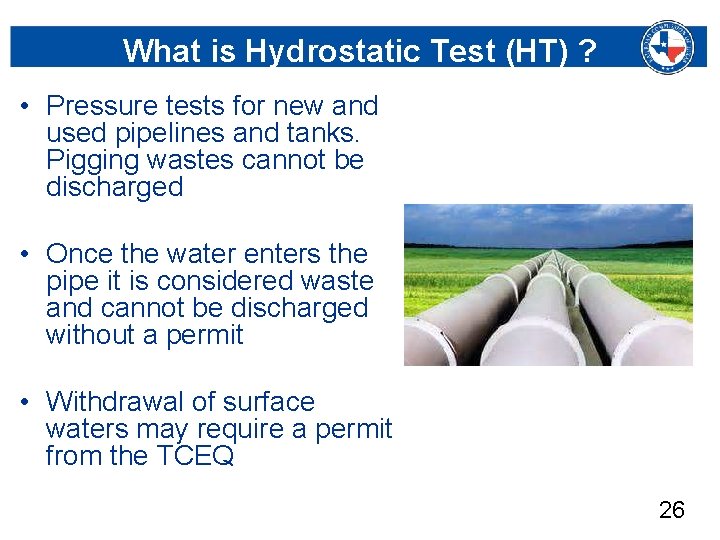
What is Hydrostatic Test (HT) ? • Pressure tests for new and used pipelines and tanks. Pigging wastes cannot be discharged • Once the water enters the pipe it is considered waste and cannot be discharged without a permit • Withdrawal of surface waters may require a permit from the TCEQ Railroad Commission of Texas | June 27, 2016 (Change Date In First Master Slide) 26
Reporting Requirements for HT’s • Each frac tank must be sampled analyzed prior to discharge • Analytical results must be reported within one month after the discharge is complete • Typical testing parameters include Benzene, Oil & Grease, COD, EC and TSS • Pictures of the effluent treatment & fluid dispersal system must be included 27 Railroad Commission of Texas | June 27, 2016 (Change Date In First Master Slide)
Recycling of Domestic Wastewater Notice to Operators (April 3, 2016) Allowing the beneficial recycling of treated domestic wastewater and mobile drinking water treatment system wastewater • On-site treatment in the “shadow of the rig” • Maximum 5, 000 (GPD) pretreated volume allowed TCEQ’s jurisdiction • Mobile potable water treatment units • Transportation of domestic waste and wastewater Railroad Commission of Texas | June 27, 2016 (Change Date In First Master Slide) 28
Reuse Options Domestic Wastewater • Down-hole (Make-up): • Drilling after surface casing has been set through the base of usable quality water • Cement • Frac fluids • Surface application: • Dust suppression (drill pads or lease roads) • Controlled irrigation Railroad Commission of Texas | June 27, 2016 (Change Date In First Master Slide) 29
Recycling of Domestic Wastewater (2) In no case may the waste stream be discharged or allowed to enter any watercourses or drainage ways, including any drainage ditch, dry creek, flowing creek, river, or any other body of surface water. • Drinking water treatment system wastewater does not require a permit IF: • Used down-hole (not commingled) • Reincorporated with rig supply water Railroad Commission of Texas | June 27, 2016 (Change Date In First Master Slide) 30
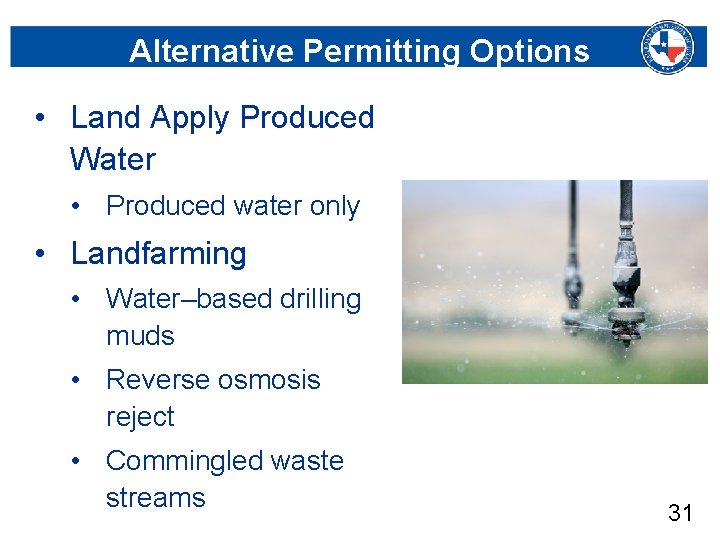
Alternative Permitting Options • Land Apply Produced Water • Produced water only • Landfarming • Water–based drilling muds • Reverse osmosis reject • Commingled waste streams Railroad Commission of Texas | June 27, 2016 (Change Date In First Master Slide) 31
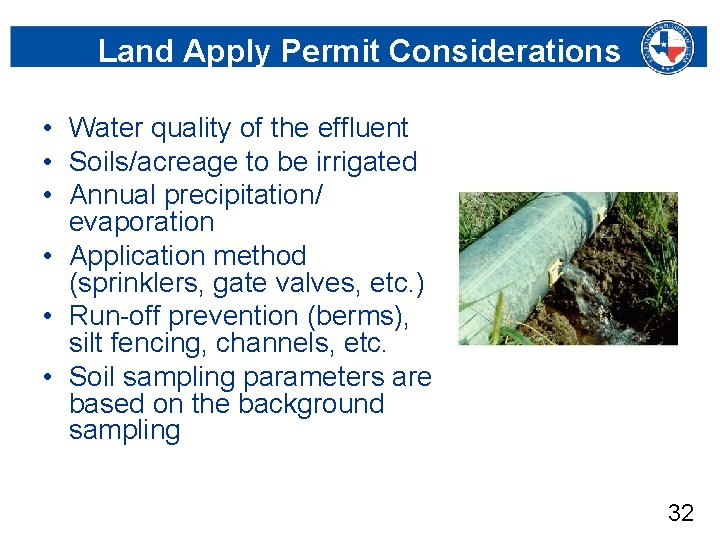
Land Apply Permit Considerations • Water quality of the effluent • Soils/acreage to be irrigated • Annual precipitation/ evaporation • Application method (sprinklers, gate valves, etc. ) • Run-off prevention (berms), silt fencing, channels, etc. • Soil sampling parameters are based on the background sampling Railroad Commission of Texas | June 27, 2016 (Change Date In First Master Slide) 32
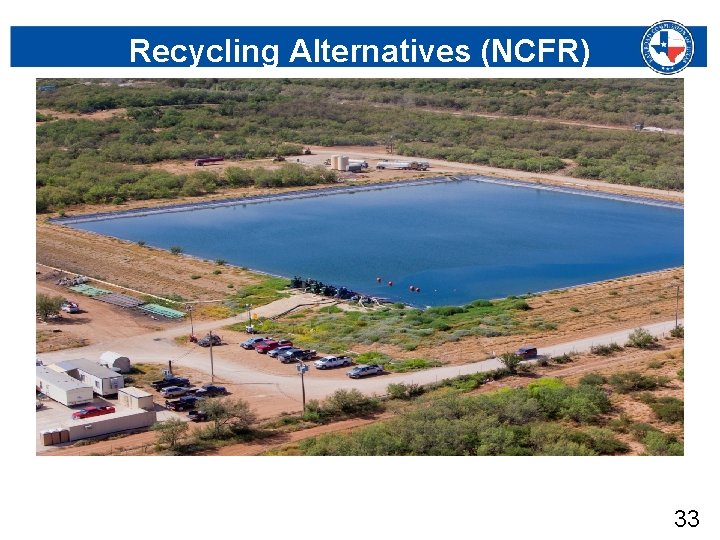
Recycling Alternatives (NCFR) Railroad Commission of Texas | June 27, 2016 (Change Date In First Master Slide) 33
Authorized Fluid Recycling Wellbore fluids under the jurisdiction of RRC may be treated and reused (recycled) without permit as authorized by Rule 8 (d)(7)(B) and § 4. 202(d). Fluid recycling is authorized if the recycling activities are located: • On a commission-designated lease or drilling unit associated with a drilling permit. • On land leased or owned by the operator of a disposal well. • On land leased or owned by the operator of an injection well. Railroad Commission of Texas | June 27, 2016 (Change Date In First Master Slide) 34
Stormwater Management Two types of Stormwater: • Noncontact - rainfall that does not come in contact with oil and gas wastes at a facility • RRC discharge permit is not required • Contact - rainfall that accumulates in waste management units or contacts oil and gas wastes in active operation areas • RRC discharge permit required • Collected in pits or tanks Railroad Commission of Texas | June 27, 2016 (Change Date In First Master Slide) 35
Best Management Practices (BMPs) must be utilized at all authorized and permitted facilities: • Use of berms, grading, or curbing to prevent runoff of contaminated fluids • Perimeter berms are required around facilities • Secondary containment requirements for storage tanks, pits, frac tanks, or other vessels containing wastes • Good Housekeeping and Inspections Railroad Commission of Texas | June 27, 2016 (Change Date In First Master Slide) 36
Thank you! Tiffany Humberson Environmental Permits and Support 512 -463 -4990 tiffany. humberson@rrc. texas. gov The application and any attachments should be mailed to: Railroad Commission of Texas Oil and Gas Division Technical Permitting P. O. Box 12967 Austin, TX 78711 -2967 Railroad Commission of Texas | June 27, 2016 (Change Date In First Master Slide) 37
- Slides: 37