
Disaster Preparedness National Disaster Risk Reduction and Management




- Slides: 18
Disaster Preparedness
National Disaster Risk Reduction and Management Council (NDRRMC) Centre for government and private coordination for disaster management. President’s sector advisory body. Allocate the resources in the country to areas that need support. Works with the Office of Civil Defense in it’s operational requirements.
Secretary of National Defense Secretary of Interior and Local Government Secretary of Social Welfare and Development Secretary of Health Secretary of Labor and Employment Secretary of Education
Secretary of Trade and Industry Secretary of Agriculture Secretary of Environment and Natural Resources Secretary of Finance Secretary of Public Works and Highways
Secretary of Tourism Secretary of Transportation and Communication Administrator, Director Office of Civil Defense General, National Economic Development Agency Secretary- General of the Philippine National Red Cross Chief of Staff, Armed Forces of the Philippines
Military’s Major Role in Disaster Management
Army Acts as a source of manpower for the restoration of vital Infrastructures. Air Force Facilitates and Augments logistical needs. Initializes aerial search-and-rescue and manages immediate repair of damaged airport facilities. Coordinate plans for air crashes outside airport facilities.
Navy Ensures rehabilitations and operations of the sea ports. Coordinate with the Philippine Coast Guard in monitoring and executing rescue operations.
Philippine Disaster Management Framework
Mitigation Aims to reduce vulnerability by decreasing risk while coping with the hazards. Two main measures that involve mitigation: Insurance from Natural Calamities and Regulations Preparedness Before disasters, measures designed to minimize loss of life and property are being intiated.
Response Involves the notification of response units that alerts, receives, and disseminates warnings to concerned communities. Rehabilitation Aims to restore normalcy in the affected regions by restoring all infrastructure and basic utilities back to their normal operational states.
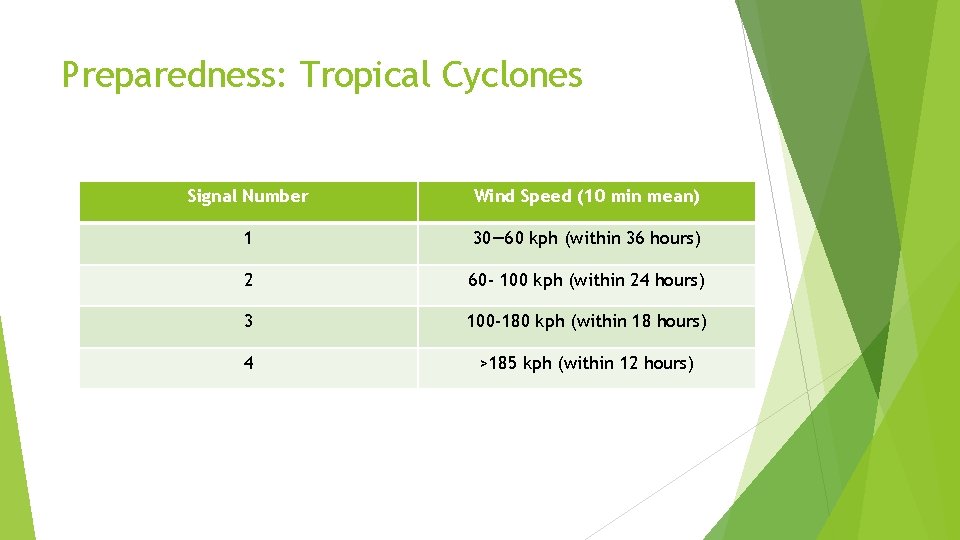
Preparedness: Tropical Cyclones Signal Number Wind Speed (10 min mean) 1 30— 60 kph (within 36 hours) 2 60 - 100 kph (within 24 hours) 3 100 -180 kph (within 18 hours) 4 >185 kph (within 12 hours)
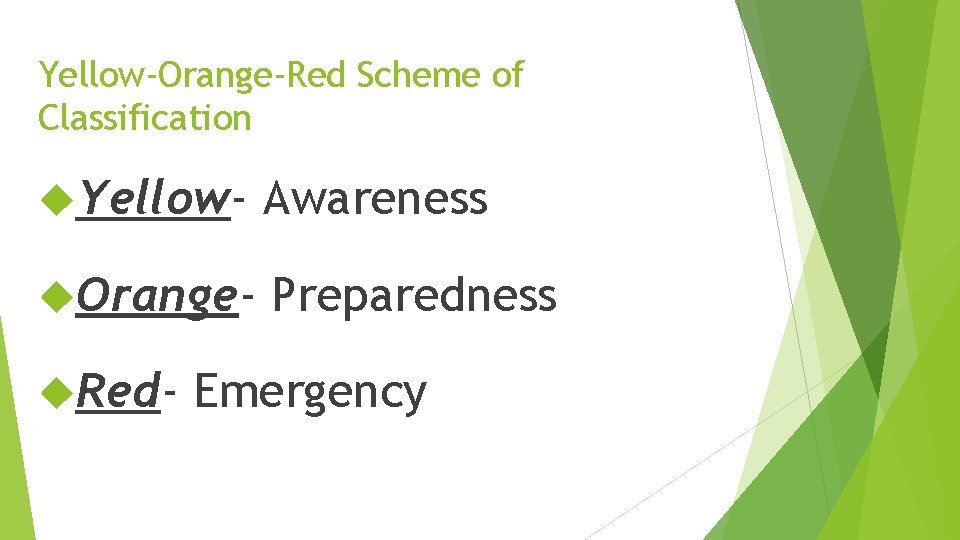
Yellow-Orange-Red Scheme of Classification Yellow- Awareness Orange- Preparedness Red- Emergency
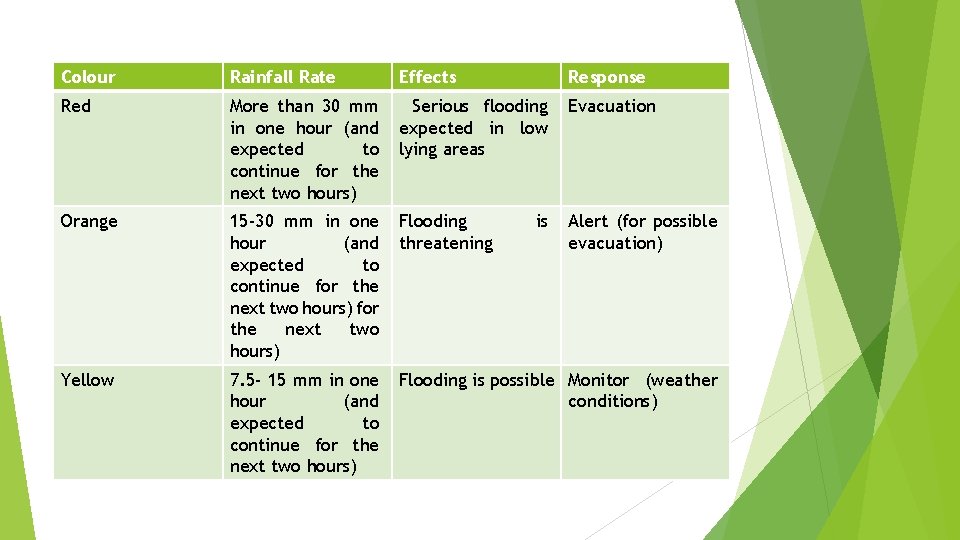
Colour Rainfall Rate Effects Response Red More than 30 mm in one hour (and expected to continue for the next two hours) Serious flooding expected in low lying areas Evacuation Orange 15 -30 mm in one hour (and expected to continue for the next two hours) Flooding threatening Alert (for possible evacuation) Yellow 7. 5 - 15 mm in one hour (and expected to continue for the next two hours) Flooding is possible Monitor (weather conditions) is
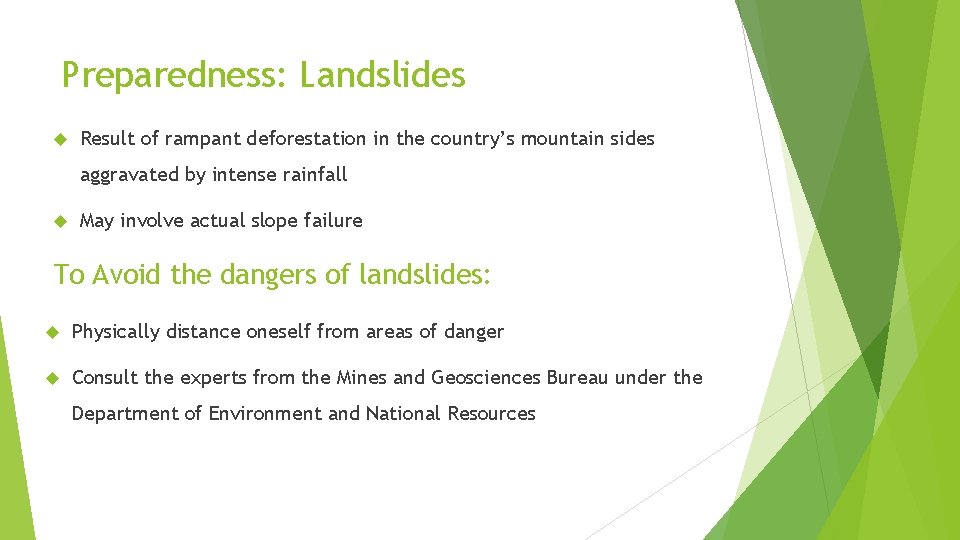
Preparedness: Landslides Result of rampant deforestation in the country’s mountain sides aggravated by intense rainfall May involve actual slope failure To Avoid the dangers of landslides: Physically distance oneself from areas of danger Consult the experts from the Mines and Geosciences Bureau under the Department of Environment and National Resources
Preparedness: Tsunamis Tsunami waves are low in amplitude but have long wavelengths and travel at hundreds of kilometers per hour. The massive inertia of the mass of water causes inundation that can extend several kilometers in land.
Preparedness: Climate Change Desertification Ø Once fertile agriculture lands transforming into desert or semi-arid areas Loss of Agricultural Land Ø The main consequence of desertification
Changes in the regions suitable for crop and livestock Areas once suitable for certain crops may now see changes wherein their growth is affected Sea-level rise Higher temperatures lead to melting of the polar ice caps Migration People resort to migration as conditions in their area become more extreme