
Disaster Mitigation in Health Facilities Wind Effects Structural

- Slides: 74
Disaster Mitigation in Health Facilities: Wind Effects Structural Issues 1
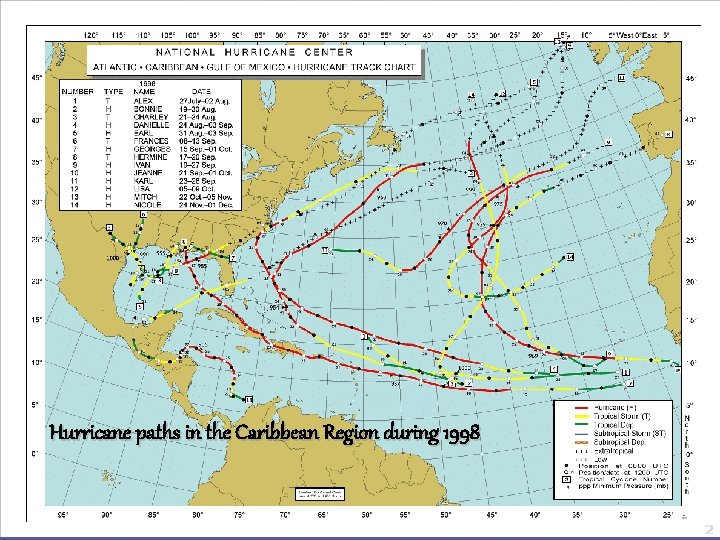
Hurricane paths in the Caribbean Region during 1998 2
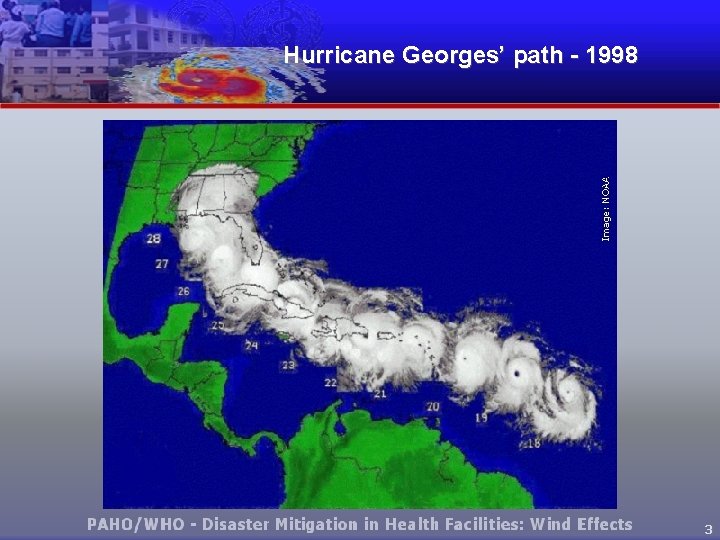
Hurricane Georges’ path - 1998 3
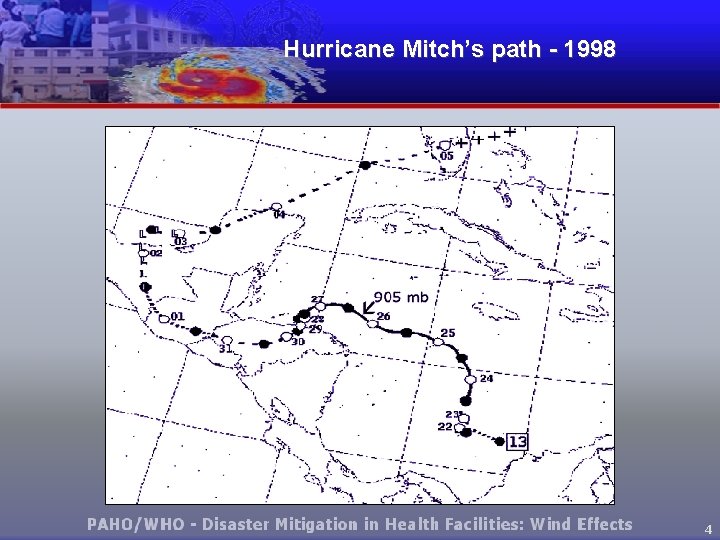
Hurricane Mitch’s path - 1998 4
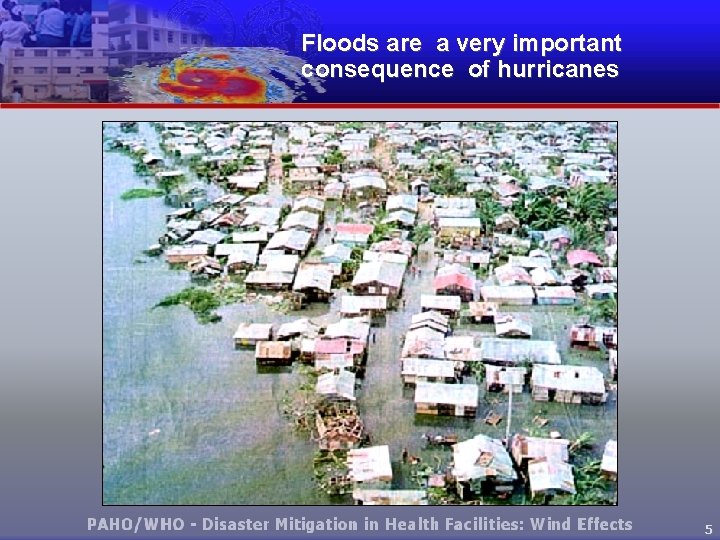
Floods are a very important consequence of hurricanes 5
Natural hazards impact in health facilities (1981 - 2001) According to the Pan American Health Organization, between 1981 and 2001 more than 100 hospitals and 650 health centers suffered serious damages as a result of natural disasters. The Economic Commission for Latin America and the Caribbean (ECLAC) reported direct economic losses of US$ 3, 120 million. This could be compared to an extreme situation in which 20 countries in the region had each suffered the loss of 6 major hospitals and 25 health centers. 6
Hospitals are specially vulnerable to natural hazards § The occupancy rate is constant, 24 hours a day, year-round. It is almost impossible to evacuate a hospital in the event of an emergency. § The survival of some patients depends on the properation of the equipment and the continuity of basic services. § Hospitals are highly dependent on public utilities (water, electricity, communications, etc. ) which are often interrupted by the effects of a disaster. § In emergencies and disasters, health facilities are essential and must continue to function after the event has taken place. 7
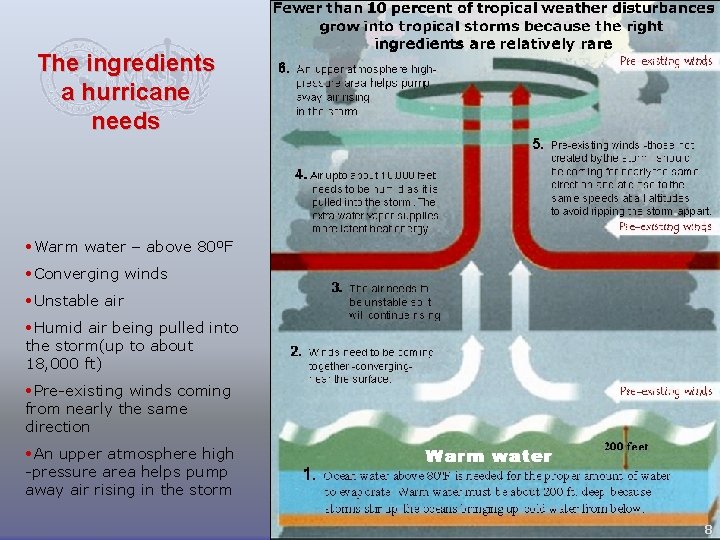
The ingredients a hurricane needs • Warm water – above 80ºF • Converging winds • Unstable air • Humid air being pulled into the storm(up to about 18, 000 ft) • Pre-existing winds coming from nearly the same direction • An upper atmosphere high -pressure area helps pump away air rising in the storm 8
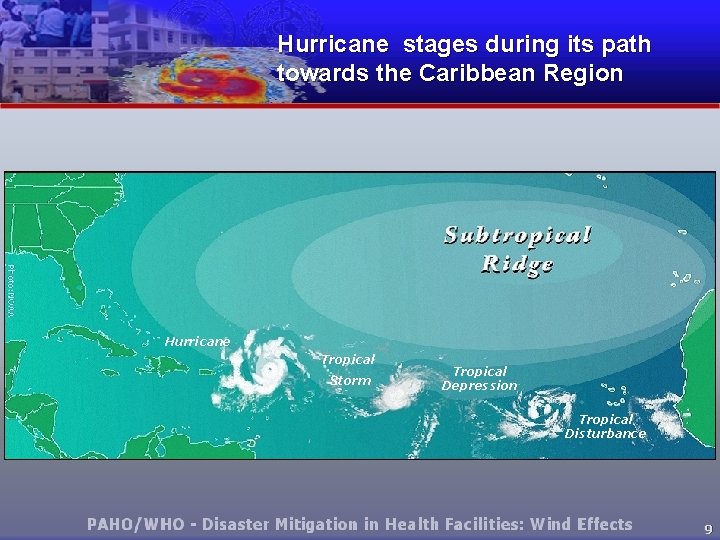
Hurricane stages during its path towards the Caribbean Region Hurricane Tropical Storm Tropical Depression Tropical Disturbance 9 9
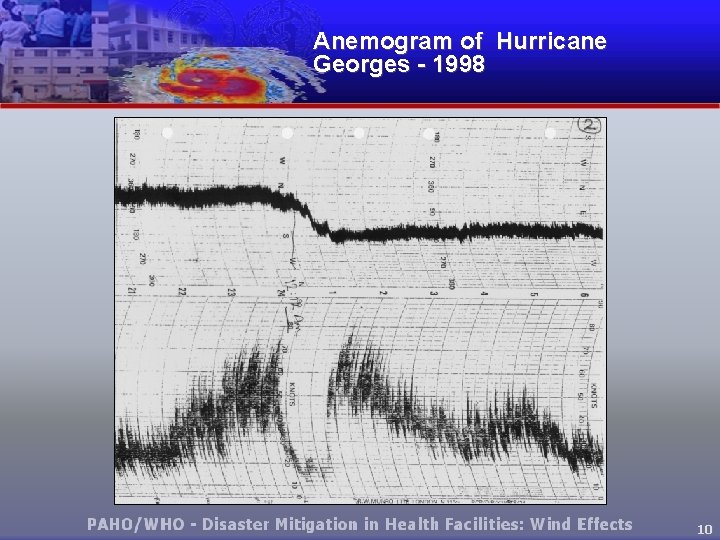
Anemogram of Hurricane Georges - 1998 10
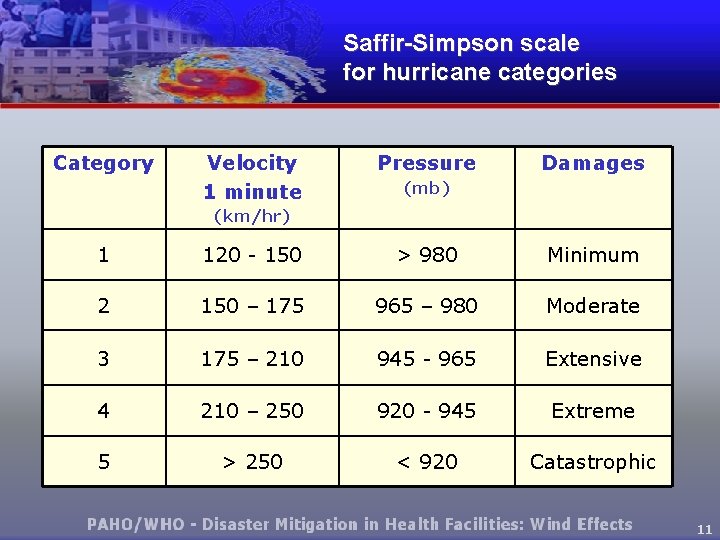
Saffir-Simpson scale for hurricane categories Category Velocity 1 minute Pressure Damages (mb) (km/hr) 1 120 - 150 > 980 Minimum 2 150 – 175 965 – 980 Moderate 3 175 – 210 945 - 965 Extensive 4 210 – 250 920 - 945 Extreme 5 > 250 < 920 Catastrophic 11
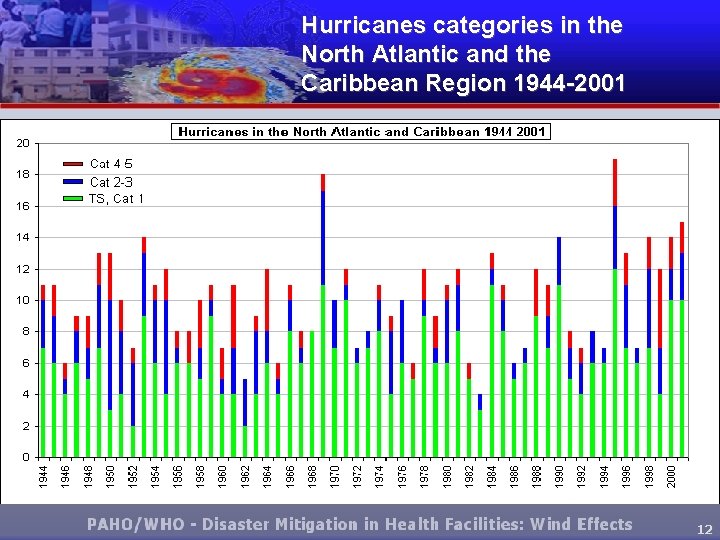
Hurricanes categories in the North Atlantic and the Caribbean Region 1944 -2001 12
Turbulent flow of wind on longitudinal and transverse sides of high-rise buildings 13
Turbulent flow on high-rise buildings due to upwind obstructions 14
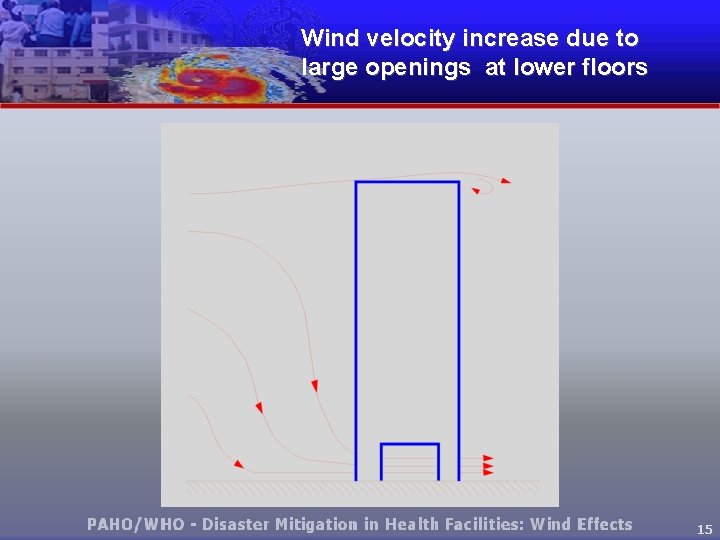
Wind velocity increase due to large openings at lower floors 15
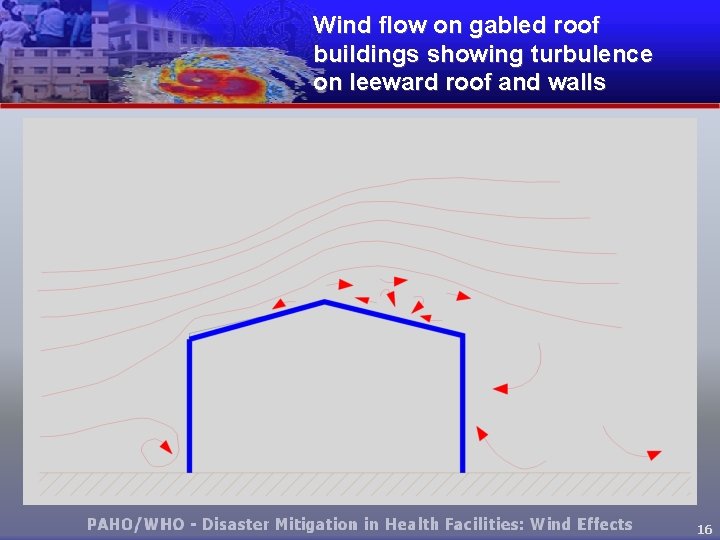
Wind flow on gabled roof buildings showing turbulence on leeward roof and walls 16
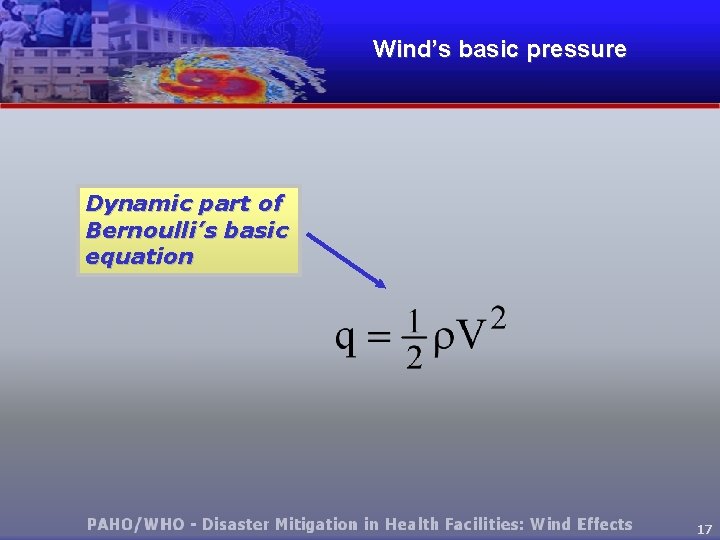
Wind’s basic pressure Dynamic part of Bernoulli’s basic equation 17
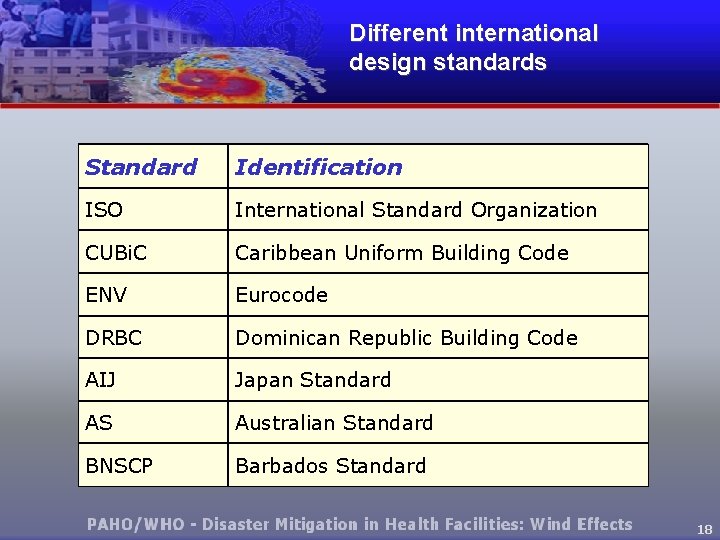
Different international design standards Standard Identification ISO International Standard Organization CUBi. C Caribbean Uniform Building Code ENV Eurocode DRBC Dominican Republic Building Code AIJ Japan Standard AS Australian Standard BNSCP Barbados Standard 18
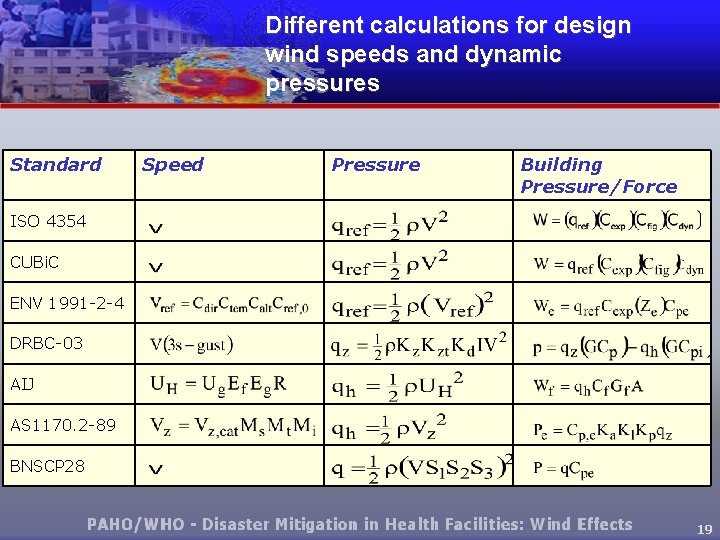
Different calculations for design wind speeds and dynamic pressures Standard Speed Pressure Building Pressure/Force ISO 4354 CUBi. C ENV 1991 -2 -4 DRBC-03 AIJ AS 1170. 2 -89 BNSCP 28 19
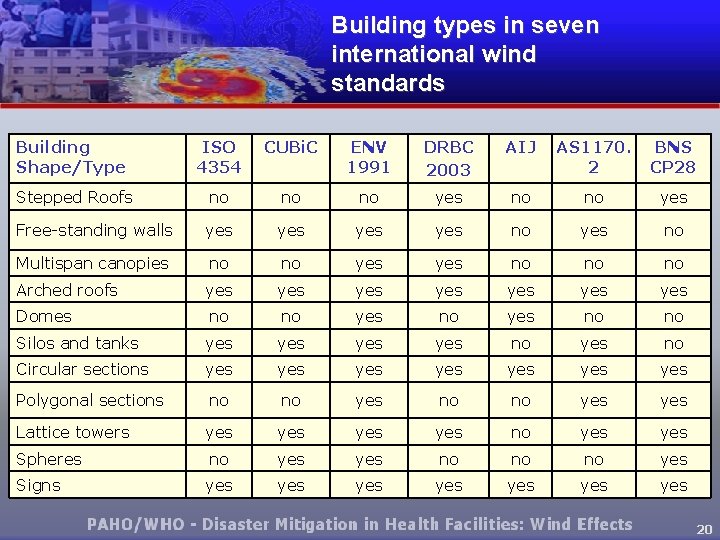
Building types in seven international wind standards Building Shape/Type ISO 4354 CUBi. C ENV 1991 DRBC 2003 AIJ AS 1170. 2 BNS CP 28 Stepped Roofs no no no yes Free-standing walls yes yes no Multispan canopies no no yes no no no Arched roofs yes yes Domes no no yes no no Silos and tanks yes yes no Circular sections yes yes Polygonal sections no no yes yes Lattice towers yes yes no yes Spheres no yes no no no yes Signs yes yes 20
The trend for international standards is to adopt and adapt the ASCE-7 approach for primary systems. 21
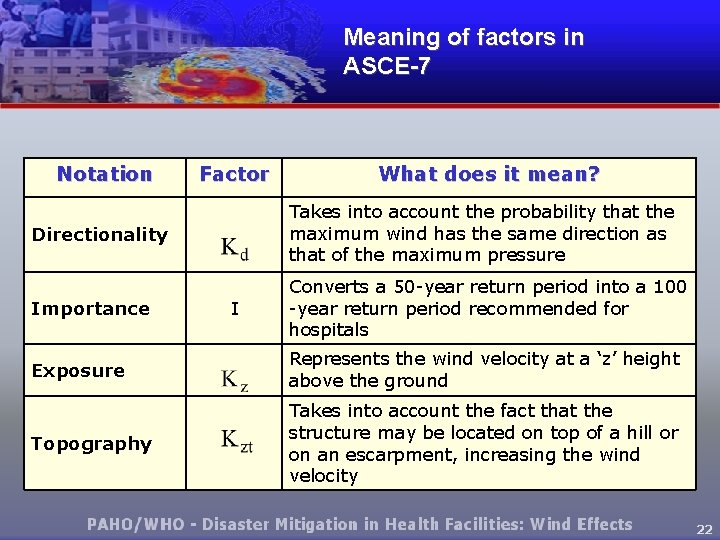
Meaning of factors in ASCE-7 Notation Factor What does it mean? Directionality Takes into account the probability that the maximum wind has the same direction as that of the maximum pressure Importance Converts a 50 -year return period into a 100 -year return period recommended for hospitals I Exposure Represents the wind velocity at a ‘z’ height above the ground Topography Takes into account the fact that the structure may be located on top of a hill or on an escarpment, increasing the wind velocity 22
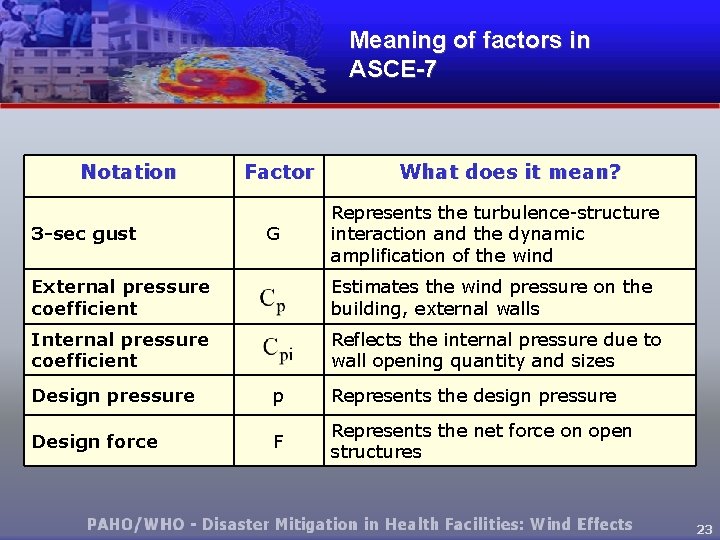
Meaning of factors in ASCE-7 Notation 3 -sec gust Factor G What does it mean? Represents the turbulence-structure interaction and the dynamic amplification of the wind External pressure coefficient Estimates the wind pressure on the building, external walls Internal pressure coefficient Reflects the internal pressure due to wall opening quantity and sizes Design pressure p Represents the design pressure Design force F Represents the net force on open structures 23
Effects of terrain roughness and height on wind speeds 24
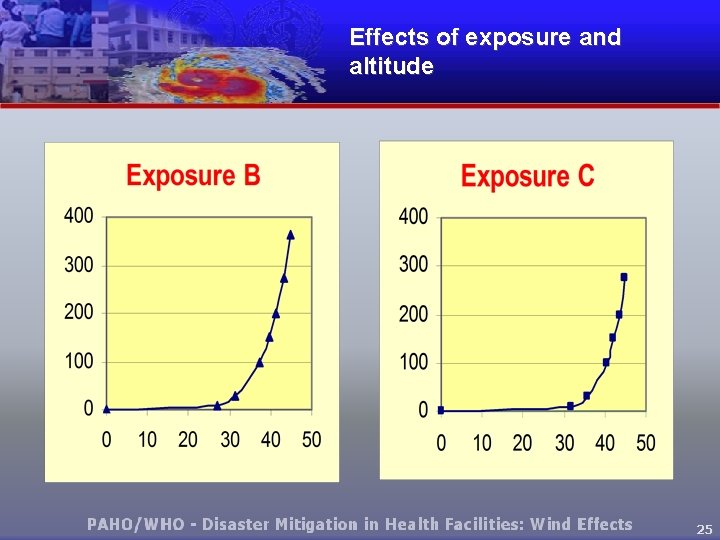
Effects of exposure and altitude 25
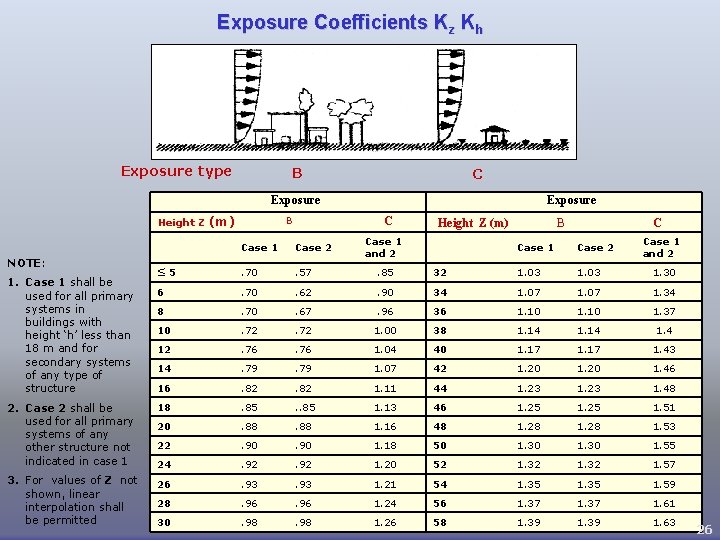
Exposure Coefficients Kz Kh Exposure type B C Exposure Height Z (m) B Exposure C Height Z (m) Case 1 and 2 ≤ 5 . 70 . 57 . 85 6 . 70 . 62 8 . 70 10 Case 1 and 2 Case 2 32 1. 03 1. 30 . 90 34 1. 07 1. 34 . 67 . 96 36 1. 10 1. 37 . 72 1. 00 38 1. 14 1. 4 12 . 76 1. 04 40 1. 17 1. 43 14 . 79 1. 07 42 1. 20 1. 46 16 . 82 1. 11 44 1. 23 1. 48 2. Case 2 shall be used for all primary systems of any other structure not indicated in case 1 18 . 85 1. 13 46 1. 25 1. 51 20 . 88 1. 16 48 1. 28 1. 53 22 . 90 1. 18 50 1. 30 1. 55 24 . 92 1. 20 52 1. 32 1. 57 3. For values of Z not shown, linear interpolation shall be permitted 26 . 93 1. 21 54 1. 35 1. 59 28 . 96 1. 24 56 1. 37 1. 61 30 . 98 1. 26 58 1. 39 1. 63 1. Case 1 shall be used for all primary systems in buildings with height ‘h’ less than 18 m and for secondary systems of any type of structure Case 2 C Case 1 NOTE: Case 1 B 26
Topographic effect showing wind velocity increase 27
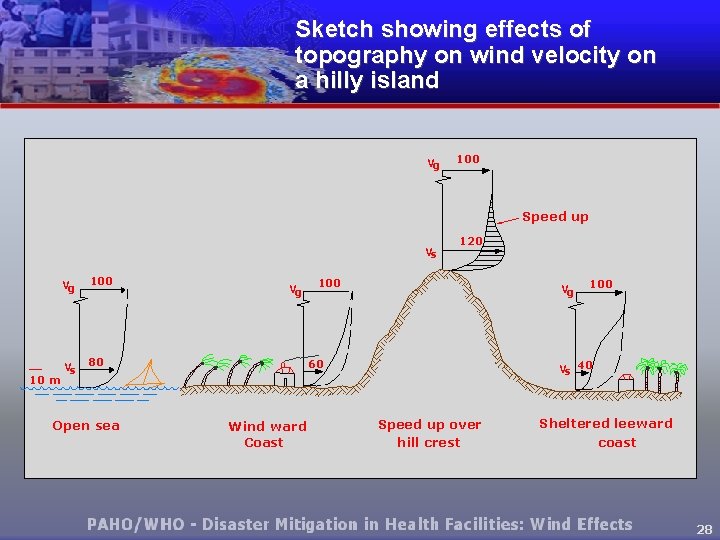
Sketch showing effects of topography on wind velocity on a hilly island Vg 100 Speed up Vs 10 m Vg 100 Vs 80 Open sea Vg 120 100 Vg 60 Wind ward Coast 100 Vs 40 Speed up over hill crest Sheltered leeward coast 28
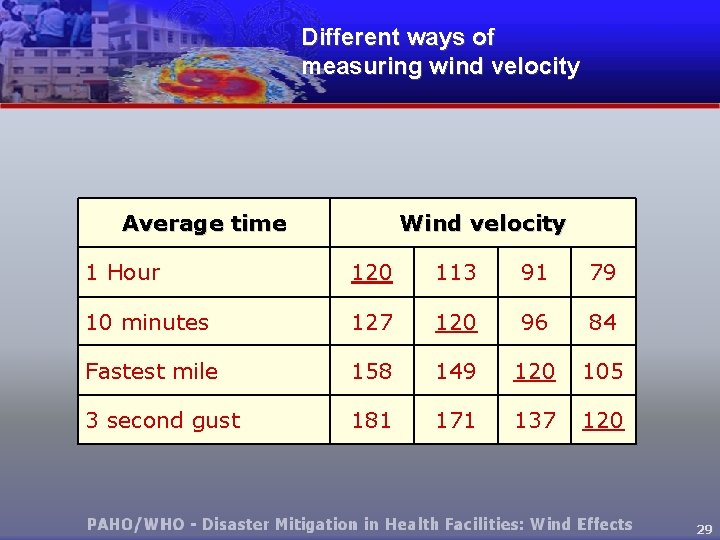
Different ways of measuring wind velocity Average time Wind velocity 1 Hour 120 113 91 79 10 minutes 127 120 96 84 Fastest mile 158 149 120 105 3 second gust 181 171 137 120 29
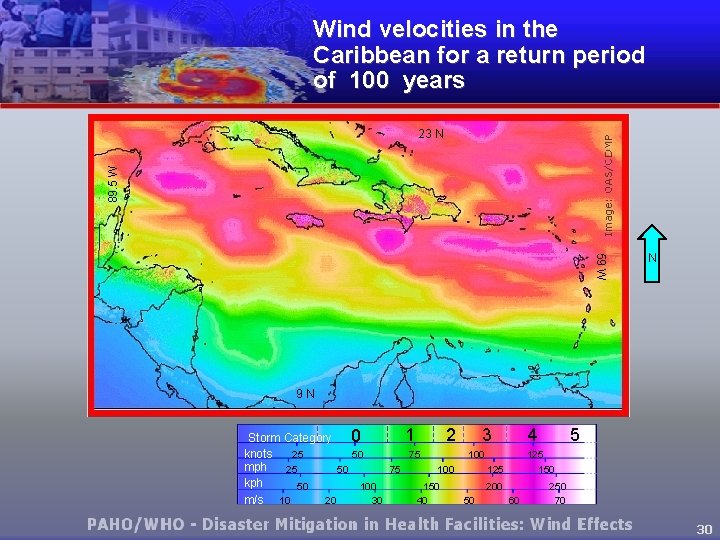
Wind velocities in the Caribbean for a return period of 100 years 89. 5 W 23 N 59 W N 9 N 1 2 3 4 Storm Category 0 25 50 75 100 125 knots mph 25 50 75 100 150 125 kph 50 100 150 200 250 m/s 10 20 60 70 30 40 50 5 30
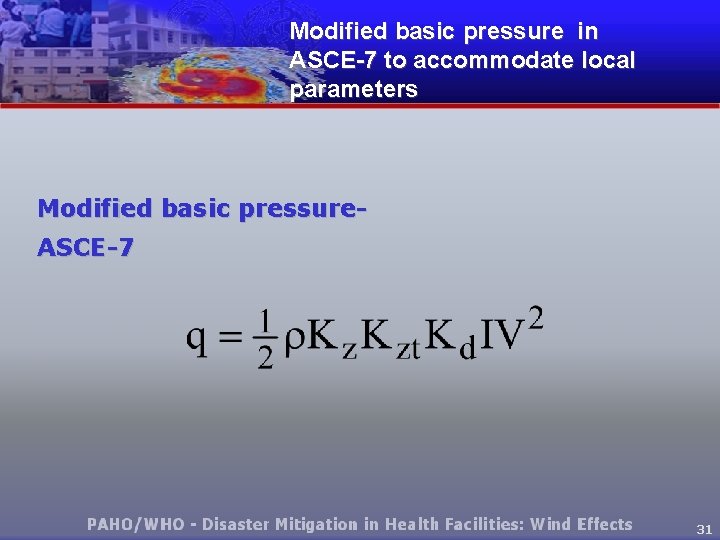
Modified basic pressure in ASCE-7 to accommodate local parameters Modified basic pressure. ASCE-7 31
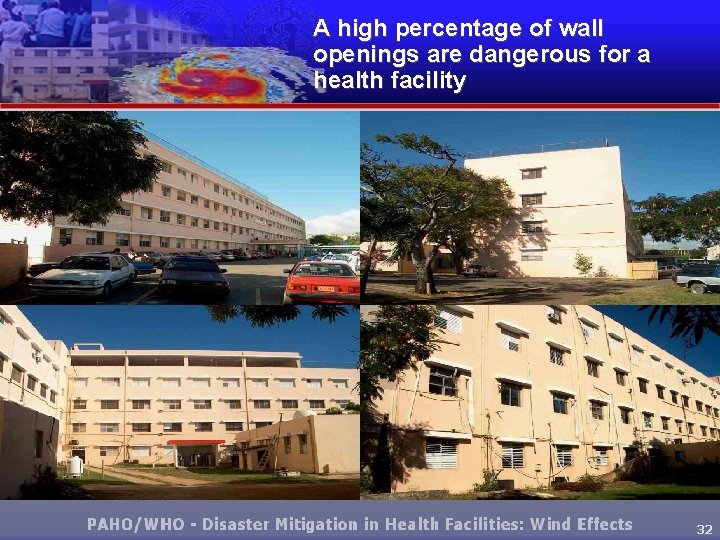
A high percentage of wall openings are dangerous for a health facility 32
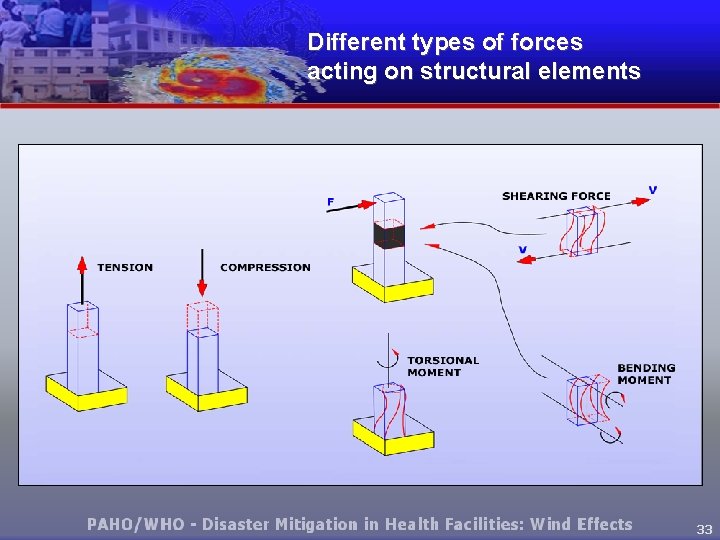
Different types of forces acting on structural elements 33
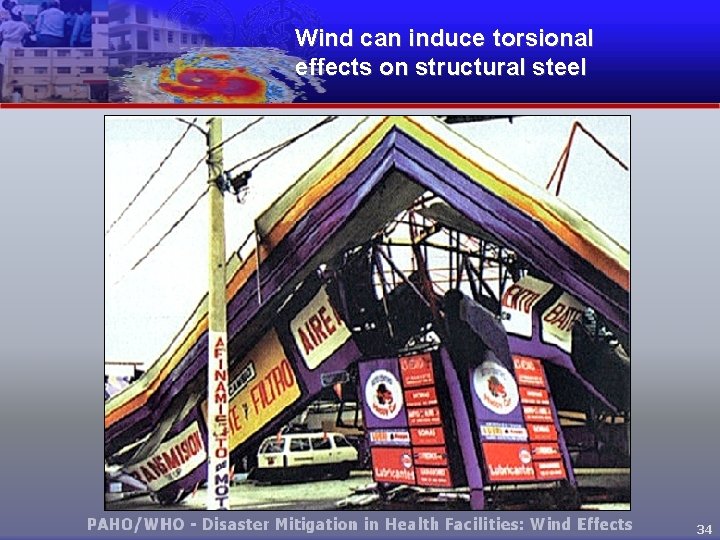
Wind can induce torsional effects on structural steel 34
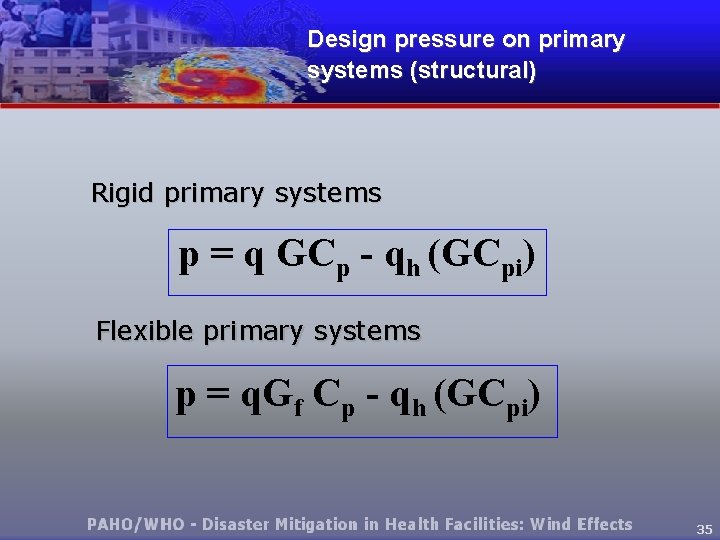
Design pressure on primary systems (structural) Rigid primary systems p = q GCp - qh (GCpi) Flexible primary systems p = q. Gf Cp - qh (GCpi) 35
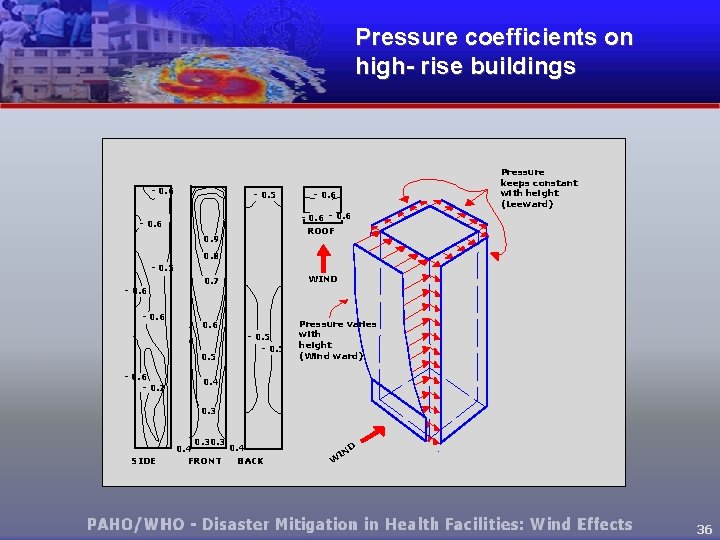
Pressure coefficients on high- rise buildings - 0. 6 - 0. 5 Pressure keeps constant with height (Leeward) - 0. 6 ROOF - 0. 6 0. 9 0. 8 - 0. 5 - 0. 6 0. 5 - 0. 6 - 0. 7 WIND 0. 7 - 0. 5 Pressure varies with height (Wind ward) 0. 4 0. 3 SIDE 0. 3 0. 4 FRONT BACK D IN W 36
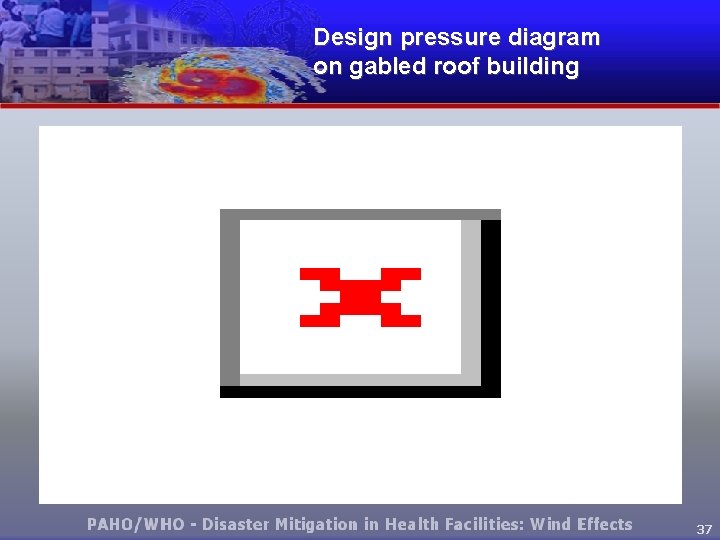
Design pressure diagram on gabled roof building 37
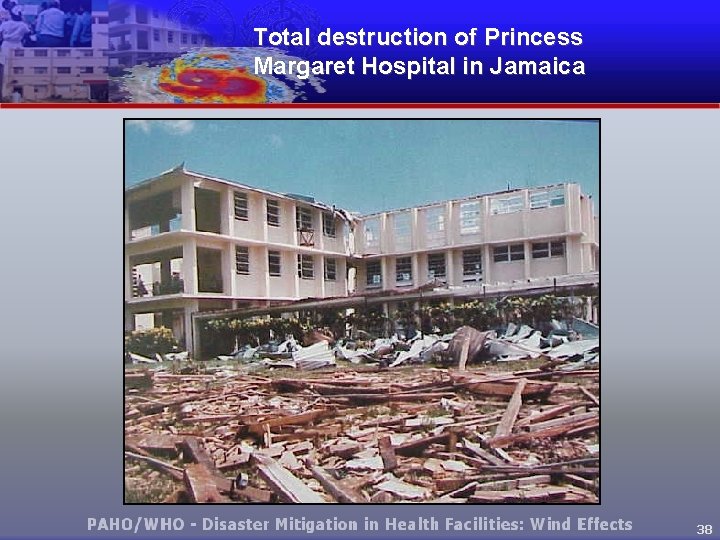
Total destruction of Princess Margaret Hospital in Jamaica 38
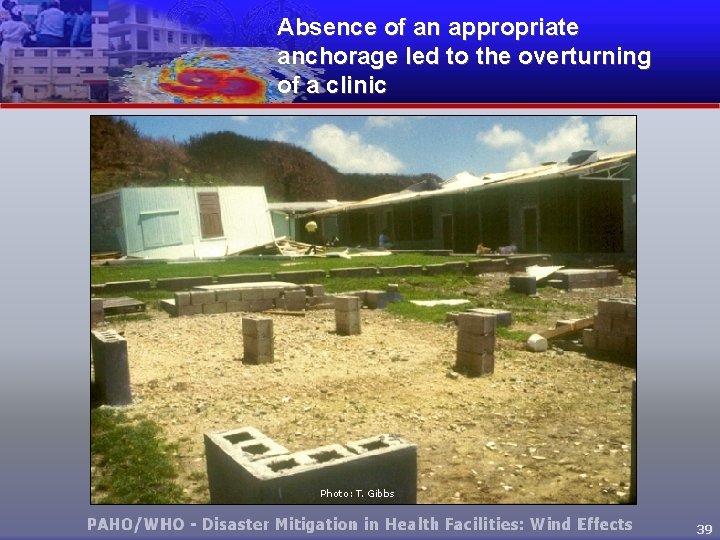
Absence of an appropriate anchorage led to the overturning of a clinic 39
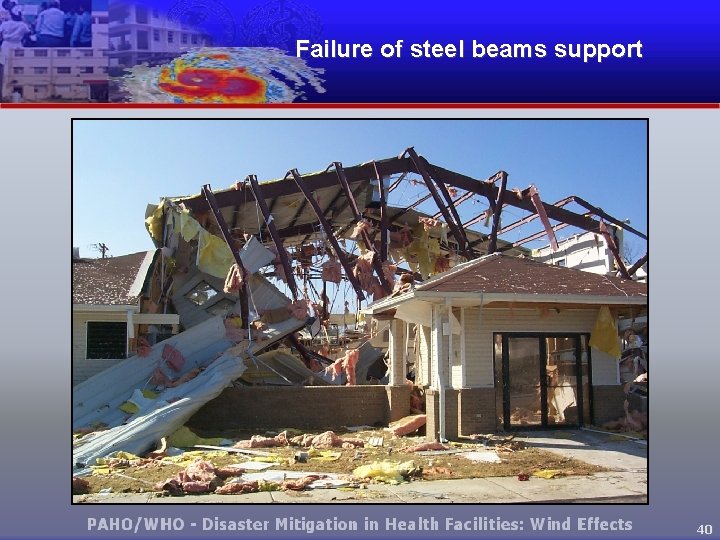
Failure of steel beams support 40
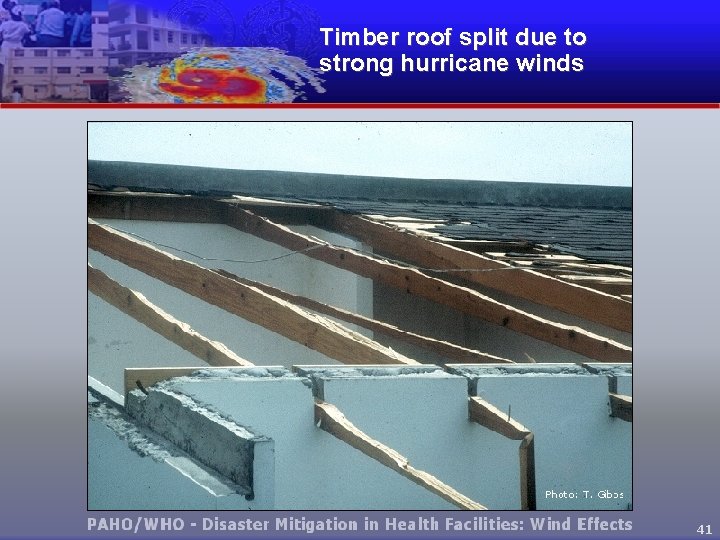
Timber roof split due to strong hurricane winds 41
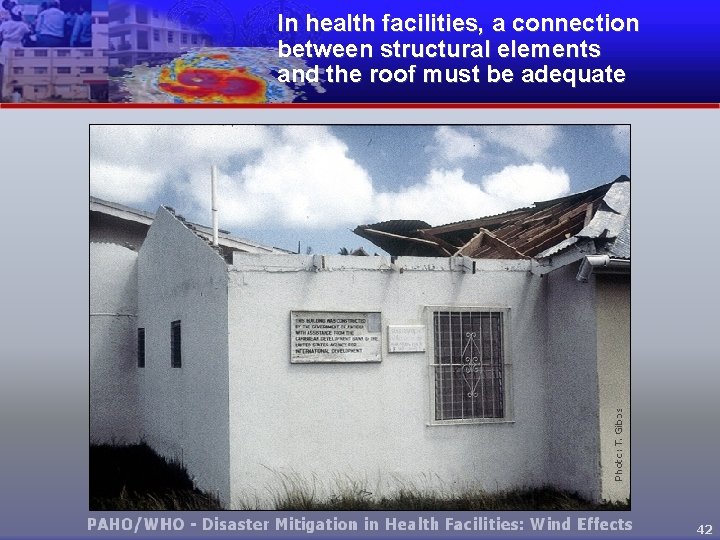
In health facilities, a connection between structural elements and the roof must be adequate 42
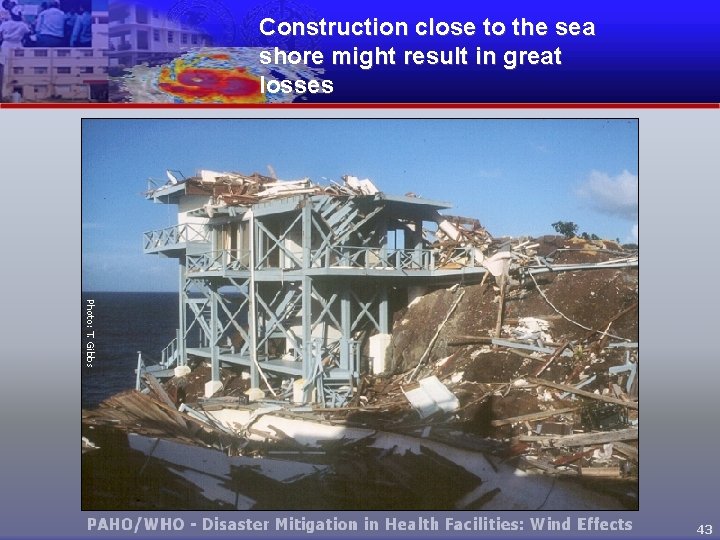
Construction close to the sea shore might result in great losses 43
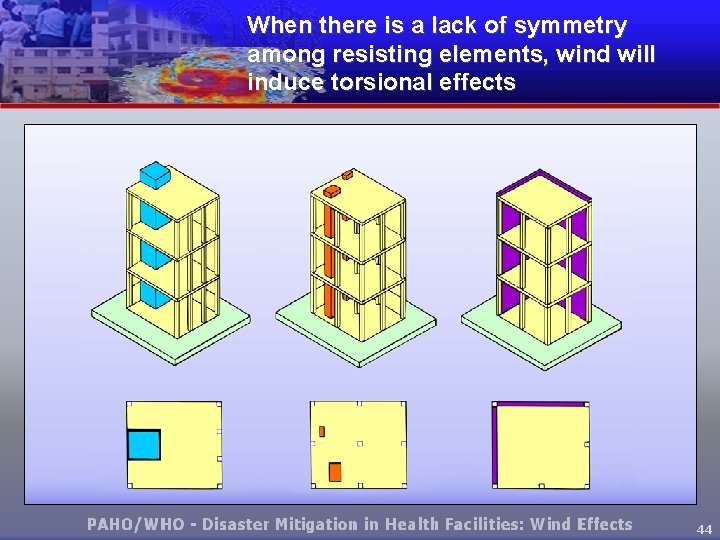
When there is a lack of symmetry among resisting elements, wind will induce torsional effects 44
Hipped roofs with slope from 20 to 30 degrees interact better with the wind forces 45
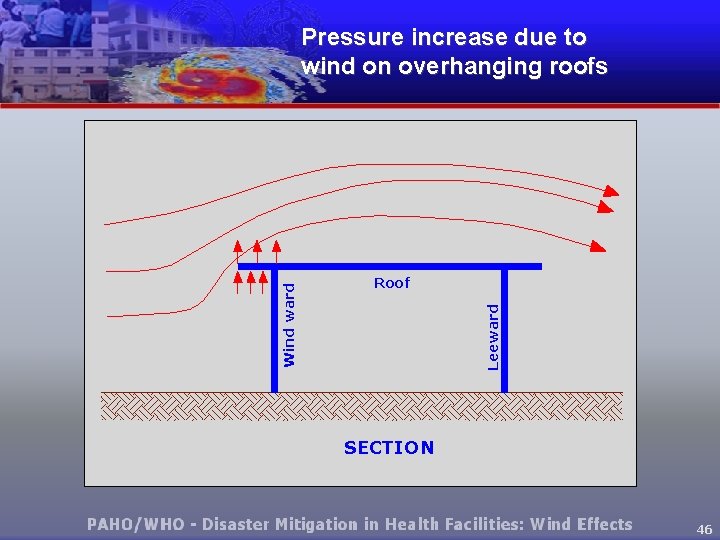
Roof Leeward Wind ward Pressure increase due to wind on overhanging roofs SECTION 46
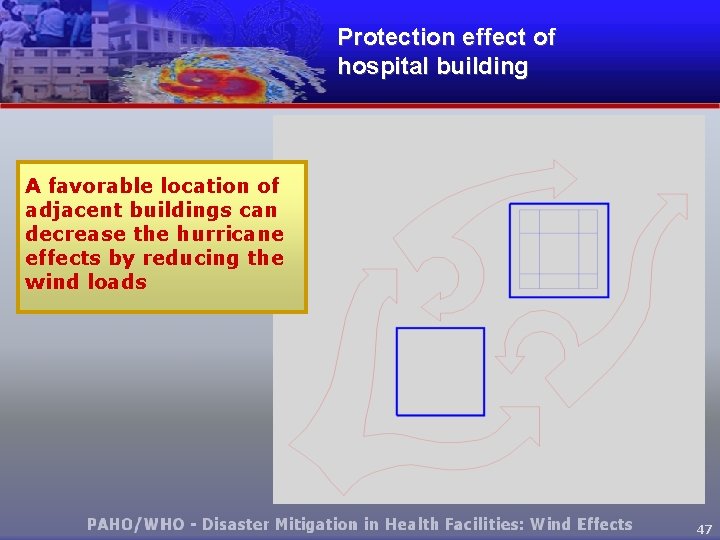
Protection effect of hospital building A favorable location of adjacent buildings can decrease the hurricane effects by reducing the wind loads 47
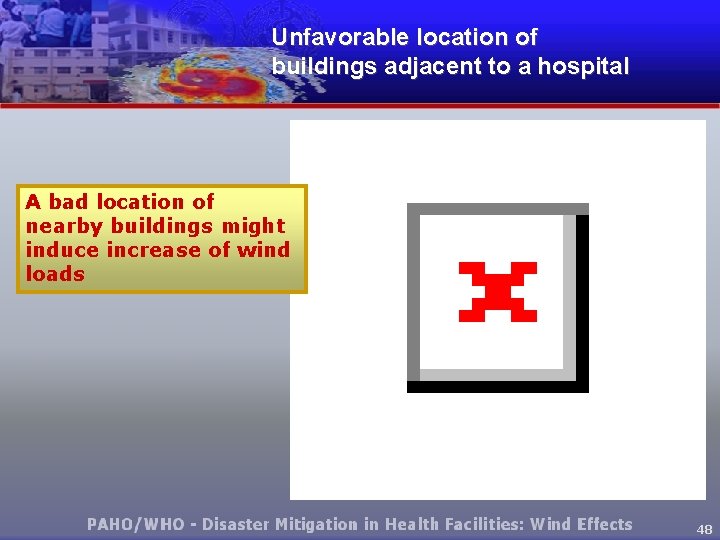
Unfavorable location of buildings adjacent to a hospital A bad location of nearby buildings might induce increase of wind loads 48
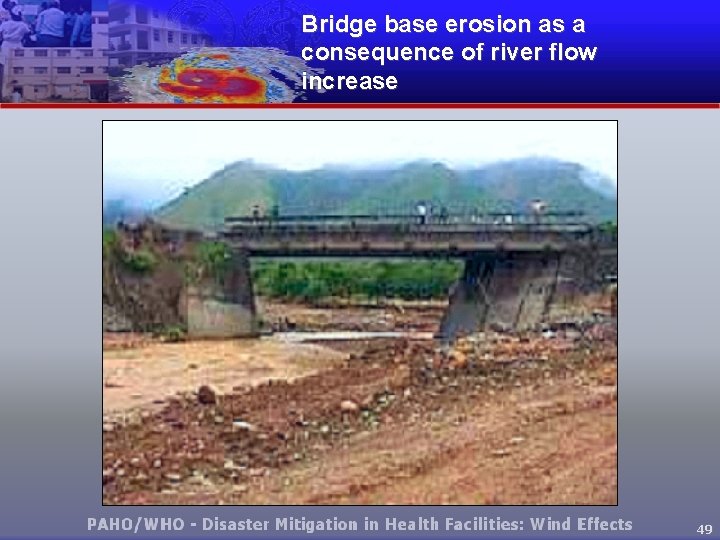
Bridge base erosion as a consequence of river flow increase 49
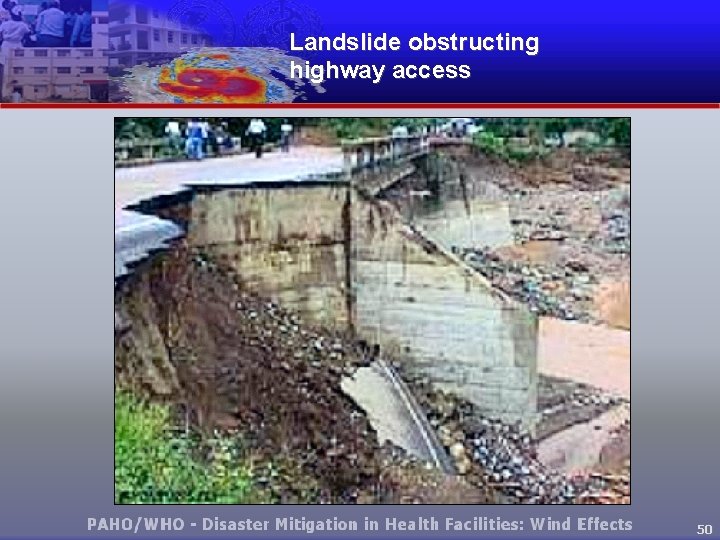
Landslide obstructing highway access 50
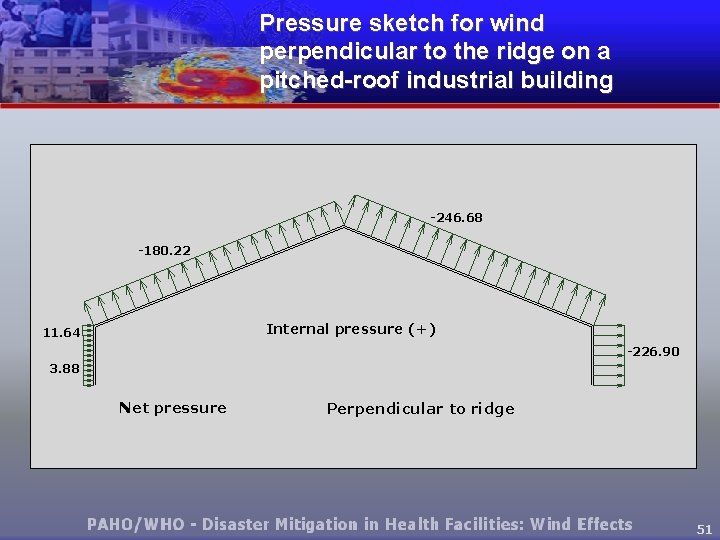
Pressure sketch for wind perpendicular to the ridge on a pitched-roof industrial building -246. 68 -180. 22 Internal pressure (+) 11. 64 -226. 90 3. 88 Net pressure Perpendicular to ridge 51
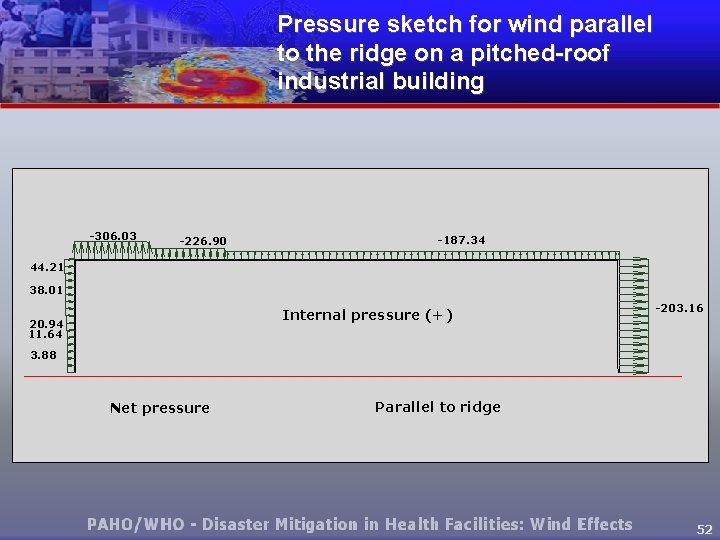
Pressure sketch for wind parallel to the ridge on a pitched-roof industrial building -306. 03 -226. 90 -187. 34 44. 21 38. 01 Internal pressure (+) 20. 94 11. 64 -203. 16 3. 88 Net pressure Parallel to ridge 52
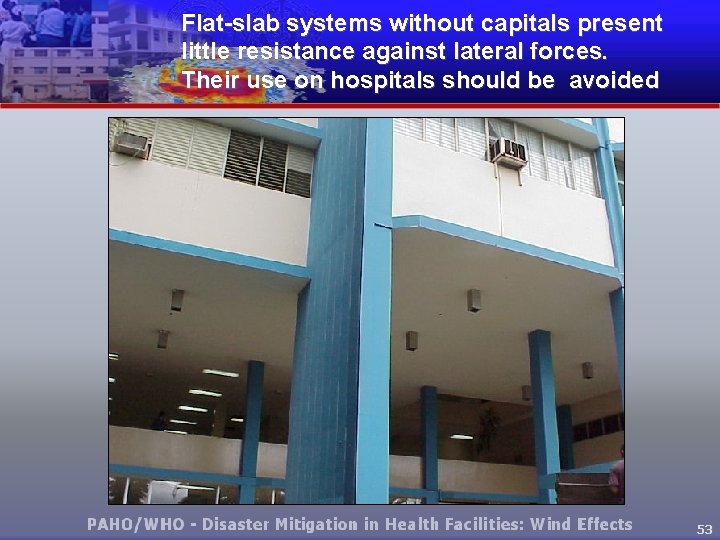
Flat-slab systems without capitals present little resistance against lateral forces. Their use on hospitals should be avoided 53
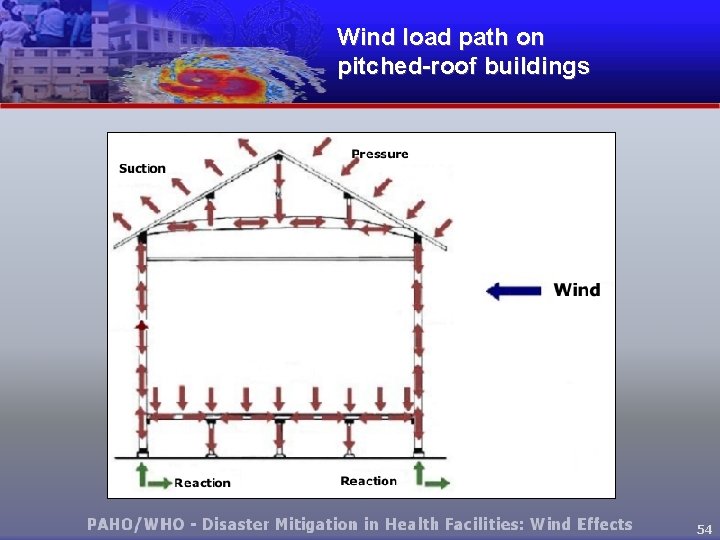
Wind load path on pitched-roof buildings 54
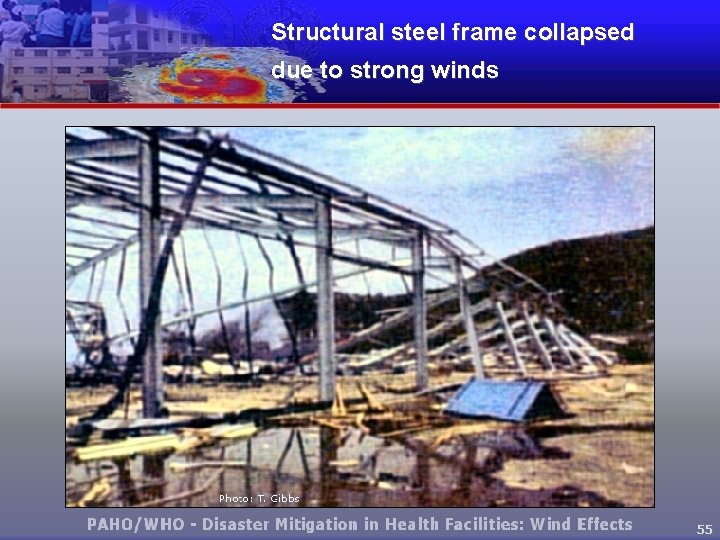
Structural steel frame collapsed due to strong winds 55
Hurricane design philosophy for hospitals The hospital structure must be designed and built in such a way that it: §withstands, without hurricane event; any damage, the design §withstands, with minor and easily repaired damage, hurricanes greater than the design event. 56
Vulnerability assessment objectives Objective To evaluate the likelihood of a structure suffering damage due to the effects of a hurricane, and to characterize the possible damage Available methodologies § § Qualitative methods Quantitative methods 57
Qualitative methods for vulnerability assessments Qualitative methods They assess quickly and simply the structural safety conditions of the building, taking into account the following parameters: • • • The The The age of the building state of conservation and maintenance characteristics of the materials used number of stories architectural plan 58
Quantitative methods for vulnerability assessments Quantitative methods The goal is to determine the levels of resistance of the structure by means of an analysis similar to that used in new buildings and incorporating nonstructural elements. 59
Structural retrofitting § The goal is to ensure that the health care facility will continue to function after a hurricane, by reinforcing existing components or incorporating additional structural components to improve the levels of strength and stiffness. § The retrofitting measures should not interfere with the operation of the hospital during the process. 60
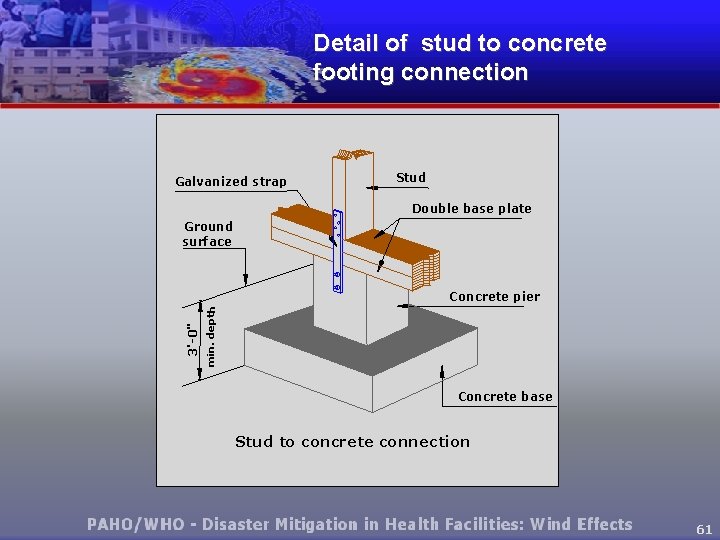
Detail of stud to concrete footing connection Galvanized strap Stud Double base plate Ground surface min. depth 3'-0" Concrete pier Concrete base Stud to concrete connection 61
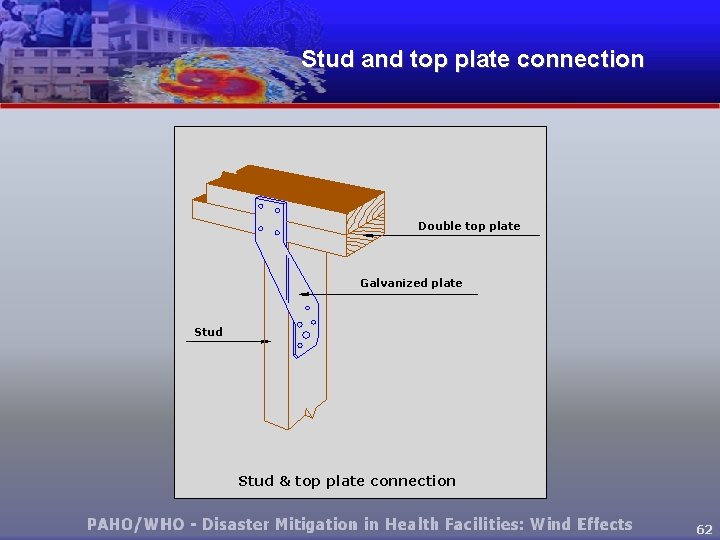
Stud and top plate connection Double top plate Galvanized plate Stud & top plate connection 62
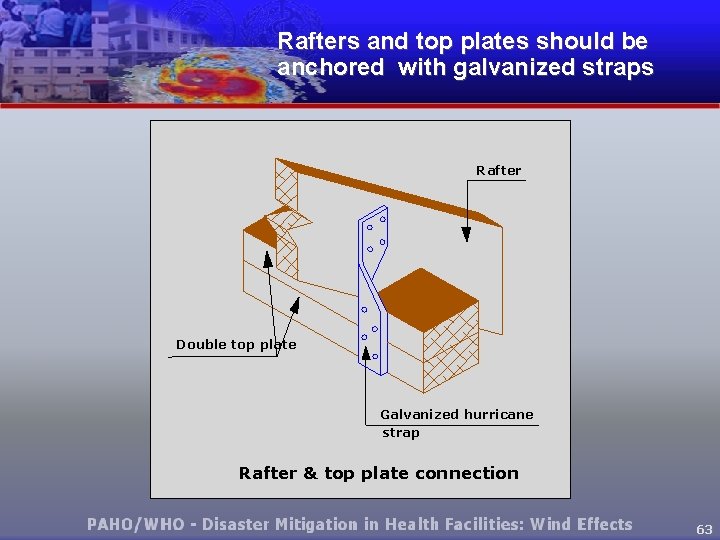
Rafters and top plates should be anchored with galvanized straps Rafter Double top plate Galvanized hurricane strap Rafter & top plate connection 63
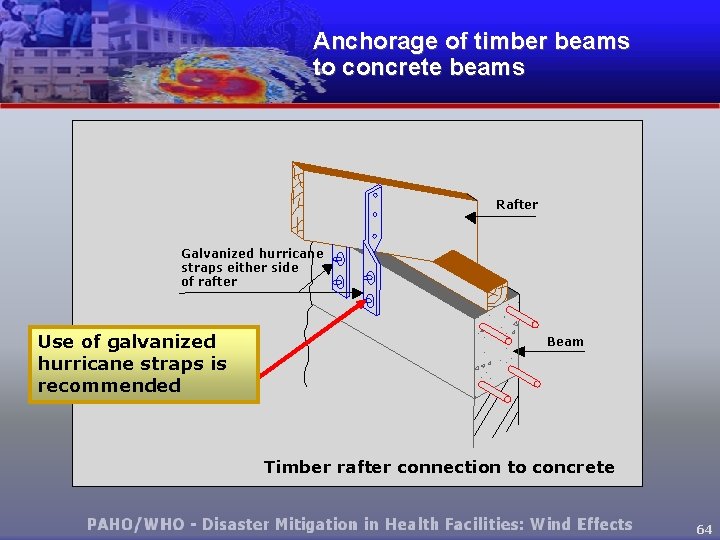
Anchorage of timber beams to concrete beams Rafter Galvanized hurricane straps either side of rafter Use of galvanized hurricane straps is recommended Beam Timber rafter connection to concrete 64
Anchorage details between steel joist and masonry walls 65
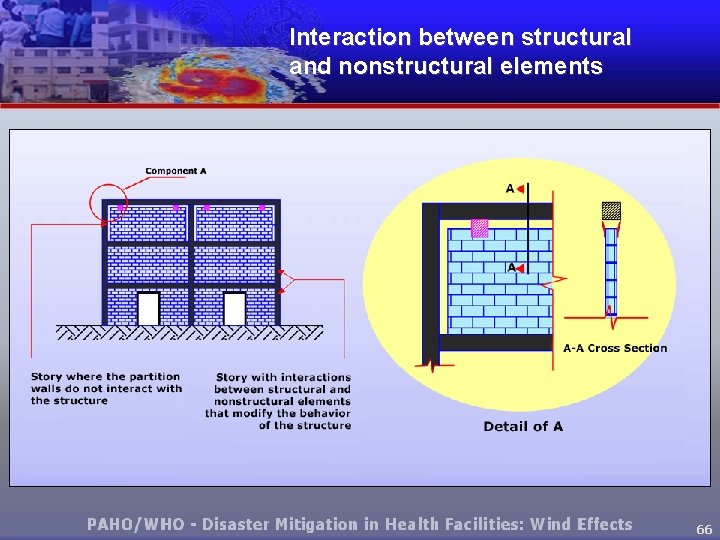
Interaction between structural and nonstructural elements 66
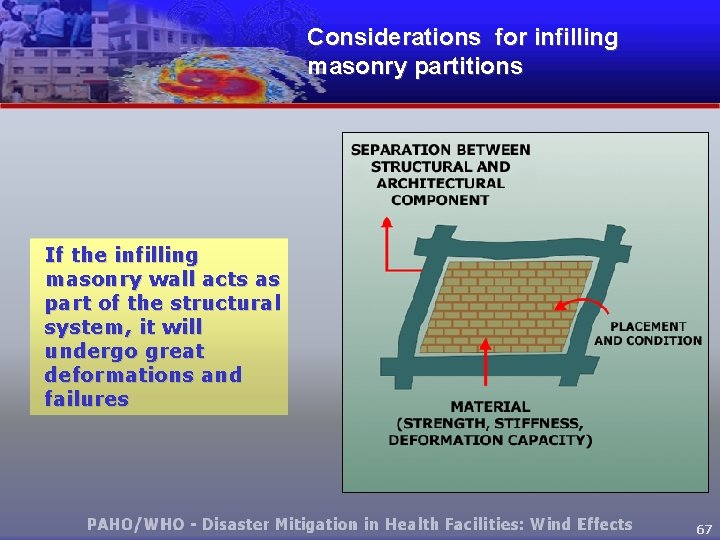
Considerations for infilling masonry partitions If the infilling masonry wall acts as part of the structural system, it will undergo great deformations and failures 67
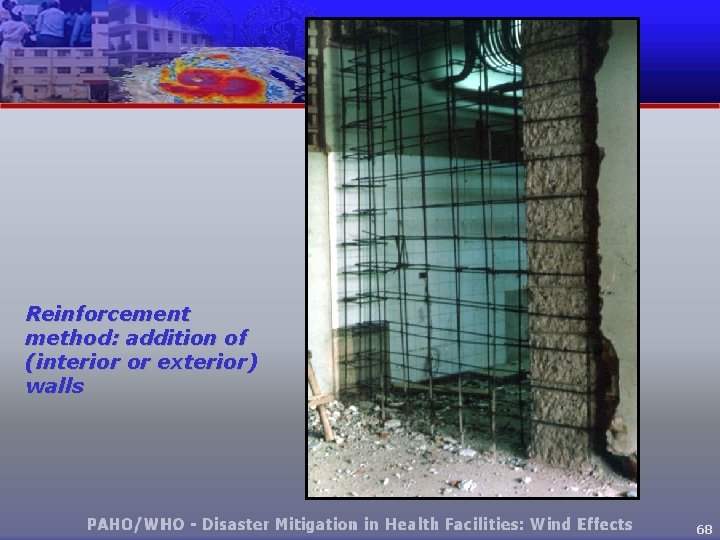
Reinforcement method: addition of (interior or exterior) walls 68
Retrofitted wall in children’s hospital in Santo Domingo 69
Details of retrofitted wall sections 70
Construction method details of retrofitted wall 71
Front view of retrofitted wall 72
Lateral view of retrofitted wall 73
Pan American Health Organization • 2005 These slides have been made possible through the financial support of the Disaster Preparedness Program of the European Commission Humanitarian Aid Department (DIPECHO III). Grupo de Estabilidad Estructural (Ge 2) / INTEC Ave Los Próceres, Galá Apdo 349 -2 Santo Domingo, Dominican Republic Ph: (809) 567 -9271 Fax: (809) 566 -3200 danielc@intec. edu. do www. intec. edu. do 74