
Disappearing Penny 1 Put the penny in the

- Slides: 53
Disappearing Penny • 1. Put the penny in the cup. Look at the penny, then walk backwards until just after you can't see the penny anymore. • 2. It's very important that you can't see the penny. Without that, the magic of this trick fizzles into nothing. • 3. Stay where you are, and have your friend pour water into the cup. • 4. If all goes well, the penny should appear. • 5. Explain why the water makes the penny reappear. Be sure to state the kind of light behavior this shows.
Activity • Observe 3 cups, labeled 1, 2, 3. • Observe each straw through the side of the cup as you slowly turn the cup. DO NOT STIR THE CONTENTS! • Write down your observations in the data table. • In which container does the straw appear broken? • Are all amounts of break the same? • When does the straw not appear to be broken?
Refraction and Snell’s Law
Boundary Behavior • When light waves hit a new boundary it doesn’t just stop • Reflection, refraction, and diffraction can all occur • Some energy remains in the original medium and some energy passes to the new medium • Conservation of energy occurs
Reflection • A reflected pulse occurs when the light strikes a boundary and bounces back into the original medium • Demo: rope of different thickness • The reflected pulse: – Is inverted – Has the same speed and wavelength – Has a smaller amplitude (has less energy than the incident wave)
Transmission • A transmitted pulse is the energy that passes into a new medium • The transmitted pulse (wave): – Is not inverted – Has a different speed and wavelength – The frequency of the wave is the same • The transmitted wave undergoes refraction (bending) if it approaches the boundary at an angle.
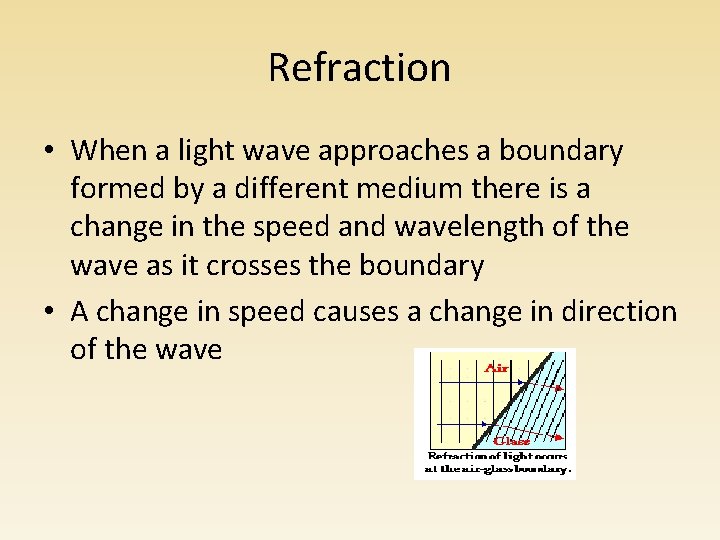
Refraction • When a light wave approaches a boundary formed by a different medium there is a change in the speed and wavelength of the wave as it crosses the boundary • A change in speed causes a change in direction of the wave
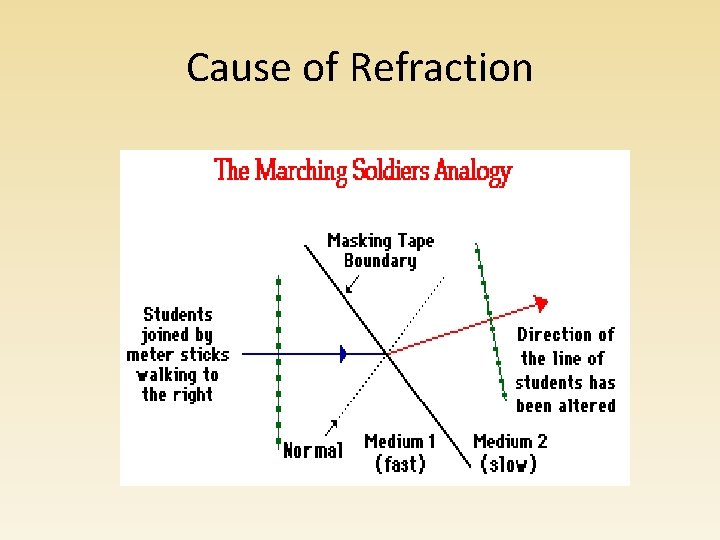
Cause of Refraction
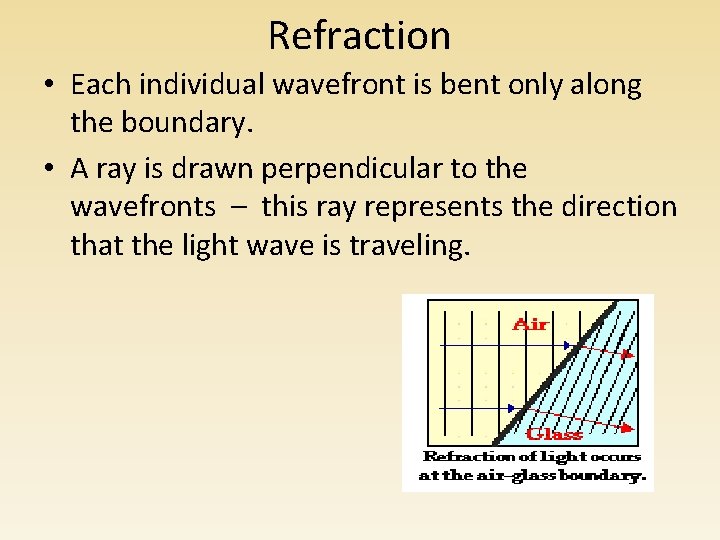
Refraction • Each individual wavefront is bent only along the boundary. • A ray is drawn perpendicular to the wavefronts – this ray represents the direction that the light wave is traveling.
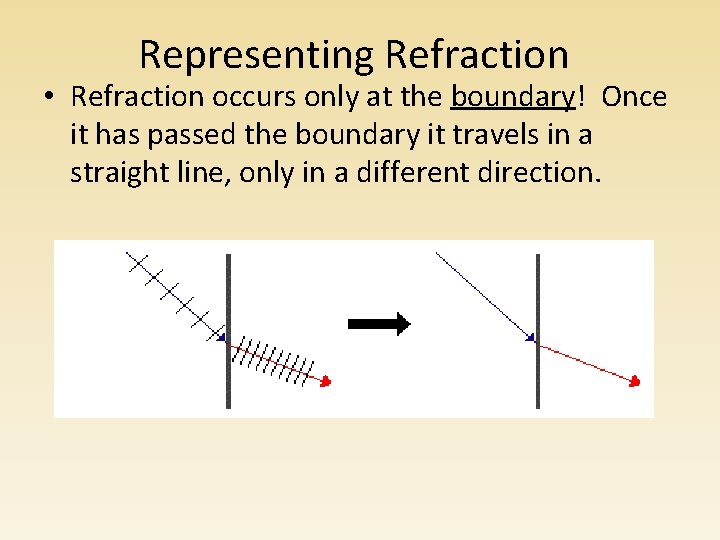
Representing Refraction • Refraction occurs only at the boundary! Once it has passed the boundary it travels in a straight line, only in a different direction.
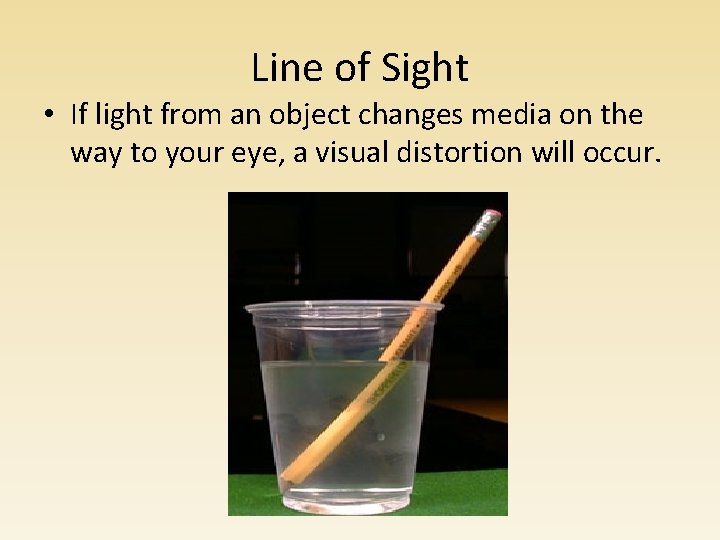
Line of Sight • If light from an object changes media on the way to your eye, a visual distortion will occur.
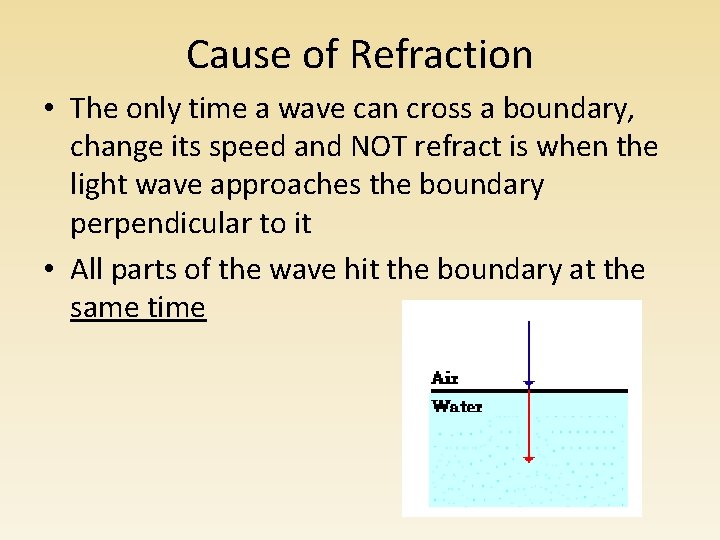
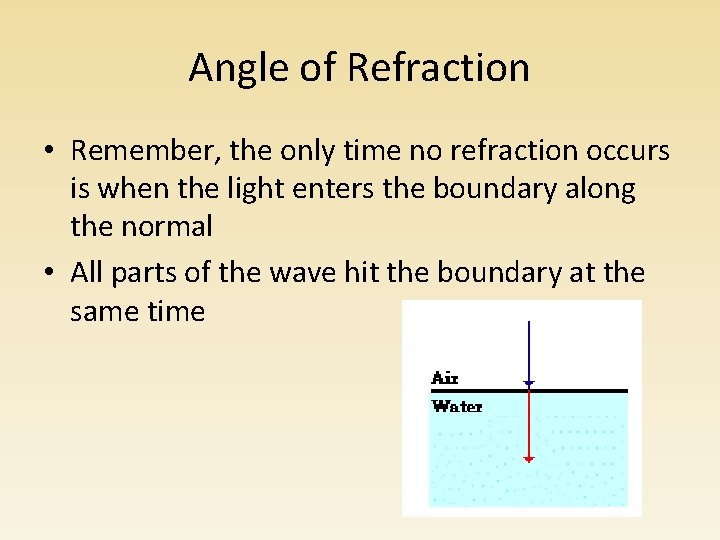
Cause of Refraction • The only time a wave can cross a boundary, change its speed and NOT refract is when the light wave approaches the boundary perpendicular to it • All parts of the wave hit the boundary at the same time
Archer Fish • http: //videos. howstuffworks. com/animalplanet/27704 -fooled-by-nature-archer-fishvideo. htm
Speed of Light in a Medium • The speed of light in a vacuum (no particles) is 3. 0 x 108 m/s • The speed of light is dependent on the properties of the medium. • Optical density determines how much energy is absorbed and re-emitted in a medium and determines the speed of light in that medium. • The higher the optical density, the slower the light wave.
Index of Refraction • The index of refraction is an indicator of optical density • Each material has a specific index of refraction • Represented by the letter n, it represents how much slower the light travels in the medium as compared to a vacuum.
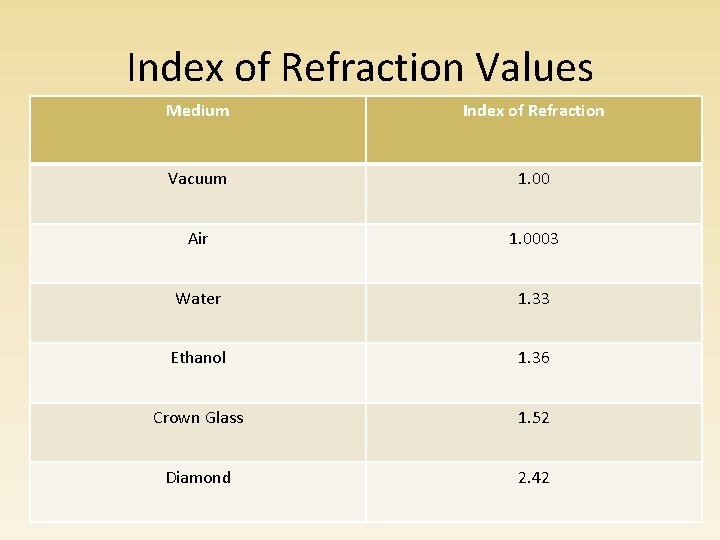
Index of Refraction Values Medium Index of Refraction Vacuum 1. 00 Air 1. 0003 Water 1. 33 Ethanol 1. 36 Crown Glass 1. 52 Diamond 2. 42
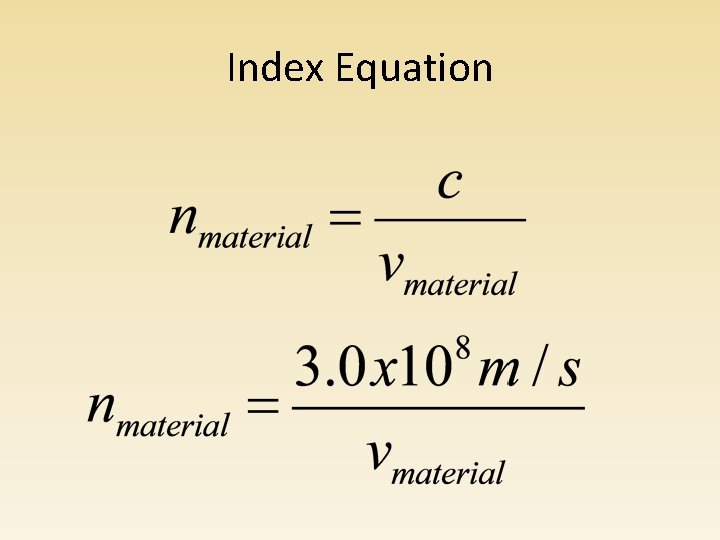
Index Equation
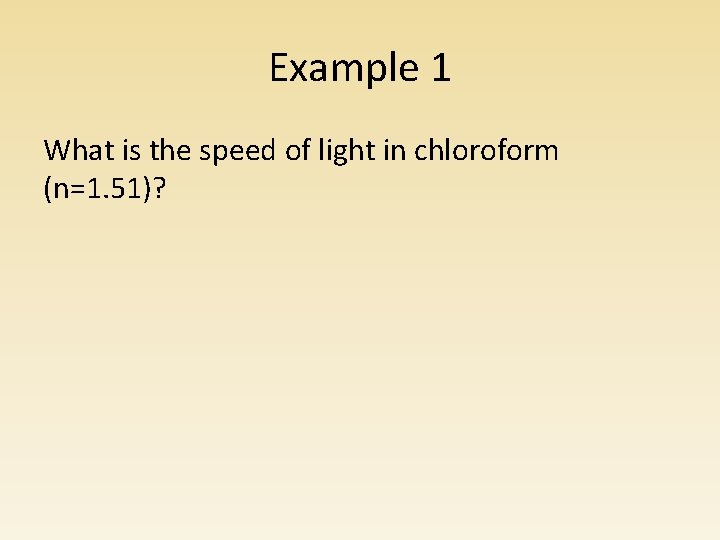
Example 1 What is the speed of light in chloroform (n=1. 51)?
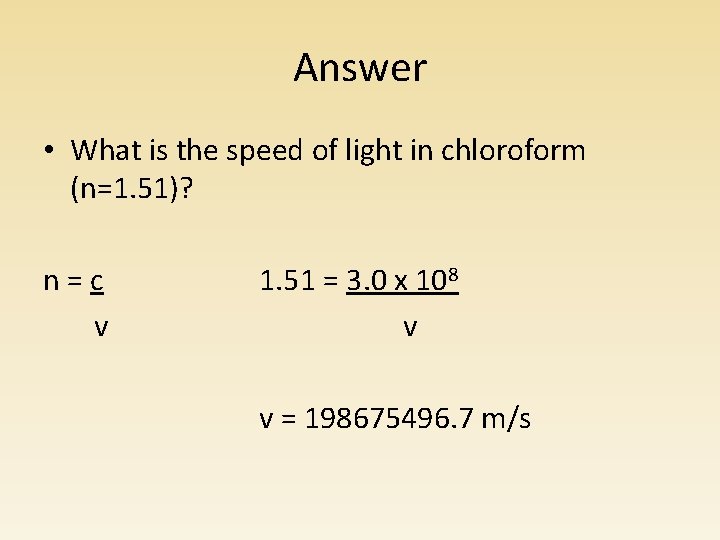
Answer • What is the speed of light in chloroform (n=1. 51)? n=c v 1. 51 = 3. 0 x 108 v v = 198675496. 7 m/s
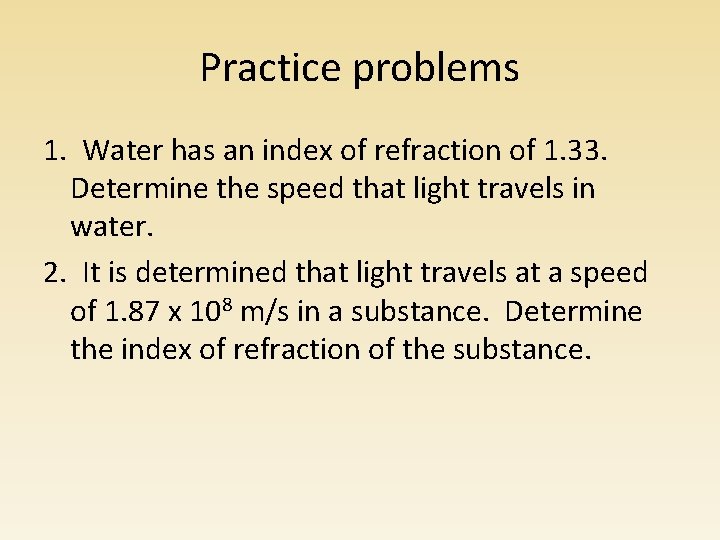
Practice problems 1. Water has an index of refraction of 1. 33. Determine the speed that light travels in water. 2. It is determined that light travels at a speed of 1. 87 x 108 m/s in a substance. Determine the index of refraction of the substance.
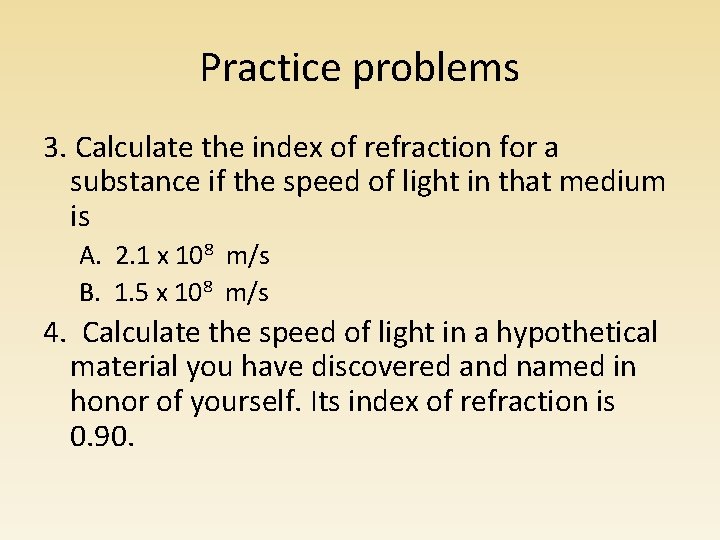
Practice problems 3. Calculate the index of refraction for a substance if the speed of light in that medium is A. 2. 1 x 10⁸ m/s B. 1. 5 x 10⁸ m/s 4. Calculate the speed of light in a hypothetical material you have discovered and named in honor of yourself. Its index of refraction is 0. 90.
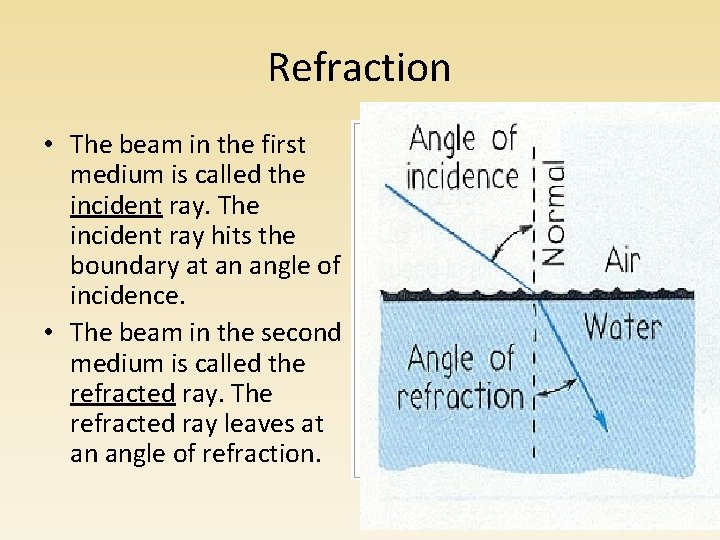
Refraction • The beam in the first medium is called the incident ray. The incident ray hits the boundary at an angle of incidence. • The beam in the second medium is called the refracted ray. The refracted ray leaves at an angle of refraction.
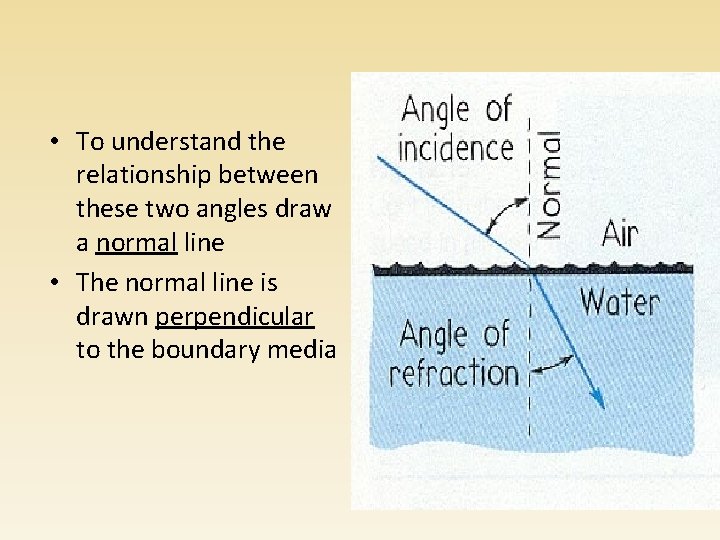
• To understand the relationship between these two angles draw a normal line • The normal line is drawn perpendicular to the boundary media
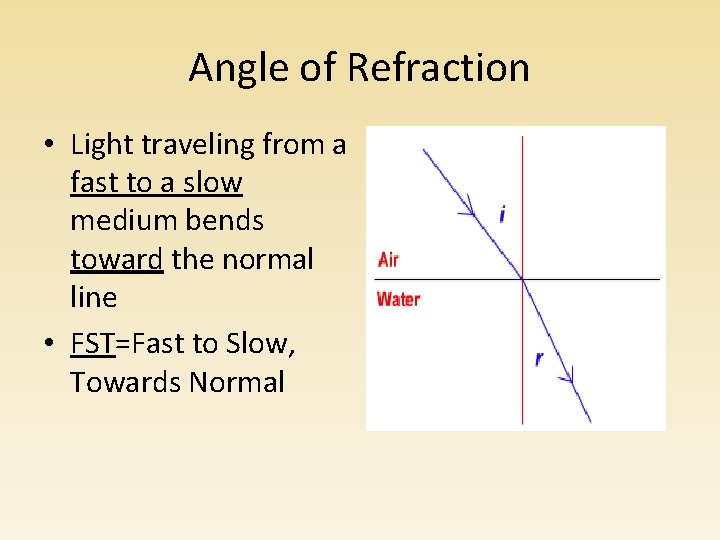
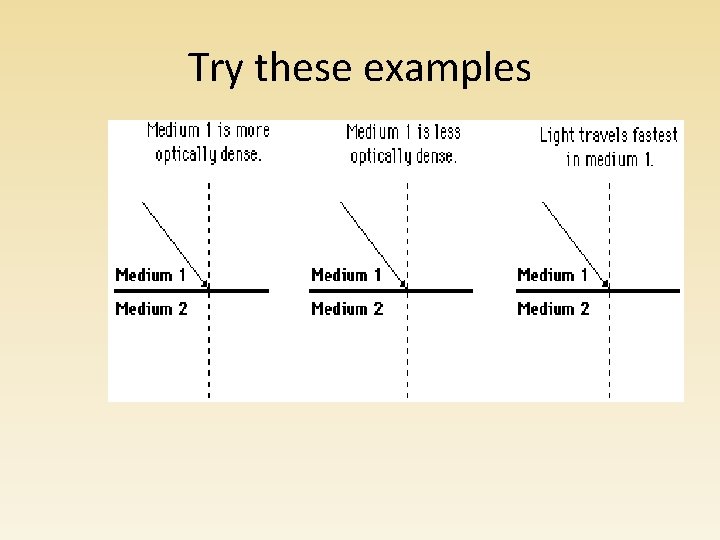
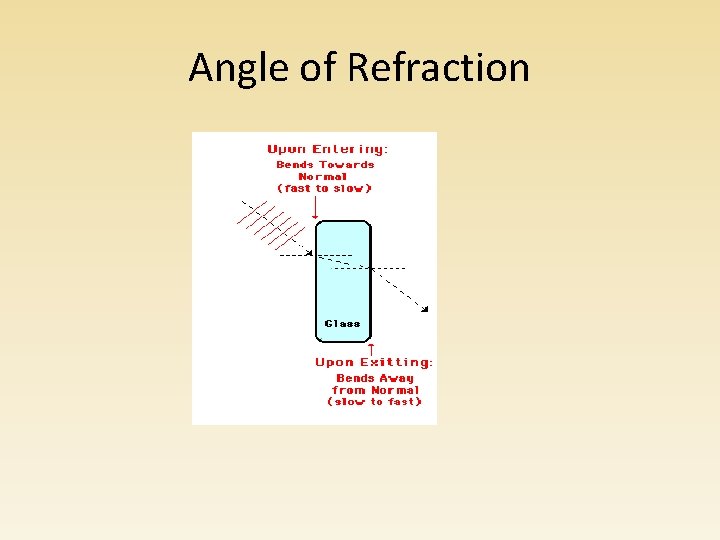
Angle of Refraction • Light traveling from a fast to a slow medium bends toward the normal line • FST=Fast to Slow, Towards Normal
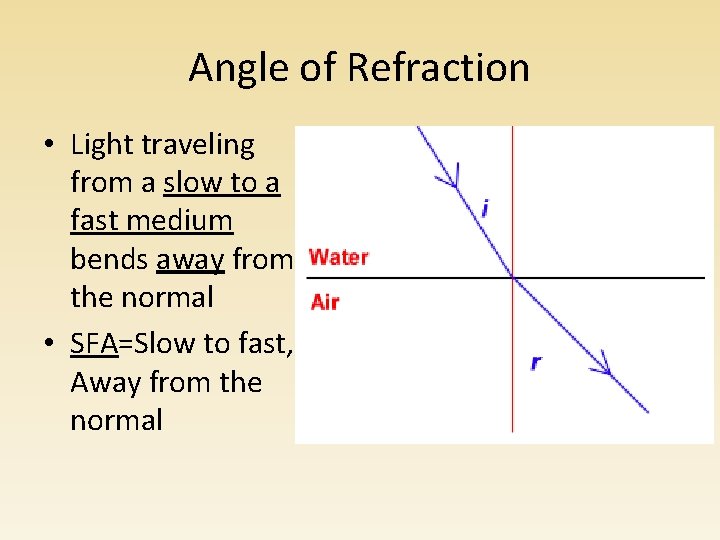
Angle of Refraction • Light traveling from a slow to a fast medium bends away from the normal • SFA=Slow to fast, Away from the normal
Angle of Refraction • Remember, the only time no refraction occurs is when the light enters the boundary along the normal • All parts of the wave hit the boundary at the same time
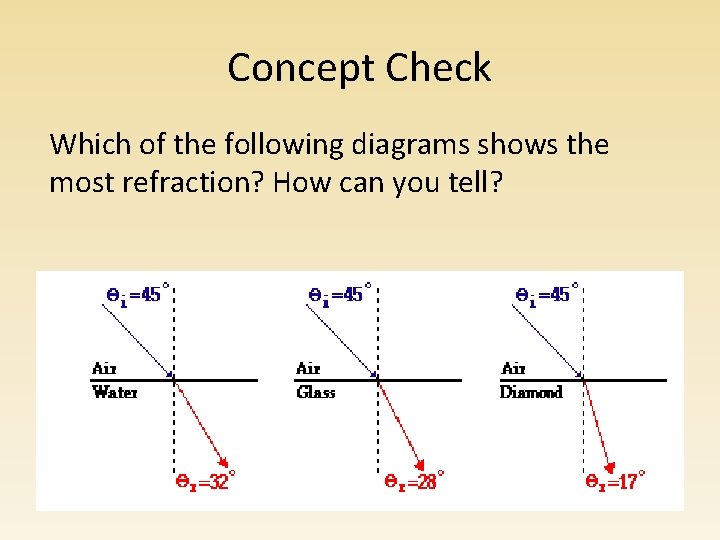
Concept Check Which of the following diagrams shows the most refraction? How can you tell?
Concept Check • There is a bigger difference in index of refraction between air and diamond • The more light refracts, the bigger the difference between the angle of incidence and angle of refraction • There is no clear linear relationship between the two angles
Try these examples
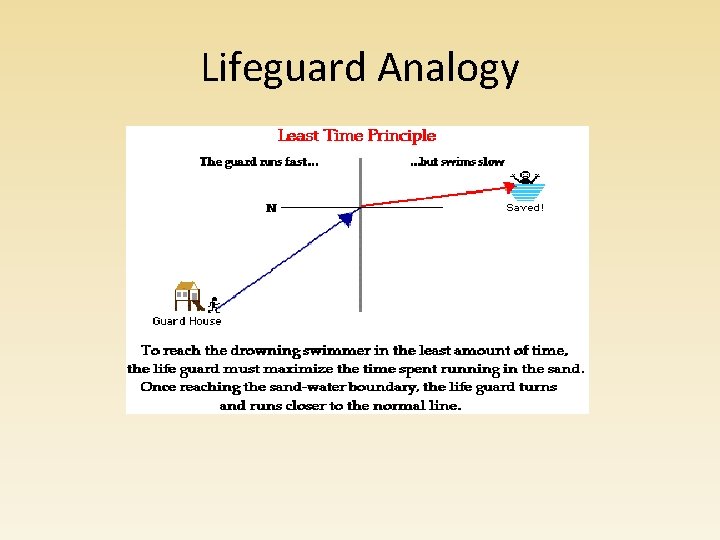
Least time Principle • Of all the possible paths that light might take to get from one point to another, it always takes the path that requires the least amount of time • Lifeguard analogy
Lifeguard Analogy
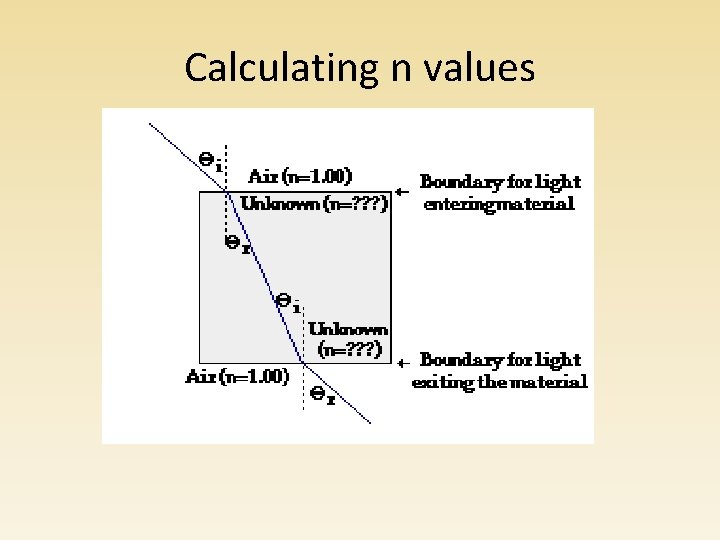
Angle of Refraction • When passing through multiple media, the direction of the original incident ray is the same as the direction of the final refracted ray. • This occurs when: – The 2 sides of the material are parallel to each other – The medium surrounding the internal medium are the same
Angle of Refraction
Snell’s Law • Snell’s law describes the mathematical relationship between the angle of incidence and the angle of refraction. • This relationship is only present when light crosses a boundary between 2 materials • Light is refracted when it enters a new medium and when it exits that medium
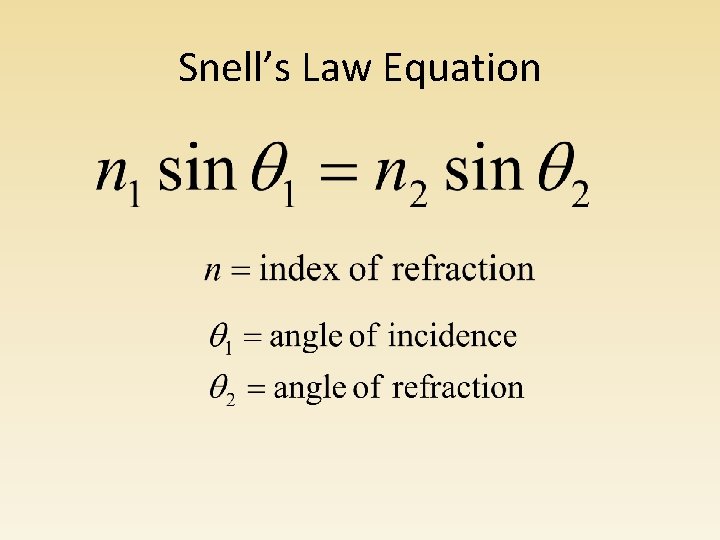
Snell’s Law • Snell’s law states that the index of refraction multiplied by the sine of the angle of incidence in the first medium is equal to the index of refraction of the second medium multiplied by the sine of the angle of refraction in the second medium
Snell’s Law Equation
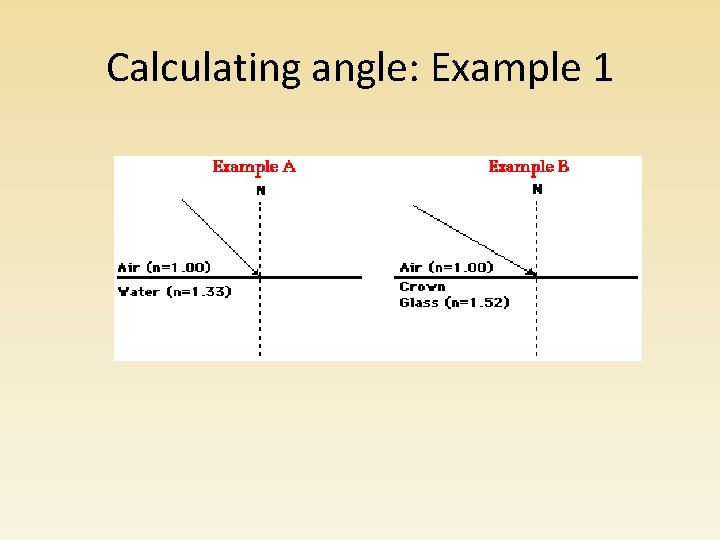
Calculating angle: Example 1
Calculating angle: Example 2 • A ray of light in air is approaching the boundary with water at an angle of 52 degrees. Determine the angle of refraction of the light ray.
Calculating angle: Example 3 • A ray of light in air is approaching the boundary with a layer of crown glass at an angle of 42. 0 degrees. Determine the angle of refraction of the light ray upon entering the crown glass and upon leaving the crown glass.
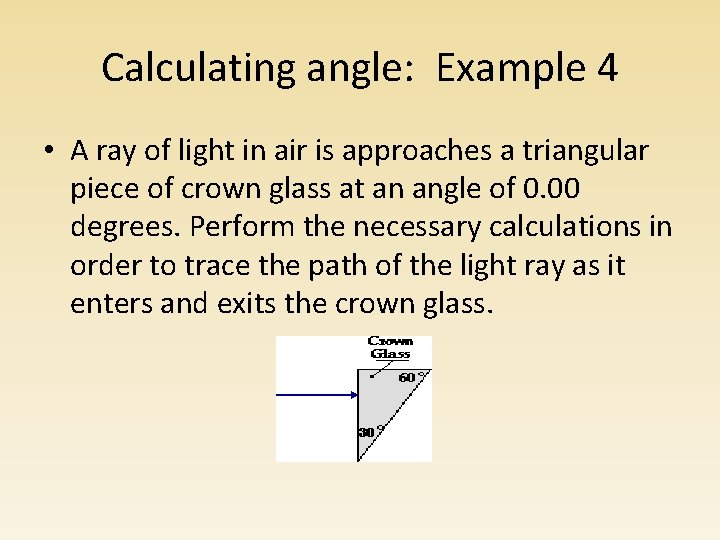
Calculating angle: Example 4 • A ray of light in air is approaches a triangular piece of crown glass at an angle of 0. 00 degrees. Perform the necessary calculations in order to trace the path of the light ray as it enters and exits the crown glass.
Calculating n values
Total Internal Reflection • Remember: a light wave is transporting energy! • When light hits a boundary some energy is transmitted to the new medium, some energy is reflected. • Total internal reflection occurs when all light is reflected, and there is no refracted ray • This can only occur when light travels from a higher density to a lower density
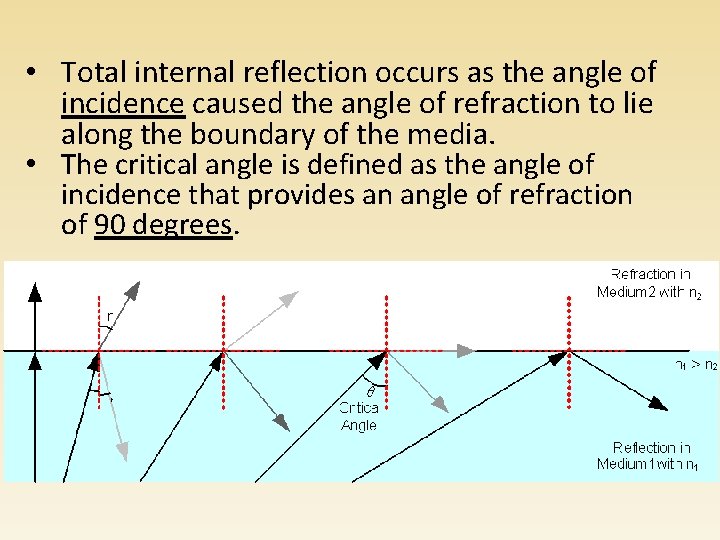
• Total internal reflection occurs as the angle of incidence caused the angle of refraction to lie along the boundary of the media. • The critical angle is defined as the angle of incidence that provides an angle of refraction of 90 degrees.
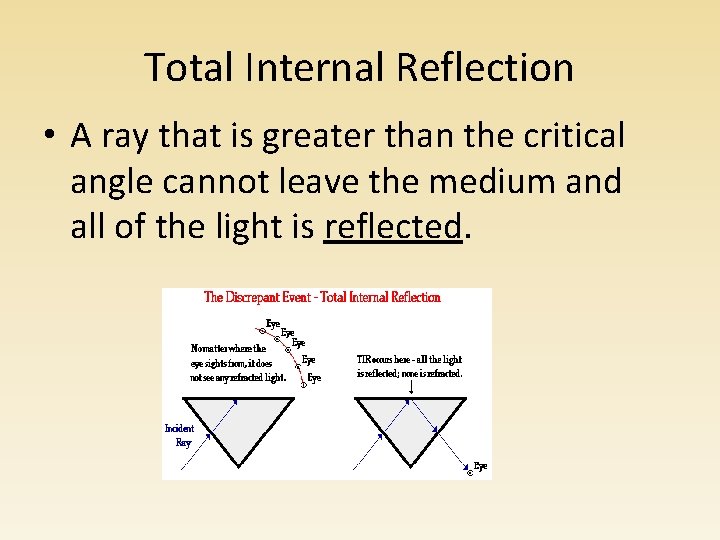
Total Internal Reflection • A ray that is greater than the critical angle cannot leave the medium and all of the light is reflected.
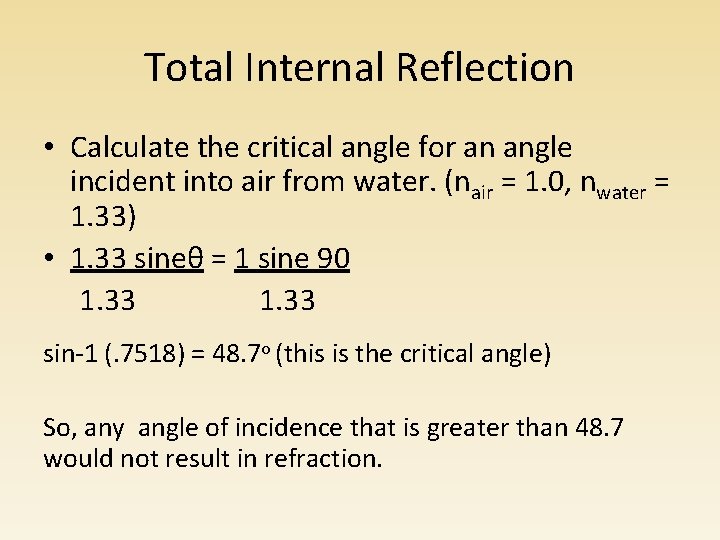
Total Internal Reflection • Calculate the critical angle for an angle incident into air from water. (nair = 1. 0, nwater = 1. 33) • 1. 33 sineθ = 1 sine 90 1. 33 sin-1 (. 7518) = 48. 7 o (this is the critical angle) So, any angle of incidence that is greater than 48. 7 would not result in refraction.
Total Internal Reflection Two requirements: 1. The light is going from a more dense medium to a less dense medium 2. The angle of incidence is greater than the critical angle
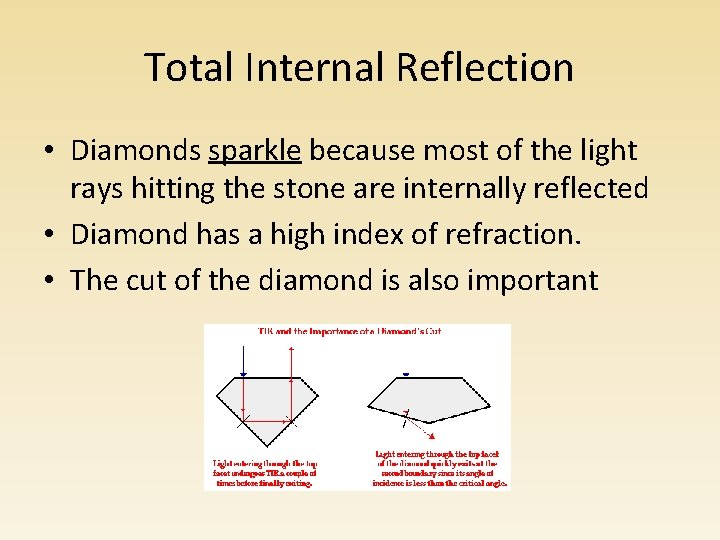
Total Internal Reflection • Diamonds sparkle because most of the light rays hitting the stone are internally reflected • Diamond has a high index of refraction. • The cut of the diamond is also important
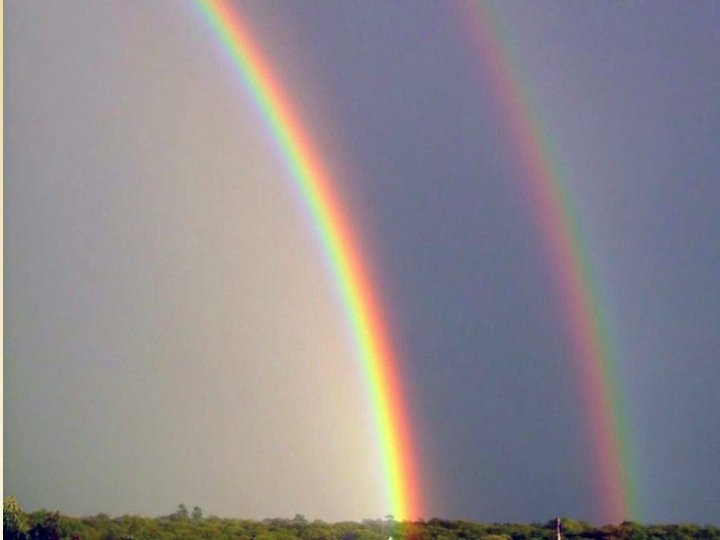
Dispersion of Light • The separation of visible light into its spectrum is called dispersion. • Each color is characteristic of a distinct wave frequency. • The index of refraction depends on the frequency of light. • Red light is bent the least, while violet light is bent the most. • A rainbow is a natural dispersion of light
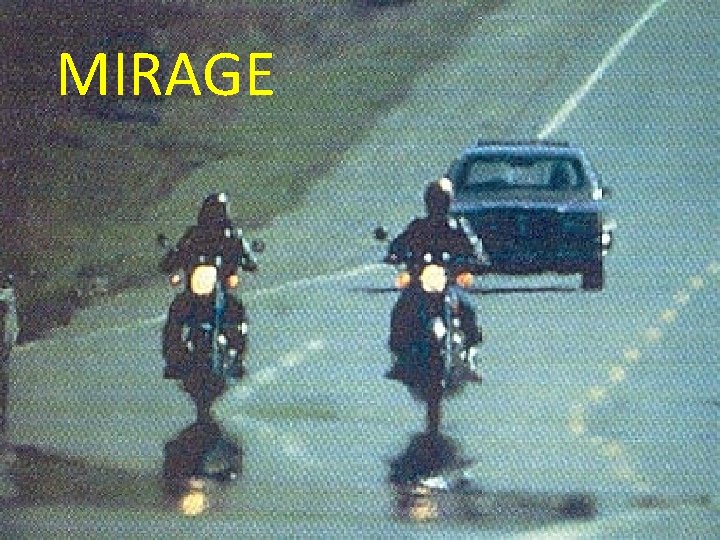
MIRAGE
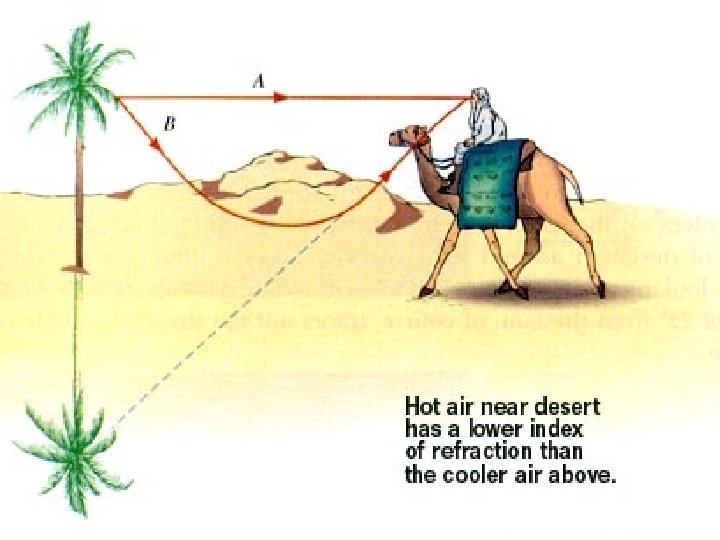
Atmospheric Refraction • Mirages, floating images that appear in the distance, are due to the refraction of light in the Earth’s atmosphere. • On hot days, a hot layer of air is in contact with the ground with cooler air above it • Light travels faster in the hot air • This increase in speed causes a bending of the light rays • The image appears upside down to the observer
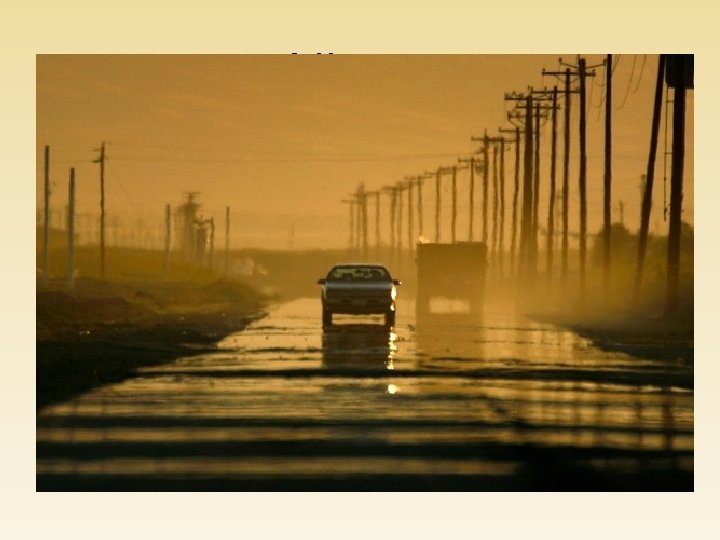
Mirages • Mirages are formed by refracted light (they are not tricks of the mind). • When a hot road appears to be wet, light from the sky is being refracted through a layer of hot air