
Disappearance of the southeast U S warming hole
- Slides: 1
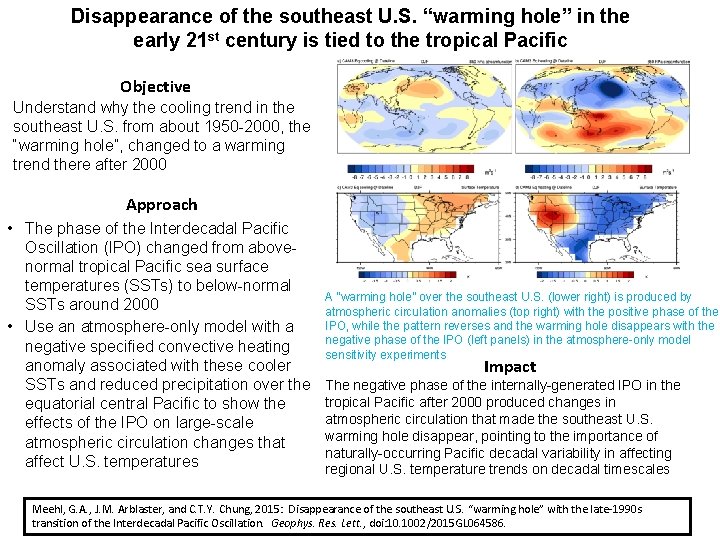
Disappearance of the southeast U. S. “warming hole” in the early 21 st century is tied to the tropical Pacific Objective Understand why the cooling trend in the southeast U. S. from about 1950 -2000, the “warming hole”, changed to a warming trend there after 2000 Approach • The phase of the Interdecadal Pacific Oscillation (IPO) changed from abovenormal tropical Pacific sea surface temperatures (SSTs) to below-normal SSTs around 2000 • Use an atmosphere-only model with a negative specified convective heating anomaly associated with these cooler SSTs and reduced precipitation over the equatorial central Pacific to show the effects of the IPO on large-scale atmospheric circulation changes that affect U. S. temperatures A “warming hole” over the southeast U. S. (lower right) is produced by atmospheric circulation anomalies (top right) with the positive phase of the IPO, while the pattern reverses and the warming hole disappears with the negative phase of the IPO (left panels) in the atmosphere-only model sensitivity experiments Impact The negative phase of the internally-generated IPO in the tropical Pacific after 2000 produced changes in atmospheric circulation that made the southeast U. S. warming hole disappear, pointing to the importance of naturally-occurring Pacific decadal variability in affecting regional U. S. temperature trends on decadal timescales Meehl, G. A. , J. M. Arblaster, and C. T. Y. Chung, 2015: Disappearance of the southeast U. S. “warming hole” with the late-1990 s transition of the Interdecadal Pacific Oscillation. Geophys. Res. Lett. , doi: 10. 1002/2015 GL 064586.