
DisabilityBased Disparities in Social Determinants of Health Among
Disability-Based Disparities in Social Determinants of Health Among Working-Age Adults Presenters: Jae Kennedy Liz Wood September 30, 2020 CHRIL-Collaborative on Health Reform and Independent Living 1
The Collaborative on Health Reform and Independent Living Mission: To discover and share essential information about how health reforms affect working-age adults with disabilities. Funding: The CHRIL is funded by a Disability and Rehabilitation Research Project grant (90 DP 0075 -01 -00) from the National Institute on Disability, Independent Living and Rehabilitation Research (NIDILRR), DHHS. CHRIL-Collaborative on Health Reform and Independent Living 2
Report overview • Using data from the 2018 National Health Interview Survey, we describe the rates of work limitation, activity limitation, functional limitation, and disability program participation among adults aged 1864. • We then compare rates of disability in specific subpopulations. • Next, we compare social determinants of health among workingage adults with and without disabilities, with a focus on the healthcare domain. • We end with a recap and calls to action. • The full report will be available soon at www. chril. org. CHRIL-Collaborative on Health Reform and Independent Living 3
Introduction Defining health disparities and social determinants of health from a disability perspective CHRIL-Collaborative on Health Reform and Independent Living 4
What are health disparities? • A health disparity is a health difference that is closely linked with social or economic disadvantage. • Health disparities adversely affect groups of people who have systematically experienced greater social or economic obstacles to health based on things such as: – Race and ethnicity – Religion – Socioeconomic status – Gender – Disability – Sexual orientation – Geographic location Or other characteristics historically linked to discrimination or exclusion. (Healthy People 2020) CHRIL-Collaborative on Health Reform and Independent Living 5
People with disabilities are not a current priority in US health disparities research • The United Nations describes people with disabilities as “the world’s largest minority, ” but US research agencies and foundations direct few resources to studying and addressing health disparities within this population. • The National Institutes of Health (NIH) designate the following minority groups as US health disparities populations: racial and ethnic minorities, socioeconomically disadvantaged populations, sexual and gender minorities, and rural populations. • People with disabilities are absent from this list. CHRIL-Collaborative on Health Reform and Independent Living 6

Understanding disability-based disparities • Disability as a minority group status is conceptually distinct from disability as a health outcome. • Disparities and differences are not the same: – A health disparity is a health difference that is closely linked with social or economic disadvantage. • Although some differences in health may be attributable to a person’s disability, disparities are the result of the interaction of minority group status with external factors known as social determinants of health, which we will cover in more detail later. CHRIL-Collaborative on Health Reform and Independent Living 7
Highlighted Finding #1: Disability is common; disability is even more common among minority groups. CHRIL-Collaborative on Health Reform and Independent Living 8
Study population We classify working-age adults (18 to 64) as disabled if they (or their proxy) report any of the following: – limited or unable to work due to a physical, mental, or emotional condition – need the help of another person with self-care (i. e. activities of daily living) or routine chores (i. e. instrumental activities of daily living) – have difficulty walking without special equipment – have difficulty remembering, or they experience periods of confusion – they are enrolled in a federal disability program (i. e. SSI or SSDI) CHRIL-Collaborative on Health Reform and Independent Living 9
Comparison groups • Based on our analyses of the 2018 National Health Interview Survey (NHIS) we estimate that for US residents between the ages of 18 and 64: – 13% meet this definition of disability (25 million) – 87% do not (173 million) • We test the statistical significance of any differences between these two groups by using Rao-Scott chi-square tests. CHRIL-Collaborative on Health Reform and Independent Living 10
Disability and Intersectionality • Our report also examined rates of disability among certain subpopulations. We found that disability is more common among: – Certain racial and ethnic minorities. • The highest observed disability rates were among American Indians/Alaska Natives (21%), those who reported multiple races (20%), and those who were Black/African-American (17%). • Disability rates among non-Hispanic whites were similar to the general population average (12%). • Lower rates of disability were observed among Hawaiian/Pacific Islanders and Latinx respondents (both 9%), and the lowest rates were among Asian respondents (6%). CHRIL-Collaborative on Health Reform and Independent Living 11
Disability and Intersectionality, Continued • Disability was more common among people who identified as gay or lesbian (18%) or bisexual (21%) than those who identified as straight/heterosexual (12%). • Disability was more common among people living in the South (14%) than among those living in the Midwest (13%), Northeast (12%), or West (12%). • The intersection of immigration policy and disability has strong impacts on who can become a citizen and who can qualify for disability benefits. This may explain why disability is twice as common among people born in the United States (14%) than among people born elsewhere (7%). Disability is more than twice as common among US citizens (14%) than non-citizen residents (5%). CHRIL-Collaborative on Health Reform and Independent Living 12
Disability and Intersectionality, Continued 2 Side note: We found no differences in rates of disability by gender in this working-age population, although other research has shown that gender differences in disability rates appear later in life due to women’s greater longevity. Gender may still play a role in some of these intersecting disparity groups, e. g. women of color with disabilities. For researchers and policymakers to truly understand the needs of these populations, disability must be a component; for them to understand the needs of the disability community, intersectional identities such as these must be a component. (We will revisit the implications of these findings again at the end of the presentation. ) CHRIL-Collaborative on Health Reform and Independent Living 13
Highlighted Finding #2: People with disabilities are consistently disadvantaged across all domains of social determinants of health. CHRIL-Collaborative on Health Reform and Independent Living 14
Social determinants of health • Social determinants of health are defined as “conditions in the environments in which people are born, live, learn, work, play, worship, and age, that affect a wide range of health, functioning, and quality-of-life outcomes and risks. ” • Healthy People 2020 classifies social determinants in 5 domains: 1. 2. 3. 4. 5. Economic stability Education Neighborhood and built environment Social and community context Healthcare We will briefly touch on each of the first four domains, then take a more detailed look at the healthcare domain. CHRIL-Collaborative on Health Reform and Independent Living 15
Social Determinants of Health: Economic Stability Domain • Household income: People with disabilities are more than three times as likely as people without disabilities to live in households earning an income below the Federal Poverty Guidelines (26% vs 8%). • Employment: People with disabilities are significantly less likely to engage in paid work compared to people without disabilities (38% vs 85%). • Food security: People with disabilities are less likely to report being food secure (67. 6% vs 91. 0%). CHRIL-Collaborative on Health Reform and Independent Living 16
Social Determinants of Health: Education Domain • People with disabilities are more likely to report never having finished high school: 18% vs 10%. • While they are slightly more likely to report attending “some college” (33% of people with disabilities, vs 31% of people without disabilities), they are half as likely to report being a college graduate (12% vs 24%). • People with disabilities are significantly less likely to have a graduate degree (5% vs 13%). CHRIL-Collaborative on Health Reform and Independent Living 17
Social Determinants of Health: Neighborhood and Built Environment Domain • There are few measures available for this domain in surveys that also include disability status. • However, people with disabilities are nearly twice as likely as those without disabilities to “strongly disagree” with the statements – “People in this neighborhood help each other out” (11% vs 6%) – “People in this neighborhood can be trusted” (13% vs 7%) – “This is a close-knit neighborhood” (21% vs 14%). CHRIL-Collaborative on Health Reform and Independent Living 18
Social Determinants of Health: Social and Community Context Domain • People with disabilities are less likely to live in households with children under 18 (23% vs 44%). • Parents or guardians with disabilities are less likely to live with a spouse or partner (14% vs 8%), compounding the challenges of parenting with a disability. • People with disabilities are more likely to live alone (27% vs 15%) than those without disabilities. • They are more likely to never marry (33% vs 28%); those who do get married at some point are more likely to be divorced/separated (21% vs 9%) or widowed (3% vs 1%). CHRIL-Collaborative on Health Reform and Independent Living 19
Highlighted Finding #3: People with disabilities experience healthcare disparities that are not directly attributable to disability. CHRIL-Collaborative on Health Reform and Independent Living 20
Understanding Differences and Disparities in the Healthcare Domain • Disability-based healthcare disparities can be tricky to tease out. Disabling conditions will generally cause more interaction with the healthcare system and poorer overall health. • However, there also observable disparities in coverage, access, and satisfaction that are not solely or primarily the result of a disabling condition. • We will briefly discuss our utilization findings before talking about coverage, access, and satisfaction. CHRIL-Collaborative on Health Reform and Independent Living 21
Differences in Healthcare Utilization As expected, we observed differences in healthcare utilization: – People with disabilities tend to visit healthcare providers more frequently: half have visited a physician’s office or clinic more than 5 times in the past year, compared to 16% of those without disabilities. – People with disabilities are less likely to make it through the year without visiting the emergency department (58% vs 82%). They are 10 x more likely to have been to the ED five or more times in the past year (4. 2% vs 0. 4%). – In essentially every area, people with disabilities visit healthcare providers more often than those without. One notable exception: women with disabilities are less likely to see a gynecologist or obstetrician (17% vs 24%). CHRIL-Collaborative on Health Reform and Independent Living 22
Social Determinants of Health: Healthcare Domain • Insurance: – Working-age adults with disabilities are less likely to receive employer-based private health insurance, in part because they are much less likely to be working full-time. – However, because of their relatively low incomes and disability program participation, they are much more likely to be categorically eligible for public health insurance programs like Medicaid and Medicare. (Percentages follow on next slide). – People with disabilities are less likely to be uninsured. CHRIL-Collaborative on Health Reform and Independent Living 23
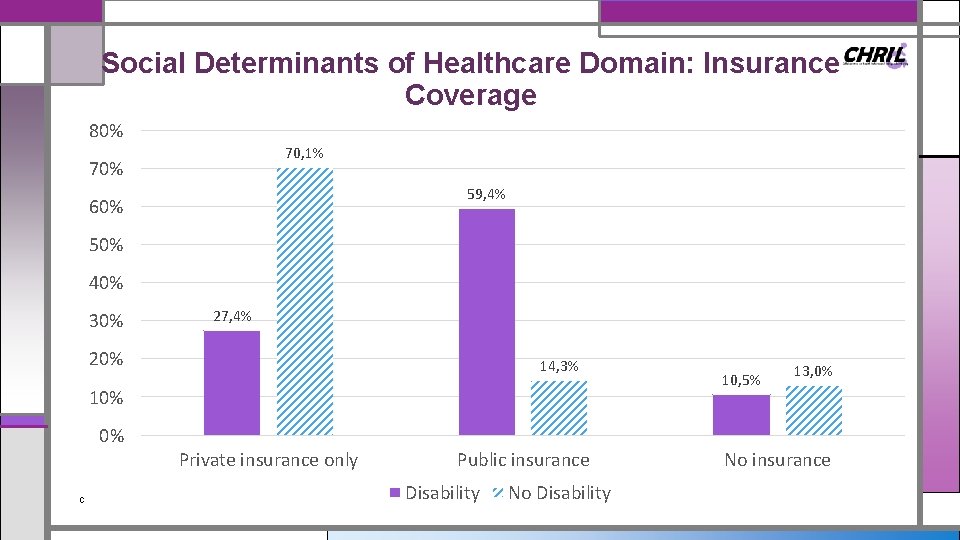
Social Determinants of Healthcare Domain: Insurance Coverage 80% 70, 1% 70% 59, 4% 60% 50% 40% 30% 27, 4% 20% 14, 3% 10, 5% 13, 0% 0% Private insurance only CHRIL-Collaborative on Health Reform and Independent Living Public insurance Disability No insurance 24
Social Determinants of Health: Healthcare Domain, Continued - People with disabilities are more likely to report difficulty finding a doctor (6% vs 3%). However, they are also more likely to have a usual source of routine or preventive care (85% vs 75%) and to have a place to obtain medical care when sick (91% vs 82%). - They are more likely to skip needed medical care (19% vs 6%), dental care (26% vs 16%), prescription medications (18% vs 5%), prescription eyeglasses (16% vs 5%), and needed mental health services (8% vs 2%) due to cost. - They are also more likely to delay the care that they need because of cost (24% vs 9%), prohibitive wait times to get appointments (17% vs 7%), and lacking transportation (10% vs 1%). CHRIL-Collaborative on Health Reform and Independent Living 25
Social Determinants of Health: Healthcare Domain, Continued 2 Lower rates of uninsurance among people with disabilities also do not translate to fewer concerns about healthcare costs, suggesting that many may be underinsured: • People with disabilities are significantly more likely to report problems with paying their medical bills (35% vs 23%), and to be paying these bills off over time (19% vs 6%). • They are nearly twice as likely to say that they are “very worried” about not being able to pay for a serious illness or injury (33% vs 18%). • They are more than twice as likely to say that they are “very worried” about not being able to pay their regular medical costs (23% vs 10%). CHRIL-Collaborative on Health Reform and Independent Living 26
Social Determinants of Health: Healthcare Domain, Continued 3 • People with disabilities are more likely to say they are “very dissatisfied” with their healthcare over the past year (5% vs 1%) or “somewhat dissatisfied” (6% vs 3%). • Given that people with disabilities use more healthcare and report more cost and access problems, it is not surprising that they are less satisfied with their care. CHRIL-Collaborative on Health Reform and Independent Living 27

Implications and next steps CHRIL-Collaborative on Health Reform and Independent Living 28
Summary • The approximately 25. 2 million working-age American adults who have disabilities are a diverse and complex population. • Disability prevalence is higher among certain working-age adult populations, including immigrants, black and indigenous people of color, and people who identify as gay, lesbian or bisexual. • People with disabilities are disadvantaged across multiple domains of Social Determinants of Health: they are poorer, less food-secure, less educated, less likely to be employed, more likely to live alone and in non-cohesive neighborhoods, more reliant on public insurance, and have more frequent healthcare cost and access problems. CHRIL-Collaborative on Health Reform and Independent Living 29
Summary, continued It is clear from this evidence that people with disabilities constitute a minority group that… – is disadvantaged in every domain of social determinants of health, – overlaps significantly with other minority groups who experience health inequity, – experiences worse access to healthcare, a higher burden of healthcare costs. CHRIL-Collaborative on Health Reform and Independent Living 30
Research implications Researchers in the field of health and healthcare disparities must engage with disability as more than an outcome measure. We call for researchers to: - Include disability in your research as a minority group and not just a health measure. - Engage whenever possible with members of the disability community, both laypeople and other researchers. - Conduct research that ensures disability is always understood in terms of its intersections with other factors that predict health, including membership in other disadvantaged groups. CHRIL-Collaborative on Health Reform and Independent Living 31
Policy implications Congress and the National Institutes of Health must support research that treats people with disabilities as a marginalized and disadvantaged population. We call on policymakers to: • Invest in research on disability-based disparities • Create statutory language that acknowledges: - People with disabilities constitute a distinct minority group. - Nearly every other minority group of interest to Congress and NIH is disproportionately represented among the disability community. CHRIL-Collaborative on Health Reform and Independent Living 32
Conclusion • While the early 21 st century has brought renewed research and policy attention to the health implications of social disadvantage for minority populations, our understanding of these populations and how they interact is still developing. • One of the largest and most disadvantaged groups, people with disabilities, is still missing from many areas of research. • Investing in a program of disability-based disparities research is a necessary step for creating a more equitable and efficient healthcare system. CHRIL-Collaborative on Health Reform and Independent Living 33

>>Slide 33 Q&A To submit a question, open the Q&A tab located on the main webinar screen. CHRIL-Collaborative on Health Reform and Independent Living 34

>>Slide 34 Wrap up & evaluation After the webinar ends, you will see an evaluation survey. Please fill this out – your feedback is important and appreciated! https: //www. surveygizmo. com/s 3/5910963/Webinar-Evaluation. September-30 -2020 -Disability-Based-Disparities-in-Social. Determinants-of-Health-Among-Working-Age-Adults CHRIL-Collaborative on Health Reform and Independent Living 35
- Slides: 35