
Disability Support Services Ministry of Health New Zealand
Disability Support Services Ministry of Health New Zealand October 2017 Toni Atkinson Group Manager Disability Support Services Ministry of Health Prepared for the Japanese Young Core Leaders, Oct 2017
Disability Support Services Who is funded through DSS? The Ministry’s DSS client group consists of people who: · are usually aged under 65 AND · have a physical, intellectual, or sensory disability or a combination of these, which is likely to: q remain even after provision of equipment, treatment and rehabilitation q continue for at least six months, and q result in a need for on-going support.
Disability Support Services Our clients • • Approx 32, 000 receive regular, ongoing support Another 70, 000 per year receive one off support (equipment) More males (56%) than females (44%) 16% Maori, 6% Pacific, 5% Asian, 69% Other 38% of clients are under the age of 19 8% are over the age of 65 Principal disabilities include intellectual (46%), physical (27%), ASD (16%), sensory (4%)
Disability Support Services What sorts of services do we fund and how much do we spend each year?
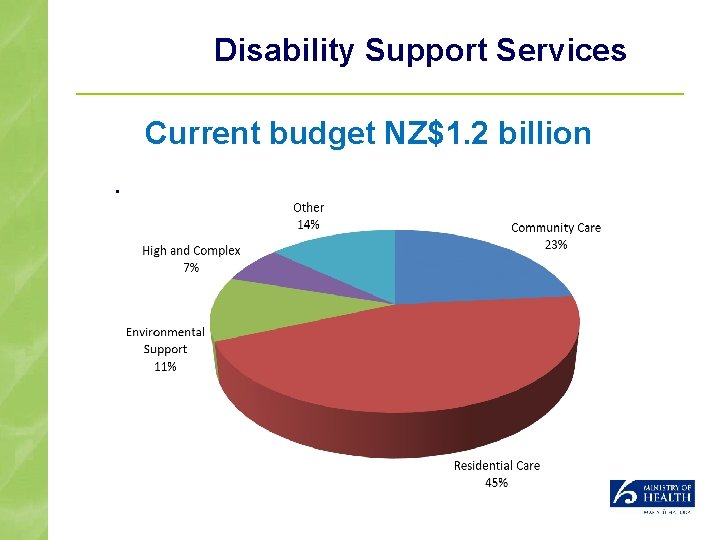
Disability Support Services Current budget NZ$1. 2 billion.
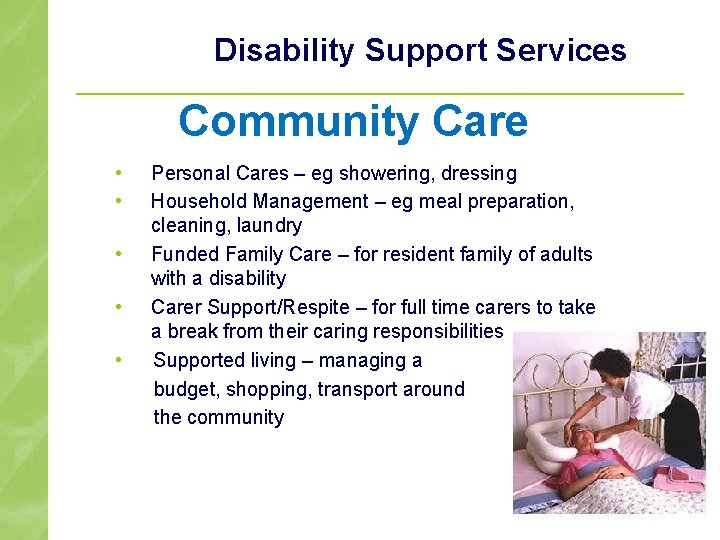
Disability Support Services Community Care • • • Personal Cares – eg showering, dressing Household Management – eg meal preparation, cleaning, laundry Funded Family Care – for resident family of adults with a disability Carer Support/Respite – for full time carers to take a break from their caring responsibilities Supported living – managing a budget, shopping, transport around the community
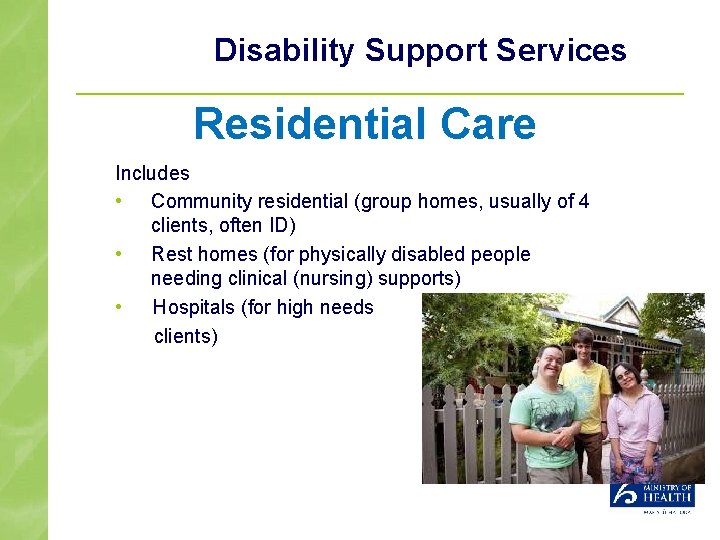
Disability Support Services Residential Care Includes • Community residential (group homes, usually of 4 clients, often ID) • Rest homes (for physically disabled people needing clinical (nursing) supports) • Hospitals (for high needs clients)
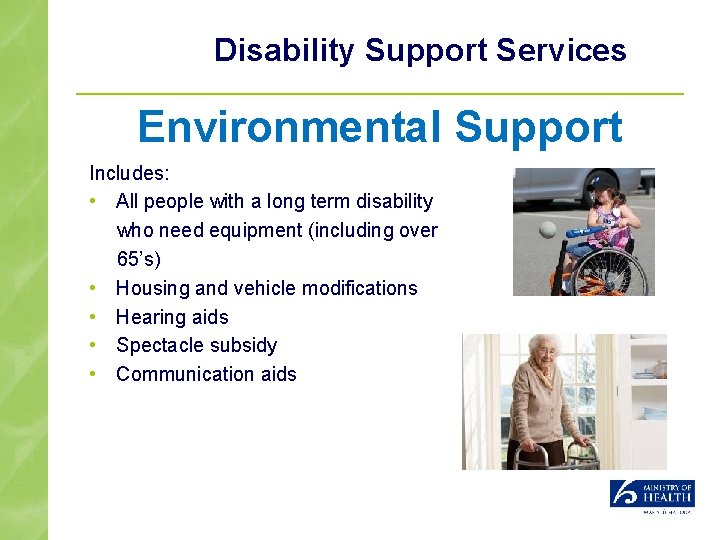
Disability Support Services Environmental Support Includes: • All people with a long term disability who need equipment (including over 65’s) • Housing and vehicle modifications • Hearing aids • Spectacle subsidy • Communication aids
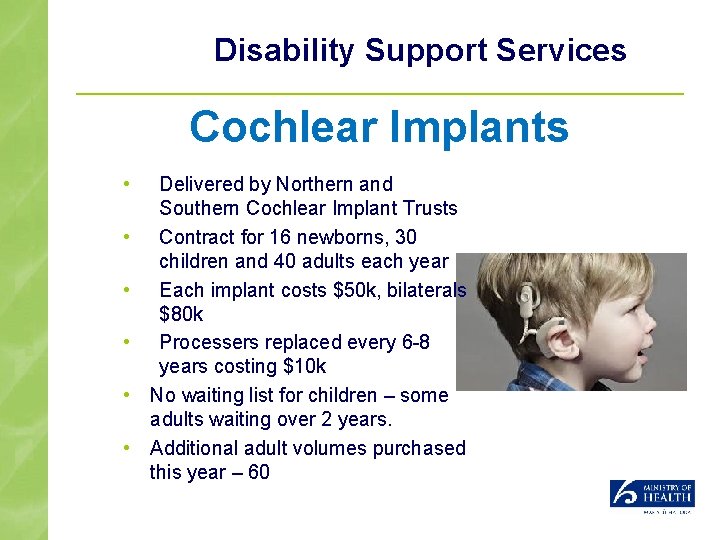
Disability Support Services Cochlear Implants • • • Delivered by Northern and Southern Cochlear Implant Trusts Contract for 16 newborns, 30 children and 40 adults each year Each implant costs $50 k, bilaterals $80 k Processers replaced every 6 -8 years costing $10 k No waiting list for children – some adults waiting over 2 years. Additional adult volumes purchased this year – 60
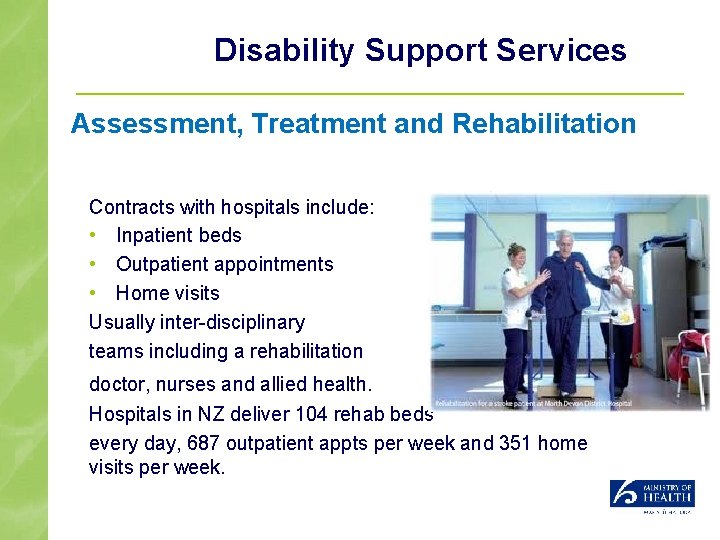
Disability Support Services Assessment, Treatment and Rehabilitation Contracts with hospitals include: • Inpatient beds • Outpatient appointments • Home visits Usually inter-disciplinary teams including a rehabilitation doctor, nurses and allied health. Hospitals in NZ deliver 104 rehab beds every day, 687 outpatient appts per week and 351 home visits per week.
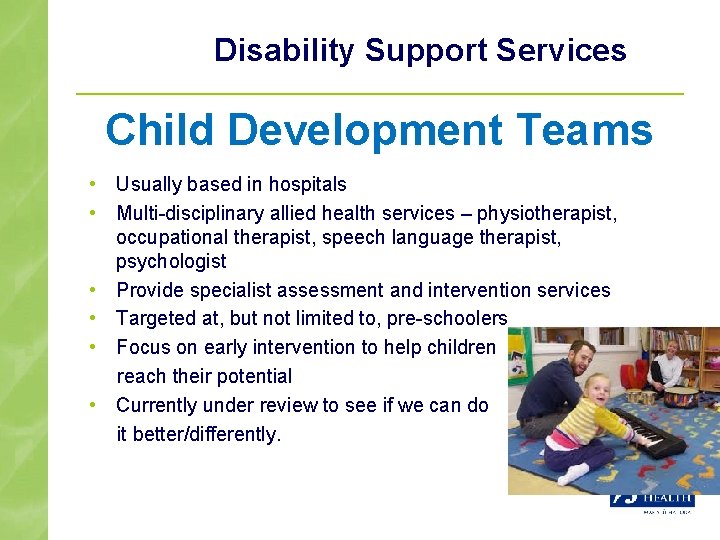
Disability Support Services Child Development Teams • Usually based in hospitals • Multi-disciplinary allied health services – physiotherapist, occupational therapist, speech language therapist, psychologist • Provide specialist assessment and intervention services • Targeted at, but not limited to, pre-schoolers • Focus on early intervention to help children reach their potential • Currently under review to see if we can do it better/differently.
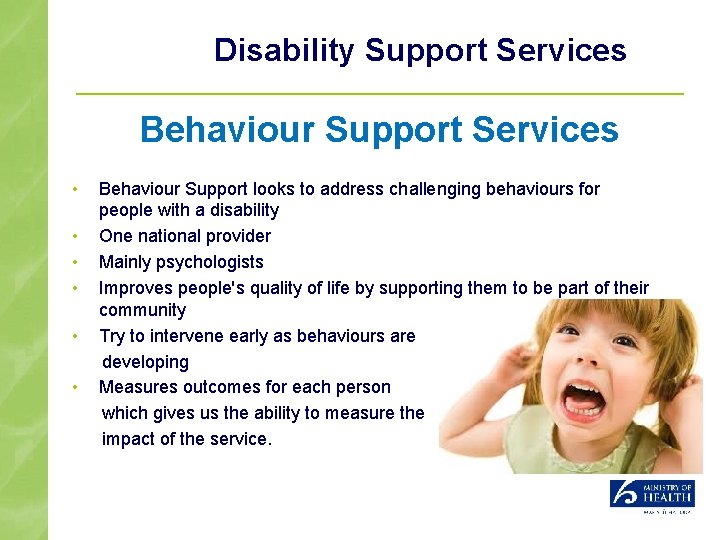
Disability Support Services Behaviour Support Services • • • Behaviour Support looks to address challenging behaviours for people with a disability One national provider Mainly psychologists Improves people's quality of life by supporting them to be part of their community Try to intervene early as behaviours are developing Measures outcomes for each person which gives us the ability to measure the impact of the service.
Disability Support Services Needs Assessment Service Coordination (NASC) agencies • • Identify needs, eligibility to DSS funded services, and outline available supports 15 NASCs across the country by region Undertake needs assessments Coordinate services which includes providing information about options, co-ordinating services within a support plan, and allocating funding
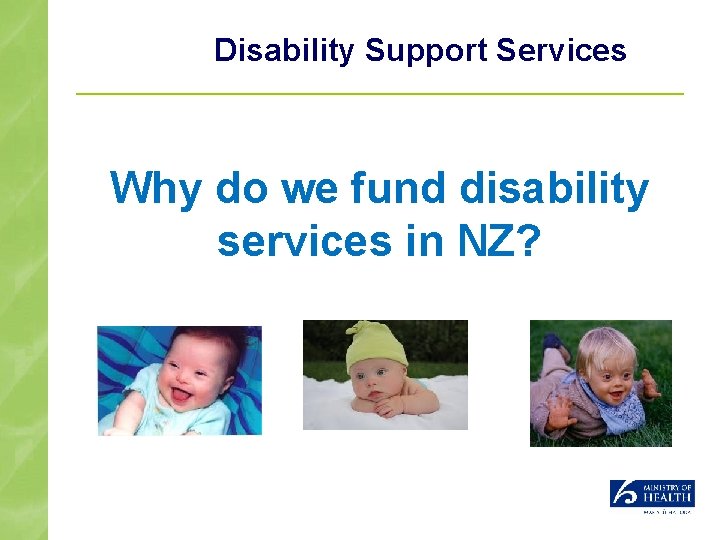
Disability Support Services Why do we fund disability services in NZ?
Disability Support Services Why? Social Policy Select Committee Inquiry 2008 Enabling Good Lives – we want to support people with a disability to have an ordinary, good life in the same way that other New Zealanders do. UN Convention on the Rights of People with a Disability 2008 Disabled people are demanding a good life!
Disability Support Services Enabling Good Lives (EGL) The principles of EGL: » » » » Self-determination Beginning early Person-centred Mainstream first Ordinary Life Outcomes Mana enhancing Easy to use Relationship building
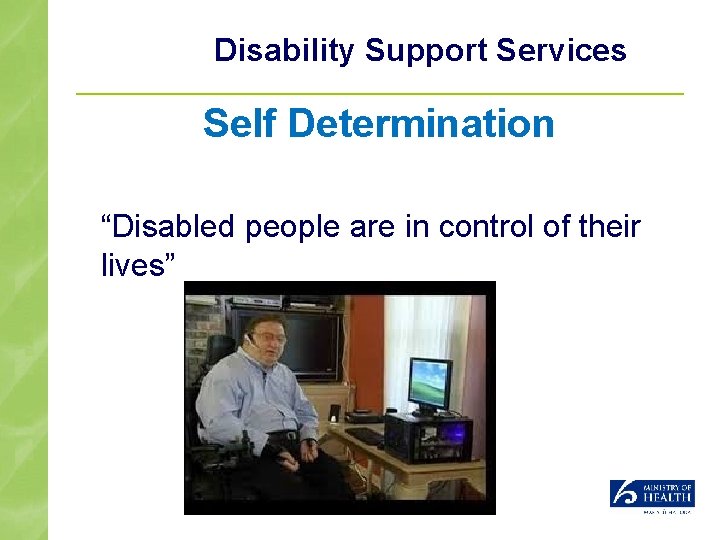
Disability Support Services Self Determination “Disabled people are in control of their lives”
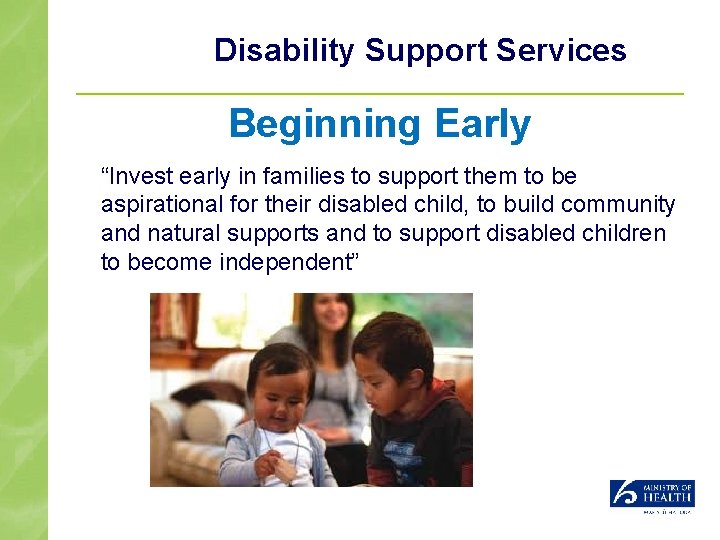
Disability Support Services Beginning Early “Invest early in families to support them to be aspirational for their disabled child, to build community and natural supports and to support disabled children to become independent”
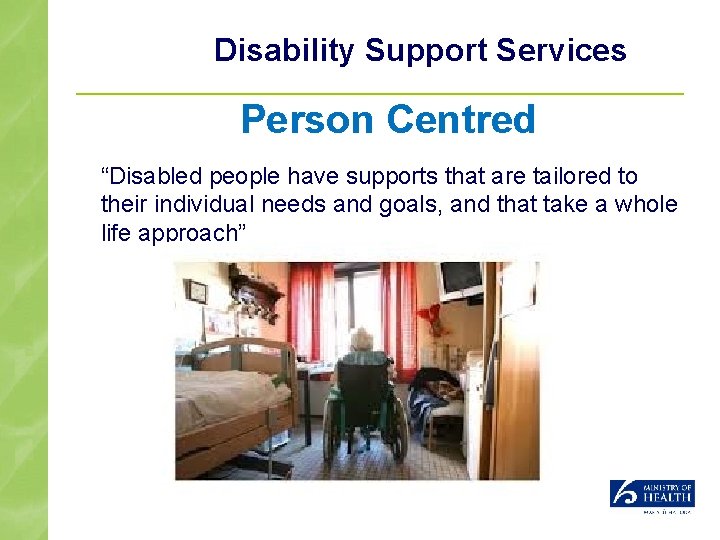
Disability Support Services Person Centred “Disabled people have supports that are tailored to their individual needs and goals, and that take a whole life approach”
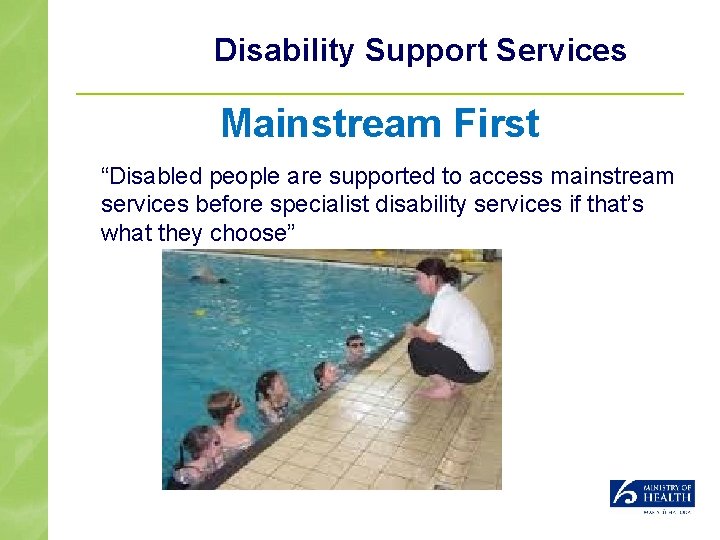
Disability Support Services Mainstream First “Disabled people are supported to access mainstream services before specialist disability services if that’s what they choose”
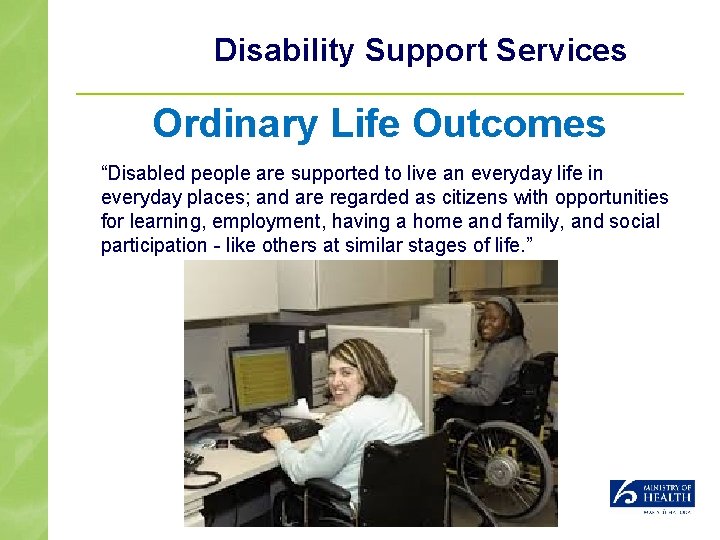
Disability Support Services Ordinary Life Outcomes “Disabled people are supported to live an everyday life in everyday places; and are regarded as citizens with opportunities for learning, employment, having a home and family, and social participation - like others at similar stages of life. ”
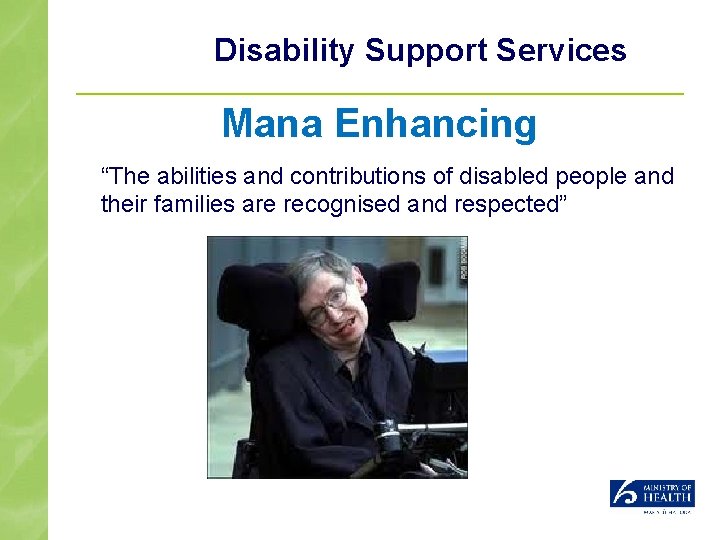
Disability Support Services Mana Enhancing “The abilities and contributions of disabled people and their families are recognised and respected”
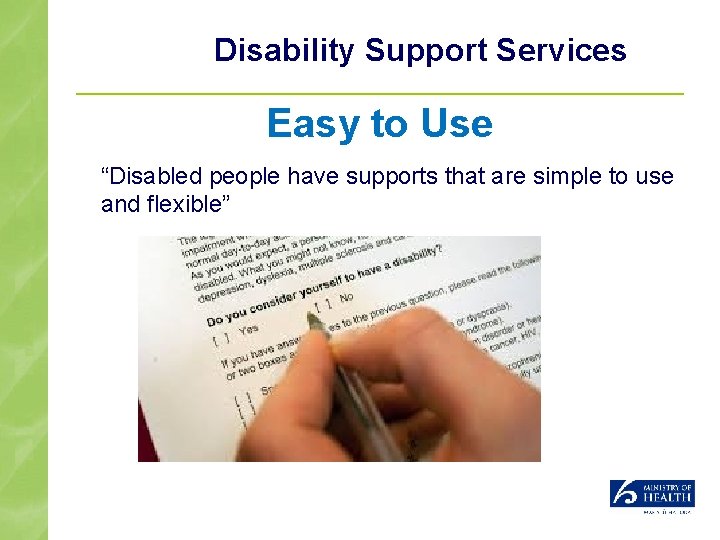
Disability Support Services Easy to Use “Disabled people have supports that are simple to use and flexible”
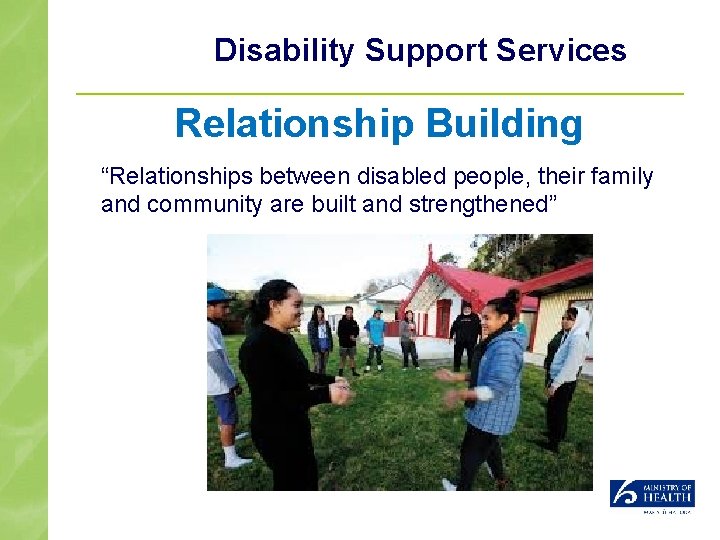
Disability Support Services Relationship Building “Relationships between disabled people, their family and community are built and strengthened”
Disability Support Services What next? – Disability System Transformation
Disability Support Services Thank you Any questions?
- Slides: 26