
DISABILITY SERVICES 101 Critical lenses used in our
DISABILITY SERVICES 101 Critical lenses used in our work
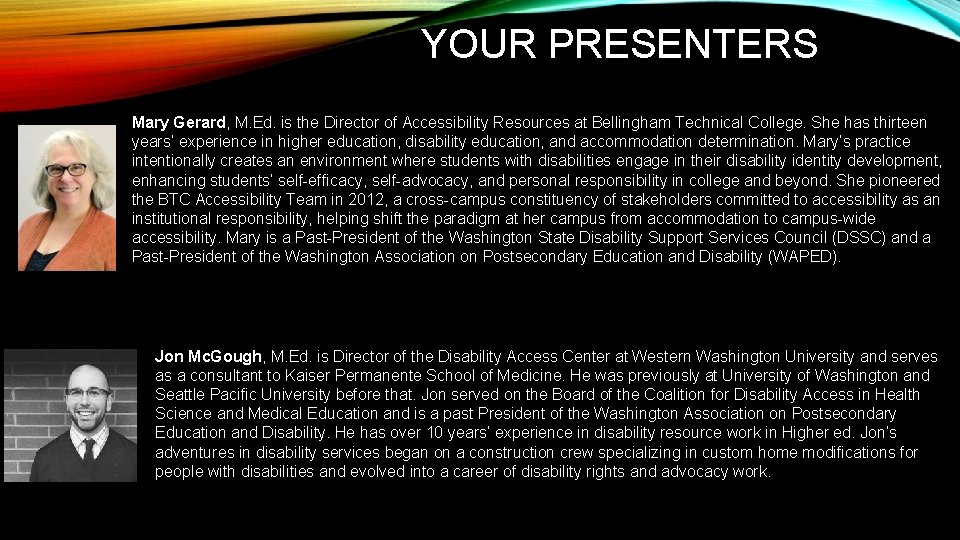
YOUR PRESENTERS Mary Gerard, M. Ed. is the Director of Accessibility Resources at Bellingham Technical College. She has thirteen years’ experience in higher education, disability education, and accommodation determination. Mary’s practice intentionally creates an environment where students with disabilities engage in their disability identity development, enhancing students’ self-efficacy, self-advocacy, and personal responsibility in college and beyond. She pioneered the BTC Accessibility Team in 2012, a cross-campus constituency of stakeholders committed to accessibility as an institutional responsibility, helping shift the paradigm at her campus from accommodation to campus-wide accessibility. Mary is a Past-President of the Washington State Disability Support Services Council (DSSC) and a Past-President of the Washington Association on Postsecondary Education and Disability (WAPED). Jon Mc. Gough, M. Ed. is Director of the Disability Access Center at Western Washington University and serves as a consultant to Kaiser Permanente School of Medicine. He was previously at University of Washington and Seattle Pacific University before that. Jon served on the Board of the Coalition for Disability Access in Health Science and Medical Education and is a past President of the Washington Association on Postsecondary Education and Disability. He has over 10 years’ experience in disability resource work in Higher ed. Jon’s adventures in disability services began on a construction crew specializing in custom home modifications for people with disabilities and evolved into a career of disability rights and advocacy work.
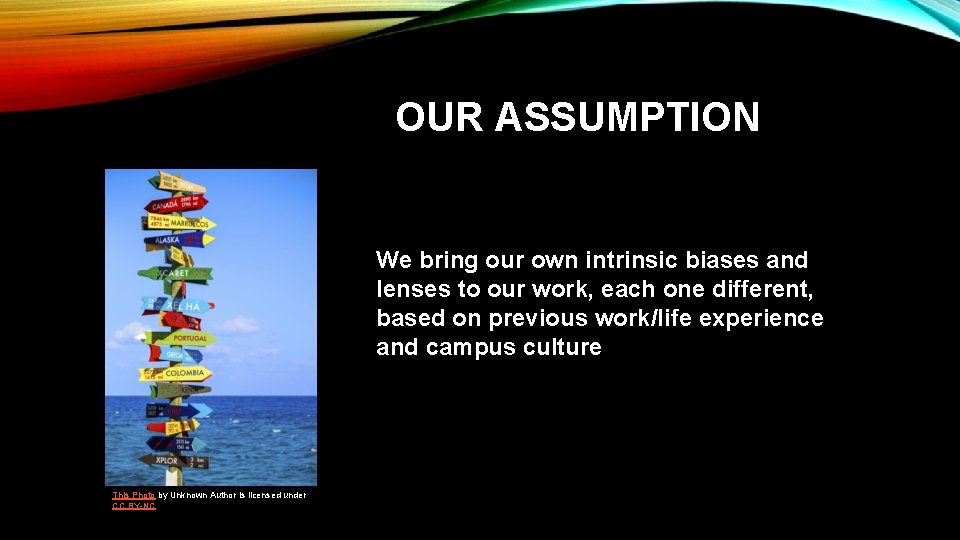
OUR ASSUMPTION We bring our own intrinsic biases and lenses to our work, each one different, based on previous work/life experience and campus culture This Photo by Unknown Author is licensed under CC BY-NC
CRITICAL LENSES • A lens is a metaphor (albeit an imperfect one) to describe how we might view situations differently when considering aspects of our daily work through our diverse backgrounds, areas of study, and cultural experience. • The goal of this presentation is to empower educators to identify the lenses used in their work and consider situations fully through each lens. • There is no one right way to do this, but rather a layered continuum to choose from. • We’re not saying the way we parse situations is the only way. • We want to bring professionals together to engage in conversation beyond: “Here’s a situation, what’s the right answer? ”
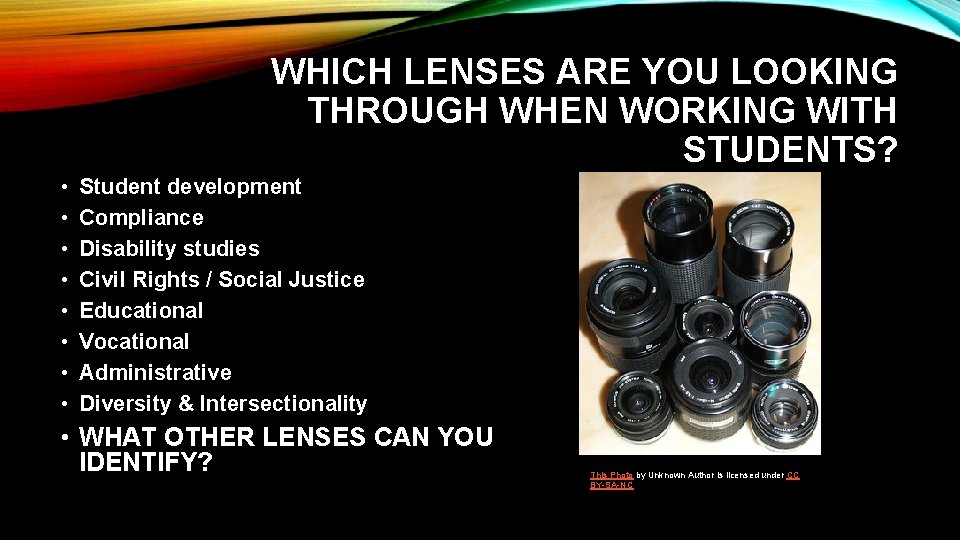
WHICH LENSES ARE YOU LOOKING THROUGH WHEN WORKING WITH STUDENTS? • • Student development Compliance Disability studies Civil Rights / Social Justice Educational Vocational Administrative Diversity & Intersectionality • WHAT OTHER LENSES CAN YOU IDENTIFY? This Photo by Unknown Author is licensed under CC BY-SA-NC
STUDENT DEVELOPMENT LENS Baxter Magolda’s Theory of Self. Authorship “The internal capacity to define one’s beliefs, identity, and social relations”: • How do I know? • Who am I? • How do I want to construct relationships with others? Retrieved from https: //studentdevelopmenttheory. wordpress. com/selfauthorship-and-transitions/ • A student fresh out of high-school, who’s parent advocated for them may not have a lexicon to discuss their disability experience. • Observe the language they use to discuss their educational barriers. • Might there be a way to support the student’s development in terms of disability pride, self-understanding, and self-authorship? • HOW DO EDUCATORS SUPPORT GREATER STUDENT DEVELOPMENT?
STUDENT DEVELOPMENT LENS VALUES • Building relationships • Holding space • Yes, and…. • Excavating
STUDENT DEVELOPMENT LENS ASKS How might a student’s developmental stage inform the information I’m getting and the student’s perception of the situation?
COMPLIANCE LENS • Process is equally as important as outcome. • Our process is: • • Individualized Interactive Involve campus partners Informed by colleagues’ expert advice • Are the approved accommodations REASONABLE* • Meaning they’re not: • An undue fiscal burden • Compromise the safety of others • Fundamental alteration
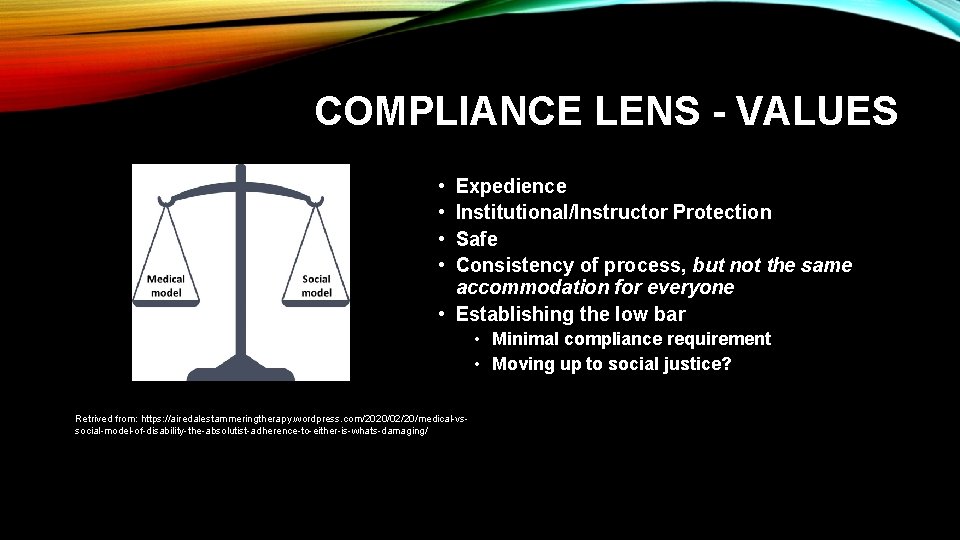
COMPLIANCE LENS - VALUES • • Expedience Institutional/Instructor Protection Safe Consistency of process, but not the same accommodation for everyone • Establishing the low bar • Minimal compliance requirement • Moving up to social justice? Retrived from: https: //airedalestammeringtherapy. wordpress. com/2020/02/20/medical-vssocial-model-of-disability-the-absolutist-adherence-to-either-is-whats-damaging/
THE COMPLIANCE LENS ASKS What Federal, local or state laws/policies might apply to the situation and inform my response?
DISABILITY STUDIES / CIVIL RIGHTS LENS • Disability as a social construct. • Internalized ableism can be a source of shame. • There is a history of marginalization, separation, and civil rights activism that clearly extends to today. • Be mindful of power and privilege dynamics in engaging with students. “It is not individual limitations, of whatever kind, which are the cause of the problem, but society’s failure to provide appropriate services and adequately ensure the needs of disabled people are taken into account in its social organization ~Michael Oliver For more information: https: //www. globalresearch. ca/newpolitics-disablement-mike-oliver/5671034
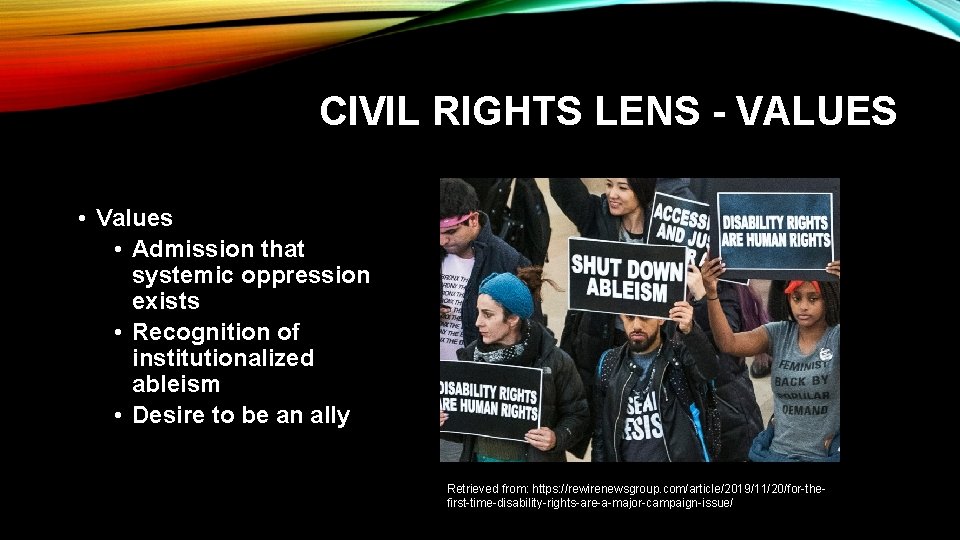
CIVIL RIGHTS LENS - VALUES • Values • Admission that systemic oppression exists • Recognition of institutionalized ableism • Desire to be an ally Retrieved from: https: //rewirenewsgroup. com/article/2019/11/20/for-thefirst-time-disability-rights-are-a-major-campaign-issue/
THE CIVIL RIGHTS LENS ASKS How might systemic oppression and power dynamics be at play in this situation?
EDUCATIONAL LENS Question: What have you gained from partnering with the DS Office? “I am more cognizant of student needs beyond what I assume they are or might be, and I am more proactive about advocating for students. ” – BTC Accessibility Team Instructor • For DS Providers, engaging with faculty requires an awareness of the arduous task of developing curriculum suitable for all learners • For faculty, engaging with DS Providers requires an awareness of the curricular barriers that may unintentionally exist • Identify the right amount of academic challenge – zone of proximal development. • “Access without support is not opportunity” –Vincent Tinto
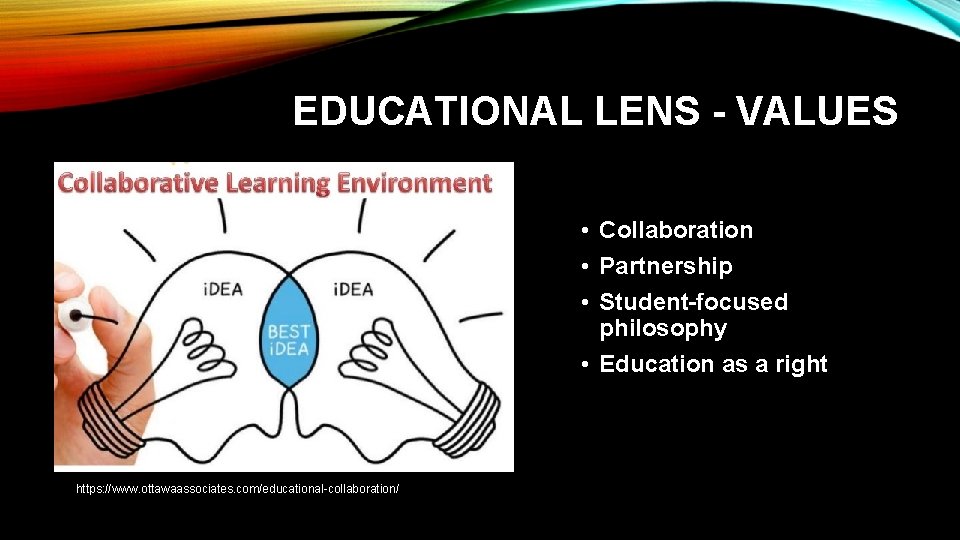
EDUCATIONAL LENS - VALUES • Collaboration • Partnership • Student-focused philosophy • Education as a right https: //www. ottawaassociates. com/educational-collaboration/
THE EDUCATIONAL LENS ASKS What are the curricular/co-curricular goals relevant to the situation and where is the zone of proximal development?
VOCATIONAL LENS • Exploring potential job opportunities and trainings, with self-awareness. • Are we giving the student ample opportunity to explore the intersection of their goals and their disabilities? • Do they understand their vocational path? • Is there an instructor who could provide expertise and help ground the student’s vocational choice? • Look for mentors and leaders to provide motivation and insider knowledge.
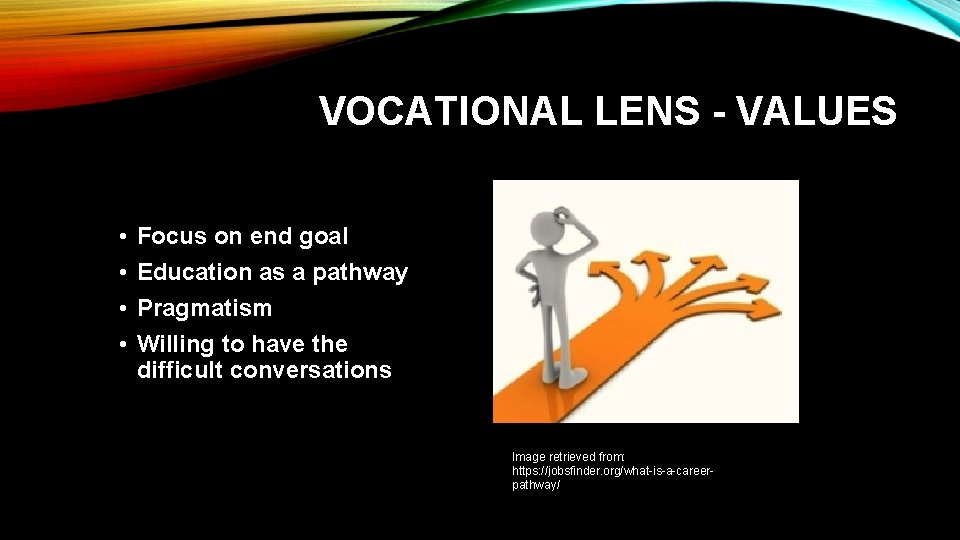
VOCATIONAL LENS - VALUES • • Focus on end goal Education as a pathway Pragmatism Willing to have the difficult conversations Image retrieved from: https: //jobsfinder. org/what-is-a-careerpathway/
THE VOCATIONAL LENS ASKS Is there opportunity to support empowerment and skills useful beyond the educational environment?
ADMINISTRATIVE LENS • Is there active assessment of the retention and graduation rates of students you serve? • Could programming improve those metrics? • What supports do you receive from your administration? • Is there a sense of trust between your office and those in leadership?
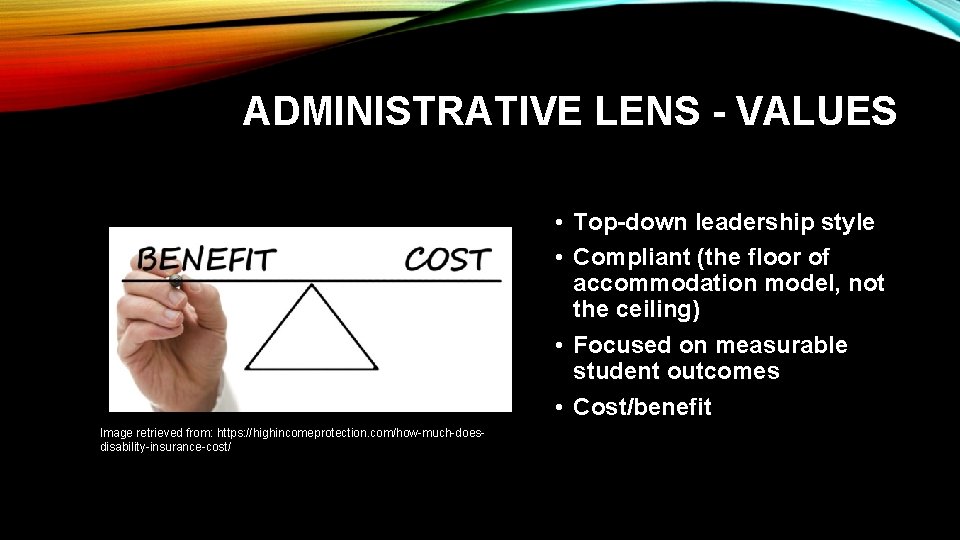
ADMINISTRATIVE LENS - VALUES • Top-down leadership style • Compliant (the floor of accommodation model, not the ceiling) • Focused on measurable student outcomes • Cost/benefit Image retrieved from: https: //highincomeprotection. com/how-much-doesdisability-insurance-cost/
THE ADMINISTRATIVE LENS ASKS How might institutional mission and metrics (ie. graduation, retention) inform decisions?
DIVERSITY/INTERSECTIONALITY LENS • The process to determine accommodations can falsely imply that it’s possible to tease out a students disability experience from other aspects of their identity. • Disabled students have gender identities, sexual orientation, cultural and socioeconomic statuses, to name a few. • These aspects of identities inform experiences. • Processes and implicit bias may include some students and exclude others. • Be conscious and critical that you are prepared to welcome a diverse group of students to your classroom.
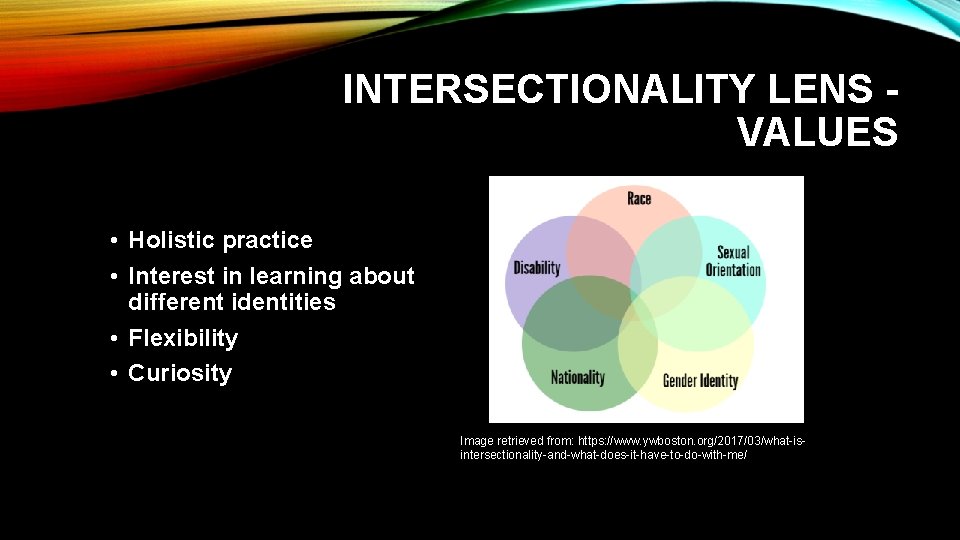
INTERSECTIONALITY LENS VALUES • Holistic practice • Interest in learning about different identities • Flexibility • Curiosity Image retrieved from: https: //www. ywboston. org/2017/03/what-isintersectionality-and-what-does-it-have-to-do-with-me/
THE DIVERSITY/INTERSECTIONALITY LENS ASKS Is a broader understanding of a student’s identity needed to better understand the situation?
OUR PROCESS AND OUR LENSES – HOW DOES ONE INFORM THE OTHER? • Each time we meet with a student, we may need to use a different lens. • You will meet colleagues that tend to use one lens more than another. • Learn from them all!!
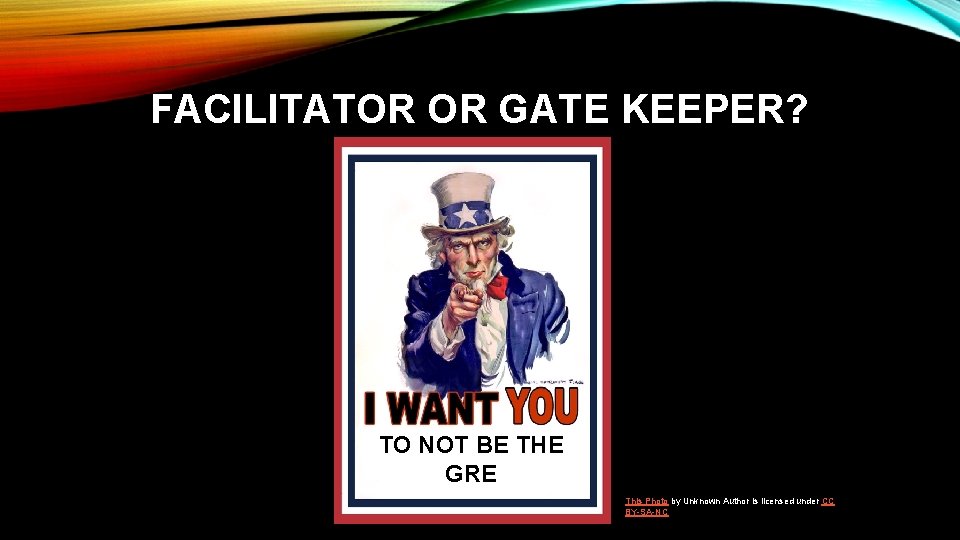
FACILITATOR OR GATE KEEPER? TO NOT BE THE GRE This Photo by Unknown Author is licensed under CC BY-SA-NC
CRITICAL LENSES IN DISABILITY SERVICES • Compliance is a low bar—and it is important! • Accessibility (being ready for the students who show up) requires raising that bar. • Working to build truly inclusive physical, relational and digital spaces requires that we value the unique histories, needs and contributions of students, • Are we mindful of inequitable systems we are a part of? • Are we brave enough to critique them or call out ableism when it occurs? (And it will occur. )
FOR FURTHER DISCUSSION OR QUESTIONS: Mary Gerard, M. Ed. Bellingham Technical College mgerard@btc. edu Jon Mc. Gough, M. Ed. Western Washington University mcgougj@wwu. edu
- Slides: 30