
DISABILITY RIGHTS WISCONSIN VICTIM ADVOCACY PROGRAM Pam Malin
DISABILITY RIGHTS WISCONSIN: VICTIM ADVOCACY PROGRAM • Pam Malin, Advocacy Specialist and VAWA Project Coordinator • Nadya Rosen, Managing Attorney
INTRODUCTION • Pam Malin, Advocacy Specialist and VAWA Project Coordinator: Pam Malin has worked at the intersection of disability and abuse for over 20 years. She is currently working at Disability Rights Wisconsin in the Victim Advocacy Program, as an Advocacy Specialist for the Victims of Crime Act (VOCA) Grant, where she works with victims of crime with disabilities and as the Violence Against Women (VAWA) Healthy and Safe Relationships Project Coordinator. She is passionate about advocating for the rights of victims of crime with disabilities. • Nadya Rosen, Managing Attorney: Nadya Rosen is Managing Attorney of the Victim Advocacy Program at Disability Rights Wisconsin. Nadya has worked with survivors of crime in California, New York, and Wisconsin. Nadya is a graduate of University of California, Santa Cruz and City University of New York School of Law. Nadya is licensed to practice law in New York and Wisconsin. She lives in Madison with her partner and son.
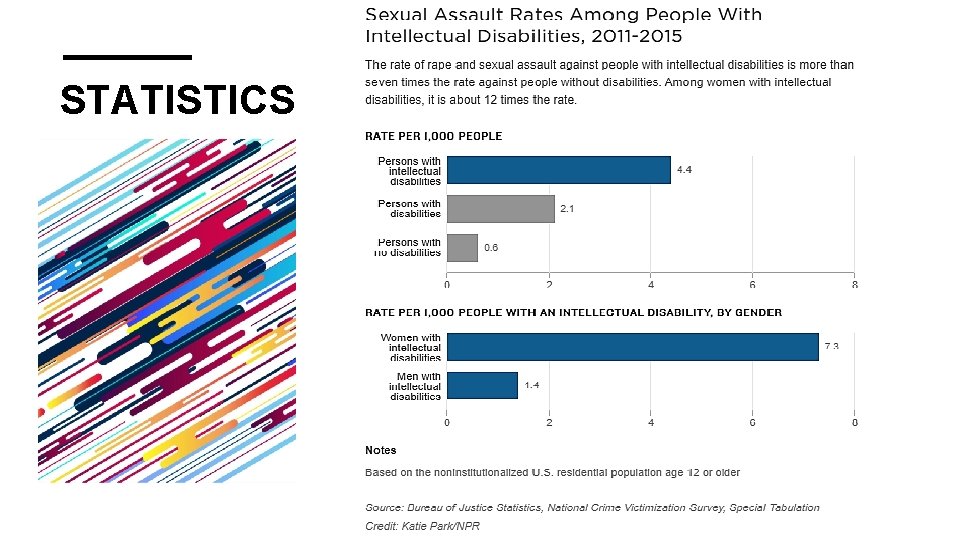
STATISTICS
DRW’S VICTIM ADVOCAC Y PROGRAM VAWA Project: Wisconsin Healthy & Safe Relationships Project OVW-funded project to create healthy relationships curriculum for people with intellectual and developmental disabilities. Curriculum will be cotaught by DRW staff and trained self advocates. Partners on the project: • Board for People with Developmental Disabilities • The Arc – Wisconsin • People First Wisconsin • End Domestic Abuse Wisconsin (statewide coalition) • Wisconsin Coalition Against Sexual Assault (statewide coalition)

DRW’S VICTIM ADVOCACY PROGRAM VOCA Project Victim of Crime Act-funded project that provides direct victim services to people with disabilities of any age who experienced crime, regardless of whether it has been reported. Advocacy Specialists and Attorneys work with survivors post-victimization to receive the advocacy, services, and support that is desired to move forward, find justice, and obtain safety and stability in whatever form the victim/survivor needs. • Victim Accompaniment • Criminal Justice Support (Law Proceedings (Custody, Enforcement, Courts) Divorce, Restraining Orders) • Representation in Civil • Crime Victim Rights Enforcement • Crime Victim Compensation • Housing Rights • School Advocacy • Access to Services (Criminal • Employment Victim Related Justice, Victim Services, Disability Services) Supports • Safety Planning
VITAL PARTNERSHIPS Both of our projects depend on working with partners to meet the wide variety of needs that survivors with disabilities present. Those partners include • Local domestic violence and sexual assault support agencies and statewide coalitions • Disability service providers (including MCOs, direct service providers, guardians, etc. ) • State/government agencies • BPDD (DD council) • Adult Protective Services • Wisconsin Department of Justice (Attorney General’s office)
CLIENT EXAMPLE #1 • CK is a 30 -year-old African American woman with an intellectual disability and mental health disability. CK has lived in a supported apartment for over 10 years, has a behavioral specialist and a mental health provider, and is an avid basketball player. • At age 16, CK disclosed that she was being sexually assaulted by her stepfather. The disclosure and subsequent doctor’s visit for a rape kit triggered CK and she was placed in a state mental health facility. Upon her release, CK recanted and denied any assaults. • At 18, CK’s mother became her guardian and CK moved to an independent apartment in the community. She began therapy and talking again about the sexual abuse. Her mother continued to deny that the abuse occurred. • By the time CK was 25, her mother stopped visiting her or speaking with her on the telephone. Her mother continued to be her legal guardian. CK was worried that at any moment, her mother might change her providers, her living situation, or withhold money from her. She began to talk to providers about obtaining a new guardian. Working with her providers, CK identified another individual willing to be her guardian.
CLIENT EXAMPLE #1 CONTINUE D • CK’s behavioral specialist reached out to DRW and asked if we could assist her in obtaining a new guardian. We agreed to file a petition on CK’s behalf, arguing that the guardian’s behavior should be examined as she was not acting in CK’s best interests. • Adult Protective Services refused to support CK’s petition because the guardian herself had not physically or financially harmed the ward. • DRW reached out directly to the guardian who refused to sign releases for us to speak with CK’s providers. DRW made a motion to the court to compel the guardian to sign, which was granted. • Before trial, the guardian relinquished guardianship which allowed the new guardian to be appointed. In court, CK was able to talk openly about her fears and to thank the judge for helping her obtain a better guardian. CK felt supported and validated by this process.
CLIENT EXAMPLE #2 (PART 1) • AM is a 27 -year-old white male with an intellectual disability, who requires 24 -hour staff for ADL and Safety needs. AM lives in a 4 -bed licensed CBRF. He attends a Day Program 5 days a week. • It was reported to APS by AM’s day program staff that AM has a distinct odor of feces. The staff noticed that something resembling feces was on the brim of AM’s baseball cap. The staff asked AM what was on his hat, and he responded that it was “Poop from his bucket. ” He then told staff that it’s the bucket he used in his room in the basement because he is locked in at night.
CLIENT EXAMPLE #2 (PART 2) • APS, contacted police, who paid a short visit to the residence, but barely walked in the door to investigate. • APS went to the residence and demanded to go downstairs and found deplorable conditions, that substantiated AM’s report. Again, APS asked the police to step in, but they declined stating that this wasn’t going to turn into anything. • APS contacted DRW Victim Advocacy Program. • An advocate from the program talked with the county prosecutor, who said he would make a call. • An interview was set up at the local Child Advocacy Center for AM, where he was interviewed by a forensically trained interviewer.
CLIENT EXAMPLE #2 (PART 3) • AM disclosed his abuse and made reference to other questionable activity happening at the home. • It was discovered that the owner had 2 licensed homes but all 8 of the residents from the 2 homes were being housed in the one home. • The advocate pushed for law enforcement to interview the other 7 residents living at the home. • It was also discovered that there was very little food available, very little supervision, and a variety of illegal activity going on. • The other 7 residents were interview with the advocate there to support them and keep guardians informed.
CLIENT EXAMPLE #2 (PART 4) • The case was sent to DOJ to the Attorney General’s Office. • The AG requested banking records and other paperwork. • After more than 3 years the case was finally charged. • 1 Felony - Intentional. Abuse Patients in Licensed Facility to Cause Bodily Harm • 4 Felony - Fraud Charges • 1 Felony - Fail/File Income Tax Return • 1 Felony - MA-Fail/Notify Circumstances • Still active in court • This case was only taken seriously due to an ongoing effort to build trusted relationships through collaboration.
THANK YOU Disability Rights Wisconsin https: //disabilityrightswi. org/ Victim Advocacy Program https: //disabilityrightswi. org/program/victim-advocacy-program/ Nadya Rosen, Managing Attorney 608 -308 -2650 Voice 608 -267 -0368 Fax 800 -928 -8778 Intake nrosen@drwi. org Email Pam Malin, Advocacy Specialist and VAWA Project Coordinator 608 -308 -2650 Voice 608 -267 -0368 Fax 800 -928 -8778 Intake pamm@drwi. org Email
- Slides: 13