
Disability Briefing November 2013 Definition of Disability Equality
Disability Briefing November 2013
Definition of Disability – Equality Act A person is disabled if they have a physical or mental impairment which has a substantial and long-term adverse effect on their ability to carry out normal day-to-day activities
Definition… ‘physical or mental impairment’ • A physical impairment is a condition affecting the body – sight or hearing loss, a mobility difficulty or a health condition. • A mental impairment is a condition affecting ‘mental functioning’ – for example a learning disability or mental health condition such as bipolar disorder.
Definition… ‘substantial’ When carrying out day-to-day tasks, does your condition make them more difficult in terms of: • time taken; • the way in which an activity is carried out; or • the overall cumulative effect if the effects of more than one activity are taken together? If changing your behaviour reduces the negative effects, then you may not be covered by the Act. But changes do not have to be major. For example, a person with a stutter does not have to avoid going to places where they might meet people. This change could itself have an adverse effect on your day-to-day activities.
Case Studies. . . 1. A ten-year-old child has cerebral palsy. The effects include muscle stiffness, poor balance and unco-ordinated movements. The child is still able to do most things for herself, but she gets tired very easily and takes longer to accomplish tasks like eating and drinking, washing, and getting dressed. Is she protected by the Act? 2. A person who has obsessive compulsive disorder (OCD) constantly checks and rechecks that electrical appliances are switched off and that the doors are locked when leaving home. Is this person protected by the Act? 3. A man with depression experiences a range of symptoms that include a loss of energy and motivation that makes even the simplest of tasks or decisions seem quite difficult. He finds it difficult to get up in the morning, get washed and dressed, and prepare breakfast. He is forgetful and cannot plan ahead. As a result he has often run out of food before he thinks of going shopping again. Household tasks are frequently left undone, or take much longer to complete than normal. Is he protected by the Act?
Definition… ‘long term’ • Long-term means that an effect of the impairment has lasted, or is likely to last, 12 months or more from the onset, or for the rest of your life. • The effects of some conditions come and go. However, if the adverse effects are more likely than not to happen again, then the effect is treated as continuing.
Case Studies. . . 1. A woman has two discrete episodes of depression within a tenmonth period. In month one she loses her job and has a period of depression lasting six weeks. In month nine she experiences a bereavement and has a further episode of depression lasting eight weeks. Is she protected by the Act? 2. A person has Menières Disease. This results in his experiencing mild tinnitus at times, which does not adversely affect his ability to carry out normal day-to-day activities. However, it also causes temporary periods of significant hearing loss every few months. The hearing loss substantially and adversely affects his ability to conduct conversations or listen to the radio or television. Is he protected by the Act?
Definition… ‘day to day activities’ These are defined as involving any of the following: • mobility – eg: going out of doors by yourself, using public transport; • doing something with your hands - eg: cannot use a knife and fork at the same time, or use a keyboard quickly; • physical coordination – eg: difficult to pour liquid between containers or to put food in your mouth without unusual concentration or assistance; • continence; • ability to lift, carry or move everyday objects; • speech, hearing or eyesight – eg: it takes you a lot longer to speak, difficulty hearing someone talking at a level normal (without a device if normally used), if, even with glasses or contact lenses, you have difficulty recognising a known person across a medium-size room; • memory or ability to concentrate, learn or understand – eg: random loss of consciousness and confused behaviour or big problems following a short sequence such as a cooking recipe; or • perception of the risk of physical danger – eg: persistent difficulty crossing the road safely or if you do not eat when you need to.
Case Studies. . . 1. A watch repairer carries out delicate work with highly specialised tools. He develops tenosynovitis. This restricts his ability to carry out delicate work though he is able to carry out activities such as general household repairs using more substantial tools. Is he protected by the Act? 2. The work of the watch repairer referred to above also includes preparing invoices and counting and recording daily takings. The effects of his tenosynovitis increase in severity over time resulting in greater restriction of movement in his hands. Is he protected by the Act?
Definition… impairments and conditions covered The definition includes: sensory impairments, impairments with fluctuating or recurring effects, progressive, organ specific, developmental, learning difficulties, mental health conditions and mental illnesses, produced by injury to the body or brain. People with cancer, multiple sclerosis or HIV infection are all now deemed to be disabled from the point of diagnosis.
Case Studies. . . 1. A young boy aged 8 has been experiencing muscle cramps and some weakness. The effects are quite minor at present, but he has been diagnosed as having muscular dystrophy (which can result in effects on his ability to walk, run and climb stairs). Is he protected by the Act? 2. A person experiences, over a long period, adverse effects arising from a lung infection and then a leg injury. Is this person covered by the Act?
Definition… ‘impairment’ An impairment is the limitation of a person’s physical, mental or sensory function on a long-term basis. Disability is often the result of an impairment.
Medical Model of Disability Identifies disability as the result of a physical condition intrinsic to the individual (part of that individual’s own body). Curing or managing disability depends on identifying it clinically, understanding it, and learning to control it. A ‘compassionate’ or just society should invest resources in health care to try and cure disabilities medically, to improve functioning, and to allow disabled people a more ‘normal’ life. The medical profession's responsibility is central. The medical model focuses on the individual's limitations and ways to reduce those impairments or using adaptive technology to adapt them to society.
Criticism of the Medical Model Disability rights groups often argue it: • Excessively misdirects resources towards an almost-exclusively medical focus, when adaptation of the disabled person's environment might be more beneficial to the society at large; • Promotes a pitiable, essentially negative, largely disempowered image of disabled people, rather than casting disability as a political, social and environmental problem.
The Social Model of Disability Identifies systemic barriers, negative attitudes and exclusion by society (deliberately or not) that mean society is the main factor in disabling people. While physical, sensory, intellectual, or psychological variations may cause individual functional limitation or impairments, these do not have to lead to disability unless society fails to take account of and include people regardless of their individual differences.
Types of Discrimination (1) Direct discrimination is where a person is treated less favourably than someone else because of their disability • Discrimination by association: eg: carers, parents, partners, children • Discrimination by perception: if someone discriminates against you because they think you are disabled. . . even if you’re not.
Types of Discrimination (2) Discrimination arising from disability - where the reason for unfavourable treatment is not the disability itself, but something that arises in consequence of the disability. • Eg: a person is turned away from an interview at a Job Centre because he is swearing. However, his swearing is the result of having Tourette syndrome. Only where employer/service provider knows or could reasonably be expected to know that the person is disabled. A service provider can justify the way they treated a disabled person if there was a good reason for it and the action they took was reasonable.
Types of Discrimination (3) Indirect discrimination - a practice or arrangement which appears to be neutral and nondiscriminatory which in fact puts a disabled person at a particular disadvantage compared to people who are not disabled. • Eg: an advice centre will only provide advice to people who visit their centre and not by telephone or email. This is likely to disadvantage people who have a mental health condition like agoraphobia as they are unable to travel to the centre. It may be justifiable if it is a proportionate way of achieving a legitimate aim.
Case Studies. . . 1. Four years ago, a woman experienced a mental illness that had a substantial and long-term adverse effect on her ability to carry out normal day-to-day activities, so it met the Act’s definition of disability. She has experienced no recurrence of the condition. Is she protected by the Act? 2. A man has Asperger’s syndrome, a form of autism. He finds it hard to understand non-verbal communications such as facial expressions, and non-factual communication such as jokes. He takes everything that is said very literally. He is given verbal instructions one day during office banter with his manager, but fails to implement them, resulting in disciplinary procedures. Is he protected by the Act?
Case Studies. . . 1. A woman has an operation to remove the colon because of progressing and uncontrollable ulcerative colitis. The operation results in her no longer experiencing adverse effects from the colitis. She requires a colostomy, however, which means that her bowel actions can only be controlled by a sanitary appliance. Is she protected by the Act? 2. A man has significant scarring to his face as a result of a bonfire accident. He uses skin camouflage to cover the scars. Does he need to take actions like avoiding large crowds and bright lights including public transport and supermarkets to be protected by the Act?
Reasonable adjustments (1) Organisations providing a service or performing a public function must consider making reasonable adjustments to ensure that a disabled person can use services as closely as it is reasonably possible to get to the standard usually offered to non-disabled people.
Reasonable adjustments (2) This may mean: • changing the way services are delivered or functions are performed, and/or; • providing extra equipment (ie: induction loop or extra staff assistance), and/or; • removing, altering or avoiding physical barriers. The duty is ‘anticipatory’: we should not wait until a disabled person wants to use our services before considering the changes to make. What is reasonable depends on all the circumstances including: • the type of service it provides • the size of the organisation and what resources it has • the effect that the change would actually have on the disabled person. If ’reasonable adjustments’ are identified, then we must make them.
What kinds of reasonable adjustments do you make? What further adjustments could you make?
Language • The language we use has an enormous impact on the way in which disabled people are perceived. • If in doubt what to say, please ask. If you respect disabled people as individuals (not a collection of medical labels) you won't go far wrong.
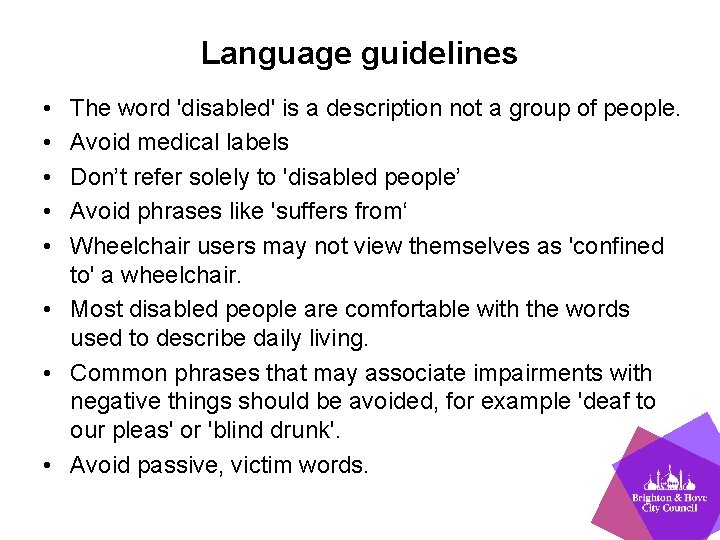
Language guidelines • • • The word 'disabled' is a description not a group of people. Avoid medical labels Don’t refer solely to 'disabled people’ Avoid phrases like 'suffers from‘ Wheelchair users may not view themselves as 'confined to' a wheelchair. • Most disabled people are comfortable with the words used to describe daily living. • Common phrases that may associate impairments with negative things should be avoided, for example 'deaf to our pleas' or 'blind drunk'. • Avoid passive, victim words.
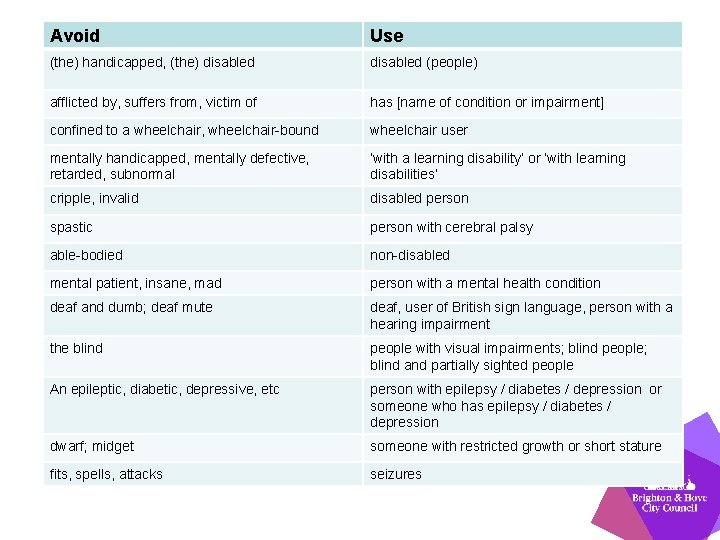
Avoid Use (the) handicapped, (the) disabled (people) afflicted by, suffers from, victim of has [name of condition or impairment] confined to a wheelchair, wheelchair-bound wheelchair user mentally handicapped, mentally defective, retarded, subnormal ‘with a learning disability’ or ‘with learning disabilities’ cripple, invalid disabled person spastic person with cerebral palsy able-bodied non-disabled mental patient, insane, mad person with a mental health condition deaf and dumb; deaf mute deaf, user of British sign language, person with a hearing impairment the blind people with visual impairments; blind people; blind and partially sighted people An epileptic, diabetic, depressive, etc person with epilepsy / diabetes / depression or someone who has epilepsy / diabetes / depression dwarf; midget someone with restricted growth or short stature fits, spells, attacks seizures
- Slides: 26