
Disability Awareness and Etiquette Course Objectives To provide
Disability Awareness and Etiquette
Course Objectives Ø To provide basic information about some common types of disabilities and the protections granted by the ADA Ø To understand some basic barriers Ø To understand appropriate disability language and basic etiquette concepts Ø To develop skills that will help staff interact and work with people with disabilities 2

What is a DISABILITY? Physical or Mental Impairment Substantially limits one or more major life activities ADA DEFINITION Record of such an impairment Regarded as having such an impairment 5
What is a MAJOR LIFE ACTIVITY? • Major Life Activities include, but are not limited to: – Hearing - Reading – Learning - Seeing – Thinking - Speaking – Communicating - Breathing – Sleeping - Walking – Working - Eating – Caring for one’s self • It also includes the operation of a Major Bodily Function, including but not limited to functions of the following systems: – Immune – Normal cell growth – Digestive – Neurological – Respiratory – Circulatory – Endocrine – Reproductive 6
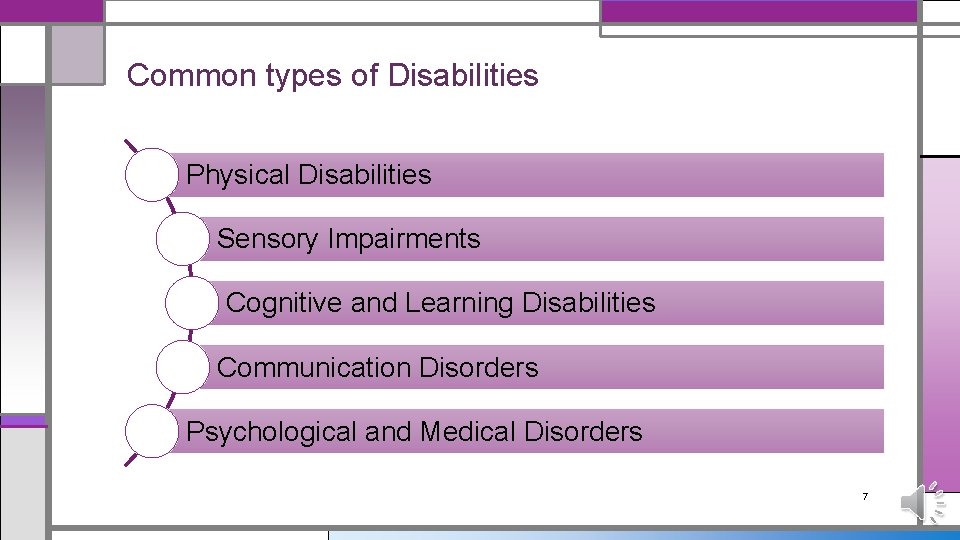
Common types of Disabilities Physical Disabilities Sensory Impairments Cognitive and Learning Disabilities Communication Disorders Psychological and Medical Disorders 7
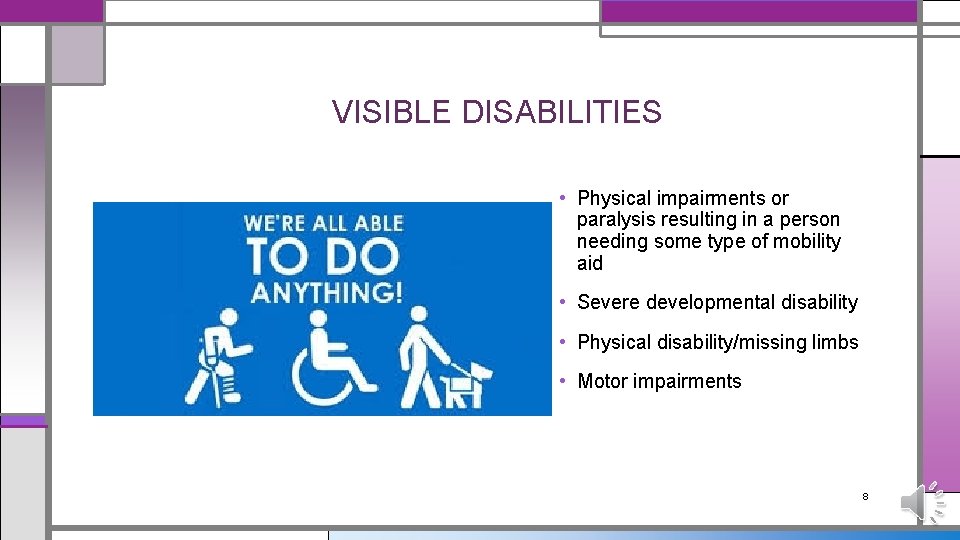
VISIBLE DISABILITIES • Physical impairments or paralysis resulting in a person needing some type of mobility aid • Severe developmental disability • Physical disability/missing limbs • Motor impairments 8
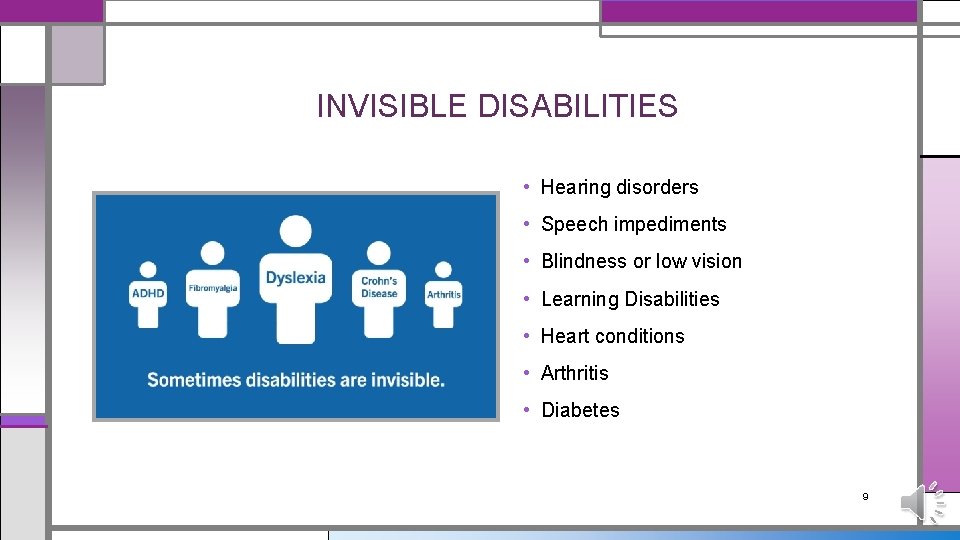
INVISIBLE DISABILITIES • Hearing disorders • Speech impediments • Blindness or low vision • Learning Disabilities • Heart conditions • Arthritis • Diabetes 9
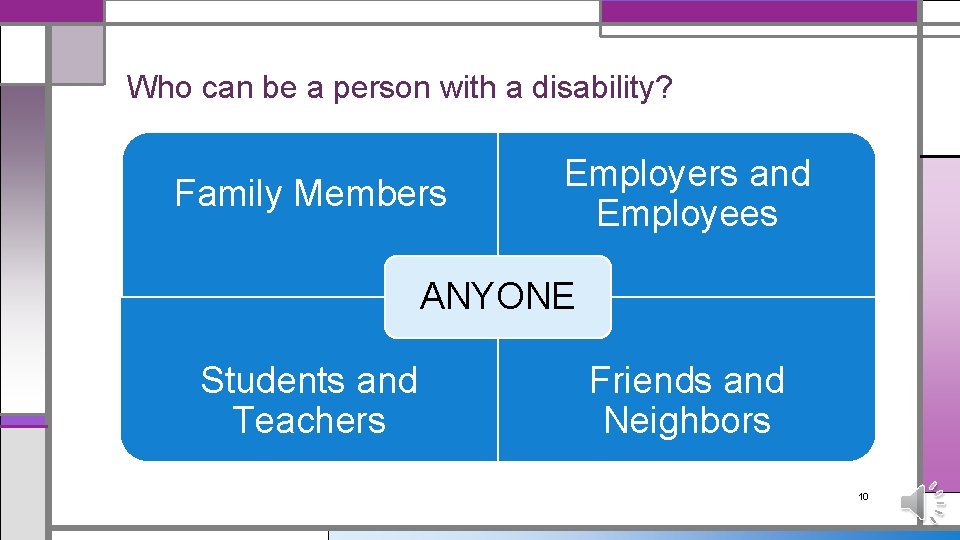
Who can be a person with a disability? Family Members Employers and Employees ANYONE Students and Teachers Friends and Neighbors 10
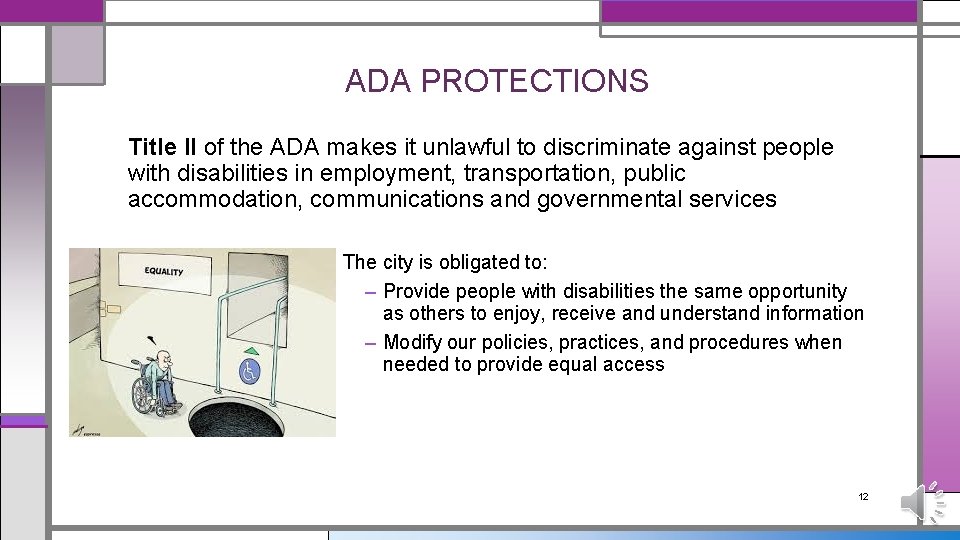
ADA PROTECTIONS Title II of the ADA makes it unlawful to discriminate against people with disabilities in employment, transportation, public accommodation, communications and governmental services The city is obligated to: – Provide people with disabilities the same opportunity as others to enjoy, receive and understand information – Modify our policies, practices, and procedures when needed to provide equal access 12
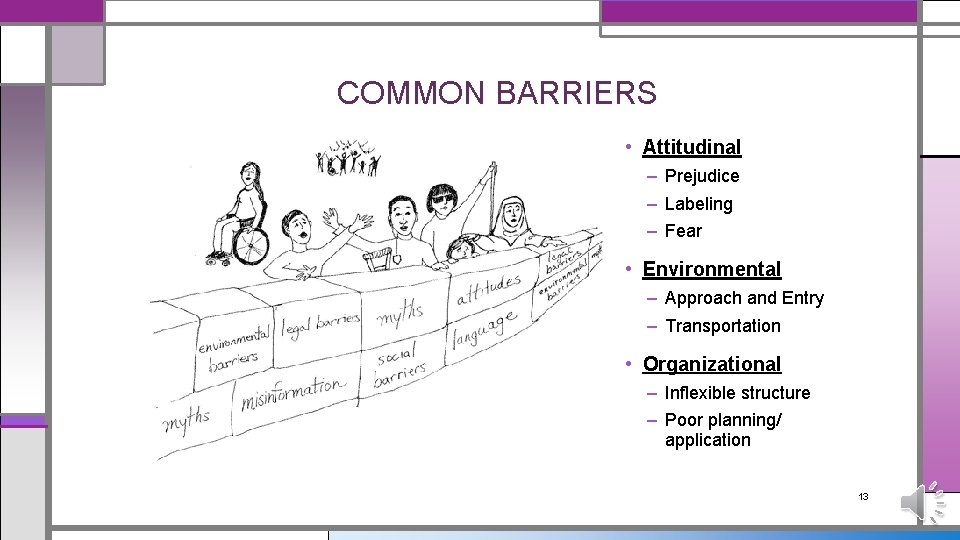
COMMON BARRIERS • Attitudinal – Prejudice – Labeling – Fear • Environmental – Approach and Entry – Transportation • Organizational – Inflexible structure – Poor planning/ application 13
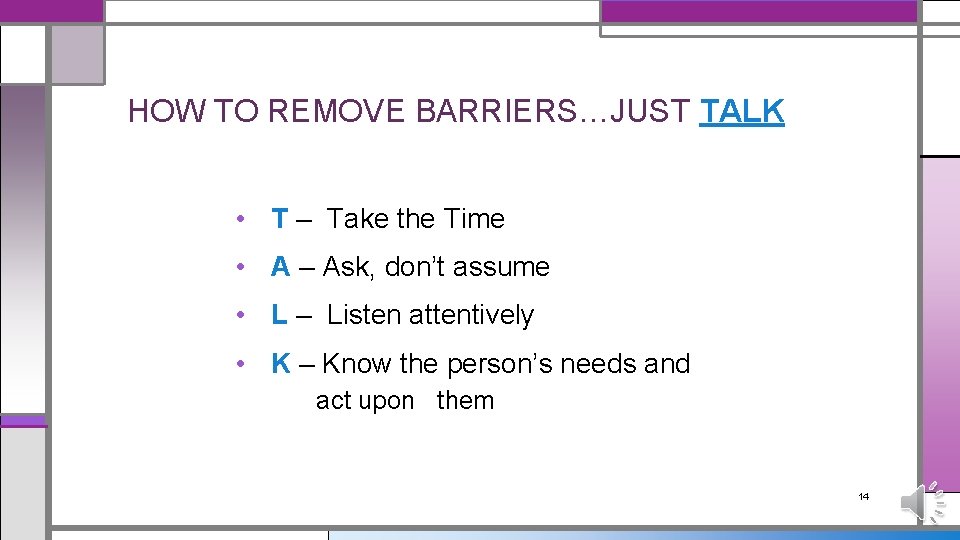
HOW TO REMOVE BARRIERS…JUST TALK • T – Take the Time • A – Ask, don’t assume • L – Listen attentively • K – Know the person’s needs and act upon them 14
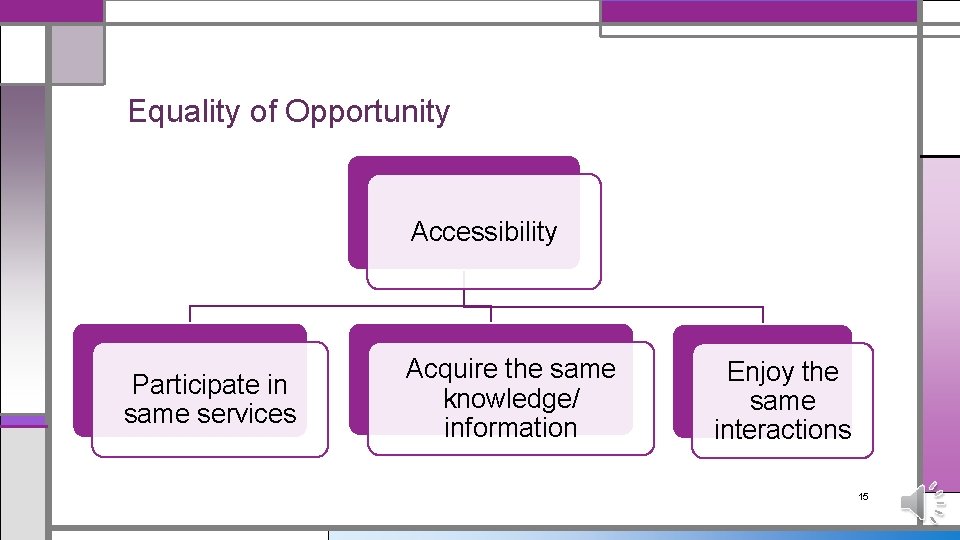
Equality of Opportunity Accessibility Participate in same services Acquire the same knowledge/ information Enjoy the same interactions 15
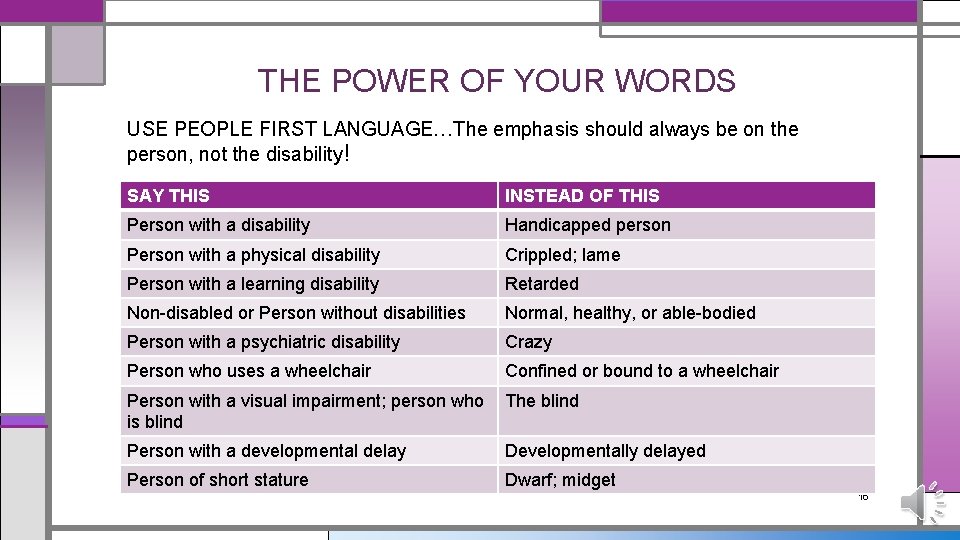
THE POWER OF YOUR WORDS USE PEOPLE FIRST LANGUAGE…The emphasis should always be on the person, not the disability! SAY THIS INSTEAD OF THIS Person with a disability Handicapped person Person with a physical disability Crippled; lame Person with a learning disability Retarded Non-disabled or Person without disabilities Normal, healthy, or able-bodied Person with a psychiatric disability Crazy Person who uses a wheelchair Confined or bound to a wheelchair Person with a visual impairment; person who is blind The blind Person with a developmental delay Developmentally delayed Person of short stature Dwarf; midget 16
How to Interact with People with Disabilities • Use Common Courtesy! – Common sense • Empathy, not sympathy • Understand that every person is unique and has different needs • Be Respectful – Basic Sensitivity • Listen Carefully • Do Not Assume • Act upon what you are told, not on your assumptions 17
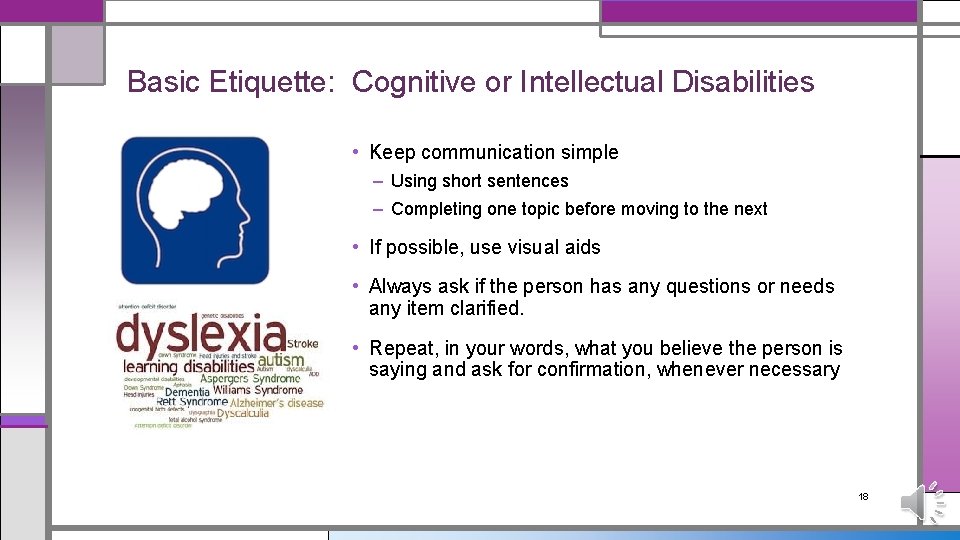
Basic Etiquette: Cognitive or Intellectual Disabilities • Keep communication simple – Using short sentences – Completing one topic before moving to the next • If possible, use visual aids • Always ask if the person has any questions or needs any item clarified. • Repeat, in your words, what you believe the person is saying and ask for confirmation, whenever necessary 18
Basic Etiquette: Hearing disability • Hearing disability refers to both persons who are hard of hearing and persons who are deaf • ASK what method of communication is preferred • Not all persons who are deaf use sign language • Not all persons who are deaf read and write • If an interpreter is used, address the person not the interpreter • If the person reads lips, speak normally (no exaggerated pronunciations). Short sentences are best • Let them know if you are going – you will not be heard leaving the room 19
Basic Etiquette: Low Vision or Blindness • Immediately greet them when they enter a room • Address them by name in a conversation so they know you are talking to them • Speak in a normal tone and speed of voice • Answer all questions verbally instead of with gestures or body language • Direct your conversation to the person rather than to someone who may be assisting them • Give specific directions. Do not say “It is over there, ” it is better to say, “It is about ten steps to your left. ” • You may offer your arm/shoulder, if they need guidance but NEVER grab their arm to guide them • Do not pet service dogs 20
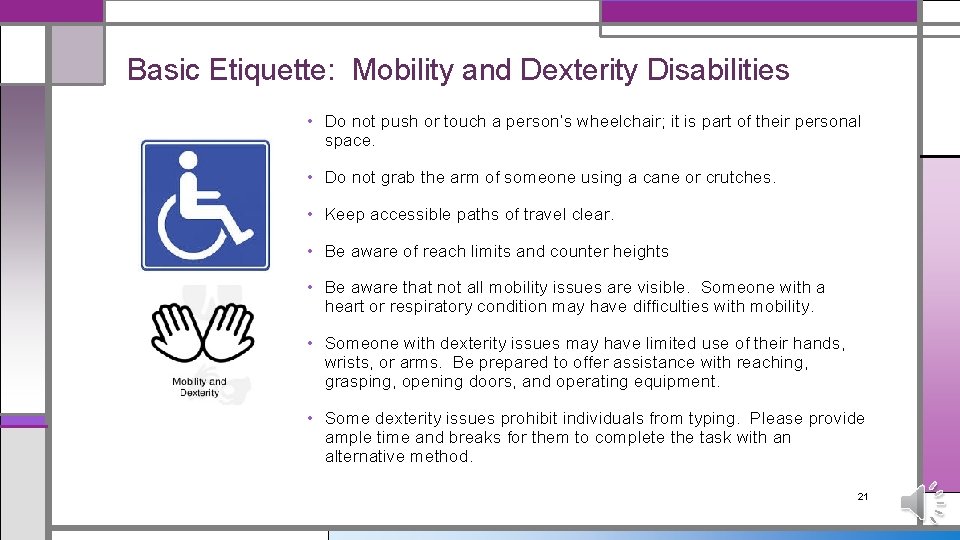
Basic Etiquette: Mobility and Dexterity Disabilities • Do not push or touch a person’s wheelchair; it is part of their personal space. • Do not grab the arm of someone using a cane or crutches. • Keep accessible paths of travel clear. • Be aware of reach limits and counter heights • Be aware that not all mobility issues are visible. Someone with a heart or respiratory condition may have difficulties with mobility. • Someone with dexterity issues may have limited use of their hands, wrists, or arms. Be prepared to offer assistance with reaching, grasping, opening doors, and operating equipment. • Some dexterity issues prohibit individuals from typing. Please provide ample time and breaks for them to complete the task with an alternative method. 21
Basic Etiquette: Speech and Language • Give the person your full attention • Do not interrupt or finish the person’s sentences • If you do not understand, ask the person to repeat what they said. • If, after trying, you still do not understand what is being said, suggest another method of communication, such as writing • Communication is easier in a quiet environment • Do not tease or laugh at the person with a speech disability 22
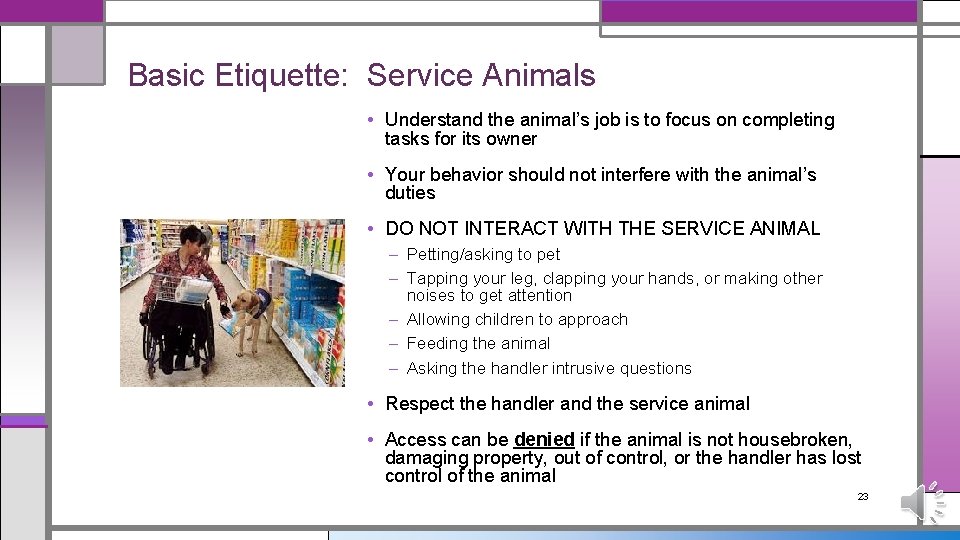
Basic Etiquette: Service Animals • Understand the animal’s job is to focus on completing tasks for its owner • Your behavior should not interfere with the animal’s duties • DO NOT INTERACT WITH THE SERVICE ANIMAL – Petting/asking to pet – Tapping your leg, clapping your hands, or making other noises to get attention – Allowing children to approach – Feeding the animal – Asking the handler intrusive questions • Respect the handler and the service animal • Access can be denied if the animal is not housebroken, damaging property, out of control, or the handler has lost control of the animal 23
WHAT DOES CLV DO? Ø We have a legal obligation to provide people with disabilities equal access to our city services, programs and activities. Ø Accessibility and ADA Coordinator Ø Parks and Recreation’s Adaptive Recreation programs 24
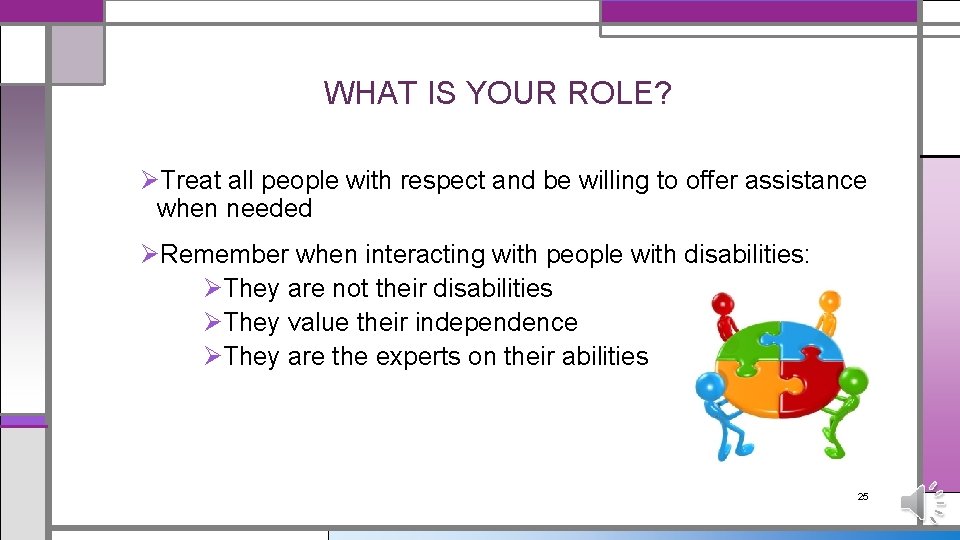
WHAT IS YOUR ROLE? ØTreat all people with respect and be willing to offer assistance when needed ØRemember when interacting with people with disabilities: ØThey are not their disabilities ØThey value their independence ØThey are the experts on their abilities 25
Any Questions? 26
THANK YOU!!! For more questions and information, contact: Tammy Counts Accessibility and ADA Coordinator Human Resources Analyst Human Resources – First Floor 702 -229 -5055 27
- Slides: 24