
Disability Access Route to Education Process Explained What
Disability Access Route to Education Process Explained

What is DARE? • The Disability Access Route to Education (DARE) is a supplementary admissions scheme for school leavers with disabilities. • DARE has been established by a number of higher education institutions as clear evidence shows that disability can have a negative impact on educational attainment at school and progression to higher education.
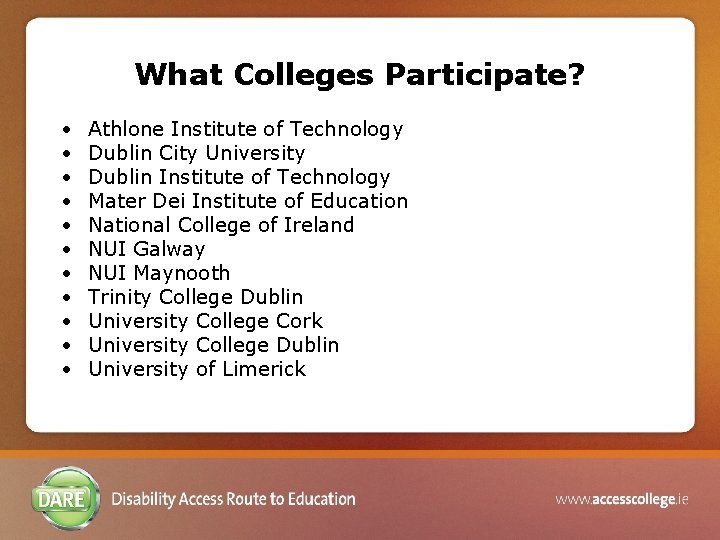
What Colleges Participate? • • • Athlone Institute of Technology Dublin City University Dublin Institute of Technology Mater Dei Institute of Education National College of Ireland NUI Galway NUI Maynooth Trinity College Dublin University College Cork University College Dublin University of Limerick
Why Should a Student Apply? • Students who are eligible for DARE may secure a place on a reduced points basis. • If a student gets a place through DARE they will have access to a variety of academic, personal and social supports while at college.
Who Should Apply? • Applicants whose disability had a significant impact on educational performance in school • Applicants who may not be able to meet the points for their preferred course due to the impact of disability. • Applicants under 23 years as at 1 st January 2012
Disabilities eligible for consideration under DARE • • • Asperger’s Syndrome/Autism ADD/ADHD Blind/Vision Impaired Deaf/Hearing Impaired Dyspraxia Mental Health Condition Neurological Conditions (incl. Brain Injury, Speech & Language Disabilities) Significant Ongoing Illness Physical Disability Specific Learning Difficulty (incl. Dyslexia) Other Disabilities
How To Apply • Applicants apply online at www. cao. ie by 1 st February 2012 • Applicants indicate a Disability/Specific Learning Difficulty on the CAO application form • Applicants are then directed to the separate online Supplementary Information Form (SIF) • Applicants must complete Section A of SIF and ‘opt in’ for DARE by 1 st February 2012 • Applicants must return supporting documentation by 1 st April 2012 (Sections B & C)
What is the Supplementary Information Form? • A separate form which gathers additional information on the applicant’s disability. • The Supplementary Information Form has 4 separate sections: 1. Section A – completed by 1 st February 2012 2. Section B – completed by the school and returned by 1 st April 2012 3. Section C – completed by the accepted Medical Consultant / Specialist and returned by 1 st April 2012 4. Supplementary Admissions Routes – applicants must ‘opt in’ for DARE by 1 st February 2012
Section C – Evidence of Disability • This form provides verification of the applicant’s disability and helps to determine appropriate supports at 3 rd level • This form should must be completed by the accepted Medical Consultant/ Specialist and returned to the CAO • All applicants must complete this form with the exception of the following: – Applicants with specific learning difficulties – Applicants who have an existing report completed by the accepted Medical Consultant/Specialist.
Section C – Evidence of Disability • Students with specific learning difficulties must provide a full psychoeducational assessment completed by an appropriately qualified psychologist. • The psycho-educational assessment must be less than 3 years old i. e. dated after 1 st February 2009. • For other disabilities, if submitting a report instead of the Evidence of Disability form: – Must have been completed by the accepted Medical Consultant / Specialist – Must have been completed within the appropriate timeframe – Must contain the same detail as the Evidence of Disability Form
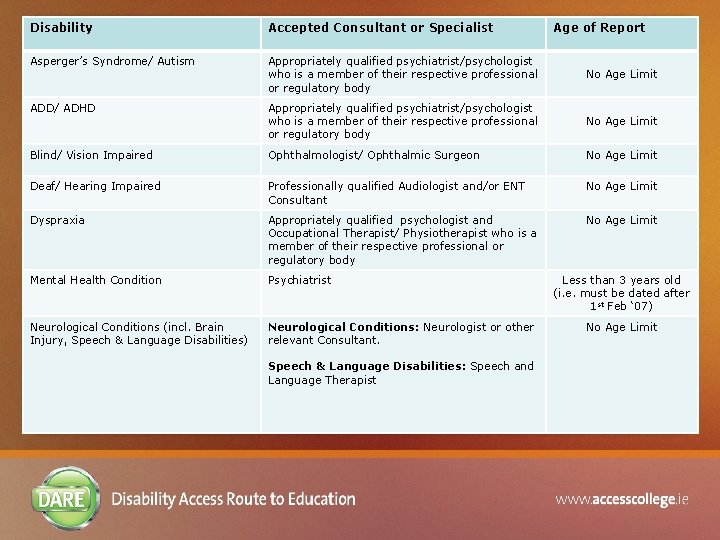
Disability Accepted Consultant or Specialist Age of Report Asperger’s Syndrome/ Autism Appropriately qualified psychiatrist/psychologist who is a member of their respective professional or regulatory body No Age Limit ADD/ ADHD Appropriately qualified psychiatrist/psychologist who is a member of their respective professional or regulatory body No Age Limit Blind/ Vision Impaired Ophthalmologist/ Ophthalmic Surgeon No Age Limit Deaf/ Hearing Impaired Professionally qualified Audiologist and/or ENT Consultant No Age Limit Dyspraxia Appropriately qualified psychologist and Occupational Therapist/ Physiotherapist who is a member of their respective professional or regulatory body No Age Limit Mental Health Condition Psychiatrist Neurological Conditions (incl. Brain Injury, Speech & Language Disabilities) Neurological Conditions: Neurologist or other relevant Consultant. Speech & Language Disabilities: Speech and Language Therapist Less than 3 years old (i. e. must be dated after 1 st Feb ‘ 07) No Age Limit
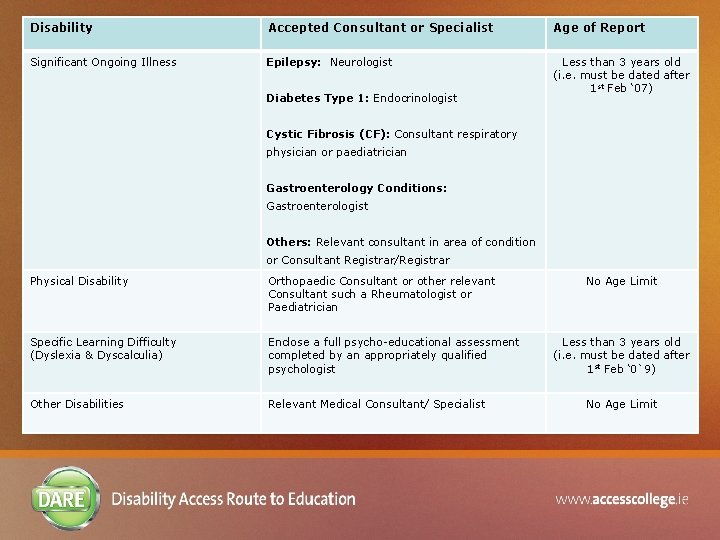
Disability Accepted Consultant or Specialist Age of Report Significant Ongoing Illness Epilepsy: Neurologist Less than 3 years old (i. e. must be dated after 1 st Feb ‘ 07) Diabetes Type 1: Endocrinologist Cystic Fibrosis (CF): Consultant respiratory physician or paediatrician Gastroenterology Conditions: Gastroenterologist Others: Relevant consultant in area of condition or Consultant Registrar/Registrar Physical Disability Orthopaedic Consultant or other relevant Consultant such a Rheumatologist or Paediatrician Specific Learning Difficulty (Dyslexia & Dyscalculia) Enclose a full psycho-educational assessment completed by an appropriately qualified psychologist Other Disabilities Relevant Medical Consultant/ Specialist No Age Limit Less than 3 years old (i. e. must be dated after 1 st Feb ‘ 0`9) No Age Limit
HEI Assessment Boards • Expert Assessment Board is convened to develop the screening criteria for each disability type • The membership of the Assessment Boards must be broadly representative of national experts in the disability that is being considered. • Every effort is made to ensure that the experts selected have significant expertise in relation to the Irish system and that they have broad geographical representation. • Asperger’s Syndrome/Autism – ASPIRE, NEPS, PSI, HSE, psychiatrists & psychologists, HEI representation • Dyslexia – NEPS, PSI, psychologists, HEI representation
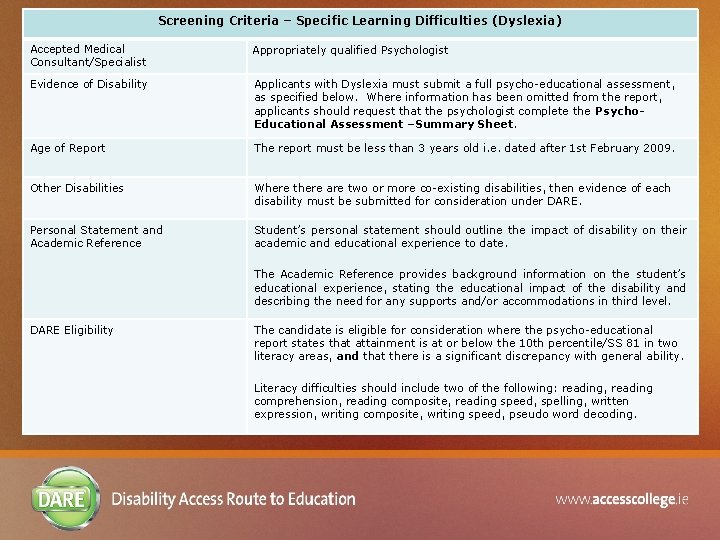
Screening Criteria – Specific Learning Difficulties (Dyslexia) Accepted Medical Consultant/Specialist Appropriately qualified Psychologist Evidence of Disability Applicants with Dyslexia must submit a full psycho-educational assessment, as specified below. Where information has been omitted from the report, applicants should request that the psychologist complete the Psycho. Educational Assessment –Summary Sheet. Age of Report The report must be less than 3 years old i. e. dated after 1 st February 2009. Other Disabilities Where there are two or more co-existing disabilities, then evidence of each disability must be submitted for consideration under DARE. Personal Statement and Academic Reference Student’s personal statement should outline the impact of disability on their academic and educational experience to date. The Academic Reference provides background information on the student’s educational experience, stating the educational impact of the disability and describing the need for any supports and/or accommodations in third level. DARE Eligibility The candidate is eligible for consideration where the psycho-educational report states that attainment is at or below the 10 th percentile/SS 81 in two literacy areas, and that there is a significant discrepancy with general ability. Literacy difficulties should include two of the following: reading, reading comprehension, reading composite, reading speed, spelling, written expression, writing composite, writing speed, pseudo word decoding.
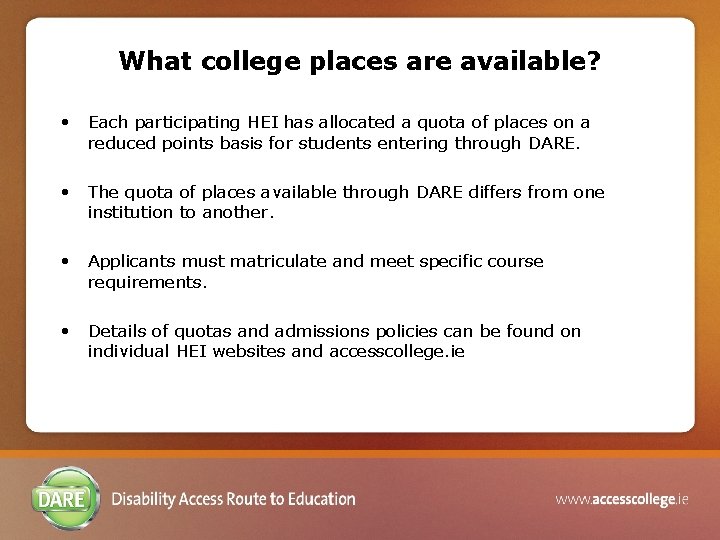
What college places are available? • Each participating HEI has allocated a quota of places on a reduced points basis for students entering through DARE. • The quota of places available through DARE differs from one institution to another. • Applicants must matriculate and meet specific course requirements. • Details of quotas and admissions policies can be found on individual HEI websites and accesscollege. ie
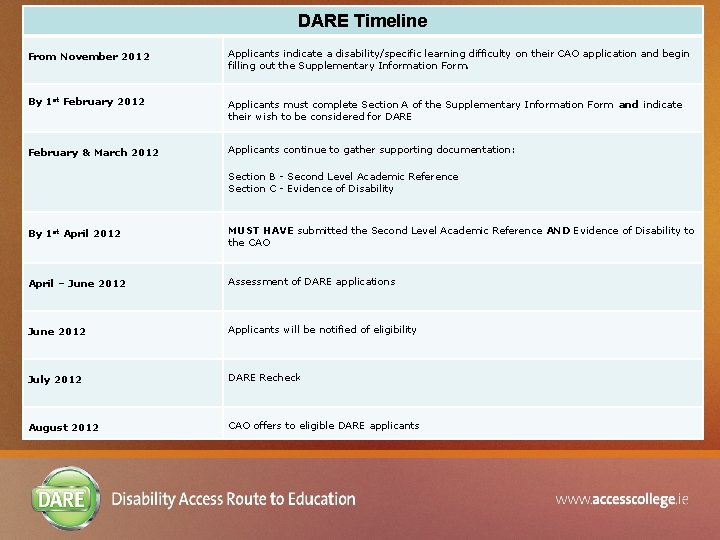
DARE Timeline From November 2012 Applicants indicate a disability/specific learning difficulty on their CAO application and begin filling out the Supplementary Information Form. By 1 st February 2012 Applicants must complete Section A of the Supplementary Information Form and indicate their wish to be considered for DARE February & March 2012 Applicants continue to gather supporting documentation: Section B - Second Level Academic Reference Section C - Evidence of Disability By 1 st April 2012 MUST HAVE submitted the Second Level Academic Reference AND Evidence of Disability to the CAO April – June 2012 Assessment of DARE applications June 2012 Applicants will be notified of eligibility July 2012 DARE Recheck August 2012 CAO offers to eligible DARE applicants
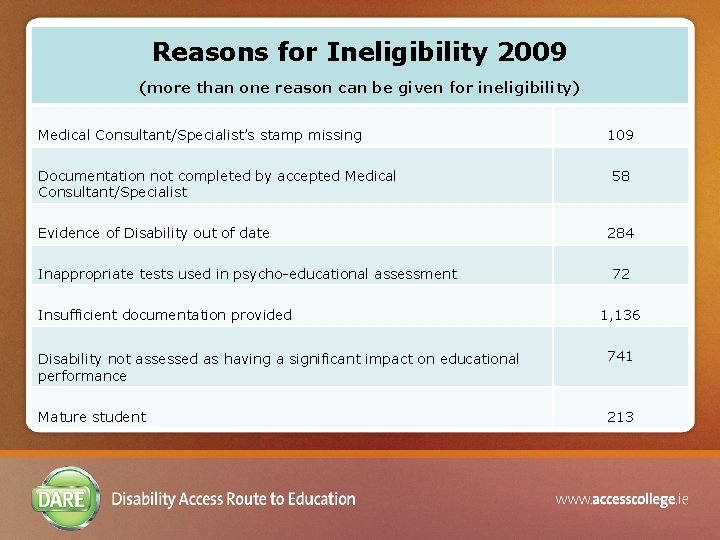
Reasons for Ineligibility 2009 (more than one reason can be given for ineligibility) Medical Consultant/Specialist’s stamp missing Documentation not completed by accepted Medical Consultant/Specialist Evidence of Disability out of date Inappropriate tests used in psycho-educational assessment Insufficient documentation provided 109 58 284 72 1, 136 Disability not assessed as having a significant impact on educational performance 741 Mature student 213
6 Possible Reasons for Ineligibility • Evidence of Disability not submitted on time • Evidence of Disability not completed by the accepted Medical Consultant/Specialist • The Evidence of Disability not stamped or accompanied by the Medical Consultant/Specialist’s business card or headed paper • Where required, the Evidence of Disability is not less than 3 years old • Insufficient information in the Evidence of Disability to determine eligibility for DARE • The disability is not assessed as having a significant impact on educational performance
More information for students… • www. accesscollege. ie • www. cao. ie see Downloads section • Better Options Events & HEAR/DARE Information Sessions • Individual HEI websites
Challenges for the Applicant • Getting documentation in on time – Getting an appointment with a Medical Consultant/Specialist – Medical Consultant/Specialist completing report on time – Backlogs for private psychologists in some rural areas • Getting updated assessments – Cost of an updated psycho-educational assessment – Difficulty getting an updated assessment through NEPS • Insufficient information in reports – Insufficient information to determine impact of disability – Summary sheet rather than full assessment – Inappropriate tests used
Educational Technology • www. accesscollege. ie • www. cao. ie • DARE Brochure – sent to every school in October 2009 • DARE Application Guide – sent to every school as part of Autumn mailing • Better Options Events & HEAR/DARE Information Sessions • Individual HEI websites
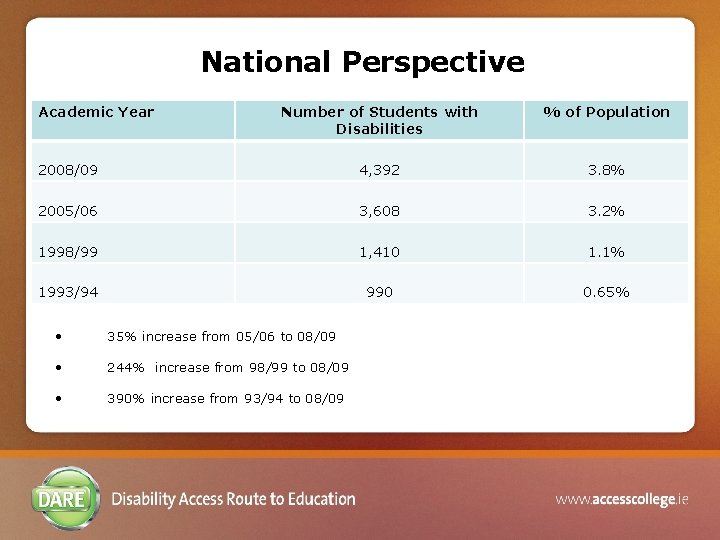
National Perspective Academic Year Number of Students with Disabilities % of Population 2008/09 4, 392 3. 8% 2005/06 3, 608 3. 2% 1998/99 1, 410 1. 1% 1993/94 990 0. 65% • 35% increase from 05/06 to 08/09 • 244% increase from 98/99 to 08/09 • 390% increase from 93/94 to 08/09
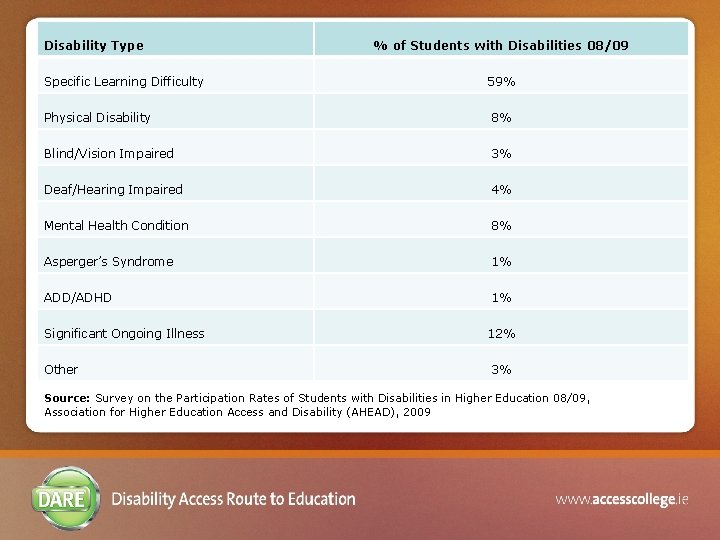
Disability Type Specific Learning Difficulty % of Students with Disabilities 08/09 59% Physical Disability 8% Blind/Vision Impaired 3% Deaf/Hearing Impaired 4% Mental Health Condition 8% Asperger’s Syndrome 1% ADD/ADHD 1% Significant Ongoing Illness Other 12% 3% Source: Survey on the Participation Rates of Students with Disabilities in Higher Education 08/09, Association for Higher Education Access and Disability (AHEAD), 2009
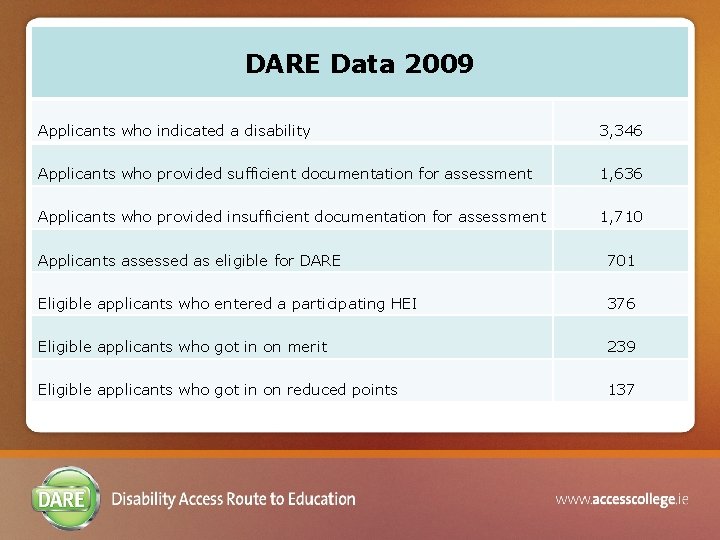
DARE Data 2009 Applicants who indicated a disability 3, 346 Applicants who provided sufficient documentation for assessment 1, 636 Applicants who provided insufficient documentation for assessment 1, 710 Applicants assessed as eligible for DARE 701 Eligible applicants who entered a participating HEI 376 Eligible applicants who got in on merit 239 Eligible applicants who got in on reduced points 137
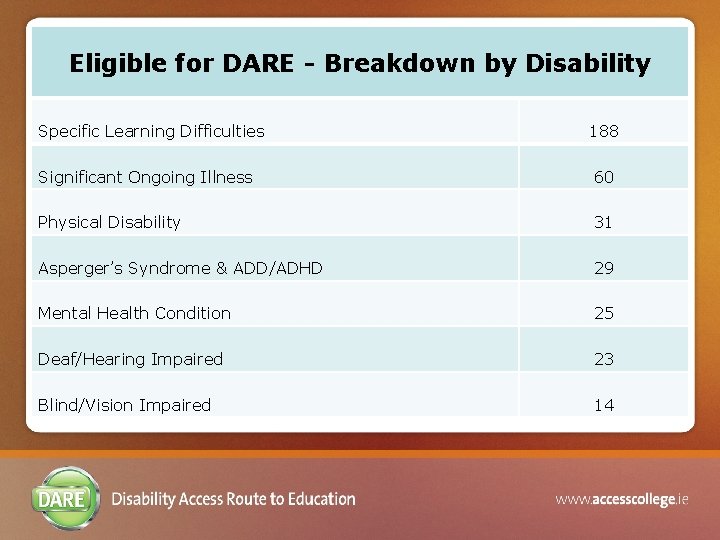
Eligible for DARE - Breakdown by Disability Specific Learning Difficulties 188 Significant Ongoing Illness 60 Physical Disability 31 Asperger’s Syndrome & ADD/ADHD 29 Mental Health Condition 25 Deaf/Hearing Impaired 23 Blind/Vision Impaired 14
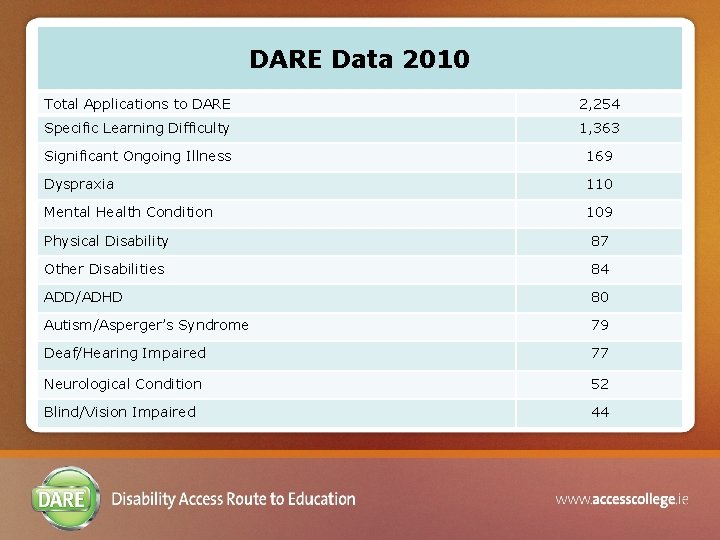
DARE Data 2010 Total Applications to DARE 2, 254 Specific Learning Difficulty 1, 363 Significant Ongoing Illness 169 Dyspraxia 110 Mental Health Condition 109 Physical Disability 87 Other Disabilities 84 ADD/ADHD 80 Autism/Asperger’s Syndrome 79 Deaf/Hearing Impaired 77 Neurological Condition 52 Blind/Vision Impaired 44
Overview of Presentation 1. Introduction to DARE 2. How applicants apply to DARE 3. How criteria are determined 4. The national perspective & data on DARE 5. Challenges for the applicant
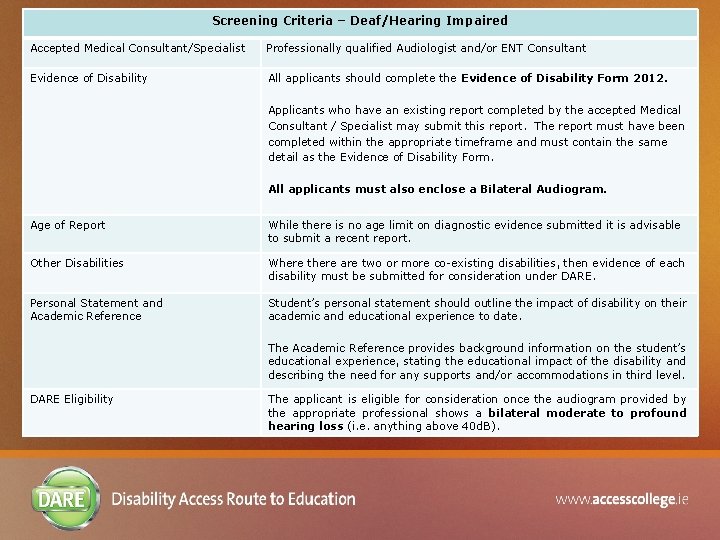
Screening Criteria – Deaf/Hearing Impaired Accepted Medical Consultant/Specialist Professionally qualified Audiologist and/or ENT Consultant Evidence of Disability All applicants should complete the Evidence of Disability Form 2012. Applicants who have an existing report completed by the accepted Medical Consultant / Specialist may submit this report. The report must have been completed within the appropriate timeframe and must contain the same detail as the Evidence of Disability Form. All applicants must also enclose a Bilateral Audiogram. Age of Report While there is no age limit on diagnostic evidence submitted it is advisable to submit a recent report. Other Disabilities Where there are two or more co-existing disabilities, then evidence of each disability must be submitted for consideration under DARE. Personal Statement and Academic Reference Student’s personal statement should outline the impact of disability on their academic and educational experience to date. The Academic Reference provides background information on the student’s educational experience, stating the educational impact of the disability and describing the need for any supports and/or accommodations in third level. DARE Eligibility The applicant is eligible for consideration once the audiogram provided by the appropriate professional shows a bilateral moderate to profound hearing loss (i. e. anything above 40 d. B).
- Slides: 28