
Dirty Bombs and Hospitals Removing Dangerous Radioactive Material
Dirty Bombs and Hospitals: Removing Dangerous Radioactive Material from the Public Space Erin Connolly Program Assistant , Center for Arms Control and Nonproliferation & FMWG PONI Winter Conference December 5 th, 2017
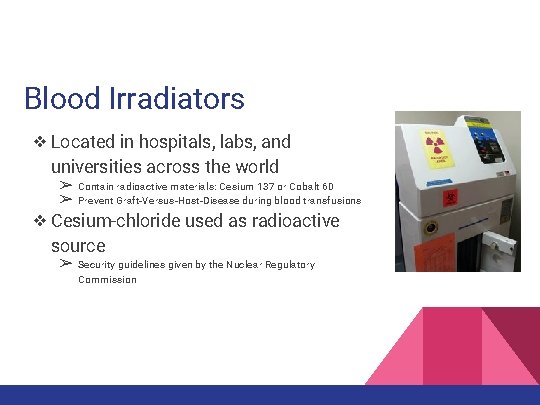
Blood Irradiators ❖ Located in hospitals, labs, and universities across the world ➢ ➢ Contain radioactive materials: Cesium 137 or Cobalt 60 Prevent Graft-Versus-Host-Disease during blood transfusions ❖ Cesium-chloride used as radioactive source ➢ Security guidelines given by the Nuclear Regulatory Commission
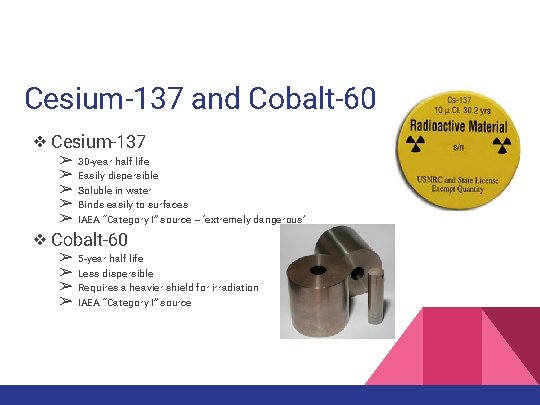
Cesium-137 and Cobalt-60 ❖ Cesium-137 ➢ ➢ ➢ 30 -year half life Easily dispersible Soluble in water Binds easily to surfaces IAEA “Category I” source -- ‘extremely dangerous’ ❖ Cobalt-60 ➢ ➢ 5 -year half life Less dispersible Requires a heavier shield for irradiation IAEA “Category I” source
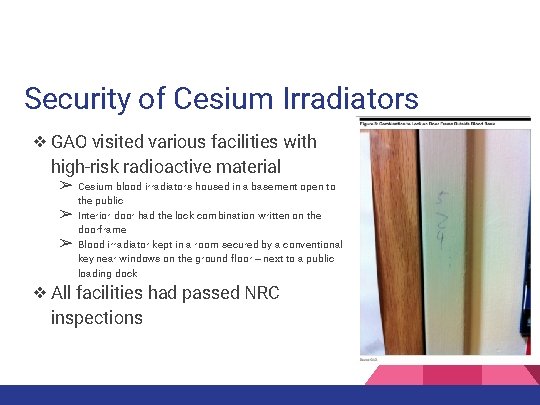
Security of Cesium Irradiators ❖ GAO visited various facilities with high-risk radioactive material ➢ ➢ ➢ Cesium blood irradiators housed in a basement open to the public Interior door had the lock combination written on the doorframe Blood irradiator kept in a room secured by a conventional key near windows on the ground floor -- next to a public loading dock ❖ All facilities had passed NRC inspections

Radiological Dispersal Device: Dirty Bomb ❖ Conventional explosive with radiological material ❖ Weapon of mass disruption ➢ Greater psychological than physical damage ❖ Radiation can remain for decades
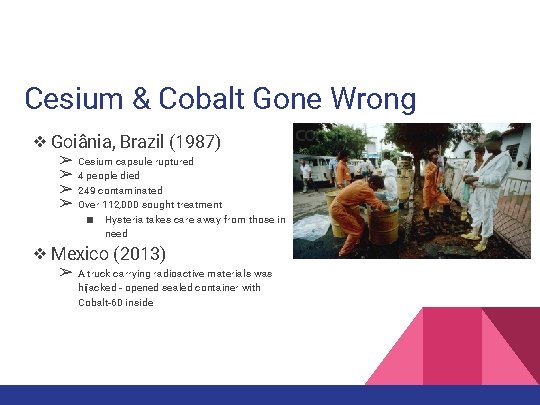
Cesium & Cobalt Gone Wrong ❖ Goiânia, Brazil (1987) ➢ ➢ Cesium capsule ruptured 4 people died 249 contaminated Over 112, 000 sought treatment ■ Hysteria takes care away from those in need ❖ Mexico (2013) ➢ A truck carrying radioactive materials was hijacked - opened sealed container with Cobalt-60 inside
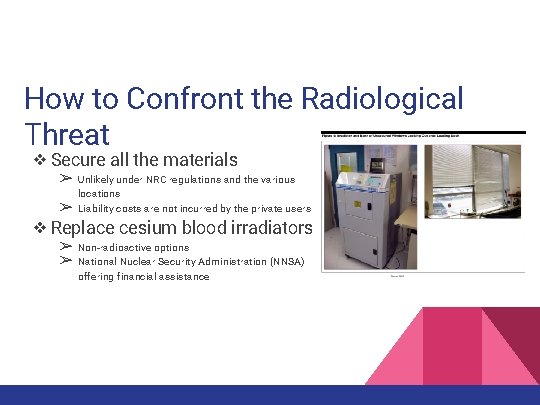
How to Confront the Radiological Threat ❖ Secure all the materials ➢ ➢ Unlikely under NRC regulations and the various locations Liability costs are not incurred by the private users ❖ Replace cesium blood irradiators ➢ ➢ Non-radioactive options National Nuclear Security Administration (NNSA) offering financial assistance
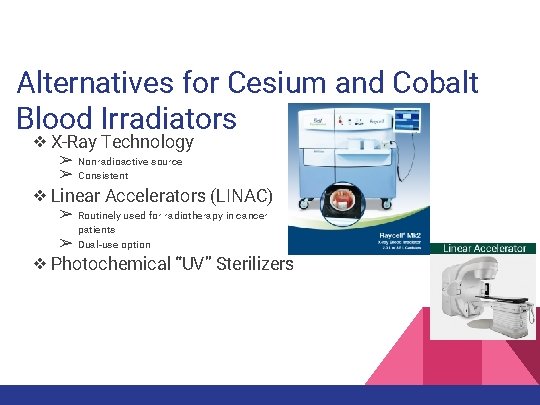
Alternatives for Cesium and Cobalt Blood Irradiators ❖ X-Ray Technology ➢ ➢ Nonradioactive source Consistent ❖ Linear Accelerators (LINAC) ➢ ➢ Routinely used for radiotherapy in cancer patients Dual-use option ❖ Photochemical “UV” Sterilizers
International Efforts ❖ France and Norway have banned cesium blood irradiators ❖ Japan has almost completed their transition to the use of x-ray irradiators ❖ Others strongly encourage use of x-ray technology ➢ Canada, Germany, Italy, Sweden, and the United Kingdom
U. S. Steps Forward ❖ Nuclear Security Summit pledges ➢ 2016 pledge: replace 34 cesium 137 irradiators by 2020 ❖ State progress ➢ ➢ New York and California have begun to make progress Largest number of radiological devices ■ Massachusetts, Pennsylvania, Texas, and California

Thank you!
- Slides: 11