
DirectReach Teachers Introducing Opportunity Culture and Defining the

- Slides: 23
Direct-Reach Teachers Introducing Opportunity Culture and Defining the Direct-Reach Teacher Role To copy or adapt this material, see Opportunity. Culture. org/terms-of-use Opportunity. Culture. org 1
Do Now On three sticky notes… 1. What have you heard about Opportunity Culture? 2. What do you know about your DRT role? 3. What questions do you have coming into this training? © 2017 Public Impact Opportunity. Culture. org 2
Learning Objectives During this session, participants will. . • Learn about Opportunity Culture and how it can improve student outcomes, provide career ladders for educators, and offer increased pay. • Understand how OC roles differ from traditional roles. • Learn the expectations of the Direct-Reach Teacher role. © 2017 Public Impact Opportunity. Culture. org 3
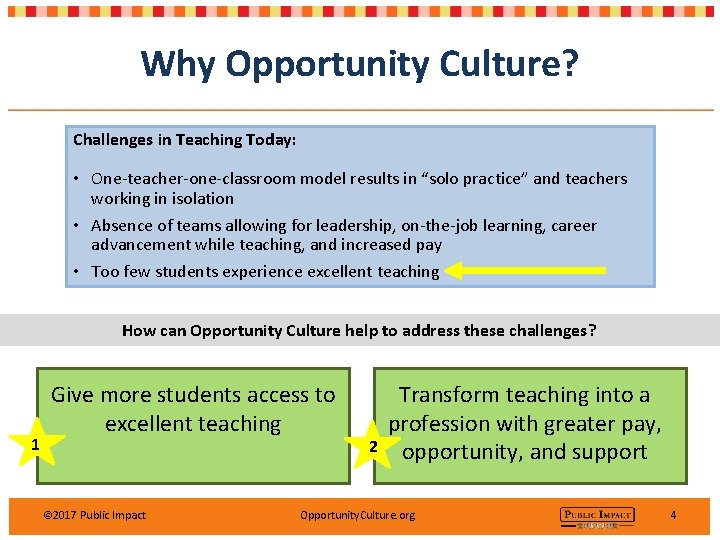
Why Opportunity Culture? Challenges in Teaching Today: • One-teacher-one-classroom model results in “solo practice” and teachers working in isolation • Absence of teams allowing for leadership, on-the-job learning, career advancement while teaching, and increased pay • Too few students experience excellent teaching How can Opportunity Culture help to address these challenges? 1 Give more students access to excellent teaching © 2017 Public Impact 2 Transform teaching into a profession with greater pay, opportunity, and support Opportunity. Culture. org 4
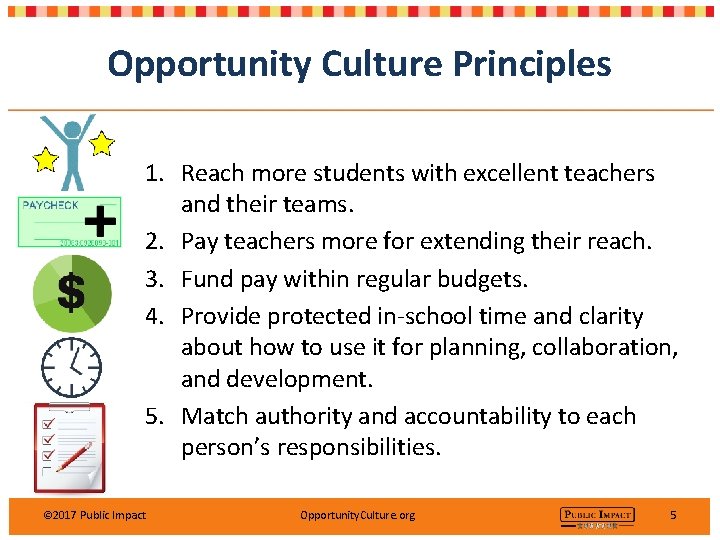
Opportunity Culture Principles 1. Reach more students with excellent teachers and their teams. 2. Pay teachers more for extending their reach. 3. Fund pay within regular budgets. 4. Provide protected in-school time and clarity about how to use it for planning, collaboration, and development. 5. Match authority and accountability to each person’s responsibilities. © 2017 Public Impact Opportunity. Culture. org 5
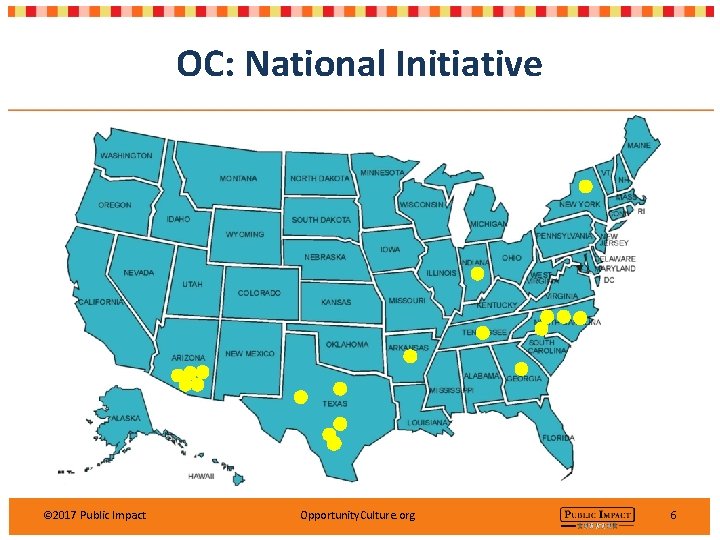
OC: National Initiative © 2017 Public Impact Opportunity. Culture. org 6
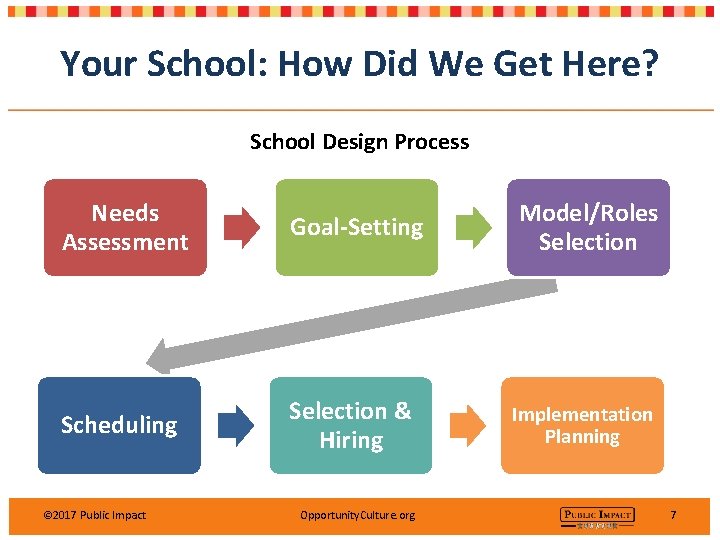
Your School: How Did We Get Here? School Design Process Needs Assessment Goal-Setting Model/Roles Selection Scheduling Selection & Hiring Implementation Planning © 2017 Public Impact Opportunity. Culture. org 7
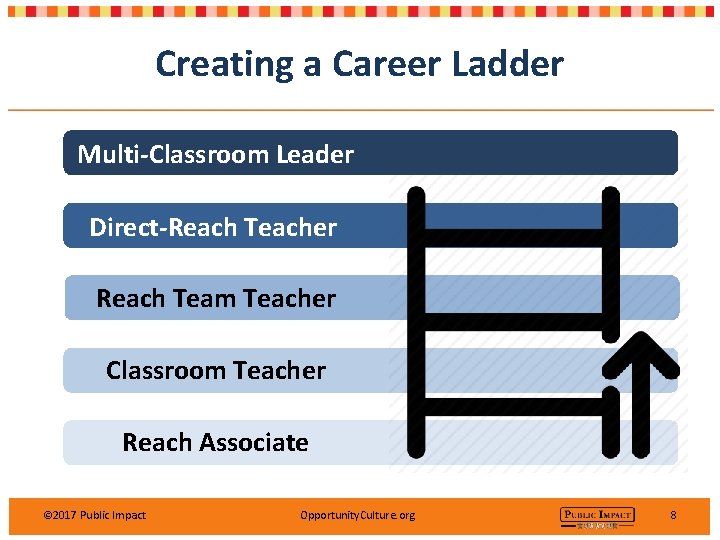
Creating a Career Ladder Multi-Classroom Leader Direct-Reach Teacher Reach Team Teacher Classroom Teacher Reach Associate © 2017 Public Impact Opportunity. Culture. org 8
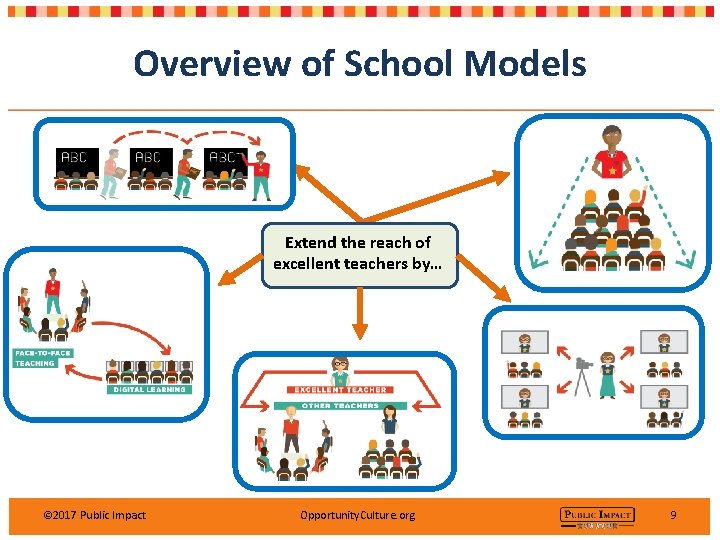
Overview of School Models Extend the reach of excellent teachers by… © 2017 Public Impact Opportunity. Culture. org 9
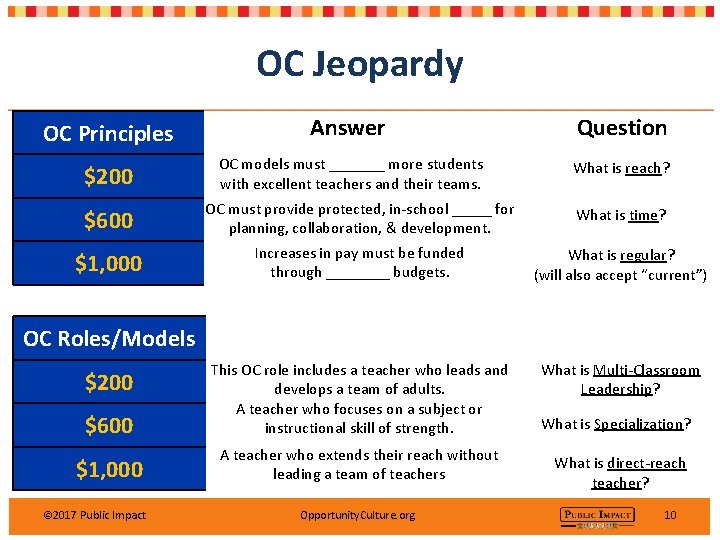
OC Jeopardy OC Principles Answer Question $200 OC models must _______ more students with excellent teachers and their teams. What is reach? $600 OC must provide protected, in-school _____ for planning, collaboration, & development. What is time? $1, 000 Increases in pay must be funded through ____ budgets. What is regular? (will also accept “current”) What is Multi-Classroom Leadership? $600 This OC role includes a teacher who leads and develops a team of adults. A teacher who focuses on a subject or instructional skill of strength. $1, 000 A teacher who extends their reach without leading a team of teachers OC Roles/Models $200 © 2017 Public Impact Opportunity. Culture. org What is Specialization? What is direct-reach teacher? 10
OC Elevator Pitch Scenario: Your school would like to implement Opportunity Culture and the direct-reach teacher role. You have been tasked with delivering a persuasive 1 -minute “elevator pitch” to district leadership to convince them to endorse the initiative. Write your pitch and share it! © 2017 Public Impact Opportunity. Culture. org 11
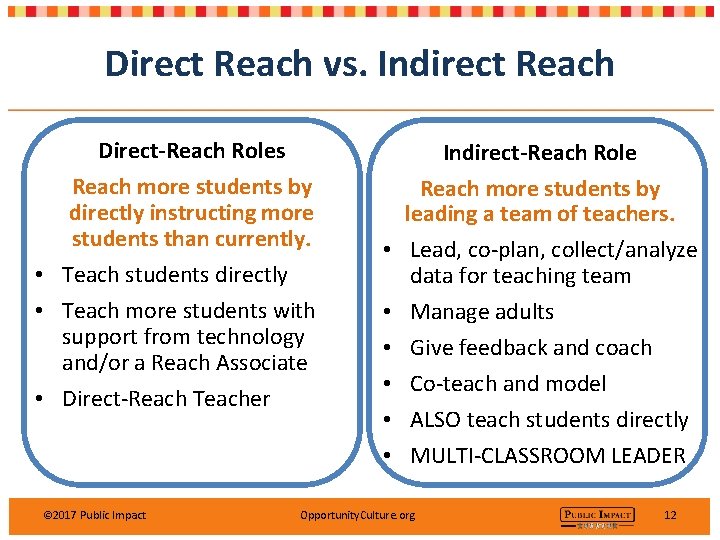
Direct Reach vs. Indirect Reach Direct-Reach Roles Reach more students by directly instructing more students than currently. • Teach students directly • Teach more students with support from technology and/or a Reach Associate • Direct-Reach Teacher © 2017 Public Impact Indirect-Reach Role Reach more students by leading a team of teachers. • Lead, co-plan, collect/analyze data for teaching team • • • Manage adults Give feedback and coach Co-teach and model ALSO teach students directly MULTI-CLASSROOM LEADER Opportunity. Culture. org 12
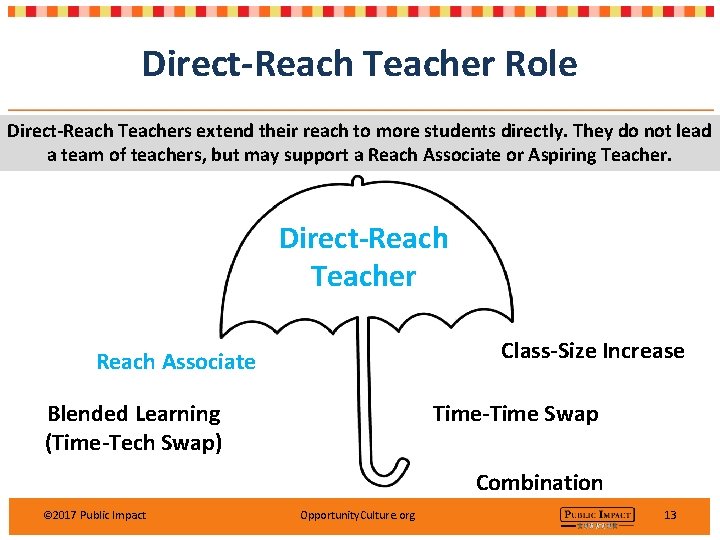
Direct-Reach Teacher Role Direct-Reach Teachers extend their reach to more students directly. They do not lead a team of teachers, but may support a Reach Associate or Aspiring Teacher. Direct-Reach Teacher Class-Size Increase Reach Associate Blended Learning (Time-Tech Swap) Time-Time Swap Combination © 2017 Public Impact Opportunity. Culture. org 13
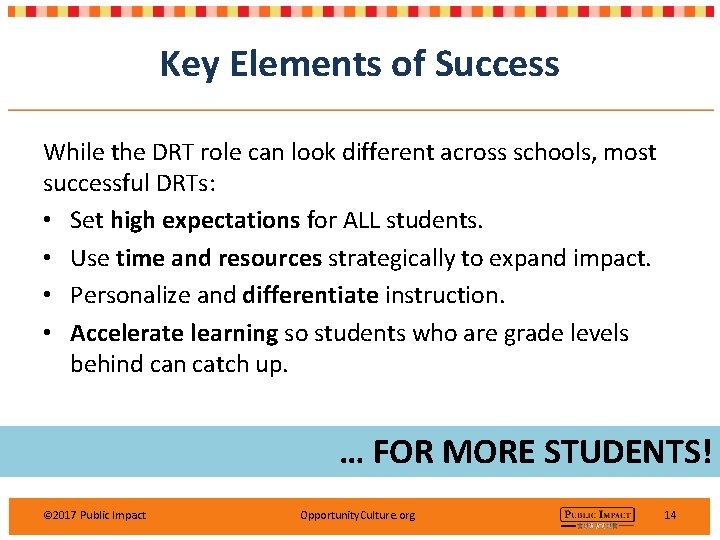
Key Elements of Success While the DRT role can look different across schools, most successful DRTs: • Set high expectations for ALL students. • Use time and resources strategically to expand impact. • Personalize and differentiate instruction. • Accelerate learning so students who are grade levels behind can catch up. … FOR MORE STUDENTS! © 2017 Public Impact Opportunity. Culture. org 14
What Qualities Led You to this Position? © 2017 Public Impact Opportunity. Culture. org 15
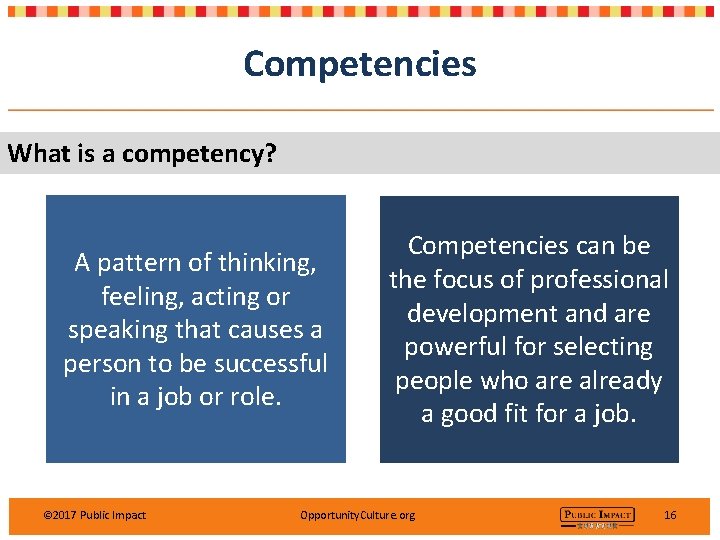
Competencies What is a competency? A pattern of thinking, feeling, acting or speaking that causes a person to be successful in a job or role. © 2017 Public Impact Competencies can be the focus of professional development and are powerful for selecting people who are already a good fit for a job. Opportunity. Culture. org 16
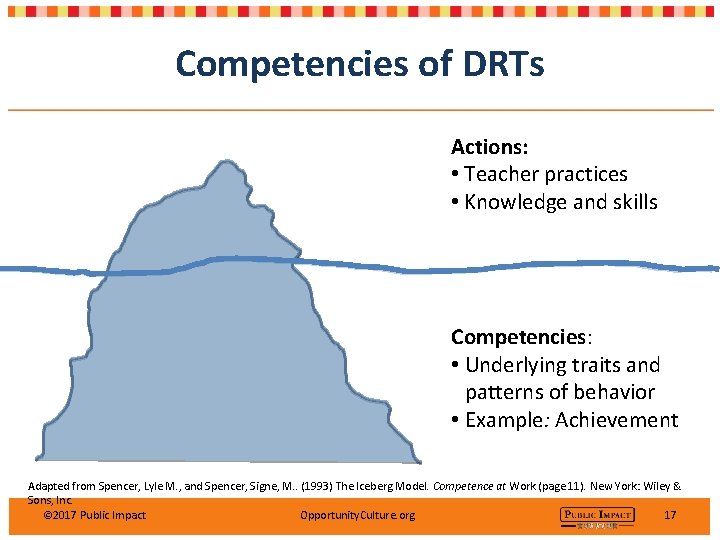
Competencies of DRTs Actions: • Teacher practices • Knowledge and skills Competencies: • Underlying traits and patterns of behavior • Example: Achievement Adapted from Spencer, Lyle M. , and Spencer, Signe, M. . (1993) The Iceberg Model. Competence at Work (page 11). New York: Wiley & Sons, Inc. 17 © 2017 Public Impact Opportunity. Culture. org
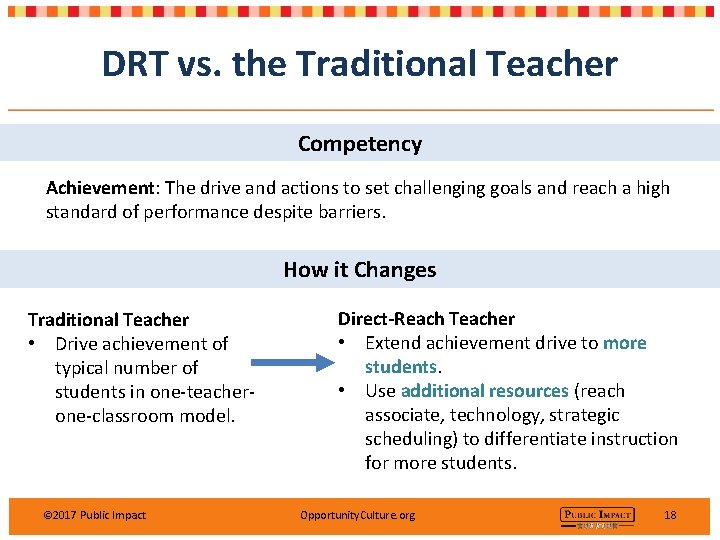
DRT vs. the Traditional Teacher Competency Achievement: The drive and actions to set challenging goals and reach a high standard of performance despite barriers. How it Changes Traditional Teacher • Drive achievement of typical number of students in one-teacherone-classroom model. © 2017 Public Impact Direct-Reach Teacher • Extend achievement drive to more students. • Use additional resources (reach associate, technology, strategic scheduling) to differentiate instruction for more students. Opportunity. Culture. org 18
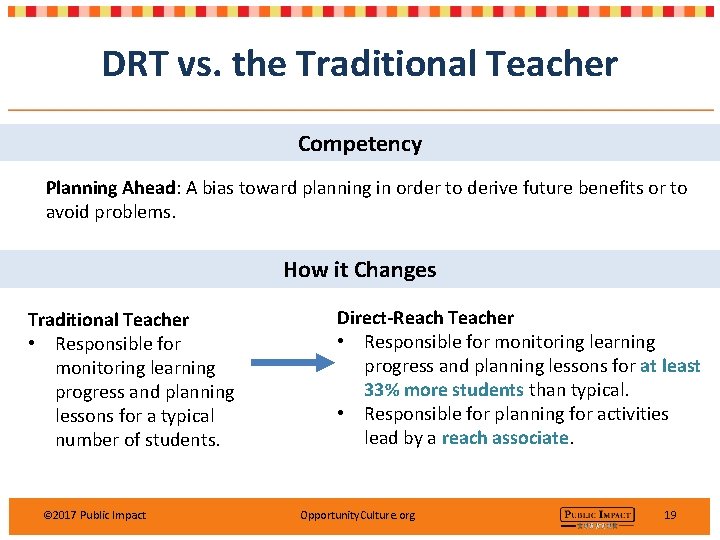
DRT vs. the Traditional Teacher Competency Planning Ahead: A bias toward planning in order to derive future benefits or to avoid problems. How it Changes Traditional Teacher • Responsible for monitoring learning progress and planning lessons for a typical number of students. © 2017 Public Impact Direct-Reach Teacher • Responsible for monitoring learning progress and planning lessons for at least 33% more students than typical. • Responsible for planning for activities lead by a reach associate. Opportunity. Culture. org 19
Job Description Analysis Review the job description and highlight key aspects of the direct-reach teacher role. Note any: • Unique aspects of the role • Responsibilities that are unclear • Questions or aspects that are missing 5 minutes: Reflect individually. 10 minutes: Review and discuss as a group. © 2017 Public Impact Opportunity. Culture. org 20
3 -2 -1 Activity Write down and share out: • 3 things you are excited about as it relates to Opportunity Culture and your new role. • 2 new things you learned. • 1 question or wondering you have. © 2017 Public Impact Opportunity. Culture. org 21
Reflection: Next Steps Imagine that one of your colleagues comes up to you during the first week of school and asks you what it means to be an direct-reach teacher. In explaining your role to this colleague, what are the two or three most important things you plan to say about your new role as a DRT? © 2017 Public Impact Opportunity. Culture. org 22
Sources • Opportunity Culture Toolkit: http: //opportunityculture. org/opportunity-culture-toolkit • The Many Faces of Leadership in Educational Leadership (2007), by Charlotte Danielson (2007) retrieved from http: //www. ascd. org/publications/educationalleadership/sept 07/vol 65/num 01/The-Many-Faces-of. Leadership. aspx • KIPP (2009). Leadership Progression Roadmap: Teacher to Grade Level Chair. Retrieved from: http: //tntp. org/assets/tools/KIPP_Leader_Progression_Teach er_to_Grade_Level_Chair. pdf • Spencer, Lyle M. , and Spencer, Signe, M. . (1993) The Iceberg Model. Competence at Work (page 11). New York: Wiley & Sons, Inc. © 2017 Public Impact Opportunity. Culture. org 23