
Directorate of Planning Health Sector Strategic Plan Presentation

- Slides: 38
Directorate of Planning - Health Sector Strategic Plan Presentation at Health Cluster Meeting Kigali, 28 October 2004
Agenda Introduction: The Structure of the HSSP Strategic Framework: The Seven Focus Areas of the HSSP Implementation, Costing and Evaluation 25. October 2005 HSSP Presentation at MINISANTE 2
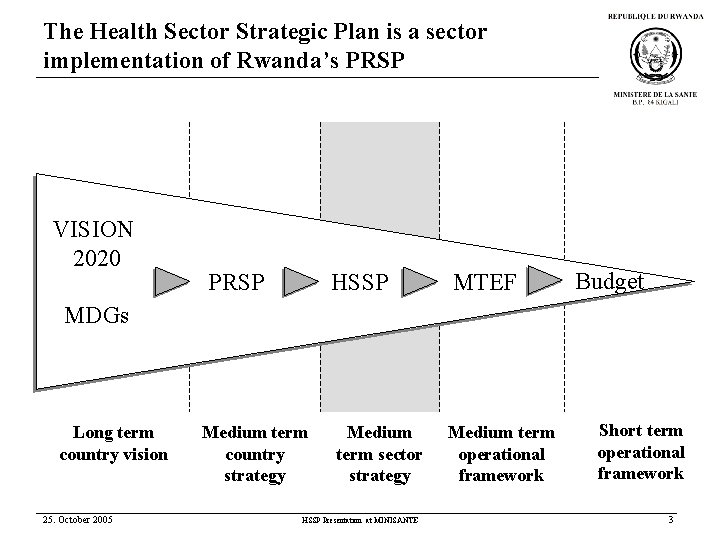
The Health Sector Strategic Plan is a sector implementation of Rwanda’s PRSP VISION 2020 PRSP HSSP MTEF Medium term sector strategy Medium term operational framework Budget MDGs Long term country vision 25. October 2005 Medium term country strategy HSSP Presentation at MINISANTE Short term operational framework 3
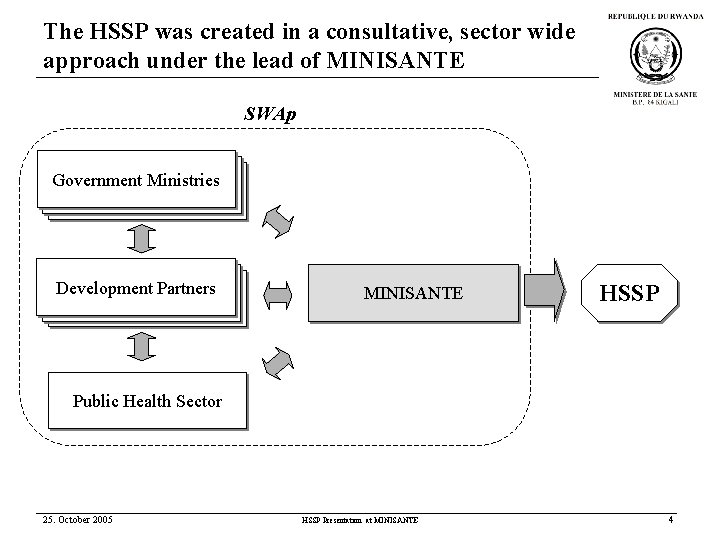
The HSSP was created in a consultative, sector wide approach under the lead of MINISANTE SWAp Government Ministries Government. Ministries Development Partners Development. Partners MINISANTE HSSP Public Health Sector 25. October 2005 HSSP Presentation at MINISANTE 4
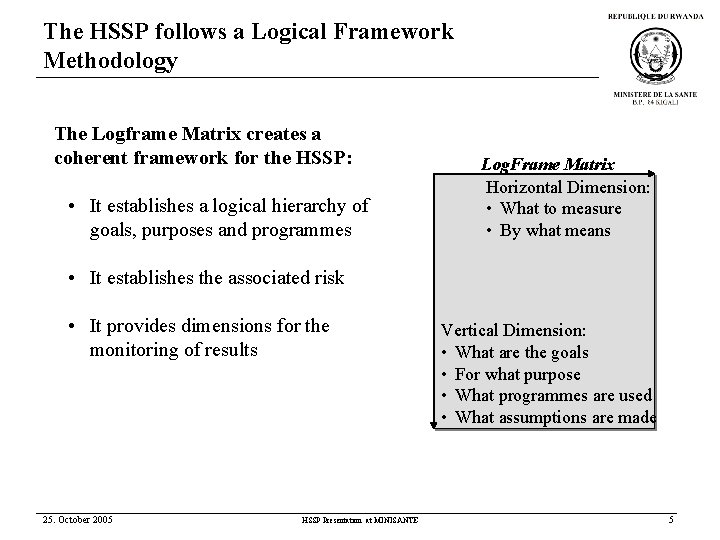
The HSSP follows a Logical Framework Methodology The Logframe Matrix creates a coherent framework for the HSSP: • It establishes a logical hierarchy of goals, purposes and programmes Log. Frame Matrix Horizontal Dimension: • What to measure • By what means • It establishes the associated risk • It provides dimensions for the monitoring of results 25. October 2005 HSSP Presentation at MINISANTE Vertical Dimension: • What are the goals • For what purpose • What programmes are used • What assumptions are made 5
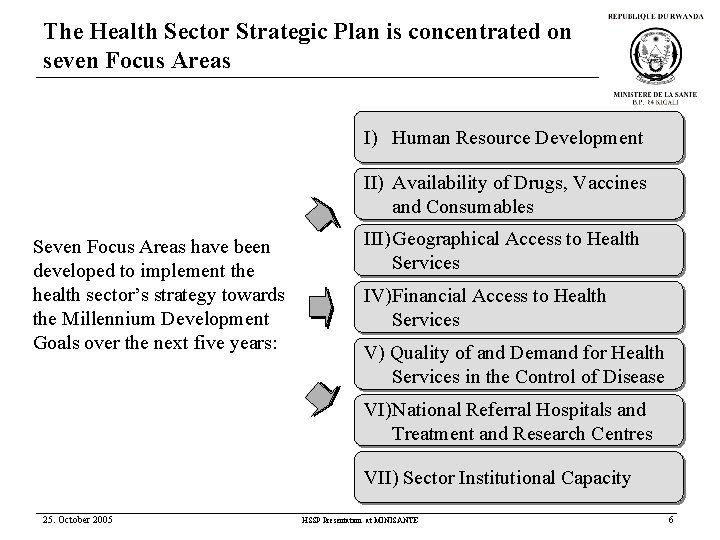
The Health Sector Strategic Plan is concentrated on seven Focus Areas I) Human Resource Development II) Availability of Drugs, Vaccines and Consumables Seven Focus Areas have been developed to implement the health sector’s strategy towards the Millennium Development Goals over the next five years: III)Geographical Access to Health Services IV)Financial Access to Health Services V) Quality of and Demand for Health Services in the Control of Disease VI)National Referral Hospitals and Treatment and Research Centres VII) Sector Institutional Capacity 25. October 2005 HSSP Presentation at MINISANTE 6
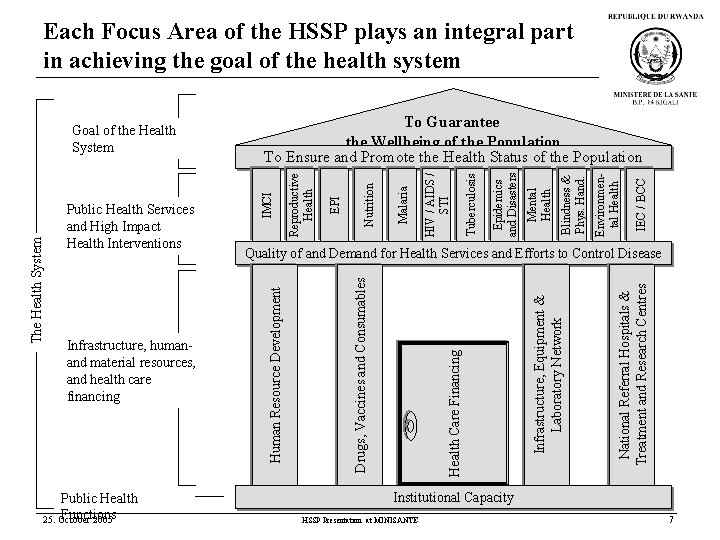
Each Focus Area of the HSSP plays an integral part in achieving the goal of the health system Public Health Functions 25. October 2005 IEC / BCC Environmental Health Blindness & Phys. Hand. Mental Health Epidemics and Disasters Tuberculosis HIV / AIDS / STI Malaria Nutrition EPI Reproductive Health National Referral Hospitals & Treatment and Research Centres Health Care Financing Infrastructure, Equipment & Laboratory Network Quality of and Demand for Health Services and Efforts to Control Disease Drugs, Vaccines and Consumables Infrastructure, humanand material resources, and health care financing IMCI Public Health Services and High Impact Health Interventions To Guarantee the Wellbeing of the Population To Ensure and Promote the Health Status of the Population Human Resource Development The Health System Goal of the Health System Institutional Capacity HSSP Presentation at MINISANTE 7
Agenda Introduction: The Structure of the HSSP Strategic Framework: The Seven Focus Areas of the HSSP Implementation, Costing and Evaluation 25. October 2005 HSSP Presentation at MINISANTE 8
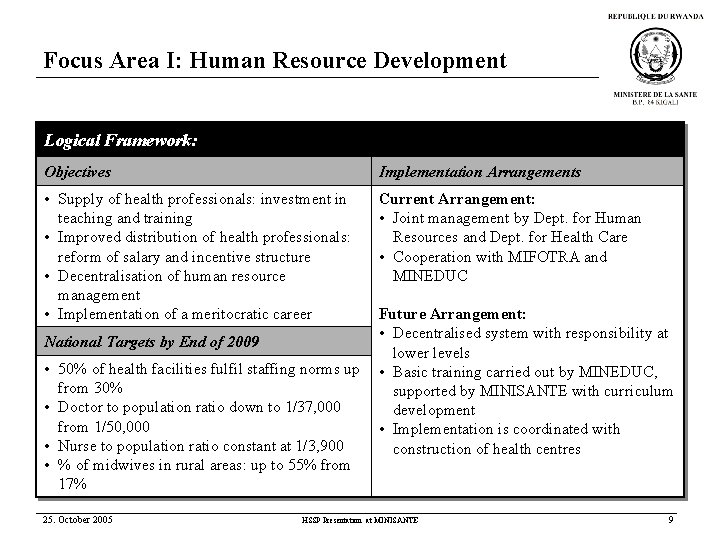
Focus Area I: Human Resource Development Logical Framework: Objectives Implementation Arrangements • Supply of health professionals: investment in teaching and training • Improved distribution of health professionals: reform of salary and incentive structure • Decentralisation of human resource management • Implementation of a meritocratic career advancement system National Targets by End of 2009 Current Arrangement: • Joint management by Dept. for Human Resources and Dept. for Health Care • Cooperation with MIFOTRA and MINEDUC • 50% of health facilities fulfil staffing norms up from 30% • Doctor to population ratio down to 1/37, 000 from 1/50, 000 • Nurse to population ratio constant at 1/3, 900 • % of midwives in rural areas: up to 55% from 17% 25. October 2005 Future Arrangement: • Decentralised system with responsibility at lower levels • Basic training carried out by MINEDUC, supported by MINISANTE with curriculum development • Implementation is coordinated with construction of health centres HSSP Presentation at MINISANTE 9
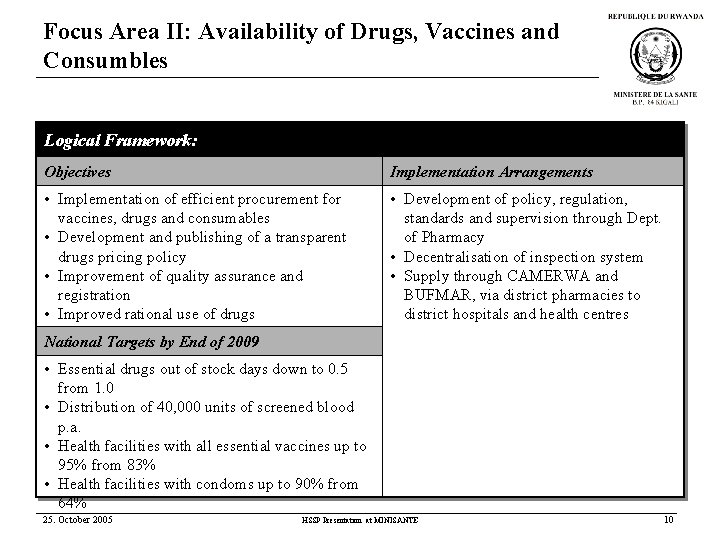
Focus Area II: Availability of Drugs, Vaccines and Consumbles Logical Framework: Objectives Implementation Arrangements • Implementation of efficient procurement for vaccines, drugs and consumables • Development and publishing of a transparent drugs pricing policy • Improvement of quality assurance and registration • Improved rational use of drugs • Development of policy, regulation, standards and supervision through Dept. of Pharmacy • Decentralisation of inspection system • Supply through CAMERWA and BUFMAR, via district pharmacies to district hospitals and health centres National Targets by End of 2009 • Essential drugs out of stock days down to 0. 5 from 1. 0 • Distribution of 40, 000 units of screened blood p. a. • Health facilities with all essential vaccines up to 95% from 83% • Health facilities with condoms up to 90% from 64% 25. October 2005 HSSP Presentation at MINISANTE 10
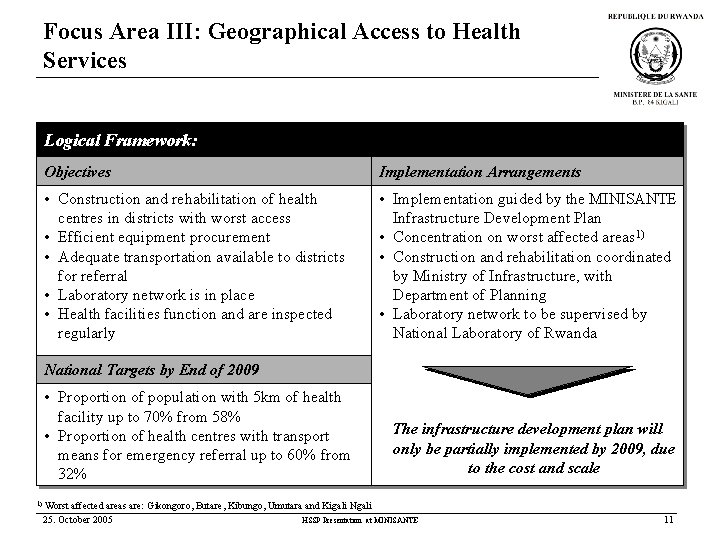
Focus Area III: Geographical Access to Health Services Logical Framework: Objectives Implementation Arrangements • Construction and rehabilitation of health centres in districts with worst access • Efficient equipment procurement • Adequate transportation available to districts for referral • Laboratory network is in place • Health facilities function and are inspected regularly • Implementation guided by the MINISANTE Infrastructure Development Plan • Concentration on worst affected areas 1) • Construction and rehabilitation coordinated by Ministry of Infrastructure, with Department of Planning • Laboratory network to be supervised by National Laboratory of Rwanda National Targets by End of 2009 • Proportion of population with 5 km of health facility up to 70% from 58% • Proportion of health centres with transport means for emergency referral up to 60% from 32% 1) The infrastructure development plan will only be partially implemented by 2009, due to the cost and scale Worst affected areas are: Gikongoro, Butare, Kibungo, Umutara and Kigali Ngali HSSP Presentation at MINISANTE 25. October 2005 11
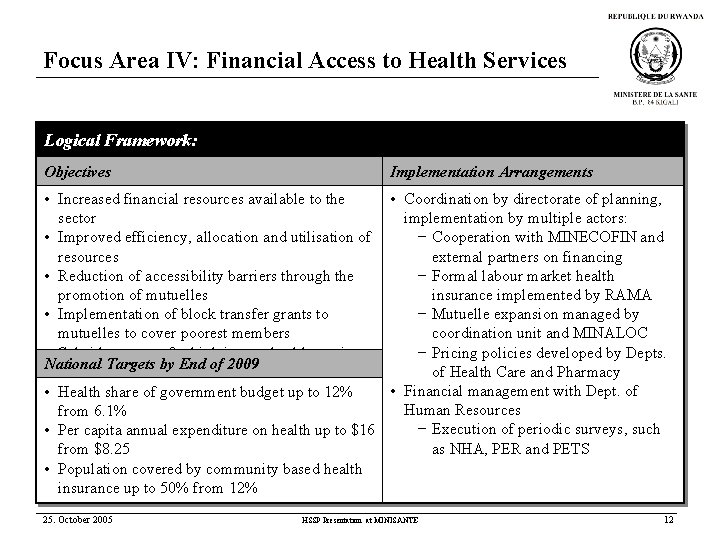
Focus Area IV: Financial Access to Health Services Logical Framework: Objectives Implementation Arrangements • Increased financial resources available to the sector • Improved efficiency, allocation and utilisation of resources • Reduction of accessibility barriers through the promotion of mutuelles • Implementation of block transfer grants to mutuelles to cover poorest members • Subsidy strategy for high impact health services National Targets by End of 2009 • Coordination by directorate of planning, implementation by multiple actors: − Cooperation with MINECOFIN and external partners on financing − Formal labour market health insurance implemented by RAMA − Mutuelle expansion managed by coordination unit and MINALOC − Pricing policies developed by Depts. of Health Care and Pharmacy • Financial management with Dept. of • Health share of government budget up to 12% Human Resources from 6. 1% − Execution of periodic surveys, such • Per capita annual expenditure on health up to $16 as NHA, PER and PETS from $8. 25 • Population covered by community based health insurance up to 50% from 12% 25. October 2005 HSSP Presentation at MINISANTE 12
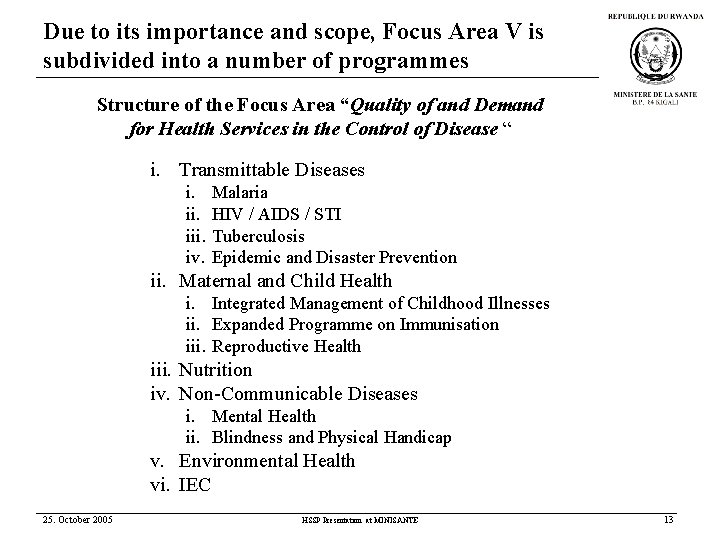
Due to its importance and scope, Focus Area V is subdivided into a number of programmes Structure of the Focus Area “Quality of and Demand for Health Services in the Control of Disease “ i. Transmittable Diseases i. iii. iv. Malaria HIV / AIDS / STI Tuberculosis Epidemic and Disaster Prevention ii. Maternal and Child Health i. Integrated Management of Childhood Illnesses ii. Expanded Programme on Immunisation iii. Reproductive Health iii. Nutrition iv. Non-Communicable Diseases i. Mental Health ii. Blindness and Physical Handicap v. Environmental Health vi. IEC 25. October 2005 HSSP Presentation at MINISANTE 13
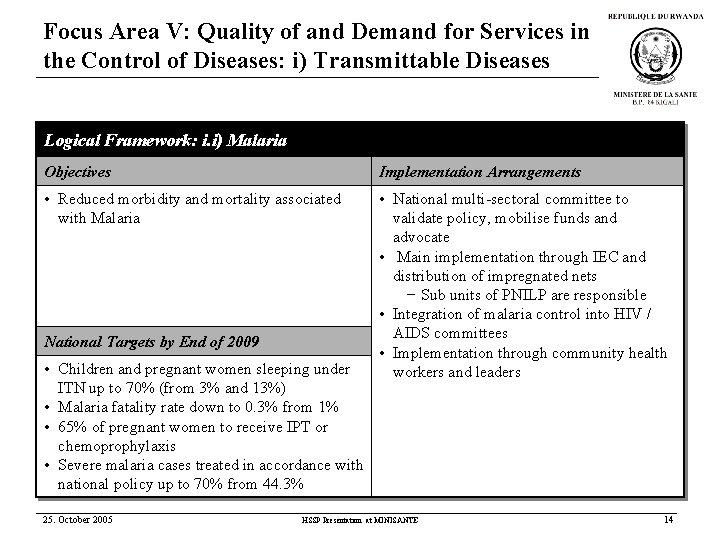
Focus Area V: Quality of and Demand for Services in the Control of Diseases: i) Transmittable Diseases Logical Framework: i. i) Malaria Objectives Implementation Arrangements • Reduced morbidity and mortality associated with Malaria • National multi-sectoral committee to validate policy, mobilise funds and advocate • Main implementation through IEC and distribution of impregnated nets − Sub units of PNILP are responsible • Integration of malaria control into HIV / AIDS committees • Implementation through community health workers and leaders National Targets by End of 2009 • Children and pregnant women sleeping under ITN up to 70% (from 3% and 13%) • Malaria fatality rate down to 0. 3% from 1% • 65% of pregnant women to receive IPT or chemoprophylaxis • Severe malaria cases treated in accordance with national policy up to 70% from 44. 3% 25. October 2005 HSSP Presentation at MINISANTE 14
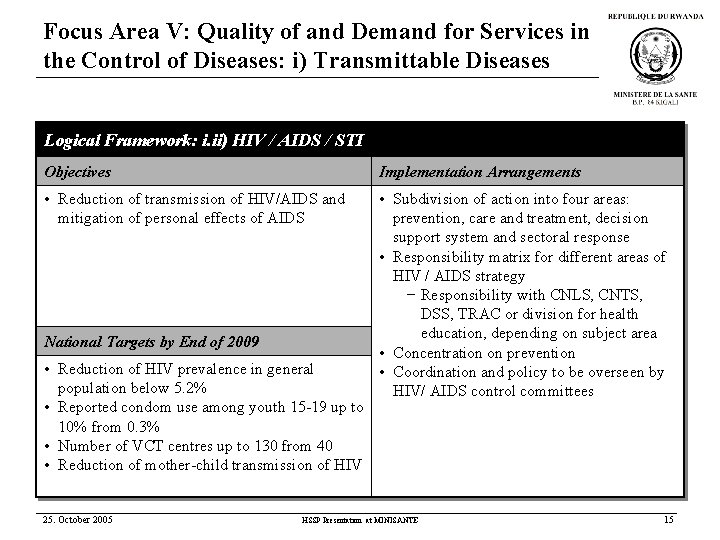
Focus Area V: Quality of and Demand for Services in the Control of Diseases: i) Transmittable Diseases Logical Framework: i. ii) HIV / AIDS / STI Objectives Implementation Arrangements • Reduction of transmission of HIV/AIDS and mitigation of personal effects of AIDS • Subdivision of action into four areas: prevention, care and treatment, decision support system and sectoral response • Responsibility matrix for different areas of HIV / AIDS strategy − Responsibility with CNLS, CNTS, DSS, TRAC or division for health education, depending on subject area • Concentration on prevention • Coordination and policy to be overseen by HIV/ AIDS control committees National Targets by End of 2009 • Reduction of HIV prevalence in general population below 5. 2% • Reported condom use among youth 15 -19 up to 10% from 0. 3% • Number of VCT centres up to 130 from 40 • Reduction of mother-child transmission of HIV 25. October 2005 HSSP Presentation at MINISANTE 15
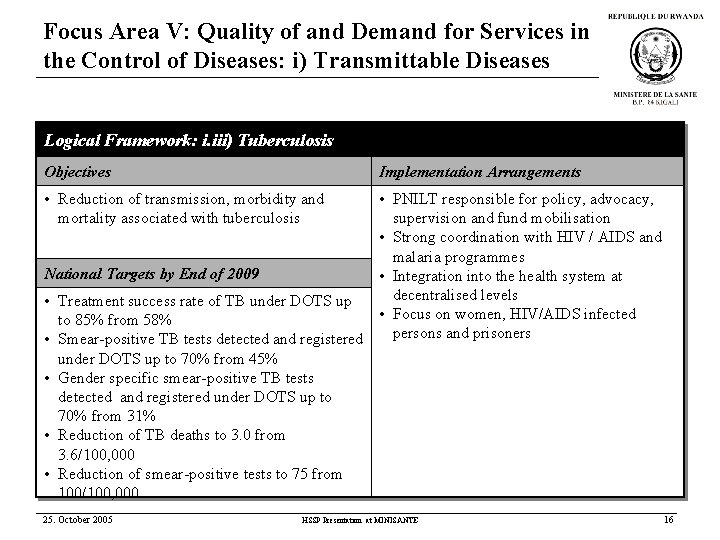
Focus Area V: Quality of and Demand for Services in the Control of Diseases: i) Transmittable Diseases Logical Framework: i. iii) Tuberculosis Objectives Implementation Arrangements • Reduction of transmission, morbidity and mortality associated with tuberculosis • PNILT responsible for policy, advocacy, supervision and fund mobilisation • Strong coordination with HIV / AIDS and malaria programmes National Targets by End of 2009 • Integration into the health system at decentralised levels • Treatment success rate of TB under DOTS up • Focus on women, HIV/AIDS infected to 85% from 58% persons and prisoners • Smear-positive TB tests detected and registered under DOTS up to 70% from 45% • Gender specific smear-positive TB tests detected and registered under DOTS up to 70% from 31% • Reduction of TB deaths to 3. 0 from 3. 6/100, 000 • Reduction of smear-positive tests to 75 from 100/100, 000 25. October 2005 HSSP Presentation at MINISANTE 16
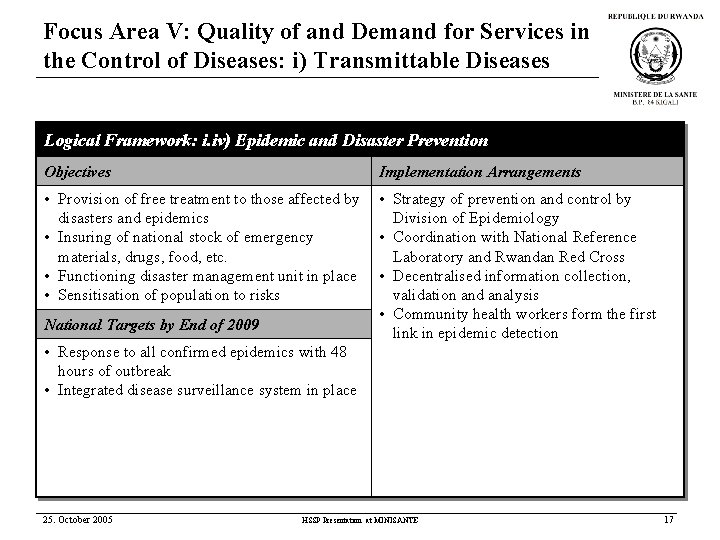
Focus Area V: Quality of and Demand for Services in the Control of Diseases: i) Transmittable Diseases Logical Framework: i. iv) Epidemic and Disaster Prevention Objectives Implementation Arrangements • Provision of free treatment to those affected by disasters and epidemics • Insuring of national stock of emergency materials, drugs, food, etc. • Functioning disaster management unit in place • Sensitisation of population to risks • Strategy of prevention and control by Division of Epidemiology • Coordination with National Reference Laboratory and Rwandan Red Cross • Decentralised information collection, validation and analysis • Community health workers form the first link in epidemic detection National Targets by End of 2009 • Response to all confirmed epidemics with 48 hours of outbreak • Integrated disease surveillance system in place 25. October 2005 HSSP Presentation at MINISANTE 17
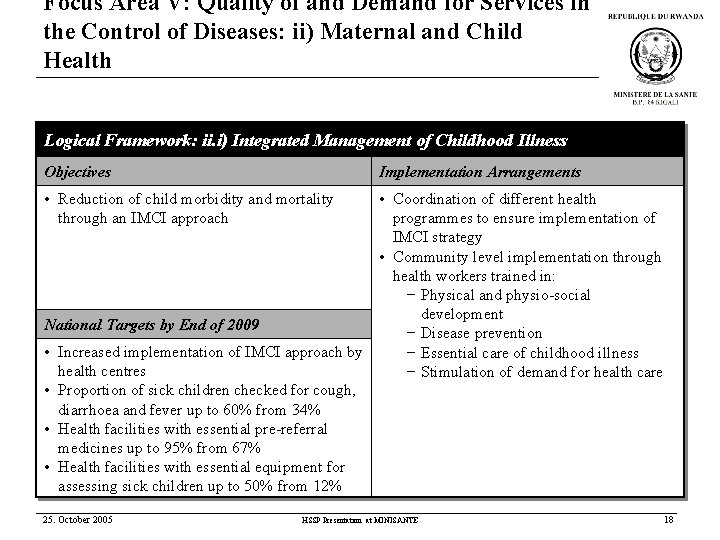
Focus Area V: Quality of and Demand for Services in the Control of Diseases: ii) Maternal and Child Health Logical Framework: ii. i) Integrated Management of Childhood Illness Objectives Implementation Arrangements • Reduction of child morbidity and mortality through an IMCI approach • Coordination of different health programmes to ensure implementation of IMCI strategy • Community level implementation through health workers trained in: − Physical and physio-social development National Targets by End of 2009 − Disease prevention • Increased implementation of IMCI approach by − Essential care of childhood illness health centres − Stimulation of demand for health care • Proportion of sick children checked for cough, diarrhoea and fever up to 60% from 34% • Health facilities with essential pre-referral medicines up to 95% from 67% • Health facilities with essential equipment for assessing sick children up to 50% from 12% 25. October 2005 HSSP Presentation at MINISANTE 18
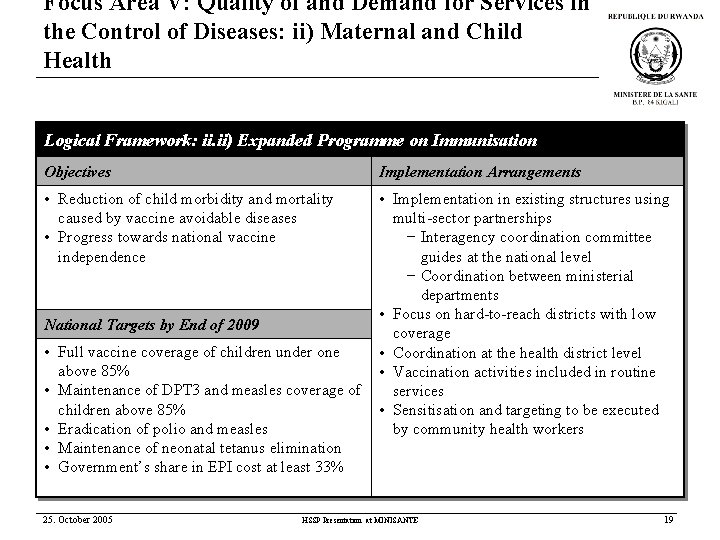
Focus Area V: Quality of and Demand for Services in the Control of Diseases: ii) Maternal and Child Health Logical Framework: ii. ii) Expanded Programme on Immunisation Objectives Implementation Arrangements • Reduction of child morbidity and mortality caused by vaccine avoidable diseases • Progress towards national vaccine independence • Implementation in existing structures using multi-sector partnerships − Interagency coordination committee guides at the national level − Coordination between ministerial departments • Focus on hard-to-reach districts with low coverage • Coordination at the health district level • Vaccination activities included in routine services • Sensitisation and targeting to be executed by community health workers National Targets by End of 2009 • Full vaccine coverage of children under one above 85% • Maintenance of DPT 3 and measles coverage of children above 85% • Eradication of polio and measles • Maintenance of neonatal tetanus elimination • Government’s share in EPI cost at least 33% 25. October 2005 HSSP Presentation at MINISANTE 19
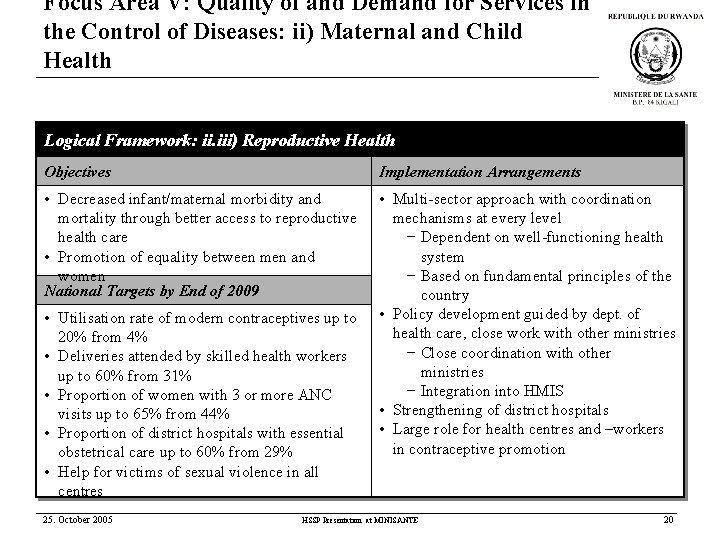
Focus Area V: Quality of and Demand for Services in the Control of Diseases: ii) Maternal and Child Health Logical Framework: ii. iii) Reproductive Health Objectives Implementation Arrangements • Decreased infant/maternal morbidity and mortality through better access to reproductive health care • Promotion of equality between men and women National Targets by End of 2009 • Multi-sector approach with coordination mechanisms at every level − Dependent on well-functioning health system − Based on fundamental principles of the country • Policy development guided by dept. of health care, close work with other ministries − Close coordination with other ministries − Integration into HMIS • Strengthening of district hospitals • Large role for health centres and –workers in contraceptive promotion • Utilisation rate of modern contraceptives up to 20% from 4% • Deliveries attended by skilled health workers up to 60% from 31% • Proportion of women with 3 or more ANC visits up to 65% from 44% • Proportion of district hospitals with essential obstetrical care up to 60% from 29% • Help for victims of sexual violence in all centres 25. October 2005 HSSP Presentation at MINISANTE 20
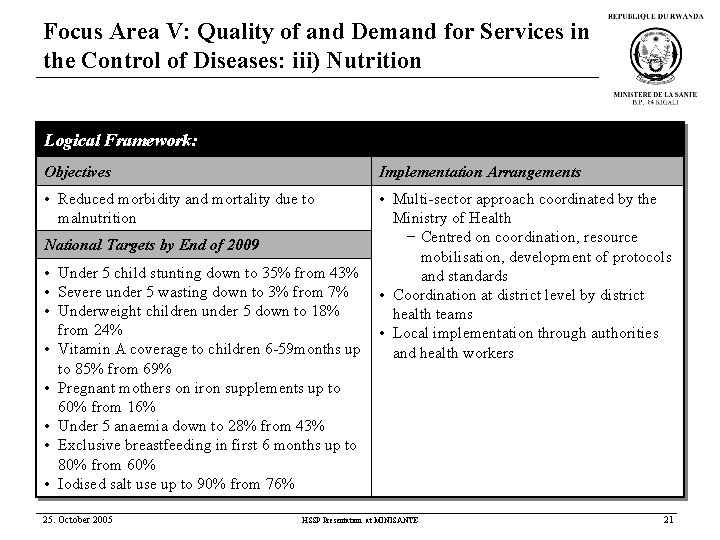
Focus Area V: Quality of and Demand for Services in the Control of Diseases: iii) Nutrition Logical Framework: Objectives Implementation Arrangements • Reduced morbidity and mortality due to malnutrition • Multi-sector approach coordinated by the Ministry of Health − Centred on coordination, resource mobilisation, development of protocols and standards • Coordination at district level by district health teams • Local implementation through authorities and health workers National Targets by End of 2009 • Under 5 child stunting down to 35% from 43% • Severe under 5 wasting down to 3% from 7% • Underweight children under 5 down to 18% from 24% • Vitamin A coverage to children 6 -59 months up to 85% from 69% • Pregnant mothers on iron supplements up to 60% from 16% • Under 5 anaemia down to 28% from 43% • Exclusive breastfeeding in first 6 months up to 80% from 60% • Iodised salt use up to 90% from 76% 25. October 2005 HSSP Presentation at MINISANTE 21
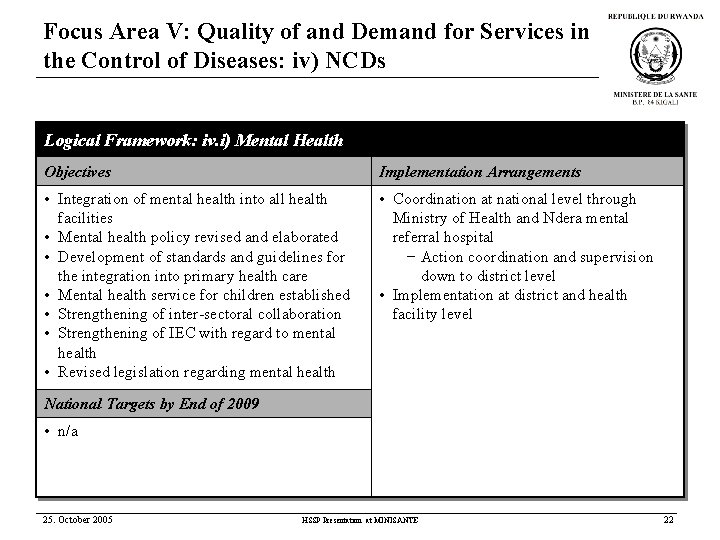
Focus Area V: Quality of and Demand for Services in the Control of Diseases: iv) NCDs Logical Framework: iv. i) Mental Health Objectives Implementation Arrangements • Integration of mental health into all health facilities • Mental health policy revised and elaborated • Development of standards and guidelines for the integration into primary health care • Mental health service for children established • Strengthening of inter-sectoral collaboration • Strengthening of IEC with regard to mental health • Revised legislation regarding mental health • Coordination at national level through Ministry of Health and Ndera mental referral hospital − Action coordination and supervision down to district level • Implementation at district and health facility level National Targets by End of 2009 • n/a 25. October 2005 HSSP Presentation at MINISANTE 22
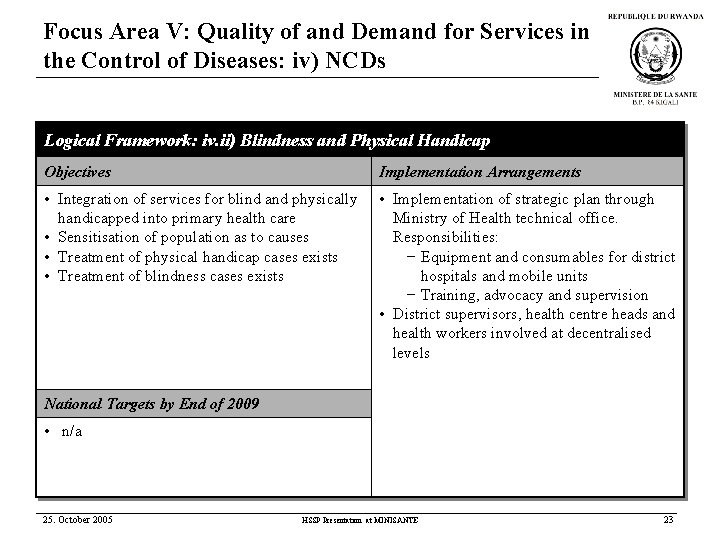
Focus Area V: Quality of and Demand for Services in the Control of Diseases: iv) NCDs Logical Framework: iv. ii) Blindness and Physical Handicap Objectives Implementation Arrangements • Integration of services for blind and physically handicapped into primary health care • Sensitisation of population as to causes • Treatment of physical handicap cases exists • Treatment of blindness cases exists • Implementation of strategic plan through Ministry of Health technical office. Responsibilities: − Equipment and consumables for district hospitals and mobile units − Training, advocacy and supervision • District supervisors, health centre heads and health workers involved at decentralised levels National Targets by End of 2009 • n/a 25. October 2005 HSSP Presentation at MINISANTE 23
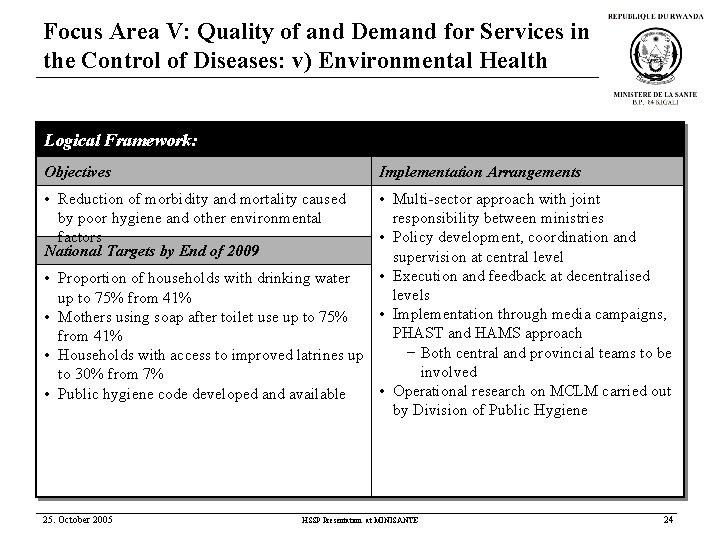
Focus Area V: Quality of and Demand for Services in the Control of Diseases: v) Environmental Health Logical Framework: Objectives Implementation Arrangements • Reduction of morbidity and mortality caused by poor hygiene and other environmental factors National Targets by End of 2009 • • • Multi-sector approach with joint responsibility between ministries • Policy development, coordination and supervision at central level • Execution and feedback at decentralised Proportion of households with drinking water levels up to 75% from 41% • Implementation through media campaigns, Mothers using soap after toilet use up to 75% PHAST and HAMS approach from 41% − Both central and provincial teams to be Households with access to improved latrines up involved to 30% from 7% • Operational research on MCLM carried out Public hygiene code developed and available by Division of Public Hygiene 25. October 2005 HSSP Presentation at MINISANTE 24
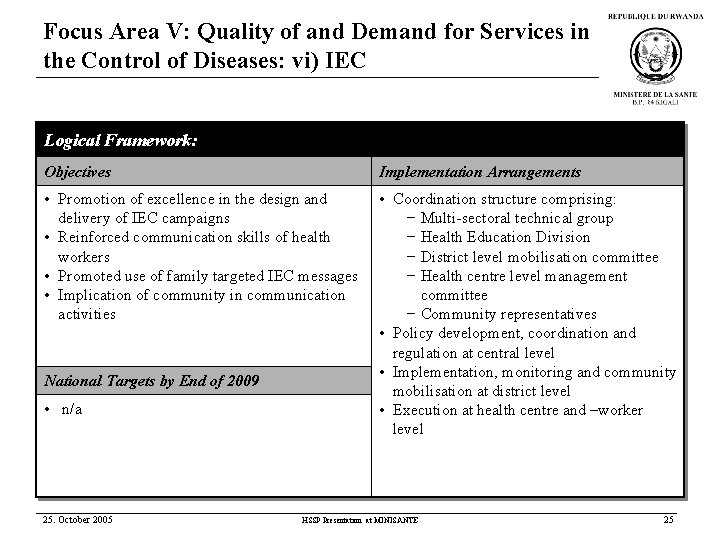
Focus Area V: Quality of and Demand for Services in the Control of Diseases: vi) IEC Logical Framework: Objectives Implementation Arrangements • Promotion of excellence in the design and delivery of IEC campaigns • Reinforced communication skills of health workers • Promoted use of family targeted IEC messages • Implication of community in communication activities • Coordination structure comprising: − Multi-sectoral technical group − Health Education Division − District level mobilisation committee − Health centre level management committee − Community representatives • Policy development, coordination and regulation at central level • Implementation, monitoring and community mobilisation at district level • Execution at health centre and –worker level National Targets by End of 2009 • n/a 25. October 2005 HSSP Presentation at MINISANTE 25
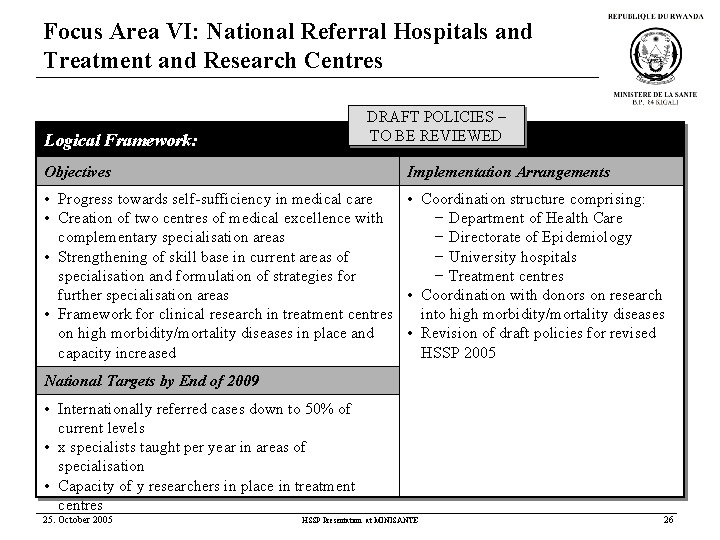
Focus Area VI: National Referral Hospitals and Treatment and Research Centres DRAFT POLICIES – TO BE REVIEWED Logical Framework: Objectives Implementation Arrangements • Progress towards self-sufficiency in medical care • Coordination structure comprising: • Creation of two centres of medical excellence with − Department of Health Care complementary specialisation areas − Directorate of Epidemiology • Strengthening of skill base in current areas of − University hospitals specialisation and formulation of strategies for − Treatment centres further specialisation areas • Coordination with donors on research • Framework for clinical research in treatment centres into high morbidity/mortality diseases on high morbidity/mortality diseases in place and • Revision of draft policies for revised capacity increased HSSP 2005 National Targets by End of 2009 • Internationally referred cases down to 50% of current levels • x specialists taught per year in areas of specialisation • Capacity of y researchers in place in treatment centres 25. October 2005 HSSP Presentation at MINISANTE 26
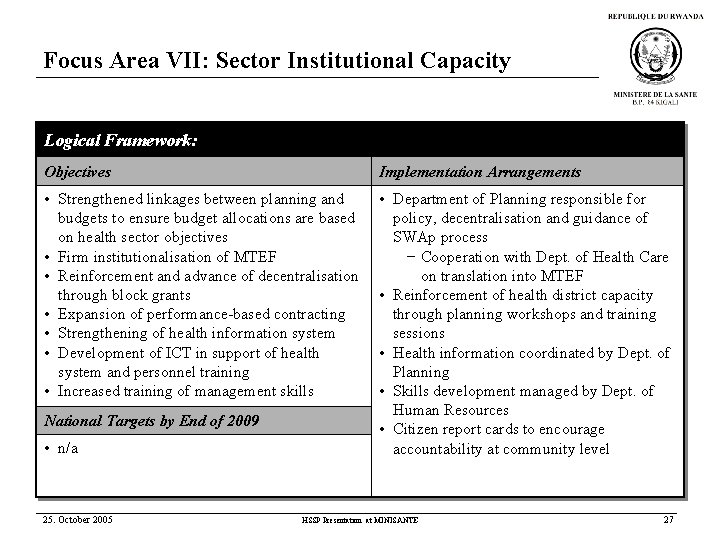
Focus Area VII: Sector Institutional Capacity Logical Framework: Objectives Implementation Arrangements • Strengthened linkages between planning and budgets to ensure budget allocations are based on health sector objectives • Firm institutionalisation of MTEF • Reinforcement and advance of decentralisation through block grants • Expansion of performance-based contracting • Strengthening of health information system • Development of ICT in support of health system and personnel training • Increased training of management skills • Department of Planning responsible for policy, decentralisation and guidance of SWAp process − Cooperation with Dept. of Health Care on translation into MTEF • Reinforcement of health district capacity through planning workshops and training sessions • Health information coordinated by Dept. of Planning • Skills development managed by Dept. of Human Resources • Citizen report cards to encourage accountability at community level National Targets by End of 2009 • n/a 25. October 2005 HSSP Presentation at MINISANTE 27
Agenda Introduction: The Structure of the HSSP Strategic Framework: The Seven Focus Areas of the HSSP Implementation, Costing and Evaluation 25. October 2005 HSSP Presentation at MINISANTE 28
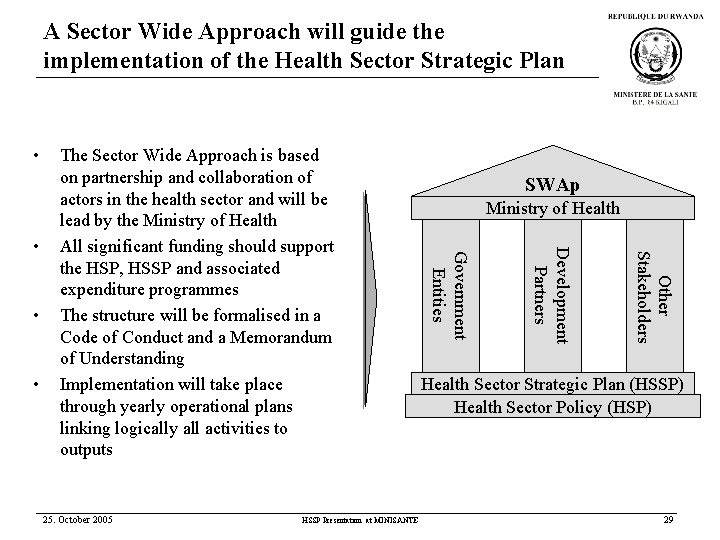
A Sector Wide Approach will guide the implementation of the Health Sector Strategic Plan • 25. October 2005 HSSP Presentation at MINISANTE Other Stakeholders • Ministry of Health Development Partners • SWAp Government Entities • The Sector Wide Approach is based on partnership and collaboration of actors in the health sector and will be lead by the Ministry of Health All significant funding should support the HSP, HSSP and associated expenditure programmes The structure will be formalised in a Code of Conduct and a Memorandum of Understanding Implementation will take place through yearly operational plans linking logically all activities to outputs Health Sector Strategic Plan (HSSP) Health Sector Policy (HSP) 29
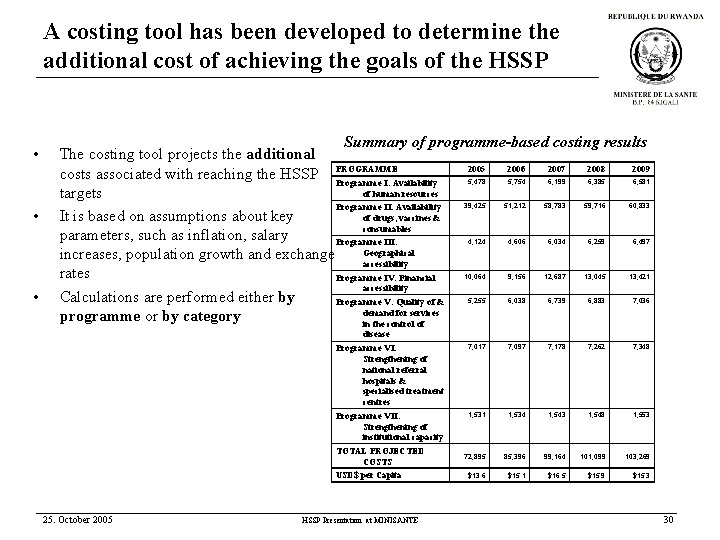
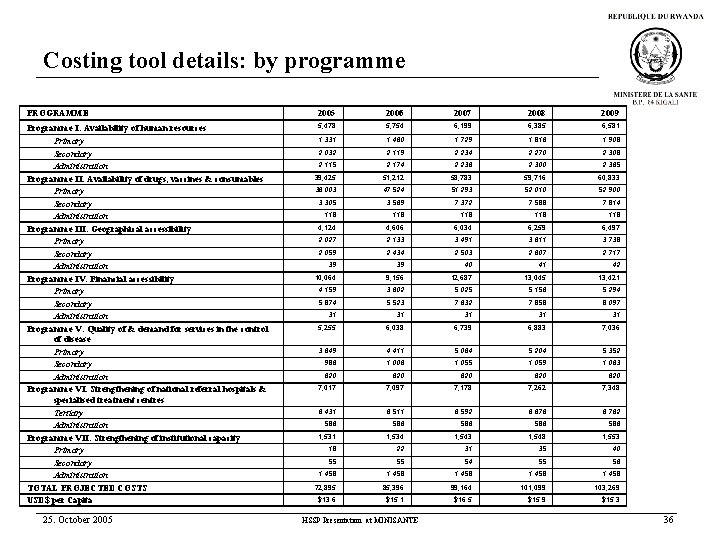
A costing tool has been developed to determine the additional cost of achieving the goals of the HSSP • • • Summary of programme-based costing results The costing tool projects the additional 2005 2006 2007 2008 2009 costs associated with reaching the HSSP PROGRAMME 5, 478 5, 754 6, 199 6, 385 6, 581 Programme I: Availability of human resources targets 39, 425 51, 212 58, 783 59, 716 60, 833 Programme II: Availability It is based on assumptions about key of drugs, vaccines & consumables parameters, such as inflation, salary 4, 124 4, 606 6, 034 6, 259 6, 497 Programme III: Geographical increases, population growth and exchange accessibility rates 10, 064 9, 156 12, 687 13, 045 13, 421 Programme IV: Financial accessibility Calculations are performed either by 5, 255 6, 038 6, 739 6, 883 7, 036 Programme V: Quality of & demand for services programme or by category in the control of disease Programme VI: Strengthening of national referral hospitals & specialised treatment centres 7, 017 7, 097 7, 178 7, 262 7, 348 Programme VII: Strengthening of institutional capacity 1, 531 1, 534 1, 543 1, 548 1, 553 72, 895 85, 396 99, 164 101, 099 103, 269 $13. 6 $15. 1 $16. 5 $15. 9 $15. 3 TOTAL PROJECTED COSTS USD$ per Capita 25. October 2005 HSSP Presentation at MINISANTE 30
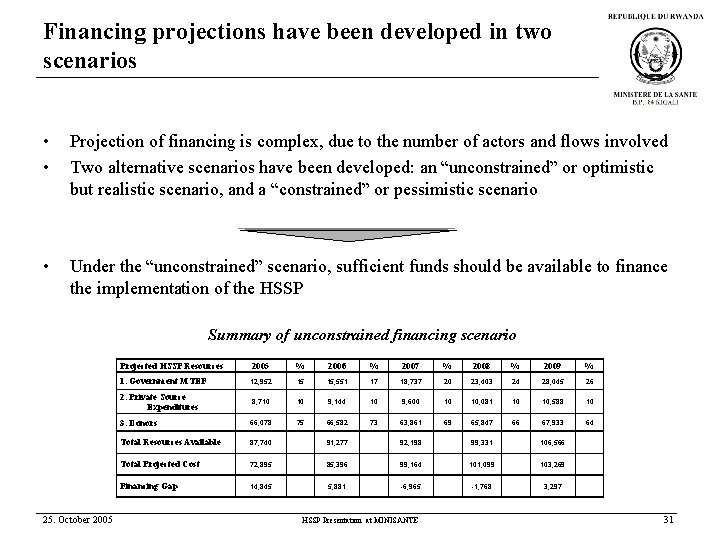
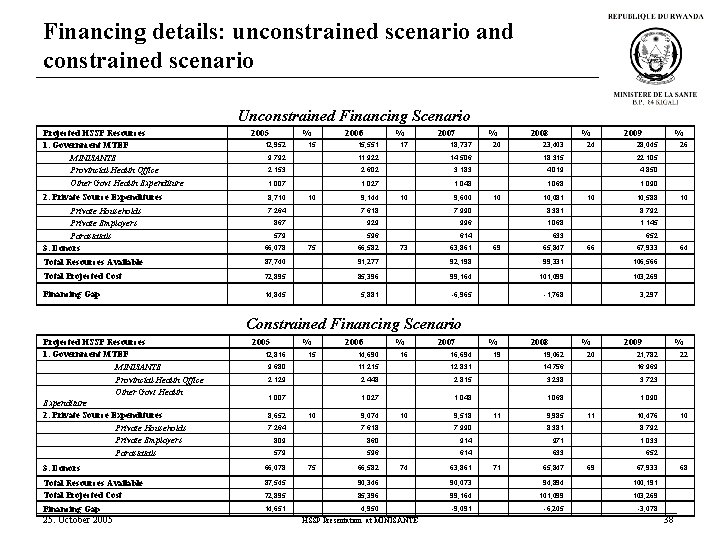
Financing projections have been developed in two scenarios • • Projection of financing is complex, due to the number of actors and flows involved Two alternative scenarios have been developed: an “unconstrained” or optimistic but realistic scenario, and a “constrained” or pessimistic scenario • Under the “unconstrained” scenario, sufficient funds should be available to finance the implementation of the HSSP Summary of unconstrained financing scenario 25. October 2005 Projected HSSP Resources 2005 % 2006 % 2007 % 2008 % 2009 % 1. Government MTEF 12, 952 15 15, 551 17 18, 737 20 23, 403 24 28, 045 26 2. Private Source Expenditures 8, 710 10 9, 144 10 9, 600 10 10, 081 10 10, 588 10 3. Donors 66, 078 75 66, 582 73 63, 861 69 65, 847 66 67, 933 64 Total Resources Available 87, 740 91, 277 92, 198 99, 331 106, 566 Total Projected Cost 72, 895 85, 396 99, 164 101, 099 103, 269 Financing Gap 14, 845 5, 881 -6, 965 -1, 768 3, 297 HSSP Presentation at MINISANTE 31
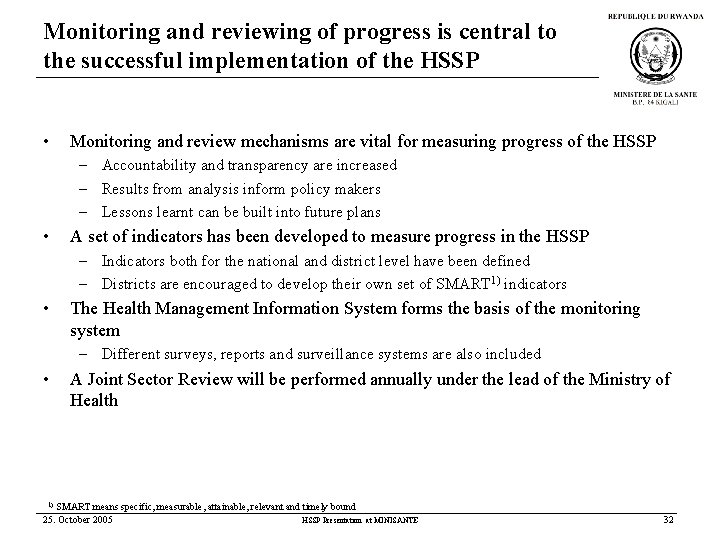
Monitoring and reviewing of progress is central to the successful implementation of the HSSP • Monitoring and review mechanisms are vital for measuring progress of the HSSP – Accountability and transparency are increased – Results from analysis inform policy makers – Lessons learnt can be built into future plans • A set of indicators has been developed to measure progress in the HSSP – Indicators both for the national and district level have been defined – Districts are encouraged to develop their own set of SMART 1) indicators • The Health Management Information System forms the basis of the monitoring system – Different surveys, reports and surveillance systems are also included • A Joint Sector Review will be performed annually under the lead of the Ministry of Health SMART means specific, measurable, attainable, relevant and timely bound HSSP Presentation 25. October 2005 1) at MINISANTE 32
Thank you for your attention 25. October 2005 HSSP Presentation at MINISANTE 33
Annex 25. October 2005 HSSP Presentation at MINISANTE 34
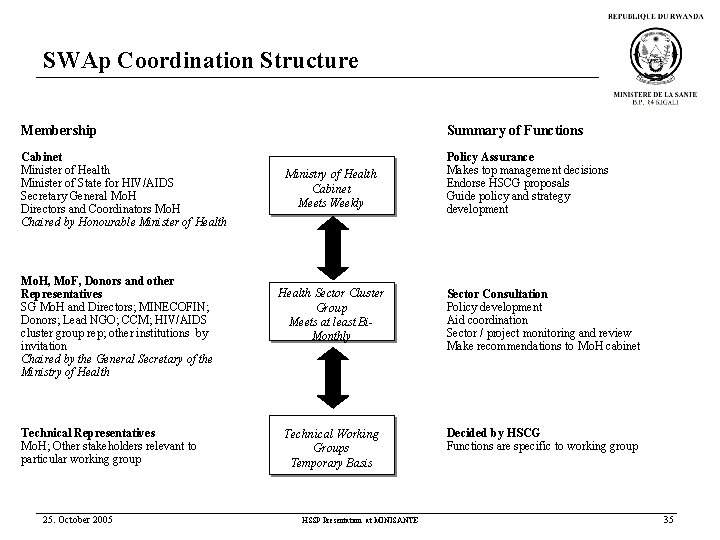
SWAp Coordination Structure Membership Summary of Functions Cabinet Minister of Health Minister of State for HIV/AIDS Secretary General Mo. H Directors and Coordinators Mo. H Chaired by Honourable Minister of Health Policy Assurance Makes top management decisions Endorse HSCG proposals Guide policy and strategy development Mo. H, Mo. F, Donors and other Representatives SG Mo. H and Directors; MINECOFIN; Donors; Lead NGO; CCM; HIV/AIDS cluster group rep; other institutions by invitation Chaired by the General Secretary of the Ministry of Health Technical Representatives Mo. H; Other stakeholders relevant to particular working group 25. October 2005 Ministry of Health Cabinet Meets Weekly Health Sector Cluster Group Meets at least Bi. Monthly Sector Consultation Policy development Aid coordination Sector / project monitoring and review Make recommendations to Mo. H cabinet Technical Working Groups Temporary Basis Decided by HSCG Functions are specific to working group HSSP Presentation at MINISANTE 35
Costing tool details: by programme PROGRAMME 2005 2006 2007 2008 2009 Programme I: Availability of human resources Primary Secondary Administration Programme II: Availability of drugs, vaccines & consumables Primary Secondary Administration Programme III: Geographical accessibility Primary Secondary Administration Programme IV: Financial accessibility Primary Secondary Administration Programme V: Quality of & demand for services in the control of disease Primary Secondary Administration Programme VI: Strengthening of national referral hospitals & specialised treatment centres Tertiary Administration Programme VII: Strengthening of institutional capacity Primary Secondary Administration TOTAL PROJECTED COSTS USD$ per Capita 5, 478 5, 754 6, 199 6, 385 6, 581 1, 331 1, 460 1, 729 1, 816 1, 908 2, 032 2, 119 2, 234 2, 270 2, 308 2, 115 2, 174 2, 236 2, 300 2, 365 39, 425 51, 212 58, 783 59, 716 60, 833 36, 003 47, 524 51, 293 52, 010 52, 900 3, 305 3, 569 7, 372 7, 588 7, 814 118 118 118 4, 124 4, 606 6, 034 6, 259 6, 497 2, 027 2, 133 3, 491 3, 611 3, 738 2, 059 2, 434 2, 503 2, 607 2, 717 39 39 40 41 42 10, 064 9, 156 12, 687 13, 045 13, 421 4, 159 3, 602 5, 025 5, 156 5, 294 5, 874 5, 523 7, 632 7, 858 8, 097 31 31 31 5, 255 6, 038 6, 739 6, 883 7, 036 3, 649 4, 411 5, 064 5, 204 5, 352 986 1, 006 1, 055 1, 059 1, 063 620 620 620 7, 017 7, 097 7, 178 7, 262 7, 348 6, 431 6, 511 6, 592 6, 676 6, 762 586 586 586 1, 531 1, 534 1, 543 1, 548 1, 553 18 22 31 35 40 55 55 54 55 56 25. October 2005 1, 458 1, 458 72, 895 85, 396 99, 164 101, 099 103, 269 $13. 6 $15. 1 $16. 5 $15. 9 $15. 3 HSSP Presentation at MINISANTE 36
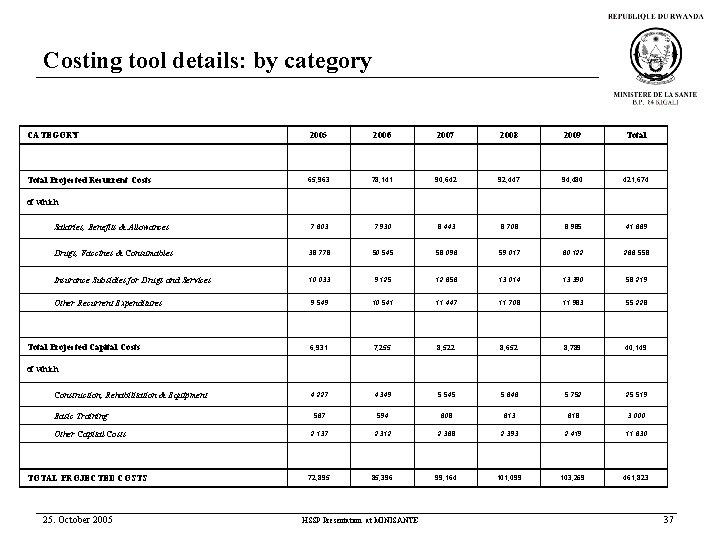
Costing tool details: by category CATEGORY 2005 2006 2007 2008 2009 Total Projected Recurrent Costs 65, 963 78, 141 90, 642 92, 447 94, 480 421, 674 Salaries, Benefits & Allowances 7, 603 7, 930 8, 443 8, 708 8, 985 41, 669 Drugs, Vaccines & Consumables 38, 778 50, 545 58, 096 59, 017 60, 122 266, 558 Insurance Subsidies for Drugs and Services 10, 033 9, 125 12, 656 13, 014 13, 390 58, 219 Other Recurrent Expenditures 9, 549 10, 541 11, 447 11, 708 11, 983 55, 228 6, 931 7, 255 8, 522 8, 652 8, 789 40, 149 4, 227 4, 349 5, 545 5, 646 5, 752 25, 519 567 594 608 613 618 3, 000 2, 137 2, 312 2, 368 2, 393 2, 419 11, 630 72, 895 85, 396 99, 164 101, 099 103, 269 461, 823 of which Total Projected Capital Costs of which Construction, Rehabilitation & Equipment Basic Training Other Capital Costs TOTAL PROJECTED COSTS 25. October 2005 HSSP Presentation at MINISANTE 37
Financing details: unconstrained scenario and constrained scenario Unconstrained Financing Scenario Projected HSSP Resources 1. Government MTEF MINISANTE Provincial Health Office Other Govt Health Expenditure 2005 % 12, 952 15 2006 % 15, 551 17 2007 % 18, 737 20 2008 % 23, 403 24 2009 % 28, 045 9, 792 11, 922 14, 506 18, 315 22, 105 2, 153 2, 602 3, 183 4, 019 4, 850 1, 007 1, 027 1, 048 1, 068 1, 090 2. Private Source Expenditures Private Households Private Employers Parastatals 3. Donors 66, 078 Total Resources Available 87, 740 91, 277 92, 198 99, 331 106, 566 Total Projected Cost 72, 895 85, 396 99, 164 101, 099 103, 269 Financing Gap 14, 845 5, 881 -6, 965 -1, 768 3, 297 8, 710 10 9, 144 10 9, 600 10 10, 081 10 10, 588 7, 264 7, 618 7, 990 8, 381 8, 792 867 929 996 1, 068 1, 145 579 596 614 633 75 66, 582 73 63, 861 69 65, 847 26 10 652 66 67, 933 64 Constrained Financing Scenario Projected HSSP Resources 1. Government MTEF MINISANTE Provincial Health Office Other Govt Health Expenditure 2. Private Source Expenditures Private Households Private Employers Parastatals 2005 % 12, 816 15 2006 % 14, 690 16 2007 % 16, 694 19 2008 % 19, 062 20 2009 % 21, 782 9, 680 11, 215 12, 831 14, 756 16, 969 2, 129 2, 448 2, 815 3, 238 3, 723 1, 007 1, 027 1, 048 1, 068 1, 090 8, 652 10 9, 074 10 9, 518 11 9, 985 11 10, 476 7, 264 7, 618 7, 990 8, 381 8, 792 809 860 914 971 1, 033 579 596 614 633 652 3. Donors 66, 078 Total Resources Available Total Projected Cost 87, 545 90, 346 90, 073 94, 894 100, 191 72, 895 85, 396 99, 164 101, 099 103, 269 Financing Gap 14, 651 4, 950 -9, 091 -6, 205 -3, 078 25. October 2005 75 66, 582 74 HSSP Presentation at MINISANTE 63, 861 71 65, 847 69 22 10 67, 933 68 38