
Directly Modulated OEICWC 1 st Generation Task Area


- Slides: 17
Directly Modulated OEIC-WC (1 st Generation – Task Area 3) Jeff Henness, John Hutchinson (Intel), Leif Johansson, Jon Barton, Matt Sysak, Jon Getty, Larry Coldren University of California Santa Barbara Chip-Scale WDM Program
Overview • Objective/Scope – Demonstrate a modulated OEIC-WC with monitoring capability • Approach – Photodiode directly connected to SGDBR gain • Major Accomplishment – Designed and fabricated 1 st run of 1 st gen OEIC-WC – Begun initial testing/characterization • Main Issues/Problems/Limitations – – Contacts, parasitics in test setup limit RF performance Improve monitor design Improve preamp-SOA design, SGDBR tuning, power output Extinction ratio and chirp University of California Santa Barbara Chip-Scale WDM Program
OEIC Approach • In-situ signal monitoring provided • No carrier lifetime limitations – Reduce pattern dependence – Increase linearity – Increase bandwidth • • No filter to remove input wavelength Separate optimization of detection and modulation Net signal gain and programmable 2 R regeneration possible High integration density – no branching waveguides required University of California Santa Barbara Chip-Scale WDM Program
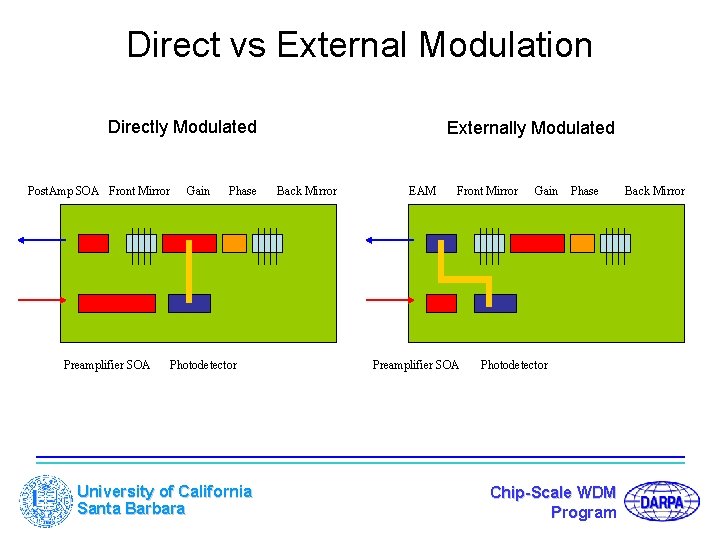
Direct vs External Modulation Directly Modulated Post. Amp SOA Front Mirror Preamplifier SOA Gain Phase Photodetector University of California Santa Barbara Externally Modulated Back Mirror EAM Front Mirror Preamplifier SOA Gain Phase Photodetector Chip-Scale WDM Program Back Mirror
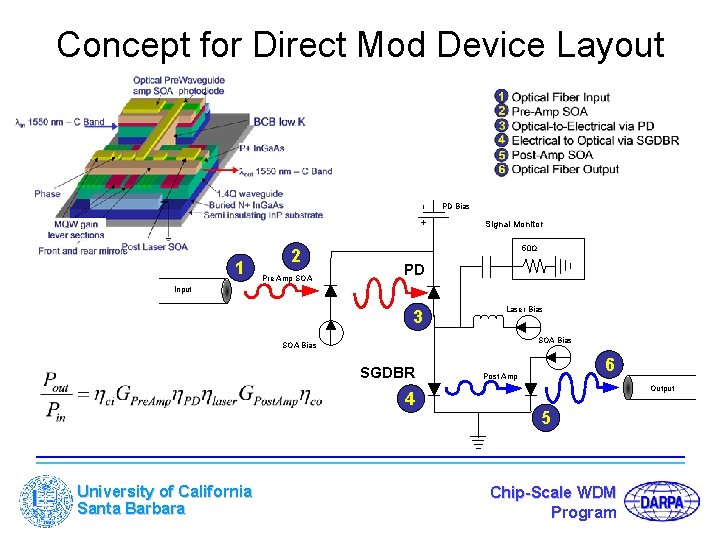
Concept for Direct Mod Device Layout PD Bias Signal Monitor 1 2 Pre Amp SOA 50Ω PD Input 3 Laser Bias SOA Bias SGDBR 4 University of California Santa Barbara 6 Post Amp Output 5 Chip-Scale WDM Program
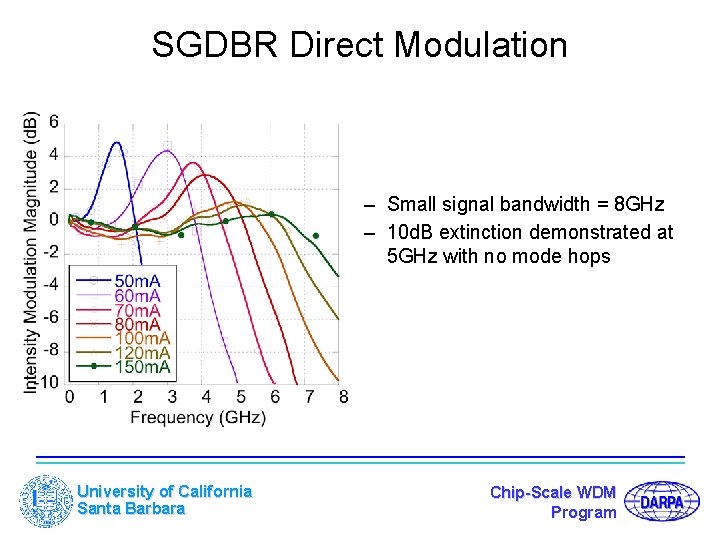
SGDBR Direct Modulation – Small signal bandwidth = 8 GHz – 10 d. B extinction demonstrated at 5 GHz with no mode hops University of California Santa Barbara Chip-Scale WDM Program
Laser Efficiency Enhancements • Gain-lever • Cascaded Multiple Active Region (MAR) University of California Santa Barbara Chip-Scale WDM Program
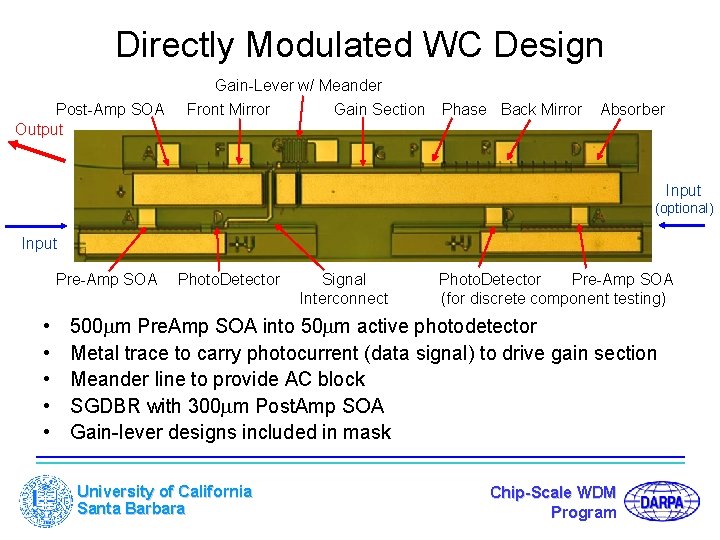
Directly Modulated WC Design Post-Amp SOA Output Gain-Lever w/ Meander Front Mirror Gain Section Phase Back Mirror Absorber Input (optional) Input Pre-Amp SOA • • • Photo. Detector Signal Interconnect Photo. Detector Pre-Amp SOA (for discrete component testing) 500 m Pre. Amp SOA into 50 m active photodetector Metal trace to carry photocurrent (data signal) to drive gain section Meander line to provide AC block SGDBR with 300 m Post. Amp SOA Gain-lever designs included in mask University of California Santa Barbara Chip-Scale WDM Program
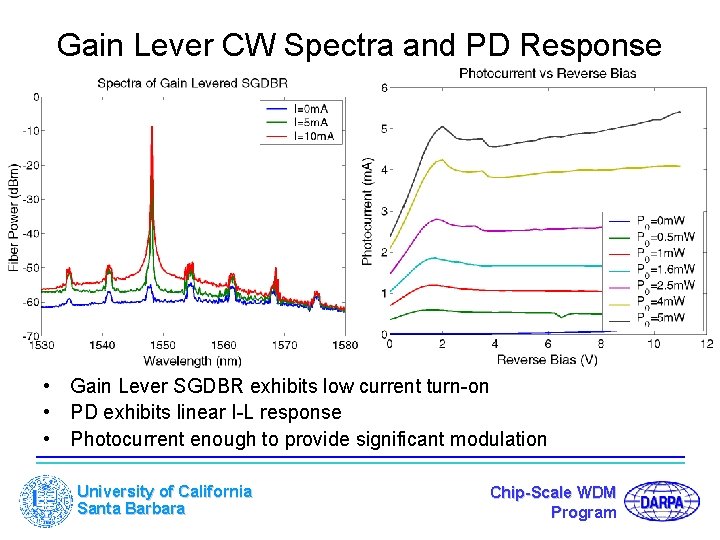
Gain Lever CW Spectra and PD Response • Gain Lever SGDBR exhibits low current turn-on • PD exhibits linear I-L response • Photocurrent enough to provide significant modulation University of California Santa Barbara Chip-Scale WDM Program
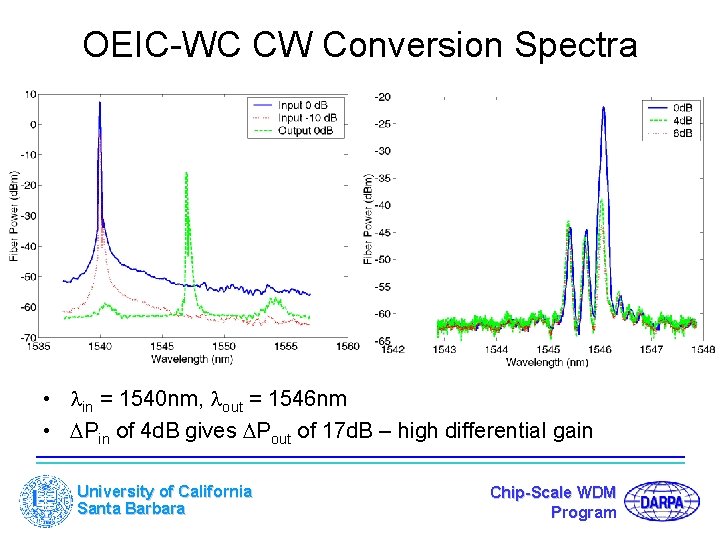
OEIC-WC CW Conversion Spectra • in = 1540 nm, out = 1546 nm • Pin of 4 d. B gives Pout of 17 d. B – high differential gain University of California Santa Barbara Chip-Scale WDM Program
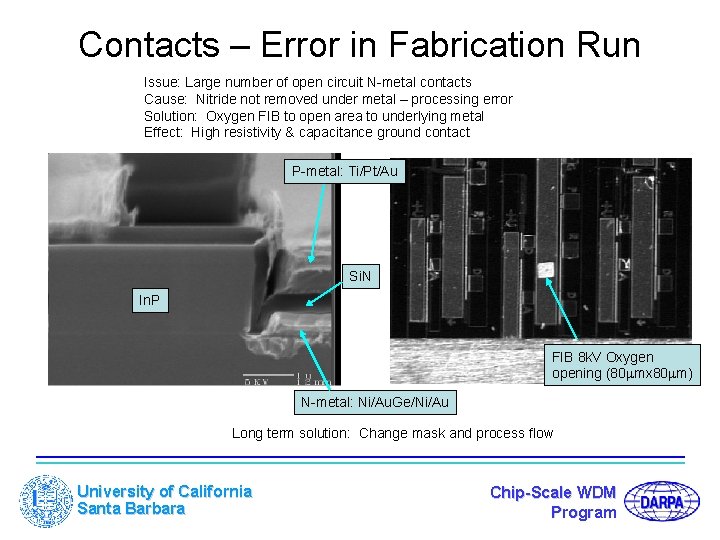
Contacts – Error in Fabrication Run Issue: Large number of open circuit N-metal contacts Cause: Nitride not removed under metal – processing error Solution: Oxygen FIB to open area to underlying metal Effect: High resistivity & capacitance ground contact P-metal: Ti/Pt/Au Si. N In. P FIB 8 k. V Oxygen opening (80 mx 80 m) N-metal: Ni/Au. Ge/Ni/Au Long term solution: Change mask and process flow University of California Santa Barbara Chip-Scale WDM Program
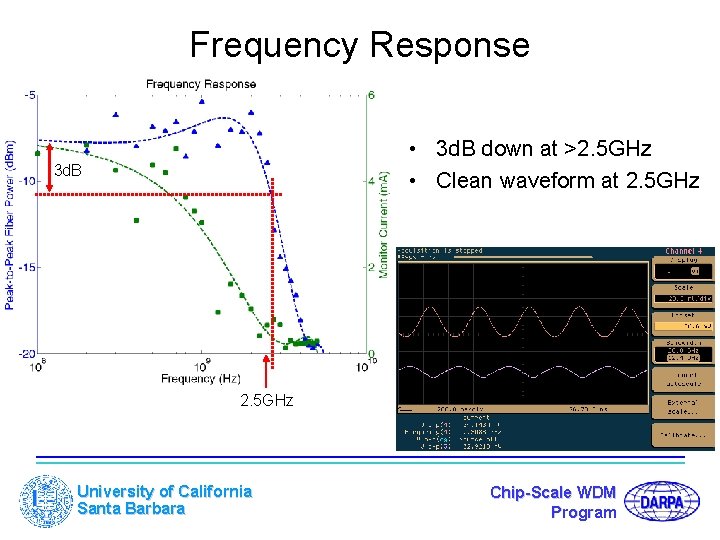
Frequency Response • 3 d. B down at >2. 5 GHz • Clean waveform at 2. 5 GHz 3 d. B 2. 5 GHz University of California Santa Barbara Chip-Scale WDM Program
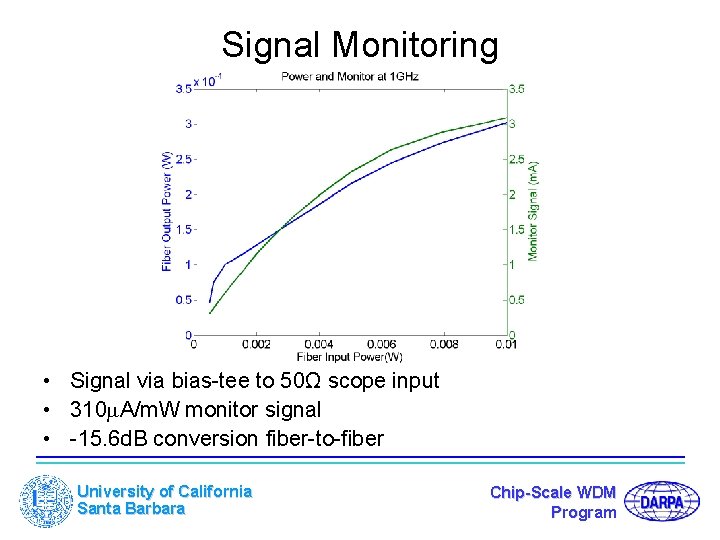
Signal Monitoring • Signal via bias-tee to 50Ω scope input • 310 A/m. W monitor signal • -15. 6 d. B conversion fiber-to-fiber University of California Santa Barbara Chip-Scale WDM Program
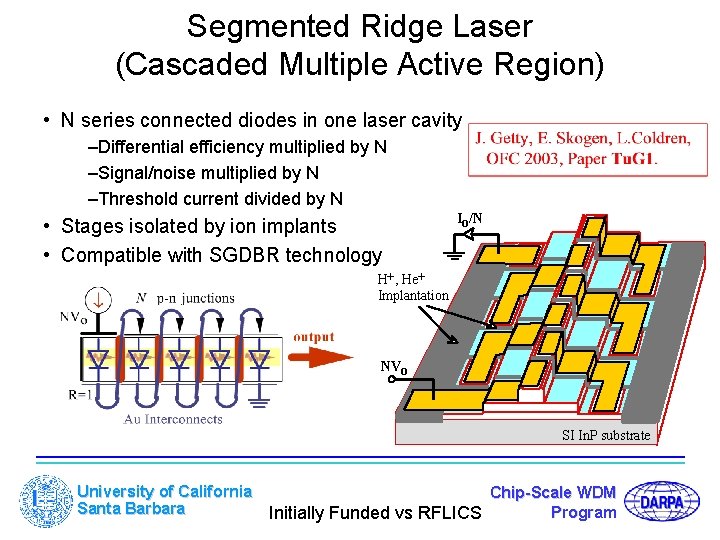
Segmented Ridge Laser (Cascaded Multiple Active Region) • N series connected diodes in one laser cavity –Differential efficiency multiplied by N –Signal/noise multiplied by N –Threshold current divided by N • Stages isolated by ion implants • Compatible with SGDBR technology Io/N H+, He+ Implantation NVo SI In. P substrate University of California Santa Barbara Chip-Scale WDM Program Initially Funded vs RFLICS
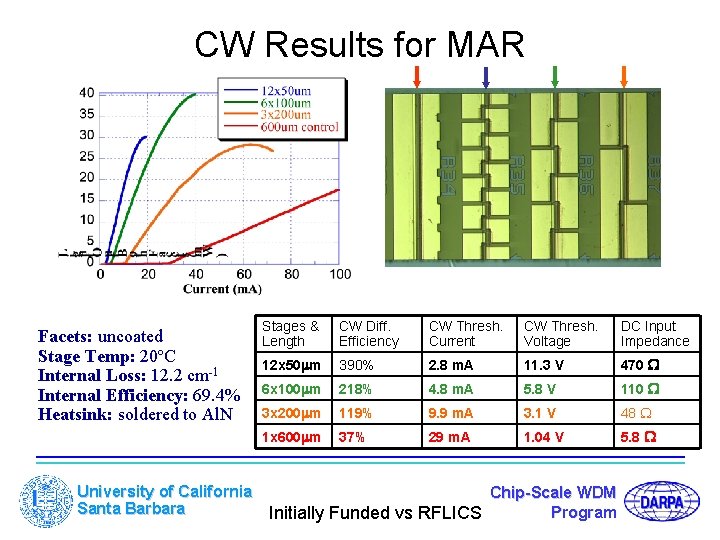
CW Results for MAR Facets: uncoated Stage Temp: 20ºC Internal Loss: 12. 2 cm-1 Internal Efficiency: 69. 4% Heatsink: soldered to Al. N University of California Santa Barbara Stages & Length CW Diff. Efficiency CW Thresh. Current CW Thresh. Voltage DC Input Impedance 12 x 50 mm 390% 2. 8 m. A 11. 3 V 470 W 6 x 100 mm 218% 4. 8 m. A 5. 8 V 110 W 3 x 200 mm 119% 9. 9 m. A 3. 1 V 48 W 1 x 600 mm 37% 29 m. A 1. 04 V 5. 8 W Chip-Scale WDM Program Initially Funded vs RFLICS
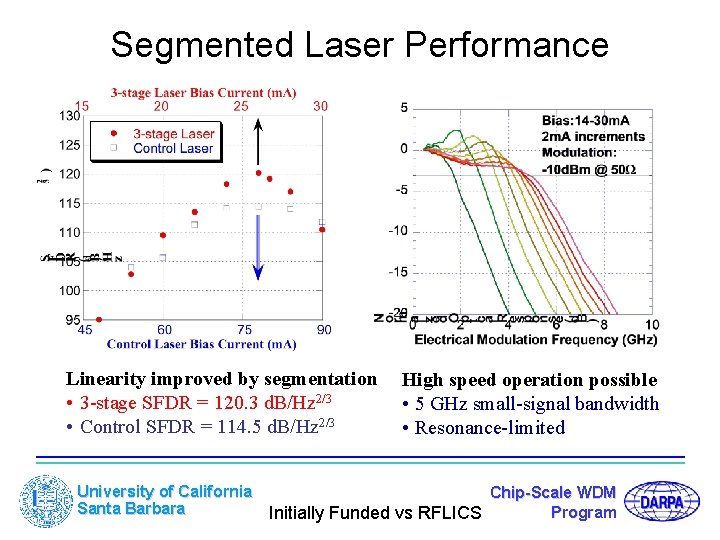
Segmented Laser Performance Linearity improved by segmentation • 3 -stage SFDR = 120. 3 d. B/Hz 2/3 • Control SFDR = 114. 5 d. B/Hz 2/3 University of California Santa Barbara High speed operation possible • 5 GHz small-signal bandwidth • Resonance-limited Chip-Scale WDM Program Initially Funded vs RFLICS
Current Status and Future Directions • Devices to mounted on carrier, RF probing improved – High speed measurements possible – Possibly satisfy Phase I milestones • Second mask spin will address several aspects – – Improved monitor/bias connection Improved SOA/detector design Improved SGDBR design Inclusion of multiple-active region embodiment • Investigation of saturable absorbers for improved extinction in digital applications University of California Santa Barbara Chip-Scale WDM Program