
Direct Variation Lesson 2 3 Algebra 2 Direct
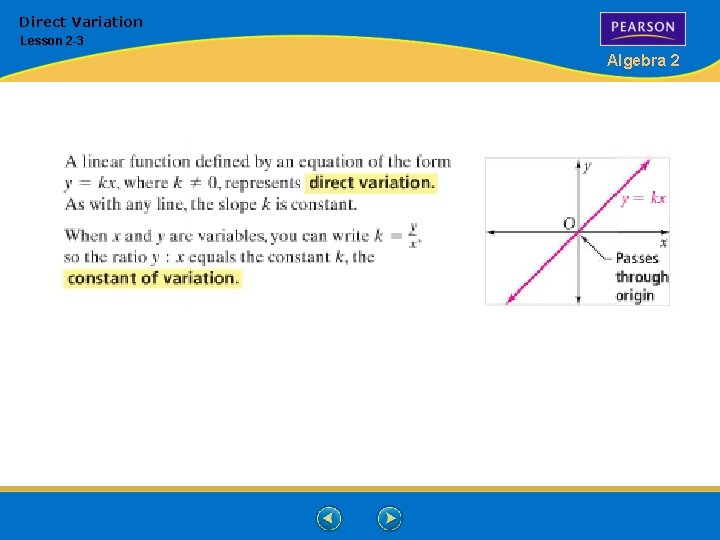
Direct Variation Lesson 2 -3 Algebra 2
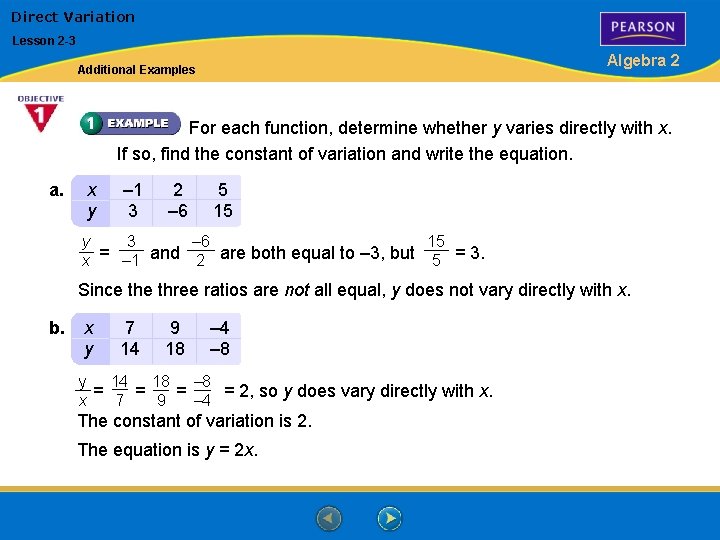
Direct Variation Lesson 2 -3 Algebra 2 Additional Examples For each function, determine whether y varies directly with x. If so, find the constant of variation and write the equation. a. x y – 1 3 2 – 6 5 15 y – 6 15 3 = and are both equal to – 3, but x 2 5 = 3. – 1 Since three ratios are not all equal, y does not vary directly with x. b. x y 7 14 9 18 – 4 – 8 y 14 18 – 8 = 7 = 9 = – 4 = 2, so y does vary directly with x. x The constant of variation is 2. The equation is y = 2 x.
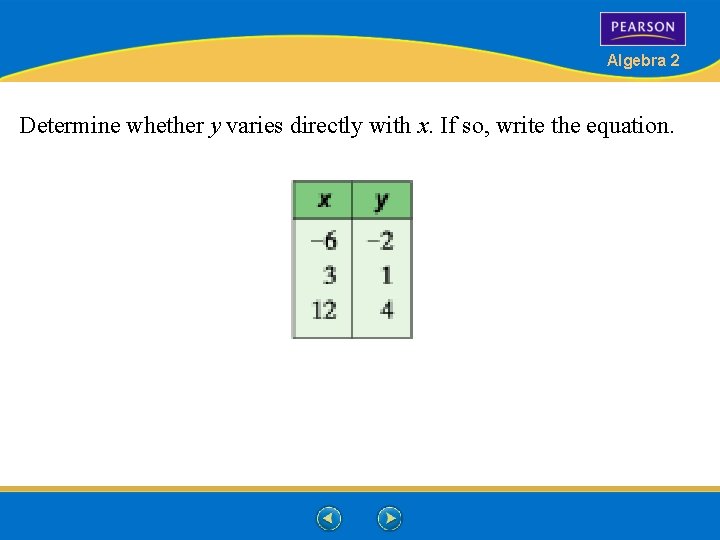
Algebra 2 Determine whether y varies directly with x. If so, write the equation.
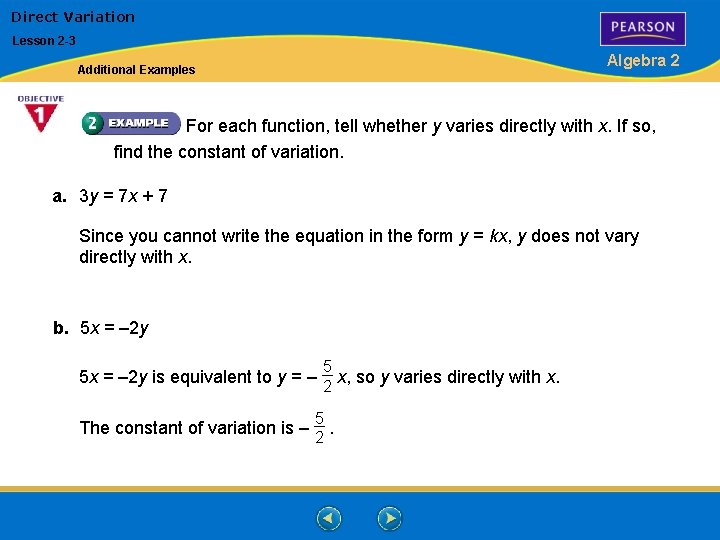
Direct Variation Lesson 2 -3 Algebra 2 Additional Examples For each function, tell whether y varies directly with x. If so, find the constant of variation. a. 3 y = 7 x + 7 Since you cannot write the equation in the form y = kx, y does not vary directly with x. b. 5 x = – 2 y 5 5 x = – 2 y is equivalent to y = – 2 x, so y varies directly with x. 5 The constant of variation is – 2.
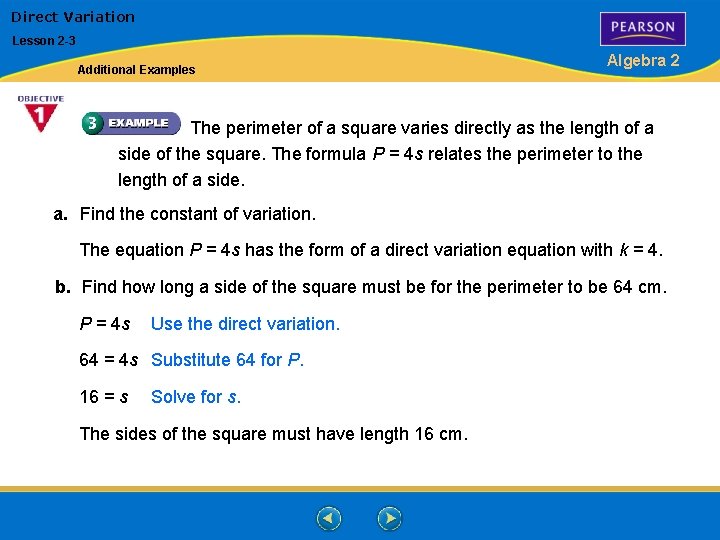
Direct Variation Lesson 2 -3 Additional Examples Algebra 2 The perimeter of a square varies directly as the length of a side of the square. The formula P = 4 s relates the perimeter to the length of a side. a. Find the constant of variation. The equation P = 4 s has the form of a direct variation equation with k = 4. b. Find how long a side of the square must be for the perimeter to be 64 cm. P = 4 s Use the direct variation. 64 = 4 s Substitute 64 for P. 16 = s Solve for s. The sides of the square must have length 16 cm.
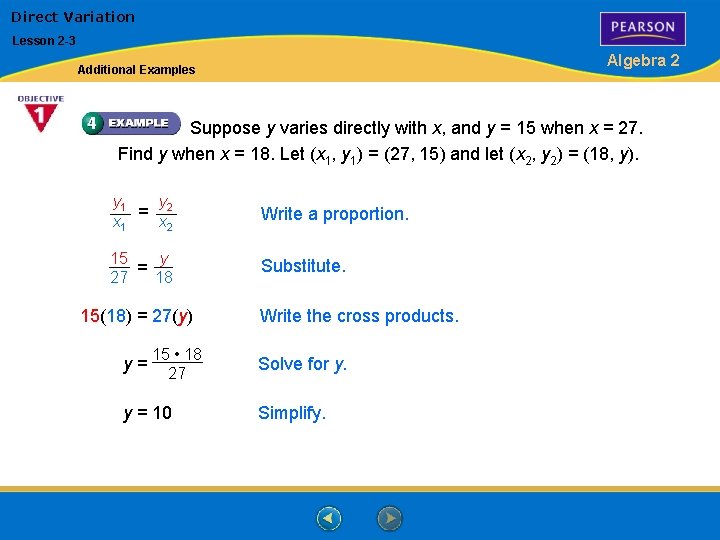
Direct Variation Lesson 2 -3 Algebra 2 Additional Examples Suppose y varies directly with x, and y = 15 when x = 27. Find y when x = 18. Let (x 1, y 1) = (27, 15) and let (x 2, y 2) = (18, y). y 1 y 2 = x 1 x 2 Write a proportion. y 15 = 18 27 Substitute. 15(18) = 27(y) y= 15 • 18 27 y = 10 Write the cross products. Solve for y. Simplify.
Algebra 2 Find the missing value for the direct variation: If y = 4 when x = 3, what is y when x = 6?
- Slides: 7