
Direct solar energy conversion with photovoltaic devices ENE
- Slides: 11
Direct solar energy conversion with photovoltaic devices ENE 304 Materials in Energy Technologies
Content • Solar Photovoltaic Technology Basics: Silicon • Solar Photovoltaic Technology Basics: Thin-Film Photovoltaics • Solar Photovoltaic Technology Basics: Organic Photovoltaics • Solar Photovoltaic Technology Basics: Concentration Photovoltaics
Direct solar energy conversion with photovoltaic devices • The photovoltaic (PV) devices, an alternative means of generating energy, places it at the point where the worldwide energy demand grows rapidly and can make a significant contribution to the challenges associated with environmental issues. • With the current technology based on silicon (Si), the growth of the field is intertwined with the development of new materials and manufacturing approaches. • Until recently, the PV industry, which is based on crystalline, polycrystalline and amorphous Si, grew at an annual average rate of 50% in the 2000 -2010 period. • This rate increased at least 11 gigawatts (GW) per year in 2009.
Direct solar energy conversion with photovoltaic devices • While this may seem like a huge number, total PV installations still only provide <0. 03% of the world's power requirements (<14 -15 TW). • As production increases, it is critical to increase the efficiency of individual cells and turn them into modules, while at the same time reducing production costs and prolonging system life is critical to obtaining a point where the PV power cost equals the price of the mains electricity. • Thin film solar cell approaches are now entering the PV market. • Nowadays, polycrystalline Cd. Te thin film solar cells have a reported production cost of less than $ 0. 80 per W of any PV technology. • Cells using alternative polycrystalline materials or nanocrystalline and amorphous films with organic polymers and small organic molecule based solar cells may be the best candidate for significant cost advantages between flexible cell and roll.
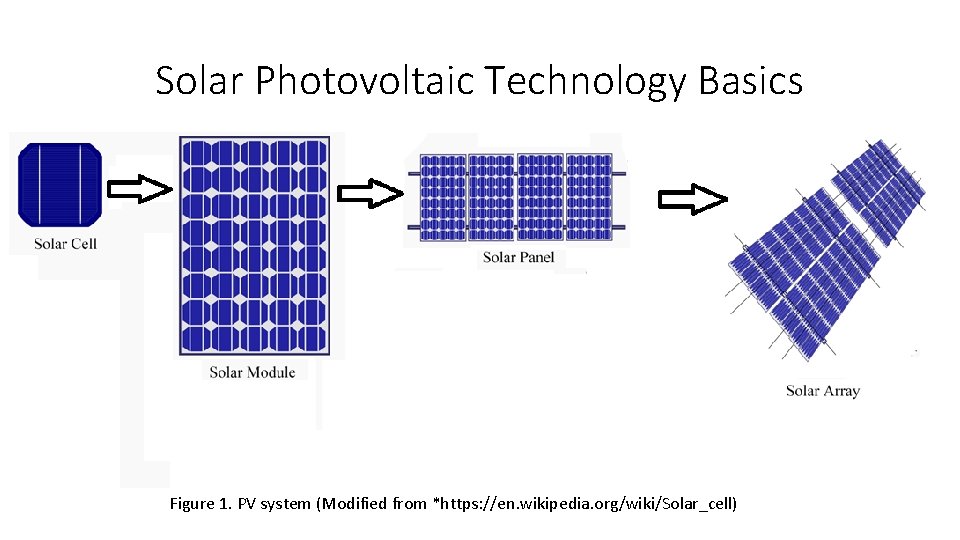
Solar Photovoltaic Technology Basics Figure 1. PV system (Modified from *https: //en. wikipedia. org/wiki/Solar_cell)
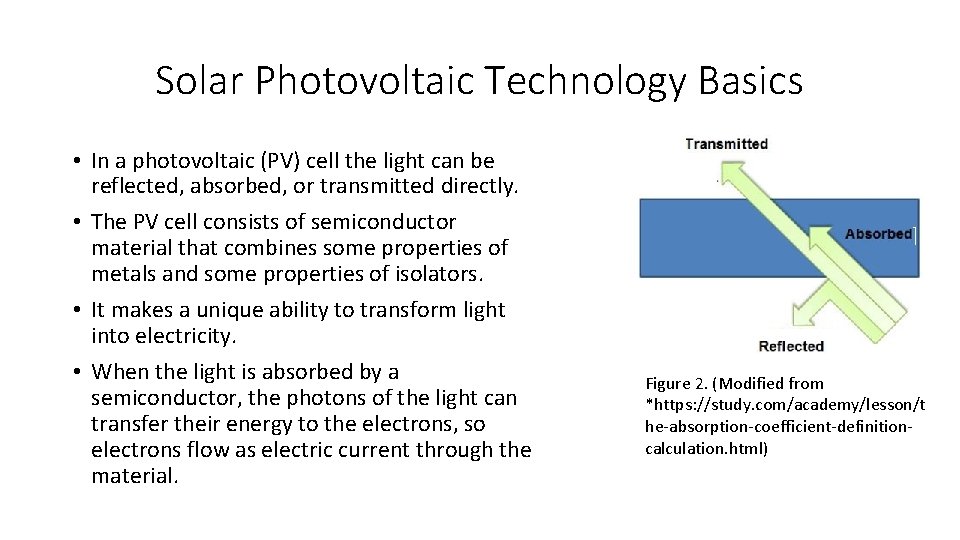
Solar Photovoltaic Technology Basics • In a photovoltaic (PV) cell the light can be reflected, absorbed, or transmitted directly. • The PV cell consists of semiconductor material that combines some properties of metals and some properties of isolators. • It makes a unique ability to transform light into electricity. • When the light is absorbed by a semiconductor, the photons of the light can transfer their energy to the electrons, so electrons flow as electric current through the material. Figure 2. (Modified from *https: //study. com/academy/lesson/t he-absorption-coefficient-definitioncalculation. html)
Solar Photovoltaic Technology Basics Thin-Film Photovoltaics • A thin film solar cell is made by adding one or more layers of thin PV material on a support material such as glass, plastic or metal. • Cadmium telluride (Cd. Te) and copper indium gallium diselenide are two main types of thin film PV semiconductors on the market today. • Both materials can be coated directly onto the front or back of the module surface. • Cd. Te is also common PV material after silicon and allows low cost manufacturing processes.
Solar Photovoltaic Technology Basics Organic Photovoltaics • Organic photovoltaic cells are made up of carbon-rich polymers and can be adapted to develop a specific function of the cell, such as sensitivity to a certain light touch. • This technology has a theoretical potential to provide electricity at a lower cost than silicon or thin film technologies. • Organic photovoltaic cells are only about half as efficient as crystal silicon and shorten their working life, but can be produced in higher volumes with cheaper price. • They can also be applied to a variety of support materials so that the Organic photovoltaic cells can serve a wide variety of uses.
Solar Photovoltaic Technology Basics Concentration Photovoltaics • Concentration photovoltaic cells focused on the sun using a mirror or lens. • By focusing the sunlight on a small area, less PV material is required. • As light intensifies, PV power becomes more efficient in energy conversion, so the highest efficiency is achieved with concentrated photovoltaic cells and modules. • However, more expensive materials, manufacturing techniques and monitoring are required, showing the necessary cost advantage over today's high volume silicon modules.
Solar Photovoltaic Technology Basics Solar Cell Performance and Efficiency • The activity of a cell is the amount of electricity generated from a cell divided by the energy from sunlight. • The amount of electricity generated by photovoltaic cells depends on the quality of the available light (intensity and wavelength) and the multiple performance characteristics of the cell. • The light energy depends on several factors, like intensity, frequency, wavelength etc.
References • David S. Ginley, Reuben Collins, and David Cahen, Direct solar energy conversion with photovoltaic devices, in Fundamentals of Materials for Energy and Environmental Sustainability, (Eds. David S. Ginley, David Cahen), Cambridge University Press, 2012. • https: //energy. gov/eere/solar/articles/solar-photovoltaic-cell-basics • https: //www. electronics-tutorials. ws/diode_2. html • https: //www. electronics-tutorials. ws/diode_3. html • faculty. ksu. edu. sa/72366/. . . /lecture%20 note%20 on%20 Photovoltaic%20 Cell. doc • https: //www. slideshare. net/Malek. Talbi/organic-photovoltaic-cells-opv