
Direct object pronouns Chapter 3 What are direct
Direct object pronouns Chapter 3
What are direct objects in English? They receive the action of the verb. � Answer the questions: whom? or what? about the verb Examples: �I have the backpack. The backpack is receiving the action of the verb The Direct Object(DO) is the backpack.
So what would it be in Spanish? Yo tengo la mochila. I have the backpack. Yo tengo la mochila is our DO � How does this sound… I have the backpack. The backpack was given to me by my sister. She liked the backpack. The backpack holds all my things. The backpack is blue and pink. I take my backpack everywhere! What could we change? ~ Let’s put IT in there!
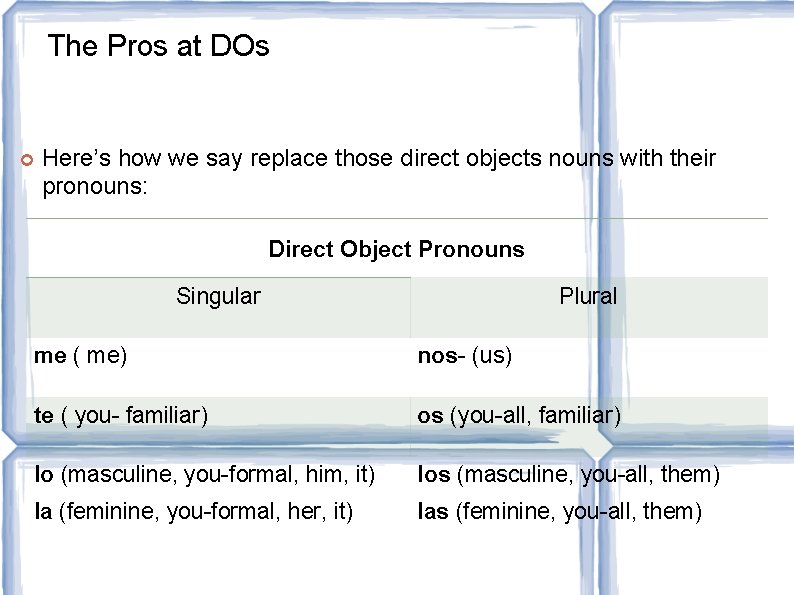
The Pros at DOs Here’s how we say replace those direct objects nouns with their pronouns: Direct Object Pronouns Singular Plural me ( me) nos- (us) te ( you- familiar) os (you-all, familiar) lo (masculine, you-formal, him, it) los (masculine, you-all, them) la (feminine, you-formal, her, it) las (feminine, you-all, them)
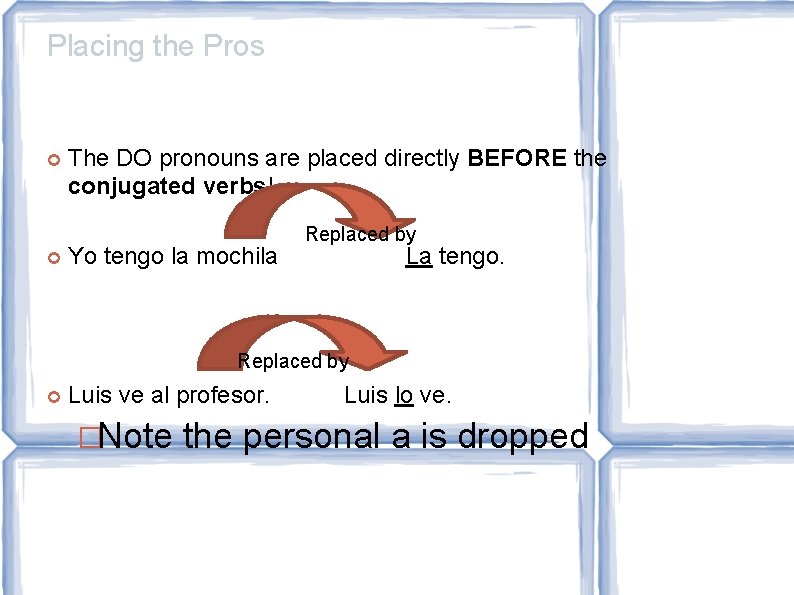
Placing the Pros The DO pronouns are placed directly BEFORE the conjugated verbs! Yo tengo la mochila Replaced by La tengo. Replaced by Luis ve al profesor. �Note Luis lo ve. the personal a is dropped
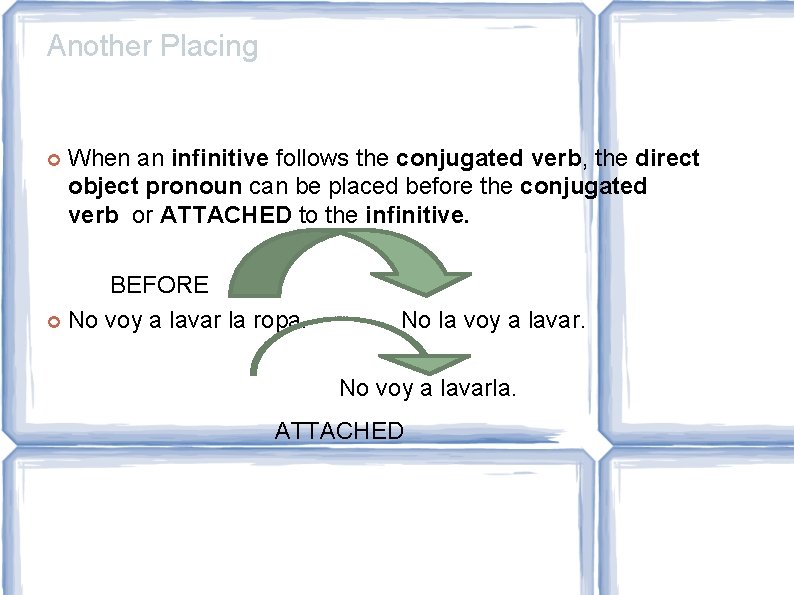
Another Placing When an infinitive follows the conjugated verb, the direct object pronoun can be placed before the conjugated verb or ATTACHED to the infinitive. BEFORE No voy a lavar la ropa. No la voy a lavar. No voy a lavarla. ATTACHED
- Slides: 6