
Direct Object Pronoun Mr Sanchez Give me the
Direct Object Pronoun Mr. Sanchez

• • Give me the book Close the windows Do your homework Paint the house
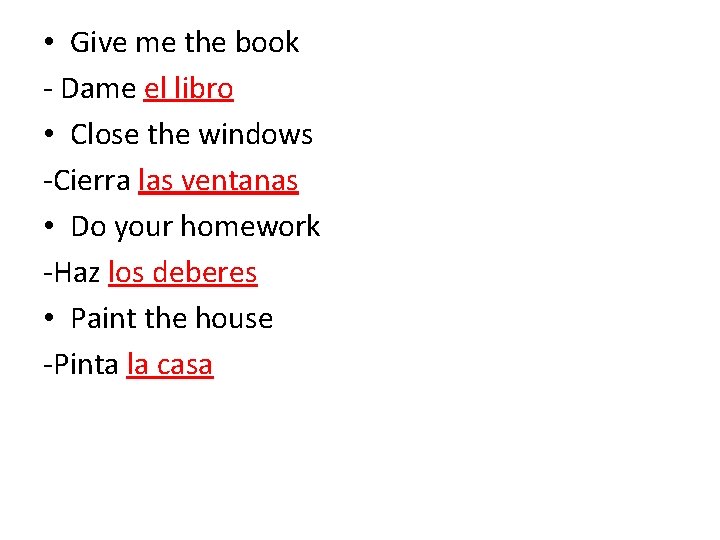
• Give me the book - Dame el libro • Close the windows -Cierra las ventanas • Do your homework -Haz los deberes • Paint the house -Pinta la casa
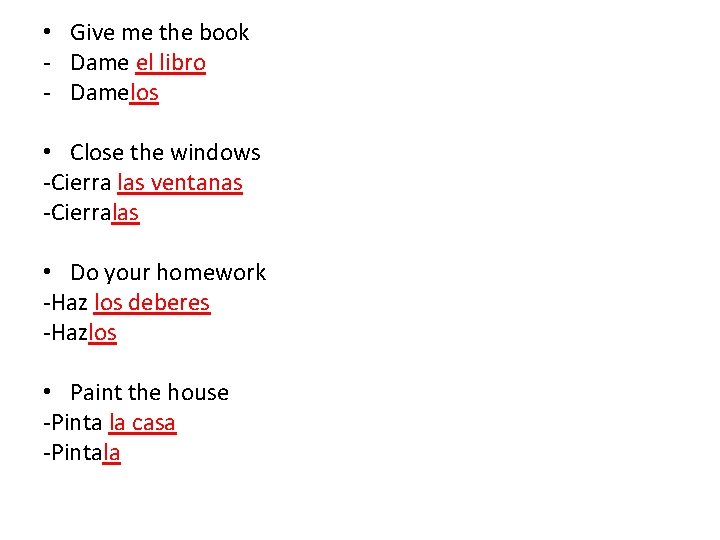
• Give me the book - Dame el libro - Damelos • Close the windows -Cierra las ventanas -Cierralas • Do your homework -Haz los deberes -Hazlos • Paint the house -Pinta la casa -Pintala
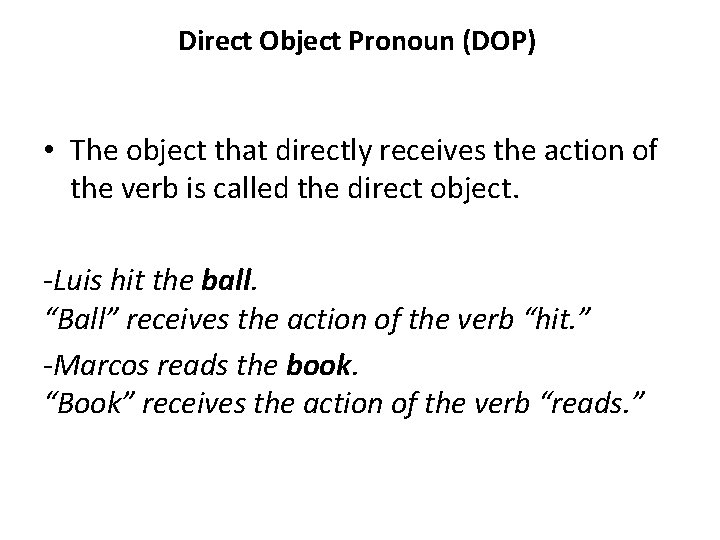
Direct Object Pronoun (DOP) • The object that directly receives the action of the verb is called the direct object. -Luis hit the ball. “Ball” receives the action of the verb “hit. ” -Marcos reads the book. “Book” receives the action of the verb “reads. ”
• The direct object answers the question “what? ” or “whom? ” with regard to what the subject of the sentence is doing. • Luis hit the ball. Luis hit what? Luis hit the ball. • Marcos hit Bill. Marcos hit whom? Marcos hit Bill.
Why do we need DOP? Often, it is desirable to replace the name of the direct object with a pronoun. Example 1 • Paul bought the flowers. He took the flowers home and gave the flowers to his wife. Example 2 • Paul bought the flowers. He took them home and gave them to his wife.
Example 1 • Paul trajo las flores. El trajo las flores a casa y le dio las flores a su mujer. Example 2 • Paul trajo las flores. El las trajo a casa y se las dio a su mujer.
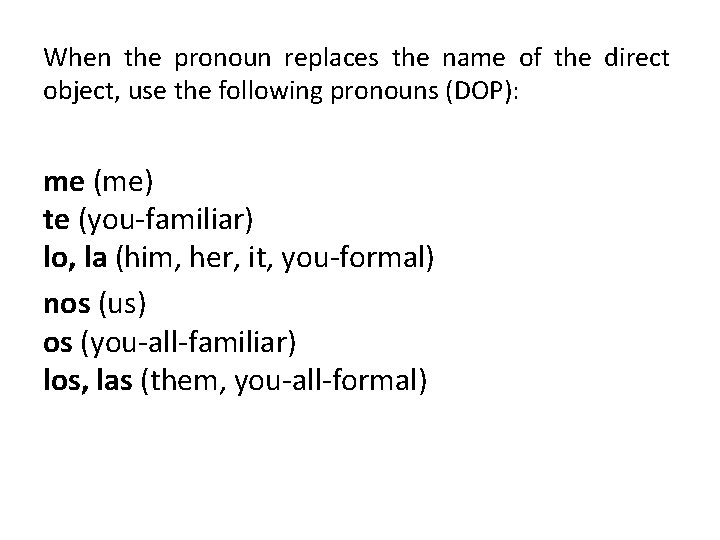
When the pronoun replaces the name of the direct object, use the following pronouns (DOP): me (me) te (you-familiar) lo, la (him, her, it, you-formal) nos (us) os (you-all-familiar) los, las (them, you-all-formal)
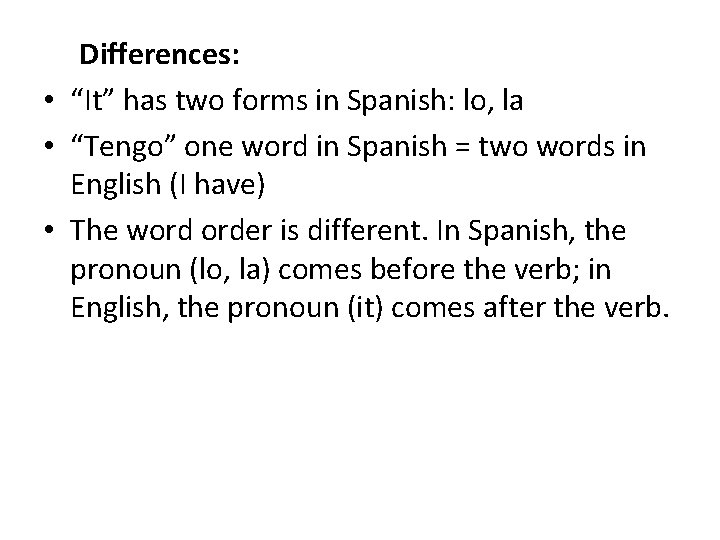
Differences: • “It” has two forms in Spanish: lo, la • “Tengo” one word in Spanish = two words in English (I have) • The word order is different. In Spanish, the pronoun (lo, la) comes before the verb; in English, the pronoun (it) comes after the verb.
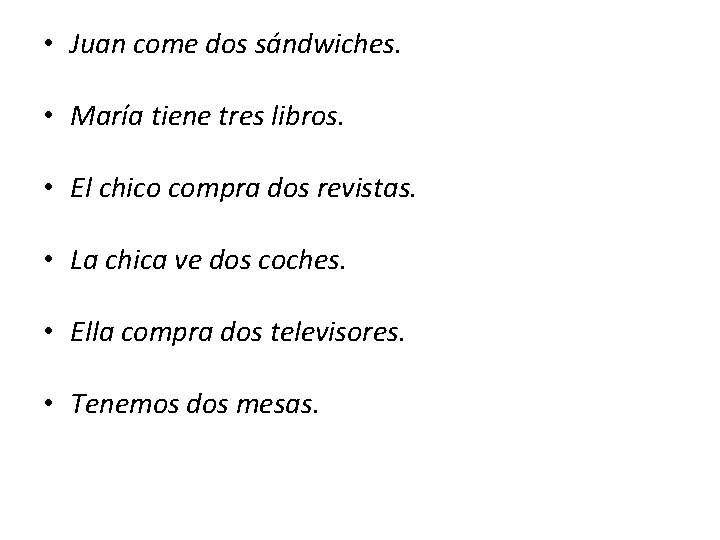
• Juan come dos sándwiches. • María tiene tres libros. • El chico compra dos revistas. • La chica ve dos coches. • Ella compra dos televisores. • Tenemos dos mesas.
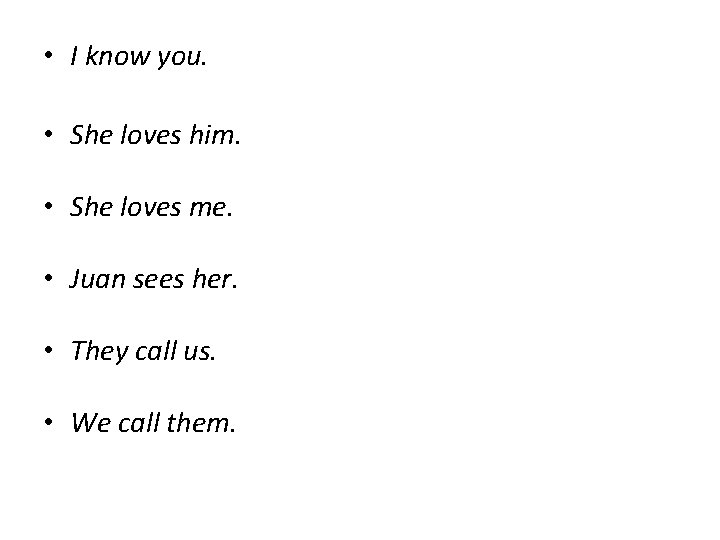
• I know you. • She loves him. • She loves me. • Juan sees her. • They call us. • We call them.
- Slides: 12