
Direct imaging of exoplanets The Pupil Mapping Coronagraph
- Slides: 54
Direct imaging of exoplanets The Pupil Mapping Coronagraph Observer (PECO) Olivier Guyon Center for Astronomical Adaptive Optics, University of Arizona Subaru Telescope
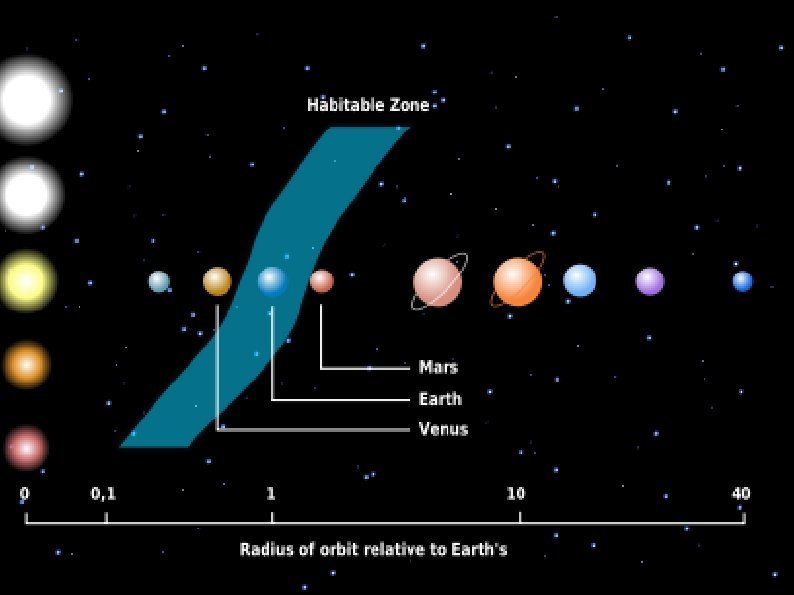
Exoplanets How many planets around other stars ? How do they form, evolved ? Mass, size, composition ? Rocky planets with atmospheres ? What is the atmosphere composition ? Weather, rotation period ? Could have life evolved on other planets ? Intelligent life somewhere else ?
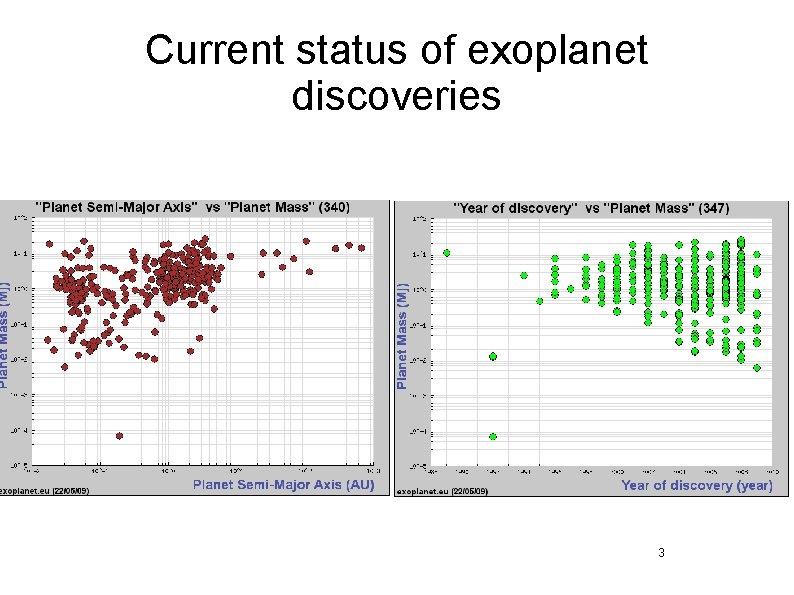
Current status of exoplanet discoveries 3
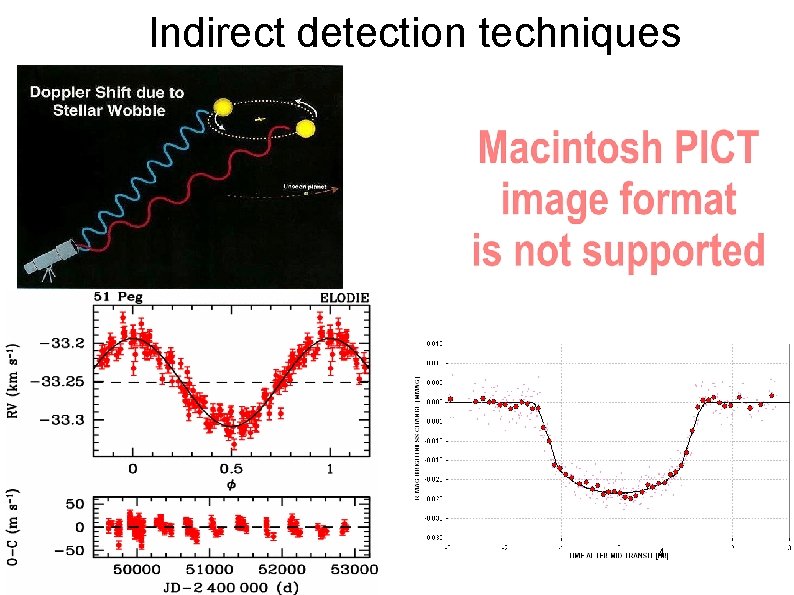
Indirect detection techniques 4
Ground-based imaging (Near-IR, with Adaptive Optics) • Most sensitive to outer young planets: very complementary to Radial Velocity, astrometry, transits -> important for testing planetary formation models (core accretion, gravitational collapse of disk instabilities ? ) • Study planet formation by imaging disks and planets • Current limitation: mass/age/luminosity relationship (cooling rate) poorly known • NEED to get closer in to the star / higher contrasts for overlap with radial velocity planets -> constrain mass/age/luminosity models • NEED to get closer in/higher contrasts to capture REFLECTED light -> “old” planets can then be detected around nearby stars (known targets from radial velocity) • NEED to increase sample size (currently ~5, possibly most of them are “exceptions” to the rule) with spectral characterization Space-based imaging (Visible, extremely high contrast) • Characterization (spectroscopy) of Earth-mass planets in habitable zone • Simultaneous imaging of exozodi cloud, massive and rocky planets
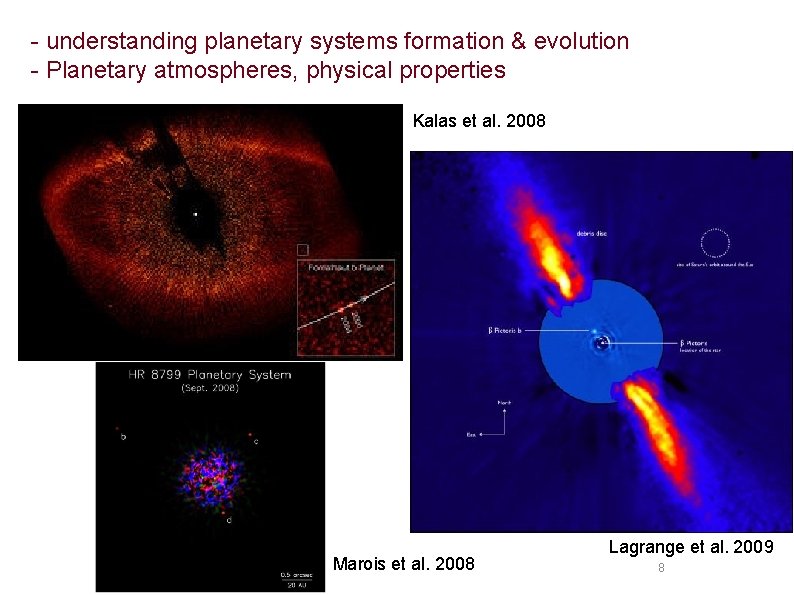
- understanding planetary systems formation & evolution - Planetary atmospheres, physical properties Kalas et al. 2008 Marois et al. 2008 Lagrange et al. 2009 8
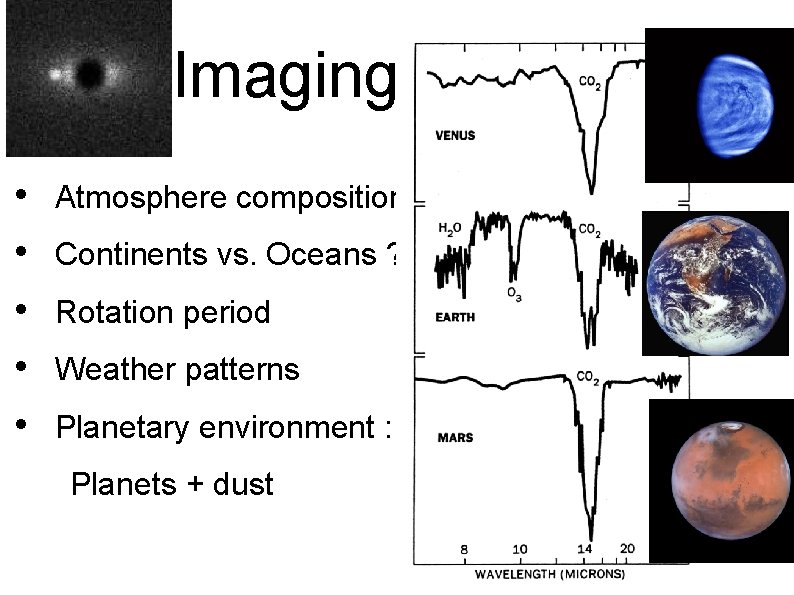
Imaging • • • Orbit Atmosphere composition Continents vs. Oceans ? Rotation period Weather patterns Planetary environment : Planets + dust 10
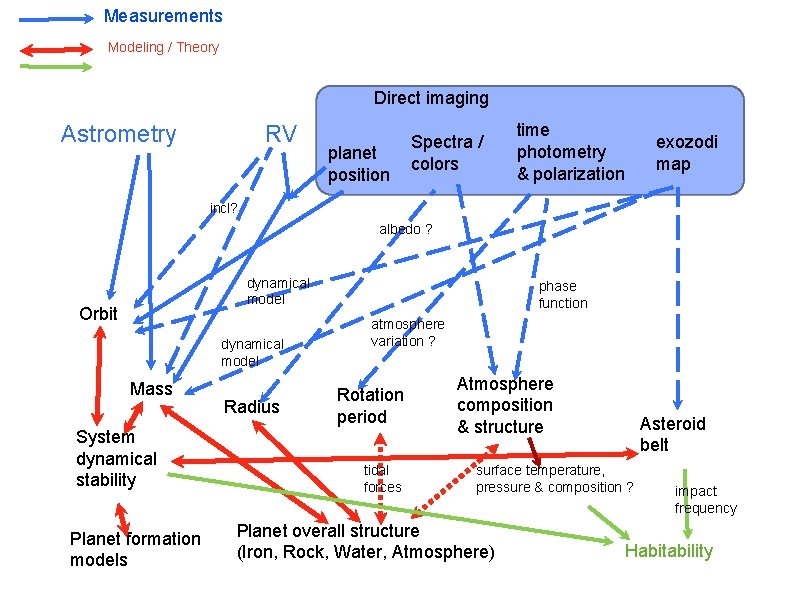
Measurements Modeling / Theory Direct imaging Astrometry RV planet position Spectra / colors time photometry & polarization exozodi map incl? albedo ? dynamical model Orbit dynamical model Mass System dynamical stability Planet formation models Radius phase function atmosphere variation ? Rotation period tidal forces Atmosphere composition & structure Asteroid belt surface temperature, pressure & composition ? Planet overall structure (Iron, Rock, Water, Atmosphere) impact frequency Habitability
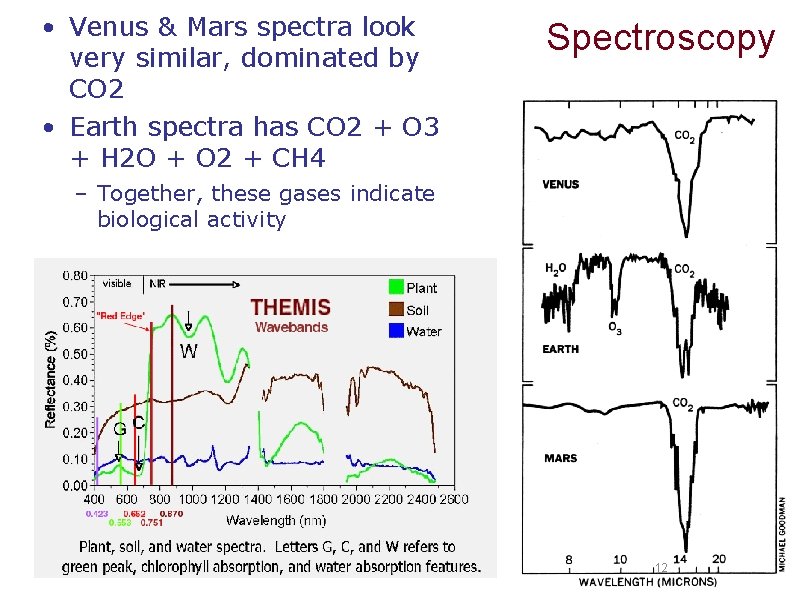
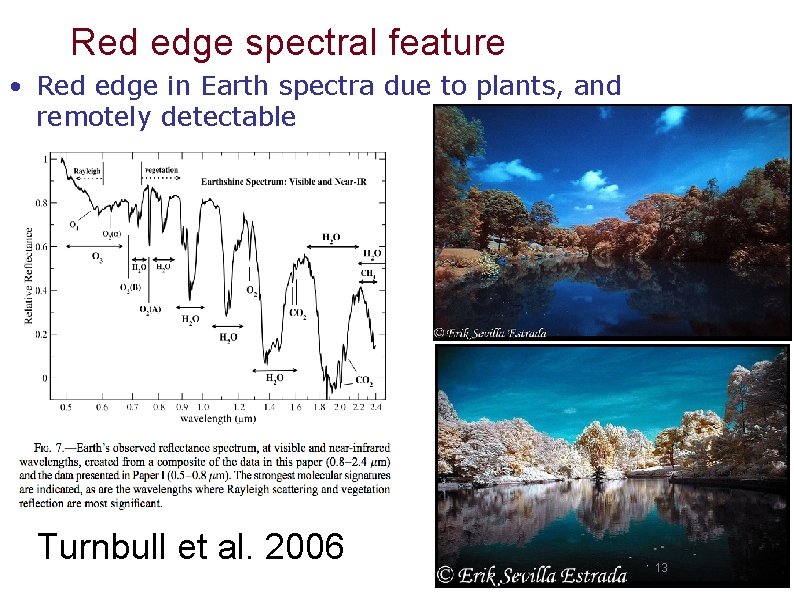
• Venus & Mars spectra look very similar, dominated by CO 2 • Earth spectra has CO 2 + O 3 + H 2 O + O 2 + CH 4 Spectroscopy – Together, these gases indicate biological activity 12
Red edge spectral feature • Red edge in Earth spectra due to plants, and remotely detectable Turnbull et al. 2006 13
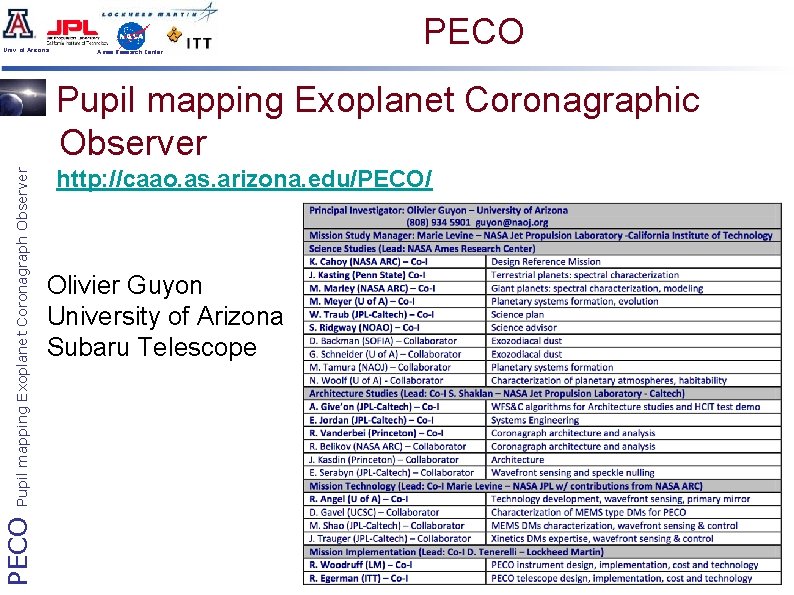
Univ. of Arizona Ames Research Center PECO Pupil mapping Exoplanet Coronagraph Observer Pupil mapping Exoplanet Coronagraphic Observer http: //caao. as. arizona. edu/PECO/ Olivier Guyon University of Arizona Subaru Telescope
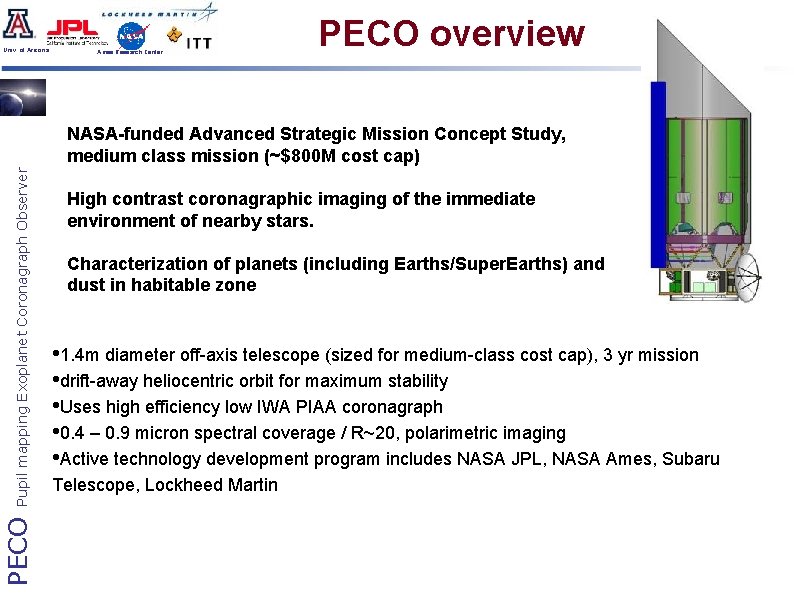
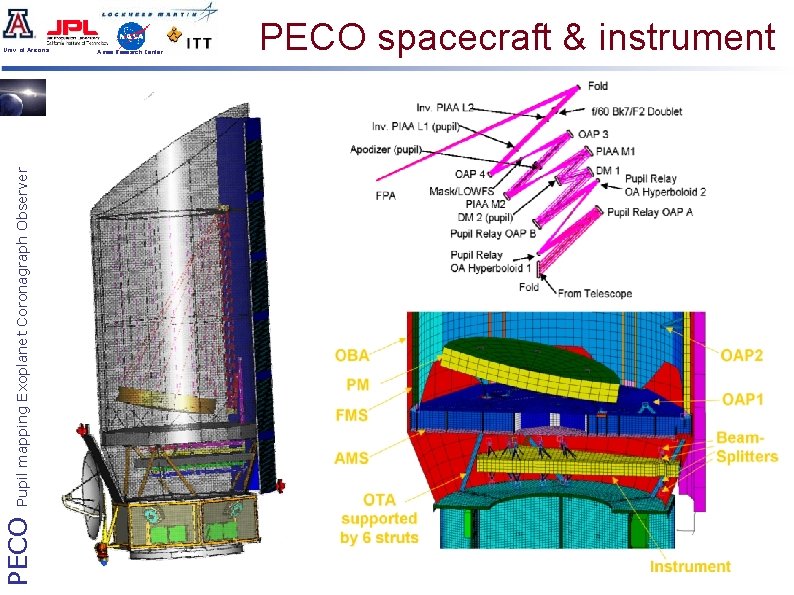
Univ. of Arizona Ames Research Center PECO overview PECO Pupil mapping Exoplanet Coronagraph Observer NASA-funded Advanced Strategic Mission Concept Study, medium class mission (~$800 M cost cap) High contrast coronagraphic imaging of the immediate environment of nearby stars. Characterization of planets (including Earths/Super. Earths) and dust in habitable zone • 1. 4 m diameter off-axis telescope (sized for medium-class cost cap), 3 yr mission • drift-away heliocentric orbit for maximum stability • Uses high efficiency low IWA PIAA coronagraph • 0. 4 – 0. 9 micron spectral coverage / R~20, polarimetric imaging • Active technology development program includes NASA JPL, NASA Ames, Subaru Telescope, Lockheed Martin
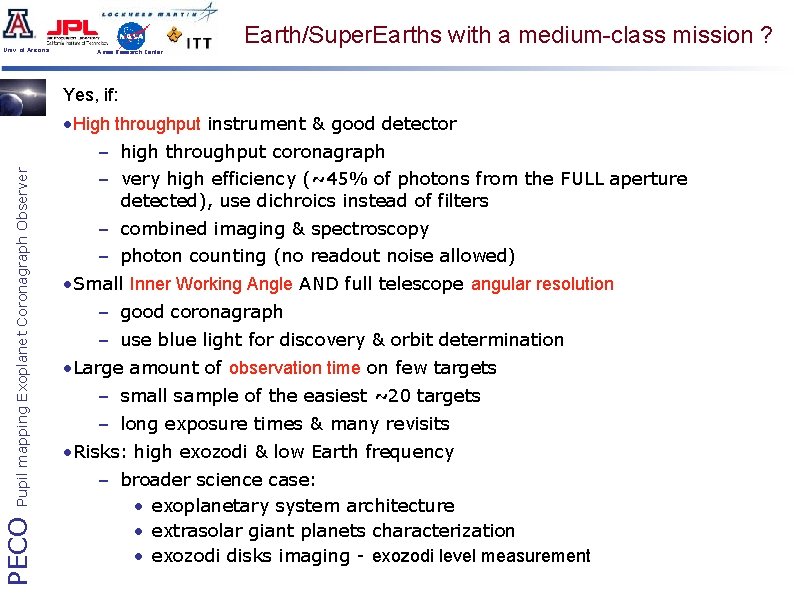
Univ. of Arizona Earth/Super. Earths with a medium-class mission ? Ames Research Center Yes, if: PECO Pupil mapping Exoplanet Coronagraph Observer • High throughput instrument & good detector – high throughput coronagraph – very high efficiency (~45% of photons from the FULL aperture detected), use dichroics instead of filters – combined imaging & spectroscopy – photon counting (no readout noise allowed) • Small Inner Working Angle AND full telescope angular resolution – good coronagraph – use blue light for discovery & orbit determination • Large amount of observation time on few targets – small sample of the easiest ~20 targets – long exposure times & many revisits • Risks: high exozodi & low Earth frequency – broader science case: • exoplanetary system architecture • extrasolar giant planets characterization • exozodi disks imaging - exozodi level measurement
Univ. of Arizona Ames Research Center PECO driving requirements • High Contrast (1 e 10) from 400 nm to 900 nm (simultaneously !) Key to achieve sensitivity required for science goals PECO Pupil mapping Exoplanet Coronagraph Observer - Coronagraph / optical train design: use of dichroics feeding coronagraph channels - Wavefront control system needs to have sufficient degrees of freedom to correct wavefront over spectral range • Wavefront Stability (A) Wavefront sensing & control response time at 1 e 10 contrast level is ~mn to ~hr. Any non calibrated WF variation on <hr timescale will seriously affect science return - High throughput efficient wavefront sensing to reduce response time - Stable telescope, temperature control, low jitter/vibrations - Stable drift-away heliocentric orbit, no telescope roll • Pointing Stability and knowledge (mas) Key to image planets/disk at small separations AND not get confused with pointing errors - Stable orbit / telescope design - Multi-stage control - High sensitivity sensing of pointing errors
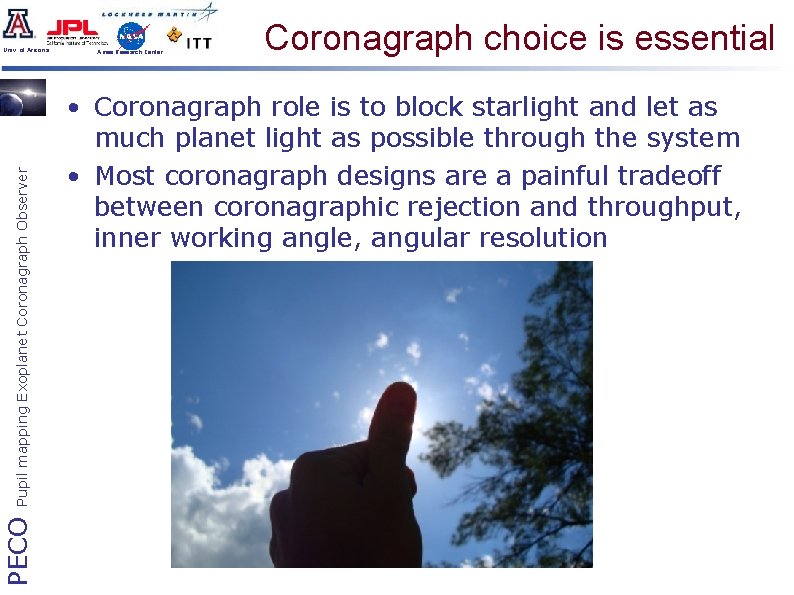
PECO Pupil mapping Exoplanet Coronagraph Observer Univ. of Arizona Ames Research Center Coronagraph choice is essential • Coronagraph role is to block starlight and let as much planet light as possible through the system • Most coronagraph designs are a painful tradeoff between coronagraphic rejection and throughput, inner working angle, angular resolution
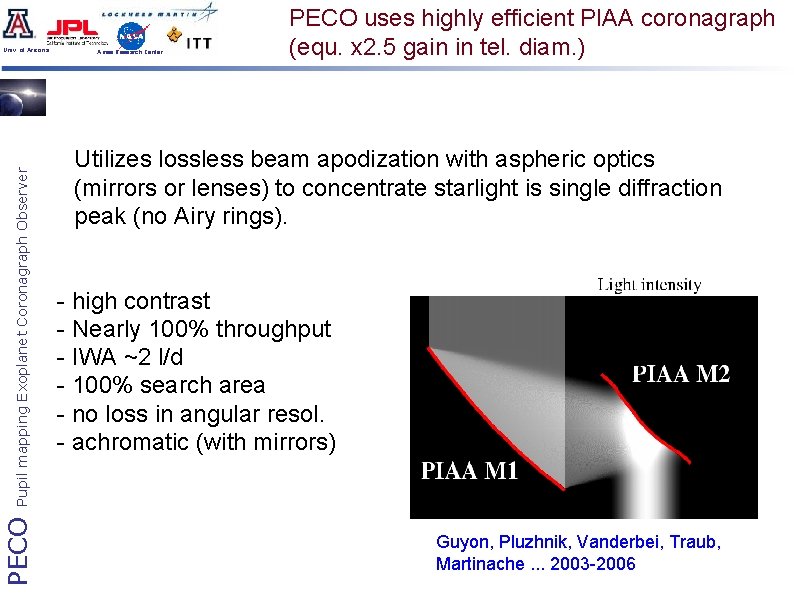
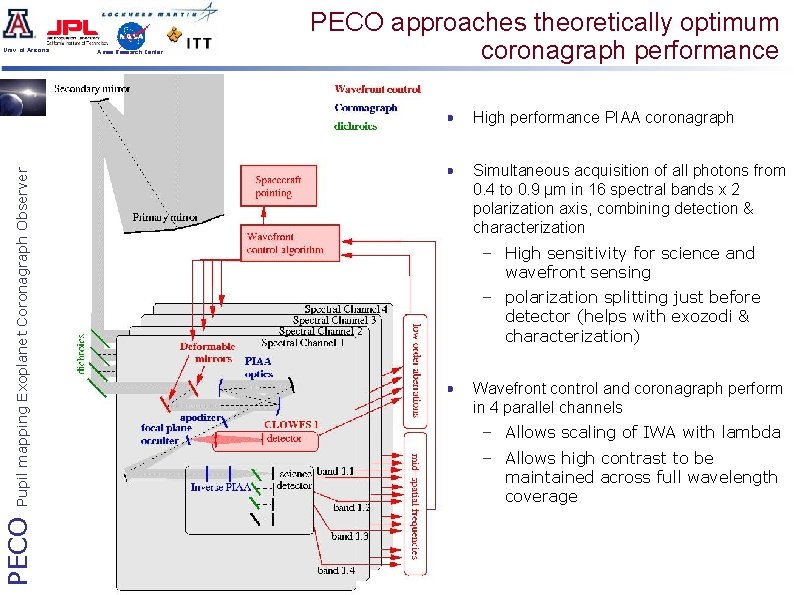
PECO Pupil mapping Exoplanet Coronagraph Observer Univ. of Arizona Ames Research Center PECO uses highly efficient PIAA coronagraph (equ. x 2. 5 gain in tel. diam. ) Utilizes lossless beam apodization with aspheric optics (mirrors or lenses) to concentrate starlight is single diffraction peak (no Airy rings). - high contrast - Nearly 100% throughput - IWA ~2 l/d - 100% search area - no loss in angular resol. - achromatic (with mirrors) Guyon, Pluzhnik, Vanderbei, Traub, Martinache. . . 2003 -2006
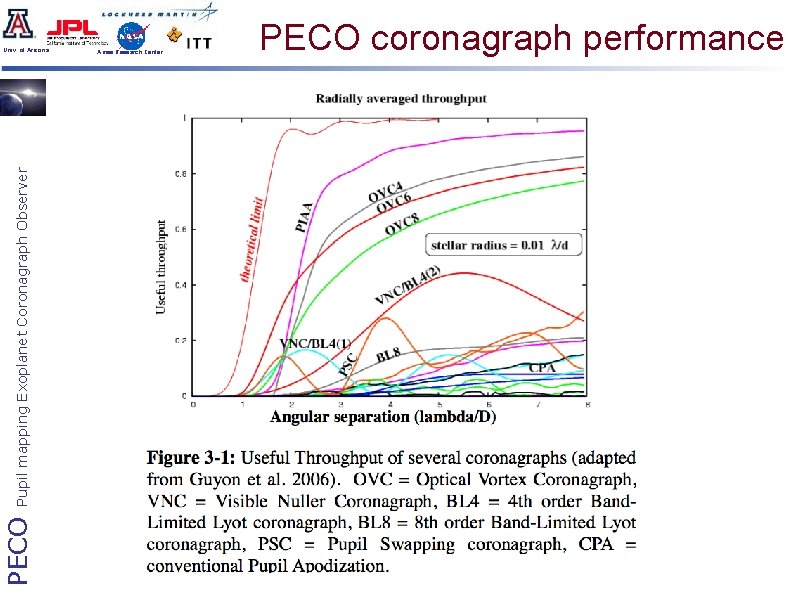
PECO Pupil mapping Exoplanet Coronagraph Observer Univ. of Arizona Ames Research Center PECO coronagraph performance
PECO Pupil mapping Exoplanet Coronagraph Observer Univ. of Arizona Ames Research Center PECO approaches theoretically optimum coronagraph performance • High performance PIAA coronagraph • Simultaneous acquisition of all photons from 0. 4 to 0. 9 μm in 16 spectral bands x 2 polarization axis, combining detection & characterization – High sensitivity for science and wavefront sensing – polarization splitting just before detector (helps with exozodi & characterization) • Wavefront control and coronagraph perform in 4 parallel channels – Allows scaling of IWA with lambda – Allows high contrast to be maintained across full wavelength coverage
PECO Pupil mapping Exoplanet Coronagraph Observer Univ. of Arizona Ames Research Center PECO spacecraft & instrument
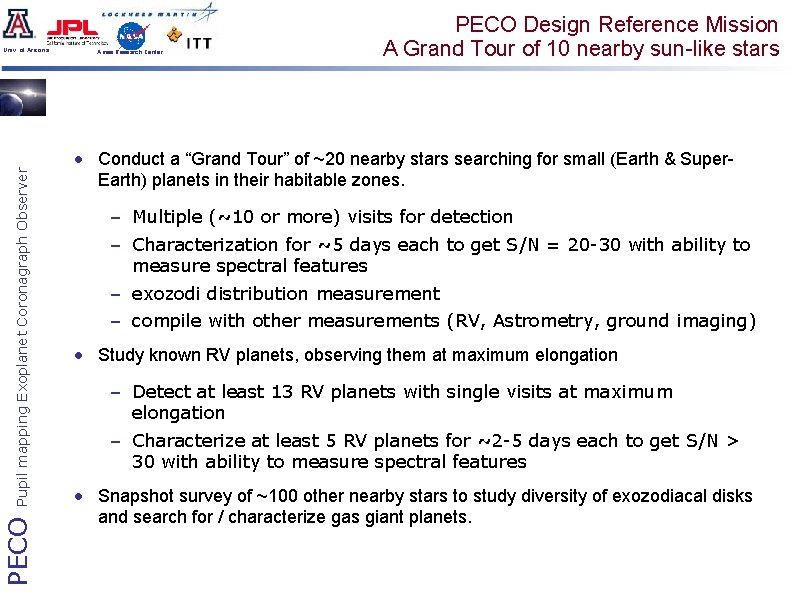
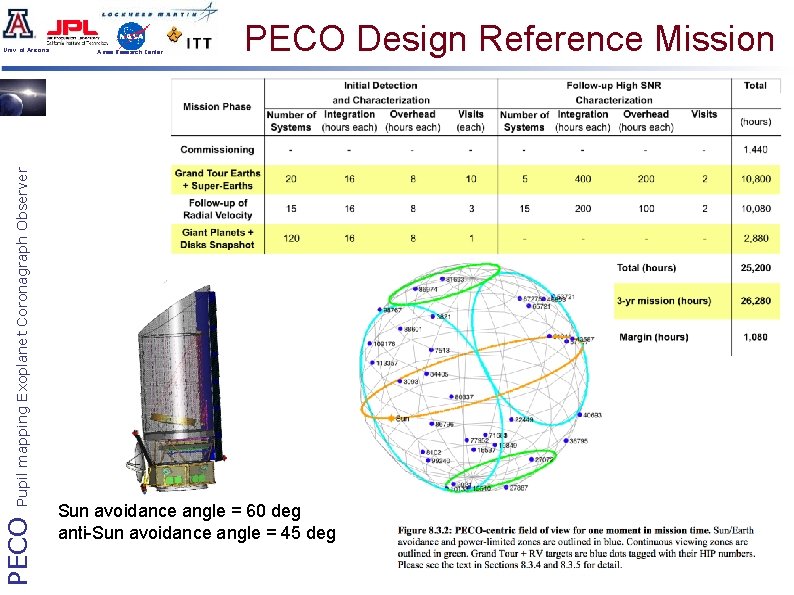
PECO Pupil mapping Exoplanet Coronagraph Observer Univ. of Arizona Ames Research Center PECO Design Reference Mission A Grand Tour of 10 nearby sun-like stars • Conduct a “Grand Tour” of ~20 nearby stars searching for small (Earth & Super. Earth) planets in their habitable zones. – Multiple (~10 or more) visits for detection – Characterization for ~5 days each to get S/N = 20 -30 with ability to measure spectral features – exozodi distribution measurement – compile with other measurements (RV, Astrometry, ground imaging) • Study known RV planets, observing them at maximum elongation – Detect at least 13 RV planets with single visits at maximum elongation – Characterize at least 5 RV planets for ~2 -5 days each to get S/N > 30 with ability to measure spectral features • Snapshot survey of ~100 other nearby stars to study diversity of exozodiacal disks and search for / characterize gas giant planets.
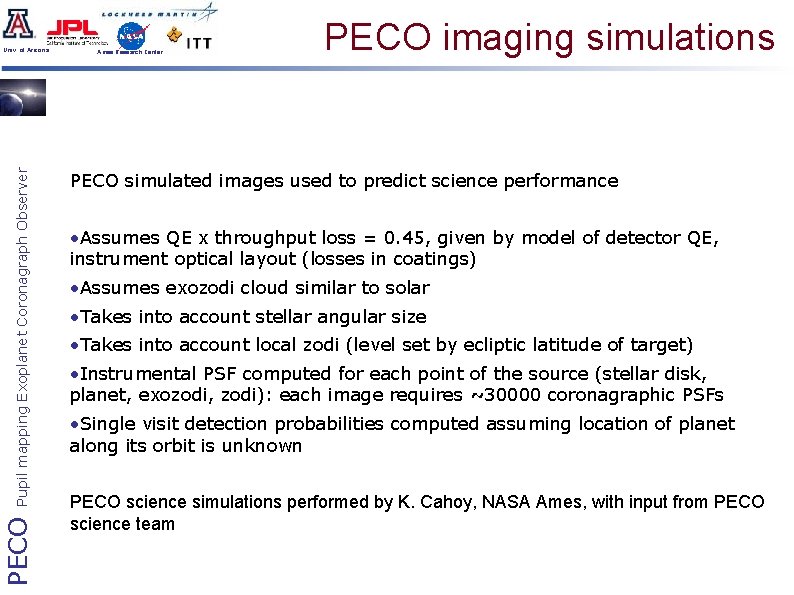
PECO Pupil mapping Exoplanet Coronagraph Observer Univ. of Arizona Ames Research Center PECO imaging simulations PECO simulated images used to predict science performance • Assumes QE x throughput loss = 0. 45, given by model of detector QE, instrument optical layout (losses in coatings) • Assumes exozodi cloud similar to solar • Takes into account stellar angular size • Takes into account local zodi (level set by ecliptic latitude of target) • Instrumental PSF computed for each point of the source (stellar disk, planet, exozodi, zodi): each image requires ~30000 coronagraphic PSFs • Single visit detection probabilities computed assuming location of planet along its orbit is unknown PECO science simulations performed by K. Cahoy, NASA Ames, with input from PECO science team
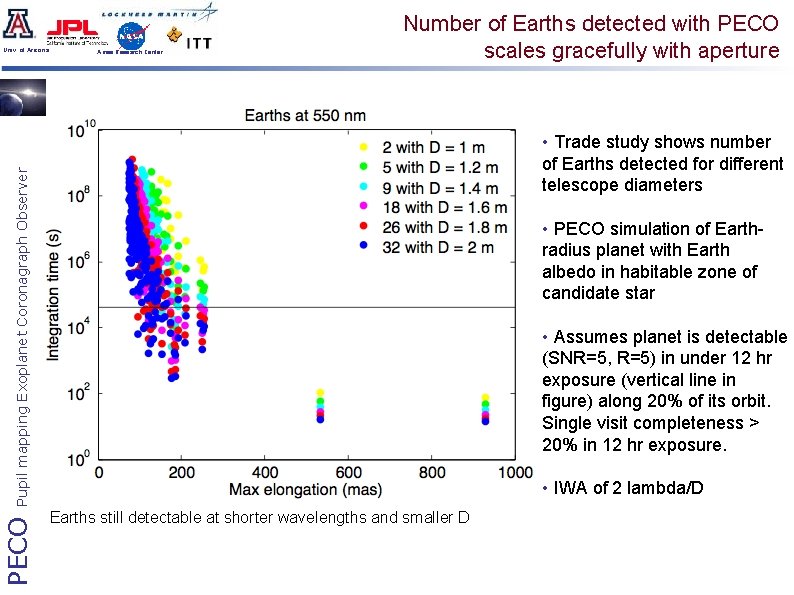
Ames Research Center • Trade study shows number of Earths detected for different telescope diameters PECO Pupil mapping Exoplanet Coronagraph Observer Univ. of Arizona Number of Earths detected with PECO scales gracefully with aperture • PECO simulation of Earthradius planet with Earth albedo in habitable zone of candidate star • Assumes planet is detectable (SNR=5, R=5) in under 12 hr exposure (vertical line in figure) along 20% of its orbit. Single visit completeness > 20% in 12 hr exposure. • IWA of 2 lambda/D Earths still detectable at shorter wavelengths and smaller D
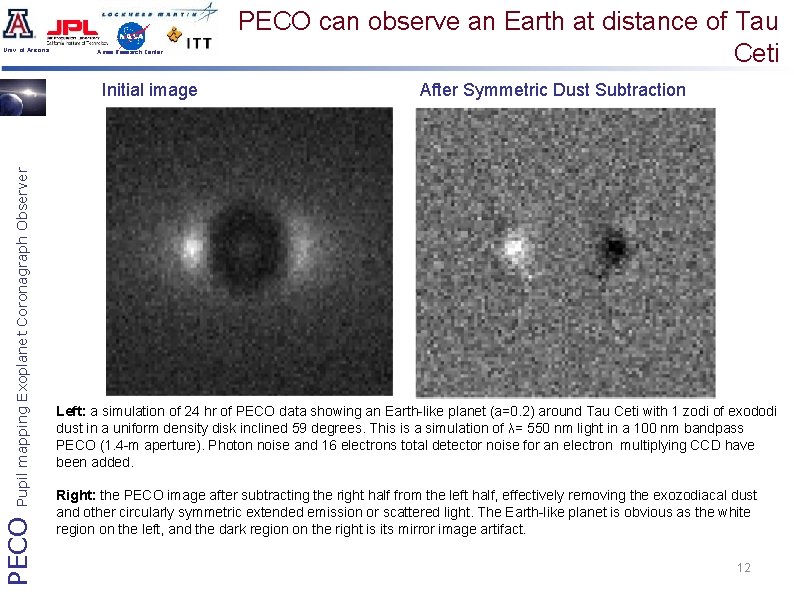
Univ. of Arizona Ames Research Center PECO Pupil mapping Exoplanet Coronagraph Observer Initial image PECO can observe an Earth at distance of Tau Ceti After Symmetric Dust Subtraction Left: a simulation of 24 hr of PECO data showing an Earth-like planet (a=0. 2) around Tau Ceti with 1 zodi of exododi dust in a uniform density disk inclined 59 degrees. This is a simulation of λ= 550 nm light in a 100 nm bandpass PECO (1. 4 -m aperture). Photon noise and 16 electrons total detector noise for an electron multiplying CCD have been added. Right: the PECO image after subtracting the right half from the left half, effectively removing the exozodiacal dust and other circularly symmetric extended emission or scattered light. The Earth-like planet is obvious as the white region on the left, and the dark region on the right is its mirror image artifact. 12
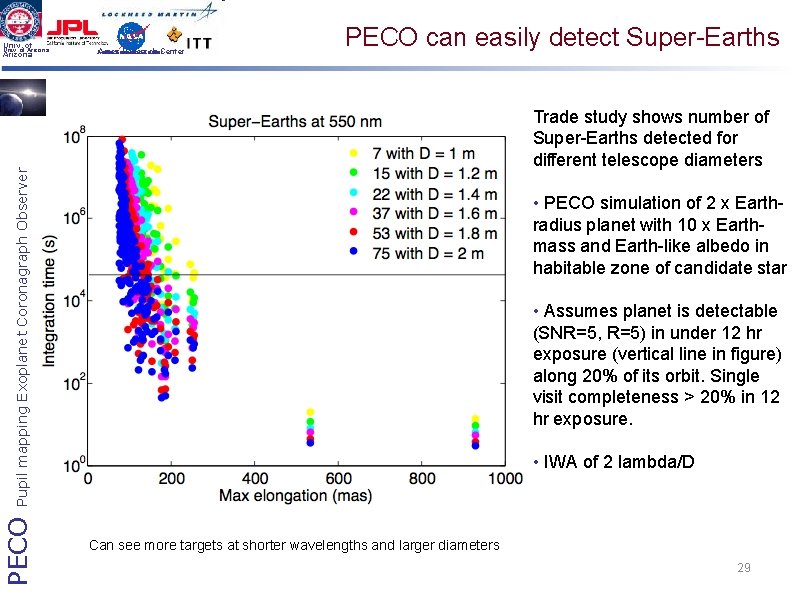
Ames Research Center PECO can easily detect Super-Earths Trade study shows number of Super-Earths detected for different telescope diameters PECO Pupil mapping Exoplanet Coronagraph Observer Univ. of Arizona • PECO simulation of 2 x Earthradius planet with 10 x Earthmass and Earth-like albedo in habitable zone of candidate star • Assumes planet is detectable (SNR=5, R=5) in under 12 hr exposure (vertical line in figure) along 20% of its orbit. Single visit completeness > 20% in 12 hr exposure. • IWA of 2 lambda/D Can see more targets at shorter wavelengths and larger diameters 29
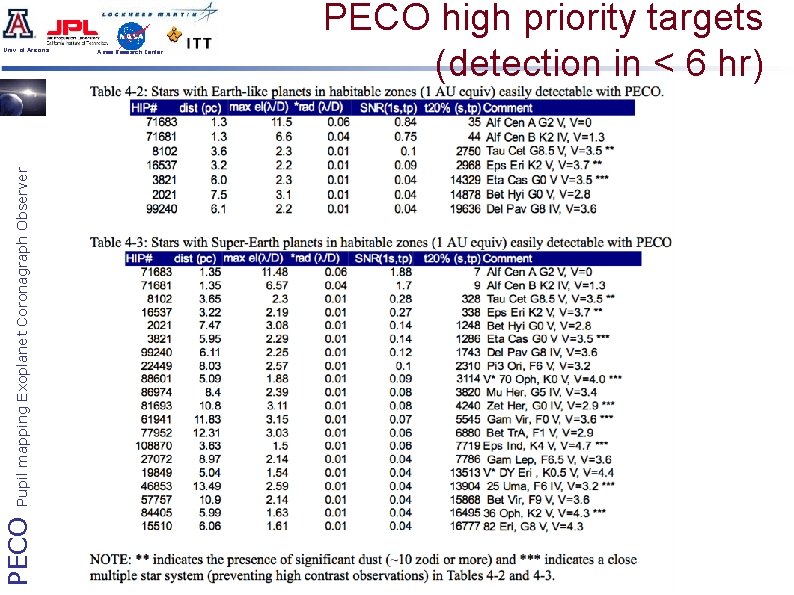
PECO Pupil mapping Exoplanet Coronagraph Observer Univ. of Arizona Ames Research Center PECO high priority targets (detection in < 6 hr)
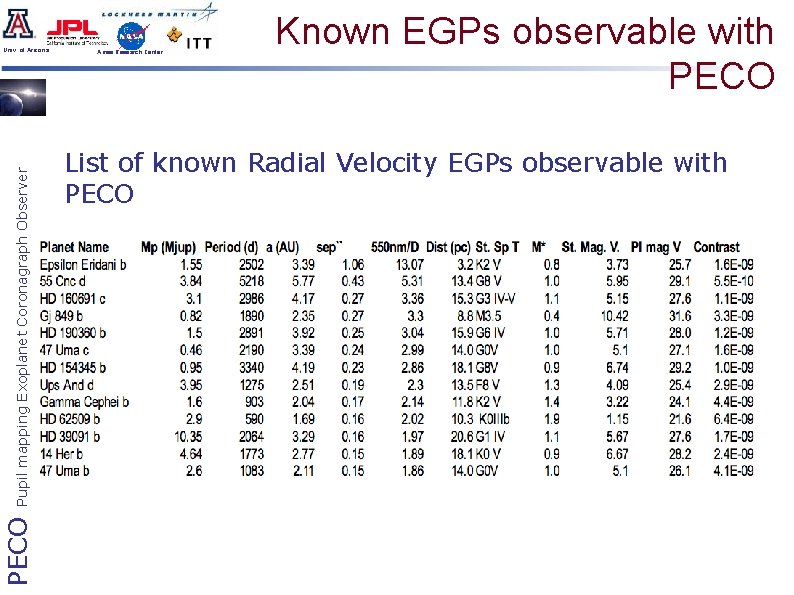
PECO Pupil mapping Exoplanet Coronagraph Observer Univ. of Arizona Ames Research Center Known EGPs observable with PECO List of known Radial Velocity EGPs observable with PECO
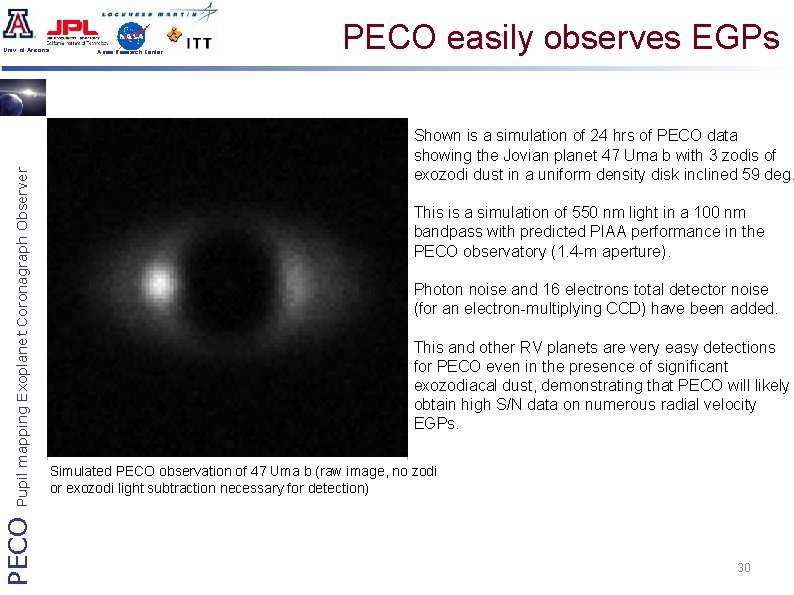
PECO Pupil mapping Exoplanet Coronagraph Observer Univ. of Arizona Ames Research Center PECO easily observes EGPs Shown is a simulation of 24 hrs of PECO data showing the Jovian planet 47 Uma b with 3 zodis of exozodi dust in a uniform density disk inclined 59 deg. This is a simulation of 550 nm light in a 100 nm bandpass with predicted PIAA performance in the PECO observatory (1. 4 -m aperture). Photon noise and 16 electrons total detector noise (for an electron-multiplying CCD) have been added. This and other RV planets are very easy detections for PECO even in the presence of significant exozodiacal dust, demonstrating that PECO will likely obtain high S/N data on numerous radial velocity EGPs. Simulated PECO observation of 47 Uma b (raw image, no zodi or exozodi light subtraction necessary for detection) 30
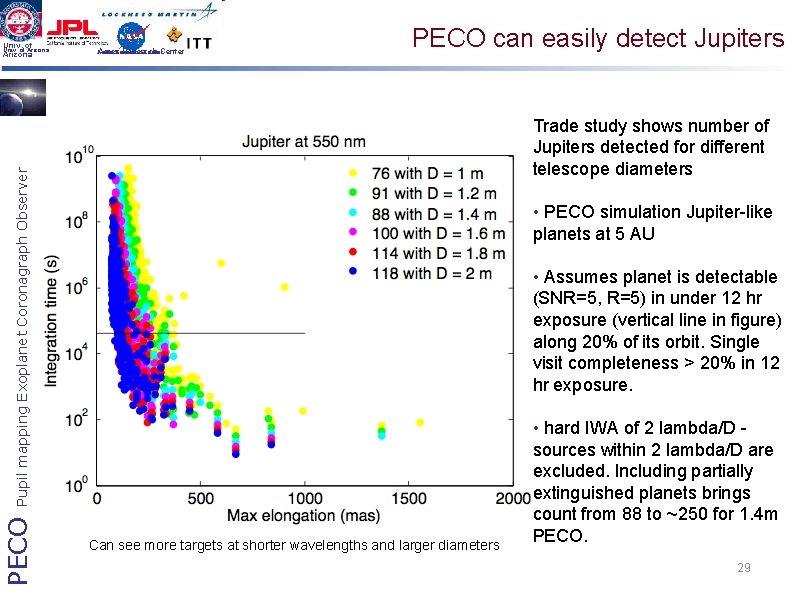
Ames Research Center PECO can easily detect Jupiters Trade study shows number of Jupiters detected for different telescope diameters PECO Pupil mapping Exoplanet Coronagraph Observer Univ. of Arizona • PECO simulation Jupiter-like planets at 5 AU • Assumes planet is detectable (SNR=5, R=5) in under 12 hr exposure (vertical line in figure) along 20% of its orbit. Single visit completeness > 20% in 12 hr exposure. Can see more targets at shorter wavelengths and larger diameters • hard IWA of 2 lambda/D sources within 2 lambda/D are excluded. Including partially extinguished planets brings count from 88 to ~250 for 1. 4 m PECO. 29
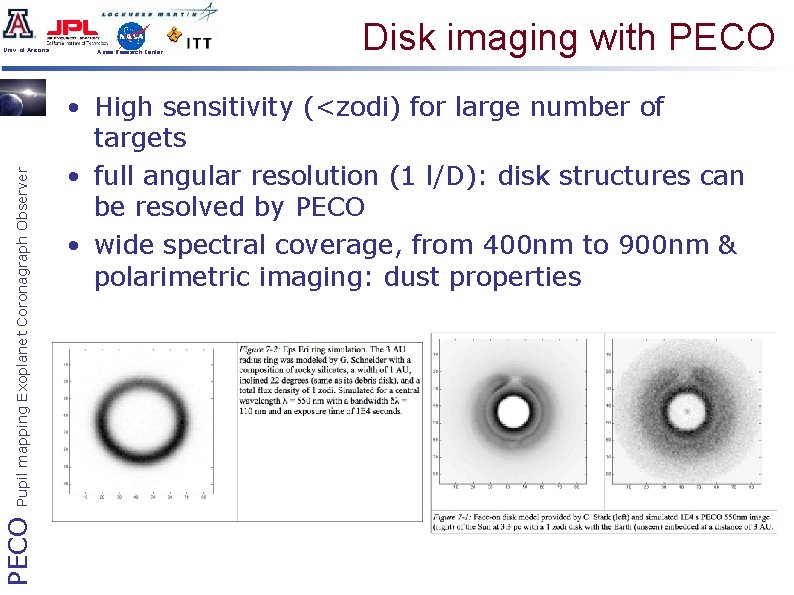
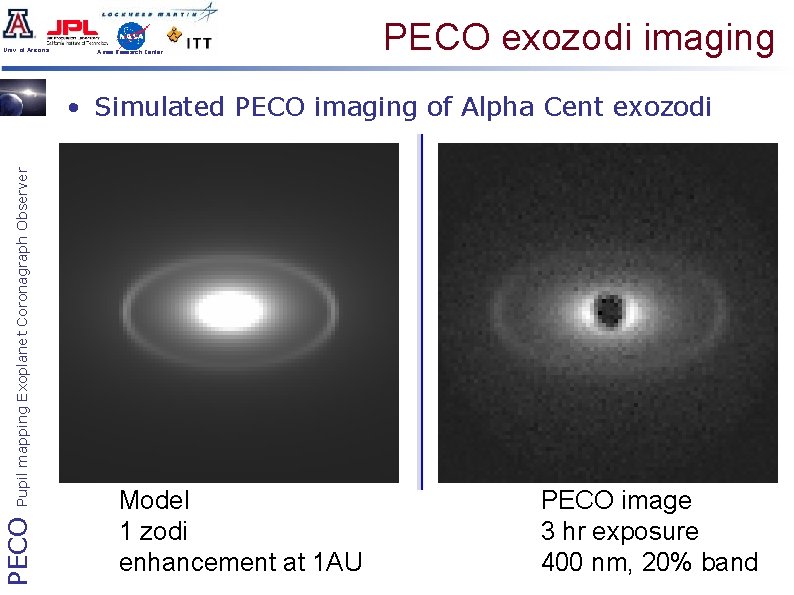
PECO Pupil mapping Exoplanet Coronagraph Observer Univ. of Arizona Ames Research Center Disk imaging with PECO • High sensitivity (<zodi) for large number of targets • full angular resolution (1 l/D): disk structures can be resolved by PECO • wide spectral coverage, from 400 nm to 900 nm & polarimetric imaging: dust properties
Univ. of Arizona Ames Research Center PECO exozodi imaging PECO Pupil mapping Exoplanet Coronagraph Observer • Simulated PECO imaging of Alpha Cent exozodi Model 1 zodi enhancement at 1 AU PECO image 3 hr exposure 400 nm, 20% band
PECO Pupil mapping Exoplanet Coronagraph Observer Univ. of Arizona Ames Research Center PECO Design Reference Mission Sun avoidance angle = 60 deg anti-Sun avoidance angle = 45 deg
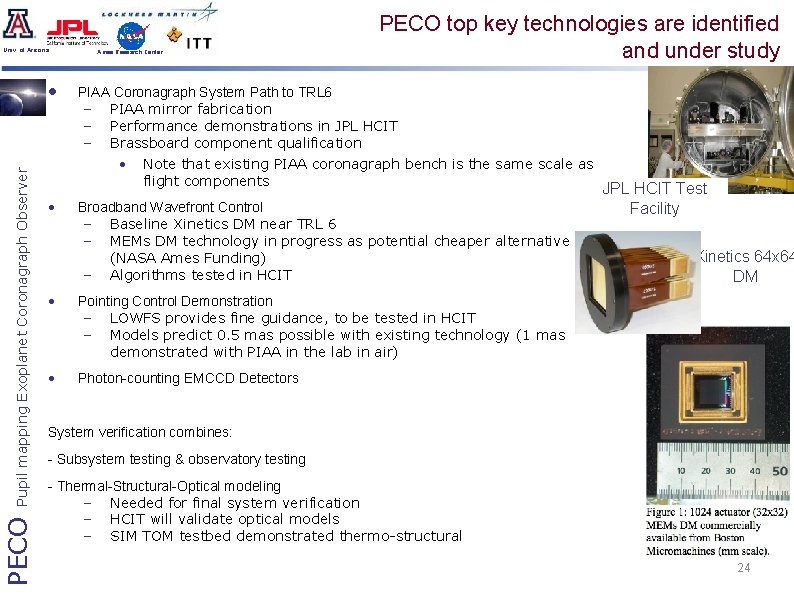
Univ. of Arizona PECO Pupil mapping Exoplanet Coronagraph Observer • • Ames Research Center PECO top key technologies are identified and under study PIAA Coronagraph System Path to TRL 6 – PIAA mirror fabrication – Performance demonstrations in JPL HCIT – Brassboard component qualification • Note that existing PIAA coronagraph bench is the same scale as flight components Broadband Wavefront Control – Baseline Xinetics DM near TRL 6 – MEMs DM technology in progress as potential cheaper alternative (NASA Ames Funding) – Algorithms tested in HCIT • Pointing Control Demonstration – LOWFS provides fine guidance, to be tested in HCIT – Models predict 0. 5 mas possible with existing technology (1 mas demonstrated with PIAA in the lab in air) • Photon-counting EMCCD Detectors JPL HCIT Test Facility Xinetics 64 x 64 DM System verification combines: - Subsystem testing & observatory testing - Thermal-Structural-Optical modeling – Needed for final system verification – HCIT will validate optical models – SIM TOM testbed demonstrated thermo-structural 24
PIAA optics - Diamond turning 36
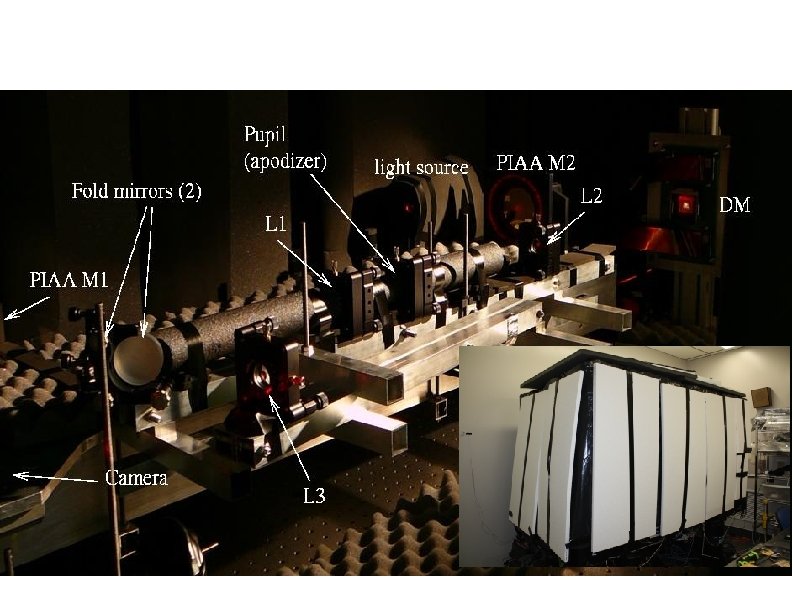
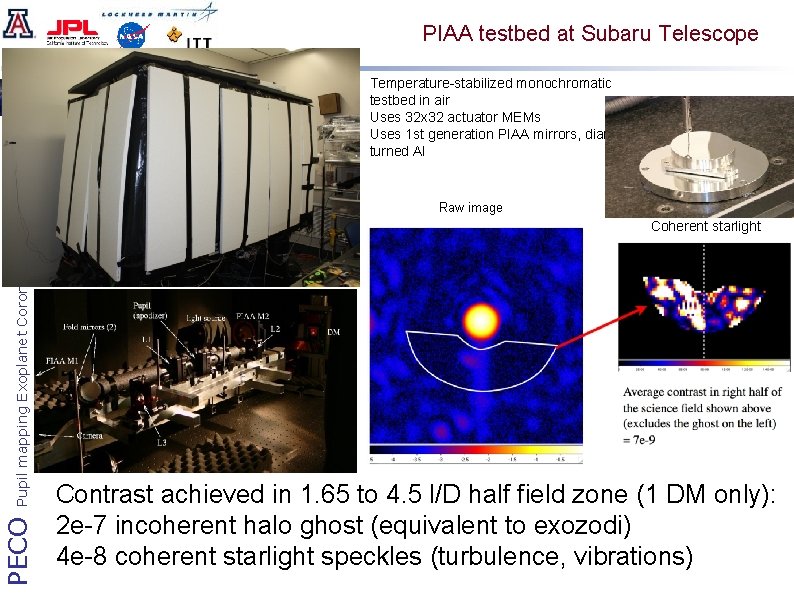
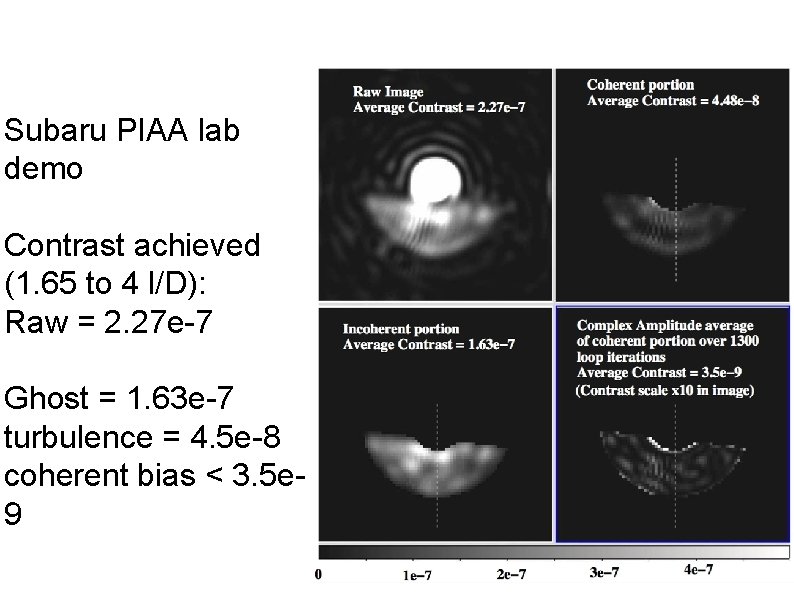
PIAA testbed at Subaru Telescope Univ. of Arizona Ames Research Center PECO Pupil mapping Exoplanet Coronagraph Observer Temperature-stabilized monochromatic testbed in air Uses 32 x 32 actuator MEMs Uses 1 st generation PIAA mirrors, diamond turned Al Raw image Coherent starlight Contrast achieved in 1. 65 to 4. 5 l/D half field zone (1 DM only): 2 e-7 incoherent halo ghost (equivalent to exozodi) 4 e-8 coherent starlight speckles (turbulence, vibrations)
Subaru PIAA lab demo Contrast achieved (1. 65 to 4 l/D): Raw = 2. 27 e-7 Ghost = 1. 63 e-7 turbulence = 4. 5 e-8 coherent bias < 3. 5 e 9
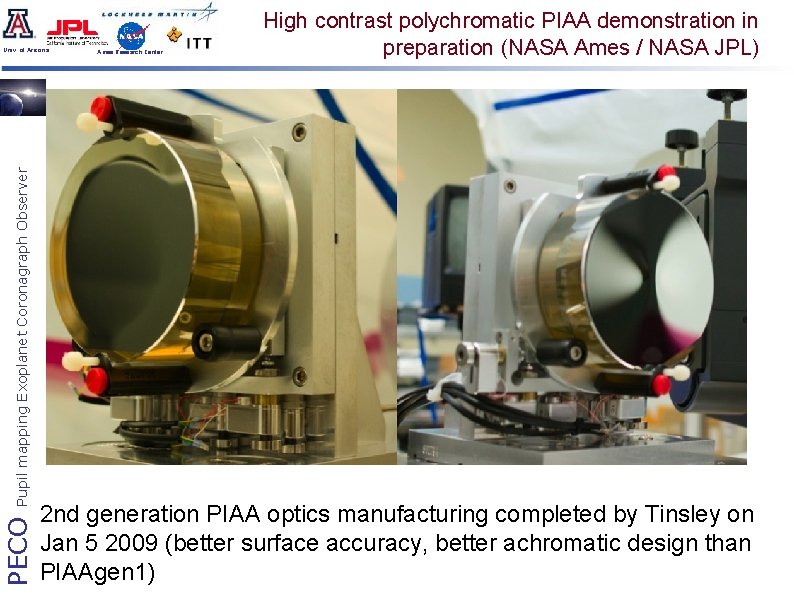
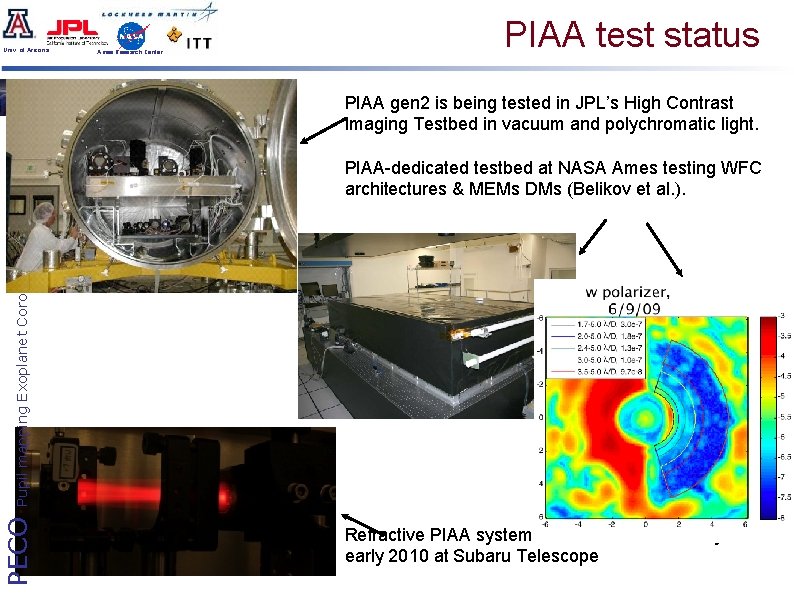
PECO Pupil mapping Exoplanet Coronagraph Observer Univ. of Arizona Ames Research Center High contrast polychromatic PIAA demonstration in preparation (NASA Ames / NASA JPL) 2 nd generation PIAA optics manufacturing completed by Tinsley on Jan 5 2009 (better surface accuracy, better achromatic design than PIAAgen 1)
Univ. of Arizona Ames Research Center PIAA test status PECO Pupil mapping Exoplanet Coronagraph Observer PIAA gen 2 is being tested in JPL’s High Contrast Imaging Testbed in vacuum and polychromatic light. PIAA-dedicated testbed at NASA Ames testing WFC architectures & MEMs DMs (Belikov et al. ). Refractive PIAA system scheduled to be on-sky in early 2010 at Subaru Telescope
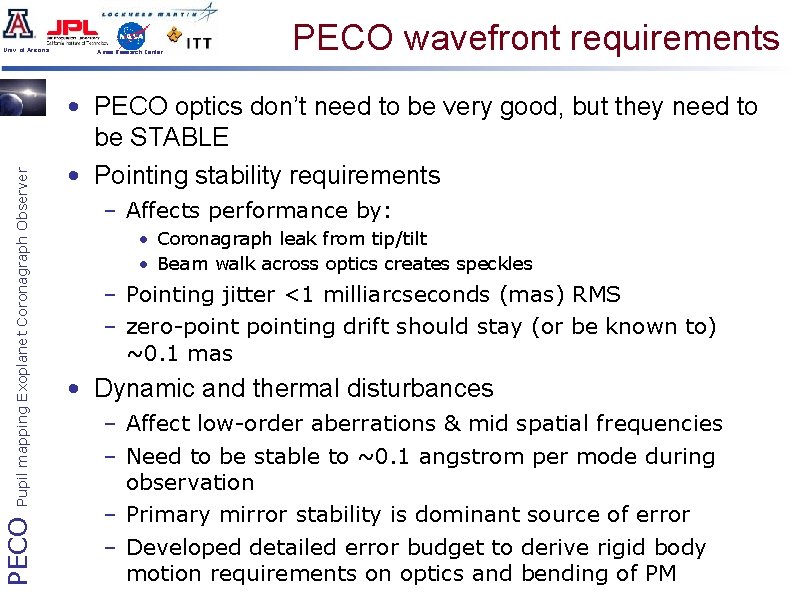
PECO Pupil mapping Exoplanet Coronagraph Observer Univ. of Arizona Ames Research Center PECO wavefront requirements • PECO optics don’t need to be very good, but they need to be STABLE • Pointing stability requirements – Affects performance by: • Coronagraph leak from tip/tilt • Beam walk across optics creates speckles – Pointing jitter <1 milliarcseconds (mas) RMS – zero-pointing drift should stay (or be known to) ~0. 1 mas • Dynamic and thermal disturbances – Affect low-order aberrations & mid spatial frequencies – Need to be stable to ~0. 1 angstrom per mode during observation – Primary mirror stability is dominant source of error – Developed detailed error budget to derive rigid body motion requirements on optics and bending of PM
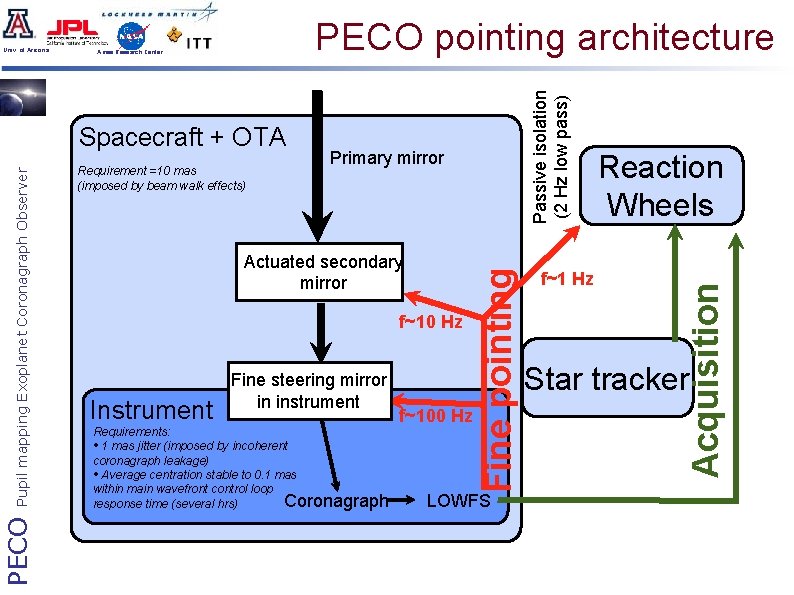
PECO Requirement =10 mas (imposed by beam walk effects) Primary mirror Actuated secondary mirror f~10 Hz Instrument Fine steering mirror in instrument Requirements: • 1 mas jitter (imposed by incoherent coronagraph leakage) • Average centration stable to 0. 1 mas within main wavefront control loop Coronagraph response time (several hrs) f~100 Hz LOWFS f~1 Hz Reaction Wheels Acquisition Pupil mapping Exoplanet Coronagraph Observer Spacecraft + OTA Passive isolation (2 Hz low pass) PECO pointing architecture Ames Research Center Fine pointing Univ. of Arizona Star tracker
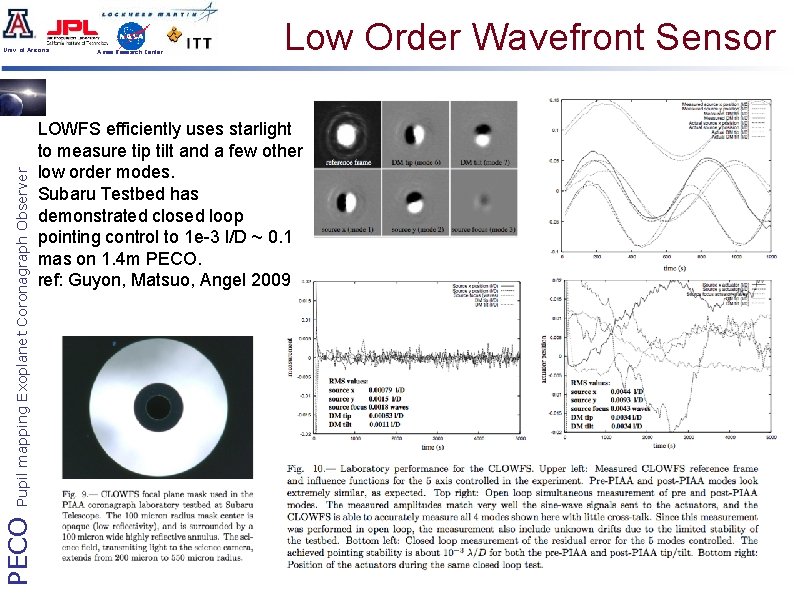
PECO Pupil mapping Exoplanet Coronagraph Observer Univ. of Arizona Ames Research Center Low Order Wavefront Sensor LOWFS efficiently uses starlight to measure tip tilt and a few other low order modes. Subaru Testbed has demonstrated closed loop pointing control to 1 e-3 l/D ~ 0. 1 mas on 1. 4 m PECO. ref: Guyon, Matsuo, Angel 2009
Univ. of Arizona Ames Research Center PECO stability analysis PECO Pupil mapping Exoplanet Coronagraph Observer • PECO wavefront needs to be very stable – it takes few minutes to see an Earth-like planet – it takes just as long to see a speckle with the same luminosity – it takes a 1. 5 pm sine wave ripple on the wavefront to create such a speckle • A 1. 5 pm sine wave ripple on the wavefront which appears in a few minutes is sufficient to confuse the detection of Earths • Detailed analysis with design iterations have to be done to verify that PECO is sufficiently stable to detect Earths
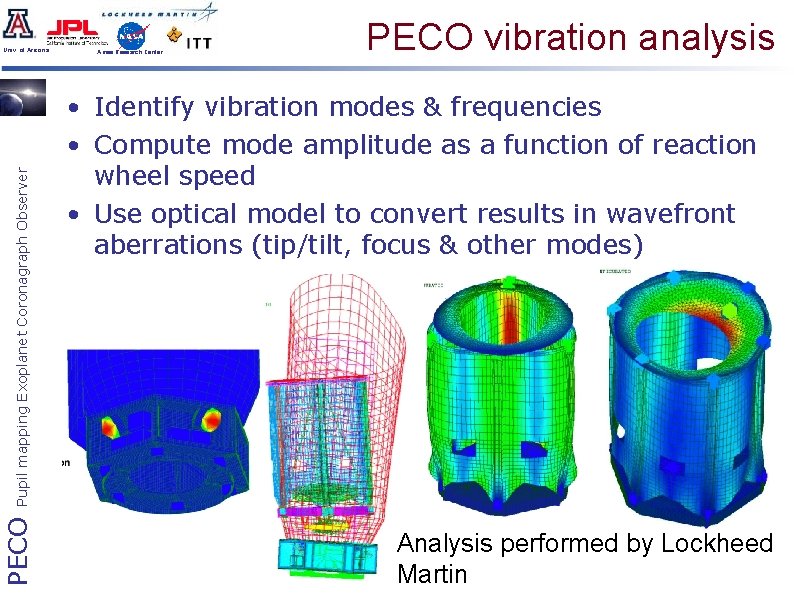
PECO Pupil mapping Exoplanet Coronagraph Observer Univ. of Arizona Ames Research Center PECO vibration analysis • Identify vibration modes & frequencies • Compute mode amplitude as a function of reaction wheel speed • Use optical model to convert results in wavefront aberrations (tip/tilt, focus & other modes) Analysis performed by Lockheed Martin
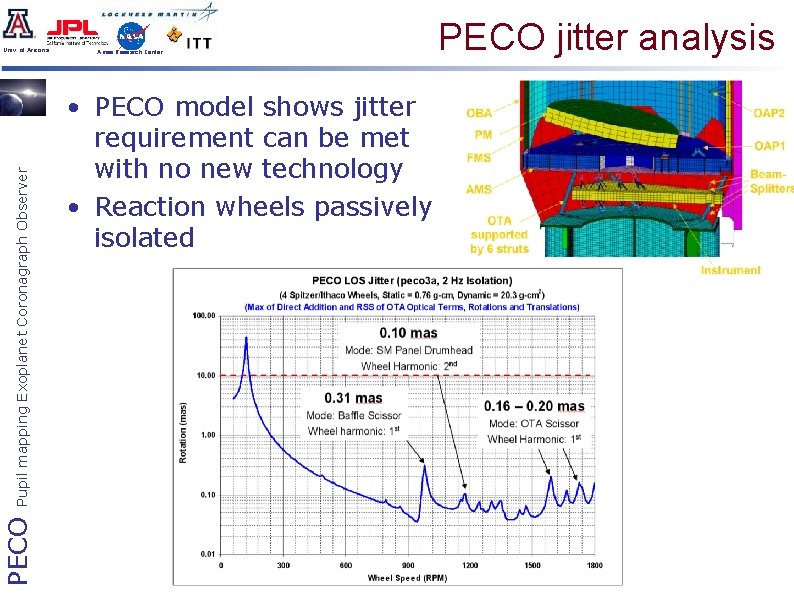
PECO Pupil mapping Exoplanet Coronagraph Observer Univ. of Arizona Ames Research Center • PECO model shows jitter requirement can be met with no new technology • Reaction wheels passively isolated PECO jitter analysis
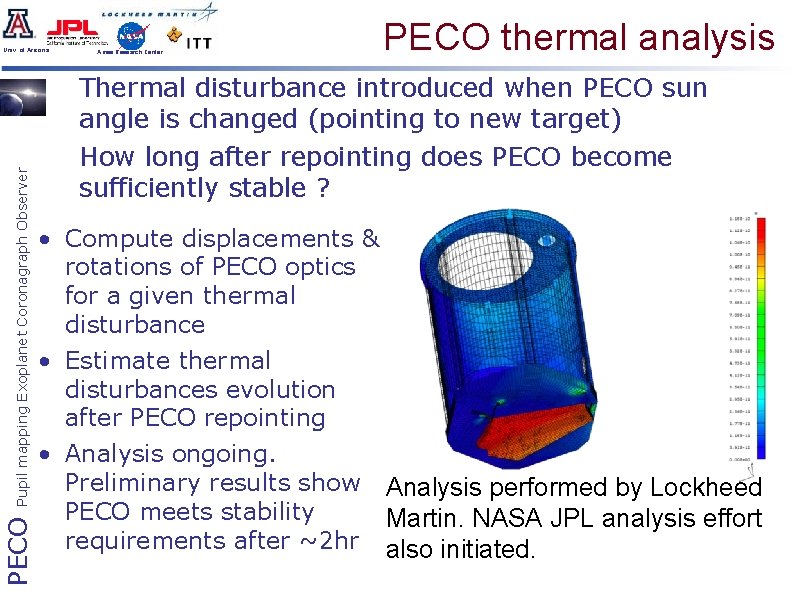
PECO Pupil mapping Exoplanet Coronagraph Observer Univ. of Arizona Ames Research Center PECO thermal analysis Thermal disturbance introduced when PECO sun angle is changed (pointing to new target) How long after repointing does PECO become sufficiently stable ? • Compute displacements & rotations of PECO optics for a given thermal disturbance • Estimate thermal disturbances evolution after PECO repointing • Analysis ongoing. Preliminary results show Analysis performed by Lockheed PECO meets stability Martin. NASA JPL analysis effort requirements after ~2 hr also initiated.
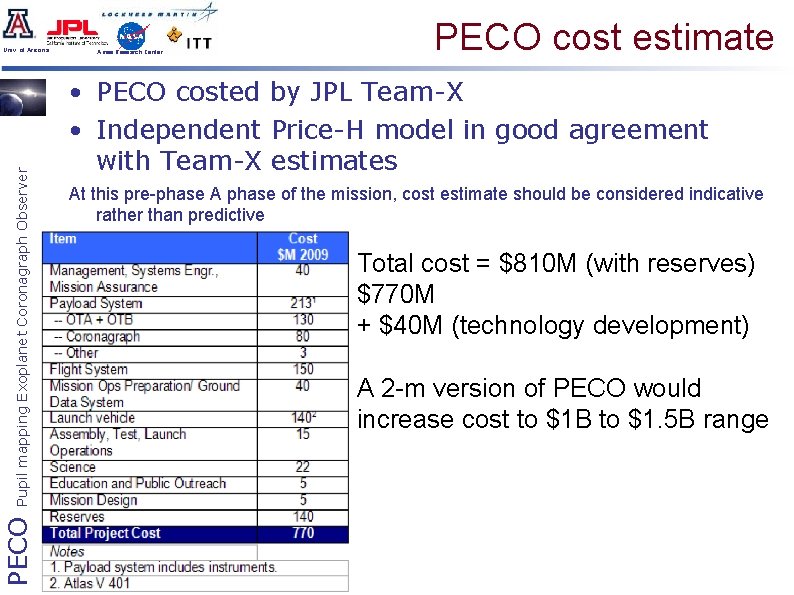
PECO Pupil mapping Exoplanet Coronagraph Observer Univ. of Arizona Ames Research Center PECO cost estimate • PECO costed by JPL Team-X • Independent Price-H model in good agreement with Team-X estimates At this pre-phase A phase of the mission, cost estimate should be considered indicative rather than predictive Total cost = $810 M (with reserves) $770 M + $40 M (technology development) A 2 -m version of PECO would increase cost to $1 B to $1. 5 B range
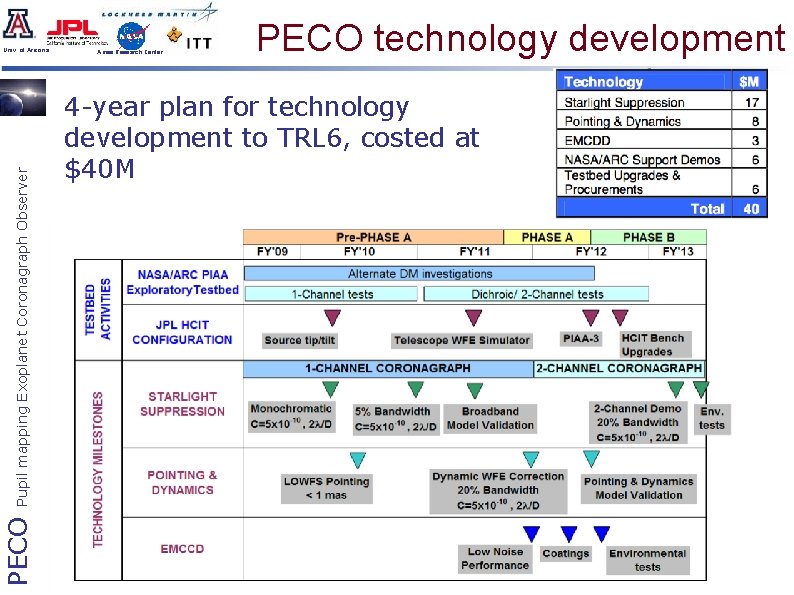
PECO Pupil mapping Exoplanet Coronagraph Observer Univ. of Arizona Ames Research Center PECO technology development 4 -year plan for technology development to TRL 6, costed at $40 M
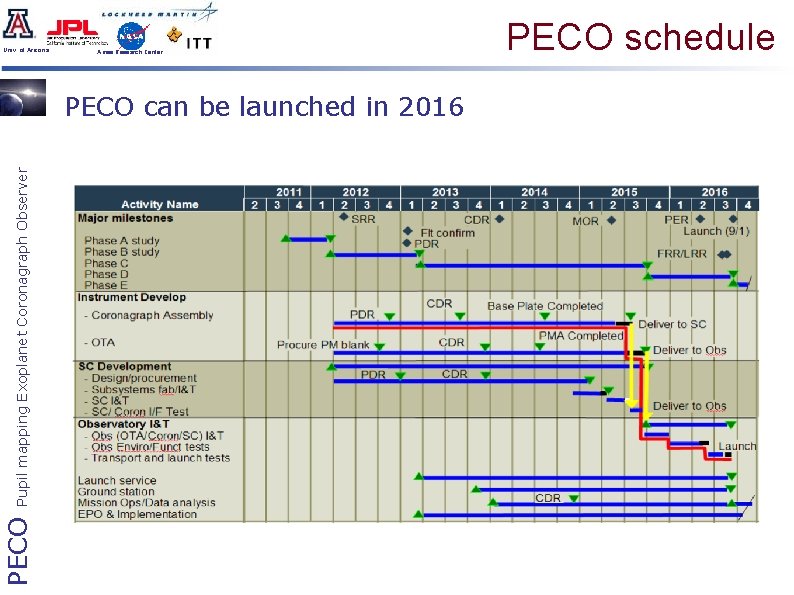
Univ. of Arizona Ames Research Center PECO Pupil mapping Exoplanet Coronagraph Observer PECO can be launched in 2016 PECO schedule
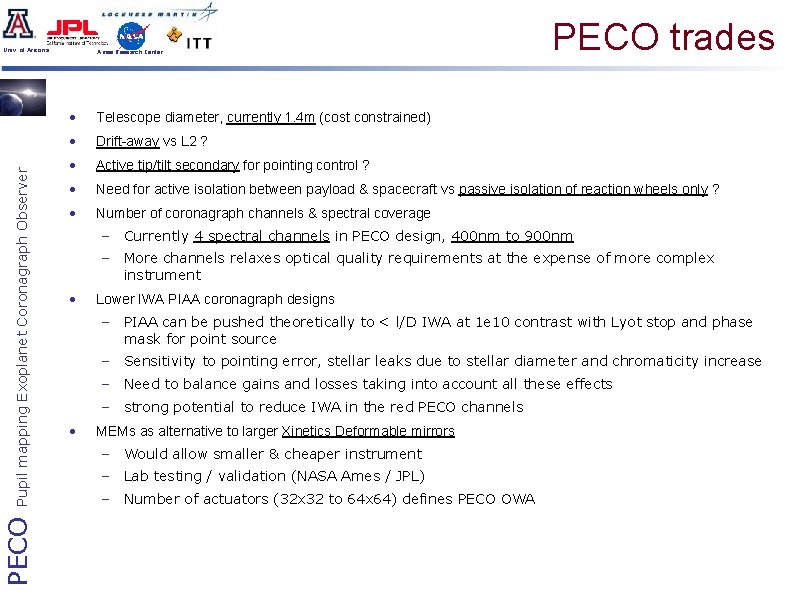
PECO Pupil mapping Exoplanet Coronagraph Observer Univ. of Arizona Ames Research Center PECO trades • Telescope diameter, currently 1. 4 m (cost constrained) • Drift-away vs L 2 ? • Active tip/tilt secondary for pointing control ? • Need for active isolation between payload & spacecraft vs passive isolation of reaction wheels only ? • Number of coronagraph channels & spectral coverage – Currently 4 spectral channels in PECO design, 400 nm to 900 nm – More channels relaxes optical quality requirements at the expense of more complex instrument • Lower IWA PIAA coronagraph designs – PIAA can be pushed theoretically to < l/D IWA at 1 e 10 contrast with Lyot stop and phase mask for point source – Sensitivity to pointing error, stellar leaks due to stellar diameter and chromaticity increase – Need to balance gains and losses taking into account all these effects – strong potential to reduce IWA in the red PECO channels • MEMs as alternative to larger Xinetics Deformable mirrors – Would allow smaller & cheaper instrument – Lab testing / validation (NASA Ames / JPL) – Number of actuators (32 x 32 to 64 x 64) defines PECO OWA
PECO Pupil mapping Exoplanet Coronagraph Observer Univ. of Arizona Ames Research Center Summary • PECO study shows direct imaging and characterization of Earths/Super-Earths possible with medium-scale mission and: – maps exozodi down to <1 zodi sensitivity – census of planets and orbits in each exosystem – extrasolar giant planets characterization • “Conventional” telescope with off-axis mirror can be used (stability OK, wavefront quality OK). All the “magic” is in the instrument -> raising TRL for instrument is key (coronagraph, wavefront control) – technology development at ~$40 M, 4 yr • PECO could launch in 2016. Total mission cost ~$810 M including technology development • PECO architecture can be scaled to a flagship 3 -4 m telescope without new technologies or new launch vehicles • PECO team actively maturing technology, and exploring further improvements to coronagraph/WFC design
PECO Pupil mapping Exoplanet Coronagraph Observer Univ. of Arizona Ames Research Center • – – – More information More info on PECO website: http: //caao. as. arizona. edu/PECO 20 -page summary of PECO activity Science Requirements Document (SRD) Design Reference Mission (DRM) Technology development plan Recent lab development updates • Several of the key coronagraphy and WFC technologies developed for PECO will be the core of the Subaru Coronagraphic Extreme-AO system – PIAA & PIAACMC – LOWFS for fast & accurate pointing control – Control & calibration of focal plane speckles Science goals: Planetary systems formation/architecture (young massive planets, disks), and possibly reflected light from massive planets