
Direct conversion of graphite into diamond through electronic


- Slides: 25
Direct conversion of graphite into diamond through electronic excited states H. Nakayama and H. Katayama-Yoshida (J. Phys : Condens. Matter 15 R 1077 (2003) Yoshida Lab. Presenter: Sho Nishida 1
Contents Introduction ・Ultrahard material ・Polymorphism of Carbon First principles calculations Graphite Diamond conversion ・Applying pressure ・Hole doping Theoretical prediction of a new diamond synthesis method Summary Polymorphism : 結晶多形 2
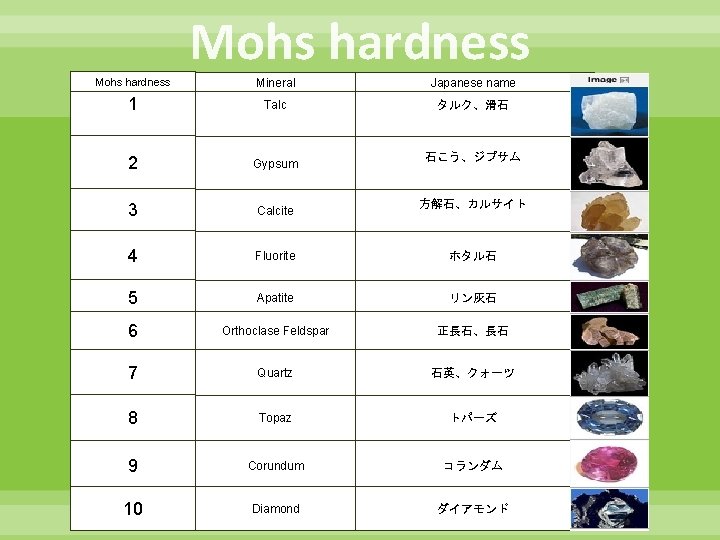
Mohs hardness Mineral Japanese name 1 Talc タルク、滑石 2 Gypsum 3 Calcite 4 Fluorite ホタル石 5 Apatite リン灰石 6 Orthoclase Feldspar 正長石、長石 7 Quartz 石英、クォーツ 8 Topaz トパーズ 9 Corundum コランダム 10 Diamond ダイアモンド 石こう、ジプサム 方解石、カルサイト 3
Ultrahard materials Diamond ・Diamond can resist indentation pressures of 97 GPa. Hexagonal diamond (Lonsdaleite) ・Lonsdaleite can resist indentation pressures of 152 GPa. (by using ab-initio calculation[1]) W-BN (Wurtzite Boron Nitride) ・W-BN can resist indentation pressures of 114 GPa. (by using ab-initio calculatiuon[1]) [1] Z. Pan, H, Sun et al Phys. Rev. Lett. 102, 055503 (2009). ab-initio calculation: 第一原理計算 4
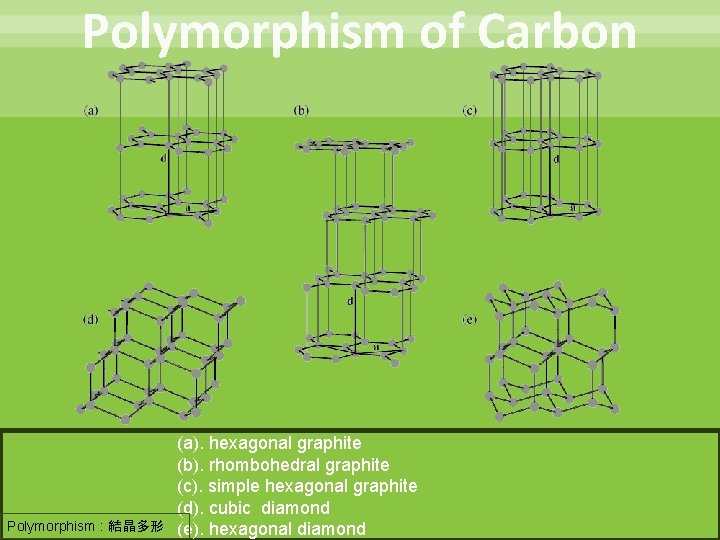
Polymorphism of Carbon (a). hexagonal graphite (b). rhombohedral graphite (c). simple hexagonal graphite (d). cubic diamond Polymorphism : 結晶多形 (e). hexagonal diamond 5
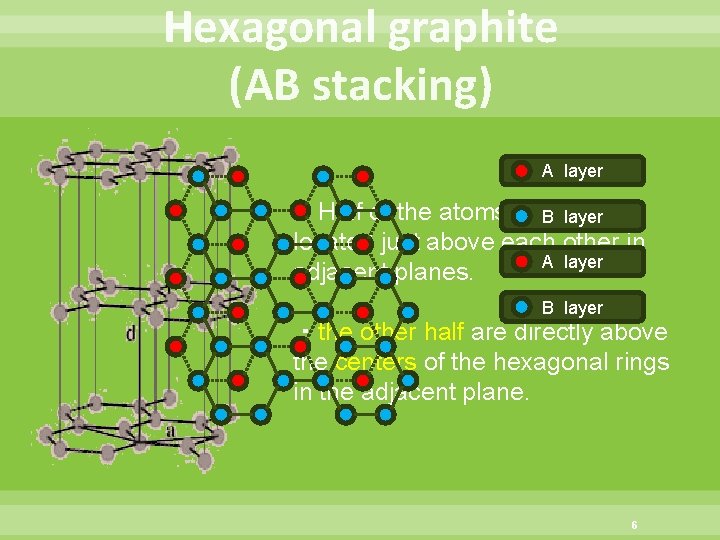
Hexagonal graphite (AB stacking) A layer ・Half of the atoms are directly B layer located just above each other in A layer adjacent planes. B layer ・the other half are directly above the centers of the hexagonal rings in the adjacent plane. 6
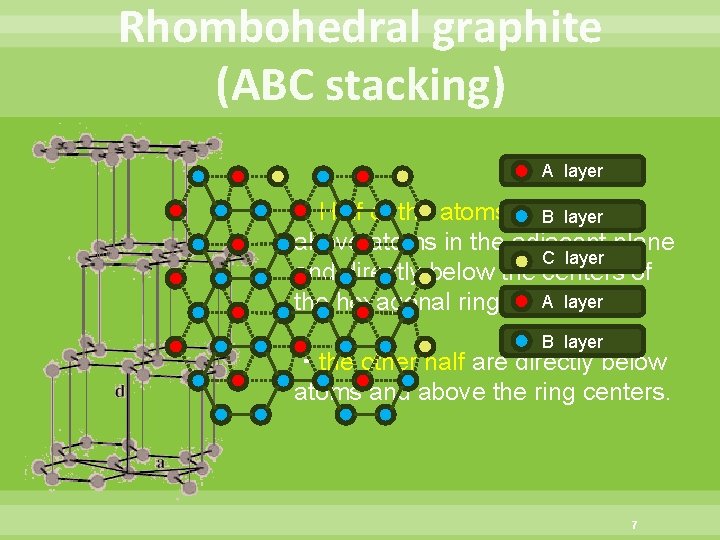
Rhombohedral graphite (ABC stacking) A layer ・Half of the atoms are directly B layer above atoms in the adjacent plane C layer and directly below the centers of the hexagonal rings. A layer B layer ・the other half are directly below atoms and above the ring centers. 7
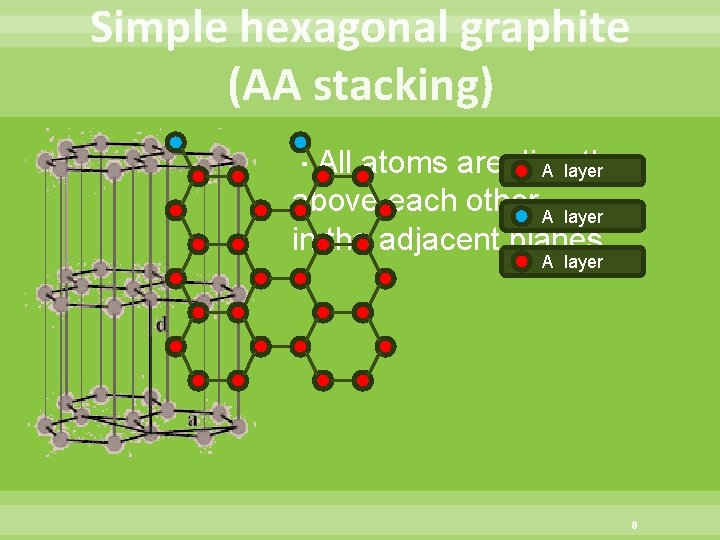
Simple hexagonal graphite (AA stacking) ・All atoms are directly A layer above each other A layer in the adjacent planes A layer 8
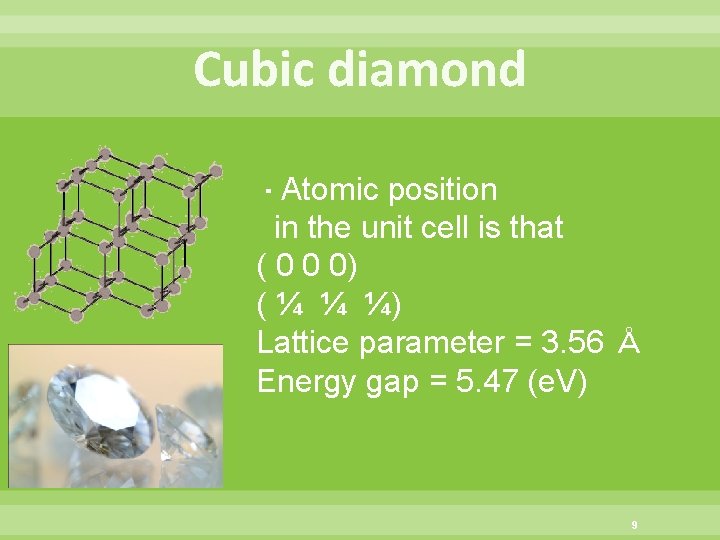
Cubic diamond ・Atomic position in the unit cell is that ( 0 0 0) ( ¼ ¼ ¼) Lattice parameter = 3. 56 Å Energy gap = 5. 47 (e. V) 9
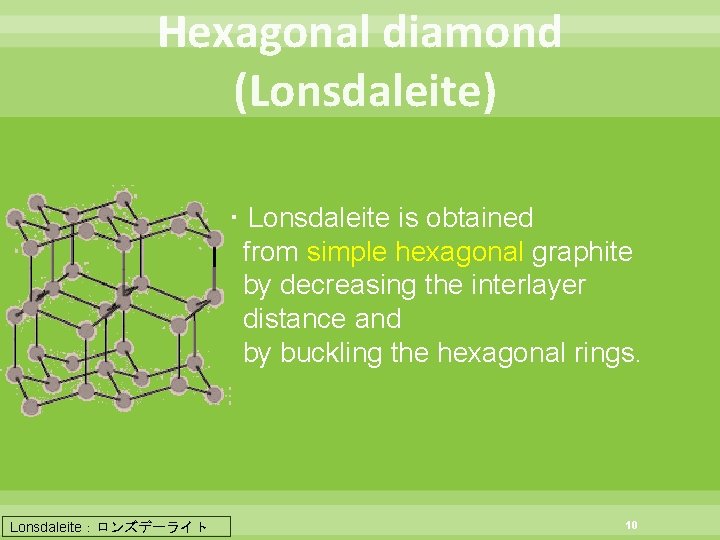
Hexagonal diamond (Lonsdaleite) ・Lonsdaleite is obtained from simple hexagonal graphite by decreasing the interlayer distance and by buckling the hexagonal rings. Lonsdaleite:ロンズデーライト 10
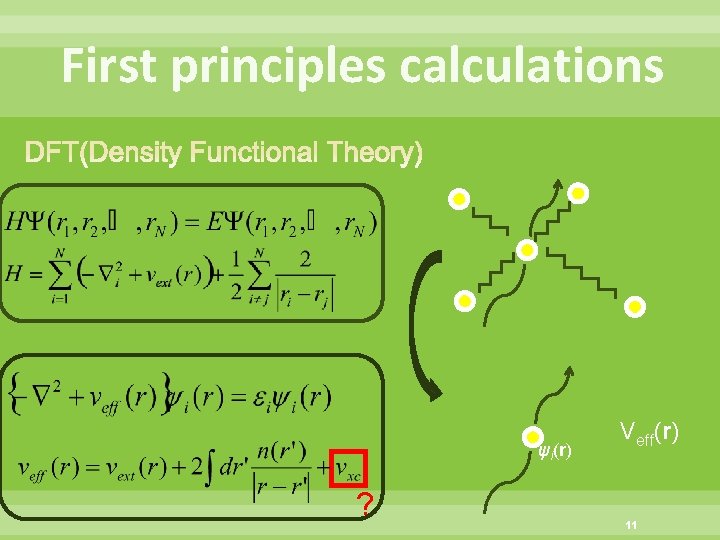
First principles calculations ψi(r) ? Veff(r) 11
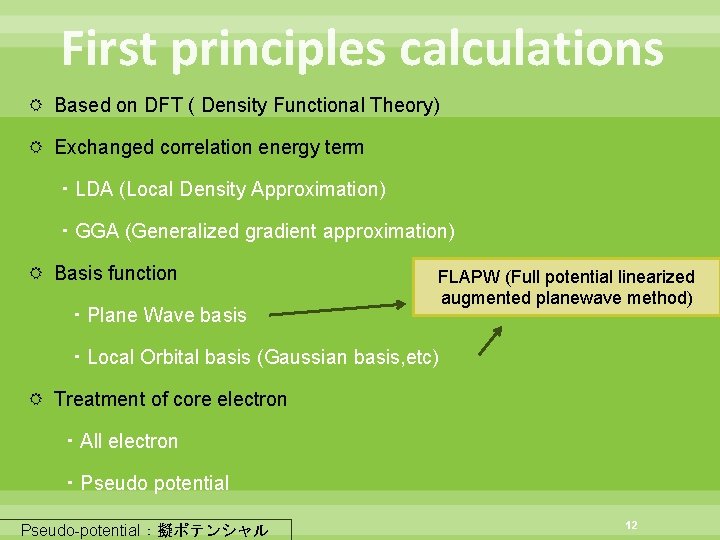
First principles calculations Based on DFT ( Density Functional Theory) Exchanged correlation energy term ・LDA (Local Density Approximation) ・GGA (Generalized gradient approximation) Basis function ・Plane Wave basis FLAPW (Full potential linearized augmented planewave method) ・Local Orbital basis (Gaussian basis, etc) Treatment of core electron ・All electron ・Pseudo potential Pseudo-potential:擬ポテンシャル 12
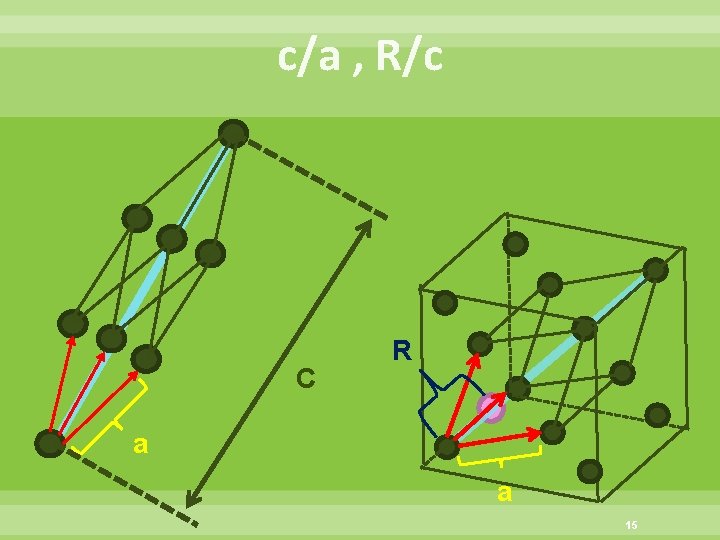
Graphite-to-diamond transition ・The transition from rhombohedral graphite to cubic diamond can be investigated by calculating the total energy E (V, β, γ) as a function of V, β(=c/a), γ(=R/c). V is cell volume, R is length between the first atom and the second atom. 13
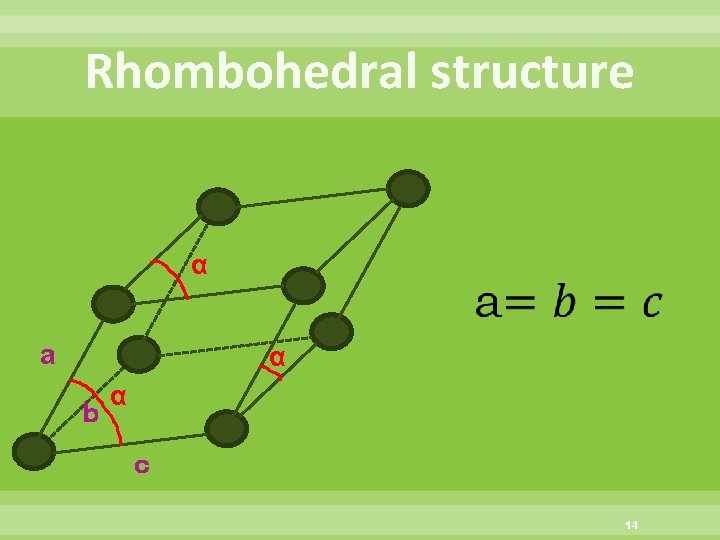
Rhombohedral structure α a α b α c 14
c/a , R/c C R a a 15
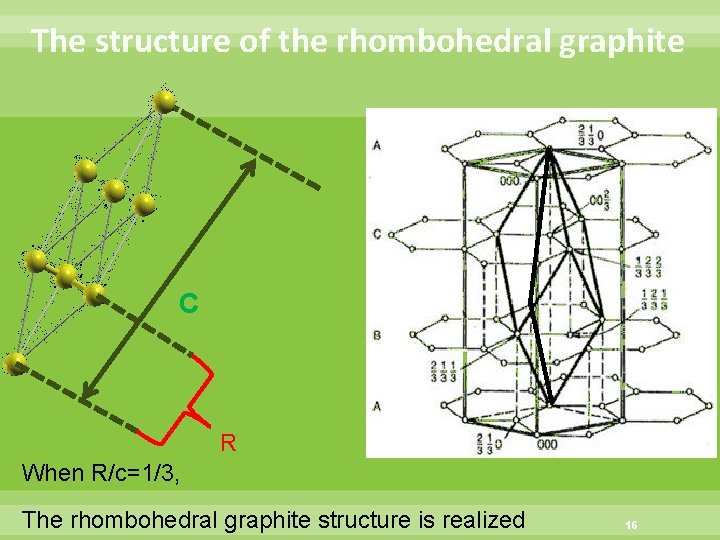
The structure of the rhombohedral graphite C R When R/c=1/3, The rhombohedral graphite structure is realized 16
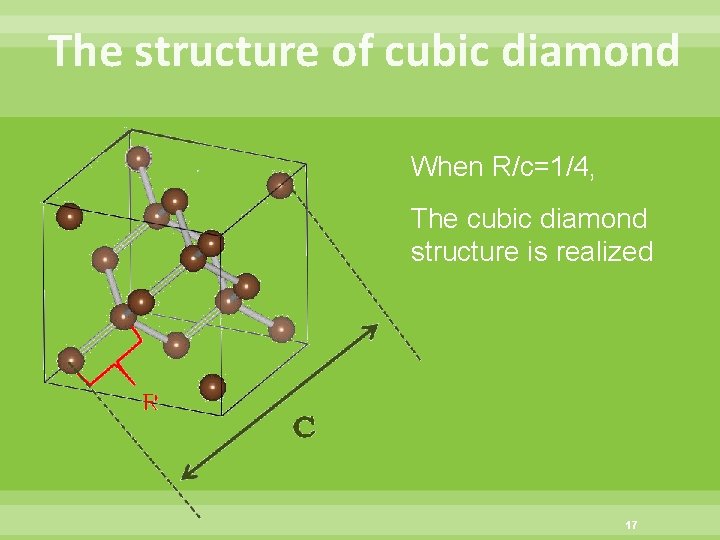
The structure of cubic diamond When R/c=1/4, The cubic diamond structure is realized 17
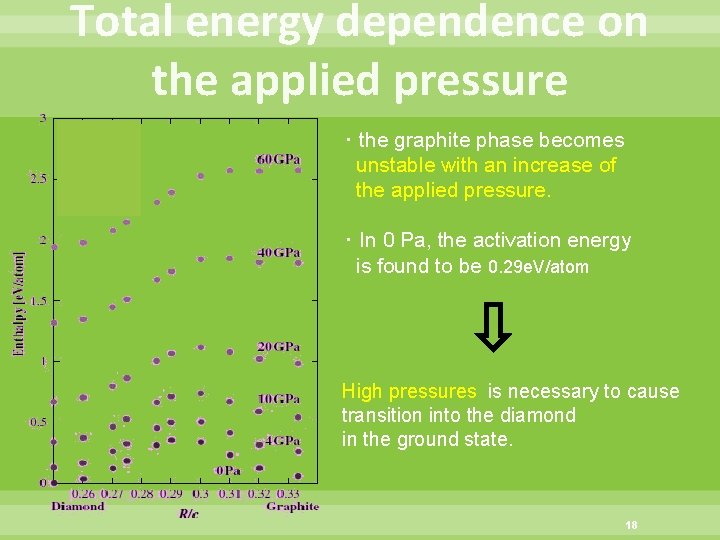
Total energy dependence on the applied pressure ・the graphite phase becomes unstable with an increase of the applied pressure. ・In 0 Pa, the activation energy is found to be 0. 29 e. V/atom High pressures is necessary to cause transition into the diamond in the ground state. 18
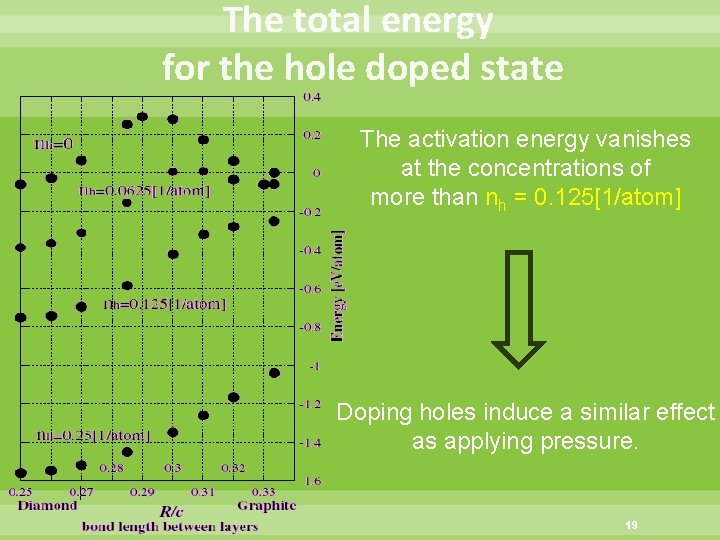
The total energy for the hole doped state The activation energy vanishes at the concentrations of more than nh = 0. 125[1/atom] Doping holes induce a similar effect as applying pressure. 19
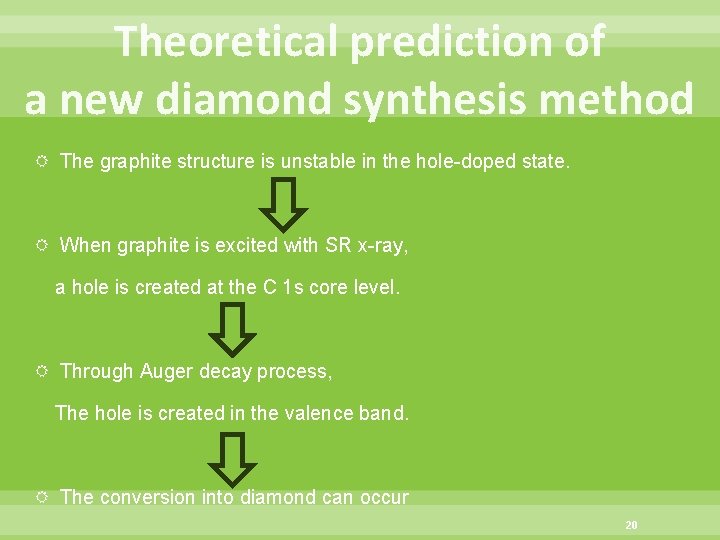
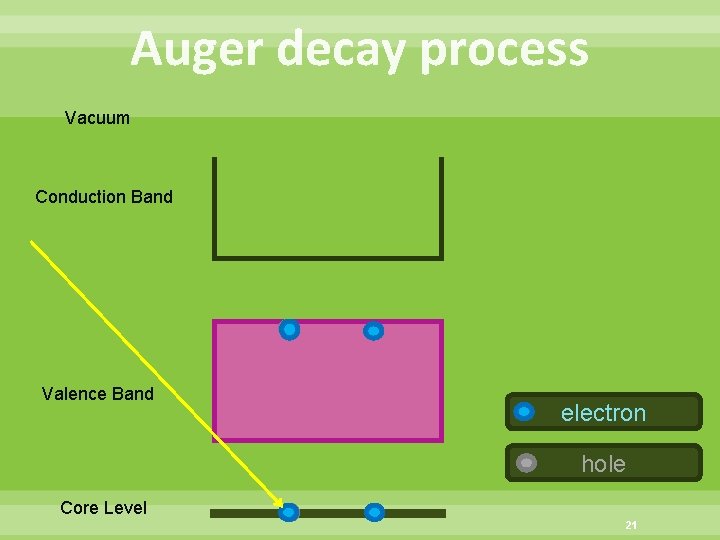
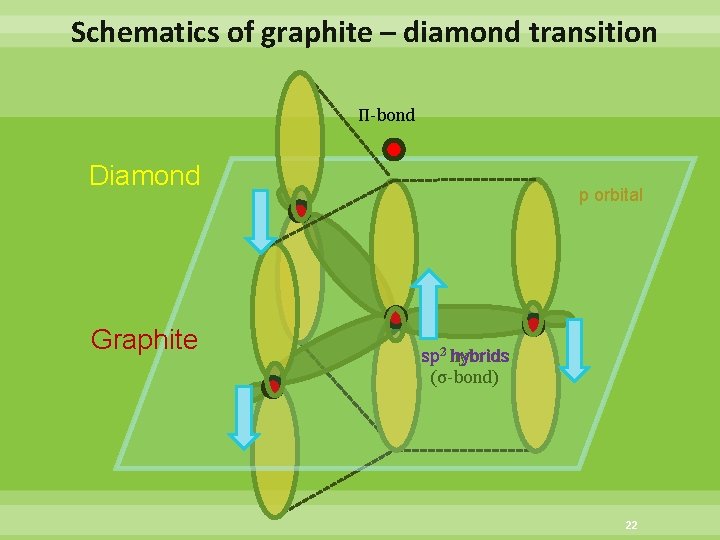
Theoretical prediction of a new diamond synthesis method The graphite structure is unstable in the hole-doped state. When graphite is excited with SR x-ray, a hole is created at the C 1 s core level. Through Auger decay process, The hole is created in the valence band. The conversion into diamond can occur 20
Auger decay process Vacuum Conduction Band Valence Band electron hole Core Level 21
Schematics of graphite – diamond transition Π-bond Diamond Graphite p orbital hybrids sp 23 hybrids (σ-bond) 22
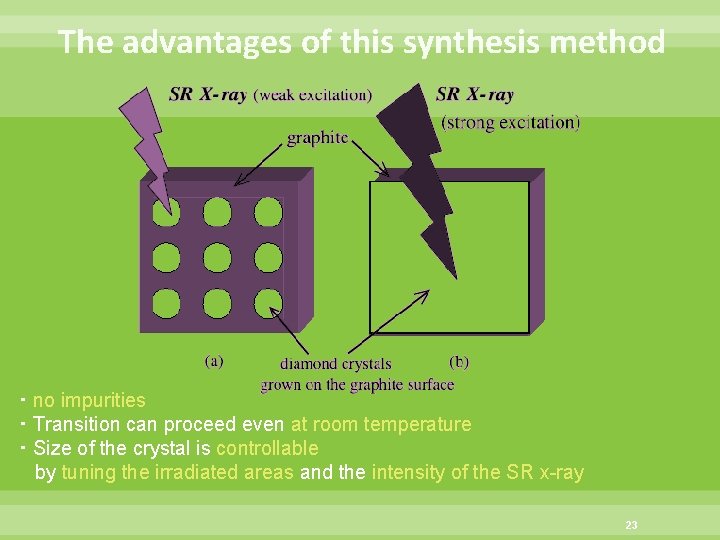
The advantages of this synthesis method ・no impurities ・Transition can proceed even at room temperature ・Size of the crystal is controllable by tuning the irradiated areas and the intensity of the SR x-ray 23
Summary When holes are excited in the valence π band, The configuration in the graphite structure becomes markedly unstable. SR x-ray can induce the conversion into diamond through the Auger decay process. 24
Fin