
Direct assistance to countries Cross border frequency coordination
Direct assistance to countries Cross border frequency coordination Spectrum management assessments István BOZSÓKI Senior Engineer BDT/IEE/TND
Cross border frequency coordination HCM 4 A implementation by ITU-EC HIPSSA project
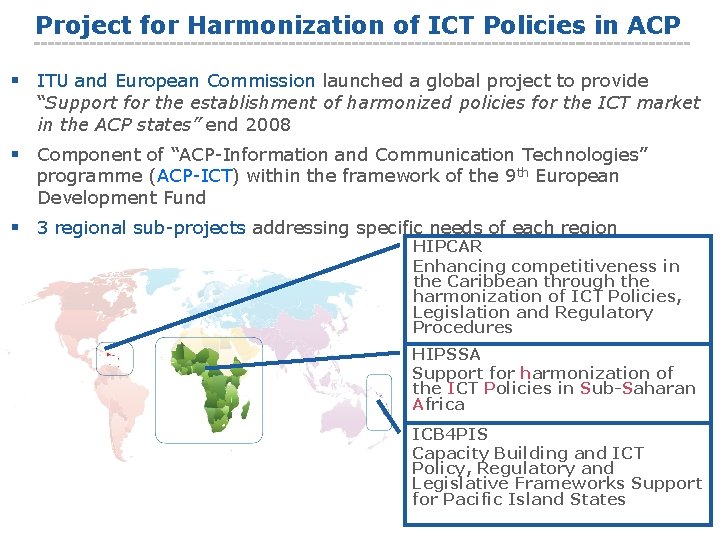
Project for Harmonization of ICT Policies in ACP § ITU and European Commission launched a global project to provide “Support for the establishment of harmonized policies for the ICT market in the ACP states” end 2008 § Component of “ACP-Information and Communication Technologies” programme (ACP-ICT) within the framework of the 9 th European Development Fund § 3 regional sub-projects addressing specific needs of each region HIPCAR Enhancing competitiveness in the Caribbean through the harmonization of ICT Policies, Legislation and Regulatory Procedures HIPSSA Support for harmonization of the ICT Policies in Sub-Saharan Africa text ICB 4 PIS Capacity Building and ICT Policy, Regulatory and Legislative Frameworks Support for Pacific Island States
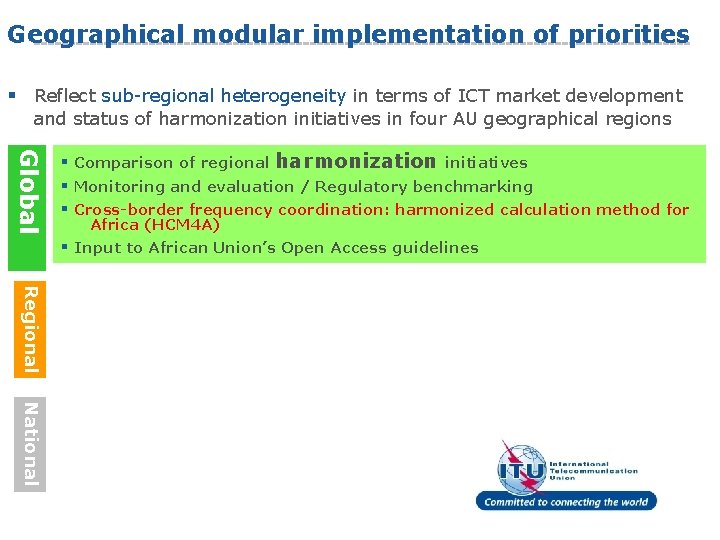
Geographical modular implementation of priorities § Reflect sub-regional heterogeneity in terms of ICT market development and status of harmonization initiatives in four AU geographical regions Global § Comparison of regional harmonization initiatives § Monitoring and evaluation / Regulatory benchmarking § Cross-border frequency coordination: harmonized calculation method for Africa (HCM 4 A) § Input to African Union’s Open Access guidelines Regional National text
Cross border frequency coordination with a harmonized calculation method for Africa § The harmonization set a standard that all the countries involved accept on a mutually beneficial approach by consensus; § Prevent and easily solve radio interference across borders; § Provide a solid basis for bilateral and multilateral agreements; § Enable creation of bilateral preferential frequency agreements at border zones (who can operate what and with which interference ranges); § Oblige each country to take account of other stations before putting own into operation.
Advantages of a harmonized calculation method for Africa (HCM 4 A) § Based on HCM Agreement used in Europe § Optimize spectrum usage; § Prevent harmful interferences; § Confer an adequate protection for stations; § Define technical procedures; provisions and administrative § Quick assignment of preferential frequencies; § Transparent decisions through agreed assessment procedures; § Quick assessment of interference through data exchange.

Implementation of HCM 4 A in four phases 1. Assessment phase Review existing bilateral and multilateral cross-border frequency coordination agreements in Sub-Sahara Africa; 2. Multilateral agreement proposal Technical working group review the results of the assessment and propose a multilateral agreement 3. Validation workshop Adopt the draft agreement in line with the conclusion of the assessment 4. Development of HCM 4 A software Develop a release software based on HCM 4 A agreement (if adopted) and propose training workshops on the software
Software tool for HCM 4 A § Optimise spectrum usage by accurate interference field strength calculations; § Establish general parameters, improvement and supplementation of technical provisions, individual restrictions; § Establish models for computer-aided interference range calculations § Harmonise parameters: objectively predictable towards transparent decisions
HCM 4 A involves all for 4 sub regions § This project includes performing a survey and a comparative analysis of existing administrative and technical procedures related to bilateral and multilateral cross-border frequency coordination agreements in 4 geographical sub-regions as defined by the AU • Central Africa [Burundi, Central African Republic, Chad, Congo, Democratic Republic of Congo, Equatorial Guinea, Gabon, Sao Tome and Principe]; • East Africa [Comores, Djibouti, Eritrea, Ethiopia, Kenya, Madagascar, Mauritius, Rwanda, Seychelles, Somalia, Sudan, Tanzania, Uganda]; • Southern Africa [Angola, Botswana, Lesotho, Malawi, Mozambique, Namibia, South Africa, Swaziland, Zambia, Zimbabwe]; • West Africa [Benin, Burkina-Faso, Cape Verde, Côte d’Ivoire, Gambia, Ghana, Guinea-Bissau, Liberia, Mali, Nigeria, Sierra. Leone, Senegal, Togo].
Team of ITU experts for HCM 4 A § Regional Experts • Central Africa • East Africa • Southern Africa • West Africa § International HCM Expert § Senior Coordinator (Regional and HCM Experts) § HIPSSA Senior Project Coordinator § BDT HQ Senior Engineer
Tasks in Phase 1 of HCM 4 A for the sub-regions § Request • Contact details of the person, dealing with spectrum management matters, and who will be the HCM 4 A Focal Point (FP) in the relevant country for this project. § Tasks from the HCM 4 A Focal Point • Fill in a questionnaire; • Provide info on any bilateral/multilateral agreement; • Provide current frequency register database format; • Provide protection requirements for the different radio- communication services; • Provide clarifications on the subject whenever the need arises.
Spectrum management assessments Case studies funded (mainly) by Canada - Benchmark study: Hungary - Timor-Leste, Cambodia, Lao PDR - Sierra Leone, Zimbabwe, Gabon - Suriname, Barbados text 12
Why Case Studies? Ø Case studies provide a structured way of looking at events or systems, collecting data, analysing information, and reporting the results Ø The outcome is a sharpened understanding of how a system works and why it has developed in the way it has Ø Also, the study can identify what might become important to look at more extensively in future research and what might be appropriate examples to be considered for application in other situations or environments text
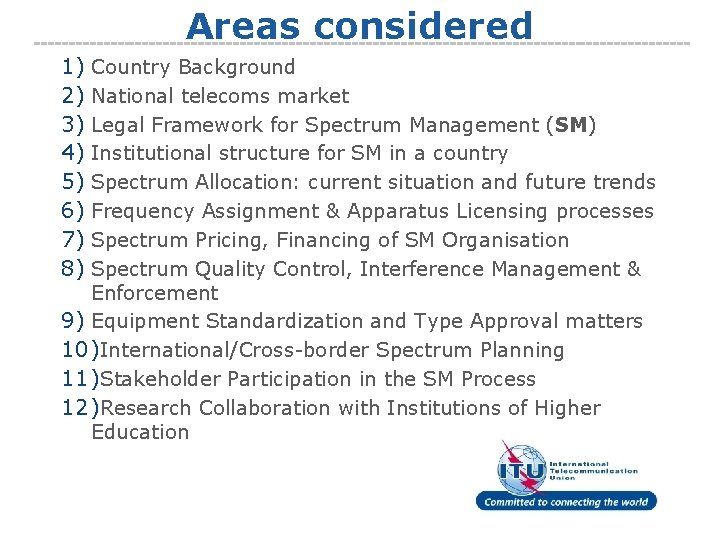
Areas considered 1) Country Background 2) National telecoms market 3) Legal Framework for Spectrum Management (SM) 4) Institutional structure for SM in a country 5) Spectrum Allocation: current situation and future trends 6) Frequency Assignment & Apparatus Licensing processes 7) Spectrum Pricing, Financing of SM Organisation 8) Spectrum Quality Control, Interference Management & Enforcement 9) Equipment Standardization and Type Approval matters 10)International/Cross-border Spectrum Planning 11)Stakeholder Participation in the SM Process 12)Research Collaboration with Institutions of Higher Education text
Timor-Leste Cambodia Lao PDR Mr. Pavel Mamchenkov (RUS) text 15
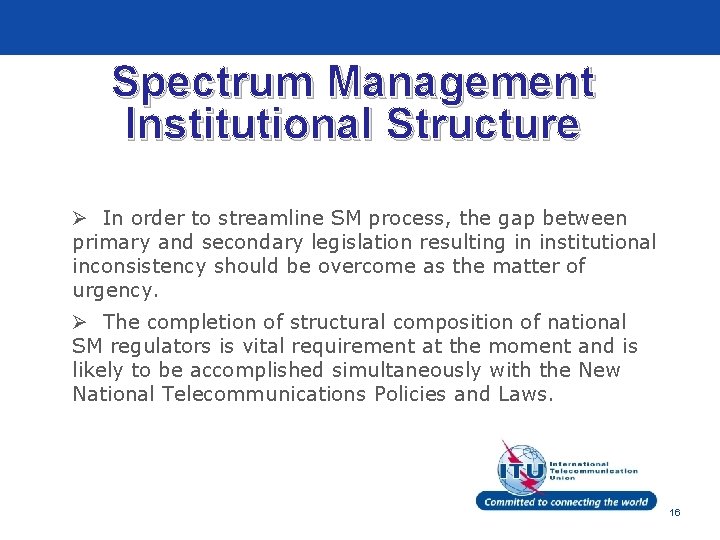
Spectrum Management Institutional Structure Ø In order to streamline SM process, the gap between primary and secondary legislation resulting in institutional inconsistency should be overcome as the matter of urgency. Ø The completion of structural composition of national SM regulators is vital requirement at the moment and is likely to be accomplished simultaneously with the New National Telecommunications Policies and Laws. text 16
Primary SM Legislation text 17
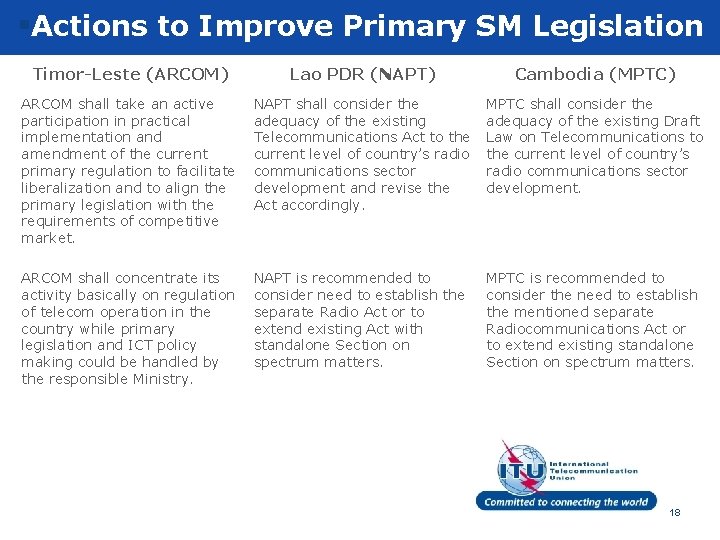
§Actions to Improve Primary SM Legislation Timor-Leste (ARCOM) Lao PDR (NAPT) Cambodia (MPTC) ARCOM shall take an active participation in practical implementation and amendment of the current primary regulation to facilitate liberalization and to align the primary legislation with the requirements of competitive market. NAPT shall consider the adequacy of the existing Telecommunications Act to the current level of country’s radio communications sector development and revise the Act accordingly. MPTC shall consider the adequacy of the existing Draft Law on Telecommunications to the current level of country’s radio communications sector development. ARCOM shall concentrate its activity basically on regulation of telecom operation in the country while primary legislation and ICT policy making could be handled by the responsible Ministry. NAPT is recommended to consider need to establish the separate Radio Act or to extend existing Act with standalone Section on spectrum matters. MPTC is recommended to consider the need to establish the mentioned separate Radiocommunications Act or to extend existing standalone Section on spectrum matters. text 18

National Frequency Allocations Tables Ø The NFATs should be reviewed in order to examine the need for country names in the footnotes of Radio Regulations related to the current spectrum usage. Ø The frequency assignment tables should be reviewed in order to eliminate misleading information on the current spectrum applications in the countries. The modification of the spectrum utilization column of the Table is recommended to be accomplished as the result of licences and radio monitoring analysis. Ø The revisions of NFATs should be carried out on the regular basis. Time period of regular revisions should be determined in the primary legislation. text 19
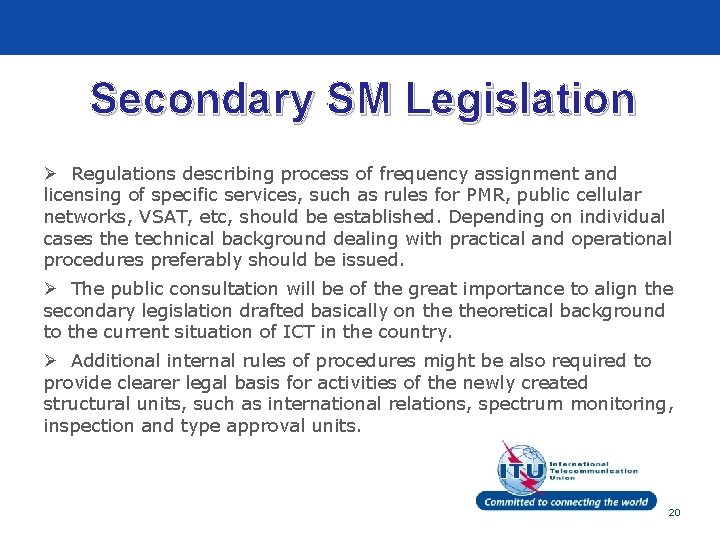
Secondary SM Legislation Ø Regulations describing process of frequency assignment and licensing of specific services, such as rules for PMR, public cellular networks, VSAT, etc, should be established. Depending on individual cases the technical background dealing with practical and operational procedures preferably should be issued. Ø The public consultation will be of the great importance to align the secondary legislation drafted basically on theoretical background to the current situation of ICT in the country. Ø Additional internal rules of procedures might be also required to provide clearer legal basis for activities of the newly created structural units, such as international relations, spectrum monitoring, inspection and type approval units. text 20
Structure and Staffing of National SM Authorities text 21
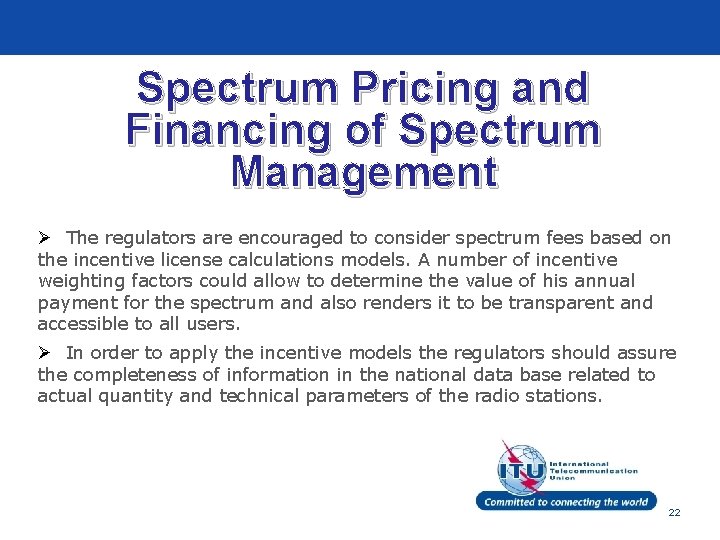
Spectrum Pricing and Financing of Spectrum Management Ø The regulators are encouraged to consider spectrum fees based on the incentive license calculations models. A number of incentive weighting factors could allow to determine the value of his annual payment for the spectrum and also renders it to be transparent and accessible to all users. Ø In order to apply the incentive models the regulators should assure the completeness of information in the national data base related to actual quantity and technical parameters of the radio stations. text 22
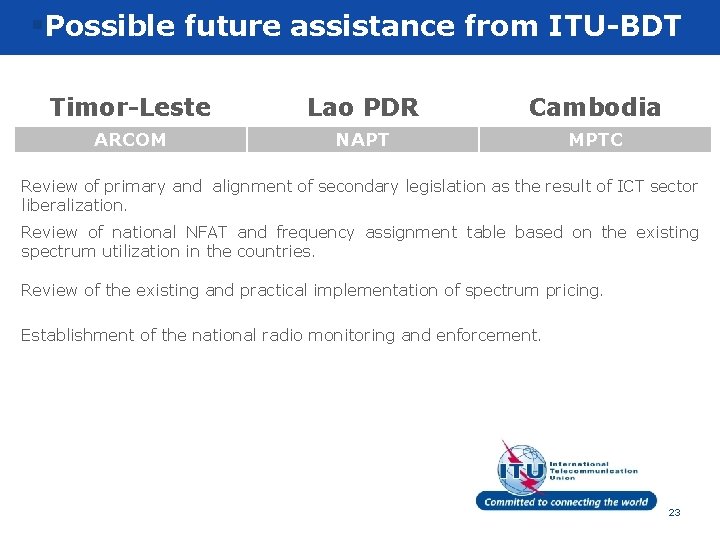
§Possible future assistance from ITU-BDT Timor-Leste Lao PDR Cambodia ARCOM NAPT MPTC Review of primary and alignment of secondary legislation as the result of ICT sector liberalization. Review of national NFAT and frequency assignment table based on the existing spectrum utilization in the countries. Review of the existing and practical implementation of spectrum pricing. Establishment of the national radio monitoring and enforcement. text 23
Sierra Leone Zimbabwe Mr. Arturas Medeisis (Lithuania) text 24
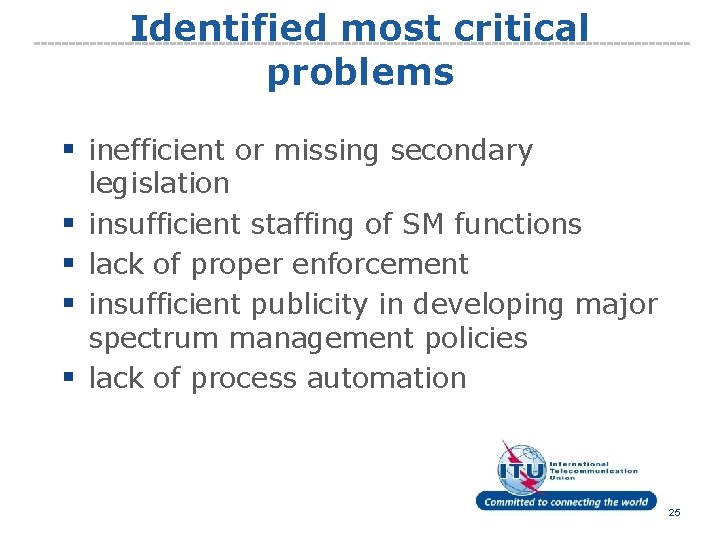
Identified most critical problems § inefficient or missing secondary § § legislation insufficient staffing of SM functions lack of proper enforcement insufficient publicity in developing major spectrum management policies lack of process automation text 25
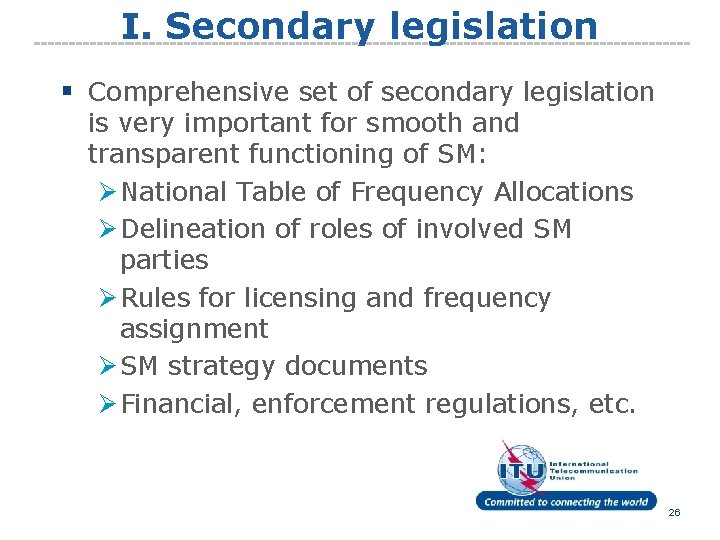
I. Secondary legislation § Comprehensive set of secondary legislation is very important for smooth and transparent functioning of SM: Ø National Table of Frequency Allocations Ø Delineation of roles of involved SM parties Ø Rules for licensing and frequency assignment Ø SM strategy documents Ø Financial, enforcement regulations, etc. text 26
Building legislative base § Needs to be assigned a clear priority § Either dedicate own staff to that task or outsource it, given its ”one-off” nature § No need to ”re-invent the wheel”, a lot of relevant information could be found in ITU materials, regional organisations and by reviewing similar legal instruments of national regulators in other countries text 27
II. Appropriate SM staffing § The number of SM staff should be appropriate for the number of carried duties § Even more important is that organisational units/dedicated staff exist to address specific SM functions: Ø planning, coordination Ø licensing, frequency assignment Ø radio monitoring Ø enforcement Ø type approval text 28
III. Role of enforcement § It is not possible for the regulator to achieve any of its objectives without proper enforcement: Øwho would follow the regulations if not faced with the prospect of prosecution for non-compliance? § Therefore permanent and highly visible enforcement activity should be an essential element of any SM organisation text 29
Building enforcement § Start from one inspection team, give it a schedule of at least one inspection visit a day § Based on initial experience, increase the number of teams, re-enforce them with suitable equipment § Build regional offices, with the main tasks of radio monitoring and enforcement text 30
IV. Publicity issues § Transparency of SM operations is important prerequisite of a stable and flourishing wireless market, where players can make well-informed decisions and are confident of the future § Publicity can be easily achieved by some organisational adjustments: Ø creating formal rules for public consultations Ø having an informative website, constantly update it Ø establishing regular venues for exchange of information with industry, such as annual seminars or consultative bodies text 31
V. Automation of SM processes § Important for increasing efficiency of SM organisation § Enables expert spectrum management decisions by providing access to: Ø administrative tools Ø spectrum planning and engineering tools Ø related databases: licensing, frequency planning, assignment, monitoring § Essential functionality provided by BDT’s SMS 4 DC software tool text 32
Conclusions § The administrations in developing countries often underestimate importance and complexity of SM § Careful design and constant improvement of SM organisations and their functioning is required if SM was to achieve its objectives § Advices may be found in ITU Handbook on National Spectrum Management text 33
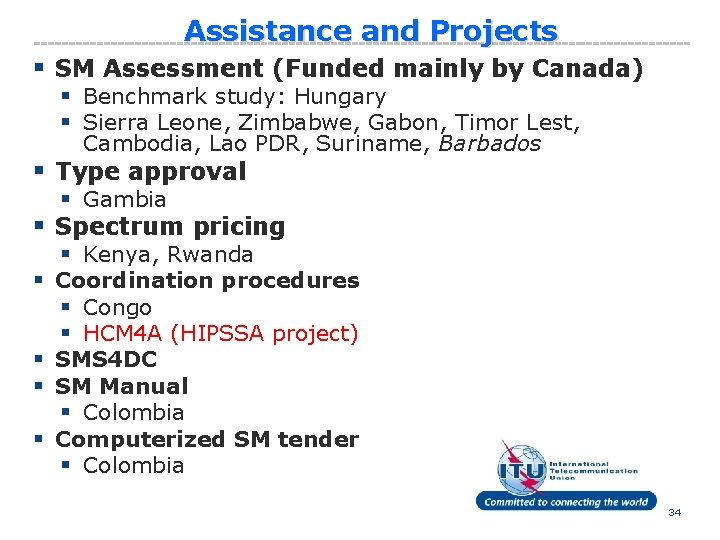
Assistance and Projects § SM Assessment (Funded mainly by Canada) § Benchmark study: Hungary § Sierra Leone, Zimbabwe, Gabon, Timor Lest, Cambodia, Lao PDR, Suriname, Barbados § Type approval § Gambia § Spectrum pricing § Kenya, Rwanda § Coordination procedures § Congo § HCM 4 A (HIPSSA project) § SMS 4 DC § SM Manual § Colombia § Computerized SM tender § Colombia text 34
Thank you! istvan. bozsoki@itu. int tnd@itu. int http: //www. itu. int/ITU-D/tech/index. html text
- Slides: 35