
DIRECT AND INDIRECT SPEECH Made by Mrs Patil
DIRECT AND INDIRECT SPEECH Made by: Mrs. Patil A. V. New English School K. digraj
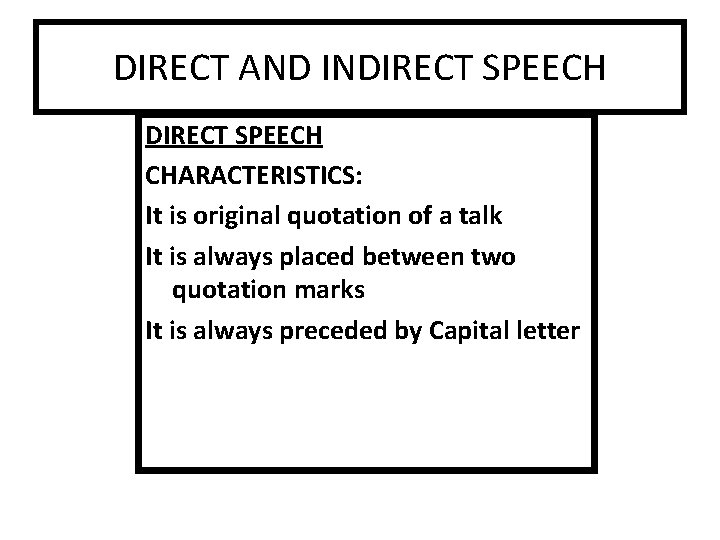
DIRECT AND INDIRECT SPEECH CHARACTERISTICS: It is original quotation of a talk It is always placed between two quotation marks It is always preceded by Capital letter
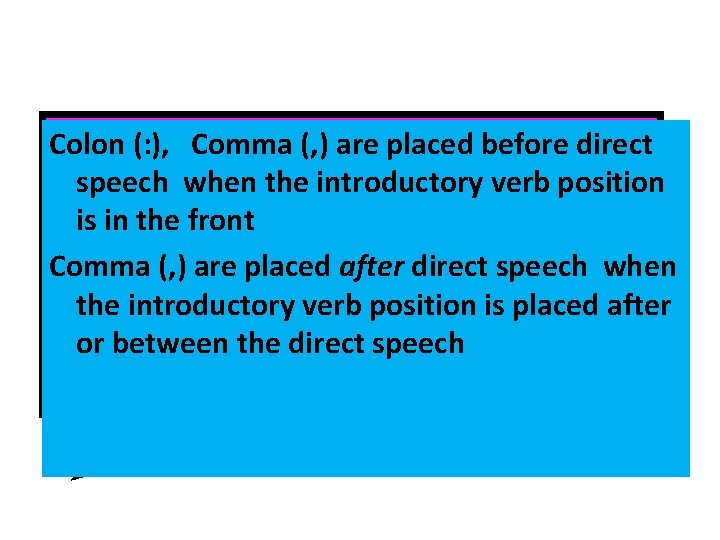
Colon (: ), Comma (, ) are placed before direct speech when the introductory verb position is in the front Comma (, ) are placed after direct speech when the introductory verb position is placed after or between the direct speech
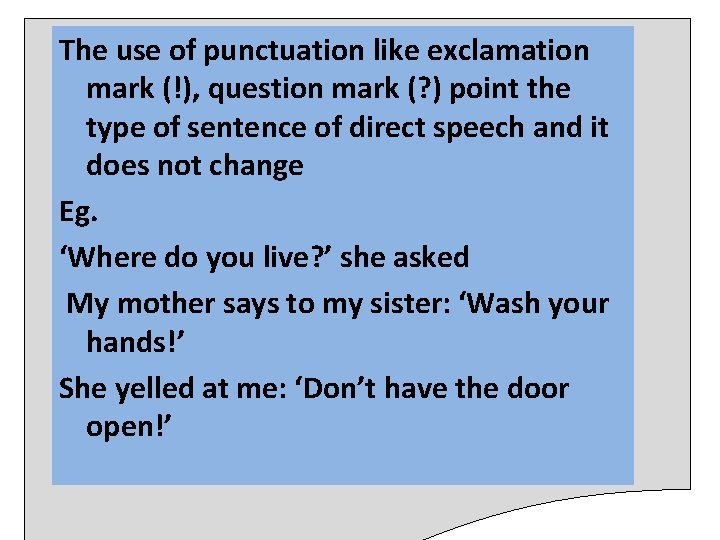
The use of punctuation like exclamation mark (!), question mark (? ) point the type of sentence of direct speech and it does not change Eg. ‘Where do you live? ’ she asked My mother says to my sister: ‘Wash your hands!’ She yelled at me: ‘Don’t have the door open!’
It is a kind of reported sentence (reported speech) It retells one’s talk or idea It undergoes certain modification It has three types of indirect speech 1. Imperative (Command/request) 2. Declarative (Statement) 3. Interrogative (question
1. Imperative (Command/request) The Imperative is a command Because of a command it does not tell the subject and the verb in direct imperative does not change E. g. “Shut the door” Let the door be shut like go, sleep, open etc so in the indirect speech is preceded by to infinitive) namely to go, to sleep, to open
• It also has non verb, so the reported command is preceded by ‘Be + adjective/adverb!’ like: be quiet, be happy, be here so in the Indirect Speech it becomes to be quiet, to be happy, to be here
POSITIVE IMPERATIVE • DIRECT SPEECH • She said, “Go away!” • “Come here!” she said. I said, • “Be quite!” ‘Be quiet!’ she yelled at the children. • She begged, “Be happy!” • ‘Please help me!’ she told him • INDIRECT SPEECH • She ordered her to go away. • She asked him to come there. • She ordered the children to be quiet • She requested to be happy • She asked him to help her
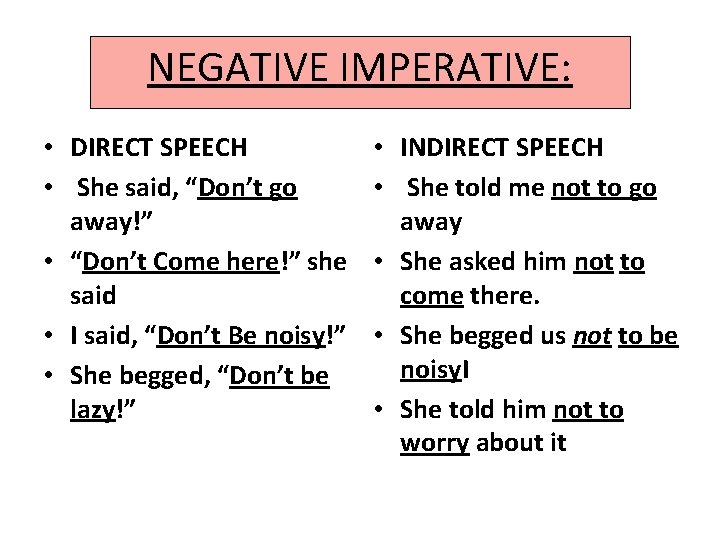
NEGATIVE IMPERATIVE: • DIRECT SPEECH • She said, “Don’t go away!” • “Don’t Come here!” she said • I said, “Don’t Be noisy!” • She begged, “Don’t be lazy!” • INDIRECT SPEECH • She told me not to go away • She asked him not to come there. • She begged us not to be noisy. I • She told him not to worry about it
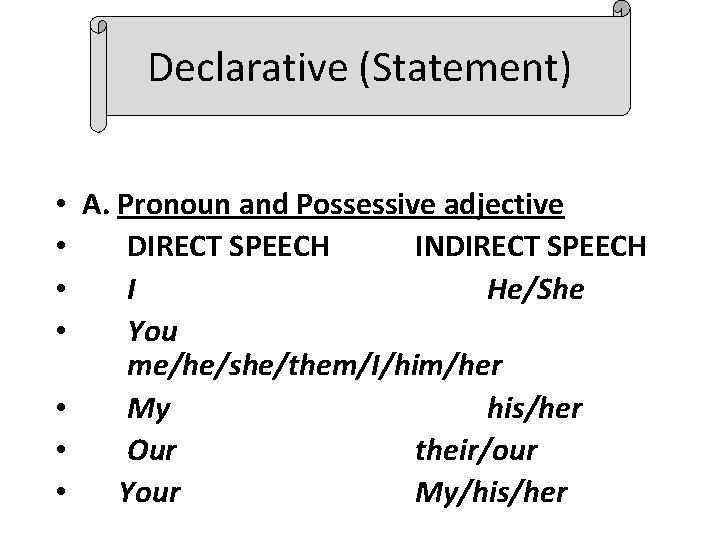
Declarative (Statement) • A. Pronoun and Possessive adjective • DIRECT SPEECH INDIRECT SPEECH • I He/She • You me/he/she/them/I/him/her • My his/her • Our their/our • Your My/his/her
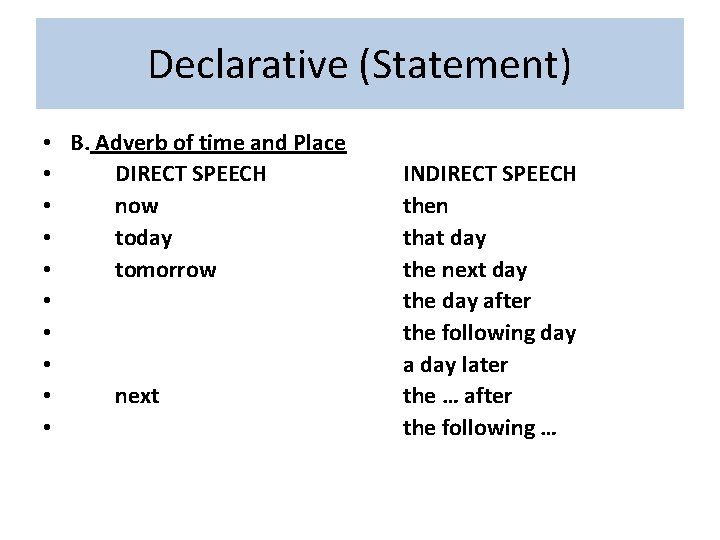
Declarative (Statement) • B. Adverb of time and Place • DIRECT SPEECH • now • today • tomorrow • • next • INDIRECT SPEECH then that day the next day the day after the following day a day later the … after the following …
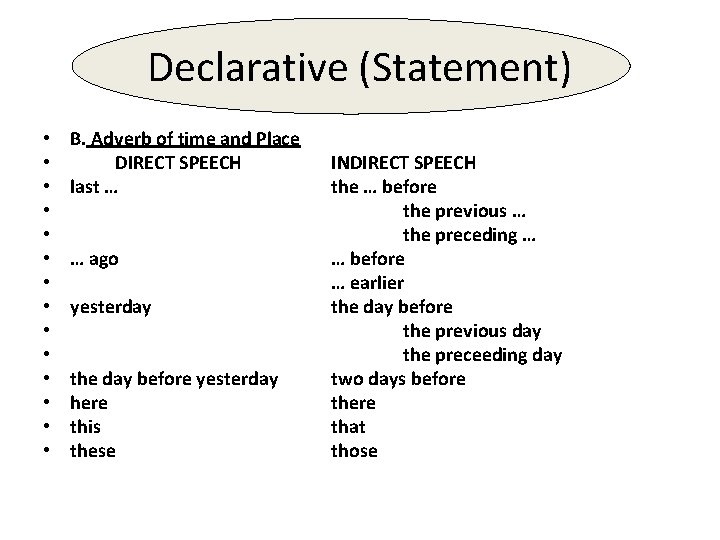
Declarative (Statement) • • • • B. Adverb of time and Place DIRECT SPEECH last … … ago yesterday the day before yesterday here this these INDIRECT SPEECH the … before the previous … the preceding … … before … earlier the day before the previous day the preceeding day two days before there that those
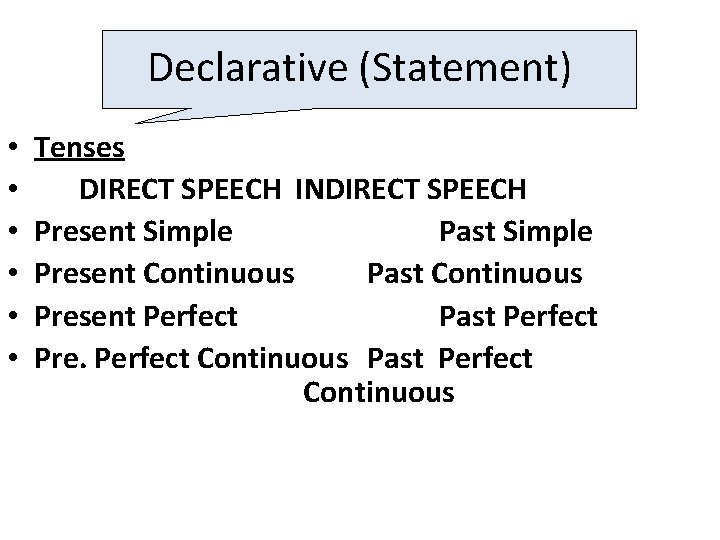
Declarative (Statement) • • • Tenses DIRECT SPEECH INDIRECT SPEECH Present Simple Past Simple Present Continuous Past Continuous Present Perfect Past Perfect Pre. Perfect Continuous Past Perfect Continuous
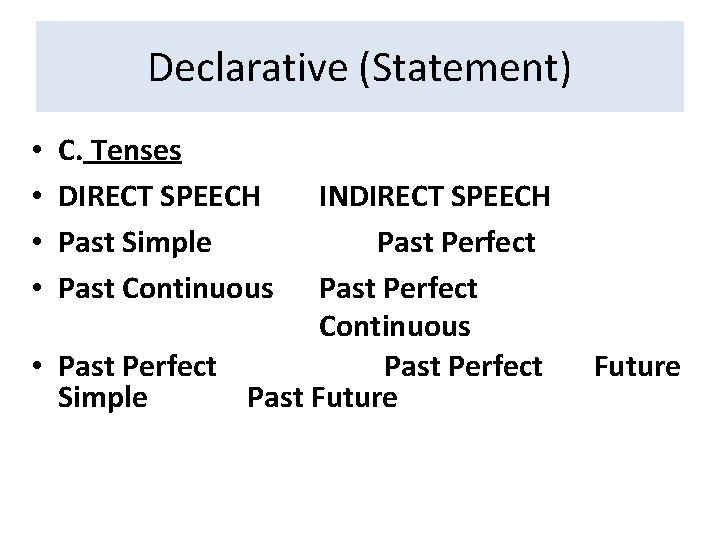
Declarative (Statement) • • C. Tenses DIRECT SPEECH Past Simple Past Continuous INDIRECT SPEECH Past Perfect Continuous • Past Perfect Simple Past Future
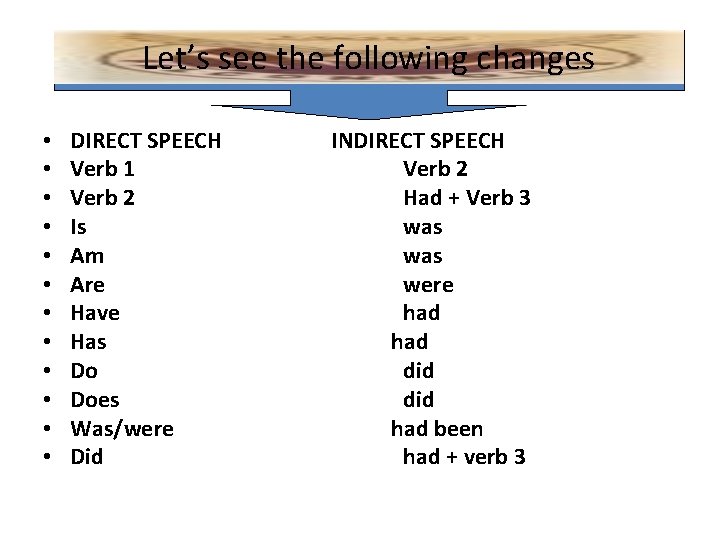
Let’s see the following changes • • • DIRECT SPEECH Verb 1 Verb 2 Is Am Are Have Has Do Does Was/were Did INDIRECT SPEECH Verb 2 Had + Verb 3 was were had did had been had + verb 3
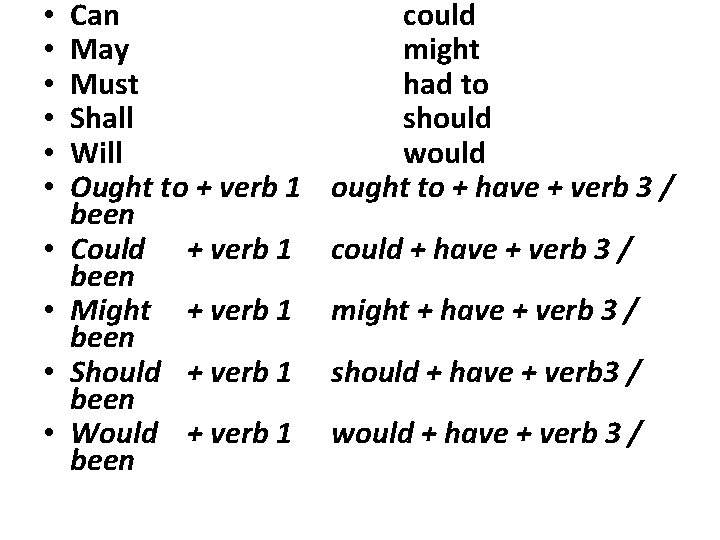
• • • Can May Must Shall Will Ought to + verb 1 been Could + verb 1 been Might + verb 1 been Should + verb 1 been Would + verb 1 been could might had to should would ought to + have + verb 3 / could + have + verb 3 / might + have + verb 3 / should + have + verb 3 / would + have + verb 3 /
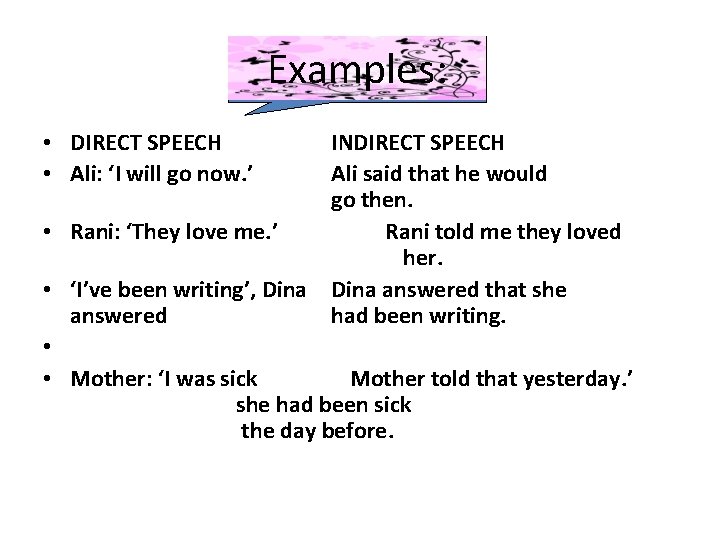
Examples: • DIRECT SPEECH • Ali: ‘I will go now. ’ INDIRECT SPEECH Ali said that he would go then. • Rani: ‘They love me. ’ Rani told me they loved her. • ‘I’ve been writing’, Dina answered that she answered had been writing. • • Mother: ‘I was sick Mother told that yesterday. ’ she had been sick the day before.
3. Interrogative (question) • a. Preceded by Auxiliary • When the question is preceded by auxiliary that needs yes/No answer it will be used the conjunction if or whether in the indirect speech • The steps how to make indirect speech: – The question sentence of the indirect speech is firstly changed to be statement – It then follows the rules before
Example • • DIRECT SPEECH INDIRECT SPEECH Doctor: ‘Do you usually take a nap? ’ It is firstly changed to be: You usually take a nap Doctor asks if/whether I usually take a nap
Example • DIRECT SPEECH • Mary: ‘Are you a student? ’ – It is firstly changed to be: • You are a student • INDIRECT SPEECH – Ratu asked if/whether I was a • student
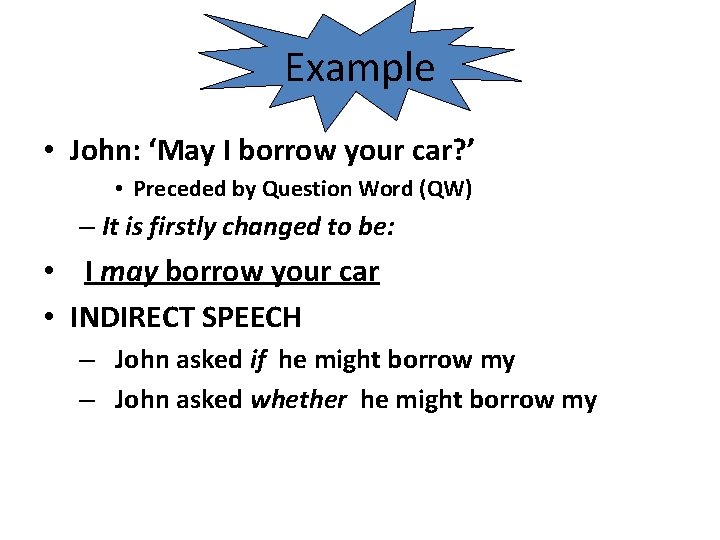
Example • John: ‘May I borrow your car? ’ • Preceded by Question Word (QW) – It is firstly changed to be: • I may borrow your car • INDIRECT SPEECH – John asked if he might borrow my – John asked whether he might borrow my
a. Preceded by Question Words • In the question using Question Word (QW) – To form indirect speech the question is firstly changed to be statement – QW: what, when, where, which, why, whom, etc. are used as conjunction
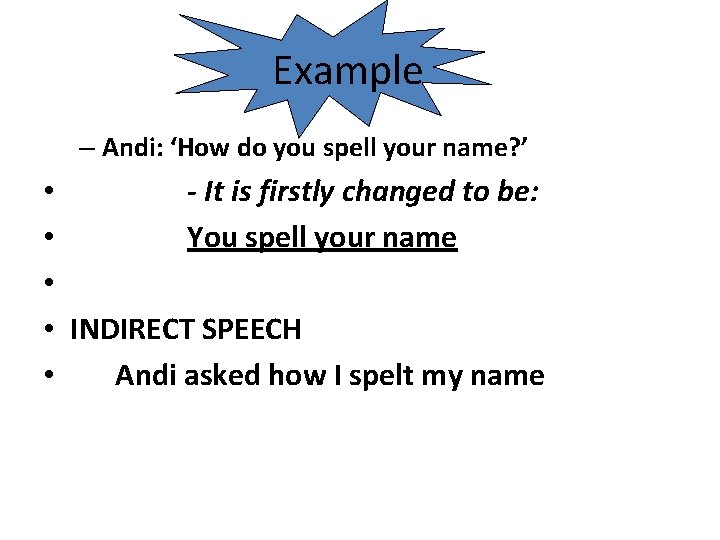
Example – Andi: ‘How do you spell your name? ’ • - It is firstly changed to be: • You spell your name • • INDIRECT SPEECH • Andi asked how I spelt my name
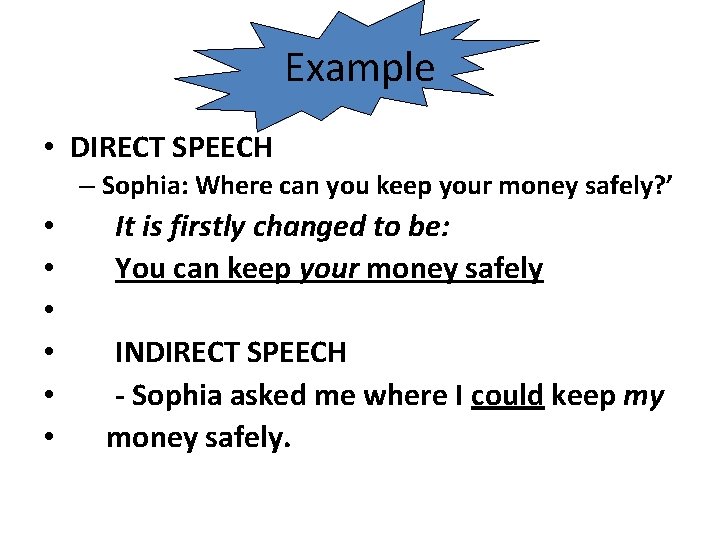
Example • DIRECT SPEECH – Sophia: Where can you keep your money safely? ’ • • • It is firstly changed to be: You can keep your money safely INDIRECT SPEECH - Sophia asked me where I could keep my money safely.
- Slides: 24