
Diplomatic Etiquette Shatrudhwan P S Pokharel shatrumitrugmail com
- Slides: 36
Diplomatic Etiquette Shatrudhwan P S Pokharel (shatrumitru@gmail. com) Ministry of Foreign Affairs
Session Objectives �Raising awareness! �Developing consciousness!! �How to be humble, decent and respectful!!! �Considering and Identifying “Right Vs Wrong”!!!! Through Diplomatic/formal/good etiquette Lets begin our journey of 90 minutes! Are you ready? ?
Background � Diplomatic Practice: Byzantine Empire: after splitting with Roman Empire (395 AD) � Permanent Resident Missions: Italian City States (15 th Century) � Diplomacy: From the ancient time, Mahabharata/Chanakya � Treaty of Westphalia 1648: Nation States System � Diplomatic Relations: Between/among States � Negotiations: Bilateral/Regional/Multilateral � Diplomats: Actors/Agents/Envoys � Diplomatic Practice: Wide and frequent
Etiquette The term etiquette was first introduced in 1750 from the French word étiquette meaning ticket. Etiquette is the ticket to the proper way of doing things. It is the conventional rules of personal behaviour in a polite society. It is the customary code of polite behavior in society or among members of a particular profession or group. Synonym: civility, code, convention, courtesy, customs, decorum, formalities, good or proper behavior, manners, politeness, protocol.
Etiquettes � Protocol � Dining etiquette � Dress etiquette � Meeting/Conference/Seminar/Workshop/Training etiquette � Negotiation etiquette � Office/professional etiquette � Team-work etiquette � Social etiquette � Etiquettes in informal setting * Seating, Eating, Meeting, Talking, Dealing…….
Where? � Ceremonies: Sequence, Seating arrangements, welcome, national anthem, toast offering etc. � Negotiation: Conduct/Participation/Engagements/Tactics � Meetings/Seminars/Workshops/Training � Chairing/Moderator/participation/intervention � Banquet/Dinner/Lunch/Reception/Cocktail reception: Organizing and attending, Buffet/Seated/Plater to plate/ Preplated etc. � Decoration: Flags/Picture etc. (E. g. 4 th BIMSTEC Summit) � Appointments, Receiving/seeing off guests (greetings) � Use of the car/flag � Dress code � Sitting postures � Invitations � In every encounter, interaction, diplomatic dealing
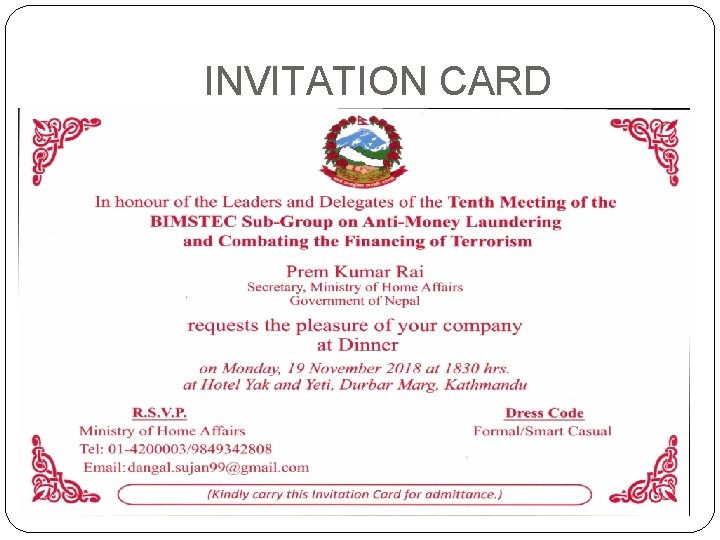
What � Food/Menu: What/When/Where (Time/type of gathering and people etc. ) � Liquors: What/How/When (time/people) � Table: What Type( invitees, lay out, location etc. ) � Seating Arrangements: who is where, when � Invitation Cards: formatting/Designing � RSVP: Répondez s'il vous plaît � Introduction: of guests, collegues � Punctuality: Vital � Dress Code: Important
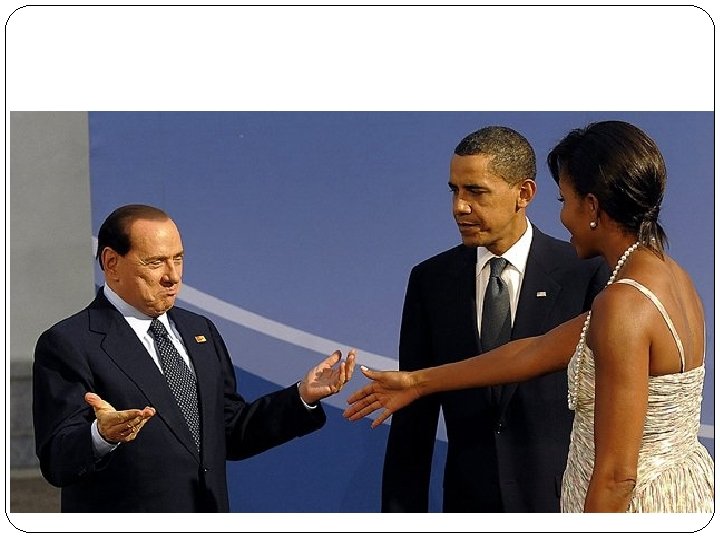
DIPLOMATIC ERRORS
Dining Etiquette
Dining Etiquette Cont…
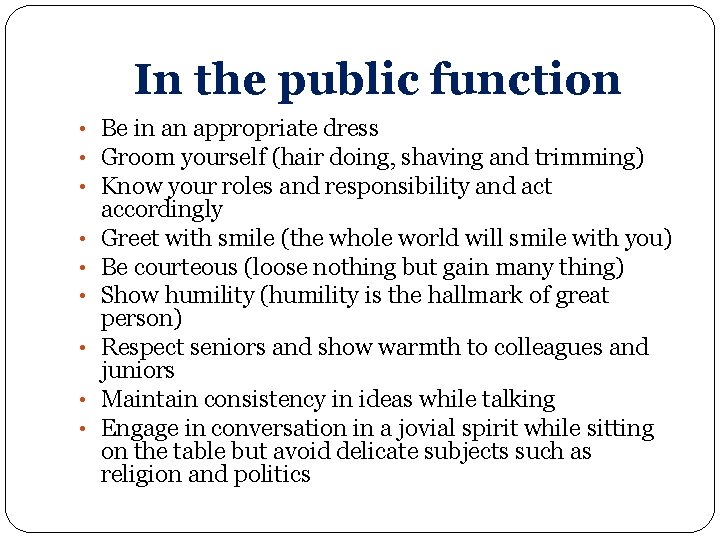
In the public function • Be in an appropriate dress • Groom yourself (hair doing, shaving and trimming) • Know your roles and responsibility and act • • • accordingly Greet with smile (the whole world will smile with you) Be courteous (loose nothing but gain many thing) Show humility (humility is the hallmark of great person) Respect seniors and show warmth to colleagues and juniors Maintain consistency in ideas while talking Engage in conversation in a jovial spirit while sitting on the table but avoid delicate subjects such as religion and politics
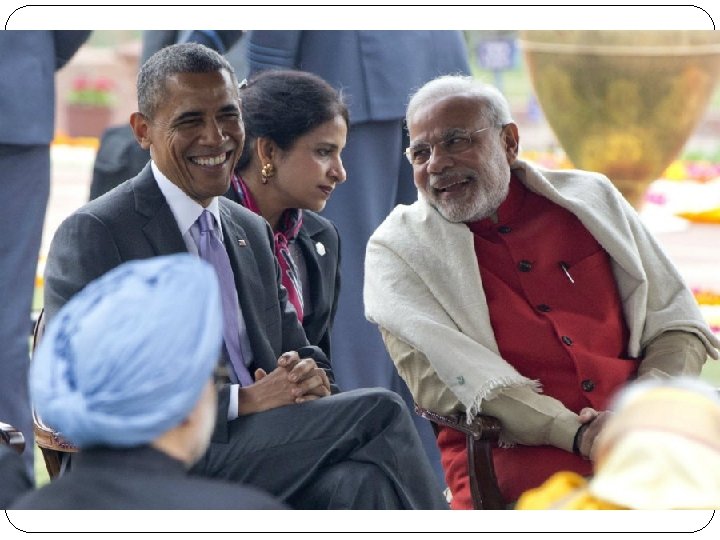
Greetings § Namaskar/Namaste: In Nepal or elsewhere we may do § § § Namaskar first and shake hand later or shake hand straight away Bend your head while doing namaskar or shaking hands with guests and seniors Handshakes: hand shakes should be firm with men and less so with ladies and do so only after they raise their hands Hugging: In Arab/Muslim cultures Kissing in most European Countries In Turkey, Malaysia, Brunei, the Philippines, women’s hands are kissed while greeting (limited to conservative upper class), started in Eastern Europe Remember the old maxim: when in Rome do as the Romans do i. e. follow the local way of doing things in a country
Conducting Meeting �Start the meeting with warm welcome �Recall the earlier meetings if any �Start and end with very positive note �Never say no while responding/reacting to a proposal/idea expressed by the counterpart �May say, we will give thought to the matter, we may get back on the matter in due course, �We may hold consultation with our head quarters and come back with our appropriate response �During the meeting, only the leader to speak, others to listen unless authorized by the leader
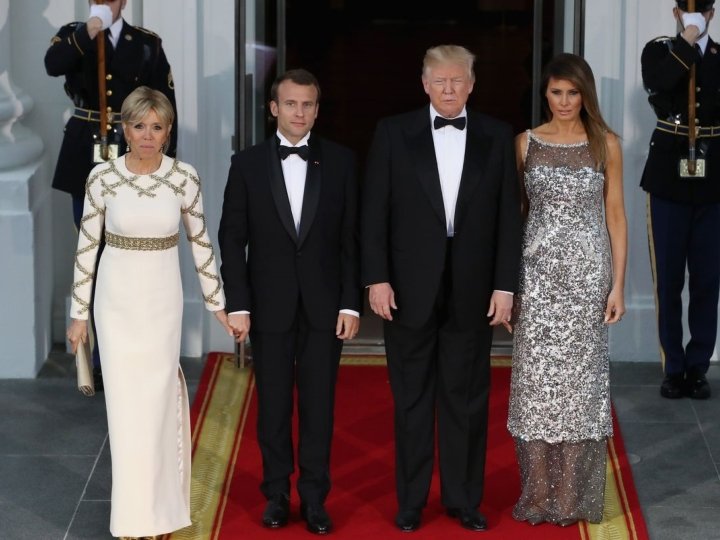
Dress Types � White tie dinner (most formal with decoration, popular in Britain � Formal Nepali dress can be used by Nepali official instead of white tie. � Black tie dinner ( bow tie), with black suit: in formal dinners � Nepali dress can also be worn instead of black tie. • National dress: Daura suruwal, coat, topi; • Lounge suit/informal: dark lounge suit, dark suits in charcoal, dark grey or navy blue are best. Brown is generally not worn. • Smart Casual: with tie and coat (combination), looking smart, generally prevalent in South Asia • Casual: Generally, without tie or coat, free style (with shirt and pant- no half pant and vest please !), tie and coat may be used depending on the weather
Dos �Be in/on time (late in time means many – lack of seriousness, dishonor, not giving importance, not understanding value of time etc. ) �Learn basic words and gestures of host community/country. �Find and sit at your place (name cards be placed on the table in formal function) �Prepare seat planning if you are host �Raise your hand to take your turn �Listen with interest while someone talks to you
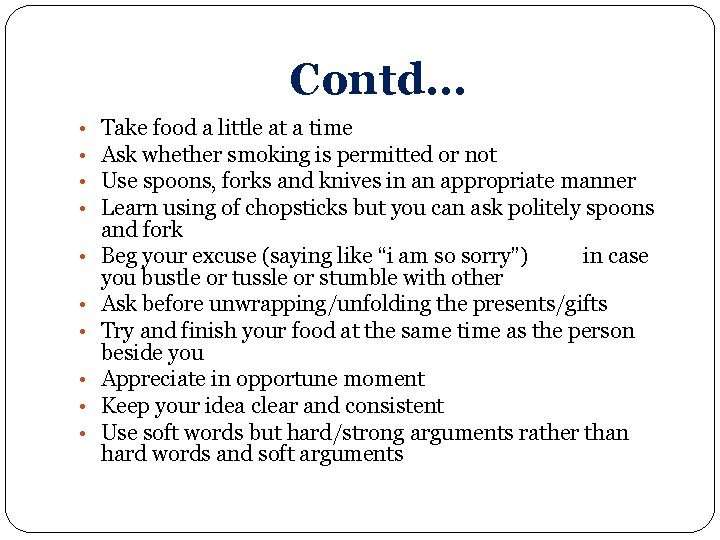
Contd… • • • Take food a little at a time Ask whether smoking is permitted or not Use spoons, forks and knives in an appropriate manner Learn using of chopsticks but you can ask politely spoons and fork Beg your excuse (saying like “i am so sorry”) in case you bustle or tussle or stumble with other Ask before unwrapping/unfolding the presents/gifts Try and finish your food at the same time as the person beside you Appreciate in opportune moment Keep your idea clear and consistent Use soft words but hard/strong arguments rather than hard words and soft arguments
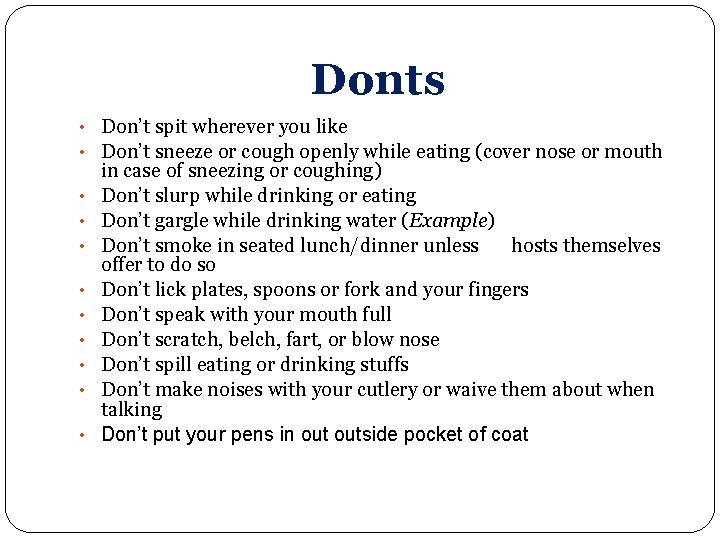
Donts • Don’t spit wherever you like • Don’t sneeze or cough openly while eating (cover nose or mouth • • • in case of sneezing or coughing) Don’t slurp while drinking or eating Don’t gargle while drinking water (Example) Don’t smoke in seated lunch/dinner unless hosts themselves offer to do so Don’t lick plates, spoons or fork and your fingers Don’t speak with your mouth full Don’t scratch, belch, fart, or blow nose Don’t spill eating or drinking stuffs Don’t make noises with your cutlery or waive them about when talking Don’t put your pens in outside pocket of coat
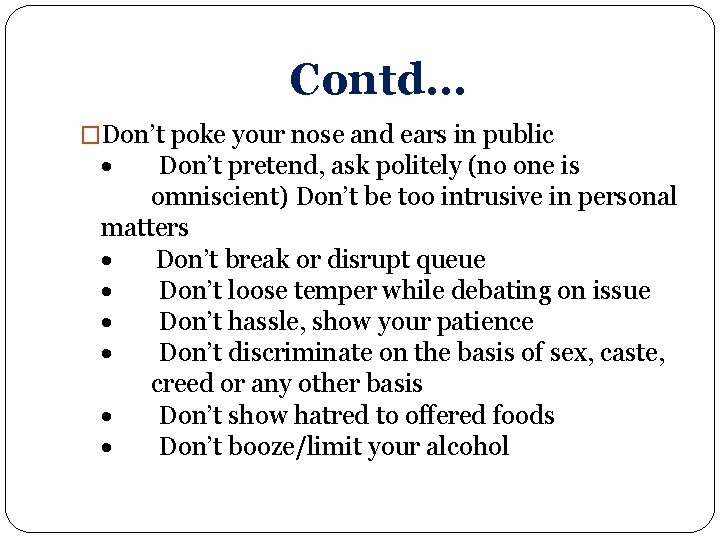
Contd… �Don’t poke your nose and ears in public · Don’t pretend, ask politely (no one is omniscient) Don’t be too intrusive in personal matters · Don’t break or disrupt queue · Don’t loose temper while debating on issue · Don’t hassle, show your patience · Don’t discriminate on the basis of sex, caste, creed or any other basis · Don’t show hatred to offered foods · Don’t booze/limit your alcohol
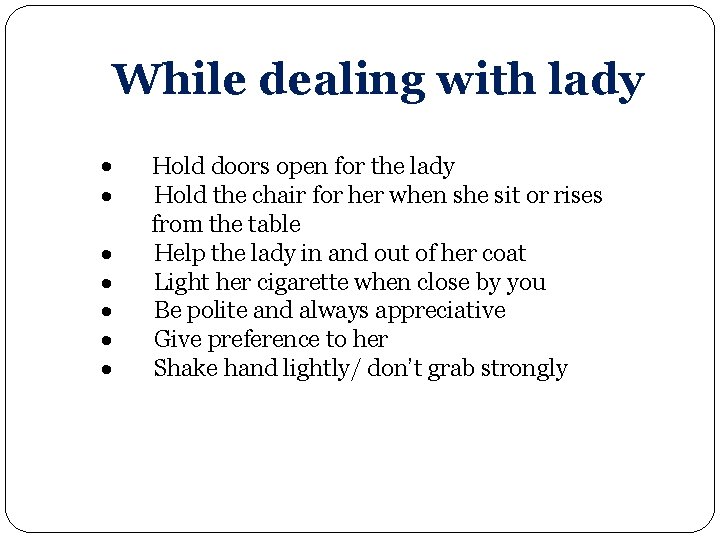
While dealing with lady · Hold doors open for the lady · Hold the chair for her when she sit or rises from the table · Help the lady in and out of her coat · Light her cigarette when close by you · Be polite and always appreciative · Give preference to her · Shake hand lightly/ don’t grab strongly
While dealing with lady · Hold doors open for the lady · Hold the chair for her when she sit or rises from the table · Help the lady in and out of her coat · Light her cigarette when close by you · Be polite and always appreciative · Give preference to her · Shake hand lightly/ don’t grab strongly
While Dealing With Foreigners � Greetings with Smile � Awareness of Language, Culture, Customs etc. � Avoid talking/discussing controversial issues/things � Don’t use politically incorrect languages � Avoid political and religious issue � Don’t talk about personal issues straight-forward � Better to mention about the symbol of historical, national significance, pride � Show interest about the country, people etc.
Telephone/Cell phone/Social Media �Receiving calls (3 ring) �Conversation (Long/Short, relevant/irrelevant) �Sound/volume �Ring-tones: sound, volume, type �Social Media: Facebook/twitter etc. �Status: Political, Legal, Societal, Moral etc. �Tag, sharing, re-twitting �Comments/like * Your Personality and Official Position/dignity always at stake
Lessons for everyday life • • • Respect everyone Think positively Foster teamwork/foster better relationships Solve problems and encourage others to excel Be dynamic/proactive (winners make it happen) Be aware of power of moral character Stay in self-discipline Show empathy Be open minded Uphold your enthusiasm
Choosing Civility: The 25 Rules of Considerate Conduct P. M. Forni
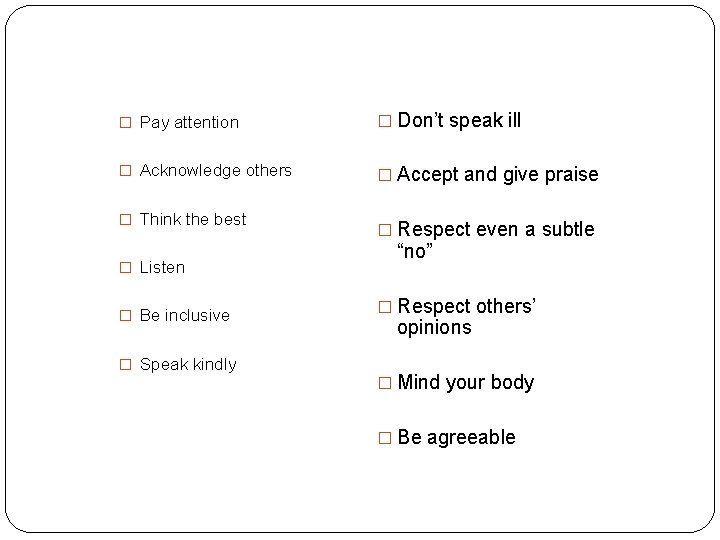
� Pay attention � Don’t speak ill � Acknowledge others � Accept and give praise � Think the best � Listen � Be inclusive � Speak kindly � Respect even a subtle “no” � Respect others’ opinions � Mind your body � Be agreeable
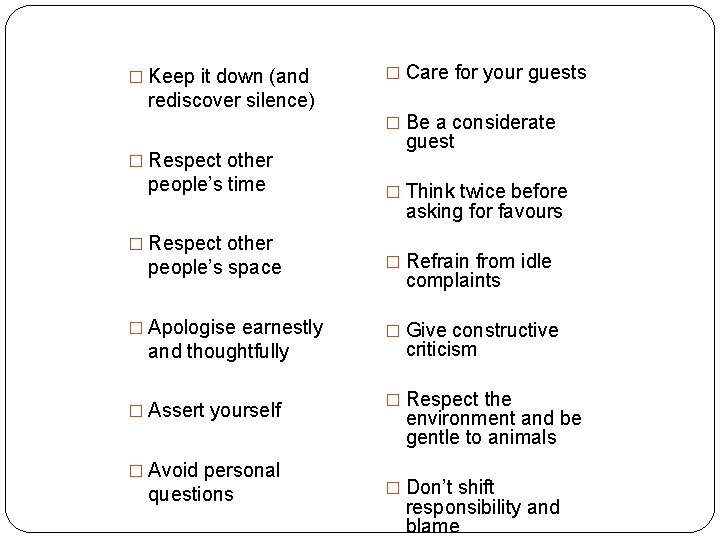
� Keep it down (and rediscover silence) � Respect other people’s time � Care for your guests � Be a considerate guest � Think twice before asking for favours � Respect other people’s space � Apologise earnestly and thoughtfully � Assert yourself � Avoid personal questions � Refrain from idle complaints � Give constructive criticism � Respect the environment and be gentle to animals � Don’t shift responsibility and blame
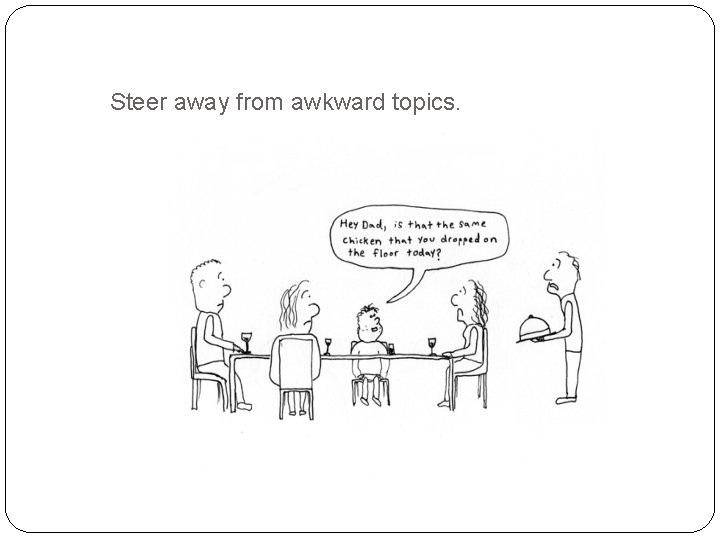
Steer away from awkward topics.
INVITATION CARD
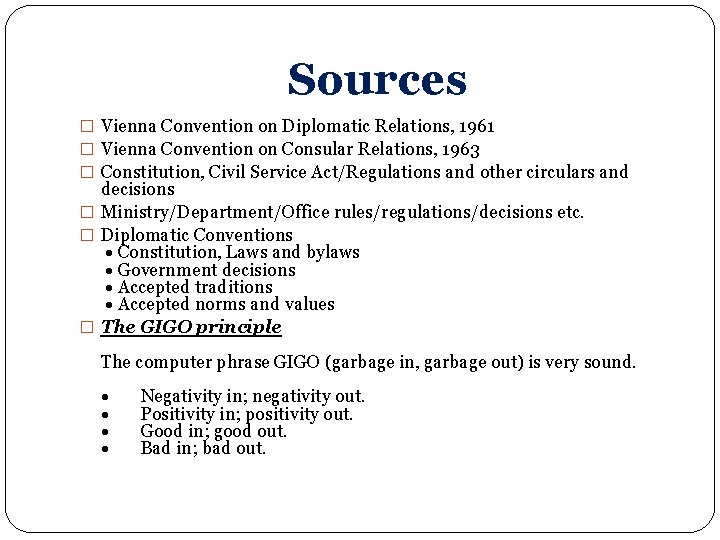
Sources � Vienna Convention on Diplomatic Relations, 1961 � Vienna Convention on Consular Relations, 1963 � Constitution, Civil Service Act/Regulations and other circulars and decisions � Ministry/Department/Office rules/regulations/decisions etc. � Diplomatic Conventions · Constitution, Laws and bylaws · Government decisions · Accepted traditions · Accepted norms and values � The GIGO principle The computer phrase GIGO (garbage in, garbage out) is very sound. · Negativity in; negativity out. · Positivity in; positivity out. · Good in; good out. · Bad in; bad out.
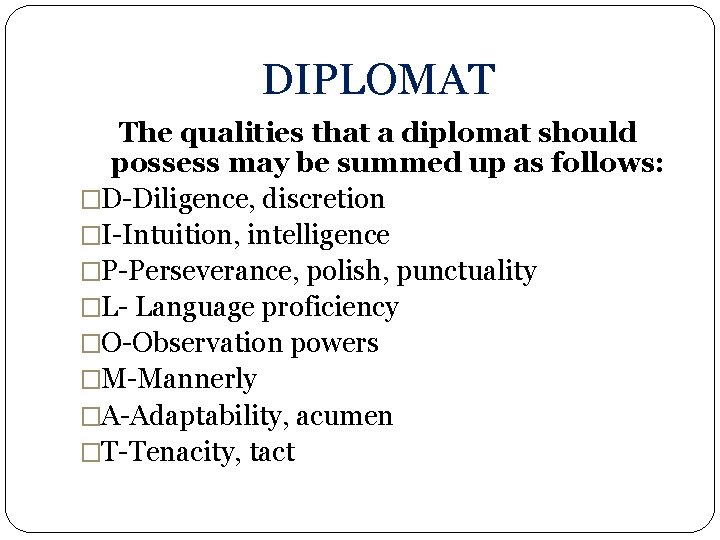
DIPLOMAT The qualities that a diplomat should possess may be summed up as follows: �D-Diligence, discretion �I-Intuition, intelligence �P-Perseverance, polish, punctuality �L- Language proficiency �O-Observation powers �M-Mannerly �A-Adaptability, acumen �T-Tenacity, tact
Any Questions/Comments? � Thank you so much! BEST WISHES !!