
DIPLOMA IN INTERNATIONAL SHIPPING LOGISTICS General Ship Knowledge
- Slides: 90
DIPLOMA IN INTERNATIONAL SHIPPING & LOGISTICS General Ship Knowledge Unit 3: Ship Types ML 301. 1(3. 0) Devron S. Newman - GSK 10/15/2021 1
Lessons in Unit 3 – Ship Types Lesson 1: Bulk Carriers and Tankers Lesson 2: General Cargo, Container and Ro/Ro vessels. Lesson 3: Specialized vessels (lumber ships; passenger ships; reefers and carriers) Devron S. Newman - GSK 10/15/2021 2
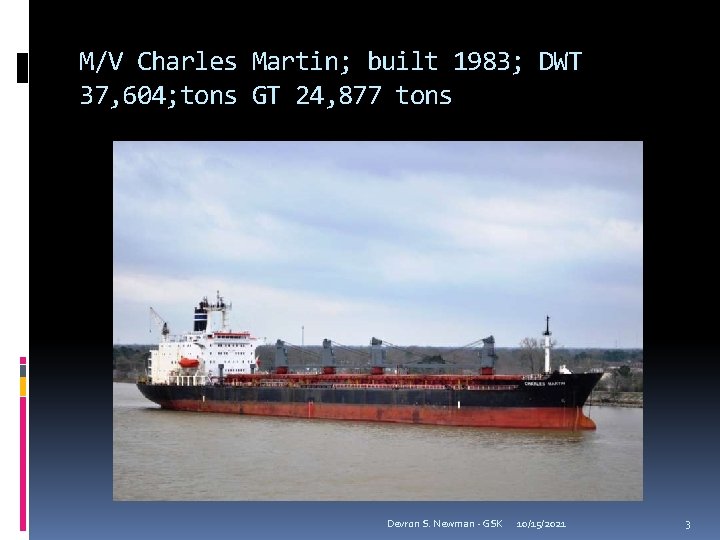
M/V Charles Martin; built 1983; DWT 37, 604; tons GT 24, 877 tons Devron S. Newman - GSK 10/15/2021 3
Lesson 1: Bulk Carriers and Tankers Bulk carriers are single deck vessels and generally have 5 to 9 hatches equipped with sliding hatch covers. They have double bottom tanks with the tank top rising outwards to the ship’s side to form hoppers. Wing tanks are provided on either side which are used as ballast tanks as well as for loading grain cargo sometimes. Devron S. Newman - GSK 10/15/2021 4
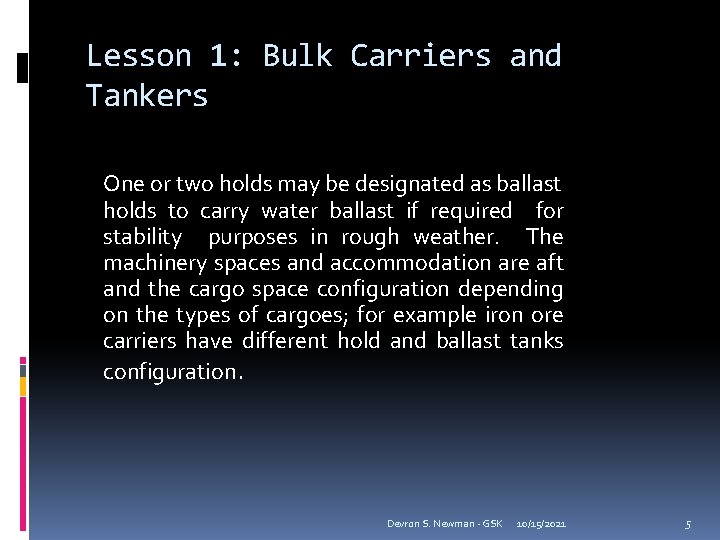
Lesson 1: Bulk Carriers and Tankers One or two holds may be designated as ballast holds to carry water ballast if required for stability purposes in rough weather. The machinery spaces and accommodation are aft and the cargo space configuration depending on the types of cargoes; for example iron ore carriers have different hold and ballast tanks configuration. Devron S. Newman - GSK 10/15/2021 5
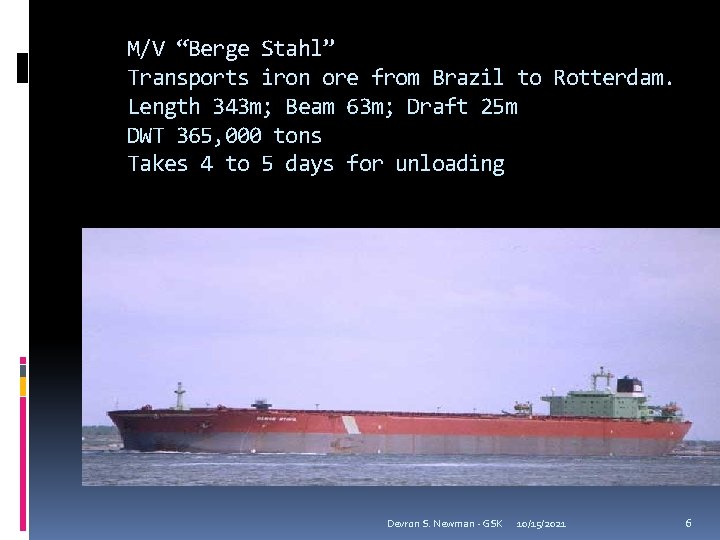
M/V “Berge Stahl” Transports iron ore from Brazil to Rotterdam. Length 343 m; Beam 63 m; Draft 25 m DWT 365, 000 tons Takes 4 to 5 days for unloading Devron S. Newman - GSK 10/15/2021 6
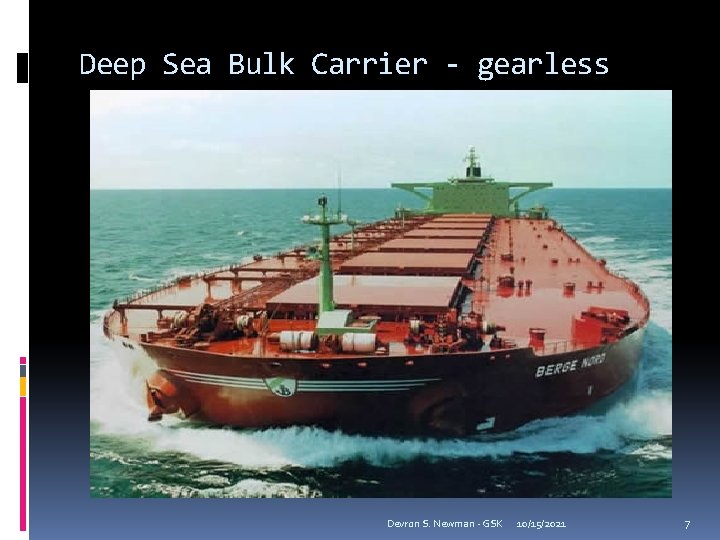
Deep Sea Bulk Carrier - gearless Devron S. Newman - GSK 10/15/2021 7
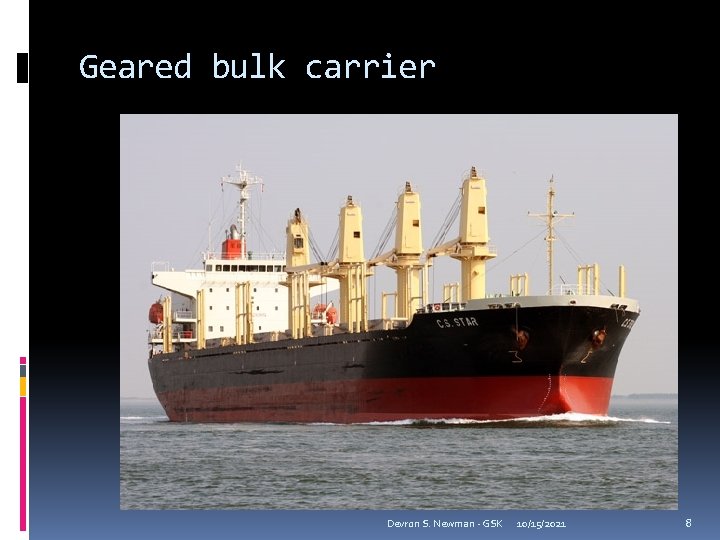
Geared bulk carrier Devron S. Newman - GSK 10/15/2021 8
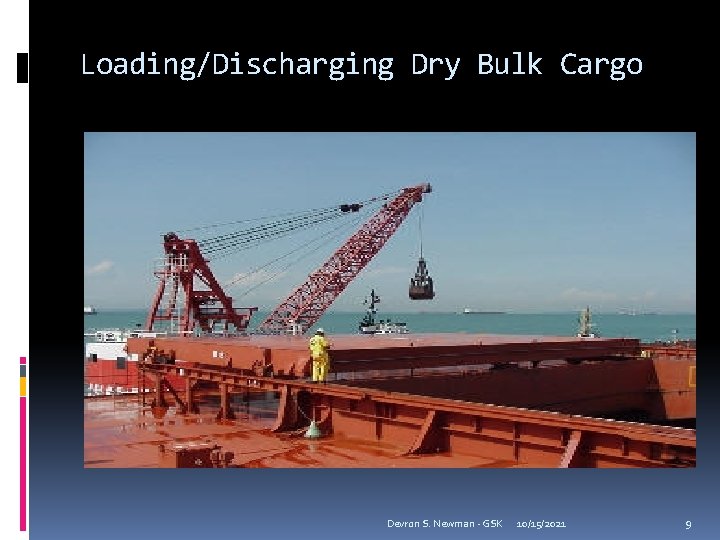
Loading/Discharging Dry Bulk Cargo Devron S. Newman - GSK 10/15/2021 9
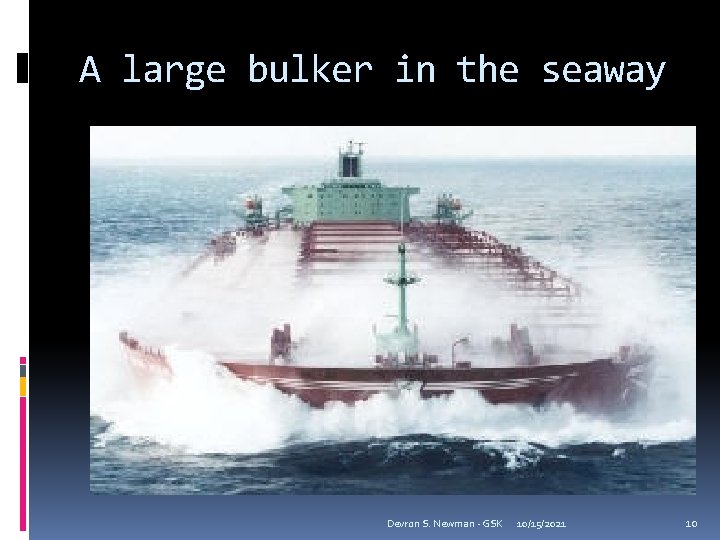
A large bulker in the seaway Devron S. Newman - GSK 10/15/2021 10
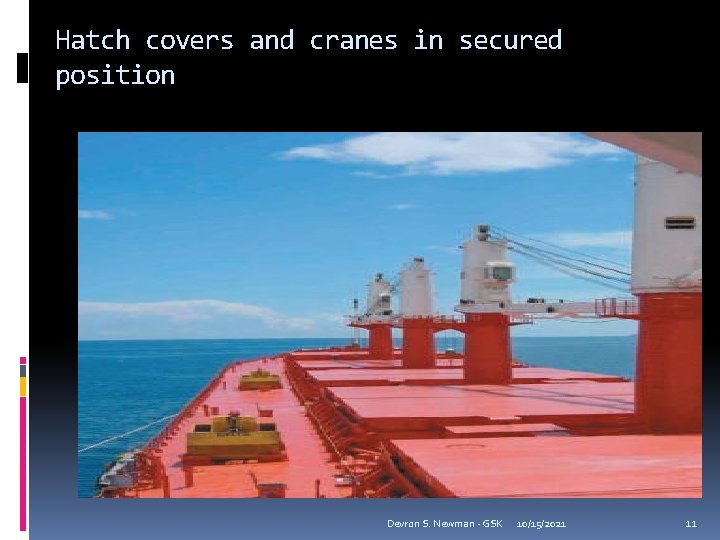
Hatch covers and cranes in secured position Devron S. Newman - GSK 10/15/2021 11
Lesson 1: Bulk Carriers and Tankers Bulk carriers normally carry single commodity for the single shipper at prevailing freight rates agreed between the owner and the shipper. On long hauls there is considerable reduction in the per ton-mile cost of transportation. Bulk carriers today typically range from 20, 000 to 300, 000 tonnes deadweight with speeds from 13 to 16 knots. Devron S. Newman - GSK 10/15/2021 12
Lesson 1: Bulk Carriers and Tankers For commercial purposes the bulk carriers have been categorized as: VLBC above 200, 000 DWT Cape size 130, 000 – 150, 000 DWT Panamax 75, 000 – 80, 000 DWT Handymax 30, 000 – 47, 000 DWT Handy size 20, 000 – 30, 000 DWT Devron S. Newman - GSK 10/15/2021 13
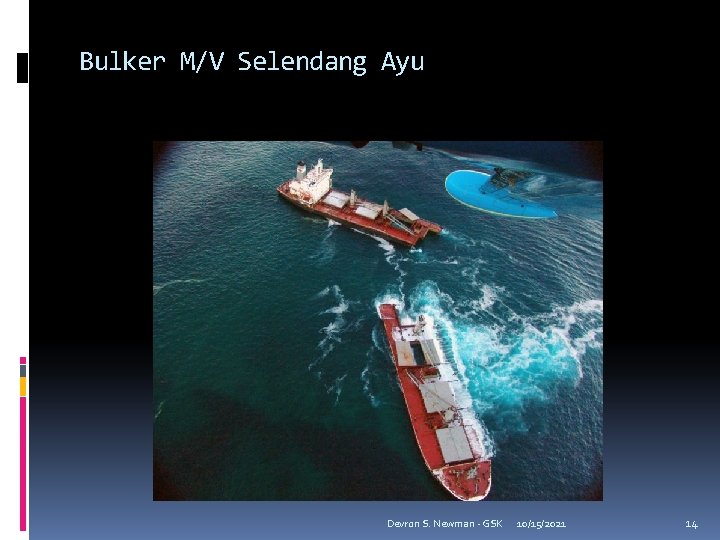
Bulker M/V Selendang Ayu Devron S. Newman - GSK 10/15/2021 14
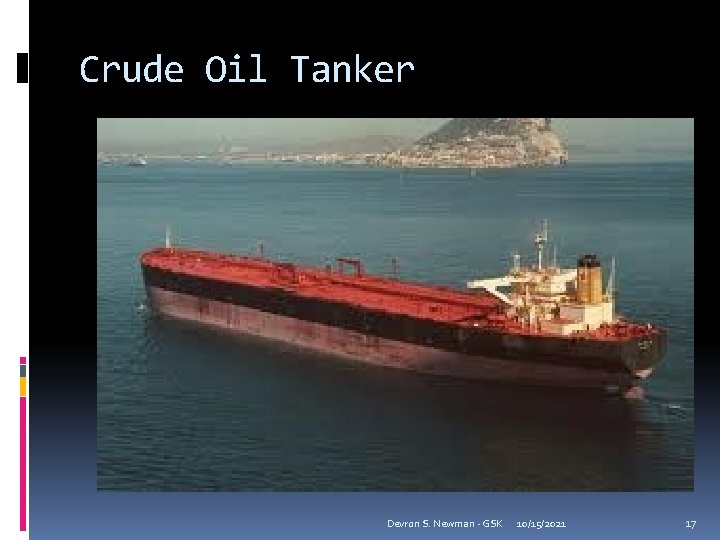
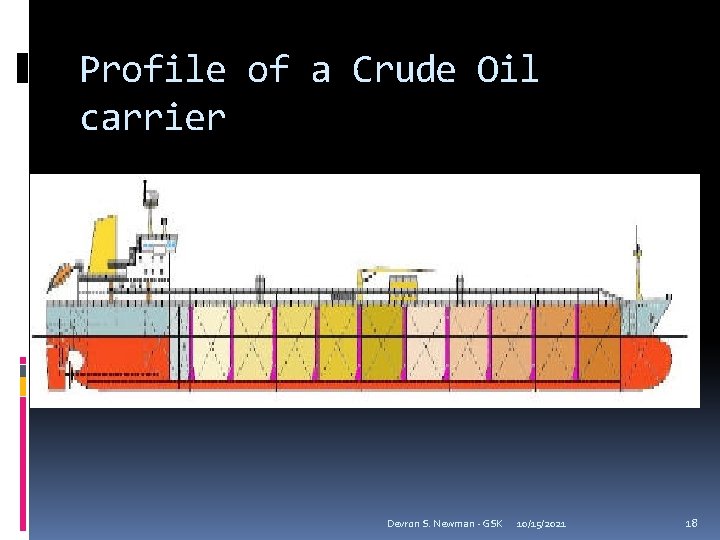
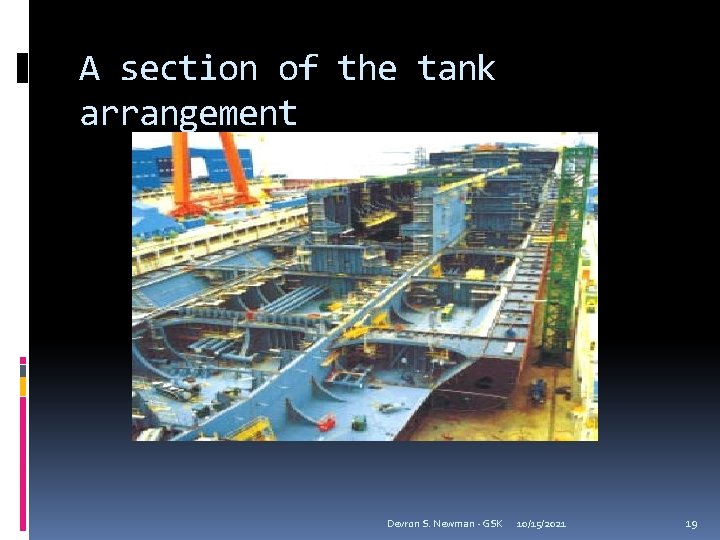
Lesson 1: Bulk Carriers and Tankers: Vessels carrying liquid cargoes in bulk are termed as tankers. They carry dirty oil (crude), clean oils (refined petroleum products); chemicals; liquefied gases. Tankers have long hulls with small freeboard. These ships have single bottom under the cargo tanks and the engine room is aft of the cargo tanks. The cargo space is divided into tanks with transverse and longitudinal bulkheads. The longitudinal bulkhead safeguard against free surface effect and sloshing. Cargo tanks are separated by cofferdams to prevent leakage into water tanks and machinery space. Because of the fire hazard associated with oils and its vapour, effective separation from the accommodation and machinery space is of paramount importance. Devron S. Newman - GSK 10/15/2021 15
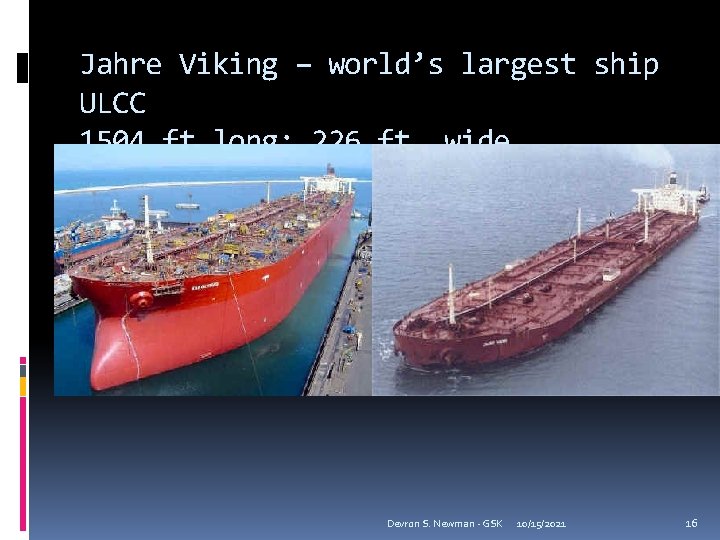
Jahre Viking – world’s largest ship ULCC 1504 ft long; 226 ft. wide Devron S. Newman - GSK 10/15/2021 16
Crude Oil Tanker Devron S. Newman - GSK 10/15/2021 17
Profile of a Crude Oil carrier Devron S. Newman - GSK 10/15/2021 18
A section of the tank arrangement Devron S. Newman - GSK 10/15/2021 19
Lesson 1: Bulk Carriers and Tankers The aft cofferdam is used as the pump room which has pumps for discharge and transfer of cargo. For commercial purposes tankers have been categorized as: ULCC > 400, 000 DWT VLCC 200, 000 – 400, 000 DWT Suezmax up to 145, 000 DWT Medium range 45, 000 – 70, 000 DWT General purpose up to 30, 000 DWT Devron S. Newman - GSK 10/15/2021 20
Lesson 1: Bulk Carriers and Tankers The biggest hazard associated with tankers is that of fire and explosion. Product tankers: These are used for transporting refined oil products. They range from about 40, 000 – 50, 000 DWT and more than one type of product can be carried simultaneously. Devron S. Newman - GSK 10/15/2021 21
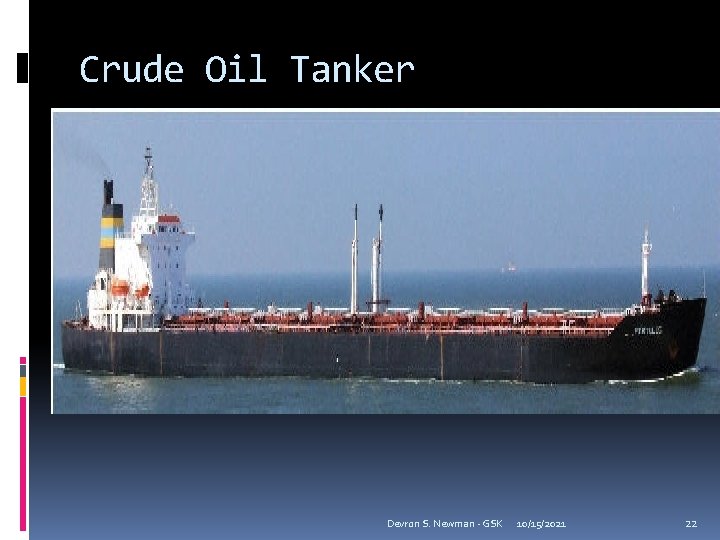
Crude Oil Tanker Devron S. Newman - GSK 10/15/2021 22
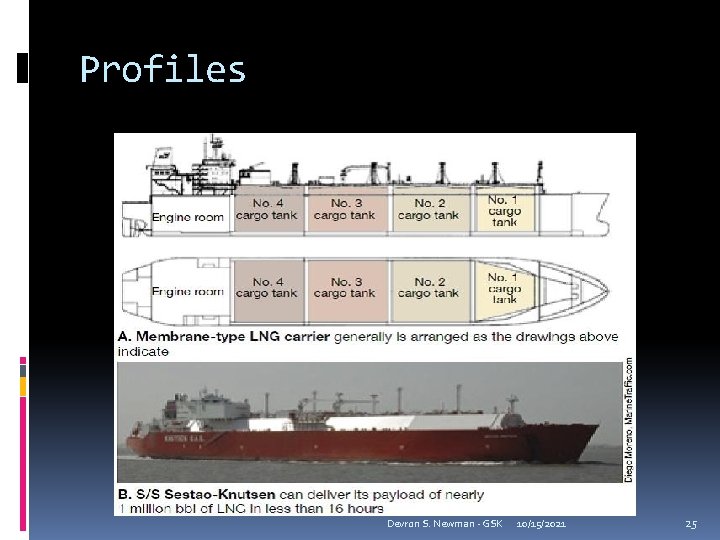
Gas Carriers Gas carriers range in capacity from the small pressurised tankers of between 500 and 6, 000 m 3 for shipment of propane, butane and the chemical gases at ambient temperature up to the fully insulated or refrigerated seagoing tankers of over 100, 000 m 3 capacity for the transport of LNG and LPG. Between those two distinct types is a third tanker type – semi pressurised gas carrier. Devron S. Newman - GSK 10/15/2021 23
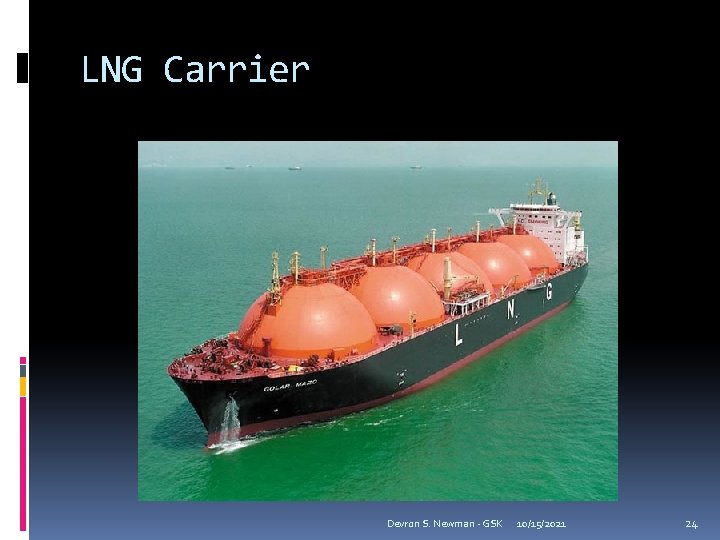
LNG Carrier Devron S. Newman - GSK 10/15/2021 24
Profiles Devron S. Newman - GSK 10/15/2021 25
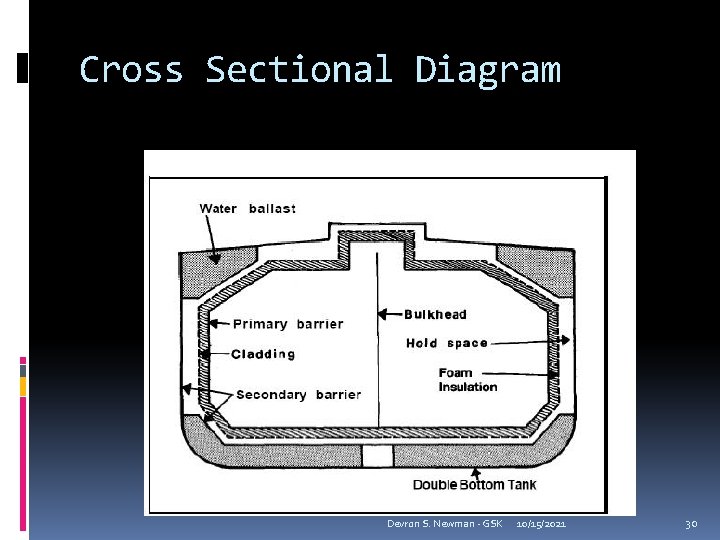
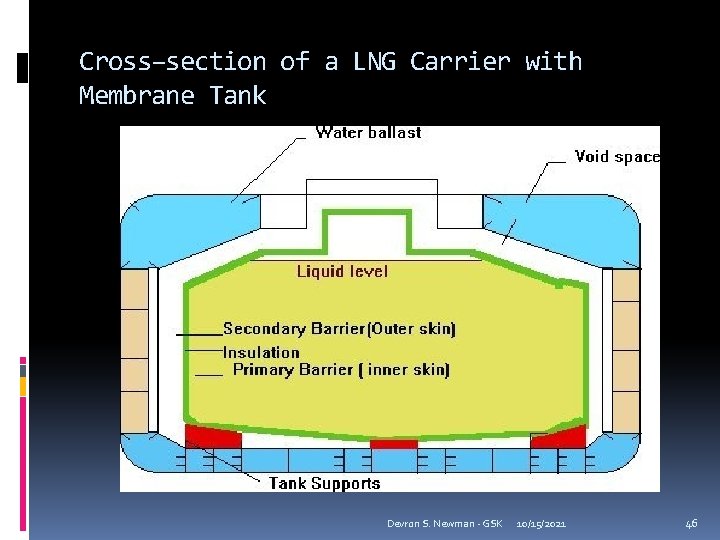
Gas carriers A nominal 3/8 -in. -thick primary membrane fabricated of stainless steel or Invar. Note that the latter, an alloy containing 36% nickel and 64% iron, has a very low coefficient of thermal expansion. A nominal 3/8 -in. -thick secondary membrane of alloy steel separated from the primary membrane by about a foot of perlite insulation. Perlite is a naturally occurring, lightweight volcanic glass. Another foot or so of perlite separates the secondary membrane from the nominal 1 -in. -thick inner hull. The outer hull (1 to 1½ in. steel plate) forms a ballast tank with the inner hull. The inner and outer hulls are separated by a distance of about 8 to 10 ft. Devron S. Newman - GSK 10/15/2021 26
Gas Carriers These very flexible tankers are able to carry many cargoes in a fully refrigerated condition at atmospheric pressure or at temperatures corresponding to carriage pressure of between five and nine bar. The movement of liquefied gases by waterways is now a mature industry, served by a fleet of many tankers, a network of export and import terminals and a wealth of knowledge and experience on the part of various people involved. Devron S. Newman - GSK 10/15/2021 27
Gas Carriers A feature almost unique to the gas carrier is that the cargo is kept under positive pressure to prevent air entering the cargo system. This means that only cargo liquid and cargo vapour are present in the cargo tank and flammable atmospheres cannot develop. Furthermore all gas carriers utilise closed cargo systems when loading or discharging, with no venting of vapour being allowed to the atmosphere. Devron S. Newman - GSK 10/15/2021 28
Boil Off Gas Neither type of storage system is fully effective and, the gas cargo boils off at the rate of around 0. 15 per cent per day. Ordinarily this would be considered a negative factor, but for the fact that most LNG ships are designed to make use of this tendency and are equipped with gas turbine engines that are mostly fuelled by the Boil Off Gas (BOG). For this reason LNG carriers only need to take on bunkers for auxiliary engines and for running the boilers for the turbines in port. Devron S. Newman - GSK 10/15/2021 29
Cross Sectional Diagram Devron S. Newman - GSK 10/15/2021 30
Gas carriers In the LNG trade, provision is always made for the use of a vapour return line between tanker and shore to pass vapour displaced by the cargo transfer. In the LPG trade this is not always the case as, under normal circumstances during loading, reliquefaction is used to retain vapour on board. By these means cargo release to the atmosphere is virtually eliminated and the risk of vapour ignition is minimised. Devron S. Newman - GSK 10/15/2021 31
Gas carriers are divided into two main groups. Liquefied Petroleum Gas (LPG) Carriers, which are designed to carry mainly butane, propane, butadiene, propylene, vinyl chloride monomer (VCM) and are able to carry anhydrous ammonia. Liquefied Natural Gas (LNG) Carriers, which are designed to carry liquefied natural gas (which is mostly methane). Devron S. Newman - GSK 10/15/2021 32
Gas Carriers Gas carriers are classed in three types based on hazard potential: i) type 1 G, designed to carry the most hazardous cargoes ii) type 2 G , designed to carry cargoes having a lesser degree of hazard iii) type 3 G, designed to carry cargoes of the least hazardous nature. Devron S. Newman - GSK 10/15/2021 33
Gas Carriers Gas carrier types All gas cargoes are transported in liquid form and, because of their physical and chemical properties, they are carried either at: - pressures greater than atmospheric, or at - temperatures below ambient, or a combination of both. Therefore, gas carriers are generally grouped as follows: i) Fully Pressurised ii) semi-pressurised and refrigerated iii) fully refrigerated Devron S. Newman - GSK 10/15/2021 34
Gas carriers LNG is mainly methane and ethane. LNG ships carry their cargo at -161°C, at a relative density of approximately 0. 600 with a volume contraction ratio of 1 in 600. LNG cargo is carried at ambient pressure. LPG is mainly propane and butane. LPG ships carry their cargo at -42°C, at a relative density of approximately 0. 500 with a volume contraction ratio of 1 in 300. LPG cargo may be carried under pressure. Devron S. Newman - GSK 10/15/2021 35
Gas Carriers The cargo tank construction of LNG and LPG ships can be of (a) prismatic design (b) membrane design or (c) spherical design. Materials used for these cargo tanks can be aluminium, balsa wood, plywood, invar or nickel steel, stainless steel, with pearlite and polyurethane foam. Because of the demand for insulation at these extremely low cargo temperatures, the first cost of these specialised ships are extremely high. A very high standard of workmanship is required for the building of these types of vessel. Devron S. Newman - GSK 10/15/2021 36
Gas carriers Their capacity ranges from 75000 to 138000 m 3 of gas, their LBPs up to 280 m and their Br. Mld from 25 to 46 m. When fully loaded, their CB can be 0. 660 up to 0. 680 with service speed in the range of 16– 20. 75 kt. They are fine-form vessels. Gas carriers must comply with the standards set by the Gas Codes or national rules, and with all safety and pollution requirements common to other tankers. Devron S. Newman - GSK 10/15/2021 37
Gas carriers Safety features inherent in the tanker design requirements have helped in the safety of these tankers. Equipment requirements for gas carriers include temp and pressure monitoring, gas detection and cargo tank liquid level indicators, all of which are provided with alarms and ancillary instrumentation. The variation of equipment as fitted can make the gas carrier one of the most sophisticated tankers afloat today. Devron S. Newman - GSK 10/15/2021 38
Gas carriers There is much variation in the design, construction and operation of gas carriers due to the variety of cargoes carried and the number of cargo containment systems utilized. Cargo containment systems may be of the independent tanks (pressurized, semipressurized or fully refrigerated) or of the membrane type. Devron S. Newman - GSK 10/15/2021 39
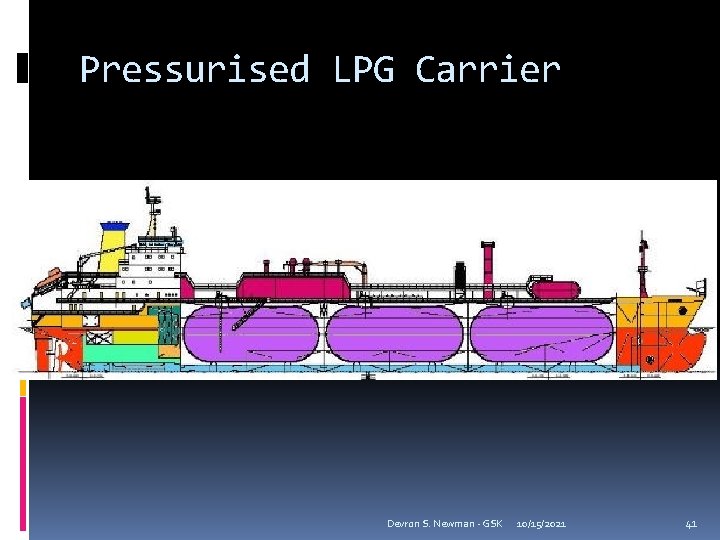
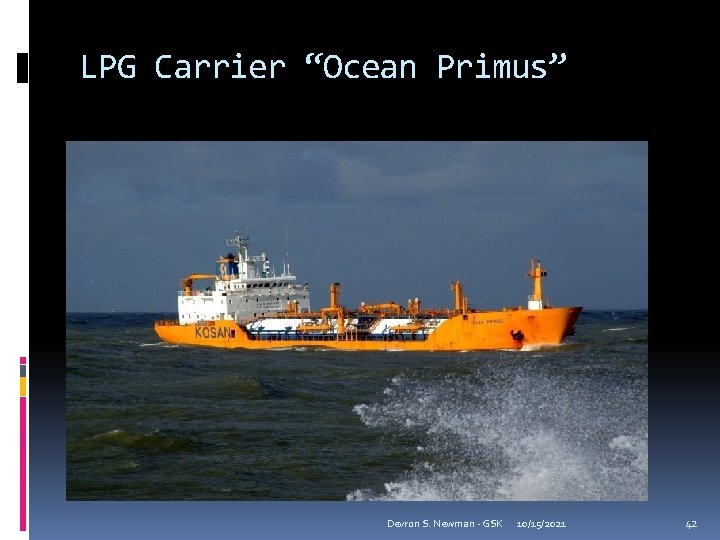
Lesson 1: Bulk Carriers and Tankers Gas carriers (LNG & LPG carriers) These vessels carry gases that are liquefied. The volume after liquefaction could be as much as 600 times less than in the gaseous state. Liquefaction can be achieved by increasing pressure or reducing the temperature or a combination of both. LPG consisting mainly of propane, butane, propylene, butylene was carried in pressurized vessels prior to 1959. Present day vessels carry the gas at a temperature of -50° C. The tanks are cylindrical, placed horizontally or of prismatic construction with insulation sprayed on the inner hull. Devron S. Newman - GSK 10/15/2021 40
Pressurised LPG Carrier Devron S. Newman - GSK 10/15/2021 41
LPG Carrier “Ocean Primus” Devron S. Newman - GSK 10/15/2021 42
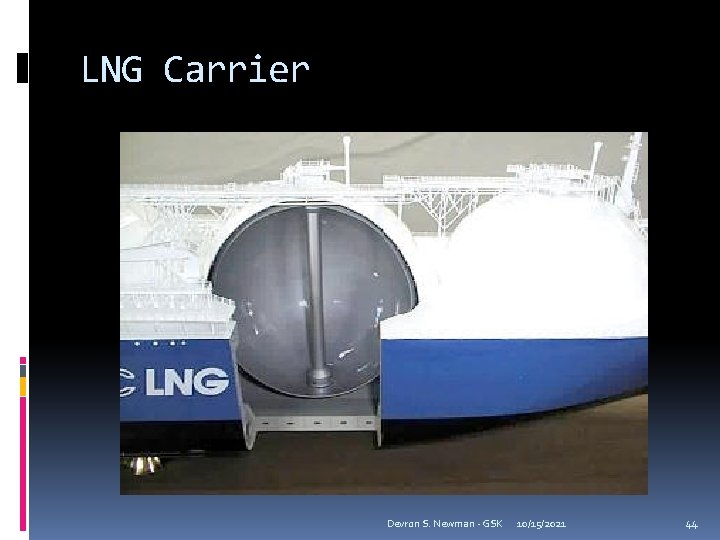
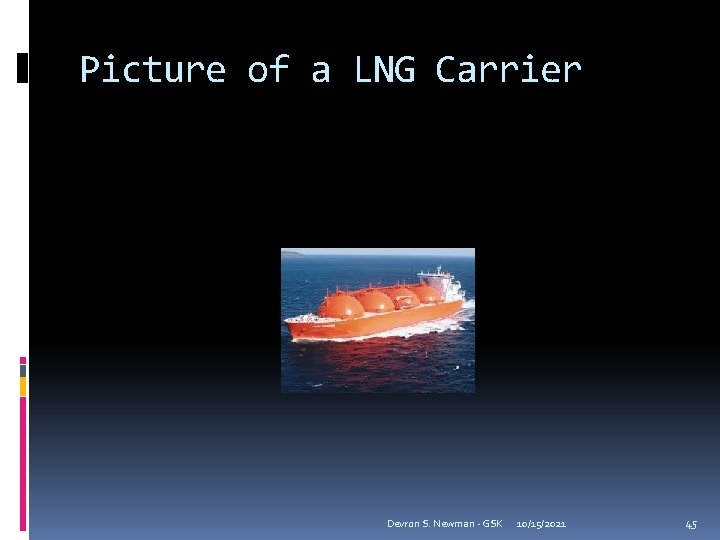
Lesson 1: Bulk Carriers and Tankers Natural gas has a much lower critical temperature and much higher critical pressure. The LNG is therefore carried at a temperature below -160° C. The tanks are either spherical free-standing with domes visible from the deck. The very low temperature of the LNG poses a problem of brittle fracture. Devron S. Newman - GSK 10/15/2021 43
LNG Carrier Devron S. Newman - GSK 10/15/2021 44
Picture of a LNG Carrier Devron S. Newman - GSK 10/15/2021 45
Cross–section of a LNG Carrier with Membrane Tank Devron S. Newman - GSK 10/15/2021 46
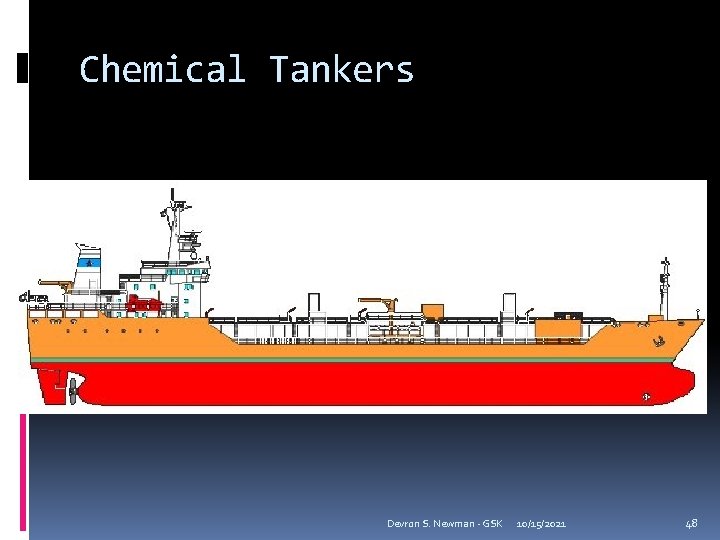
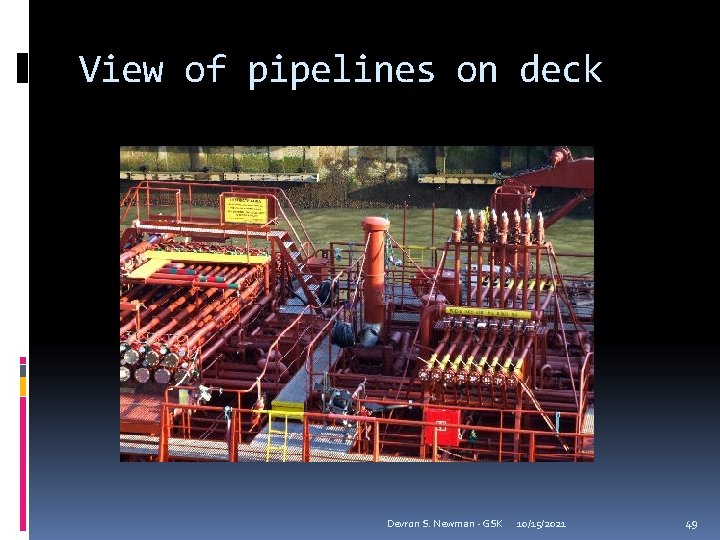
Lesson 1: Bulk Carriers and Tankers Chemical carriers: These purpose-built tankers were constructed from about 1954. Chemicals carried in bulk are either derivatives of crude oil, coal tar, vegetable oils and fats or are heavy chemicals like sulphuric, nitric, phosphoric acids and caustic soda. The problems associated with the carriage of chemicals are pollution and safety hazards. The operation and construction of these vessels are governed by the Bulk Chemical (BCH) Code. Devron S. Newman - GSK 10/15/2021 47
Chemical Tankers Devron S. Newman - GSK 10/15/2021 48
View of pipelines on deck Devron S. Newman - GSK 10/15/2021 49
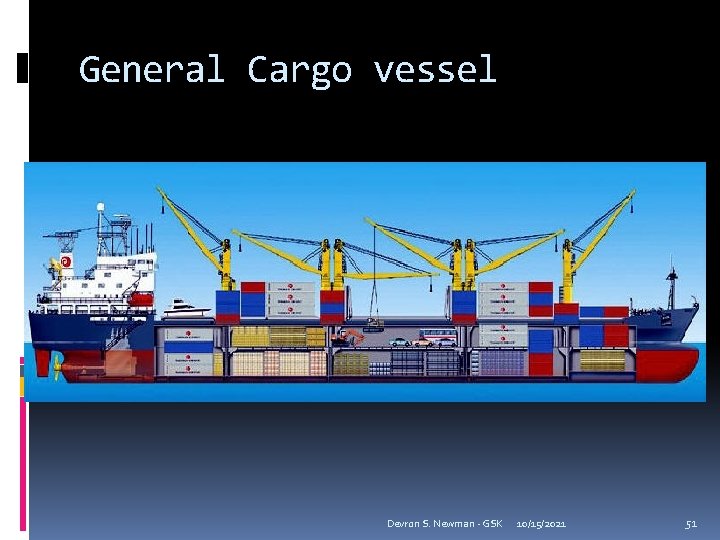
Lesson 2: General Cargo, Container and Ro/Ro Vessels General cargo vessels carry cargoes of finished products, raw material, construction material, chemicals in packaged form, heavy machinery items etc. These vessels fall into two categories – liner and tramp. These terms are associated with the trade rather than the actual vessel type. Their sizes range from 10, 000 – 20, 000 DWT and normally operate at speeds of 15 – 20 knots. They have double bottom tanks that are used for storage of fuel carriage of ballast water. Devron S. Newman - GSK 10/15/2021 50
General Cargo vessel Devron S. Newman - GSK 10/15/2021 51
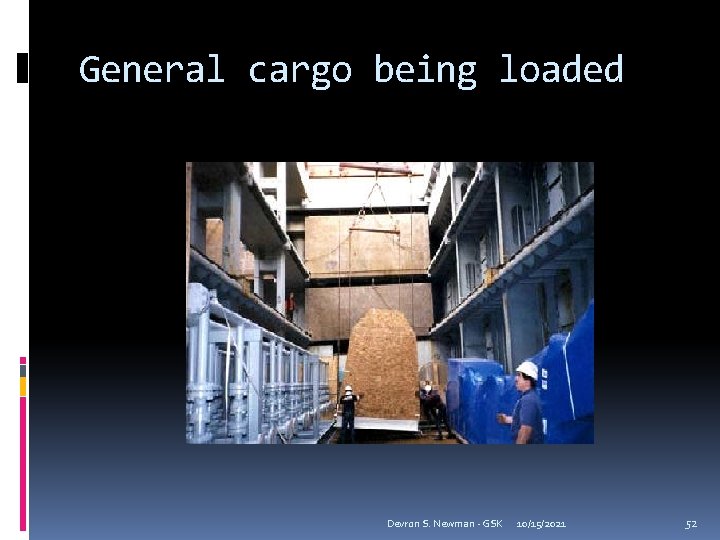
General cargo being loaded Devron S. Newman - GSK 10/15/2021 52
General Cargo, Container and Ro/Ro Vessels The hull is divided by transverse bulkheads to form holds, typically four to six. The engine room is located aft of the cargo holds. The holds may be further divided by one or two ‘tween decks with hatchways that will allow cargo to be loaded or unloaded into the compartment. General cargo vessels may have one or two refrigerated holds to carry refrigerated cargo and deep tanks for carrying small parcels of edible oil, or non-hazardous liquid chemicals. Devron S. Newman - GSK 10/15/2021 53
General Cargo, Container and Ro/Ro Vessels Over the years the equipment fitted to general cargo vessels have changed to facilitate better cargo handling. For example derricks and hatch covers have changed to cranes and more sophiscated hatch covers. The concept of unitization i. e. pre-slung cargo and palletisation has reduced break-bulk handling, reduced handling time and improved stowage, security and safety of the cargo. Devron S. Newman - GSK 10/15/2021 54
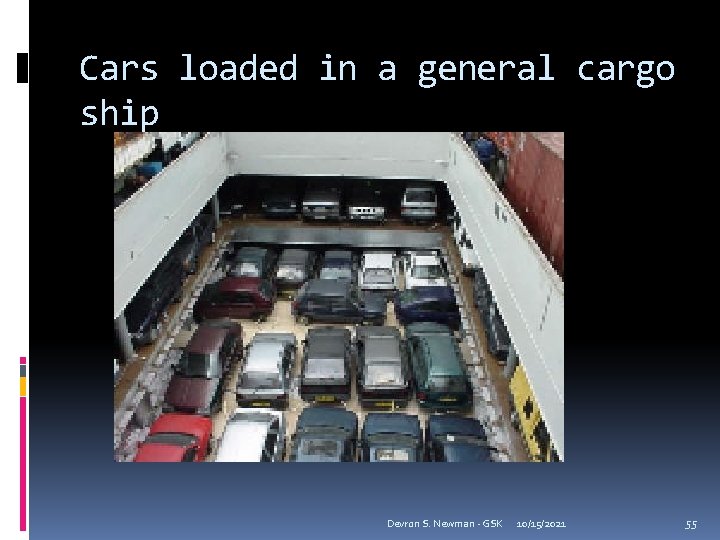
Cars loaded in a general cargo ship Devron S. Newman - GSK 10/15/2021 55
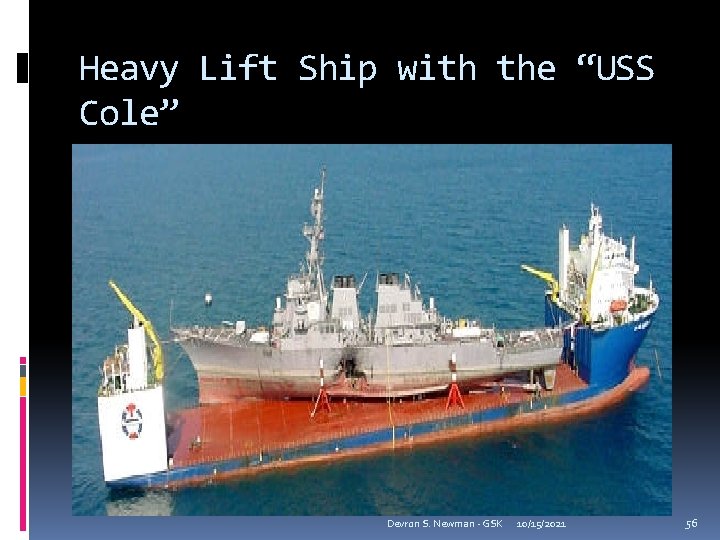
Heavy Lift Ship with the “USS Cole” Devron S. Newman - GSK 10/15/2021 56
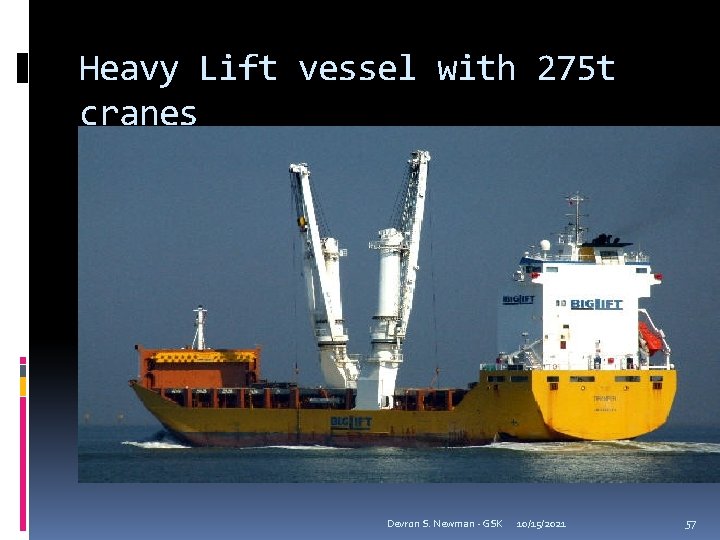
Heavy Lift vessel with 275 t cranes Devron S. Newman - GSK 10/15/2021 57
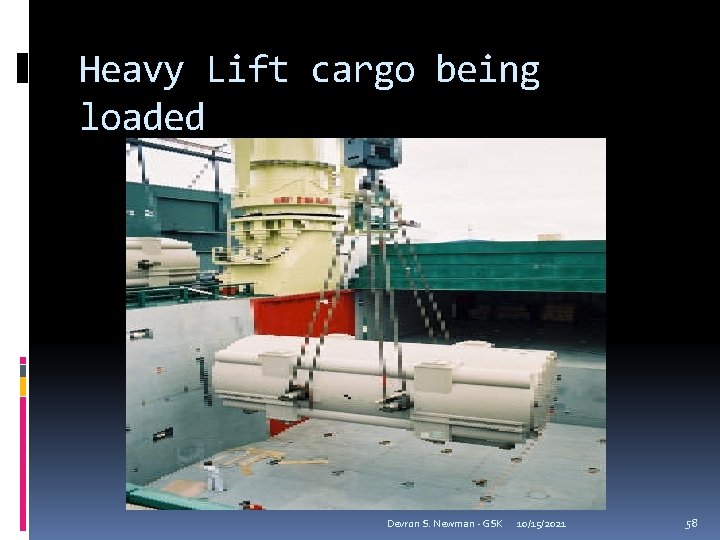
Heavy Lift cargo being loaded Devron S. Newman - GSK 10/15/2021 58
General Cargo, Container and Ro/Ro Vessels Container ships: A container is an extended form of unit load in transportation. The popularity and dominance of containerized transportation nearly wiped out the breakbulk transportation business due to the fast turnaround time associated with this mode of transportation. Devron S. Newman - GSK 10/15/2021 59
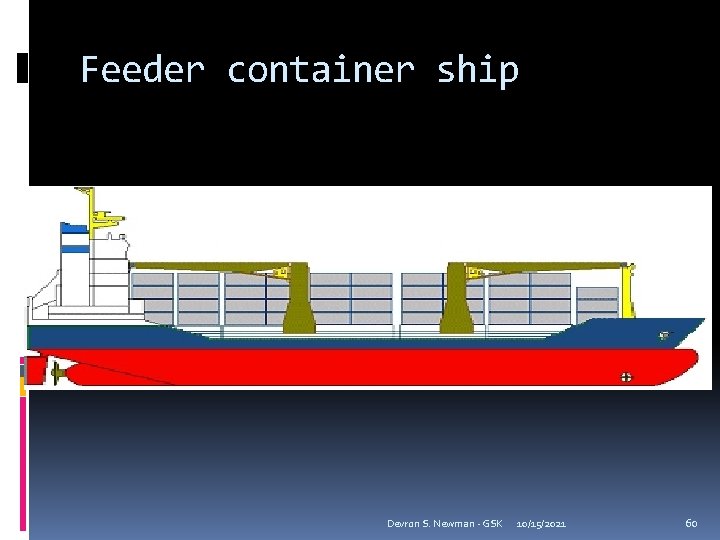
Feeder container ship Devron S. Newman - GSK 10/15/2021 60
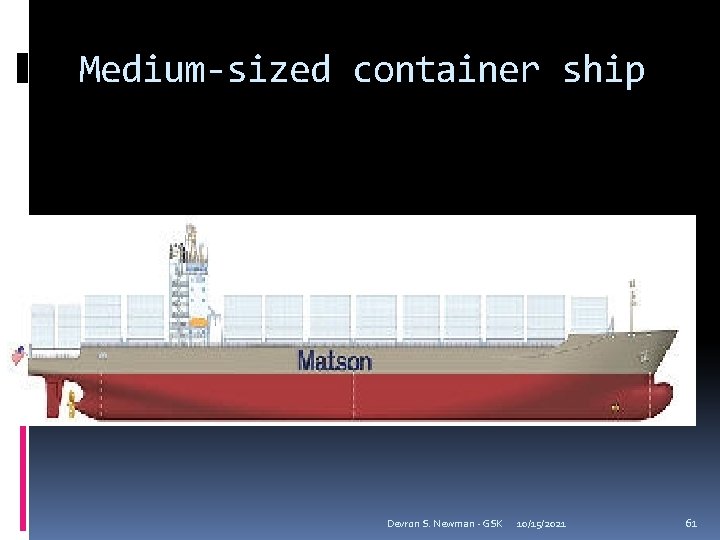
Medium-sized container ship Devron S. Newman - GSK 10/15/2021 61
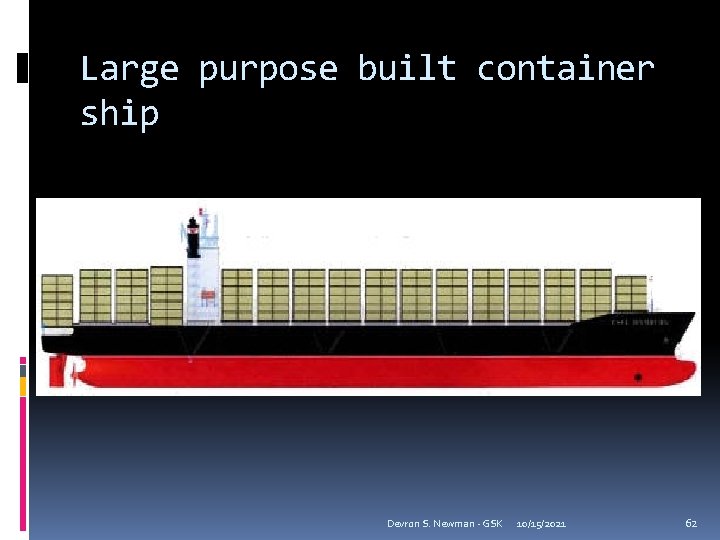
Large purpose built container ship Devron S. Newman - GSK 10/15/2021 62
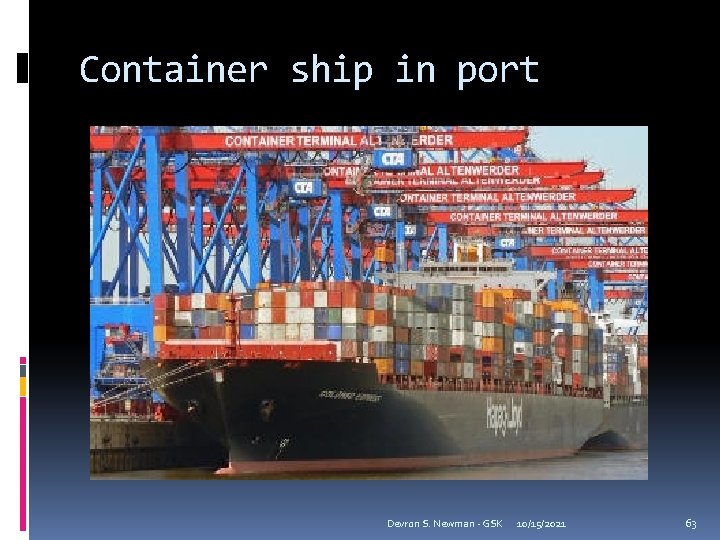
Container ship in port Devron S. Newman - GSK 10/15/2021 63
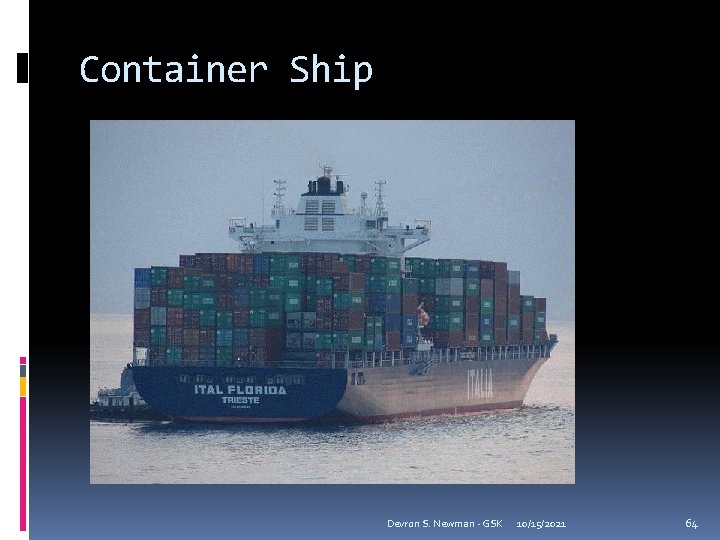
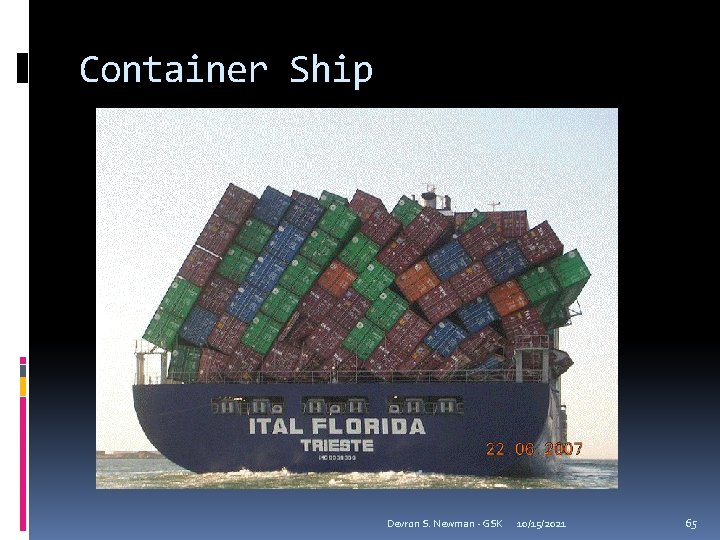
Container Ship Devron S. Newman - GSK 10/15/2021 64
Container Ship Devron S. Newman - GSK 10/15/2021 65
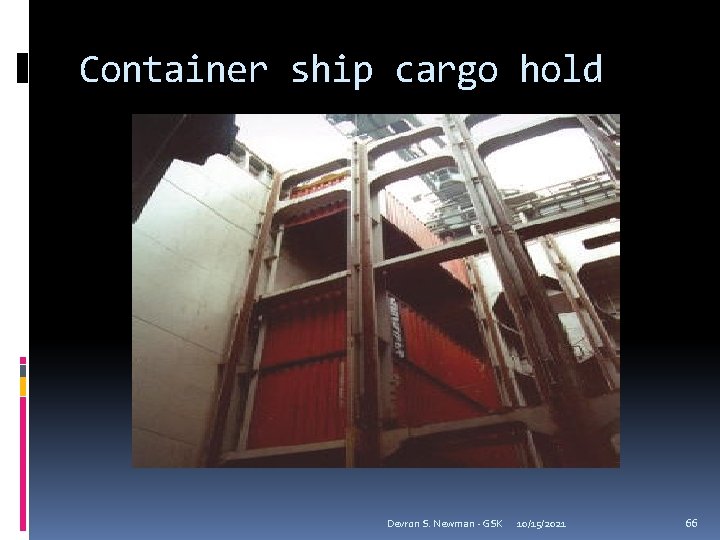
Container ship cargo hold Devron S. Newman - GSK 10/15/2021 66
General Cargo, Container and Ro/Ro Vessels Containerization is one of the units of modal and multimodal transportation in door-to-door or floor-to-floor service. The first container ship was a converted tanker the S/S “Maxton”which carried 58 containers in April 1956. But it was not until 1966 that the first container service crossed the Atlantic ocean. Devron S. Newman - GSK 10/15/2021 67
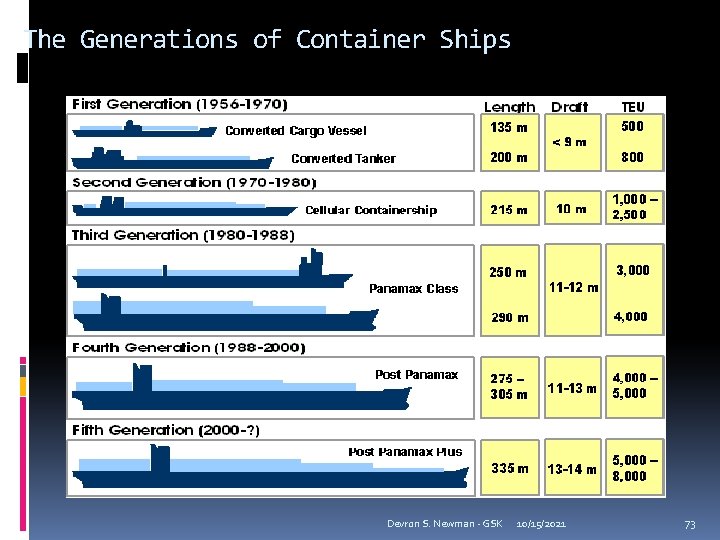
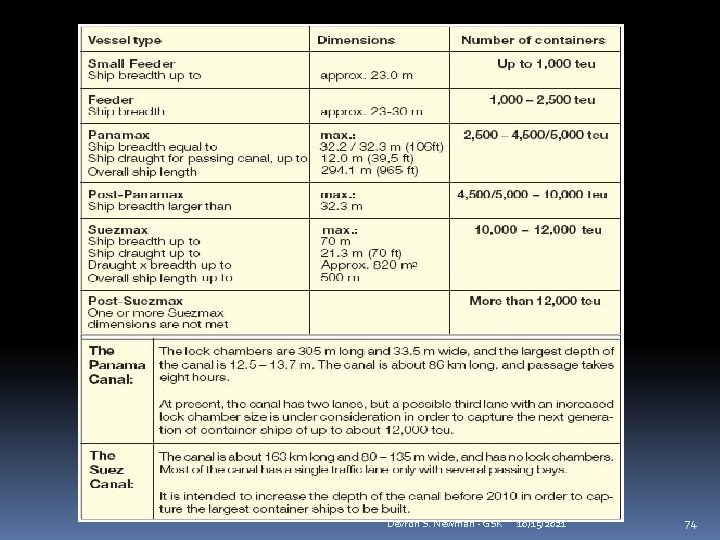
General Cargo, Container and Ro/Ro Vessels Container vessels are classified as first generation – those carrying less than 1000 TEUs and second generation – those carrying more than 1000 TEUs while fourth generation have capacities of 4, 000 to 5, 000 TEUs. These ships have speeds of 18 to 25 knots. They may have their own cargo handling equipment or may be gearless. Devron S. Newman - GSK 10/15/2021 68
General Cargo, Container and Ro/Ro Vessels Devron S. Newman - GSK 10/15/2021 69
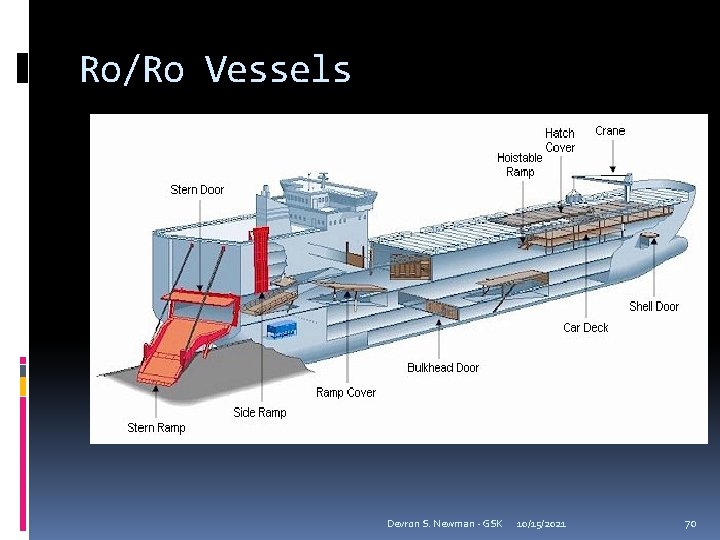
Ro/Ro Vessels Devron S. Newman - GSK 10/15/2021 70
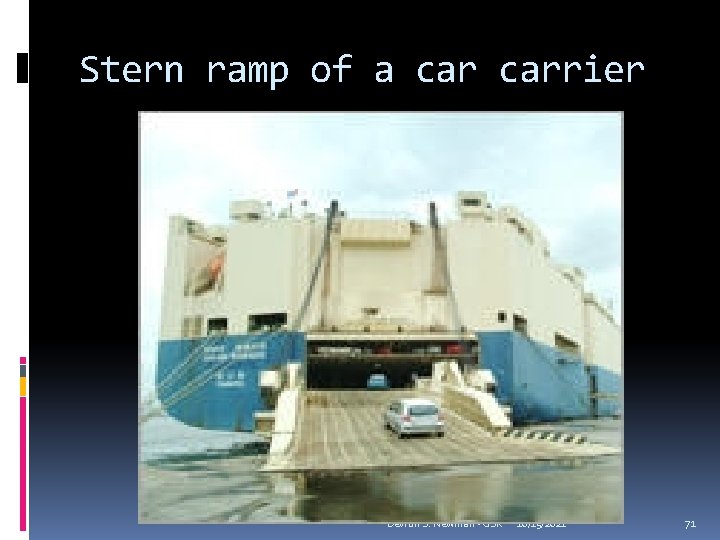
Stern ramp of a carrier Devron S. Newman - GSK 10/15/2021 71
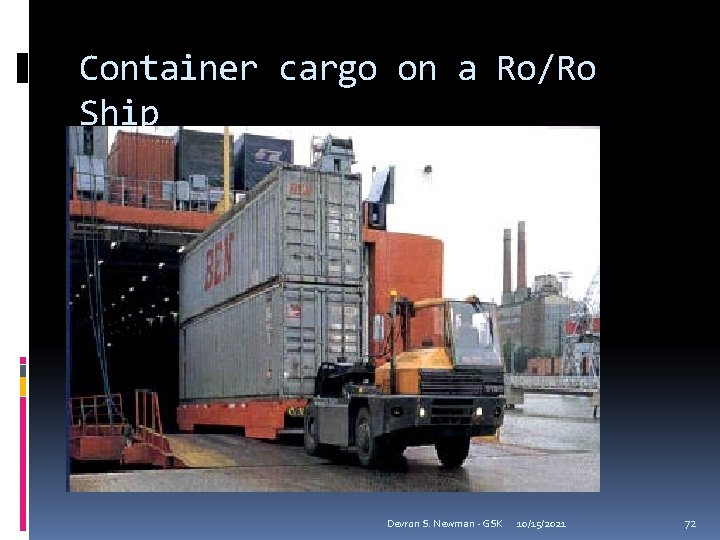
Container cargo on a Ro/Ro Ship Devron S. Newman - GSK 10/15/2021 72
The Generations of Container Ships Devron S. Newman - GSK 10/15/2021 73
Devron S. Newman - GSK 10/15/2021 74
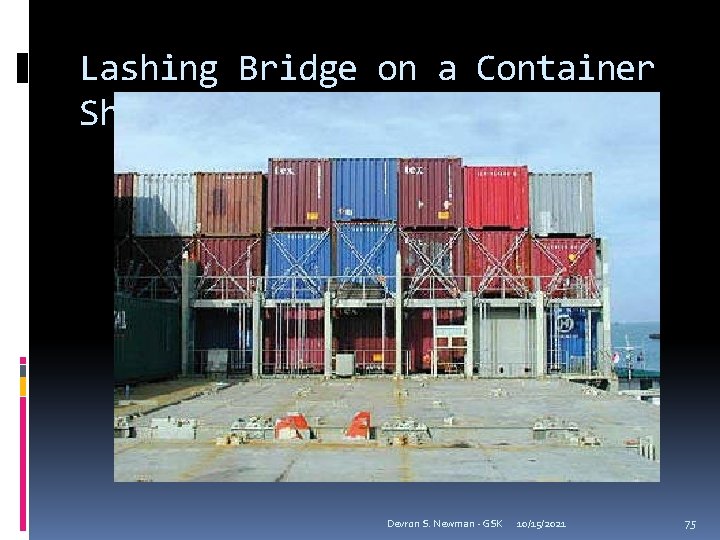
Lashing Bridge on a Container Ship Devron S. Newman - GSK 10/15/2021 75
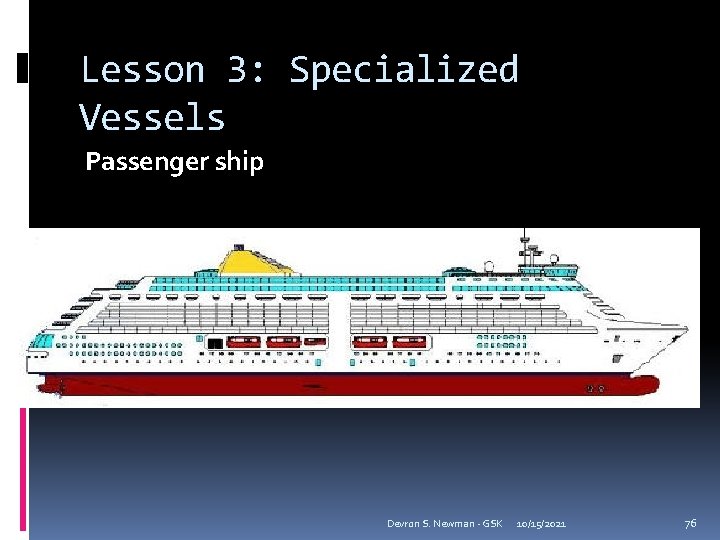
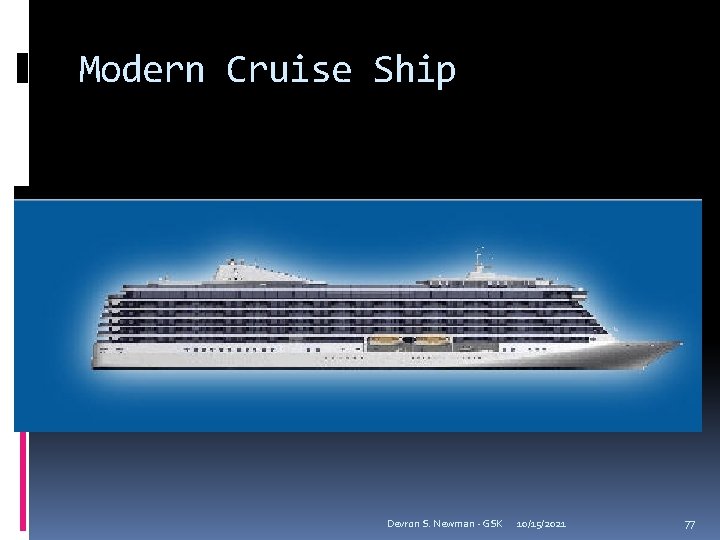
Lesson 3: Specialized Vessels Passenger ship Devron S. Newman - GSK 10/15/2021 76
Modern Cruise Ship Devron S. Newman - GSK 10/15/2021 77
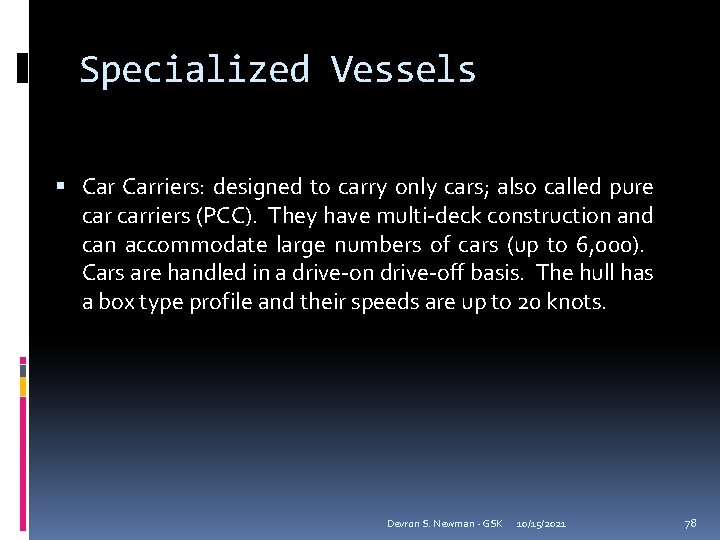
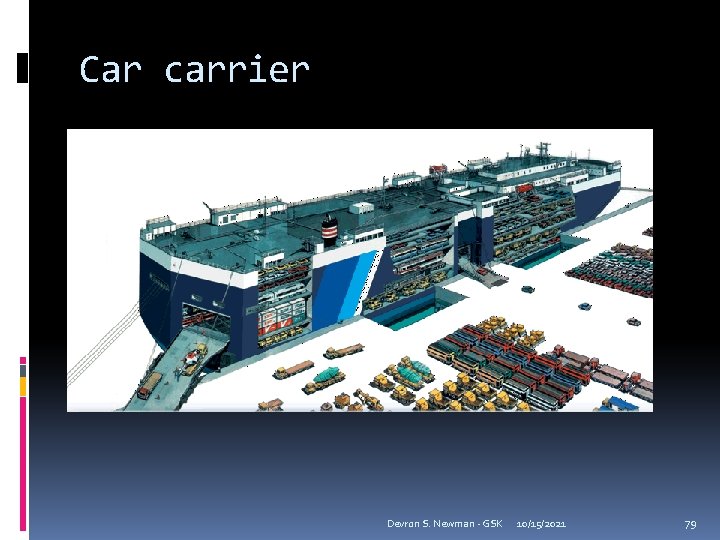
Specialized Vessels Carriers: designed to carry only cars; also called pure carriers (PCC). They have multi-deck construction and can accommodate large numbers of cars (up to 6, 000). Cars are handled in a drive-on drive-off basis. The hull has a box type profile and their speeds are up to 20 knots. Devron S. Newman - GSK 10/15/2021 78
Car carrier Devron S. Newman - GSK 10/15/2021 79
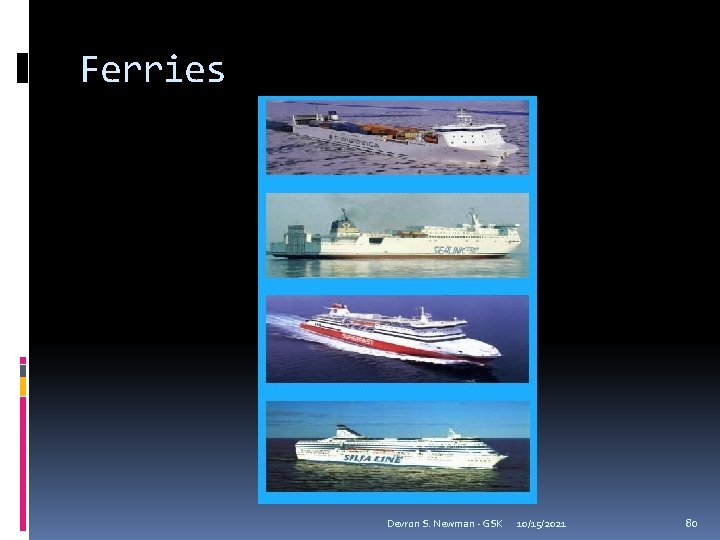
Ferries Devron S. Newman - GSK 10/15/2021 80
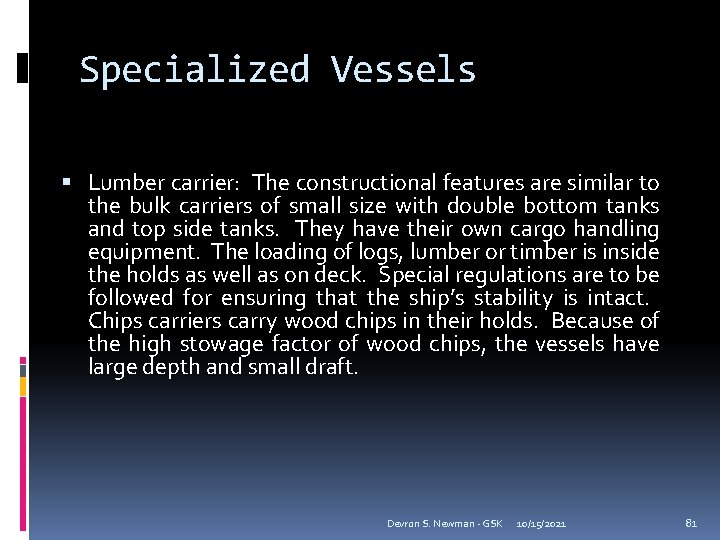
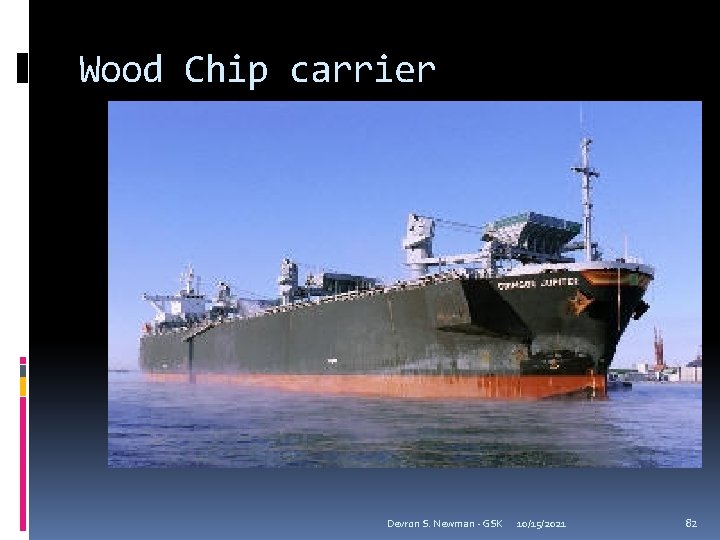
Specialized Vessels Lumber carrier: The constructional features are similar to the bulk carriers of small size with double bottom tanks and top side tanks. They have their own cargo handling equipment. The loading of logs, lumber or timber is inside the holds as well as on deck. Special regulations are to be followed for ensuring that the ship’s stability is intact. Chips carriers carry wood chips in their holds. Because of the high stowage factor of wood chips, the vessels have large depth and small draft. Devron S. Newman - GSK 10/15/2021 81
Wood Chip carrier Devron S. Newman - GSK 10/15/2021 82
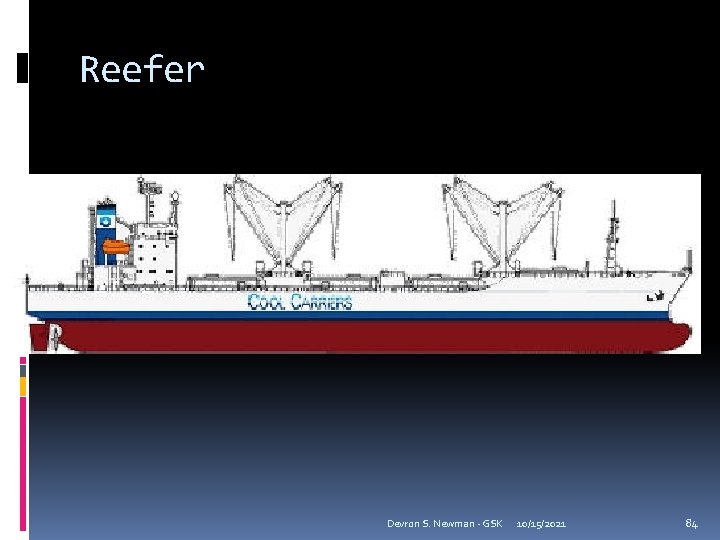
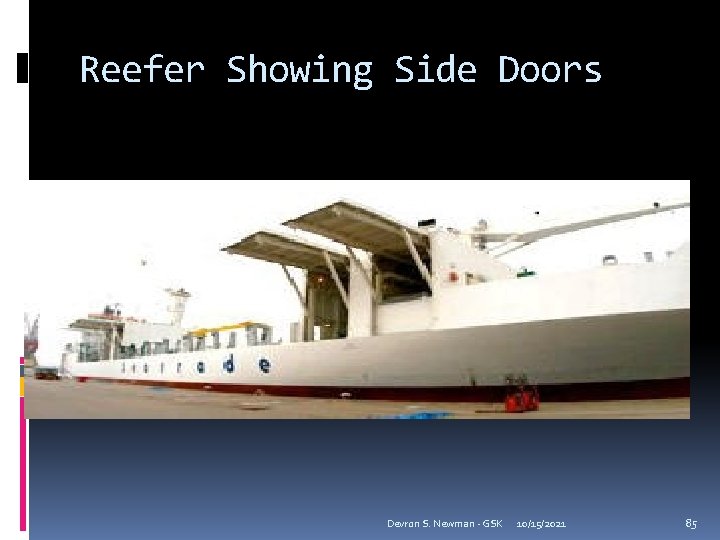
Specialized Vessels Refrigerated Cargo Ships: These ships have constructional features of a general cargo ship with four or five holds divided vertically by two or three ‘tween decks. The holds are insulated to maintain low temperatures down to -30 C. They have their own cargo handling equipment. Their speed s are relatively high and usually range between 20 -23 knots. Devron S. Newman - GSK 10/15/2021 83
Reefer Devron S. Newman - GSK 10/15/2021 84
Reefer Showing Side Doors Devron S. Newman - GSK 10/15/2021 85
Specialized Vessels Heavy Lifters: Most of the general cargo ships have cargo handling equipment to handle cargo weighing up to 100 tonnes. However, the heavy lifters have equipment to handle single pieces of cargo weighing up to 1, 000 tonnes. The heavy lift cargoes a are carried along with the general cargoes as and when available. The strength and stability along with spec ial securing arrangements for heavy cargoes are given special consideration. Devron S. Newman - GSK 10/15/2021 86
Elements of a Ship The Hull Material: The hull is usually constructed from steel plates welded together. The steel may be mild or high tensile steel which is categorised into several grades according to the chemical and physical properties. Typical structures: Bow part; Fore part; Mid ship; Aft part; Stern part Devron S. Newman - GSK 10/15/2021 87
Elements of a Ship Propeller: There are several kinds of propulsion devices in addition to the known screw propeller. There are fixed pitch and controllable pitch propellers. Devron S. Newman - GSK 10/15/2021 88
Elements of a Ship Steering Gears: Rudder, a device which is used to turn the ship and a hydraulic system integrated with the rudder which facilitates the steering of the vessel. Fittings on Deck; Mooring devices (anchors; winches; capstans; windlass) Devron S. Newman - GSK 10/15/2021 89
Elements of a Ship Cargo Handling Devices: These are the main outfittings for a cargo ship. There are many different types of cargo handling gear depending on the type of ship. Navigation Bridge: This is where the navigating of the vessel takes place. All the navigational instruments and systems are located here. Devron S. Newman - GSK 10/15/2021 90