
Diploma in ICT Professional Competence The QCF framework






- Slides: 20
Diploma in ICT Professional Competence
The QCF framework • New way of recognising achievement: awarding a credit value for units and qualifications • Qualifications titles, sizes and levels (entry→ L 8) standardised nationally: Awards (1 -12 credits), Certificates (13 -36 credits), Diplomas (37+ credits) • Qualifications will be: – designed to fit a national (unit) template with learning outcomes and assessment criteria – subject to agreed rules of combination (Ro. C) – migrated to the new framework by end 2010
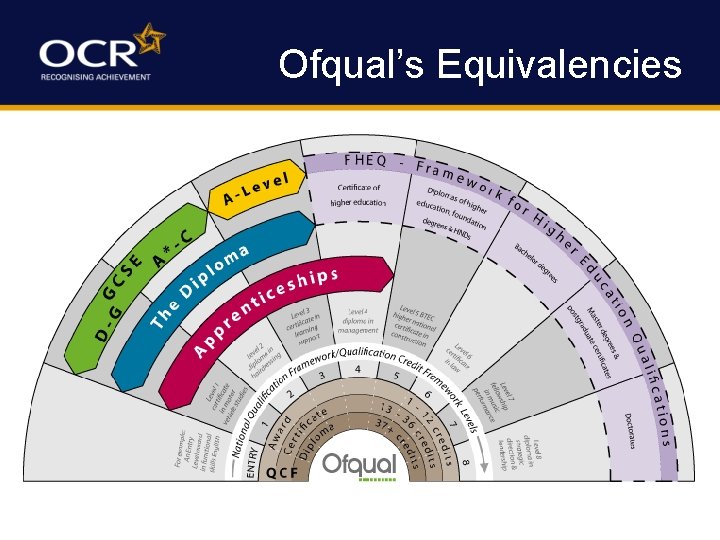
Credits and Levels • All units will be assigned a credit value at a level • Levels are same as NQF – L 2 roughly GSCE level, L 3 A Level, L 4 1 st year undergrad, L 8 Ph. D. • One credit = 10 notional learning hours (NLH) • NLH – average time it would take a learner to complete a unit – consists of guided learning hours (GLH), personal study time, ‘on the job’ experience, assessment preparation and assessment time
QCF Structure
Ofqual’s Equivalencies
General observations • The framework has changed, but methods of assessment have not • Each unit needs to be able to be assessed separately in a work environment, but evidence can still be used across a number of units where appropriate • Greater flexibility may result in qualifications with more than one assessment model - OCR will consider the assessment burden when developing rules of combination • Full scheme documentation, including entry details, will be available on the our website • Named and unnamed registration routes will be available • Full qualification and unit entry will be available
Further information More information about the QCF is available on the following websites: www. ocr. org. uk/qcf www. ofqual. gov. uk
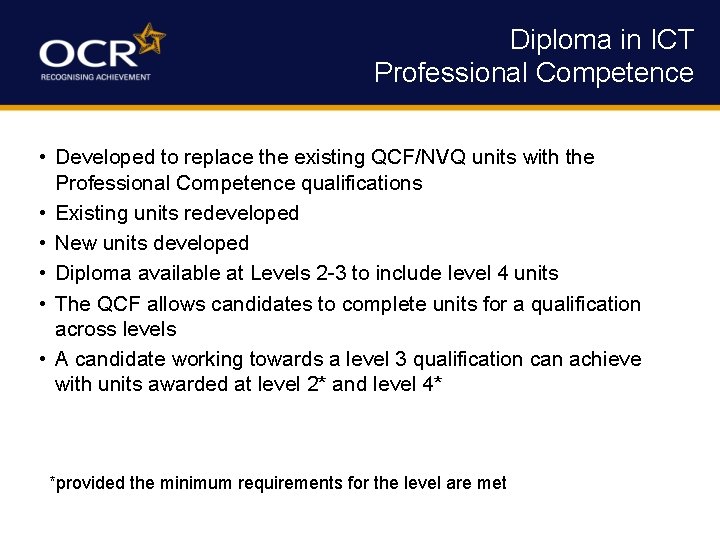
Diploma in ICT Professional Competence • Developed to replace the existing QCF/NVQ units with the Professional Competence qualifications • Existing units redeveloped • New units developed • Diploma available at Levels 2 -3 to include level 4 units • The QCF allows candidates to complete units for a qualification across levels • A candidate working towards a level 3 qualification can achieve with units awarded at level 2* and level 4* *provided the minimum requirements for the level are met
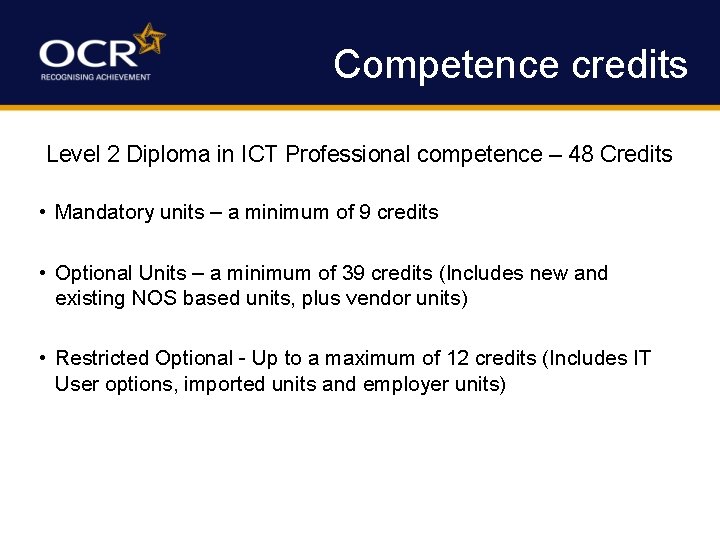
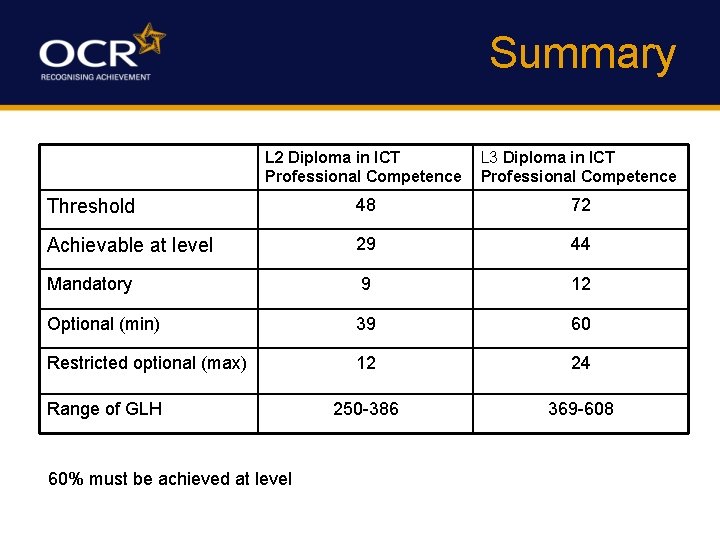
Competence credits Level 2 Diploma in ICT Professional competence – 48 Credits • Mandatory units – a minimum of 9 credits • Optional Units – a minimum of 39 credits (Includes new and existing NOS based units, plus vendor units) • Restricted Optional - Up to a maximum of 12 credits (Includes IT User options, imported units and employer units)
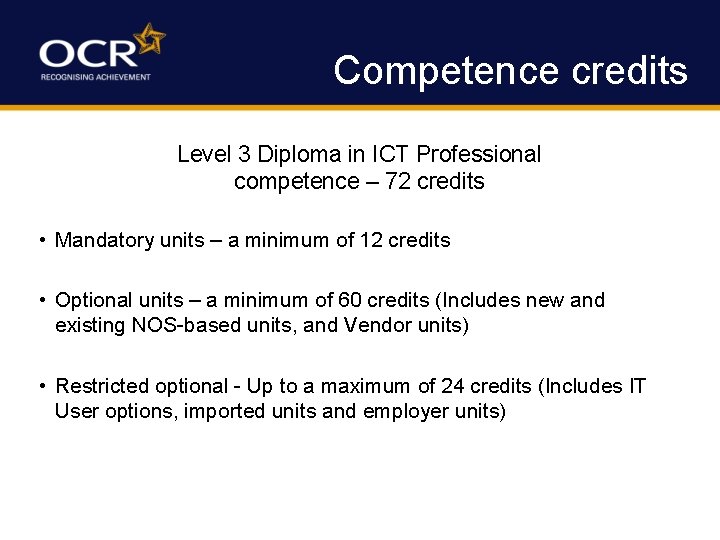
Competence credits Level 3 Diploma in ICT Professional competence – 72 credits • Mandatory units – a minimum of 12 credits • Optional units – a minimum of 60 credits (Includes new and existing NOS-based units, and Vendor units) • Restricted optional - Up to a maximum of 24 credits (Includes IT User options, imported units and employer units)
New & Existing units Unit Title Level Credit New or replaced unit Computer games development 2 4 New Computer games development 3 10 New Creating a procedural computer programme 2 10 Software development – component creation Creating a procedural computer programme 3 12 Software development – component creation Creating an event driven computer programme 2 7 Software development – component creation Creating an event driven computer programme 3 12 Software development – component creation Creating an object orientated computer programme 2 7 Software development – component creation Creating an object orientated computer programme 3 12 Software development – component creation
New & Existing units cont. Data modelling 2 6 Data analysis and data structure design Data modelling 3 9 Data analysis and data structure design Data Structures and Algorithms 4 15 Data analysis and data structure design Designing and Developing a Website 4 15 Software Designing and Developing Event Driven Computer Programmes 4 10 Software Designing and Developing Object Orientated Computer Programmes 4 15 Software Designing and Developing Procedural Computer Programmes 4 15 Software Design Develop own effectiveness and professionalism 2 6 Develop personal and organisational effectiveness Develop own effectiveness and professionalism 3 9 Develop personal and organisational effectiveness
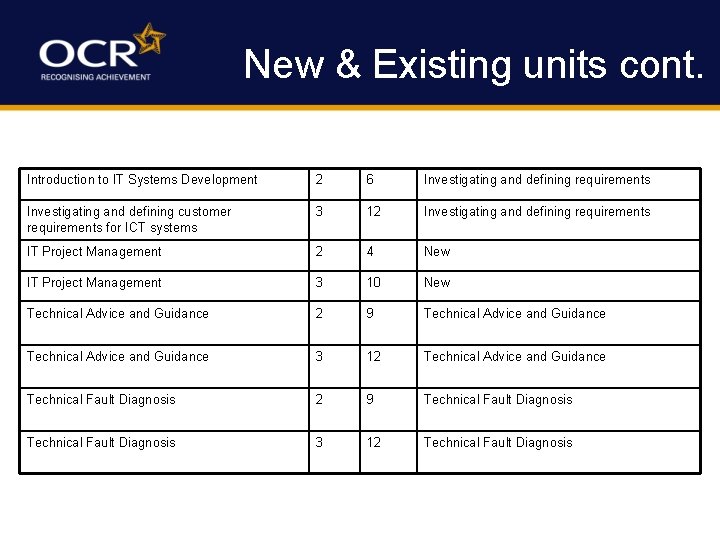
New & Existing units cont. Introduction to IT Systems Development 2 6 Investigating and defining requirements Investigating and defining customer requirements for ICT systems 3 12 Investigating and defining requirements IT Project Management 2 4 New IT Project Management 3 10 New Technical Advice and Guidance 2 9 Technical Advice and Guidance 3 12 Technical Advice and Guidance Technical Fault Diagnosis 2 9 Technical Fault Diagnosis 3 12 Technical Fault Diagnosis
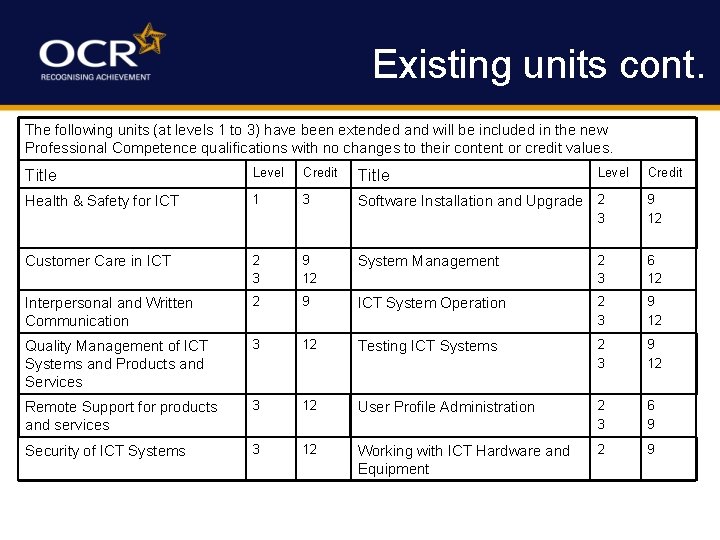
Existing units cont. The following units (at levels 1 to 3) have been extended and will be included in the new Professional Competence qualifications with no changes to their content or credit values. Title Level Credit Title Level Health & Safety for ICT 1 3 Software Installation and Upgrade 2 Credit 3 9 12 Customer Care in ICT 2 3 9 12 System Management 2 3 6 12 Interpersonal and Written Communication 2 9 ICT System Operation 2 3 9 12 Quality Management of ICT Systems and Products and Services 3 12 Testing ICT Systems 2 3 9 12 Remote Support for products and services 3 12 User Profile Administration 2 3 6 9 Security of ICT Systems 3 12 Working with ICT Hardware and Equipment 2 9
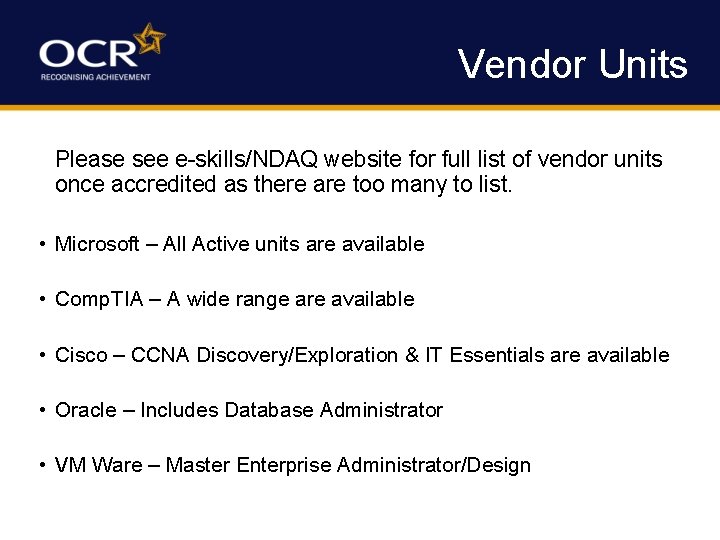
Vendor Units Please see e-skills/NDAQ website for full list of vendor units once accredited as there are too many to list. • Microsoft – All Active units are available • Comp. TIA – A wide range are available • Cisco – CCNA Discovery/Exploration & IT Essentials are available • Oracle – Includes Database Administrator • VM Ware – Master Enterprise Administrator/Design
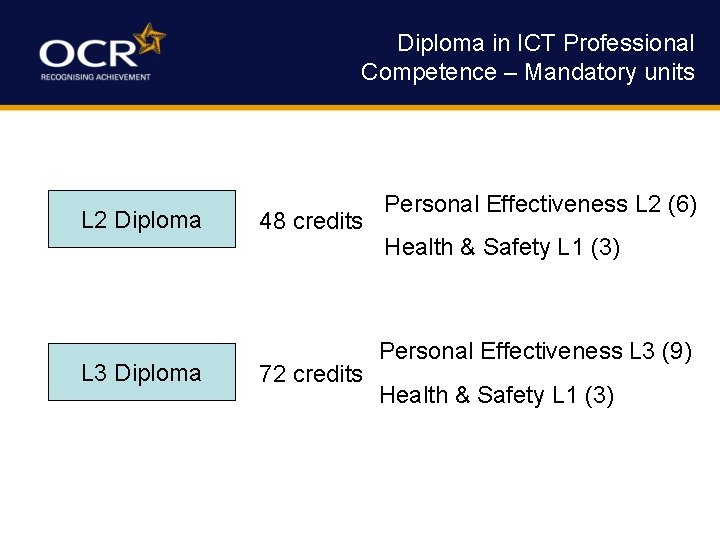
Diploma in ICT Professional Competence – Mandatory units L 2 Diploma L 3 Diploma 48 credits 72 credits Personal Effectiveness L 2 (6) Health & Safety L 1 (3) Personal Effectiveness L 3 (9) Health & Safety L 1 (3)
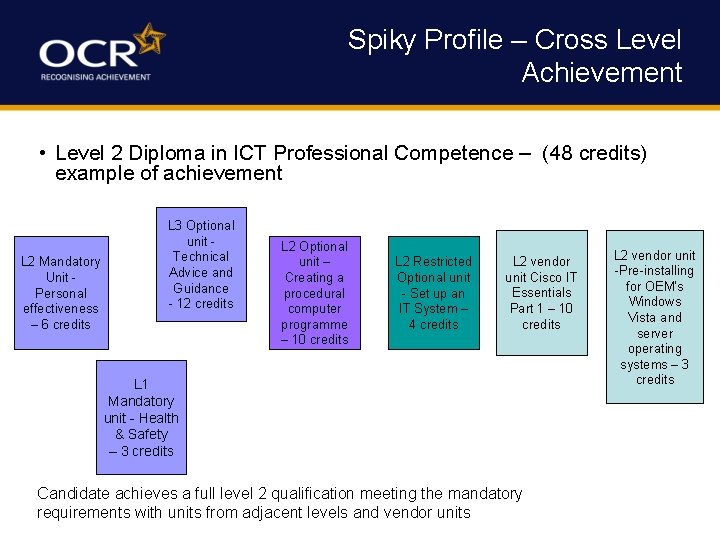
Spiky Profile – Cross Level Achievement • Level 2 Diploma in ICT Professional Competence – (48 credits) example of achievement L 2 Mandatory Unit Personal effectiveness – 6 credits L 3 Optional unit Technical Advice and Guidance - 12 credits L 2 Optional unit – Creating a procedural computer programme – 10 credits L 2 Restricted Optional unit - Set up an IT System – 4 credits L 2 vendor unit Cisco IT Essentials Part 1 – 10 credits L 1 Mandatory unit - Health & Safety – 3 credits Candidate achieves a full level 2 qualification meeting the mandatory requirements with units from adjacent levels and vendor units L 2 vendor unit -Pre-installing for OEM’s Windows Vista and server operating systems – 3 credits
Assessment • Candidates are still required to meet all assessment objectives • Evidence must not be simulated
Support • Exemplar material to be developed for new units • New handbooks and units available from Sept 2010
Summary L 2 Diploma in ICT Professional Competence L 3 Diploma in ICT Professional Competence Threshold 48 72 Achievable at level 29 44 Mandatory 9 12 Optional (min) 39 60 Restricted optional (max) 12 24 250 -386 369 -608 Range of GLH 60% must be achieved at level