
Dioscorea floribunda Family Diascoreaceae is Importance and chemical
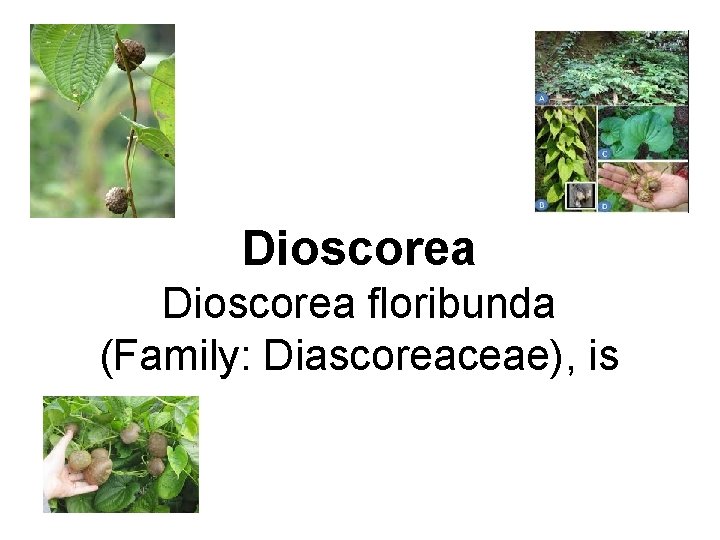
Dioscorea floribunda (Family: Diascoreaceae), is
Importance and chemical composition • Diosgenin, a steroidal sapogenin obtained from the rhizomes of various species
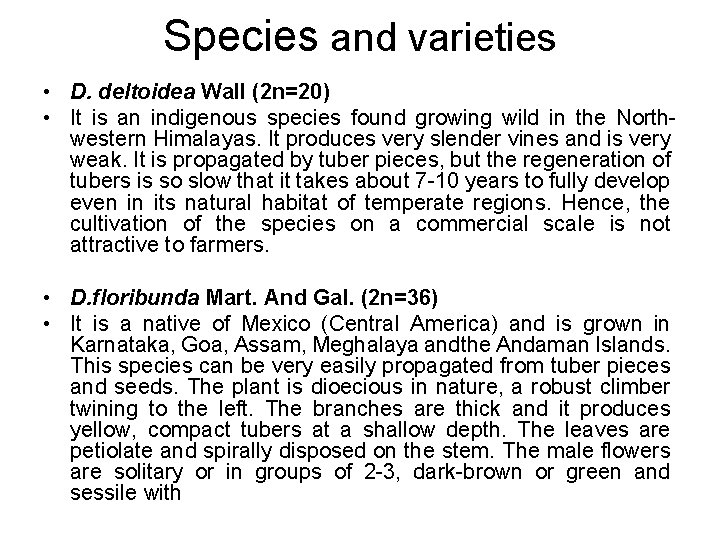
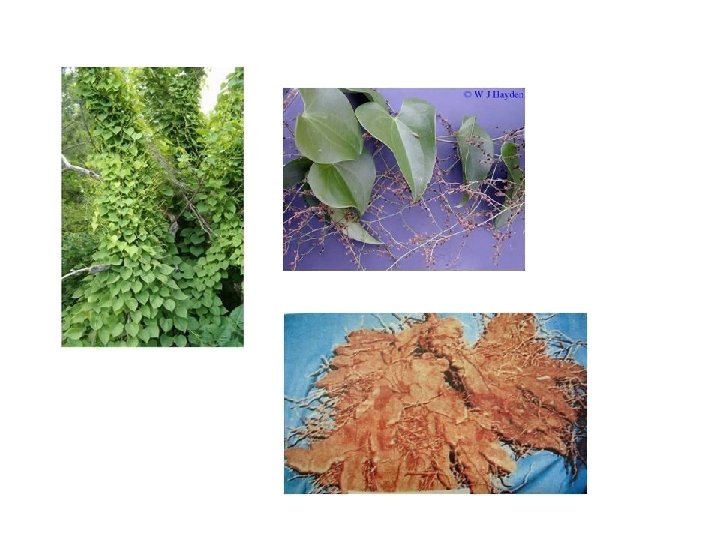
Species and varieties • D. deltoidea Wall (2 n=20) • It is an indigenous species found growing wild in the Northwestern Himalayas. It produces very slender vines and is very weak. It is propagated by tuber pieces, but the regeneration of tubers is so slow that it takes about 7 -10 years to fully develop even in its natural habitat of temperate regions. Hence, the cultivation of the species on a commercial scale is not attractive to farmers. • D. floribunda Mart. And Gal. (2 n=36) • It is a native of Mexico (Central America) and is grown in Karnataka, Goa, Assam, Meghalaya andthe Andaman Islands. This species can be very easily propagated from tuber pieces and seeds. The plant is dioecious in nature, a robust climber twining to the left. The branches are thick and it produces yellow, compact tubers at a shallow depth. The leaves are petiolate and spirally disposed on the stem. The male flowers are solitary or in groups of 2 -3, dark-brown or green and sessile with
Varieties • FBC-1 strain and Arka Upkar were released from the Indian Institute of Horticultural Research (IIHR), Bangalore, while Pusa-1 by the Indian Agricultural Research Institute (ICAR), New Delhi. These three varieties adapt well to tropical and subtropical regions. The salient features of these varieties are as follows. • FB (C)-1 • This is a composite strain from introduced clonal material from Central America. The plants are vigorous and relatively free from pests and diseases. The tuber yield is 20 000 -25 000 kg/yr (1 kg/plant) or 60 000 kg for a 2 -year-old crop (2. 5 kg/plant). The diosgenin content of the dried roots varies from 2. 5 to 3%. • Arka Upkar • A high yielding clonal selection from FB(C)-1 with intense dark-green leaves and a vigorous growth. The tuber yield exceeds 6000 kg (in a 2 -year-old crop) and the diosegenin content ranges from 3. 5 to 4. 0%. • Pusa-1 • A selection from germplasm with a tuber yield of 1. 5 kg/vine after 18 months.
• Soil • Dioscorea can be grown in several types of soils. Light or sandy soils require heavy irrigation and fertilization whereas heavy clay soils restrict tuber growth and harvest and often create waterlogging. • The bet yields are obtained in medium loam and in deep soils which are rich in organic • matter. In red, soils, the best growth has been observed for both D. floribunda and D. composita. • It tolerates wide variation in soil p. H, but highly acidic and highly alkaline soils should be avoided. • Climate • The different species of Dioscorea are found growing in different climates, but while D. floribunda and • D. composita are more suited to the tropics, D. deltoidea is reported to be a suitable species for temperate • locations. It grows well in the temperate regions of Kashmir and Himachal Pradesh.
Land preparation • The field should be ploughed and harrowed several times, leveled properly and drainage channels should be made. Since yams have a high requirement of organic matter of good tuber formation, a • recommended quantity (20 -25 t/ha) of FYM is incorporated at the time of land preparation. A spacing of 45 x 30 cm for a 1 -year-old crop and 60 x 45 cm for a 2 -year-old crop in D. floribunda is found to be optimum under irrigated conditions. For planting, deep furrows are made at 60 cm • distance and sprouted tubers are planted in furrows at 5 cm depth. After sprouting is completed, earthing up is done, utilizing the soil from the ridges. • D. composita and D. deltoidea are reported to give higher yields at spacing of 60 x 30 cm and 30 x 70 cm, respectively.
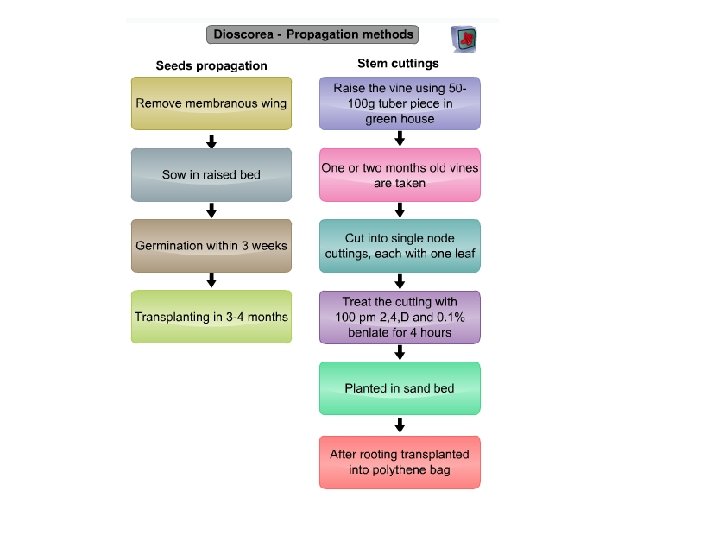
Propagation • • The yams can be propagated either by seeds, rhizome pieces or stem-cuttings. In India, a)Propagation from tuber pieces This crop grows best from tuber pieces. Tubers or rhizomes are divided into approximately 50 -60 g pieces for planting. The growth of plants is slow and the yield lower if smaller pieces are used for planting. There are 3 types of pieces (1) Crowns (stem end), (2) Medians (middle portion) and (3) Tips (distal ends). Crowns produce new shoots within 30 days of planting, while the others take nearly 100 days to sprout. Besides, the crown portion contains less diosgenin compared to the median and the tips, hence the later can be used for the extraction of alkaloids and the former can be used for propagation. But, if there is a shortage of planting material, the median and tips can also be used for planting. In order to avoid the rotting of tubers (before sprouting), only healthy tubers should be selected. The healthy tubers must then be dipped in benlate fungicide (0. 3%) for 5 minutes followed by dusting the cut ends with 0. 3% benlate powder before planting or storage. Before planting the tubers directly in the main field, they should be stored in a moist, well-areated rooting medium until shoot growth commences. The benlate-treated tuber pieces should be kept in raised beds in the shade, covered with sand watered daily. After 30 days the sand may be removed and the sprouted crowns taken out and planted in the field. The median and tip portionsare again covered with sand watered regularly. Subsequently, after 60
• Season of planting • The tuber pieces can be planted either in February-March or June. July. In Karnataka, February-March planting is better. For medians and tips, it is better to plant from the middle of January because they take more time to sprout compared to the crowns. The new sprouts will grow vigorously during the rainy season which commences from June. • b)Propagation by seeds • Propagation through seeds is much more successful in D. floribunda and D. composita, as compared to the other temperate species. The seed has a wide membranous wing that can be removed without affecting germination. The seeds can be sown either in raised beds in the shade (with a mixture of loamy soils and FYM) or in polythene bags (filled with sand, soil and FYM; 2: 1: 1). The planting depth should not be more than 1. 25 cm and frequent watering of the beds is essential. The seeds germinate within three weeks and are ready for transplanting in 3 -4 months. The seedlings should be supported immediately. • The best season for transplanting the seedlings to the field is just before the start of rains, i. e. , in June in South India, but in North India, this can be done at any time except during the winter.
• Provision of support • The vines need support for their optimum growth, as this exposes the maximum number of leaves to sunlight. The system tried successfully at Bangalore consists of 2 m-high, stone pillars spaced 9 m apart in the field. Galvanized wires (Nos. 6 and 8) are used on the boundaries and the interconnecting wires can be of 12 gauge thickness. The vines are supported on coir ropes tied to the wires and • pegged to the ground by wooden stakes.
• • • Manures and fertilizer A well decomposed FYM of 20 -25 t/ha is applied while preparing the land. Yams respond very well to fertilizer application. A fertilizer dose of 300 kg N, 150 kg P 2 O 5 and 150 kg K 2 O/ha, has been found to be optimum for a one-year-old crop of D. floribunda. The entire quantity of P should be applied as a basal does, while N and K are given in four equal split doses at bimonthly intervals commencing from 2 months after sprouting. For D. deltoidea, for a 4 -year-old crop, the recommended fertilizers under Kashmir conditions are 40 kg N, 80 kg P 2 O 5 and 60 kg K 2 O in split doses at an interval of one month from the time of planting in the first year and the same quantity in the second year. In the third year, only N at 30 kg/ha has to be applied in two split doses. For increasing the tuber yield and diosgenin content, the application of S, Ca and Mg has also been recommended. Irrigation The crop needs irrigation frequently during summer months. An interval of 4 to 5 days in summer and 7 to 10 days in winter is desirable for the proper growth and development of this crop and for economic yields. Interculture In the initial stages, yam plantations require more frequent hand-weeding than in the later stages. Chemical herbicides have also been tried, but are not recommended commercially. Studies have revealed that it is feasible to intercrop medicinal yam with short duration crops like cowpea, cluster beans and kidney beans, where irrigation is available. This practice not only minimizes the growth of weeds but also gives additional returns. Apart from this, intercropping also helps in reducing the requirement of nitrogen as these crops are leguminous
• • • Pests and diseases Pests The two important pests affecting this crop are aphids and red spider mites which can easily be controlled by spraying 0. 5 -1. 0% of Kelthane (1 ml/1). Cut-worms are also reported to damage this crop. Diseases No major disease has been reported to affect this crop. The only disease which affects the crop is the rotting of D. floribunda tuber pieces during storage in sand-beds. This can be controlled by treating the tubers with 0. 3% benlate solution. Leaf spot disease, caused by Drechelera sorokiniana, is also reported to occur in D. composita, resulting in defoliation and death of the seedlings. The disease can be effectively controlled by spraying Benlate (0. 1%). Besides, Cercospora, Remularia and late blight caused by Phytophthora infestans are reported from Tamil Nadu and can be controlled by Dithane Z-78 (0. 3%) or any other copper fungicide. Collar rot of seedlings, which is a nursery disease, can be effectively controlled by spraying Brassicol (0. 5%).
Harvesting, yield and processing • Studies have shown that the growing of D. floribunda as a two -year crop is economical. • An average yield of 15 to 20 t/ha of fresh tubers can be obtained during the first year, and up to 40 to 50 t/ha during the second year. • The diosegnin content of the tubers tends to increase, on an average, from 2. 5 -3. 0% in the first year to 3. 0 -3. 5% in the second year. The cost of cultivation is, however, much less during the second year. • The D. deltoidea should be harvested only after three years to get the optimum yield from the crop with the maximum diosgenin content. Generally, the tubers are harvested during February-March. • Harvesting can be done by manual labour with pickaxes. The tubers are harvested when the plants are in a dormant condition to obtain the maximum yield of diosgenin. • Processing • The tubers are dried under sun to 6 -7 per cent moisture which takes about a week to fully dry the material. The dried tubers are solvent extracted to isolate diosgenin.
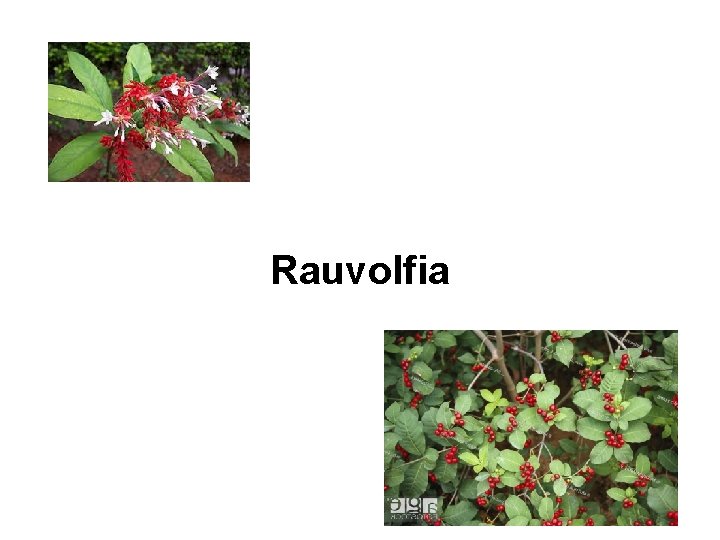
Rauvolfia
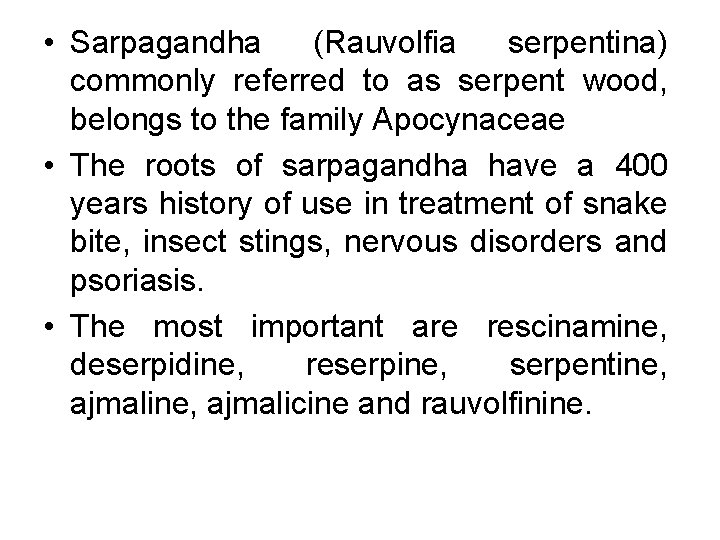
• Sarpagandha (Rauvolfia serpentina) commonly referred to as serpent wood, belongs to the family Apocynaceae • The roots of sarpagandha have a 400 years history of use in treatment of snake bite, insect stings, nervous disorders and psoriasis. • The most important are rescinamine, deserpidine, reserpine, serpentine, ajmalicine and rauvolfinine.
Origin and distribution • Sarpagandha is indigenous to the moist, deciduous forests of south East Asia including Myamnar, Bangladesh, Sri Lanka, Malaysia and the Andaman Islands. • In India, it is found in the central regions like Uttar Pradesh, Bihar, North Bengal, parts of Western Ghats and Assam. • Area & production: There is no commercial cultivation of Rauvolfia in India, and the entire demand is met by import.
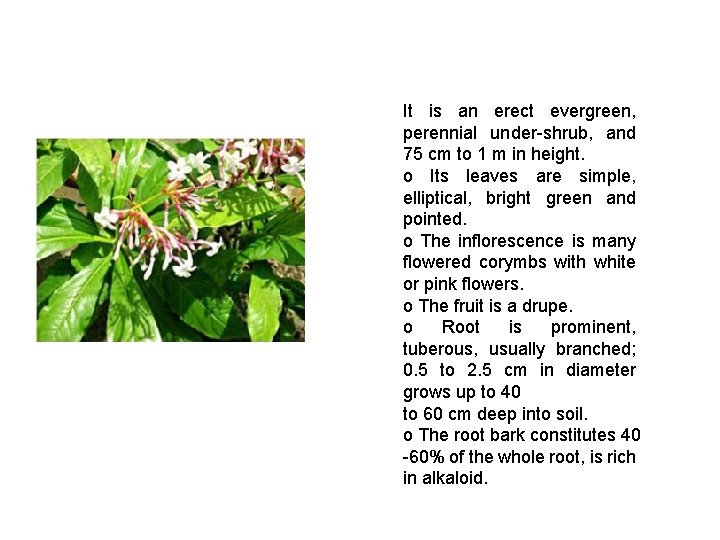
It is an erect evergreen, perennial under-shrub, and 75 cm to 1 m in height. o Its leaves are simple, elliptical, bright green and pointed. o The inflorescence is many flowered corymbs with white or pink flowers. o The fruit is a drupe. o Root is prominent, tuberous, usually branched; 0. 5 to 2. 5 cm in diameter grows up to 40 to 60 cm deep into soil. o The root bark constitutes 40 -60% of the whole root, is rich in alkaloid.
Varieties • Jawaharlal Nehru Krishi Vishwa Vidhyalaya, College of Agriculture, Indore released ‘RS-1’ for commercial cultivation. The RS-1 culture gives 50 -60% seed germination even after storing it for seven months and the yield of air dried root gives upto 25 q/ha, contain 1. 641 to 2. 94% of total alkaloid
• Soil • The plant requires slightly acidic to neutral soils for good growth with medium to deep well drained fertile soils. The ideal p. H for this crop is from 4. 6 -6. 2. Clay-loam to silt-loam soils, rich in organic content are suitable for its commercial cultivation. • Climate • Sarpagandha can be grown under a wide range of climatic conditions. A climate with a temperature range of 10 -30 o. C seems to be well suited for this plant. It grows well in frostfree tropical to sub-tropical situations under irrigation.
• Propagation • Sarpagandha can be propagated by seeds and also by vegetative means like root cuttings, stem cuttings, leaf cuttings and root stumps. • Seed propagation is the best method for raising commercial plantation. Seed germination in Sarpagandha is highly variable. It is reported to vary from 5 to 30 percent even when only heavy seeds are chosen for sowing purpose. Light and heavy seeds can easily be separated by simple water floatation. Germination of heavy seeds during May-June after soaking them in water for 24 hours was 20 -40 per cent and 62. 77 per cent germination was recorded in freshly collected heavy seed lot. In all, 6 kg of seeds are sufficient to raise one-hectare plantation. The nursery is prepared by raised beds of 10 x 10 m dimension under partial shade made up of one-third of well matured FYM and leaf mould, and twothirds amount medium of silt-loam soil. About 500 sq m seed bed area is sufficient for raising seedlings enough for planting one hectare land. The seeds sown, 23 cm apart in rows in shallow furrows during April end.
• Cuttings : The cuttings begin to sprout within 3 weeks. These can be planted in field during rainy season after 8 to 10 cm rains are received; the seedlings are transplanted at 45 cm row to row and 30 cm plant to plant distance. In this manner, an estimated 100 kg of root cuttings are found sufficient for planting one hectare area. • Stem cuttings • Hard wooded stem cutting measuring 15 to 22 cm are closely planted during June in the nursery beds where continuous moisture is maintained. After sprouting and giving out roots, these plants are transplanted in the main field at given spacing. • Root stumps • About 5 cm of roots, intact with a portion of stem above the collar, are directly transplanted in the field having irrigation facilities.
Transplanting • Transplanting Seedlings of 40 -50 days, which have 4 -6 leaves, are ready for transplanting. Well decomposed FYM@ 25 -30 t/ha is added during land preparation. The seedlings are transplanted in the furrows. About 15 cm deep furrows are dug at a distance of 45 cm. A spacing of 30 cm between the plants should be maintained
• Pests • Nematode: Root knot appears as galls of various sizes, covering the root system. Application of 25 kg of 3 G carbofuran or 20 kg of 10 G phorate granules per hectare will control the nematode. • Pyralid caterpillar: It feeds on tender leaves, causing defoliation of the plant. It can be controlled by spraying 0. 2% Rogar. • Grub: Attacks the seedlings about 2 cm below the hypocotyl resulting in their drying up. To control the attack of grubs, mix phorate granules with the soil at the time of nursery preparation. • Diseases • Leaf spot: Dark brown coloured spots on the upper surface of the leaves and yellowish brown on the lower surface. Spray Mancozb @ 0. 2%. • The other diseases are mosaic and die back.
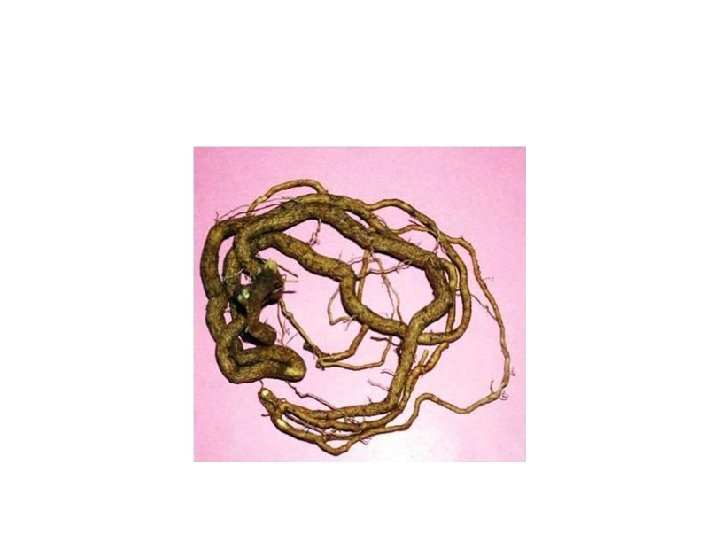
Harvesting , processing and yield • The roots are harvested at 2 -3 years after planting i. e. , from 18 months onwards. The roots are dug out in winter (December) when the plants have shed their leaves, are richer in total alkaloid content than the roots harvested in August. Care should be taken to keep the root bark intact as the bark constitutes 40 -56% of the whole root and has a higher alkaloid content. At harvest the root may be found to go up to 40 cm deep in the soil. • After digging, the roots are cleaned, washed and cut into 12 to 15 cm pieces for convenience in drying and storage. • The dry roots possess up to 8 -10 per cent of moisture. The dried roots are stored in polythene lined gunny bags in cool dry place to protect it from mould. • Yield: A yield of 2200 kg per hectare of air dried roots has been obtained from 2 -year old plantation and • 3300 kg per hectare from 3 year old plantation, under irrigated conditions on sandy, clay loam soil
Opium
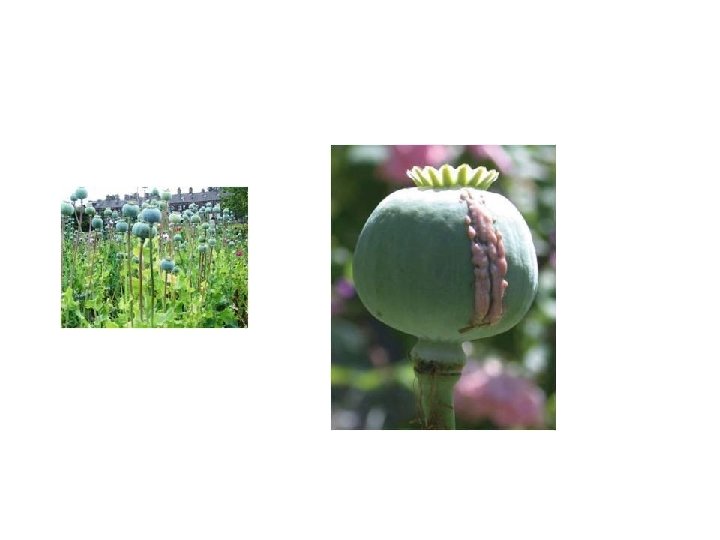
• Opium poppy (Papaver somniferum) is an annual herb belonging to the family, Papavaraceae. • Valuable alkaloids like morphine, codeine, narcotine, papaverine and thebain. • The alkaloids, morphine and codeine, are widely used as sedatives to relieve pain and induce sleep, in addition to their use against cough. Opium is a very valuable but dangerous drug. • The seed is also an important culinary item in India. • It is extensively used in the preparation of native confectionery, pastries and bread. • In some places, the young plants are also consumed as a leafy vegetable. • Its cultivation has to be done under the strict control of the Central Excise Department and it cannot be cultivated everywhere. • It can be grown only in those areas specified by the
• Origin and distribution • Opium poppy is supposed to have originated in the western Mediterranean region and from there it has spread through the Balkan peninsula to Asia Minor and India. Since antiquity, its cultivation has been in vogue in Italy, Greece and Asia Minor. It was during the 15 th century that the herb was introduced in India. First, it was cultivated along the sea coast and later penetrated into the interior of the peninsula. • Area and production • The 1953, the United Nation's Opium Conference Protocol (still in effect) for limiting and regulating the cultivation of opium poppy plants asserts that Bulgaria, Greece, India, Iran, Turkey, the USSR, Egypt, Czechoslovakia, Poland, Germany, Holland, China, Japan, Argentina, Spain, Hungary, Portugal and Yugoslavia are the countries that may legally produce opium. The only country where substantial amount of opium is now produced for export is, India which amounts to 1, 465 t annually and forms over 90% of the world production. In India, all the opium of commerce is now grown mainly in the states of Uttar Pradesh, Madhya Pradesh and Rajasthan covering an area of 18000 ha. The control and regulation of all aspects of the cultivation of poppy and wholesale trade has been under the purview of the Government of the India since 1773. After the partitioning of the Indian subcontinent in 1947, the essentials of the present system of narcotics control, which derived from the system instituted by the British in the 1857 Opium Act, were retained
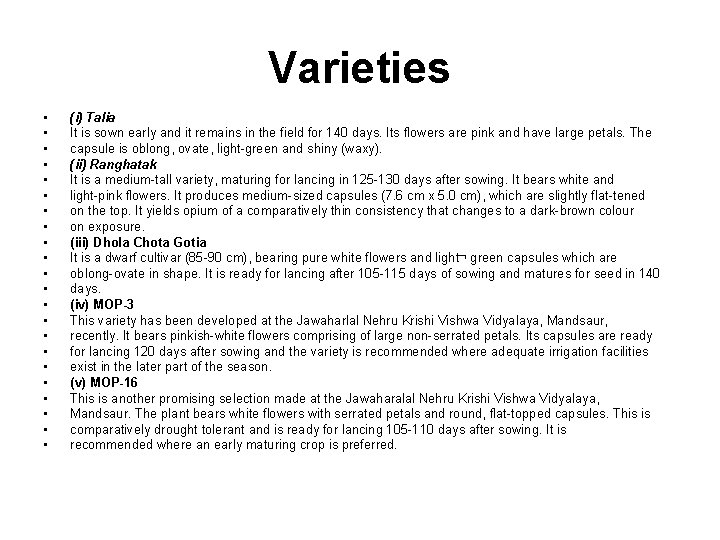
Varieties • • • • • • (i) Talia It is sown early and it remains in the field for 140 days. Its flowers are pink and have large petals. The capsule is oblong, ovate, light-green and shiny (waxy). (ii) Ranghatak It is a medium-tall variety, maturing for lancing in 125 -130 days after sowing. It bears white and light-pink flowers. It produces medium-sized capsules (7. 6 cm x 5. 0 cm), which are slightly flat-tened on the top. It yields opium of a comparatively thin consistency that changes to a dark-brown colour on exposure. (iii) Dhola Chota Gotia It is a dwarf cultivar (85 -90 cm), bearing pure white flowers and light¬ green capsules which are oblong-ovate in shape. It is ready for lancing after 105 -115 days of sowing and matures for seed in 140 days. (iv) MOP-3 This variety has been developed at the Jawaharlal Nehru Krishi Vishwa Vidyalaya, Mandsaur, recently. It bears pinkish-white flowers comprising of large non-serrated petals. Its capsules are ready for lancing 120 days after sowing and the variety is recommended where adequate irrigation facilities exist in the later part of the season. (v) MOP-16 This is another promising selection made at the Jawaharalal Nehru Krishi Vishwa Vidyalaya, Mandsaur. The plant bears white flowers with serrated petals and round, flat-topped capsules. This is comparatively drought tolerant and is ready for lancing 105 -110 days after sowing. It is recommended where an early maturing crop is preferred.
• • • • (vi) Shama This variety was released by the CIMAP, Lucknow during the year 1983. The main alkaloids like Morphine (14. 51 -16. 75%), Codeine (2. 05 -3/24%), Thebaine (1. 84 -2. 16%), Papaverine (0. 82%) and Narcotine (5. 89 -6. 32%) in this variety are reported to be on higher side than the existing commercially cultivated variety. It yields 39. 5 kg of latex and 8. 8 kg/ha of seeds. (vii) Shweta This variety was also released by the CIMAP, Lucknow, along with Shama. However, it is reported to be superior to Shama in the content of the main alkaloids-morphine (15. 75 -22. 38%), codeine (2. 152. 76%), thebaine (2. 04 -2. 5%), papaverine (0. 94 -1. 1%) and Narcotine (5. 94 -6. 5%). It gives an average yield of 42. 5 kg of latex and 7. 8 kg/ha of seeds. (viii) BROP 1 (Botanical Research Opium Poppy-l) (NBRI-3) It is a synthetic variety developed at the National Botanical Research Institute, Lucknow, by crossing selections from Kali Dandi, Suyapankhi and Safaid Dandi. This variety is highly adaptable to varied agroc 1 imatic conditions and gives a higher yield than national checks. It is moderately resistant to diseases. It yields about 54 kg/ha of opium and 10 -13 q/ha of seeds. The morphine content is 13% and above pose a problem, since they remain wet during the rains and are too difficult to cultivate in the dry period. (ix) Kirtiman (NOP-4) It was developed at the Narendra Dev University of Agriculture and Technology, Kumarganj, Faizabad, through selection from local races. The variety is moderately resistant to downy mildew. It yields 35 -45 kg/ha of latex and 9 -10 q/ha of seeds. The morphine content is up to 12%. . (x) Chetak (U. O. 285) This variety was developed at the Rajasthan Agriculture University, Udaipur. It is moderately (xii) Jawahar Aphim 16 (JA-16) It is a pure line selection of 10 Ca. IIandraces developed at the Jawaha¬ralal Nehru Krishi Vishwa Vidyalaya, College of Agriculture, Mandsaur (Madhya Pradesh). It is moderately resistant to downy mildew. It gives 45 -54 kg/ha of latex, 8 -10 q/ha of seeds and contains up to 12% morphine. Recently, another three varieties: 'NBRI-3' of opium, 'Sujatha' an opium-free poppy for the production of oil and
• Sowing • Poppy seeds should be sown in a well prepared soil. The file dshould be given 5 -6 cross ploughings followed by planting. The land should be divided into small plots to facilitate irrigation. The seeds should be treated with thiram (405 g/kg of seed) to protect the seeds against soil borne pathogens. The seeds are sown between late October to mid November. After sowing, seeds are covered by a thin layer of soil followed by a light irrigation. • Fertilizer application • The crop requires nutrients required for flowering and capsule formation. A fertilizer recommendation of 90: 50: 30 kg NPK/hectare is followed. • Irrigation • The first irrigation is given, immediately after sowing, if there is not enough moisture available in the soil. For subsequent irrigations, 710 days Irrigation schedule is the optimum depending upon the weather and soil conditions. A total of 10 to 15 irrigations are required for this crop.
• Pest and diseases • Insects • 1. Cutworms (Agrotis suffuse): This insect can be controlled by flooding the field water and dusting the crop with 2% Carbaryl. • 2. Weevils (Stenocarus fulginosus-root weevil and Cautorhynchus maculalba – capsule weevil). • Diseases • Downey mildew and powdery mildew : This disease can be controlled by the application of Dithane Z-78 (0. 4%) • Other diseases : Root rot , leaf blight, cabbage ring spot virus, beet yellow virus and bean yellow mosaic virus
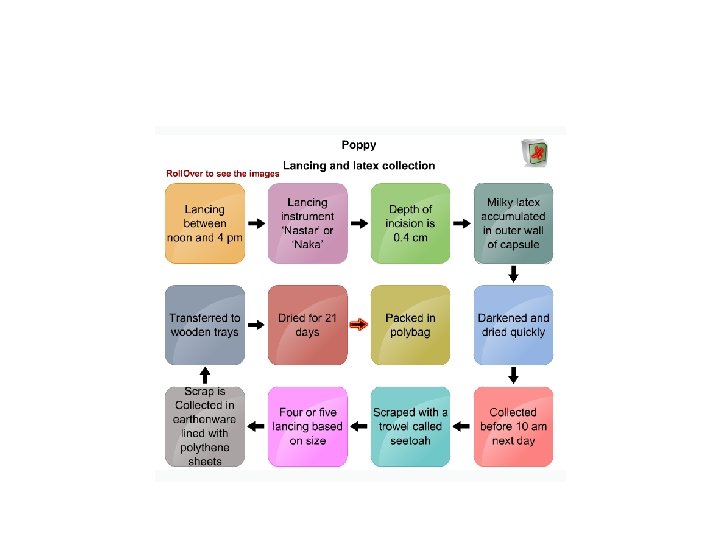
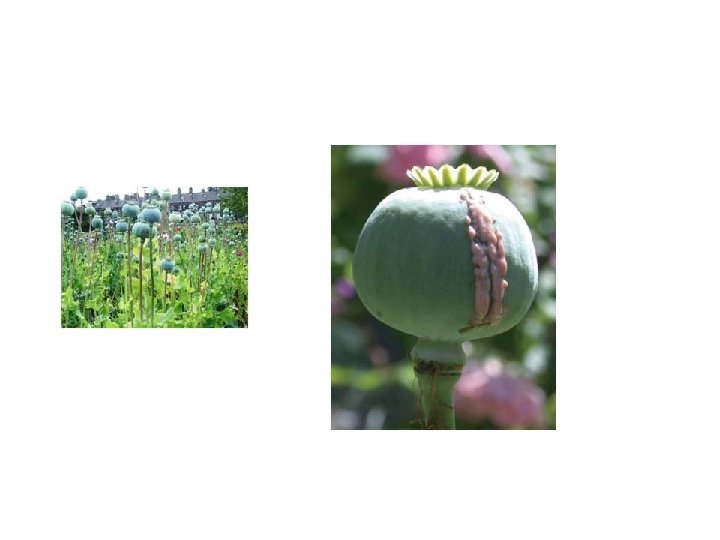
Lancing and latex collection • • The lancing operation is performed by skilled labour (an average of 6 persons to a plot), usually on bright sunny days between noon and 4 p. m. The hottest part of the day is chosen, since the pellicle is said to form on the surface of the freshly exuded latex due to the hot sun, resulting in a greater degree of evaporation and quicker thickening. This also helps prevent the latex from falling off the capsule. The lancing operation is started at the edge of the field and the person works backward to avoid contact with the exuding latex. The hand is quickly passed over a capsule and a subjective decision is made as to whether it is ready for incision or not. The lancing instrument, called “Nastar” or “Naka”, comprises of four lines about the dimension of ordinary needles spaced at 1. 5 to 2 mm apart and affixed to a holder about 18 cm long. The nester is held carefully, as one holds a pencil while writing and the incision is made by a swift downward stroke starting just below the stigmatic rays. The depth of the incision is controlled by the affixation of the lines to the holder, for if incisions are too deep the latex is exuded to the interior of the capsules and is thus lost. If the cut is too shallow the yield of latex will be low, usually, an incision with a depth of 0. 4 cm is considered ideal. About 150 -200 capsules can be lanced per hour by an experienced.
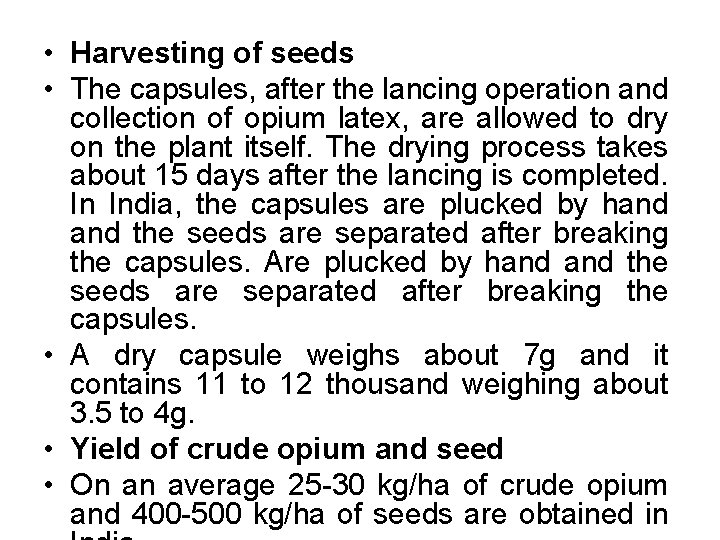
• Harvesting of seeds • The capsules, after the lancing operation and collection of opium latex, are allowed to dry on the plant itself. The drying process takes about 15 days after the lancing is completed. In India, the capsules are plucked by hand the seeds are separated after breaking the capsules. Are plucked by hand the seeds are separated after breaking the capsules. • A dry capsule weighs about 7 g and it contains 11 to 12 thousand weighing about 3. 5 to 4 g. • Yield of crude opium and seed • On an average 25 -30 kg/ha of crude opium and 400 -500 kg/ha of seeds are obtained in
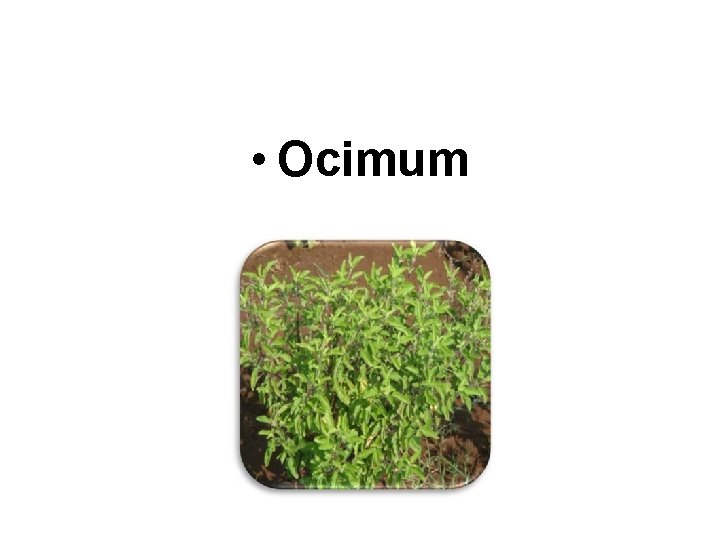
• Ocimum
• The ‘Sacred basil’ or ‘Holy basil’, Ocimum sanctum Linn. belonging to the family Lamiaceae, is commonly cultivated in gardens. The species is worshipped by the Hindus of India and traditionally grown in courtyards and temples. The leaves of this species, on steam-distillation, yield a bright yellow, volatile oil possessing a pleasant odour characteristic of the plant, with an appreciable note of camphor and cloves.
• The plant contains mainly phenols, aldehydes, tannin, saponin and fats. • The essential oil components are eugenol (about 71%, eugenol methyl ether (20%), nerol caryophyllene, selinene, α-pinene, βpinene, camphorcineole, linalool and carvacrol (3%).
• The juice of the leaves possesses disphoretic, antiperiodic, stimulating, expectorant and antipyretic properties. • It is used in catarrh and bronchitis, applied to the skin in ringworm and other cutaneous diseases and as drops to relieve earache. • An infusion of the leaves is used as a stomachic in gastric disorders of children. If taken internally, it strengthens the liver and heart and is a good appetizer. It cures amenorrhoea and promotes the secretion of milk in lactating women. • The leaves, if chewed, give relief from toothache. The leaf-juice is applied to reduce inflammations. • A decoction of the root is given as a disphoretic in malarial fevers
Origin and distribution • O. sanctum has wide distributions, covering the entire Indian subcontinent, ascending up to 1, 800 m in the Himalayas and as far as the Andaman and Nicobar Islands • This plant-occupies a wide range of habitats.
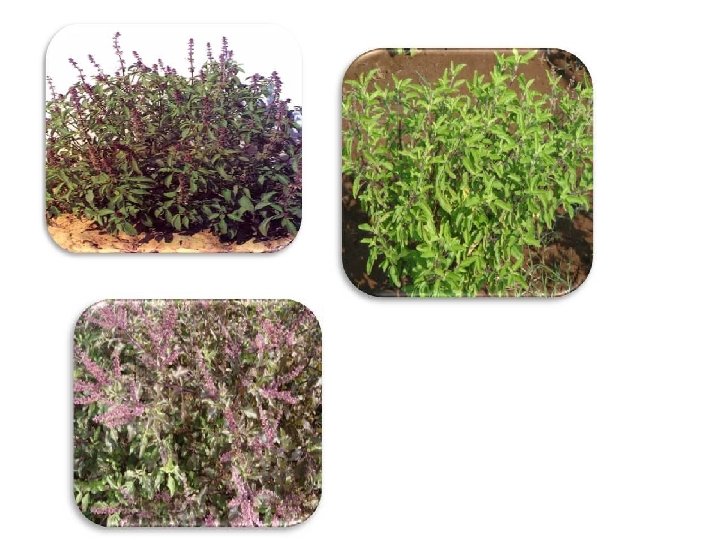
• Types and varieties • In India, two types of O. sanctum are under cultivation; the green type (Sri Tulsi) is the most common, • the second type (Krishna Tulsi) bears purple leaves and is preferred in the trade for its higher potency of the drug. Many new varieties have been released from RRLs and CIMAP, Lucknow. • Among them CIM-Angana, CIM-Soumya are important.
• Soil • It thrives well on a variety of soils. Rich loam to poor laterite, saline and alkaline to moderately acidic soils are all well suited for its cultivation. Well-drained soils aid in better vegetative growth. Waterlogged conditions can cause root-rot and result in stunted growth. • Climate • The plant can be grown under partially shaded conditions but it yields less oil. It flourishes well under fairly high rainfall and humid conditions. Long days and high temperatures have been found favourable for the plant growth and oil production. Tropical and subtropical climate (at altitudes up to 900 m) are suited for its cultivation. The plant is moderately tolerant to drought and frost. • The nursery can be raised in the third week of February and transplanting is generally started in the middle of April. This can be undertaken in the month of March, if the seedlings are raised in beds.
• • • Land preparation The land is brought to a fine tilth and laid out into plots of convenient sizes for irrigation. It is preferable to add 15 t/ha of FYM during the preparation of the land. Propagation The plant is propagated by seeds. The seeds are likely to deteriorate in future generations on account of the highly cross-pollinated nature of the crop. Hence, for fresh plantings, the growers have to take fresh seeds from the pedigree stock. Nursery raising Raised seed-beds of 15’ x 4’x 9” size should be thoroughly prepared and well manured by the addition of FYM. About 200 -300 g seeds are enough to raise seedlings for planting one hectare of land. The seeds should be sown 2 cm deep in the nursery-beds. After sowing the seeds in the nursery, a mixture of FYM and soil is thinly spread over the seeds and irrigated with a sprinkler-hose. The seeds germinate in 8 -12 days and the seedlings are ready for transplanting in about 6 weeks time, at the 4 -5 leaf stage. A spray of 2% urea solution on the nursery plants 15 to 20 days before transplanting helps in raising very healthy plants for transplanting. Transplanting It is recommended to plant the seedlings at a distance of 40 x 40 cm, 40 x 50 cm and 50 x 30 cm to get high herbage and oil-yield per hectare at Lucknow, New Delhi and Indore, respectively. The plots are irrigated immediately after transplanting. The seedlings will establish well by the time of the second irrigation. At this stage gap filling and replacement of the poor plants is done so that a uniform stand is achieved.
• • Fertilizer application The application of 120 kg/ha, 105 kg/ha of P 2 O 5 and K 2 O is recommended for saline and alkaline soils at Lucknow. The optimum fertilizer dose recommended for this crop is 120 kg N and 60 kg P 2 O 5/ha. Half the dose of N and the entire dose of P 2 O 5 are given as a basal dose. Whereas, the remaining N is applied in two split doses, after the first and second cuttings. The application of the micronutrients Co and Mn at 50 and 100 ppm concentrations, respectively, is reported to increase the oil-yield significantly. Irrigation depends upon the moisture content of the soil. In summer, 3 irrigations per month are necessary whereas, during the remaining period, it should be done as and when required, except in the rainy season when no irrigation is necessary. Altogether, about 12 -15 irrigations years are sufficient. Weeding The first weeding is done month after planting, and the second 4 weeks after the first. After this, no further weeding is required as the plants become bushy, thereby naturally suppressing the weeds. Interculture One hoeing, two months after planting, is sufficient. The crop may also be earthed-up at this stage.
Diseases and pests • Diseases • The plant is susceptible to powdery mildew caused by Oidium spp. , seedling blight caused by • Rhizoctonia solani and roor-rot caused by Rhizoctonia bataticola. Powdery mildew can be controlled by spraying wettable sulphur (4 g/I of water), and the latter two diseases are managed by improved phyto-sanitary measures and by drenching the nursery-beds with a solution of mercurial fungicide. • Pests • Among the insects, the larvae of leaf-rollers sticking to the under surface of the leaves fold them backwards lengthwise, thus webbing them. Malathion (0. 2%) may be sprayed to control this insect.
Harvesting, yield and processing • The crop is harvested when it is in full bloom. The first harvest is obtained 90 -95 days after planting. Afterwards, it may be harvested at every 65 -75 days, intervals. Harvesting should be done on bright, sunny days in order to obtain good quality oil-yield. It is not desirable to harvest the crop if it has rained the previous day. • The crop should be cut 15 -20 cm above ground-level. The harvested produce may be allowed to wilt in the field itself for 4 -5 hours, to reduce the moisture content and the bulkiness. About 5 t/ha of fresh herbage can be obtained twice or thrice a year. • Distillation of oil • The harvested produce is usually distilled in its fresh form. However, the oil quality and yield do not diminish up to 6 -8 hours after harvest, by any further delay may cause considerable loss in yield and quality of oil. Steam-distillation is found to be superior to water distillation. The whole herb

• Any questions?
- Slides: 51