
Dining Philosophers Then Deadlocks part I Ken Birman
Dining Philosophers…. Then Deadlocks (part I) Ken Birman

Dining Philosophers �A problem that was invented to illustrate some issues related to synchronization with objects �Our focus here is on the notion of sharing resources that only one user at a time can own �Such as a keyboard on a machine with many processes active at the same time �Or a special disk file that only one can write at a time (bounded buffer is an instance)
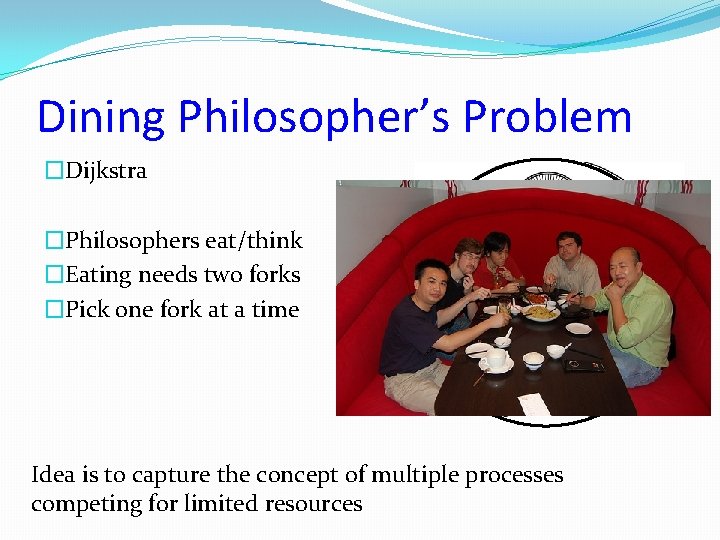
Dining Philosopher’s Problem �Dijkstra �Philosophers eat/think �Eating needs two forks �Pick one fork at a time Idea is to capture the concept of multiple processes competing for limited resources
Rules of the Game �The philosophers are very logical �They want to settle on a shared policy that all can apply concurrently �They are hungry: the policy should let everyone eat (eventually) �They are utterly dedicated to the proposition of equality: the policy should be totally fair
What can go wrong? �Lots of things! We can give them names: �Starvation: A policy that can leave some philosopher hungry in some situation (even one where the others collaborate) � Fairness: even if nobody starves, should we worry about policies that let some eat more often than others? �Deadlock: A policy that leaves all the philosophers “stuck”, so that nobody can do anything at all �Livelock: A policy that makes them all do something endlessly without ever eating!
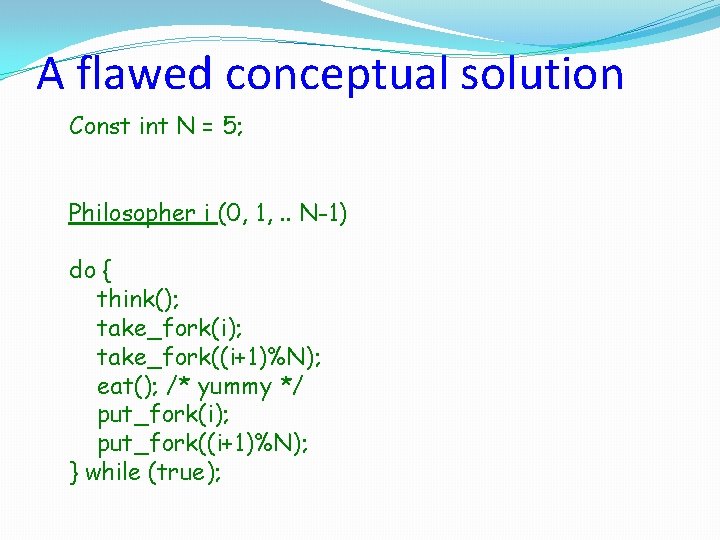
A flawed conceptual solution Const int N = 5; Philosopher i (0, 1, . . N-1) do { think(); take_fork(i); take_fork((i+1)%N); eat(); /* yummy */ put_fork(i); put_fork((i+1)%N); } while (true);
![Coding our flawed solution? Shared: semaphore fork[5]; Init: fork[i] = 1 for all i=0.](http://slidetodoc.com/presentation_image/47866615558a19abe72f23e80ad75eec/image-7.jpg "Coding our flawed solution? Shared: semaphore fork[5]; Init: fork[i] = 1 for all i=0.")
Coding our flawed solution? Shared: semaphore fork[5]; Init: fork[i] = 1 for all i=0. . 4 Philosopher i do { fork[i]. acquire(); fork[i+1]. acquire(); /* eat */ fork[i]. release(); fork[i+1]. release(); /* think */ } while(true); Oops! Subject to deadlock if they all pick up their “right” fork simultaneously!
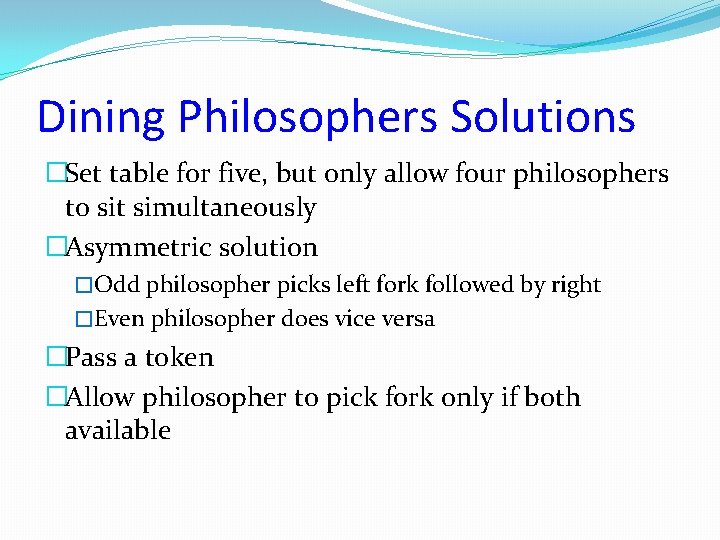
Dining Philosophers Solutions �Set table for five, but only allow four philosophers to sit simultaneously �Asymmetric solution �Odd philosopher picks left fork followed by right �Even philosopher does vice versa �Pass a token �Allow philosopher to pick fork only if both available
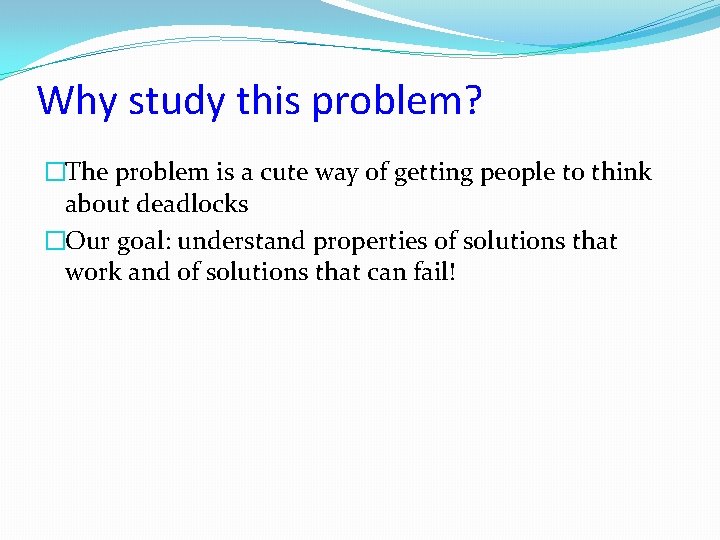
Why study this problem? �The problem is a cute way of getting people to think about deadlocks �Our goal: understand properties of solutions that work and of solutions that can fail!
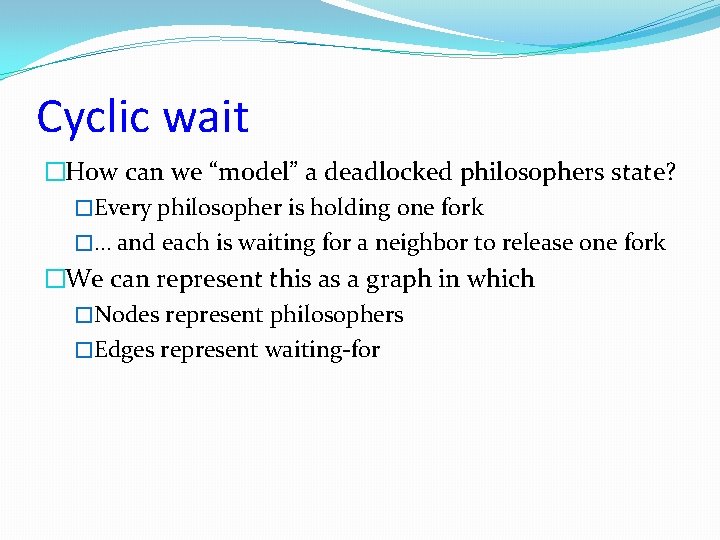
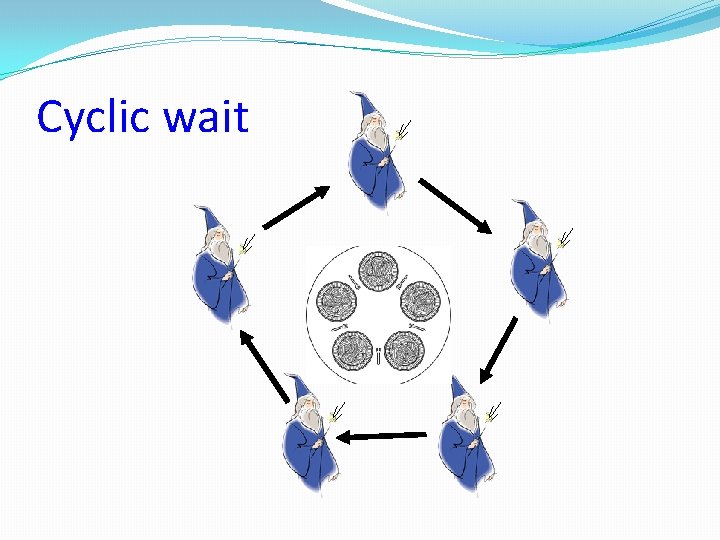
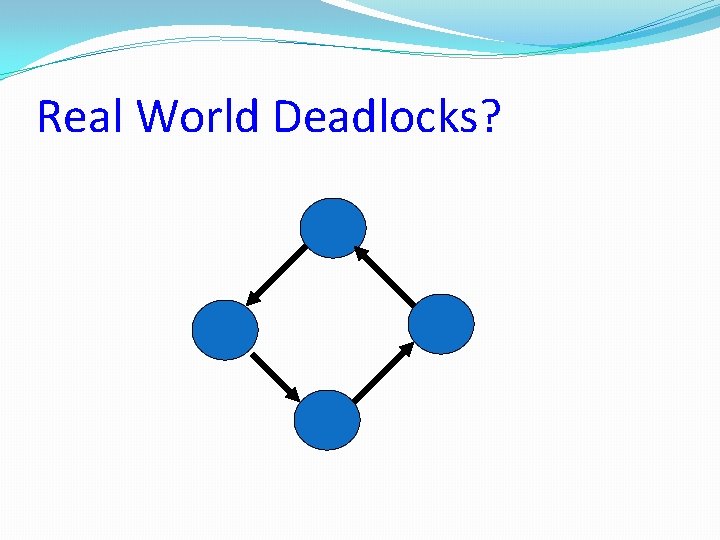
Cyclic wait �How can we “model” a deadlocked philosophers state? �Every philosopher is holding one fork �… and each is waiting for a neighbor to release one fork �We can represent this as a graph in which �Nodes represent philosophers �Edges represent waiting-for
Cyclic wait
Cyclic wait �We can define a system to be in a deadlock state if �There exists ANY group of processes, such that �Each process in the group is waiting for some other process �And the wait-for graph has a cycle �Doesn’t require that every process be stuck… even two is enough to say that the system as a whole contains a deadlock (“is deadlocked”)
Four Conditions for Deadlock �Mutual Exclusion � At least one resource must be held is in non-sharable mode �Hold and wait � There exists a process holding a resource, and waiting for another �No preemption � Resources cannot be preempted �Circular wait � There exists a set of processes {P 1, P 2, … PN}, such that � P 1 is waiting for P 2, P 2 for P 3, …. and PN for P 1 All four conditions must hold for deadlock to occur 13
What about livelock? �This is harder to express �Need to talk about making “meaningful progress” �In CS 414 we’ll limit ourselves to deadlock �Detection: For example, build a graph and check for cycles (not hard to do) �Avoidance – we’ll look at several ways to avoid getting into trouble in the first place! �As it happens, livelock is relatively rare (but you should worry about it anyhow!)
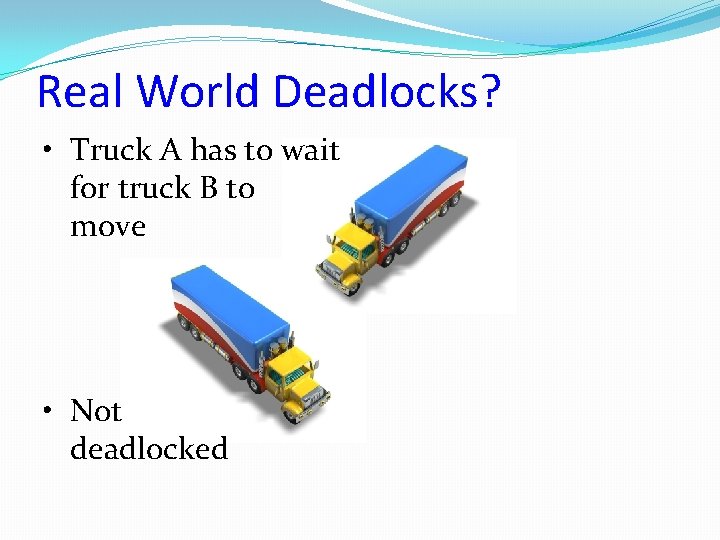
Real World Deadlocks? • Truck A has to wait for truck B to move • Not deadlocked
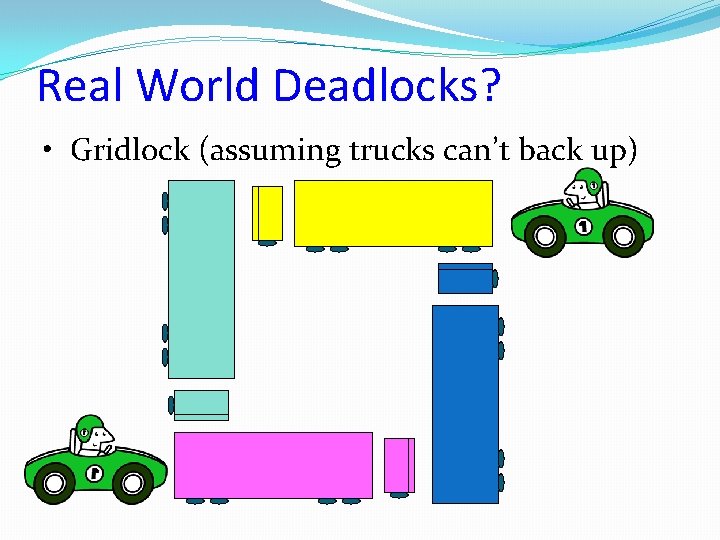
Real World Deadlocks? • Gridlock (assuming trucks can’t back up)
Real World Deadlocks?
The strange story of “priorité a droite” �France has many traffic circles… �… normally, the priority rule is that a vehicle trying to enter must yield to one trying to exit �Can deadlock occur in this case? �But there are two that operate differently �Place Etoile and Place Victor Hugo, in Paris �What happens in practice?
Belgium: “priorité a droite” �In Belgium, all incoming roads from the right have priority unless otherwise marked, even if the incoming road is small and you are on a main road. �This is important to remember if you drive in Europe! �Thought question: �Is the entire country deadlock-prone?
Testing for deadlock �Steps �Collect “process state” and use it to build a graph � Ask each process “are you waiting for anything”? � Put an edge in the graph if so �We need to do this in a single instant of time, not while things might be changing �Now need a way to test for cycles in our graph
Testing for deadlock �How do cars do it? �Never block an intersection �Must back up if you find yourself doing so �Why does this work? �“Breaks” a wait-for relationship �Illustrates a sense in which intransigent waiting (refusing to release a resource) is one key element of true deadlock!
Testing for deadlock �One way to find cycles �Look for a node with no outgoing edges �Erase this node, and also erase any edges coming into it � Idea: This was a process people might have been waiting for, but it wasn’t waiting for anything else �If (and only if) the graph has no cycles, we’ll eventually be able to erase the whole graph! �This is called a graph reduction algorithm
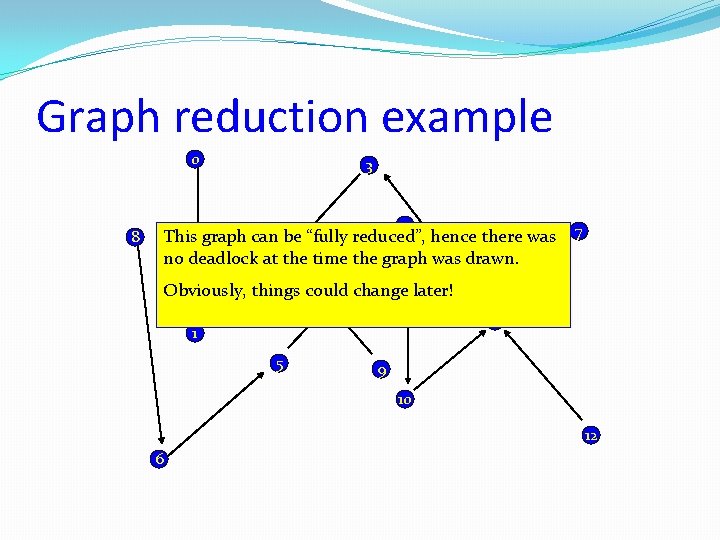
Graph reduction example 0 8 3 4 This graph can be “fully reduced”, hence there was no deadlock at 2 the time the graph was drawn. 7 Obviously, things could change later! 11 1 5 9 10 12 6
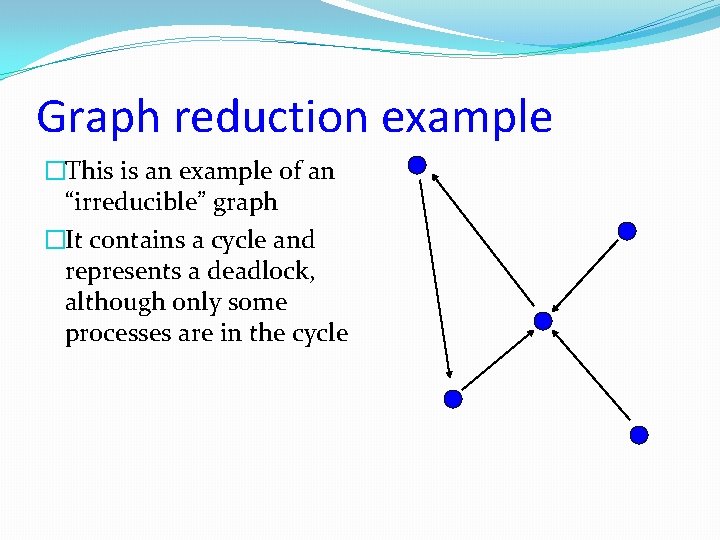
Graph reduction example �This is an example of an “irreducible” graph �It contains a cycle and represents a deadlock, although only some processes are in the cycle
Graph Reduction �Given a “state” that our system is in, tells us how to determine whether the system is deadlocked �But as stated only works for processes that wait for each other, like trucks in our deadlock example �What about processes waiting to acquire locks? �Locks are “objects” �Our graphs don’t have a notation for this…
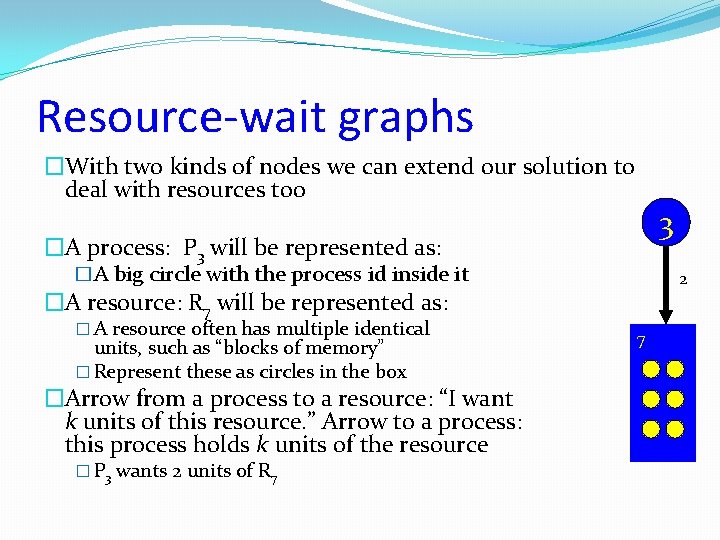
Resource-wait graphs �With two kinds of nodes we can extend our solution to deal with resources too 3 �A process: P 3 will be represented as: �A big circle with the process id inside it 2 �A resource: R 7 will be represented as: � A resource often has multiple identical units, such as “blocks of memory” � Represent these as circles in the box �Arrow from a process to a resource: “I want k units of this resource. ” Arrow to a process: this process holds k units of the resource � P 3 wants 2 units of R 7 7
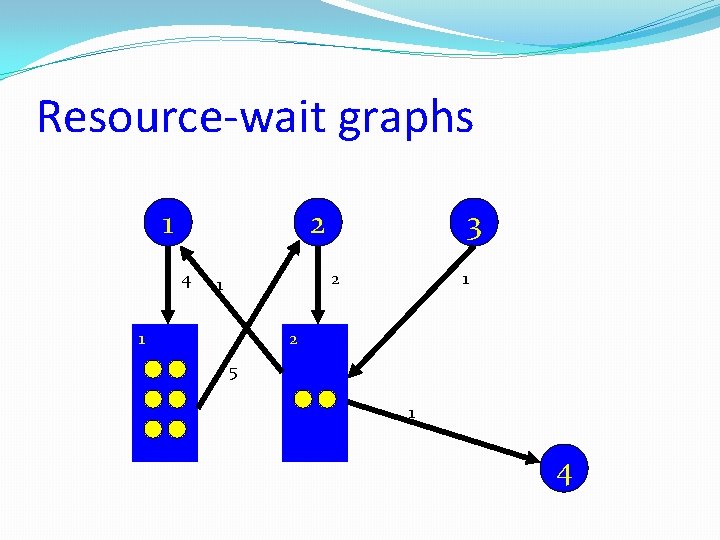
Resource-wait graphs 1 2 4 3 2 1 1 1 2 5 1 4
Reduction rules? �Find a process that can have all its current requests satisfied (e. g. the “available amount” of any resource it wants is at least enough to satisfy the request) �Erase that process (in effect: grant the request, let it run, and eventually it will release the resource) �Continue until we either erase the graph or have an irreducible component. In the latter case we’ve identified a deadlock
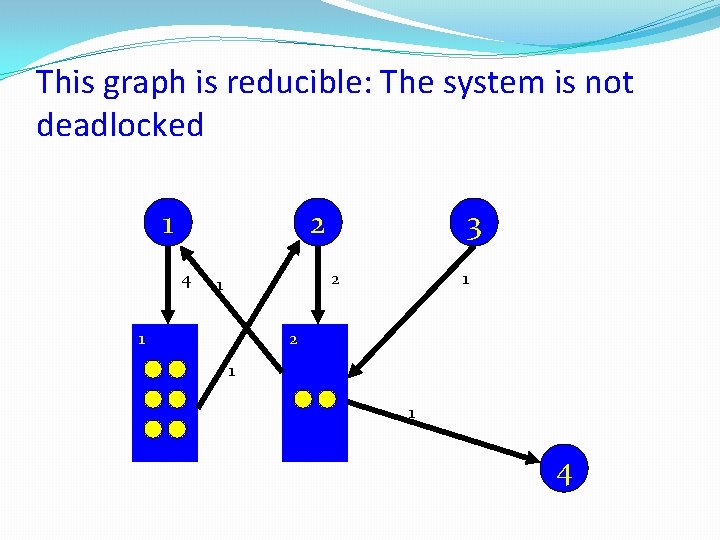
This graph is reducible: The system is not deadlocked 1 2 4 3 2 1 1 1 2 1 1 4
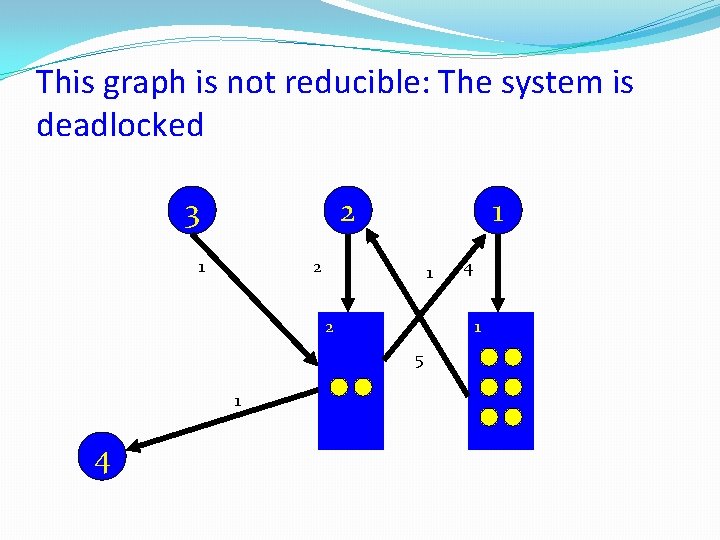
This graph is not reducible: The system is deadlocked 3 2 1 1 2 1 5 1 4 4
A tricky choice… �When should resources be treated as “different classes”? �Seems obvious � “memory pages” are different from “forks” �But suppose we split some resource into two sets? � The main group of memory and the extra memory �Keep this in mind next week when we talk about ways of avoiding deadlock. � It proves useful in doing “ordered resource allocation”
Take-Away: Conditions for Deadlock �Mutual Exclusion � At least one resource must be held is in non-sharable mode �Hold and wait � There exists a process holding a resource, and waiting for another �No preemption � Resources cannot be preempted �Circular wait � There exists a set of processes {P 1, P 2, … PN}, such that � P 1 is waiting for P 2, P 2 for P 3, …. and PN for P 1 All four conditions must hold for deadlock to occur 32
- Slides: 32