
Dining Facility Menu Management 1 Menu Management All
- Slides: 20
Dining Facility Menu Management 1
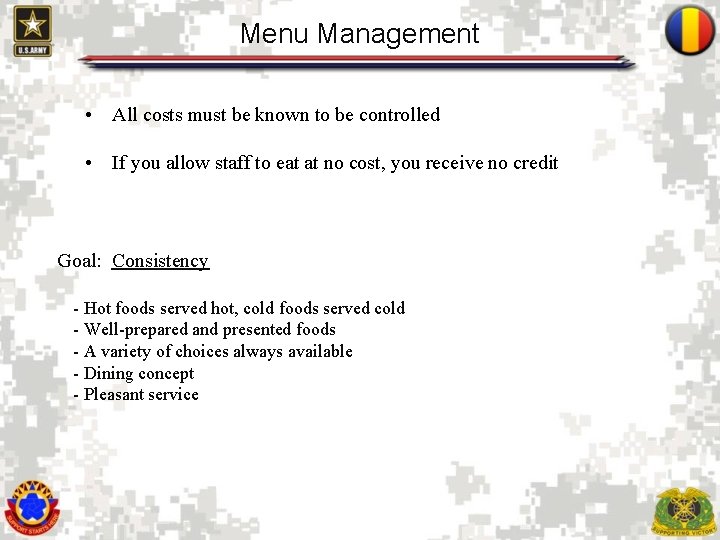
Menu Management • All costs must be known to be controlled • If you allow staff to eat at no cost, you receive no credit Goal: Consistency - Hot foods served hot, cold foods served cold - Well-prepared and presented foods - A variety of choices always available - Dining concept - Pleasant service 2
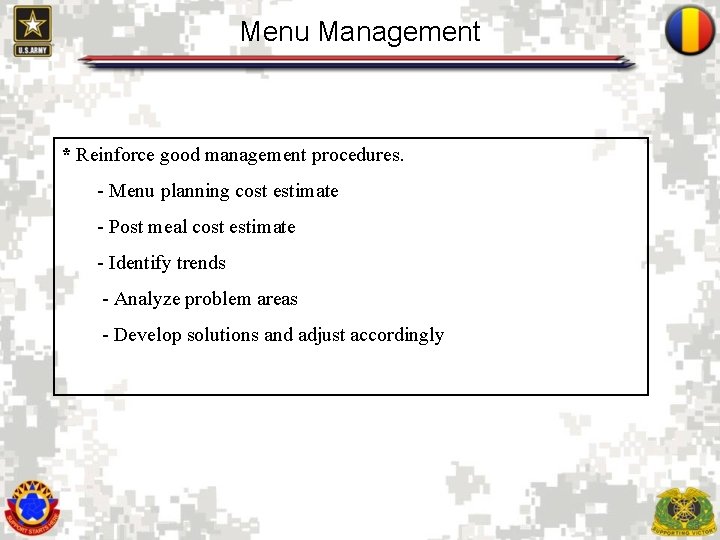
Menu Management * Reinforce good management procedures. - Menu planning cost estimate - Post meal cost estimate - Identify trends - Analyze problem areas - Develop solutions and adjust accordingly 3
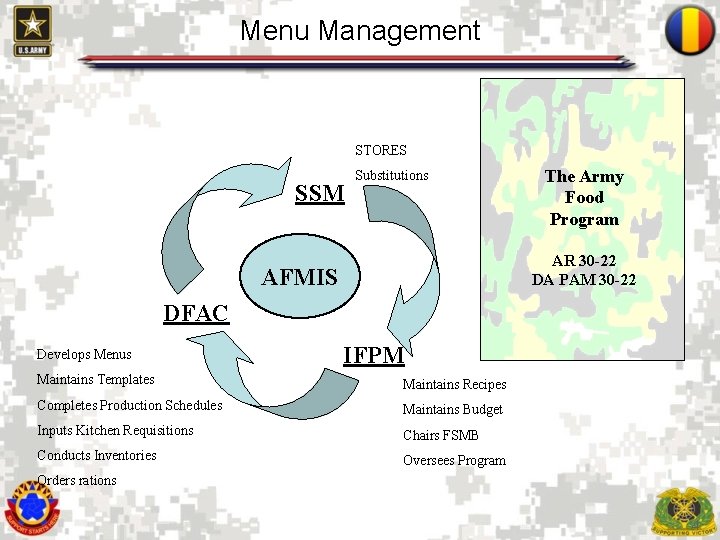
Menu Management STORES SSM Substitutions The Army Food Program AR 30 -22 DA PAM 30 -22 AFMIS DFAC Develops Menus IFPM Maintains Templates Maintains Recipes Completes Production Schedules Maintains Budget Inputs Kitchen Requisitions Chairs FSMB Conducts Inventories Oversees Program Orders rations 4
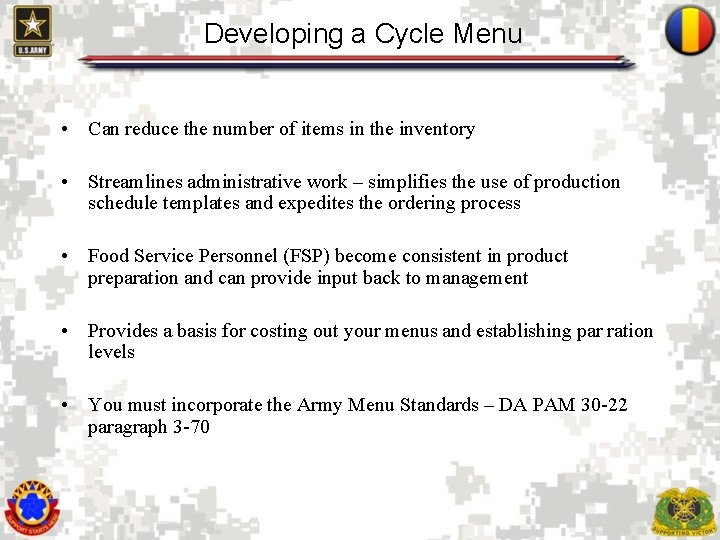
Developing a Cycle Menu • Can reduce the number of items in the inventory • Streamlines administrative work – simplifies the use of production schedule templates and expedites the ordering process • Food Service Personnel (FSP) become consistent in product preparation and can provide input back to management • Provides a basis for costing out your menus and establishing par ration levels • You must incorporate the Army Menu Standards – DA PAM 30 -22 paragraph 3 -70 5
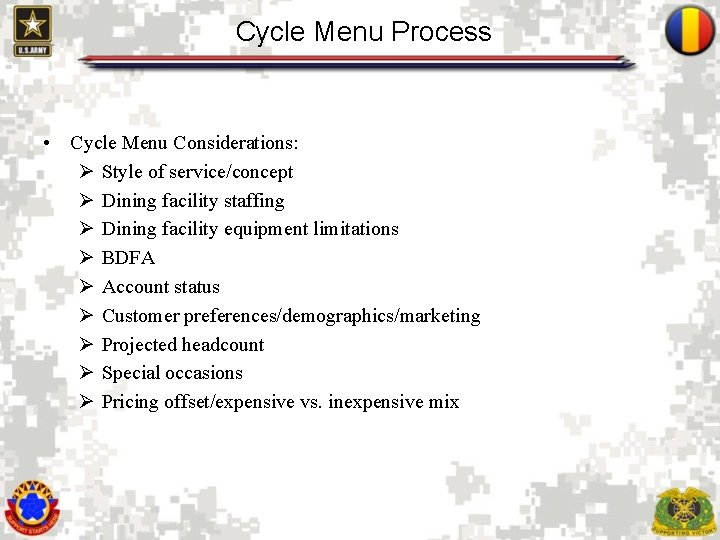
Cycle Menu Process • Cycle Menu Considerations: Ø Style of service/concept Ø Dining facility staffing Ø Dining facility equipment limitations Ø BDFA Ø Account status Ø Customer preferences/demographics/marketing Ø Projected headcount Ø Special occasions Ø Pricing offset/expensive vs. inexpensive mix 6
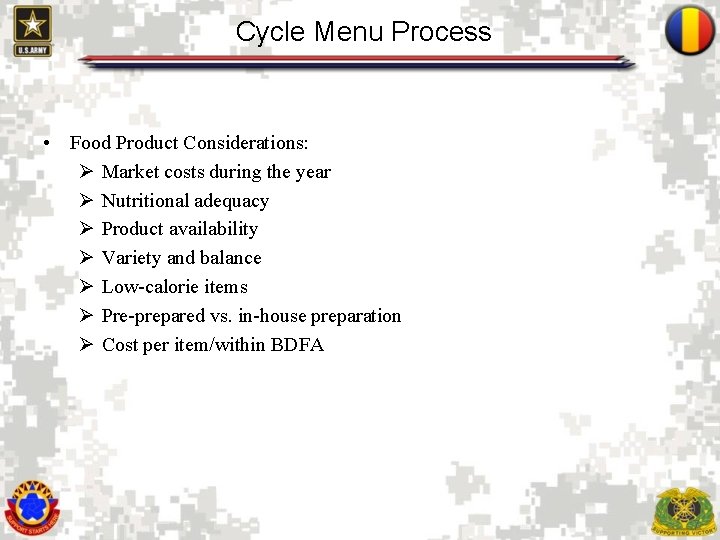
Cycle Menu Process • Food Product Considerations: Ø Market costs during the year Ø Nutritional adequacy Ø Product availability Ø Variety and balance Ø Low-calorie items Ø Pre-prepared vs. in-house preparation Ø Cost per item/within BDFA 7
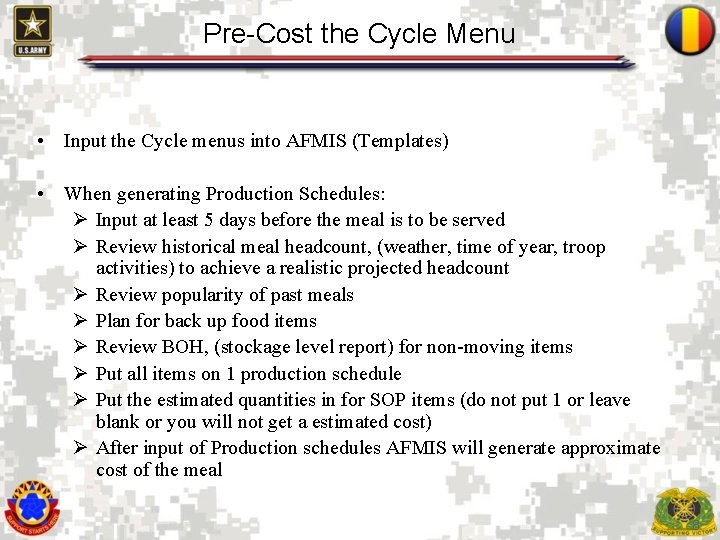
Pre-Cost the Cycle Menu • Input the Cycle menus into AFMIS (Templates) • When generating Production Schedules: Ø Input at least 5 days before the meal is to be served Ø Review historical meal headcount, (weather, time of year, troop activities) to achieve a realistic projected headcount Ø Review popularity of past meals Ø Plan for back up food items Ø Review BOH, (stockage level report) for non-moving items Ø Put all items on 1 production schedule Ø Put the estimated quantities in for SOP items (do not put 1 or leave blank or you will not get a estimated cost) Ø After input of Production schedules AFMIS will generate approximate cost of the meal 8
Pre-Cost the Cycle Menu • AFMIS Recipe Cards and SOPs must be current and written correctly to get accurate cost – Ensure recipe cards reflect the right product by TIIN – Ensure use of correct recipe variation – SOPs must be input into AFMIS – Kitchen Requisitions will let you know if correct product is reflected in the recipe – Kitchen requisition will give actual cost after items are input into AFMIS • Compare the cost of the meal with the BDFA – By Meal: Divide the cost of the meal reflected on the Production Schedule with the projected headcount § Each menu cycle should have high-cost vs. low-cost meals 9
Purchasing • Review Catalog for: Ø Best value food items Ø Best packaging, case counts to fit your operation • Compare AFMIS shopping list requirement with: Ø BOH Ø Due-ins Ø Due-outs Ø Establish par stocks • Submit shopping lists in a timely manner • Create order templates where applicable 10
Receiving, Storage & Issuing • Date all food items with date received • Use First in, First out (FIFO), First to Expire stock rotation with the exception of bread • Record items on Kitchen Requisitions – Input item only if used on that meal – If bulk issue system is used only issue enough for the day and spread the item over each meal it is used for – The Kitchen Requisition will give you the meal cost • Check dates on rations to see if they are being used in a timely manner 11
Receiving, Storage & Issuing • Conduct 100% weekly physical inventories, this will give a more accurate accounting for subsistence, and a more accurate account status • The price of food items can change weekly, refer to the Inventory Adjustment Monetary Account report (IAMA) weekly. • Food items are charged to your account when issued and input into AFMIS from the kitchen requisition. 12
Food Preparation • Utilize meal production tools, (Food Risk Management, recipe cards, etc. ) • Control preparation waste • Sample each food product • Utilize progressive cookery • Serve foods at proper temperature 13
Service • Review portion sizes with servers prior to the meal • Do not under serve customers • Monitor headcount flow to establish peak periods • Annotate run-out times of entrees to plan for the next time that particular item is served • Get diner feedback for future menu planning • Monitor plate waste (at the tray drop off point) 14
Post-Meal Analysis • Accurately record meal data on production schedules and kitchen requisitions • Kitchen requisitions are not 100% accurate due to human error • Kitchen requisitions are a working tool and give you a daily estimate of actual meal cost • Review meal cost Ø Use the Meal Cost Analysis Worksheet to track. Ø To get Meal Cost: review completed Kitchen Requisition after input into AFMIS for estimated cost of the meal 15
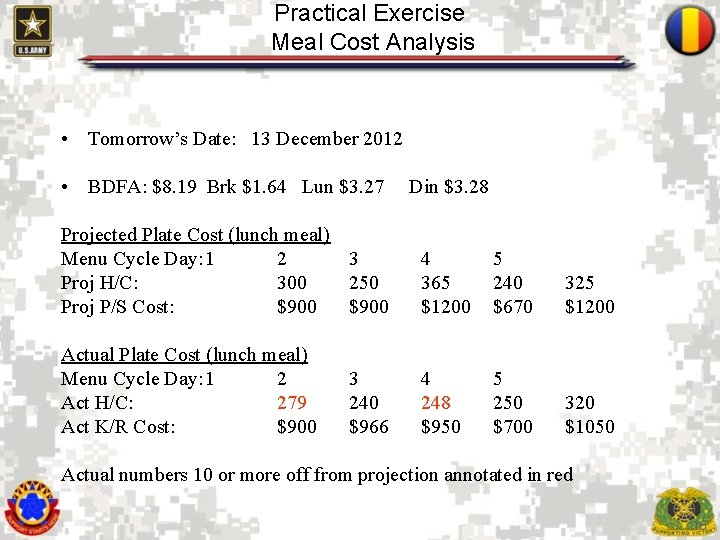
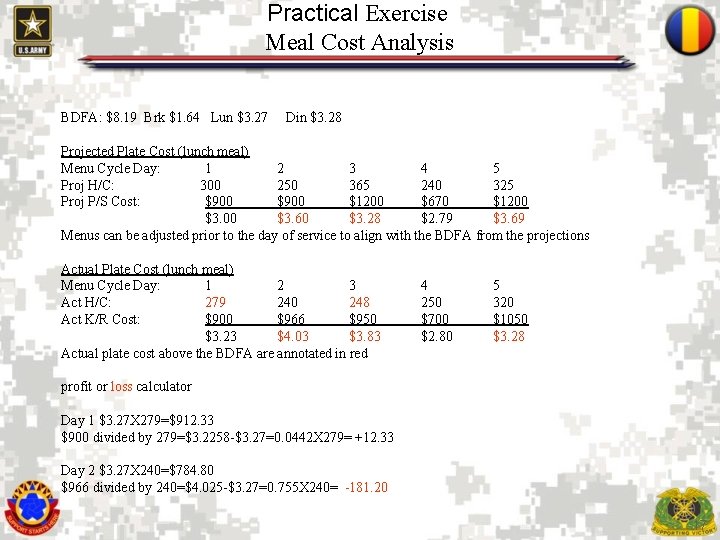
Practical Exercise Meal Cost Analysis • Tomorrow’s Date: 13 December 2012 • BDFA: $8. 19 Brk $1. 64 Lun $3. 27 Din $3. 28 Projected Plate Cost (lunch meal) Menu Cycle Day: 1 2 3 Proj H/C: 300 250 Proj P/S Cost: $900 4 365 $1200 5 240 $670 325 $1200 Actual Plate Cost (lunch meal) Menu Cycle Day: 1 2 Act H/C: 279 Act K/R Cost: $900 4 248 $950 5 250 $700 320 $1050 3 240 $966 Actual numbers 10 or more off from projection annotated in red 16
Practical Exercise Meal Cost Analysis BDFA: $8. 19 Brk $1. 64 Lun $3. 27 Din $3. 28 Projected Plate Cost (lunch meal) Menu Cycle Day: 1 2 3 4 5 Proj H/C: 300 250 365 240 325 Proj P/S Cost: $900 $1200 $670 $1200 $3. 60 $3. 28 $2. 79 $3. 69 Menus can be adjusted prior to the day of service to align with the BDFA from the projections Actual Plate Cost (lunch meal) Menu Cycle Day: 1 2 3 Act H/C: 279 240 248 Act K/R Cost: $900 $966 $950 $3. 23 $4. 03 $3. 83 Actual plate cost above the BDFA are annotated in red 4 250 $700 $2. 80 5 320 $1050 $3. 28 profit or loss calculator Day 1 $3. 27 X 279=$912. 33 $900 divided by 279=$3. 2258 -$3. 27=0. 0442 X 279= +12. 33 Day 2 $3. 27 X 240=$784. 80 $966 divided by 240=$4. 025 -$3. 27=0. 755 X 240= -181. 20 17
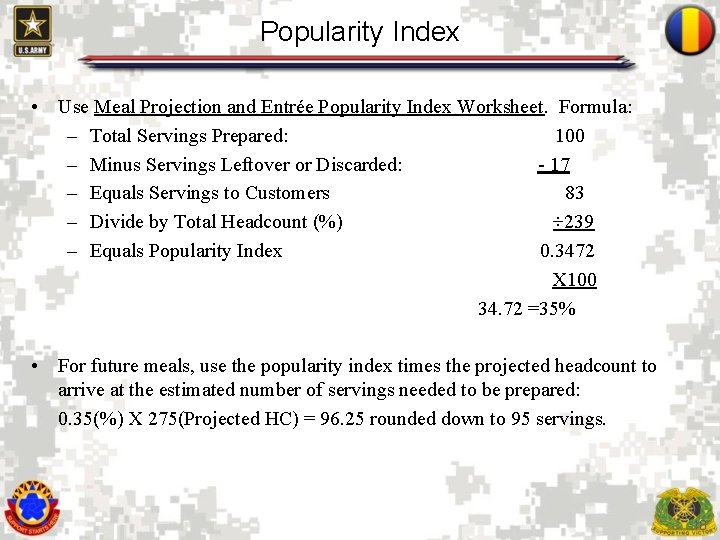
Popularity Index • Use Meal Projection and Entrée Popularity Index Worksheet. Formula: – Total Servings Prepared: 100 – Minus Servings Leftover or Discarded: - 17 – Equals Servings to Customers 83 – Divide by Total Headcount (%) ÷ 239 – Equals Popularity Index 0. 3472 X 100 34. 72 =35% • For future meals, use the popularity index times the projected headcount to arrive at the estimated number of servings needed to be prepared: 0. 35(%) X 275(Projected HC) = 96. 25 rounded down to 95 servings. 18
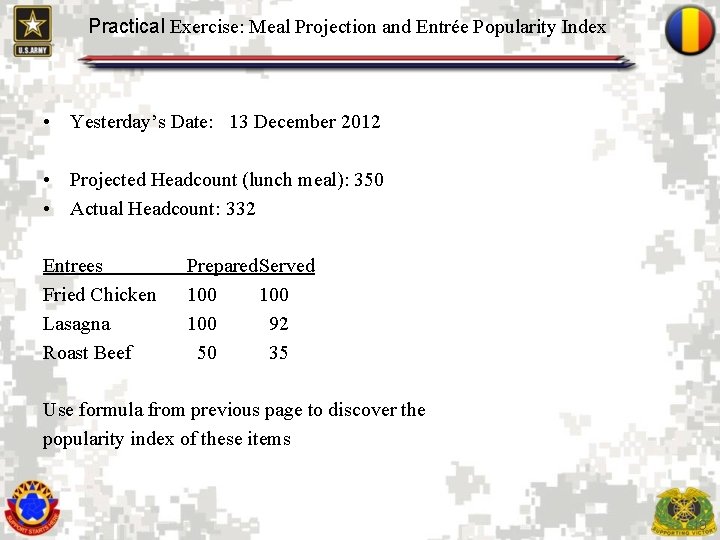
Practical Exercise: Meal Projection and Entrée Popularity Index • Yesterday’s Date: 13 December 2012 • Projected Headcount (lunch meal): 350 • Actual Headcount: 332 Entrees Fried Chicken Lasagna Roast Beef Prepared. Served 100 100 92 50 35 Use formula from previous page to discover the popularity index of these items 19
Questions ? 20