
Dimorphic Fungi Dimorphic fungi have two different reproduction


- Slides: 12
Dimorphic Fungi
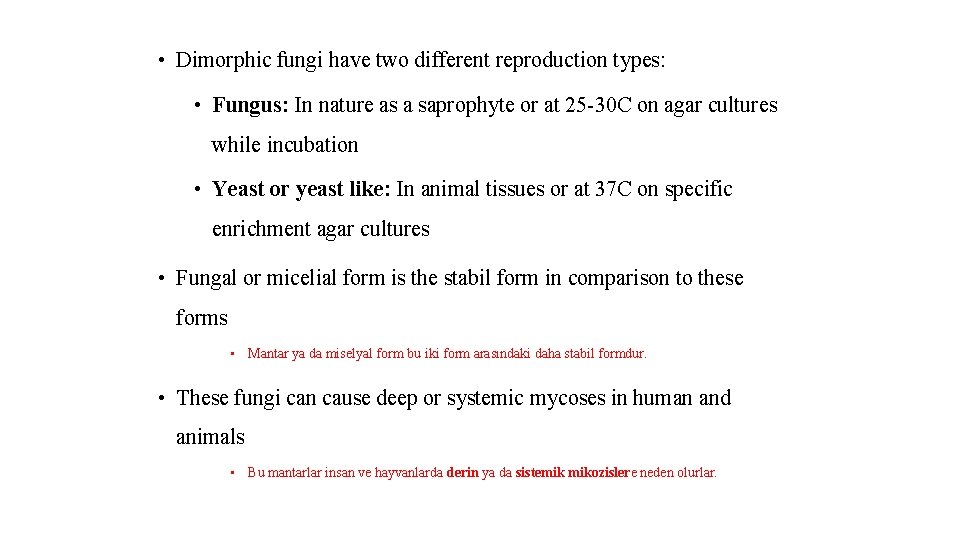
• Dimorphic fungi have two different reproduction types: • Fungus: In nature as a saprophyte or at 25 -30 C on agar cultures while incubation • Yeast or yeast like: In animal tissues or at 37 C on specific enrichment agar cultures • Fungal or micelial form is the stabil form in comparison to these forms • Mantar ya da miselyal form bu iki form arasındaki daha stabil formdur. • These fungi can cause deep or systemic mycoses in human and animals • Bu mantarlar insan ve hayvanlarda derin ya da sistemik mikozislere neden olurlar.
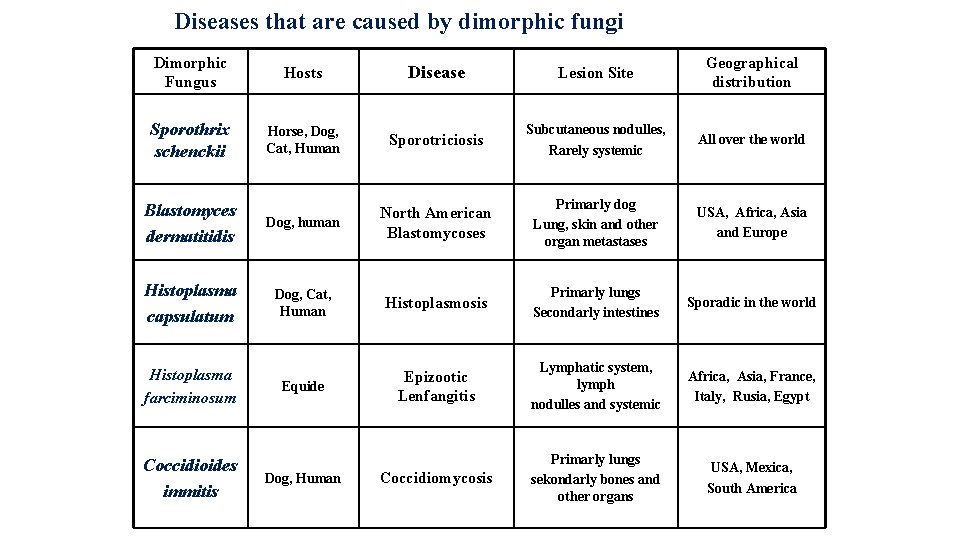
Diseases that are caused by dimorphic fungi Dimorphic Fungus Hosts Disease Lesion Site Geographical distribution Sporothrix schenckii Horse, Dog, Cat, Human Sporotriciosis Subcutaneous nodulles, Rarely systemic All over the world Blastomyces dermatitidis Dog, human North American Blastomycoses Primarly dog Lung, skin and other organ metastases USA, Africa, Asia and Europe Histoplasma capsulatum Dog, Cat, Human Histoplasmosis Primarly lungs Secondarly intestines Sporadic in the world Equide Epizootic Lenfangitis Lymphatic system, lymph nodulles and systemic Africa, Asia, France, Italy, Rusia, Egypt Coccidiomycosis Primarly lungs sekondarly bones and other organs USA, Mexica, South America Histoplasma farciminosum Coccidioides immitis Dog, Human
Sporotrichosis
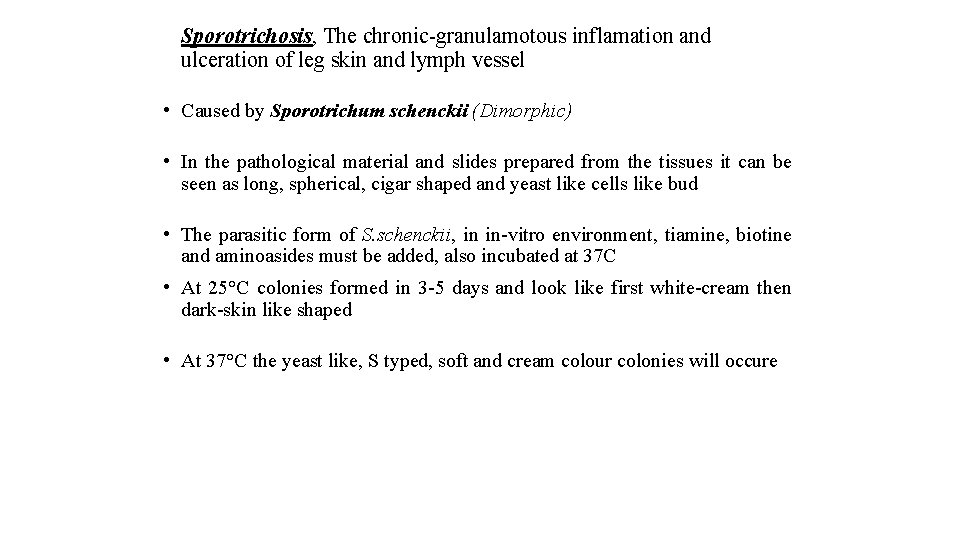
Sporotrichosis, The chronic-granulamotous inflamation and ulceration of leg skin and lymph vessel • Caused by Sporotrichum schenckii (Dimorphic) • In the pathological material and slides prepared from the tissues it can be seen as long, spherical, cigar shaped and yeast like cells like bud • The parasitic form of S. schenckii, in in-vitro environment, tiamine, biotine and aminoasides must be added, also incubated at 37 C • At 25°C colonies formed in 3 -5 days and look like first white-cream then dark-skin like shaped • At 37°C the yeast like, S typed, soft and cream colour colonies will occure
Epidemiology • Sporotrichum schenckii, can be found in nature • Soil, water, fertilizer (gübre), decayed plant and the oral and gastrointestinal mucosa of rats • Penetration to the body is from the portantres of skin • Moisture and heat is important in the initial of disease. At 30 C and higher temperatures the rate of the occurence of the disease will be very less Clinical Findings • In equide spores that penetrate from the microscopic portantres of the skin will form the lesions found in the skin and lymphoid tissue under the skin. Sometimes they can metastase to the inner organs • Mallein test can be performed for the differntiation from Malleus in equide • Usually the nodulles under the chest skin will get bigger, hardened and became ulserative. The hair at that site will fall and pus will leak from the wounds
Treatment and Control • Amphotericin-B, Griseofulvin and Sodium – Potasium Iodure • Hygenic precautions must be ruled • The legs of animals must be controlled routinely and prvented from the wound occurences
Blastomycosis
Blastomycosis, The chronic-granulamotous and suppurative infection caused by dimorphic (diphasic) fungus Blastomyces dermatitidis • Blastomyces dermatitidis, is in mycelial form when incubated at 22 - 25 ˚C and yeast like form at 37 ˚C • In living organisms the body temperature is 36 -37 ˚C so in the body and pathological material the fungus can be found as yeastlike form • In skin, lungs, bones, neural system, urogenital system and other orgns the lesions can be occured
• Blastomyces dermatitidis infections can be observed in dogs lived in Canada and USA. Agent can reproduce in the nature and the spores can be inhalated by air • There is no spread between living organisms. All living organism will take the agent individually from outside and infection will occur • There are two clinical forms: Skin Blastomycosis and Systemic Blastomycosis • Systemic Blastomycosis, occures when the agent invade into primer tissue sites. Lung, liver, kidney, splen and related organs are the tissue that the lesions are observed • Skin Blastomycosis, rarely from skin wound but mostly by hematogen ways are the main routes that the disease agent causes skin lesions. Skin and under skin the lymph nodes are effected and the abscess, furuncules will occur
Identification • Clinical identification, B. dermatitis lesions can be confused with other related lesions similar to lesions of many bacterial and viral agents. • Necropsy is found in the animals, in the skin and subcutaneous tissues, in the lungs and other internal organs, numerous nodules. Lesothoracic lung, liver, spleen, kidney, lymph ovules, skin lesions are sent to the relevant laboratory for laboratory diagnosis. • Culture: Antibiotic SDA or brain-heart infusion agar is applied from the lesioned tissue, organs and other materials and left to incubate at 25 ˚C and 37 ˚C for about 10 -15 days. Macro and micro morphology of breeding fungus colonies are examined. • Microscopy: Lenticular materials are first treated with 10% KOH or Lactophenol Cotton Blue, and cross-lamellar examination is performed. Under the microscope, large, round, thick-walled, granular and some buds are visible.
• Treatment and Preservation: There is no known effective therapeutic agent in the treatment of the disease. Generally, Amphotericin-B is administered to the animals while the injured is being treated with surgical interventions. - The general hygienic conditions must be observed and the sick animals and healthy animals must be kept away from each other