
Diminishing Manufacturing Sources And Material Shortages DMSMS What

- Slides: 20
Diminishing Manufacturing Sources And Material Shortages (DMSMS): What Program Management Needs to Know and Why DAU Hot Topics Forum February 15, 2017 Robin Brown, OSD DMSMS Lead 703 -767 -1415 Robin. Brown@dla. mil Ethan Plotkin, CEO GDCA 925 -456 -9900 EPlotkin@gdca. com
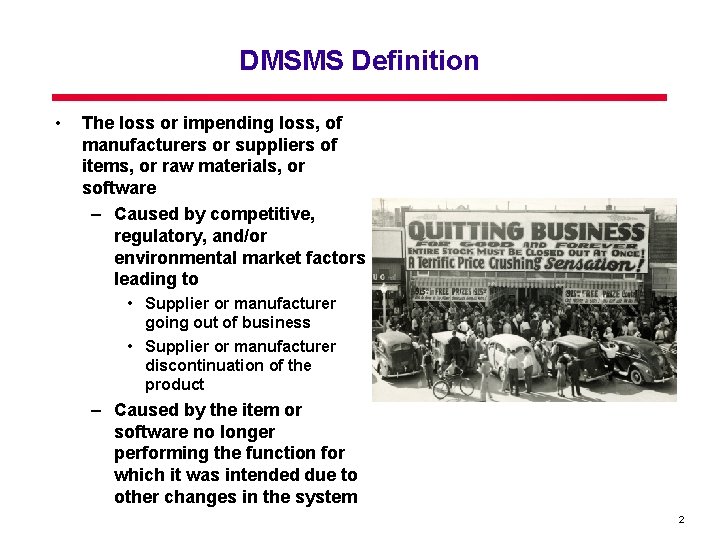
DMSMS Definition • The loss or impending loss, of manufacturers or suppliers of items, or raw materials, or software – Caused by competitive, regulatory, and/or environmental market factors leading to • Supplier or manufacturer going out of business • Supplier or manufacturer discontinuation of the product – Caused by the item or software no longer performing the function for which it was intended due to other changes in the system 2
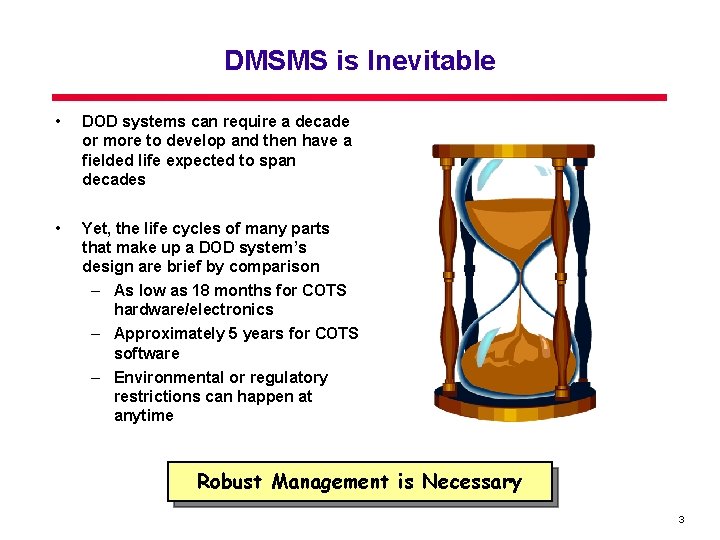
DMSMS is Inevitable • DOD systems can require a decade or more to develop and then have a fielded life expected to span decades • Yet, the life cycles of many parts that make up a DOD system’s design are brief by comparison – As low as 18 months for COTS hardware/electronics – Approximately 5 years for COTS software – Environmental or regulatory restrictions can happen at anytime Robust Management is Necessary 3
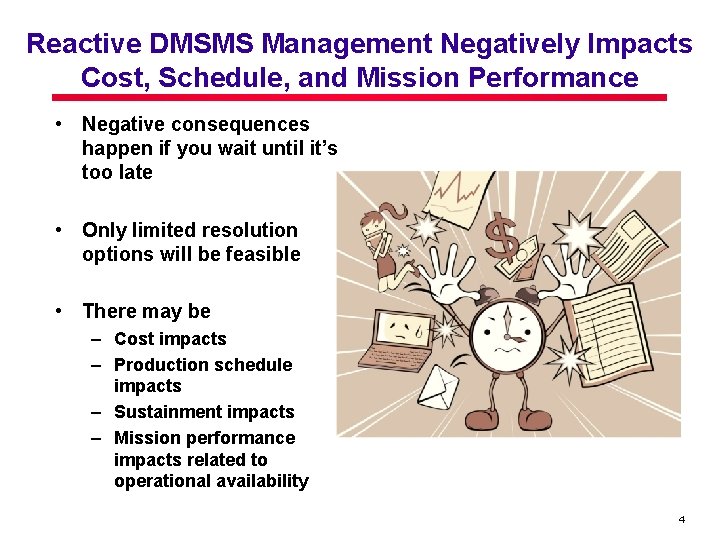
Reactive DMSMS Management Negatively Impacts Cost, Schedule, and Mission Performance • Negative consequences happen if you wait until it’s too late • Only limited resolution options will be feasible • There may be – Cost impacts – Production schedule impacts – Sustainment impacts – Mission performance impacts related to operational availability 4
Robust DMSMS Management Minimizes the Negative Impacts • A robust and more proactive DMSMS management approach ensures that— – More resolution options are available – There is more time to consider available resolution options, which allows for many benefits – The optimal resolution for the program can be selected 5
Product Improvement as a Potential By. Product • While not their primary purpose, planned redesigns to resolve DMSMS can result in product improvement: – Opportunity to upgrade to better, faster, and cheaper parts – Reduction in the number of parts – Reduction in power usage – Improved reliability, logistics footprint, and sustainability – Reduction in transportation, labor, and spare part costs – Opportunity to develop improved supply chain relationships 6
Overarching DMSMS Program Objectives Cost effectively • Minimize the scope of DMSMSrelated out-of-cycle redesigns when they cannot be eliminated • Eliminate DMSMS-related production schedule impacts • Eliminate DMSMS-related degradations to readiness … in order to assist in developing, fielding, and supporting a sustainable product 7
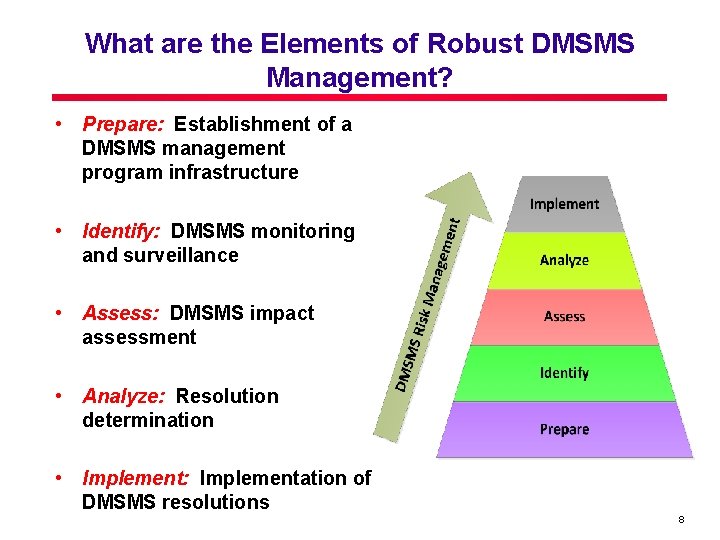
What are the Elements of Robust DMSMS Management? • Prepare: Establishment of a DMSMS management program infrastructure • Identify: DMSMS monitoring and surveillance • Assess: DMSMS impact assessment • Analyze: Resolution determination • Implement: Implementation of DMSMS resolutions 8
Most Important Program Leadership Actions to Enable Robust DMSMS Management • Establish Strategic Underpinnings for DMSMS Management • Establish a Strong Foundation for Robust DMSMS Management • Ensure DMSMS is Fully Funded • Make DMSMS Management a High Priority in the Government Program Office and with the Prime Contractor • Link DMSMS Health Assessments to Product Roadmaps • Obtain DMSMS Health Assessments on All Designs, Redesigns, and Design Reviews 9
Establish Strategic Underpinnings for DMSMS Management • Program Management should: – Make strategic decisions that drive a risk-based DMSMS management plan • DMSMS management objectives • DMSMS Management Team (DMT) membership and roles and responsibilities • DMT operating guidelines – Define Program Leadership involvement 10
Key Considerations for Establishing DMT Operating Guidelines • Principal elements of DMSMS management • A risk-based approach to DMSMS management • What to monitor – Which systems? – Which components and assemblies? • Products and deliverables 11
Establish a Strong Foundation for Robust DMSMS Management The elements of a STRONG foundation for robust DMSMS management are: • Data and Tools • Prime Contractor/Original Equipment Manufacturer (OEM) support thoroughly codified and incentivized in contract language • Centralized linkage to DMSMS activities and best practices in other Programs Independent Subject Matter Experts should be involved in every aspect of DMSMS management. They ensure adequate communication by: – Providing a second set of eyes – Pulling everything together 12
Ensure DMSMS is Fully Funded Adopt a risk-based approach to budget for: • Program Management and Operations activities – – – • Prepare Identify Assess Analyze Implement Resolutions – Be prepared to react to end-of -life notices – Based on forecasts developed from historical data and analysis 13
Make DMSMS Management a High Priority • Establish a Program Office champion – Full time – Knowledgeable – Access to prime contractor and DOD program leadership • Ensure stakeholder involvement in DMSMS management team activities – Participation by all stakeholders – Full cooperation – Open and full communications – Ensure the team is empowered to make decisions 14
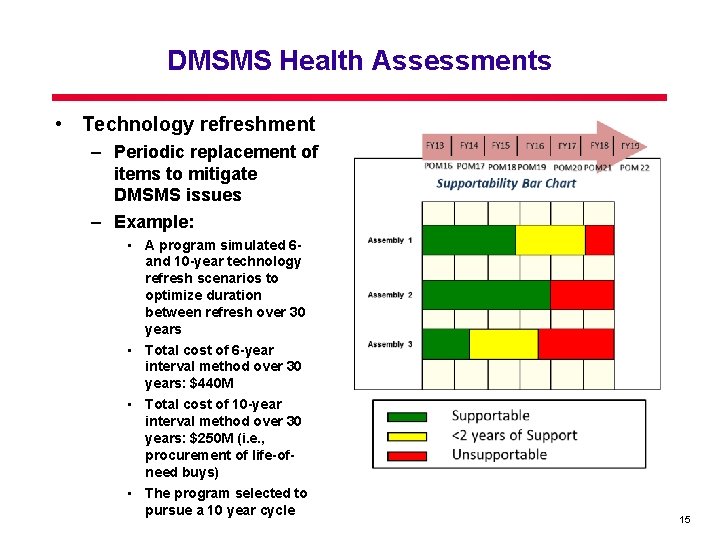
DMSMS Health Assessments • Technology refreshment – Periodic replacement of items to mitigate DMSMS issues – Example: • A program simulated 6 and 10 -year technology refresh scenarios to optimize duration between refresh over 30 years • Total cost of 6 -year interval method over 30 years: $440 M • Total cost of 10 -year interval method over 30 years: $250 M (i. e. , procurement of life-ofneed buys) • The program selected to pursue a 10 year cycle 15
Link DMSMS Health Assessments to Product Roadmaps • Product Roadmap – Planned technology insertion for increasing capability to meet current or future requirements • Combining these processes minimizes out-of-cycle redesign • Align life-of-need buys to the roadmap to avoid under- or overbuying obsolete material • Don’t plan your roadmap based on obsolescence, but drive your solutions to your roadmap 16
Obtain DMSMS Comments on All Designs, Redesigns, and Design Reviews • Begin DMT involvement by the Preliminary Design Review to ensure there are no obsolete or soon to be obsolete parts on the parts list – Example: Independent SMEs reviewed list of 323 parts that could be used in design • 80 obsolete/being phased out • 31 in “declining” phase of life cycle (within 2 years of losing support) • 22 were mature (2 -6 years of support) • 190 in “growth” phase (7+ years of support) • Enabled program to not have obsolescence designed in 17
Obtain DMSMS Comments on All Designs, Redesigns, and Design Reviews • Review of redesigns is another source of savings – Example: • Program facing $150 M redesign bill due to redesign • SMEs performed parallel obsolescence analysis (costing $42, 000) and recommended: – $5 M in resolutions – Prime contractor ultimately proposed $65 M additional to implement modernization and low maintenance mods – Saved the program $80 M • Program Leadership should ensure DMT input is not overlooked: it often will reduce some short term costs and avoid some long term costs 18
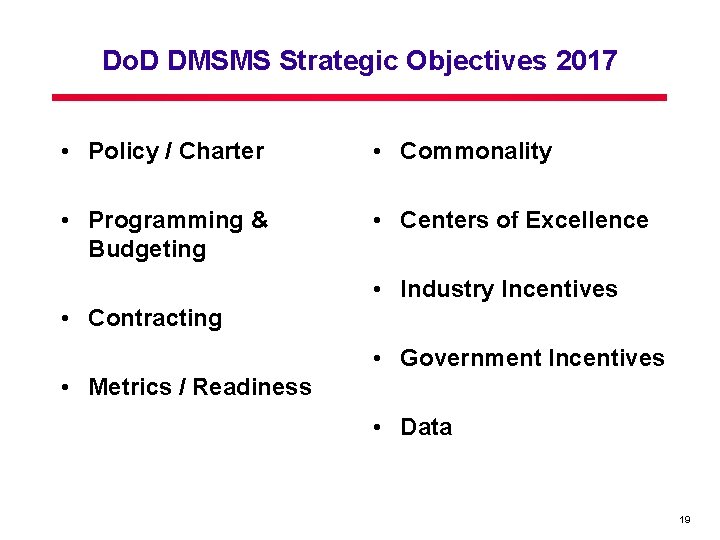
Do. D DMSMS Strategic Objectives 2017 • Policy / Charter • Commonality • Programming & Budgeting • Centers of Excellence • Industry Incentives • Contracting • Government Incentives • Metrics / Readiness • Data 19
For More Information … • Do. D 4140. 1 -R, Do. D Supply Chain Materiel Management Regulation • Defense Acquisition Guidebook • DMSMS Knowledge Sharing Portal – https: //www. dmsms. org • SD-22, Diminishing Manufacturing Sources and Material Shortages (DMSMS) Guidebook • Defense Acquisition University (DAU) DMSMS Courses Thank you for your participation! Questions? 20