
Dimensions of Interpersonal Relationships Communication and Relational Dynamics
- Slides: 32
Dimensions of Interpersonal Relationships Communication and Relational Dynamics CH 8
�Why we form relationships? APPEARANCE SIMILARITY COMPLEMENTARY REWARDS COMPETENCY PROXIMITY DISCLOSURE
APPEARANCE • We are drawn to people who we deem physically attractive • We tend to be attracted to people who look similar to us • The more pleasing one’s personality is the more attractive they appear • Physical attraction become less important as a relationship progresses
SIMILARITY • We tend to form relationships with people who have similar values, backgrounds, and experiences. • Similarity thesis-the more similar people are the more likely they report being happy in their relationship • We usually pick people who are similar for the following reasons • Social validation-we are not alone in our thinking • Easier to make fairly accurate predictions about them • We assume if they are similar to us they will probably like us
COMPLEMENTARY • We tend to form relationships with people who have characteristics that are different from us but complement us • For ex. An attraction between a dominant and a passive person
COMPETENCY • We want to be in a relationship with someone who is competent/intelligent. • We don’t want their intelligence level to be much different from our own.
PROXIMITY • We tend to form relationships with people who are around us • You likely develop strong personal feelings, either positive or negative, toward others you encounter frequently
DISCLOSURE • We tend to form relationships with people who we share important information about ourselves with. • Self-disclosure increases liking because it indicates regard and indicates respect and trust • Keys to satisfying self-disclosure are reciprocity and timing
WHAT IS INTIMACY? • Close union, contact, association, or acquaintance • Intimacy • Every makes us happier in our relationships human being has a need for some form of intimacy at some point in time in their life
Dimensions of Intimacy EMOTIONAL PHYSICAL INTELLECTUAL SHARED ACTIVITIES
INFLUENCES ON INTIMACY AND DISTANCE • Male and Female Influences on Intimacy • Research shows women as a group are more interested in achieving emotional intimacy then men • Men are better at developing intimacy through shared activities • In romantic relationships men are more likely to build intimacy through physical contact and shared activities • Women are more likely to build intimacy through emotional and intellectual sharing • Cultural Influences on Intimacy • Disclosure is especially high in mainstream U. S. /Canadian societies; there is also less of a distinction between personal and casual relationships • Germans and Japanese societies tend to disclose little about themselves except in close relationships • The level of self-disclosure that is appropriate in one culture may seem completely inappropriate in another
DIALECTICS OF INTIMACY AND DISTANCE • Balance is required you can’t always be intimate or distance • Intimacy is not essential in every relationship • Intimacy is rewarding but is not the only way of relating to others
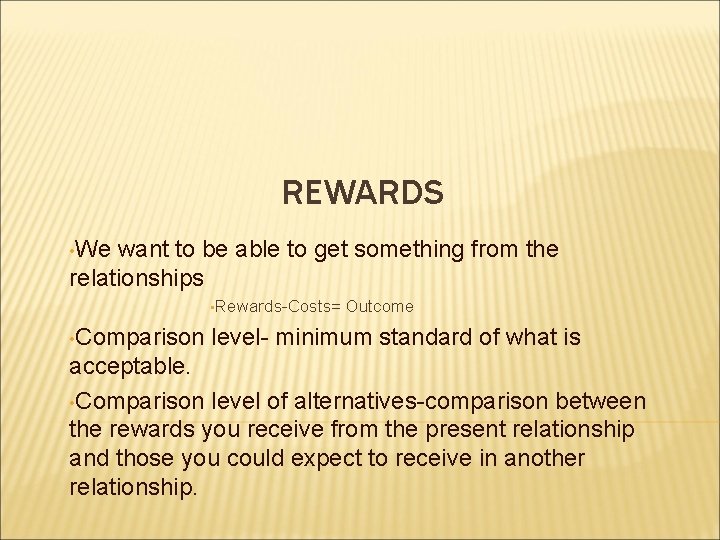
REWARDS • We want to be able to get something from the relationships • Rewards-Costs= • Comparison Outcome level- minimum standard of what is acceptable. • Comparison level of alternatives-comparison between the rewards you receive from the present relationship and those you could expect to receive in another relationship.
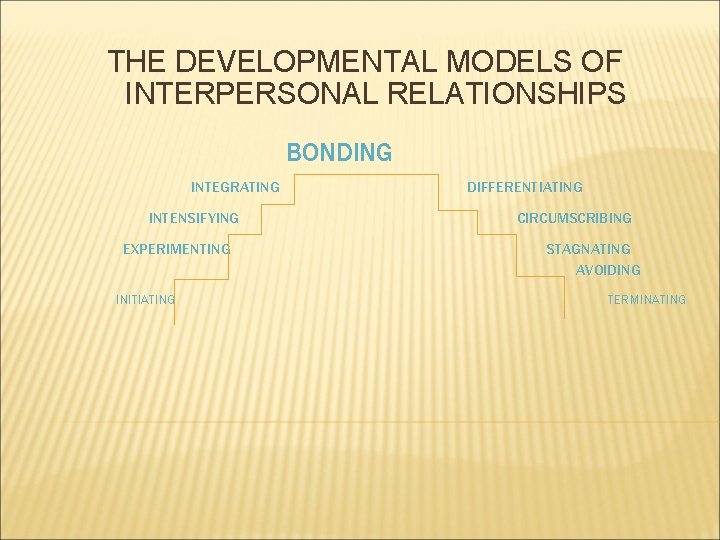
THE DEVELOPMENTAL MODELS OF INTERPERSONAL RELATIONSHIPS BONDING INTEGRATING INTENSIFYING EXPERIMENTING INITIATING DIFFERENTIATING CIRCUMSCRIBING STAGNATING AVOIDING TERMINATING
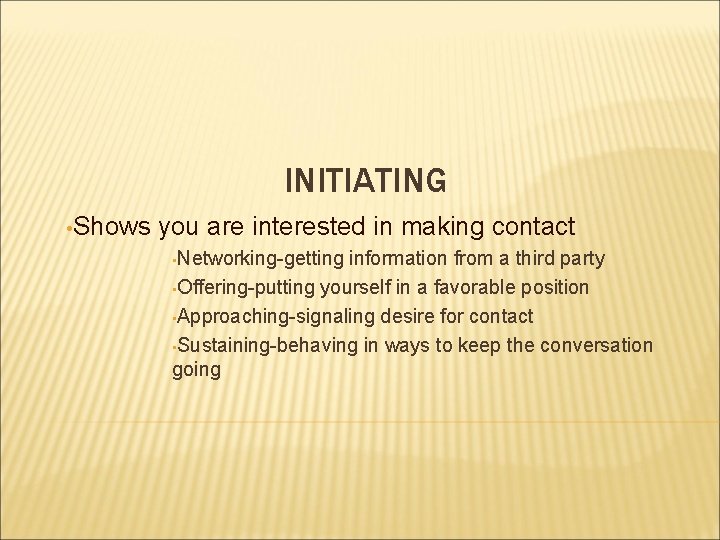
INITIATING • Shows you are interested in making contact • Networking-getting information from a third party • Offering-putting yourself in a favorable position • Approaching-signaling desire for contact • Sustaining-behaving in ways to keep the conversation going
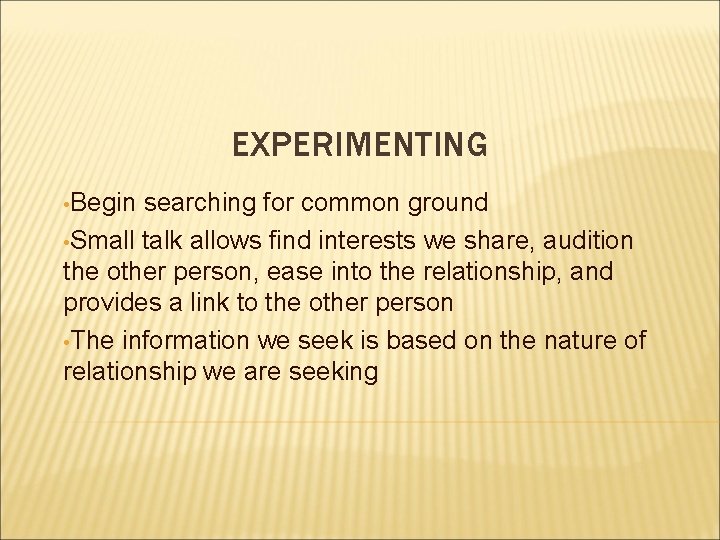
EXPERIMENTING • Begin searching for common ground • Small talk allows find interests we share, audition the other person, ease into the relationship, and provides a link to the other person • The information we seek is based on the nature of relationship we are seeking
INTENSIFYING • When we begin expressing our feelings in the relationship • Spending increasing time together • Asking for support from one another • Doing favors • Giving tokens of affection • Hinting and flirting • Expressing feelings nonverbally • Getting to know the partners friends and family • Trying to look more physically attractive • Say “I Love You”, exciting and euphoric feelings
INTEGRATING • Begin taking on an identity as a social unit • Sense of obligation grows • Uncertainty about our relationship decreases
BONDING • The partners make a symbolic gesture to show the world that their relationship exists usually involves some permanency. • Generates social support • Custom and law impose certain obligations on partners who have officially bonded
DIFFERENTIATING • Happens when the relationship starts to feel it’s first, inevitable feelings of stress. • Start to pursue some individual goals • Key to successful differentiation is maintaining commitment to the relationship while creating space for being individuals as well
CIRCUMSCRIBING • When communication begins to decrease in quality and quantity • Dissatisfaction grows more evident • Restrictions and restraints in communication develops
STAGNATING • Behave toward each other in old, familiar ways without feeling • No growth occurs in the relationship • Relationships represents a hollow shell of its former self
AVOIDING • Create distance between each other physical and mental • Expressing detachment- avoiding the other person altogether • Avoiding involvement-ignoring questions, no touching • Showing antagonism-behaving in a hostile way, treating the other person as less • Mentally dissociate-thinking of each other as unimportant • Avoiding creates a reciprocal cycle
TERMINATING • Making a clear request to dissociate • It can become long and drawn out for ex. “Make up break up” • Often the way in which the relationship ends determines how individuals deal with each other after termination.
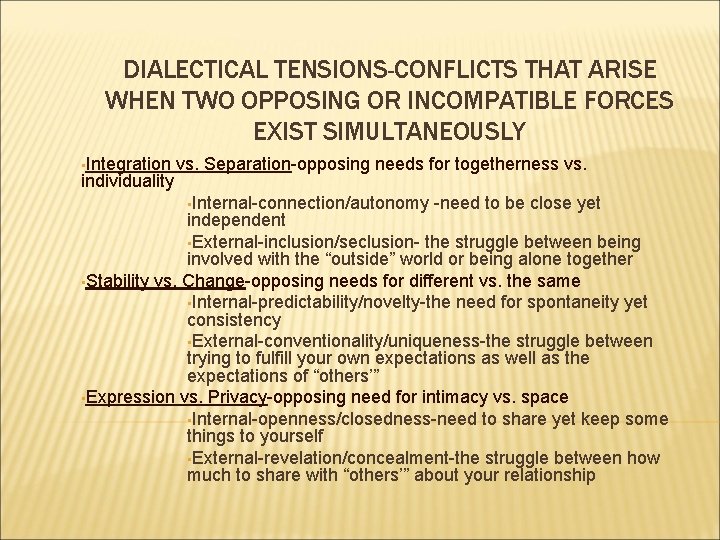
DIALECTICAL TENSIONS-CONFLICTS THAT ARISE WHEN TWO OPPOSING OR INCOMPATIBLE FORCES EXIST SIMULTANEOUSLY • Integration individuality vs. Separation-opposing needs for togetherness vs. • Internal-connection/autonomy -need to be close yet independent • External-inclusion/seclusion- the struggle between being involved with the “outside” world or being alone together • Stability vs. Change-opposing needs for different vs. the same • Internal-predictability/novelty-the need for spontaneity yet consistency • External-conventionality/uniqueness-the struggle between trying to fulfill your own expectations as well as the expectations of “others’” • Expression vs. Privacy-opposing need for intimacy vs. space • Internal-openness/closedness-need to share yet keep some things to yourself • External-revelation/concealment-the struggle between how much to share with “others’” about your relationship
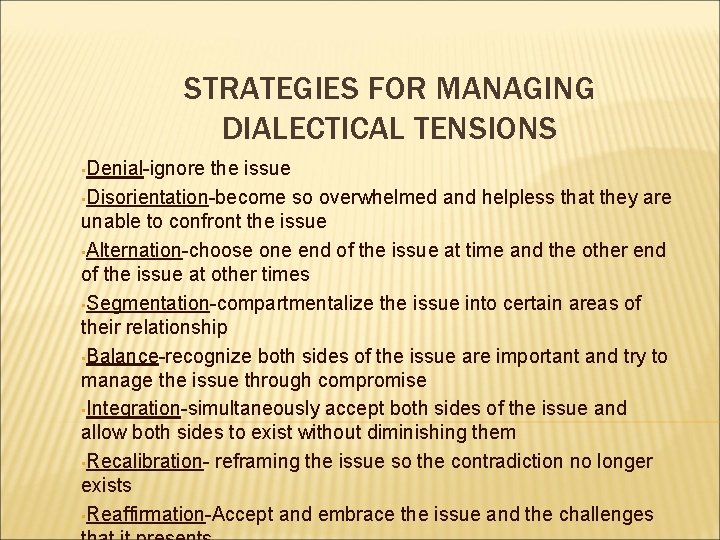
STRATEGIES FOR MANAGING DIALECTICAL TENSIONS • Denial-ignore the issue • Disorientation-become so overwhelmed and helpless that they are unable to confront the issue • Alternation-choose one end of the issue at time and the other end of the issue at other times • Segmentation-compartmentalize the issue into certain areas of their relationship • Balance-recognize both sides of the issue are important and try to manage the issue through compromise • Integration-simultaneously accept both sides of the issue and allow both sides to exist without diminishing them • Recalibration- reframing the issue so the contradiction no longer exists • Reaffirmation-Accept and embrace the issue and the challenges
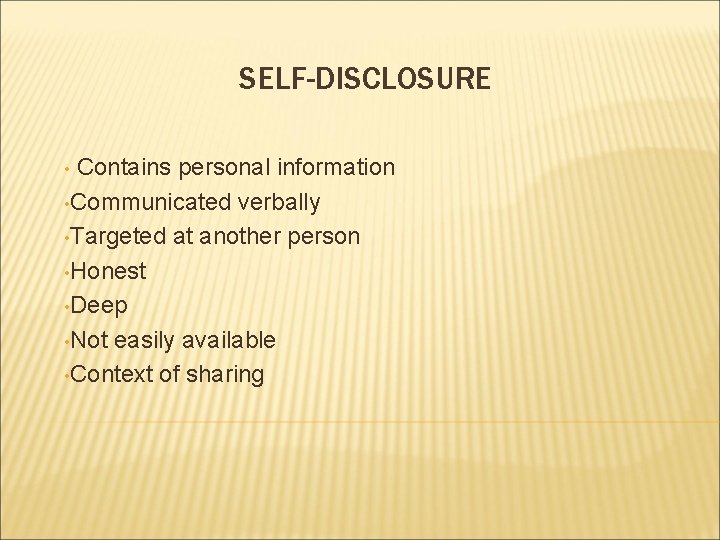
SELF-DISCLOSURE Contains personal information • Communicated verbally • Targeted at another person • Honest • Deep • Not easily available • Context of sharing •
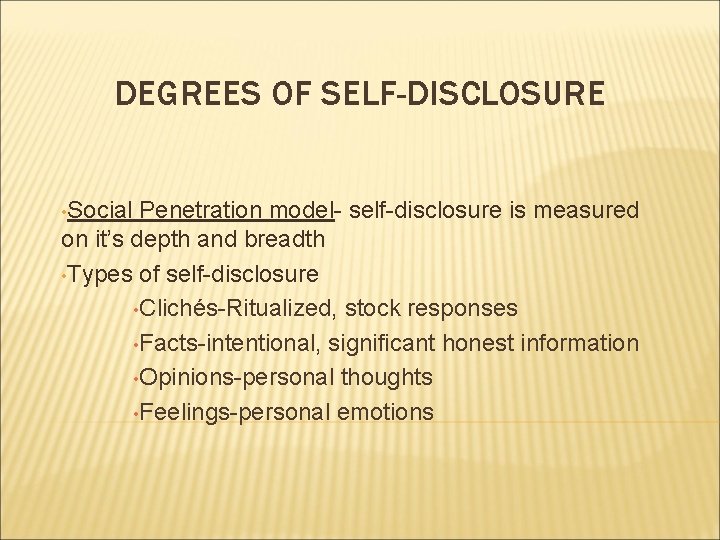
DEGREES OF SELF-DISCLOSURE • Social Penetration model- self-disclosure is measured on it’s depth and breadth • Types of self-disclosure • Clichés-Ritualized, stock responses • Facts-intentional, significant honest information • Opinions-personal thoughts • Feelings-personal emotions
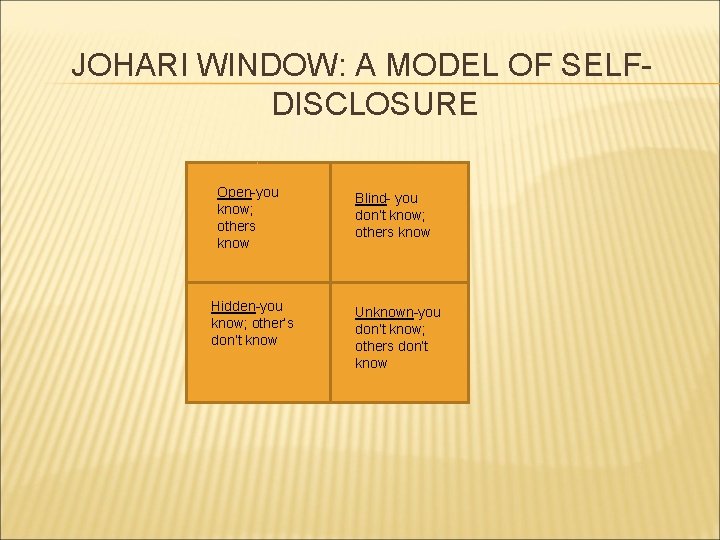
JOHARI WINDOW: A MODEL OF SELFDISCLOSURE Open-you know; others know Hidden-you know; other’s don’t know Blind- you don’t know; others know Unknown-you don’t know; others don’t know
BENEFITS OF SELF-DISCLOSURE • Cathartic-makes you feel better • Self-Clarification-helps you to gain insight • Self-Validation-confirms a belief that you hold • Reciprocity-returning the gesture • Impression Formation-makes us more attractive to other’s • Relationship Maintenance and Enhancement-we like people more when we share with them and they share with us • Moral Obligation-because we feel we should • Social Influence-can help you control or have influence over a situation • Self-Defense-choose to reveal something before someone else discloses it for you.
GUIDELINES FOR SELF-DISCLOSURE • Is the other person important to you? • Is the risk of disclosing reasonable? • Is the Self-Disclosure Appropriate? • Is the Disclosure Relevant to the Situation at hand? • Is the Disclosure Reciprocated? • Will the effect be Constructive? • Is the Self-Disclosure clear and Understandable?
ALTERNATIVES TO SELF-DISCLOSURE • Silence • Lying • Benevolent lies-not malicious • Reasons for lying • To Save Face • To avoid tension or conflict • To guide social interaction • To mange a relationship • To gain power • To Protect other relationships • Effects of lies-when the relationship is intense and the subject of the lie is high in importance the effects are usually grave • Equivocation-being ambiguous • Hinting-indirect statement to get a desired result • Ethics of Evasion- A good way to check the justifiability of a lie is to imagine how others would respond if they knew you were being dishonest