
Dimensions of Human Behavior Person and Environment Chapter
Dimensions of Human Behavior: Person and Environment Chapter 4 The Psychological Person: Cognition, Emotion, and Self
KEY POINTS ADDRESSED n Defining and Differentiating Cognition and Emotion n Theories of Cognition: Themes and Concepts n n n Cognitive Information Processing Social Learning Multiple Intelligences Moral Reasoning n Theories of Emotion: Themes and Concepts n n n Physiological Social Psychological n Cognition and Emotion: Integrated into The Self n Visualizing the Integrated Self Chapter 4: Psychological Person
Cognition and Emotion: Defined and Differentiated Cognition - Our conscious or preconscious thinking processes. The mental activities of which we are aware or can become aware with probing Emotion - A feeling state characterized by our appraisal of a stimulus, by changes in bodily sensations, and by displays of expressive gestures Chapter 4: Psychological Person
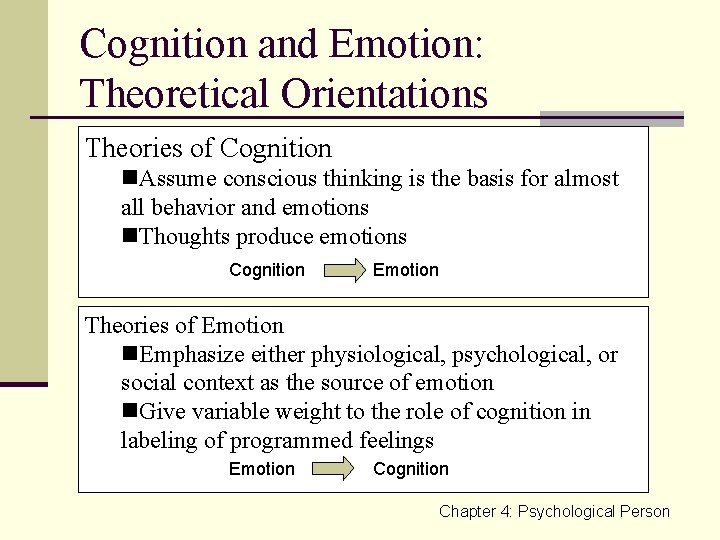
Cognition and Emotion: Theoretical Orientations Theories of Cognition n. Assume conscious thinking is the basis for almost all behavior and emotions n. Thoughts produce emotions Cognition Emotion Theories of Emotion n. Emphasize either physiological, psychological, or social context as the source of emotion n. Give variable weight to the role of cognition in labeling of programmed feelings Emotion Cognition Chapter 4: Psychological Person
General Points of Agreement n Cognition and emotion are complex and interactive n Symptoms of psychological problems may be primarily cognitive or emotional, but both cognition and emotion influence the development of problems n Cognition and emotion integrate into some cohesive notion of the self Chapter 4: Psychological Person
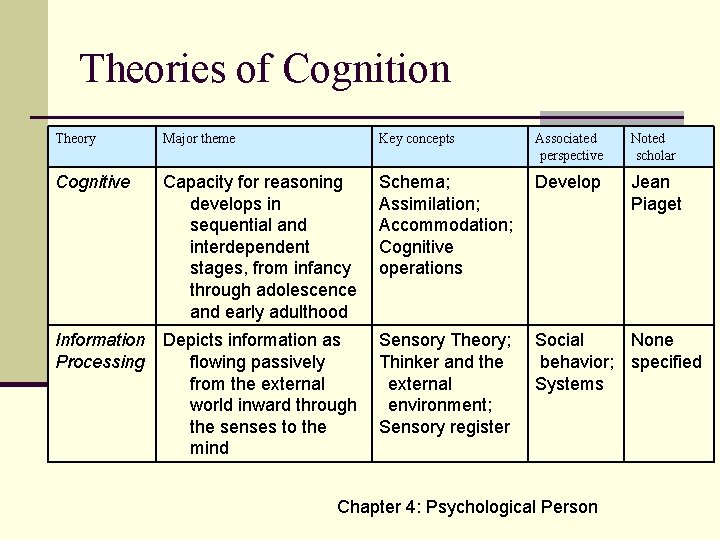
Theories of Cognition Theory Major theme Key concepts Associated perspective Noted scholar Cognitive Capacity for reasoning develops in sequential and interdependent stages, from infancy through adolescence and early adulthood Schema; Assimilation; Accommodation; Cognitive operations Develop Jean Piaget Information Processing Depicts information as flowing passively from the external world inward through the senses to the mind Sensory Theory; Thinker and the external environment; Sensory register Social None behavior; specified Systems Chapter 4: Psychological Person
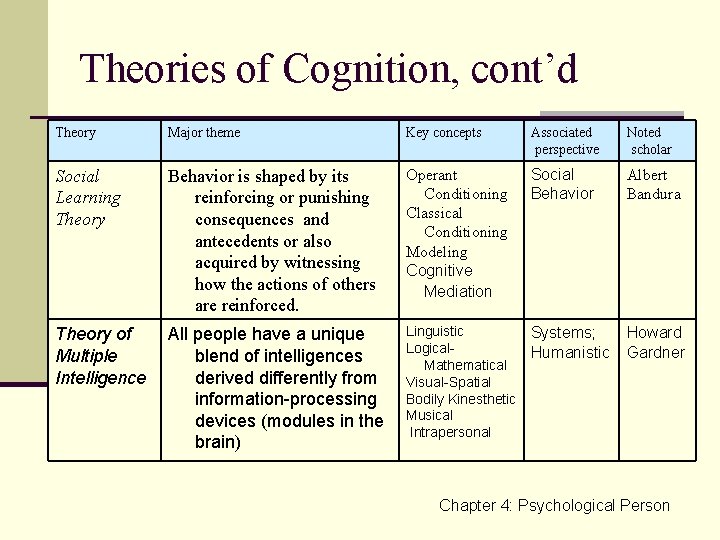
Theories of Cognition, cont’d Theory Major theme Key concepts Associated perspective Noted scholar Social Learning Theory Behavior is shaped by its reinforcing or punishing consequences and antecedents or also acquired by witnessing how the actions of others are reinforced. Operant Conditioning Classical Conditioning Modeling Cognitive Mediation Social Behavior Albert Bandura Theory of Multiple Intelligence All people have a unique blend of intelligences derived differently from information-processing devices (modules in the brain) Linguistic Logical. Mathematical Visual-Spatial Bodily Kinesthetic Musical Intrapersonal Systems; Humanistic Howard Gardner Chapter 4: Psychological Person
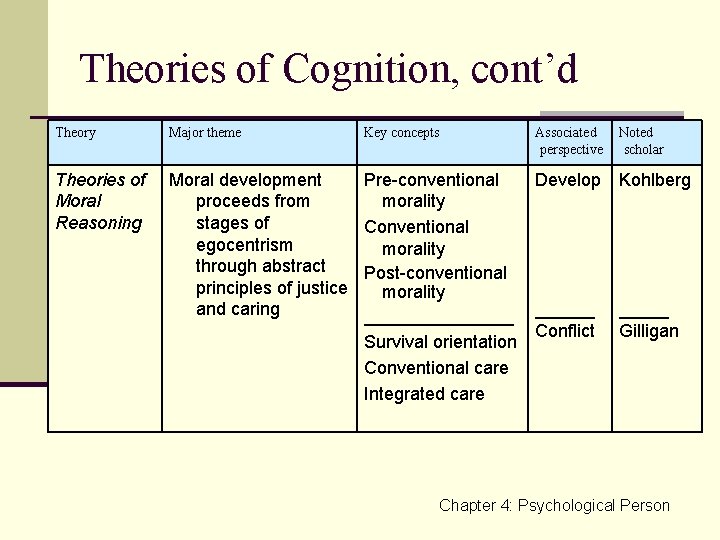
Theories of Cognition, cont’d Theory Major theme Key concepts Associated perspective Theories of Moral Reasoning Moral development proceeds from stages of egocentrism through abstract principles of justice and caring Pre-conventional morality Conventional morality Post-conventional morality ________ Survival orientation Conventional care Integrated care Develop Kohlberg ______ Conflict Noted scholar _____ Gilligan Chapter 4: Psychological Person
Identify the cognitive errors in Sheila’s situation n Discuss how each of theories of cognition can help a social worker understand Sheila’s situation. n How would each of theories help a social worker decide on interventions to help Sheila to minimize her cognitive errors? Chapter 4: Psychological Person
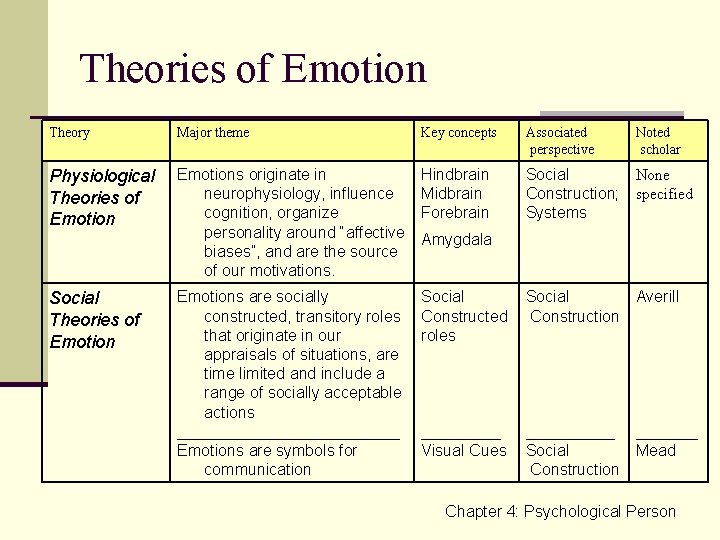
Theories of Emotion Theory Major theme Key concepts Associated perspective Physiological Theories of Emotions originate in neurophysiology, influence cognition, organize personality around “affective biases”, and are the source of our motivations. Hindbrain Midbrain Forebrain None Social Construction; specified Systems Emotions are socially constructed, transitory roles that originate in our appraisals of situations, are time limited and include a range of socially acceptable actions _____________ Emotions are symbols for communication Social Constructed roles Social Averill Construction _____ Visual Cues _______ Social Mead Construction Social Theories of Emotion Noted scholar Amygdala Chapter 4: Psychological Person
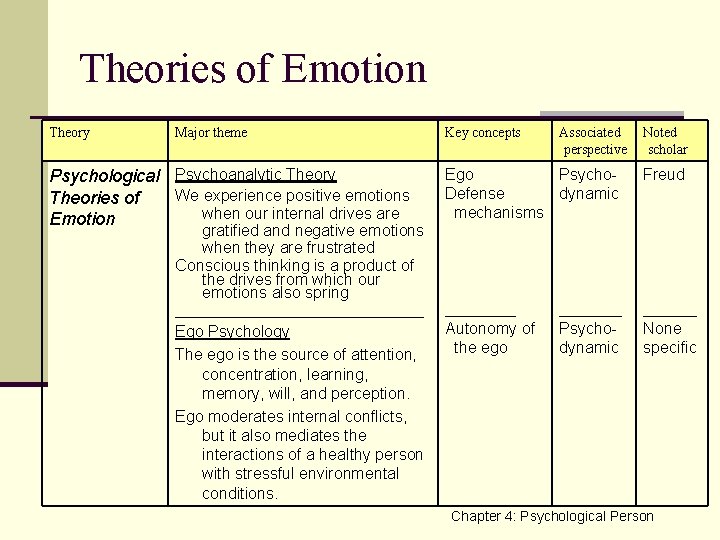
Theories of Emotion Theory Major theme Psychological Psychoanalytic Theory We experience positive emotions Theories of when our internal drives are Emotion gratified and negative emotions when they are frustrated Conscious thinking is a product of the drives from which our emotions also spring ______________ Ego Psychology The ego is the source of attention, concentration, learning, memory, will, and perception. Ego moderates internal conflicts, but it also mediates the interactions of a healthy person with stressful environmental conditions. Key concepts Associated perspective Noted scholar Ego Psycho. Defense dynamic mechanisms Freud ____ Autonomy of the ego ______ None specific _______ Psychodynamic Chapter 4: Psychological Person
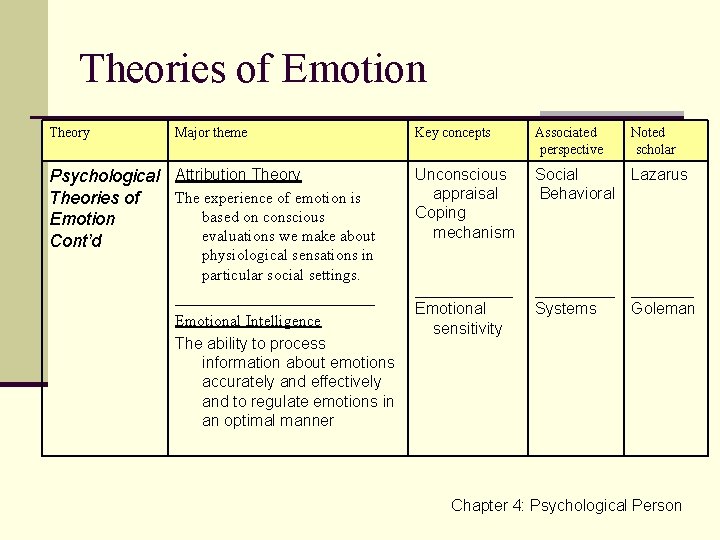
Theories of Emotion Theory Major theme Psychological Attribution Theory The experience of emotion is Theories of based on conscious Emotion evaluations we make about Cont’d physiological sensations in particular social settings. _____________ Emotional Intelligence The ability to process information about emotions accurately and effectively and to regulate emotions in an optimal manner Key concepts Associated perspective Noted scholar Unconscious appraisal Coping mechanism Social Lazarus Behavioral ______ Emotional sensitivity _______ Systems Goleman Chapter 4: Psychological Person
Consider Sheila’s depression n Discuss how a social worker would use an emotion-focused practice approach in working with Sheila. n What theories of emotion can be identified in this approach? Chapter 4: Psychological Person
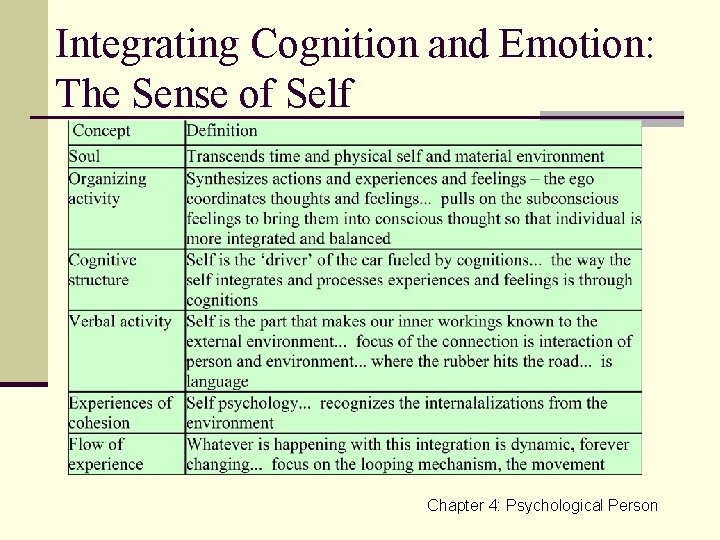
Integrating Cognition and Emotion: The Sense of Self Chapter 4: Psychological Person
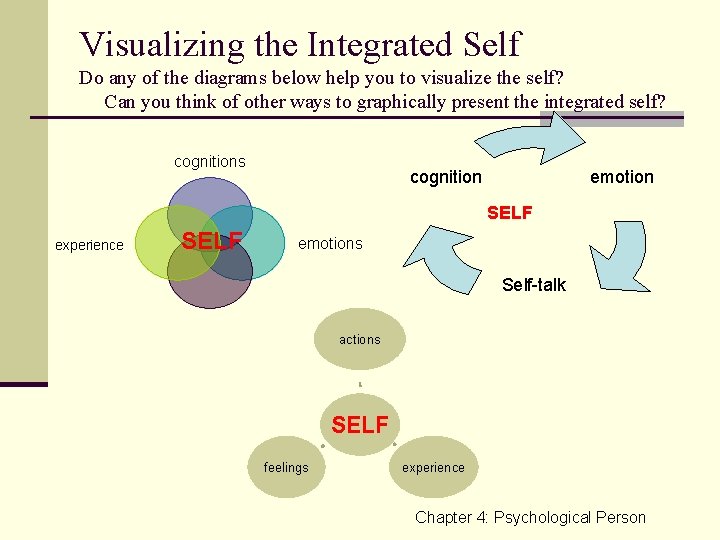
Visualizing the Integrated Self Do any of the diagrams below help you to visualize the self? Can you think of other ways to graphically present the integrated self? cognitions emotion cognition SELF experience SELF emotions Self-talk actions SELF feelings experience Chapter 4: Psychological Person
- Slides: 15