
DIMENSIONS GRIDS Steve Ward MA BCBA Whole Child

DIMENSIONS GRIDS Steve Ward, MA, BCBA Whole Child Consulting, LLC www. wholechildconsulting. com http: //www. facebook. com/wholechildconsulting
My student can’t/won’t _______, unless: • • • • • -
“My student can’t/won’t ______, • …and we have to work on grade level and we have to work for the 90 minute block and he can’t have any supports that the other students don’t have. ”
If consequences are truly working • You don’t need to be such an antecedent magician, and you probably shouldn’t be • If escape extinction, wait outs, or punishment are truly working, schools should almost never need them by Halloween. *Some on-going reactive measures may be necessary as you continue to “raise your bar”, but it these should be of minimal duration and of decreasing intrusion.
Reading and group responding • My student is behind in reading and doesn’t attend well in group

Your first dimensions grid (simple) Easier Harder 1: 1 or 1: 2 Larger groups Easy content (phonics, easy sight words, language) Harder content (blending, rhyming, “silent e”)
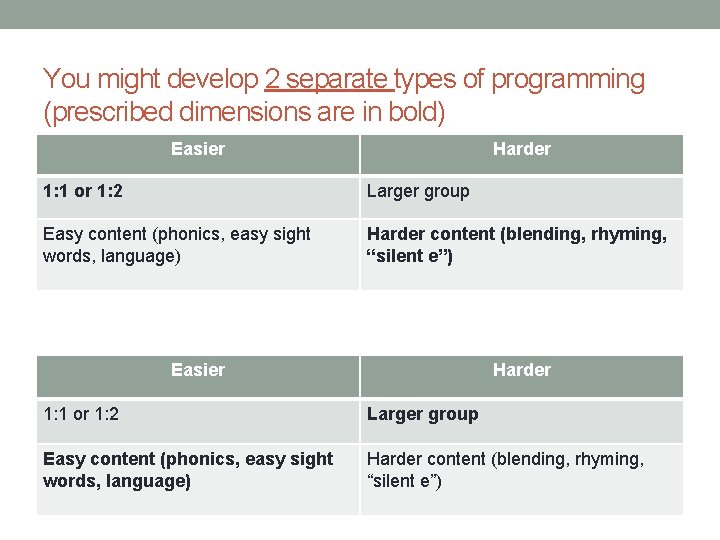
You might develop 2 separate types of programming (prescribed dimensions are in bold) Easier Harder 1: 1 or 1: 2 Larger group Easy content (phonics, easy sight words, language) Harder content (blending, rhyming, “silent e”)
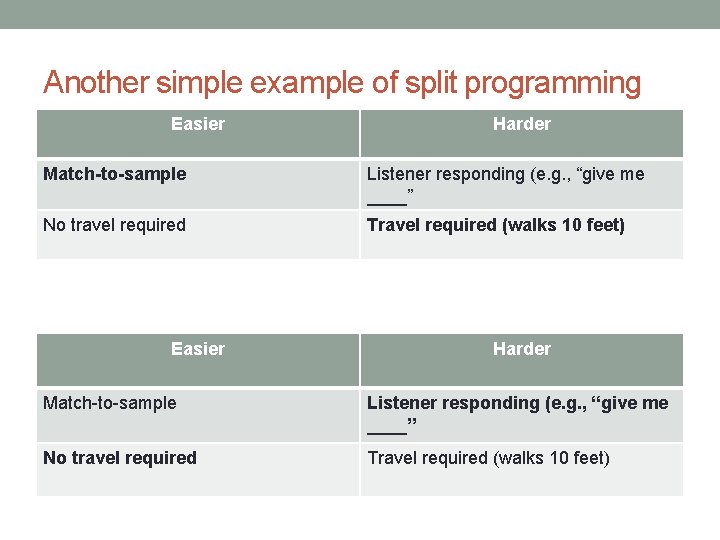
Another simple example of split programming Easier Harder Match-to-sample Listener responding (e. g. , “give me ____” No travel required Travel required (walks 10 feet)

A more complicated example (“Come here”) Easier Harder Short distances Long distances Can see potential reinforcer Cannot see potential reinforcer Is engaged in activity of modest interest Is engaged in high-interest activity Reinforcement for each success Occasional reinforcement Powerful reinforcer Weak reinforcer
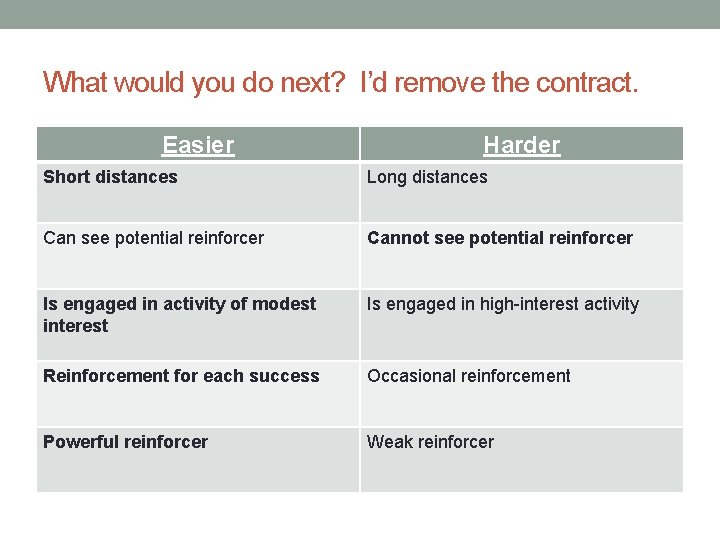
What would you do next? I’d remove the contract. Easier Harder Short distances Long distances Can see potential reinforcer Cannot see potential reinforcer Is engaged in activity of modest interest Is engaged in high-interest activity Reinforcement for each success Occasional reinforcement Powerful reinforcer Weak reinforcer
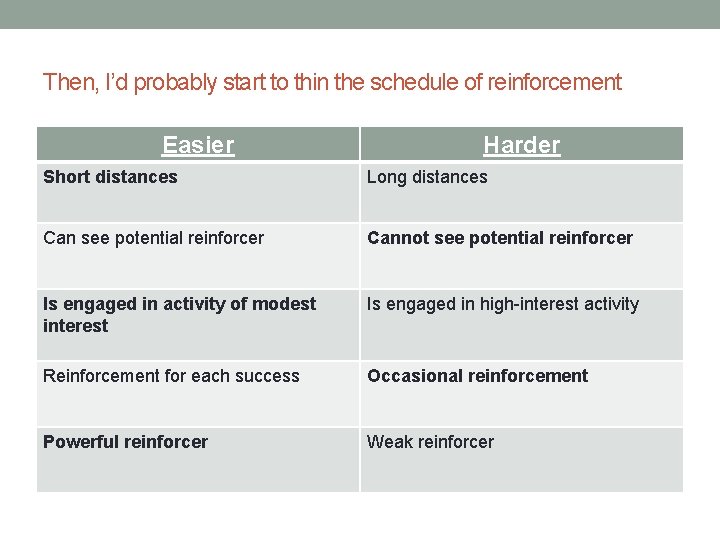
Then, I’d probably start to thin the schedule of reinforcement Easier Harder Short distances Long distances Can see potential reinforcer Cannot see potential reinforcer Is engaged in activity of modest interest Is engaged in high-interest activity Reinforcement for each success Occasional reinforcement Powerful reinforcer Weak reinforcer
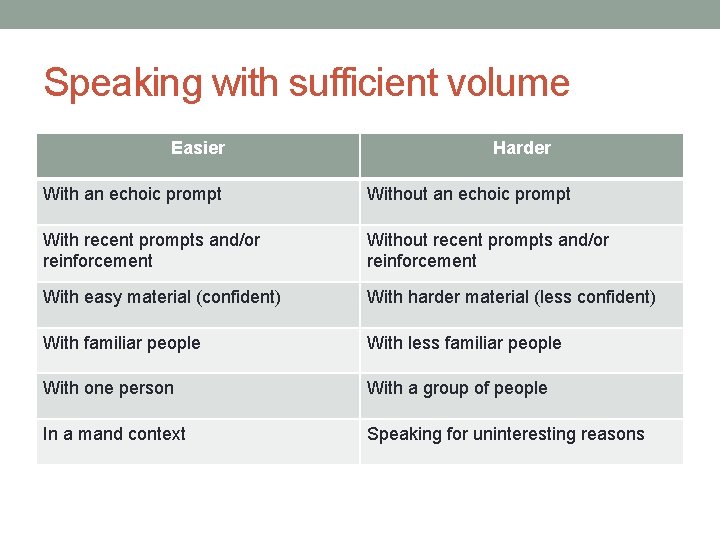
Speaking with sufficient volume Easier Harder With an echoic prompt Without an echoic prompt With recent prompts and/or reinforcement Without recent prompts and/or reinforcement With easy material (confident) With harder material (less confident) With familiar people With less familiar people With one person With a group of people In a mand context Speaking for uninteresting reasons
In case you’re not familiar
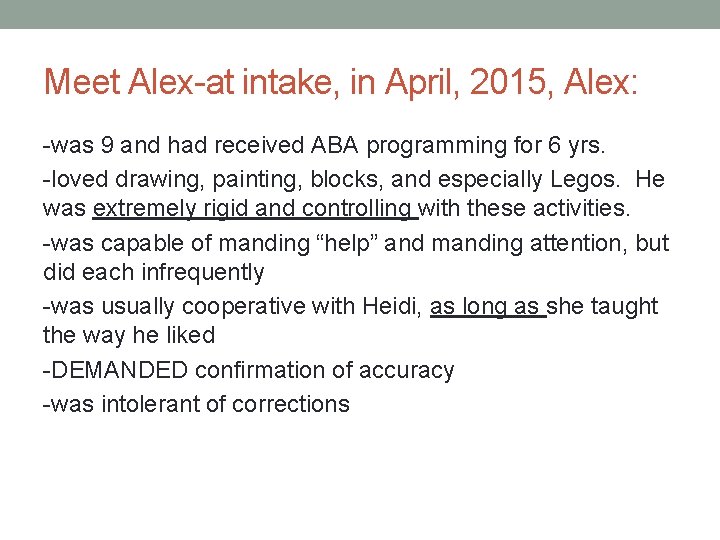
Meet Alex-at intake, in April, 2015, Alex: -was 9 and had received ABA programming for 6 yrs. -loved drawing, painting, blocks, and especially Legos. He was extremely rigid and controlling with these activities. -was capable of manding “help” and manding attention, but did each infrequently -was usually cooperative with Heidi, as long as she taught the way he liked -DEMANDED confirmation of accuracy -was intolerant of corrections
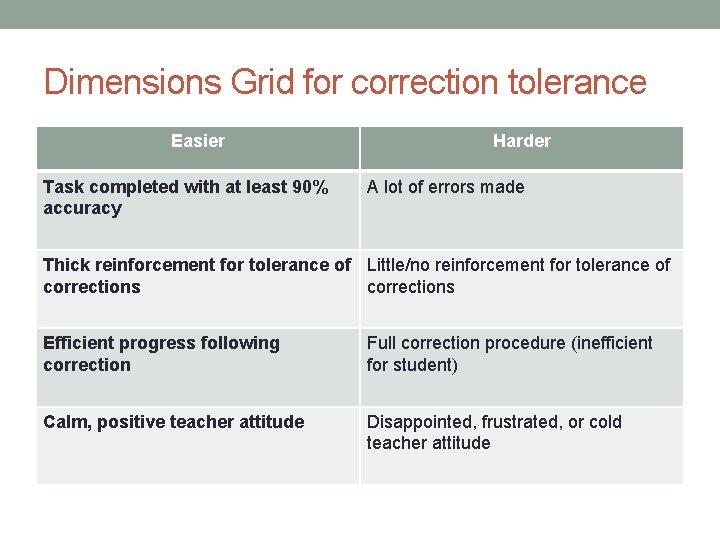
Dimensions Grid for correction tolerance Easier Task completed with at least 90% accuracy Harder A lot of errors made Thick reinforcement for tolerance of Little/no reinforcement for tolerance of corrections Efficient progress following correction Full correction procedure (inefficient for student) Calm, positive teacher attitude Disappointed, frustrated, or cold teacher attitude
Do you remember the first slides (i. e. , “My student can’t/won’t _____ unless…”)? • Dimensions Grids are also relevant to the other end of training (i. e. , mastery). • So, having seen Alex’s first video and first Dimensions Grid for tolerating corrections, would you say our job is done? Has he mastered tolerance of corrections?
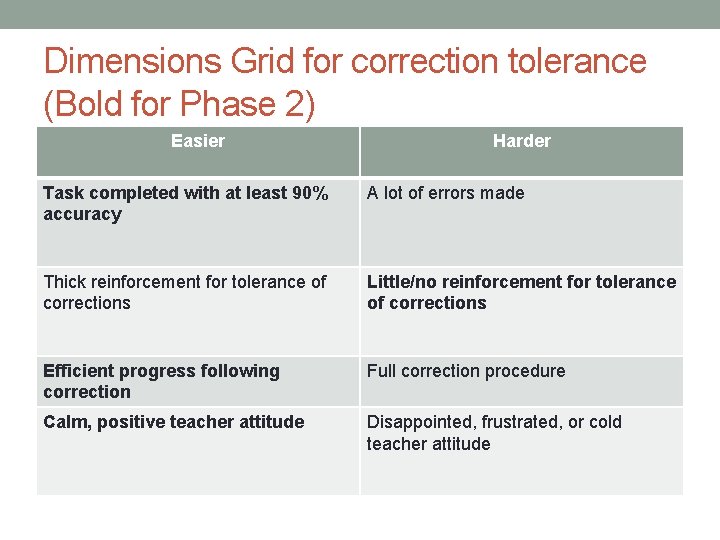
Dimensions Grid for correction tolerance (Bold for Phase 2) Easier Harder Task completed with at least 90% accuracy A lot of errors made Thick reinforcement for tolerance of corrections Little/no reinforcement for tolerance of corrections Efficient progress following correction Full correction procedure Calm, positive teacher attitude Disappointed, frustrated, or cold teacher attitude

Dimensions Grid for correction tolerance (Bold for Phase 3) Easier Harder Task completed with at least 90% accuracy A lot of errors made Thick reinforcement for tolerance of corrections Little/no reinforcement for tolerance of corrections Efficient progress following correction Full correction procedure (less efficient) Calm, positive teacher attitude Disappointed, frustrated, or cold teacher attitude
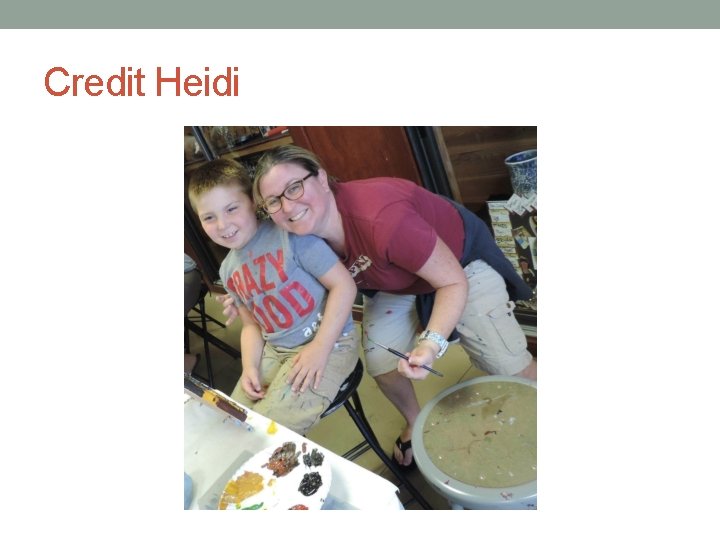
Credit Heidi
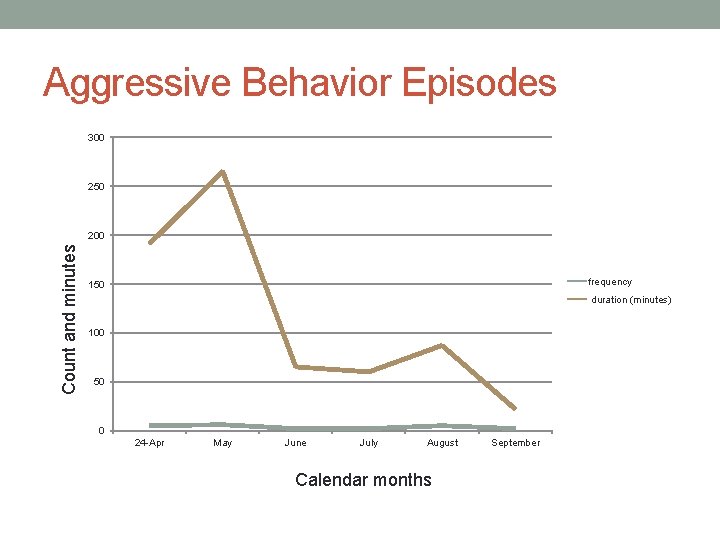
Aggressive Behavior Episodes 300 250 Count and minutes 200 frequency 150 duration (minutes) 100 50 0 24 -Apr May June July August Calendar months September
What would you like to target? Easier Harder
- Slides: 21