
Dimensionality reduction Usman Roshan Supervised dim reduction Linear
- Slides: 28
Dimensionality reduction Usman Roshan
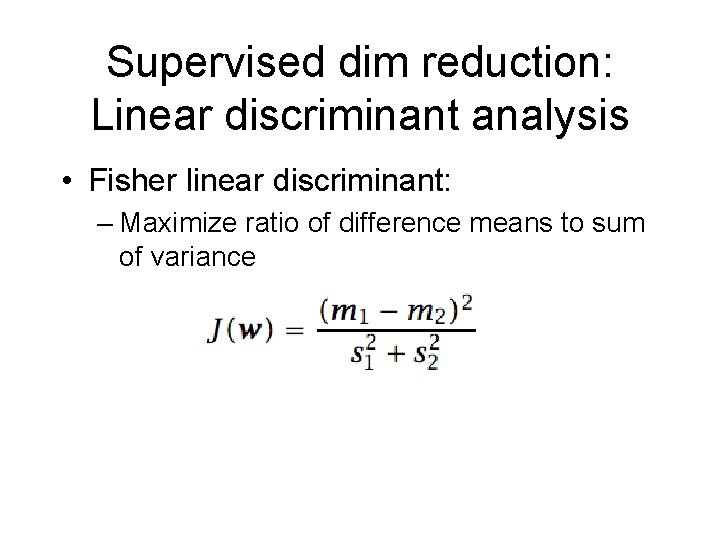
Supervised dim reduction: Linear discriminant analysis • Fisher linear discriminant: – Maximize ratio of difference means to sum of variance
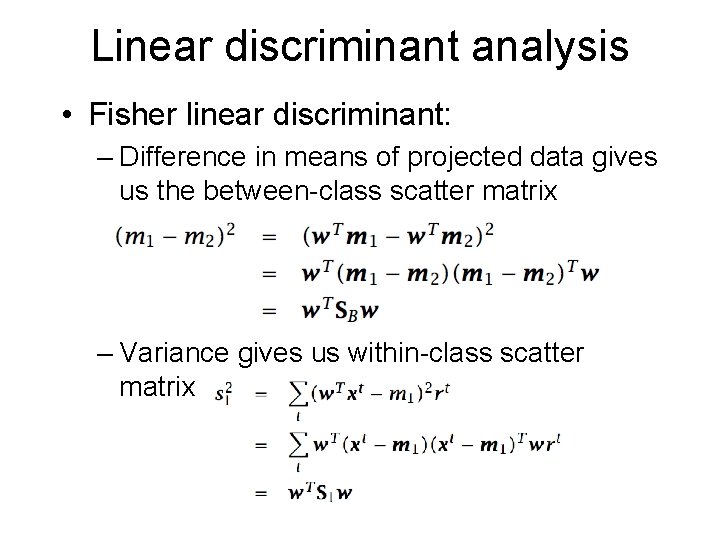
Linear discriminant analysis • Fisher linear discriminant: – Difference in means of projected data gives us the between-class scatter matrix – Variance gives us within-class scatter matrix
Linear discriminant analysis • Fisher linear discriminant solution: – Take derivative w. r. t. w and set to 0 – This gives us w = c. Sw-1(m 1 -m 2)
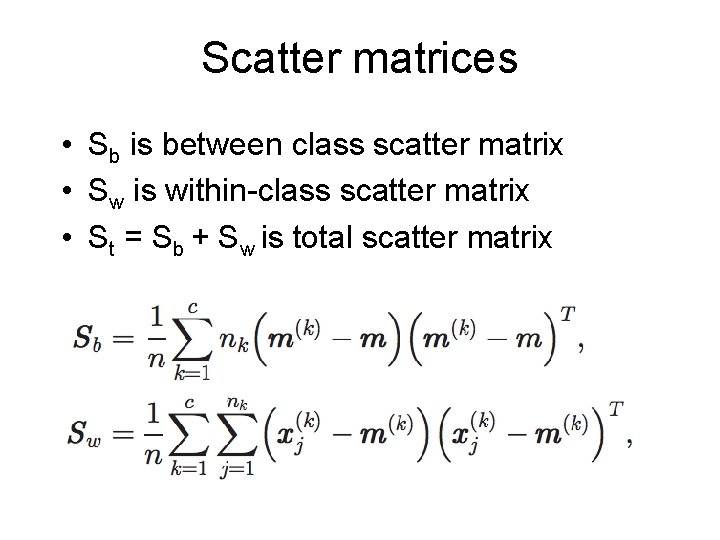
Scatter matrices • Sb is between class scatter matrix • Sw is within-class scatter matrix • St = Sb + Sw is total scatter matrix
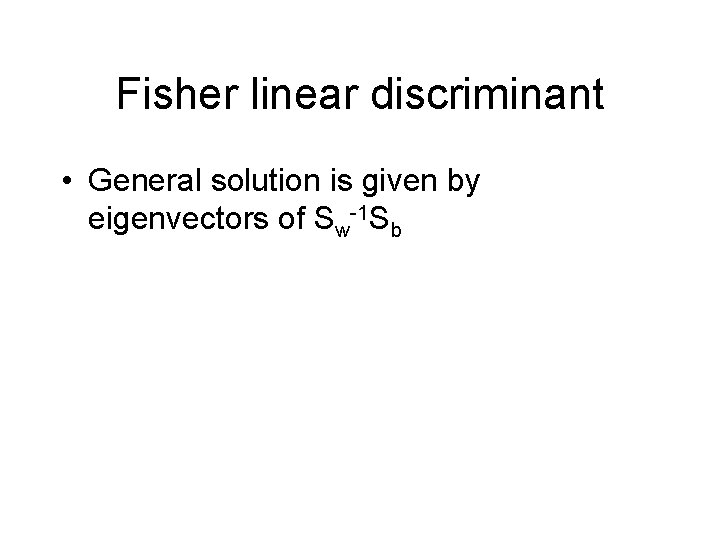
Fisher linear discriminant • General solution is given by eigenvectors of Sw-1 Sb
Fisher linear discriminant • Computational problems can happen with calculating the inverse • A different approach is the maximum margin criterion
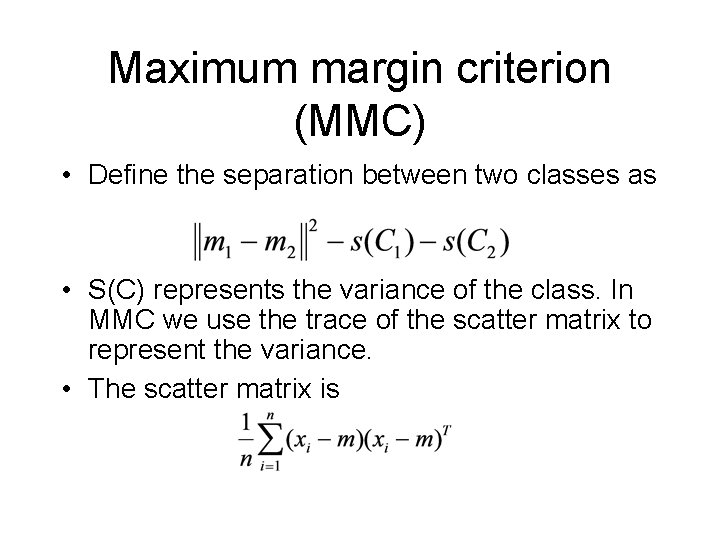
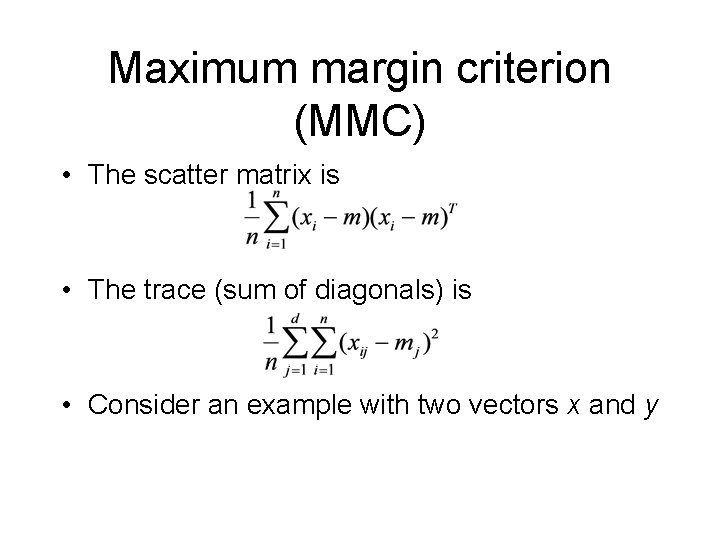
Maximum margin criterion (MMC) • Define the separation between two classes as • S(C) represents the variance of the class. In MMC we use the trace of the scatter matrix to represent the variance. • The scatter matrix is
Maximum margin criterion (MMC) • The scatter matrix is • The trace (sum of diagonals) is • Consider an example with two vectors x and y
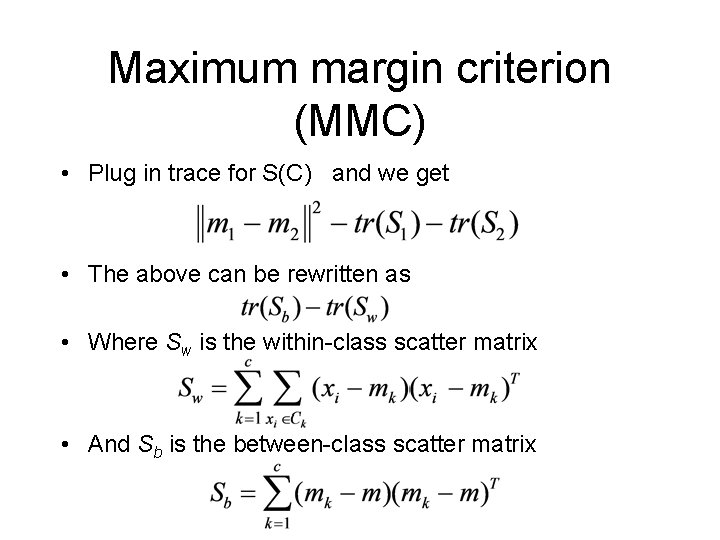
Maximum margin criterion (MMC) • Plug in trace for S(C) and we get • The above can be rewritten as • Where Sw is the within-class scatter matrix • And Sb is the between-class scatter matrix
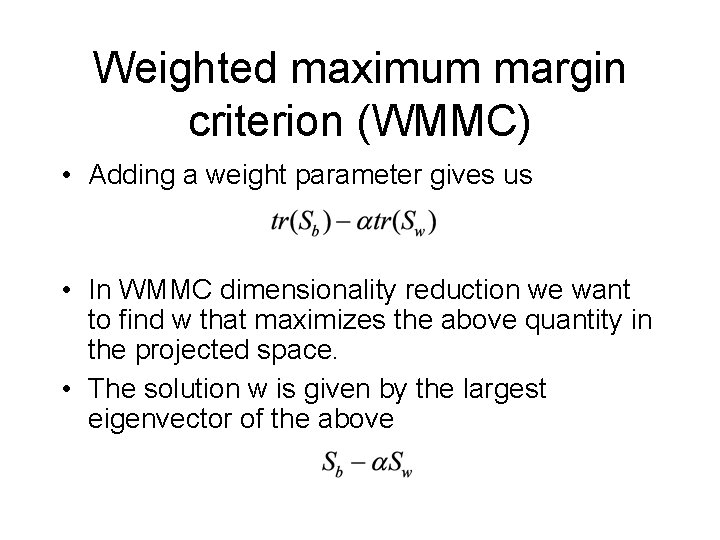
Weighted maximum margin criterion (WMMC) • Adding a weight parameter gives us • In WMMC dimensionality reduction we want to find w that maximizes the above quantity in the projected space. • The solution w is given by the largest eigenvector of the above
How to use WMMC for classification? • Reduce dimensionality to fewer features • Run any classification algorithm like nearest means or nearest neighbor.
K-nearest neighbor • Classify a given datapoint to be the majority label of the k closest points • The parameter k is cross-validated • Simple yet can obtain high classification accuracy
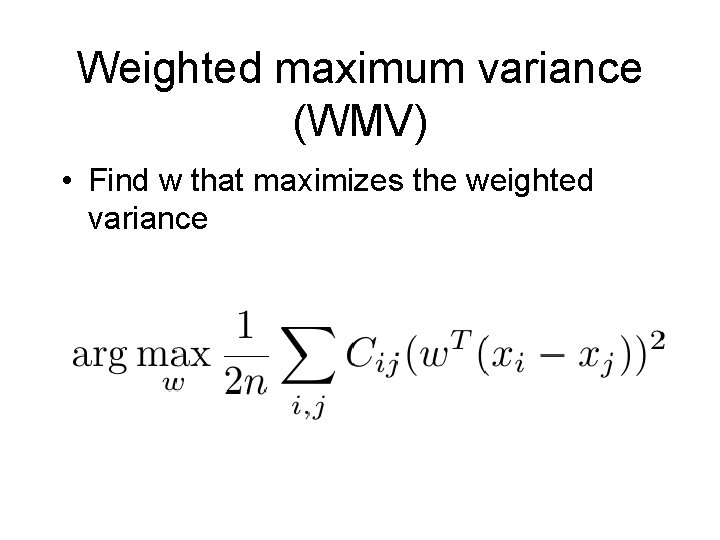
Weighted maximum variance (WMV) • Find w that maximizes the weighted variance
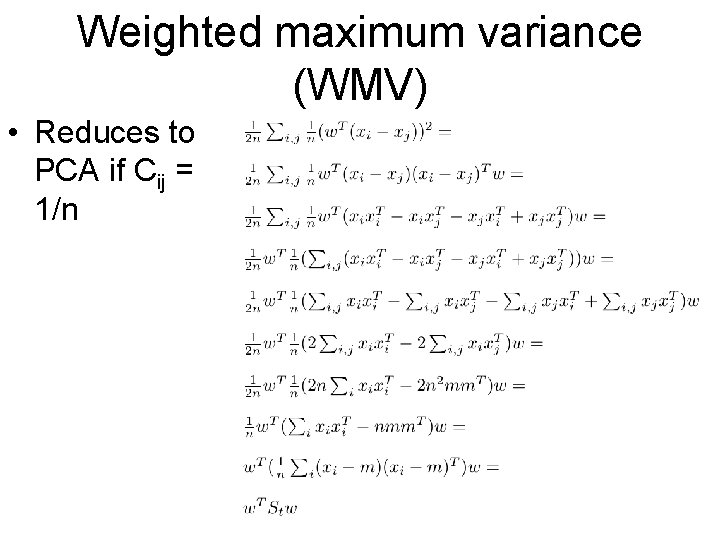
Weighted maximum variance (WMV) • Reduces to PCA if Cij = 1/n
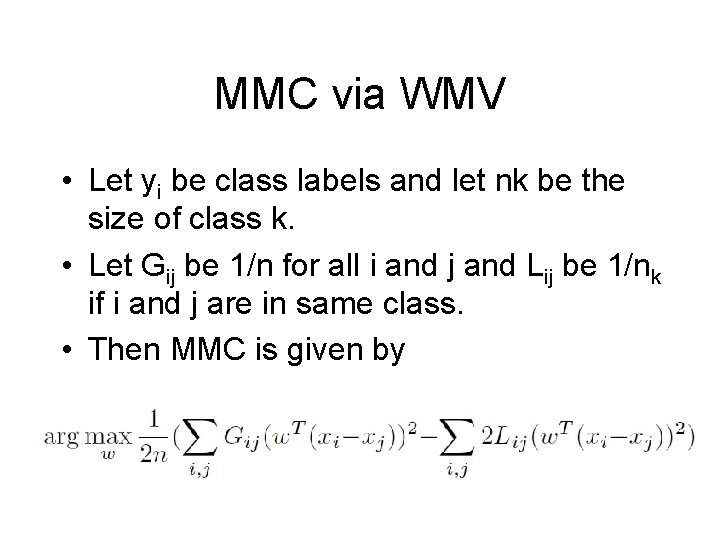
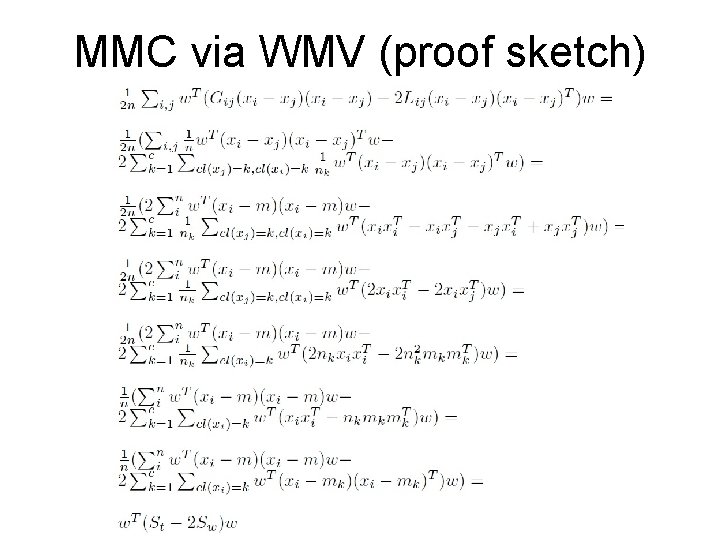
MMC via WMV • Let yi be class labels and let nk be the size of class k. • Let Gij be 1/n for all i and j and Lij be 1/nk if i and j are in same class. • Then MMC is given by
MMC via WMV (proof sketch)
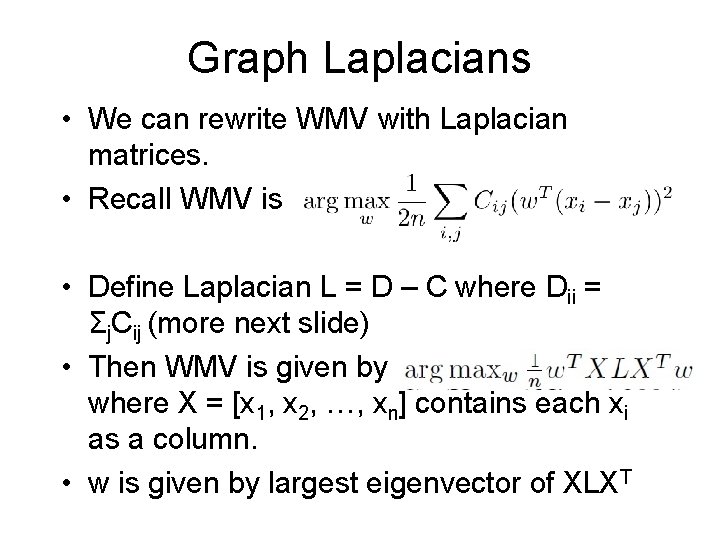
Graph Laplacians • We can rewrite WMV with Laplacian matrices. • Recall WMV is • Define Laplacian L = D – C where Dii = Σj. Cij (more next slide) • Then WMV is given by where X = [x 1, x 2, …, xn] contains each xi as a column. • w is given by largest eigenvector of XLXT
Graph Laplacians • Widely used in spectral clustering (see tutorial on course website) • Weights Cij may be obtained via – Epsilon neighborhood graph – K-nearest neighbor graph – Fully connected graph • Allows semi-supervised analysis (where test data is available but not labels)
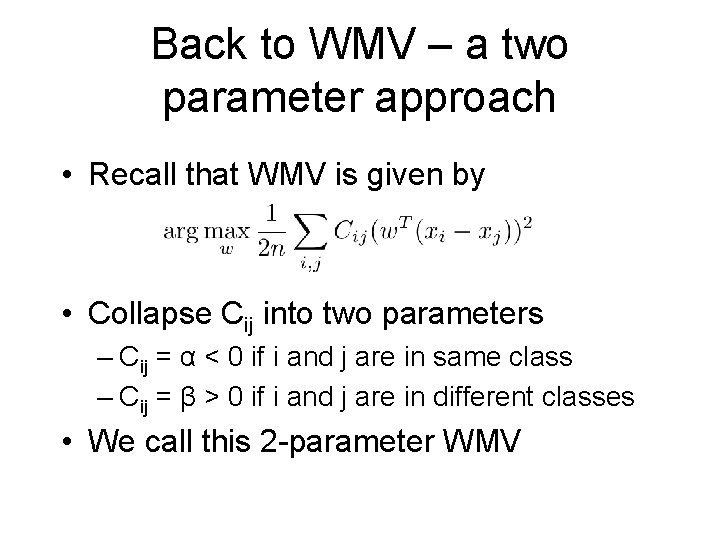
Back to WMV – a two parameter approach • Recall that WMV is given by • Collapse Cij into two parameters – Cij = α < 0 if i and j are in same class – Cij = β > 0 if i and j are in different classes • We call this 2 -parameter WMV
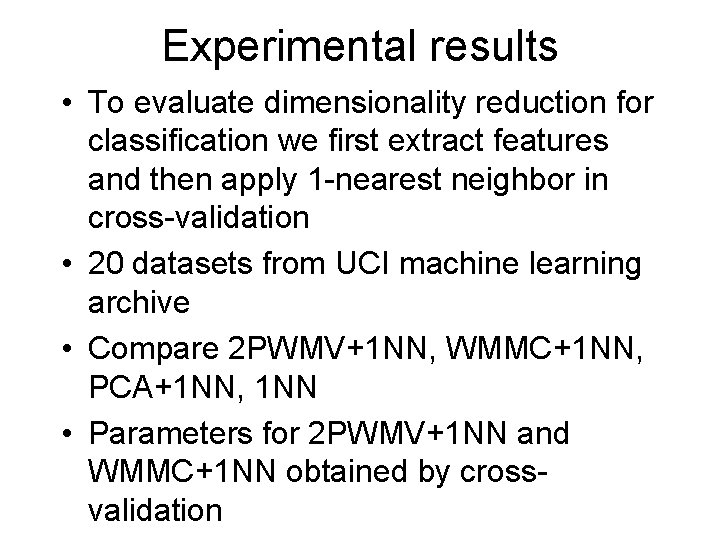
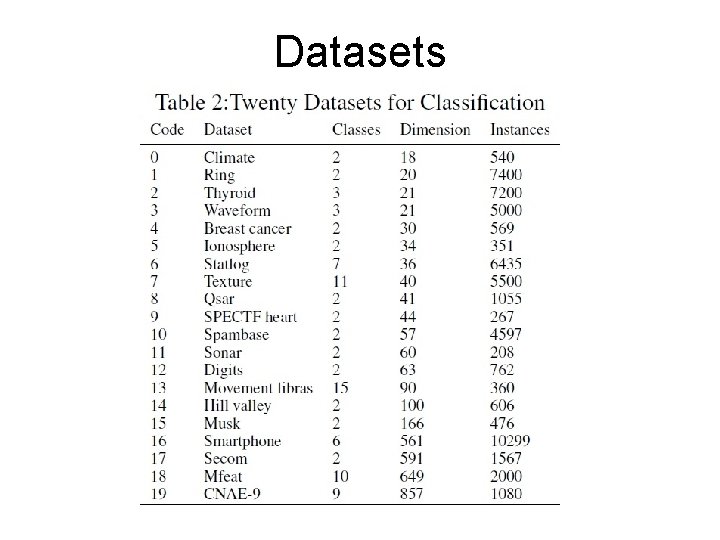
Experimental results • To evaluate dimensionality reduction for classification we first extract features and then apply 1 -nearest neighbor in cross-validation • 20 datasets from UCI machine learning archive • Compare 2 PWMV+1 NN, WMMC+1 NN, PCA+1 NN, 1 NN • Parameters for 2 PWMV+1 NN and WMMC+1 NN obtained by crossvalidation
Datasets
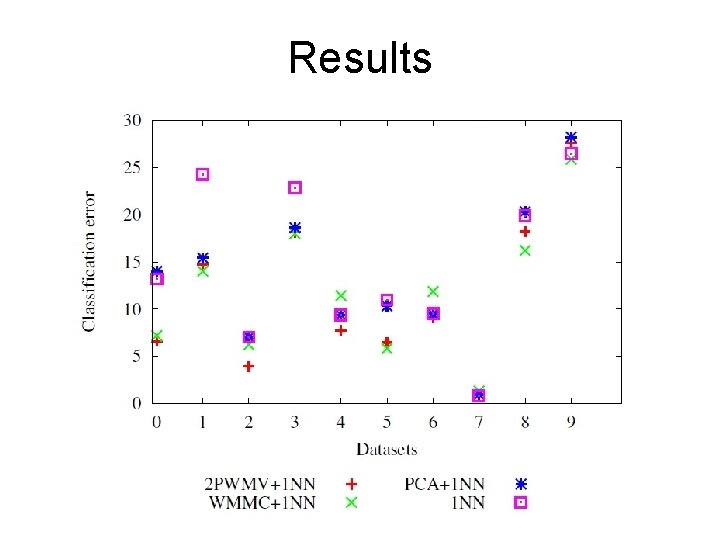
Results
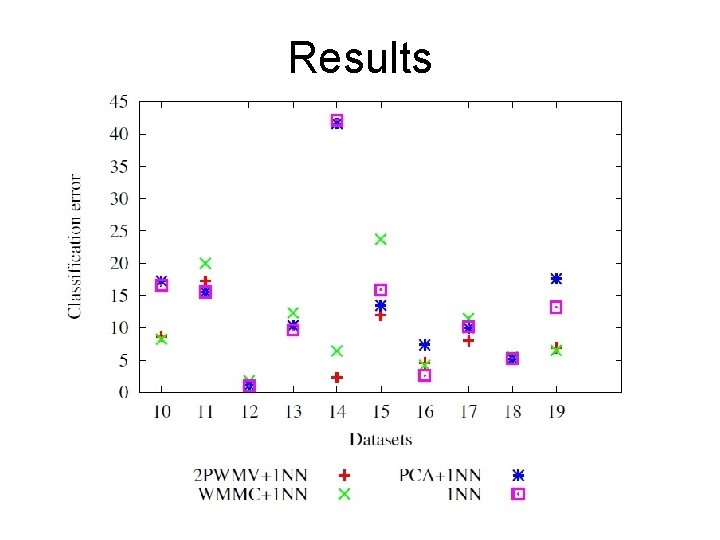
Results
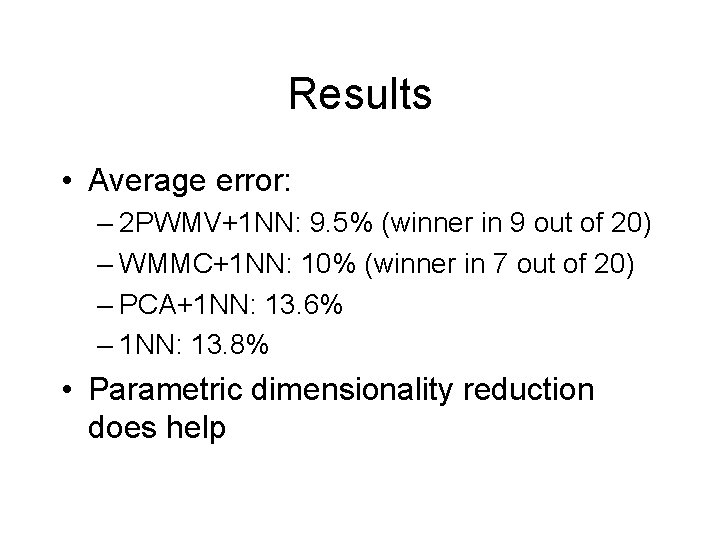
Results • Average error: – 2 PWMV+1 NN: 9. 5% (winner in 9 out of 20) – WMMC+1 NN: 10% (winner in 7 out of 20) – PCA+1 NN: 13. 6% – 1 NN: 13. 8% • Parametric dimensionality reduction does help
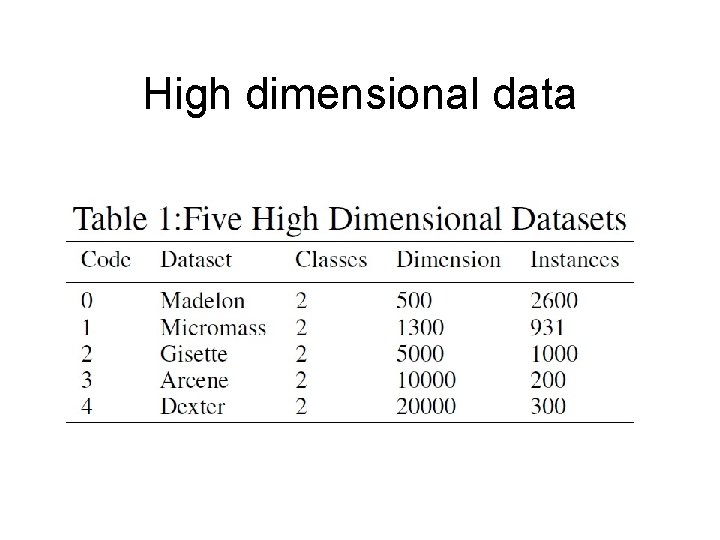
High dimensional data
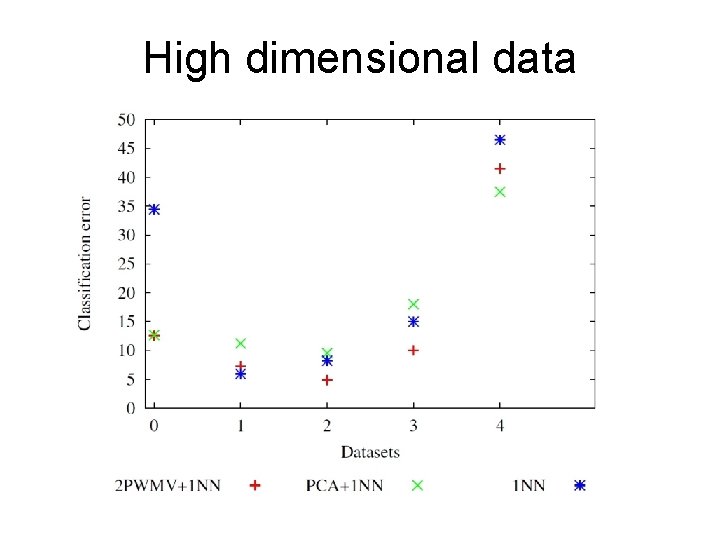
High dimensional data
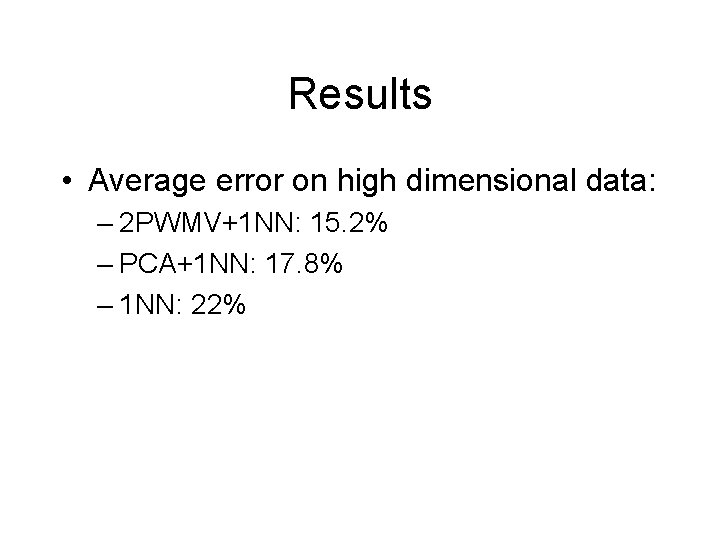
Results • Average error on high dimensional data: – 2 PWMV+1 NN: 15. 2% – PCA+1 NN: 17. 8% – 1 NN: 22%