
Dimensionality in Combined Visible to TIR Imagery National
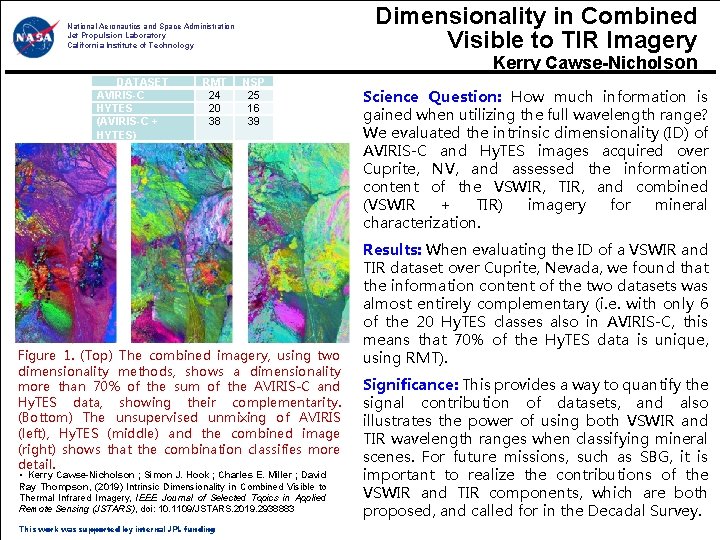
Dimensionality in Combined Visible to TIR Imagery National Aeronautics and Space Administration Jet Propulsion Laboratory California Institute of Technology Kerry Cawse-Nicholson DATASET AVIRIS-C HYTES (AVIRIS-C + HYTES) RMT 24 20 38 NSP 25 16 39 Figure 1. (Top) The combined imagery, using two dimensionality methods, shows a dimensionality more than 70% of the sum of the AVIRIS-C and Hy. TES data, showing their complementarity. (Bottom) The unsupervised unmixing of AVIRIS (left), Hy. TES (middle) and the combined image (right) shows that the combination classifies more detail. • Kerry Cawse-Nicholson ; Simon J. Hook ; Charles E. Miller ; David Ray Thompson, (2019) Intrinsic Dimensionality in Combined Visible to Thermal Infrared Imagery, IEEE Journal of Selected Topics in Applied Remote Sensing (JSTARS), doi: 10. 1109/JSTARS. 2019. 2938883 This work was supported by internal JPL funding Science Question: How much information is gained when utilizing the full wavelength range? We evaluated the intrinsic dimensionality (ID) of AVIRIS-C and Hy. TES images acquired over Cuprite, NV, and assessed the information content of the VSWIR, TIR, and combined (VSWIR + TIR) imagery for mineral characterization. Results: When evaluating the ID of a VSWIR and TIR dataset over Cuprite, Nevada, we found that the information content of the two datasets was almost entirely complementary (i. e. with only 6 of the 20 Hy. TES classes also in AVIRIS-C, this means that 70% of the Hy. TES data is unique, using RMT). Significance: This provides a way to quantify the signal contribution of datasets, and also illustrates the power of using both VSWIR and TIR wavelength ranges when classifying mineral scenes. For future missions, such as SBG, it is important to realize the contributions of the VSWIR and TIR components, which are both proposed, and called for in the Decadal Survey.
National Aeronautics and Space Administration Jet Propulsion Laboratory California Institute of Technology Contact: Kerry Cawse-Nicholson, 183 -503, Jet Propulsion Laboratory, Pasadena, CA 91109 kcawseni@jpl. nasa. gov Citation: K. Cawse-Nicholson, J. B. Fisher, C. A. Famiglietti, A. Braverman, F. M. Schwandner, J. L. Lewicki, P. A. Townsend, D. S. Schimel, R. Pavlick, K. J. Bormann, A. Ferraz, E. L. Kang, P. Ma, R. R. Bogue, T. Youmans, D. C. Pieri, (2018) Ecosystem responses to elevated CO 2 using airborne remote sensing at Mammoth Mountain, California, Biogeosciences, 15 (24) pp. 7403 -7418. doi: 10. 5194/bg-15 -7403 -2018 Data Sources: • Soil CO 2 data are the property of the USGS and may be requested through Cynthia Werner at the USGS. • AVIRIS data are available by searching for flight line f 141021 t 01 p 00 r 05 at https: //aviris. jpl. nasa. gov/alt_locator/. • MASTER data are available via https: //masterprojects. jpl. nasa. gov/L 2_Products. TS 6 (flight ID 14 -903 -00; line 02). • Lidar data used in this study are the property of the Airborne Snow Observatory and may be obtained. CE 3 through Kat Bormann at JPL. Technical Description of Figure: The normalized difference vegetation index (NDVI) is modelled using CO 2 as a predictor, and accounting for confounding factors, such as slope, aspect, and elevation. NDVI decreases with increasing CO 2, showing a change in plant function and composition with long-term exposure to elevated CO 2. Scientific significance, societal relevance, and relationships to future missions: We have shown that passively emitting volcanic systems are viable environments in which to study CO 2 impacts on ecosystems, with CO 2 the most significant predictor in regression ensemble models of several ecological variables, including NDVI, canopy nitrogen concentration, ET, and biomass. We have shown that a combination of different remote sensing platforms is capable of providing a comprehensive view of ecosystem responses to long-term elevated volcanic CO 2.
- Slides: 2