
Dimensional Analysis Unit conversions to powerfully solve problems
Dimensional Analysis Unit conversions to powerfully solve problems.
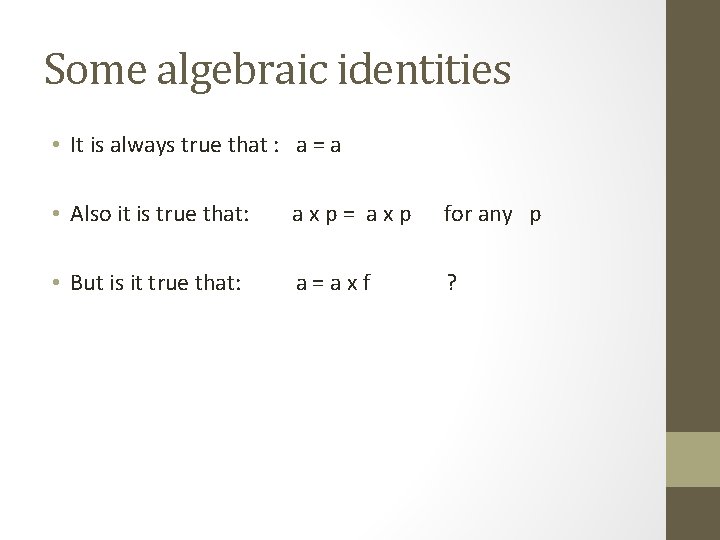
Some algebraic identities • It is always true that : a = a • Also it is true that: axp= axp for any p • But is it true that: a=axf ?
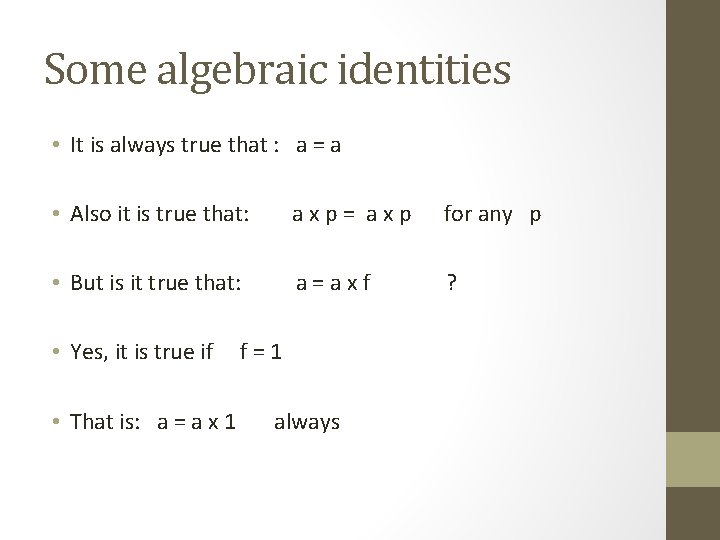
Some algebraic identities • It is always true that : a = a • Also it is true that: axp= axp for any p • But is it true that: a=axf ? • Yes, it is true if • That is: a = a x 1 f=1 always
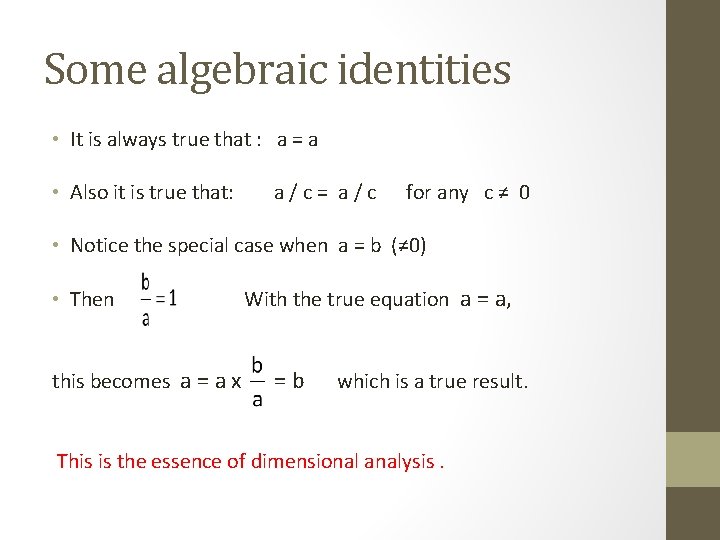
Some algebraic identities • It is always true that : a = a • Also it is true that: a/c= a/c for any c ≠ 0 • Notice the special case when a = b (≠ 0) • Then this becomes a = a x With the true equation a = a, =b which is a true result. This is the essence of dimensional analysis.
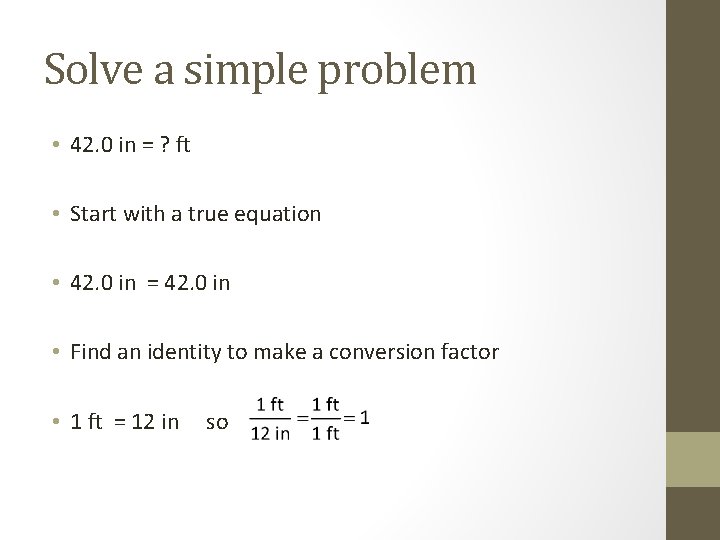
Solve a simple problem • 42. 0 in = ? ft • Start with a true equation • 42. 0 in = 42. 0 in • Find an identity to make a conversion factor • 1 ft = 12 in so
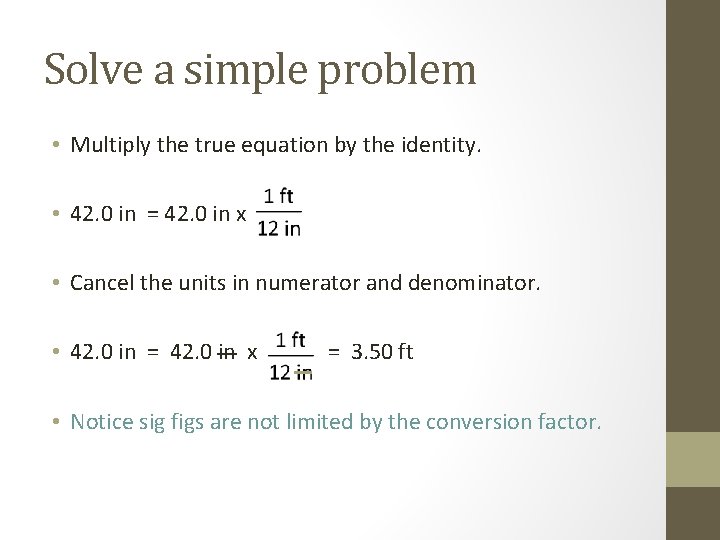
Solve a simple problem • Multiply the true equation by the identity. • 42. 0 in = 42. 0 in x • Cancel the units in numerator and denominator. • 42. 0 in = 42. 0 in x = 3. 50 ft • Notice sig figs are not limited by the conversion factor.
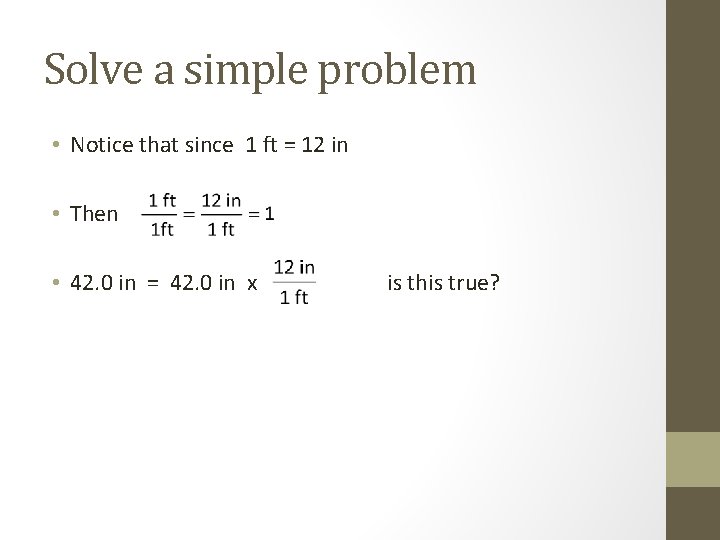
Solve a simple problem • Notice that since 1 ft = 12 in • Then • 42. 0 in = 42. 0 in x is this true?
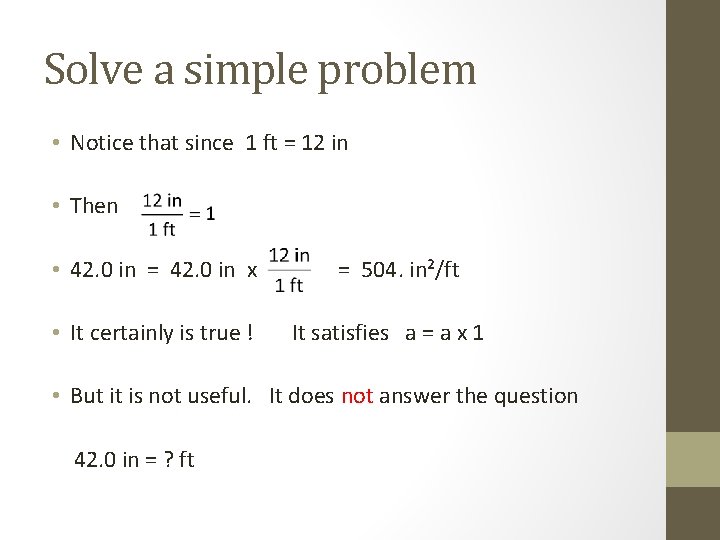
Solve a simple problem • Notice that since 1 ft = 12 in • Then • 42. 0 in = 42. 0 in x • It certainly is true ! = 504. in²/ft It satisfies a = a x 1 • But it is not useful. It does not answer the question 42. 0 in = ? ft
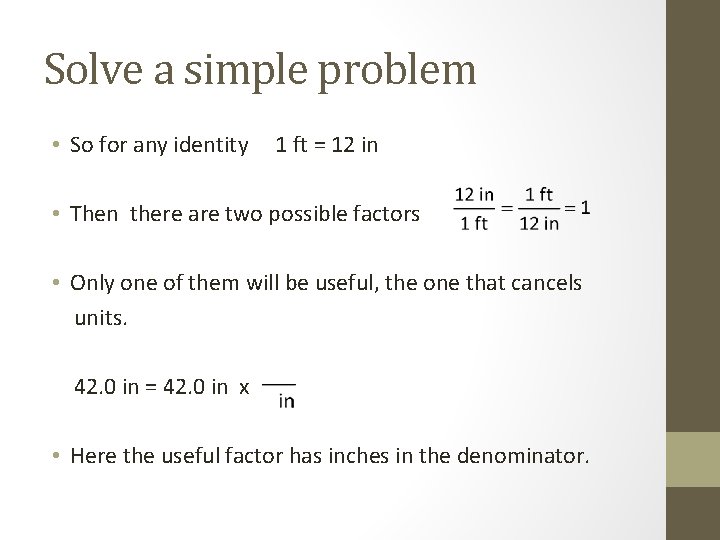
Solve a simple problem • So for any identity 1 ft = 12 in • Then there are two possible factors • Only one of them will be useful, the one that cancels units. 42. 0 in = 42. 0 in x • Here the useful factor has inches in the denominator.
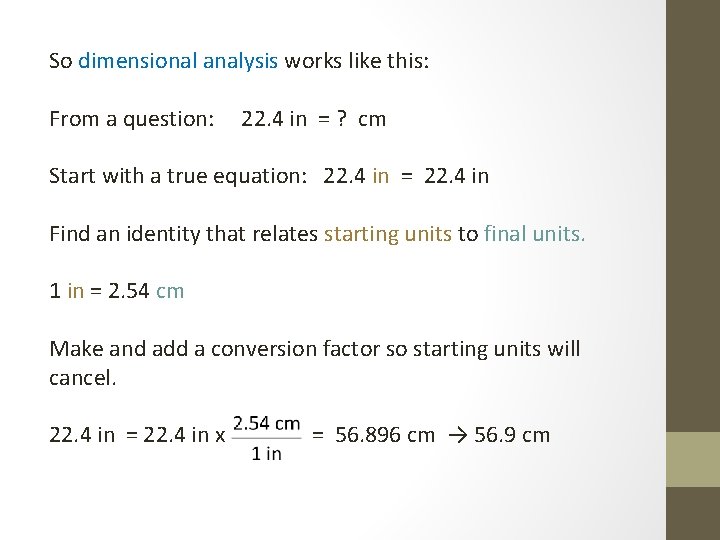
So dimensional analysis works like this: From a question: 22. 4 in = ? cm Start with a true equation: 22. 4 in = 22. 4 in Find an identity that relates starting units to final units. 1 in = 2. 54 cm Make and add a conversion factor so starting units will cancel. 22. 4 in = 22. 4 in x = 56. 896 cm → 56. 9 cm
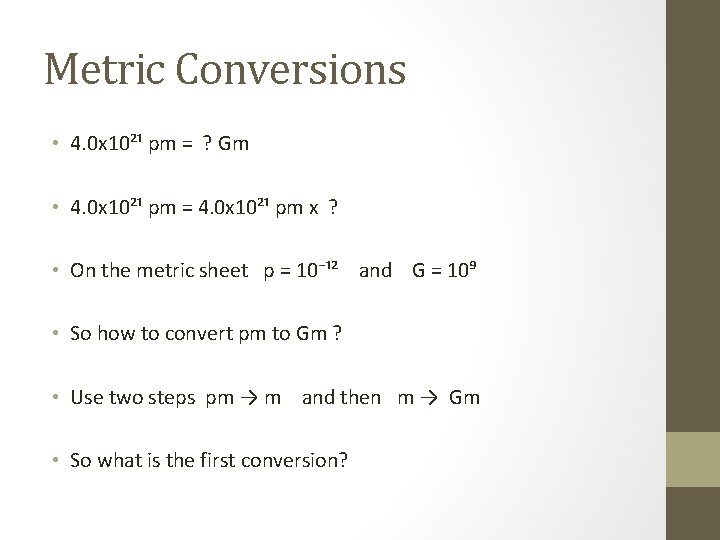
Metric Conversions • 4. 0 x 10²¹ pm = ? Gm • 4. 0 x 10²¹ pm = 4. 0 x 10²¹ pm x ? • On the metric sheet p = 10⁻¹² and G = 10⁹ • So how to convert pm to Gm ? • Use two steps pm → m and then m → Gm • So what is the first conversion?
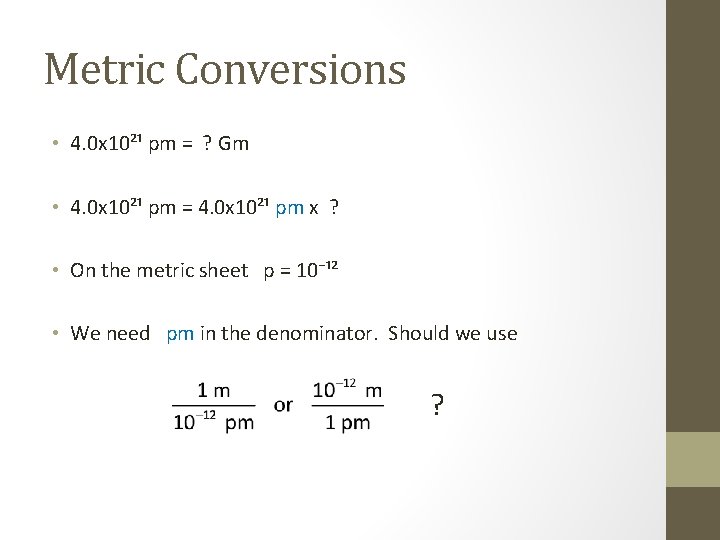
Metric Conversions • 4. 0 x 10²¹ pm = ? Gm • 4. 0 x 10²¹ pm = 4. 0 x 10²¹ pm x ? • On the metric sheet p = 10⁻¹² • We need pm in the denominator. Should we use ?
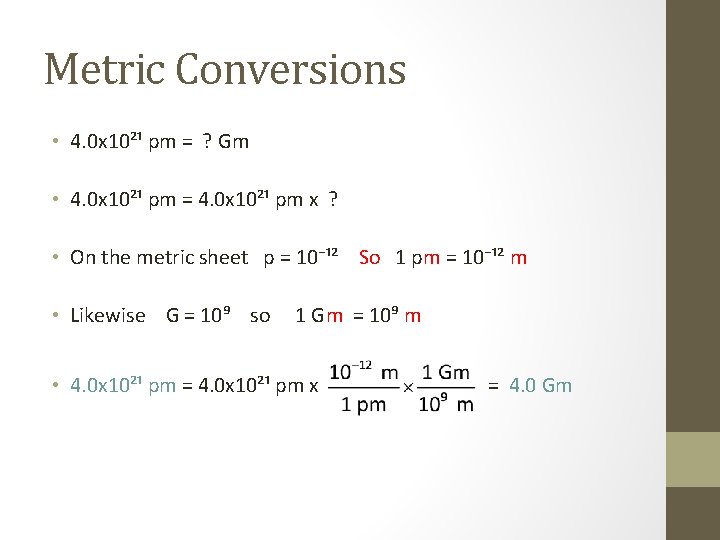
Metric Conversions • 4. 0 x 10²¹ pm = ? Gm • 4. 0 x 10²¹ pm = 4. 0 x 10²¹ pm x ? • On the metric sheet p = 10⁻¹² So 1 pm = 10⁻¹² m • Likewise G = 10⁹ so 1 Gm = 10⁹ m • 4. 0 x 10²¹ pm = 4. 0 x 10²¹ pm x = 4. 0 Gm
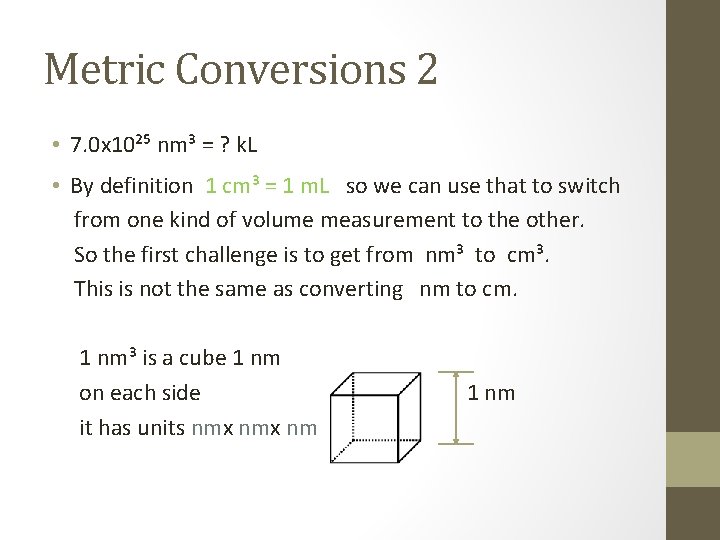
Metric Conversions 2 • 7. 0 x 10²⁵ nm³ = ? k. L • By definition 1 cm³ = 1 m. L so we can use that to switch from one kind of volume measurement to the other. So the first challenge is to get from nm³ to cm³. This is not the same as converting nm to cm. 1 nm³ is a cube 1 nm on each side it has units nmx nm 1 nm
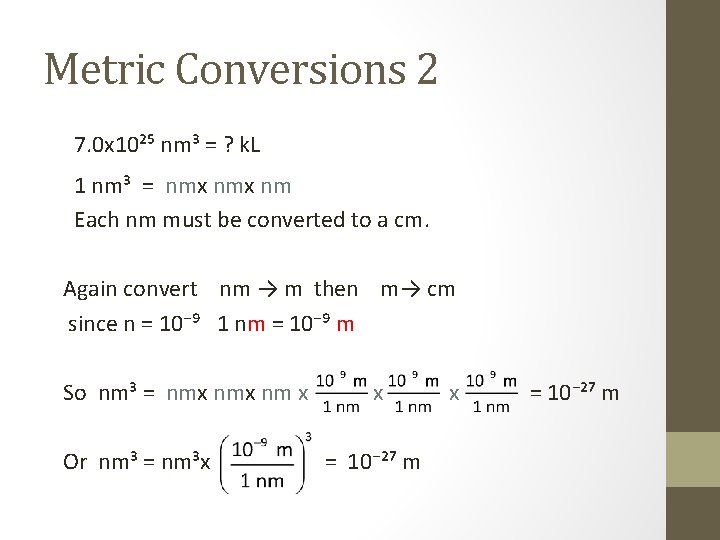
Metric Conversions 2 7. 0 x 10²⁵ nm³ = ? k. L 1 nm³ = nmx nm Each nm must be converted to a cm. Again convert nm → m then m→ cm since n = 10⁻⁹ 1 nm = 10⁻⁹ m So nm³ = nmx nm x Or nm³ = nm³x x = 10⁻²⁷ m
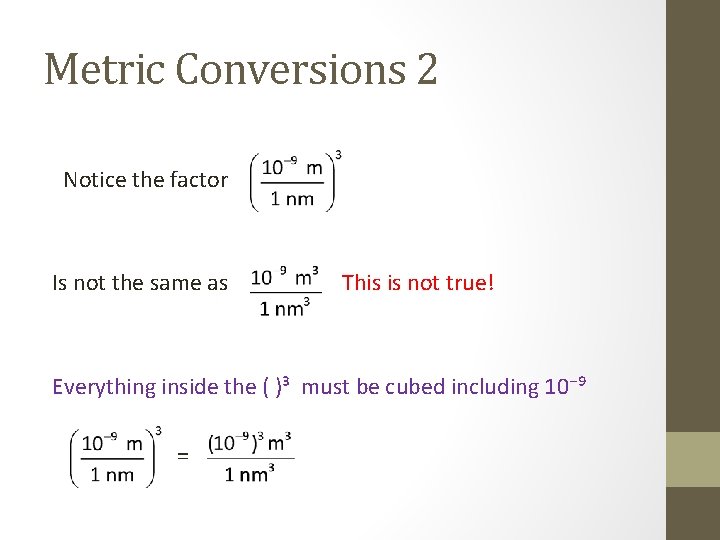
Metric Conversions 2 Notice the factor Is not the same as This is not true! Everything inside the ( )³ must be cubed including 10⁻⁹ =
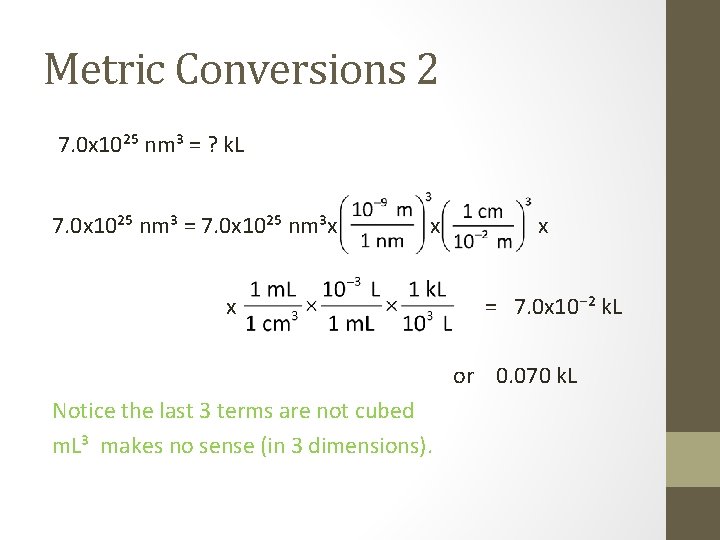
Metric Conversions 2 7. 0 x 10²⁵ nm³ = ? k. L 7. 0 x 10²⁵ nm³ = 7. 0 x 10²⁵ nm³x x = 7. 0 x 10⁻² k. L or 0. 070 k. L Notice the last 3 terms are not cubed m. L³ makes no sense (in 3 dimensions).
Solving Word Problems • Dimensional Analysis solves problems of the form: • Number units 1 = ? units 2 • Story problems can be solved by the same methods if the question can be converted to this form. The remainder of the problem is used to make conversion to arrive at a solution. Consider the following problem: A 500 sheet stack of paper has thickness 1. 45 inches. How many sheets of paper are in a stack 2. 50 inches thick?
Solving Word Problems A 500 sheet stack of paper has thickness 1. 45 inches. How many sheets of paper are in a stack 2. 50 inches thick? Rewrite the question in the form _______ = ? ___ The question often has a “? ” mark. Usually the units after ? is the easiest to determine. Think of the “? ” as meaning “how many”. So the question is: 2. 50 in = ? sheets 2. 50 is the only number in the question.
Solving Word Problems A 500 sheet stack of paper has thickness 1. 45 inches. How many sheets of paper are in a stack 2. 50 inches thick? So this question is rewritten as: 2. 50 in = ? sheets The conversion factor will come from the statement. It obviously means: 500 sheets = 1. 45 in To have 1. 45 in of paper is to have 500 sheets. The two are equivalent.
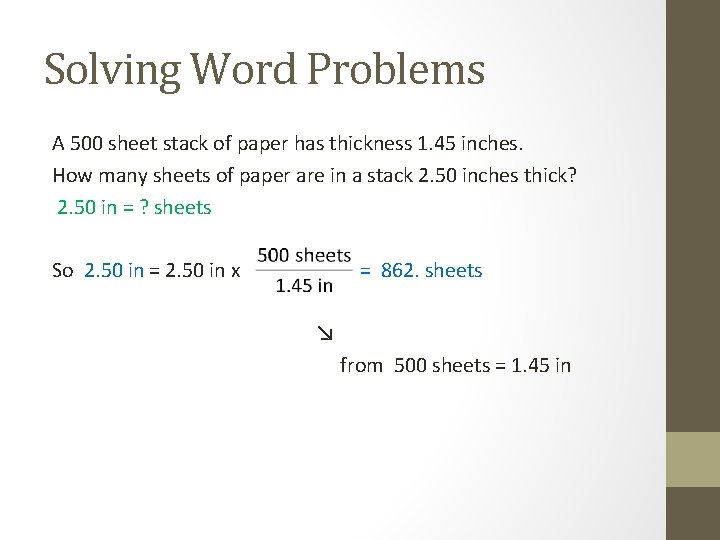
Solving Word Problems A 500 sheet stack of paper has thickness 1. 45 inches. How many sheets of paper are in a stack 2. 50 inches thick? 2. 50 in = ? sheets So 2. 50 in = 2. 50 in x = 862. sheets ↘ from 500 sheets = 1. 45 in
Solving Word Problems 2 Ethyl alcohol has density 0. 789 g / m. L. Calculate the mass of 25. 0 m. L of ethyl alcohol. Rewrite the question as ____ = ? ____ where “? ” means “how many”. There is no direct question, but “calculate” is an indirect question about finding the mass. It makes no sense to ask “how many mass”, so the question needs units. The only mass units in the whole problem is “g” for grams. So we should ask “how many grams” = ? g.
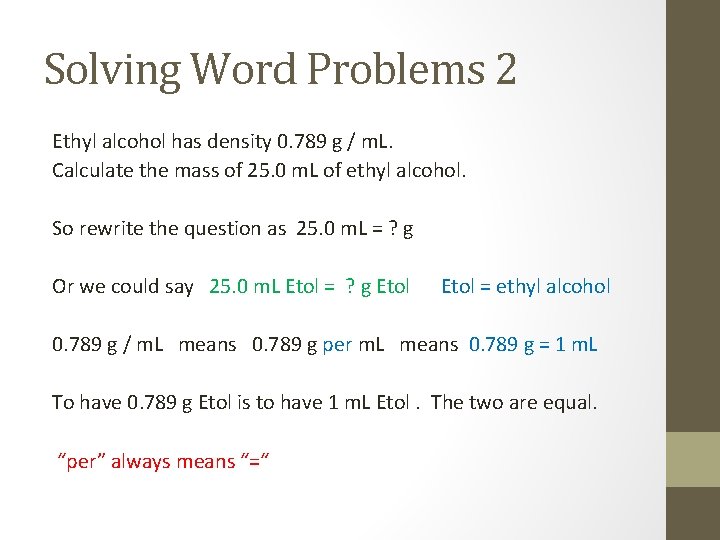
Solving Word Problems 2 Ethyl alcohol has density 0. 789 g / m. L. Calculate the mass of 25. 0 m. L of ethyl alcohol. So rewrite the question as 25. 0 m. L = ? g Or we could say 25. 0 m. L Etol = ? g Etol = ethyl alcohol 0. 789 g / m. L means 0. 789 g per m. L means 0. 789 g = 1 m. L To have 0. 789 g Etol is to have 1 m. L Etol. The two are equal. “per” always means “=“
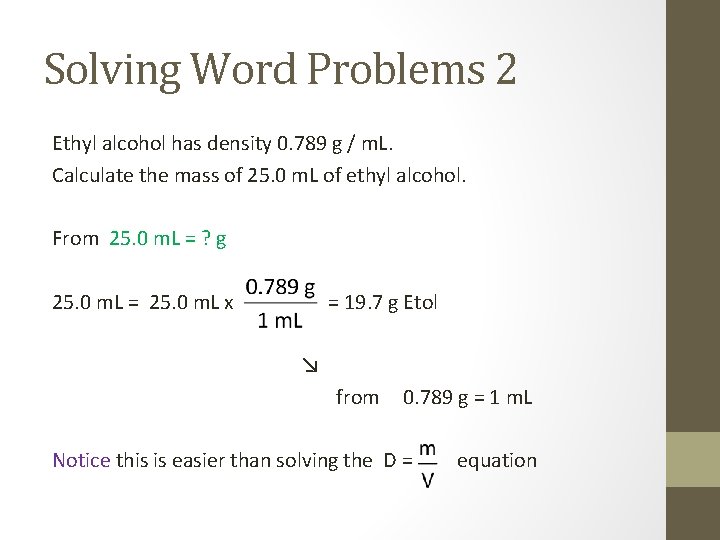
Solving Word Problems 2 Ethyl alcohol has density 0. 789 g / m. L. Calculate the mass of 25. 0 m. L of ethyl alcohol. From 25. 0 m. L = ? g 25. 0 m. L = 25. 0 m. L x = 19. 7 g Etol ↘ from 0. 789 g = 1 m. L Notice this is easier than solving the D = equation
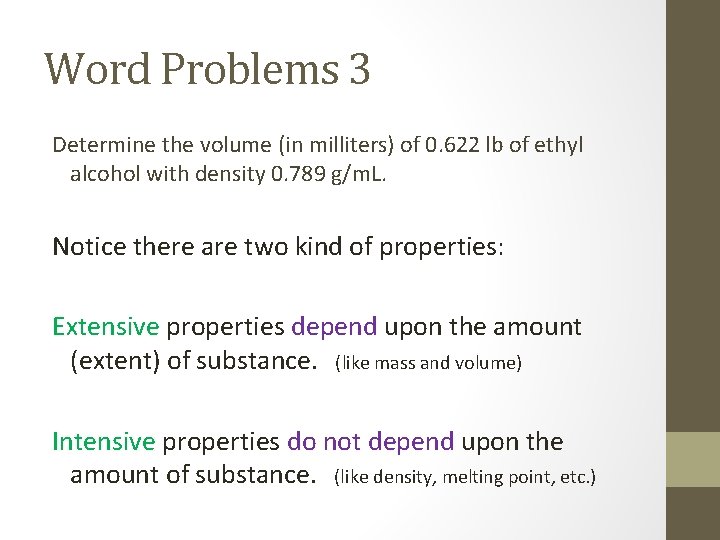
Word Problems 3 Determine the volume (in milliters) of 0. 622 lb of ethyl alcohol with density 0. 789 g/m. L. Notice there are two kind of properties: Extensive properties depend upon the amount (extent) of substance. (like mass and volume) Intensive properties do not depend upon the amount of substance. (like density, melting point, etc. )
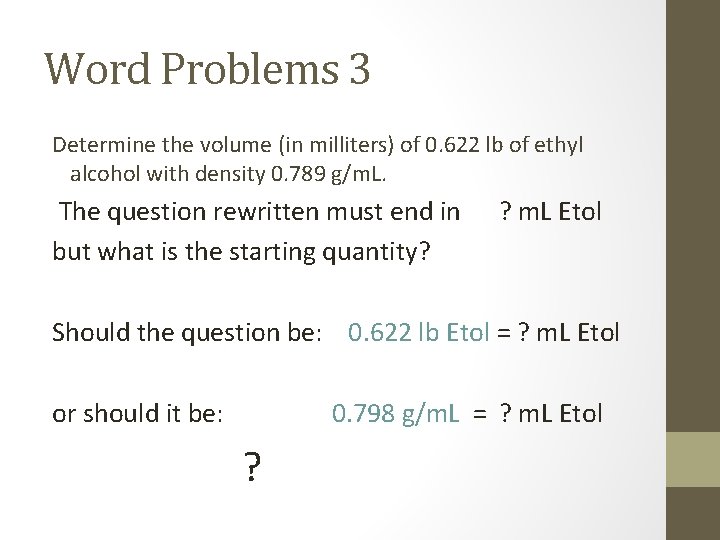
Word Problems 3 Determine the volume (in milliters) of 0. 622 lb of ethyl alcohol with density 0. 789 g/m. L. The question rewritten must end in but what is the starting quantity? ? m. L Etol Should the question be: 0. 622 lb Etol = ? m. L Etol or should it be: 0. 798 g/m. L = ? m. L Etol ?
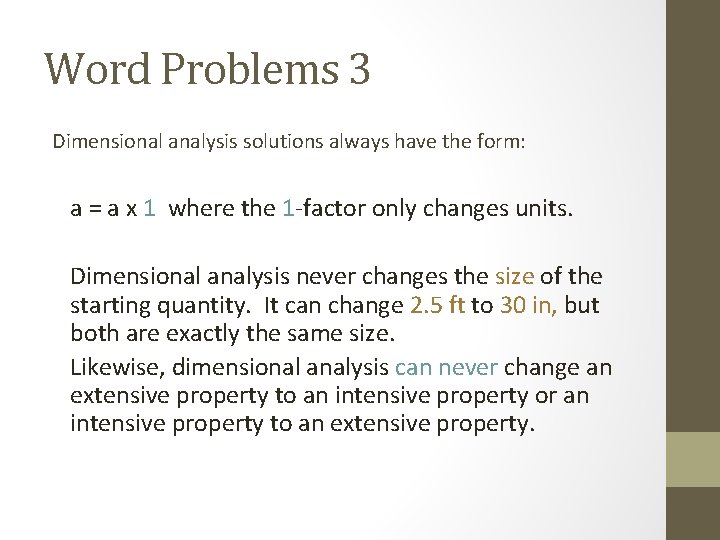
Word Problems 3 Dimensional analysis solutions always have the form: a = a x 1 where the 1 -factor only changes units. Dimensional analysis never changes the size of the starting quantity. It can change 2. 5 ft to 30 in, but both are exactly the same size. Likewise, dimensional analysis can never change an extensive property to an intensive property or an intensive property to an extensive property.
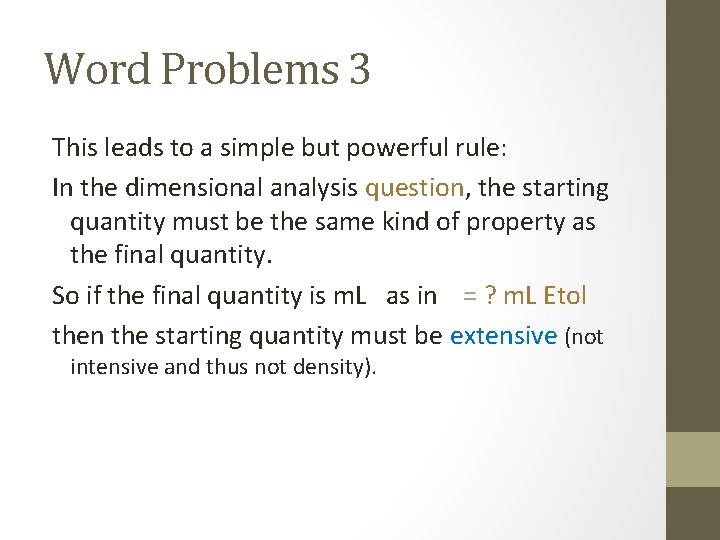
Word Problems 3 This leads to a simple but powerful rule: In the dimensional analysis question, the starting quantity must be the same kind of property as the final quantity. So if the final quantity is m. L as in = ? m. L Etol then the starting quantity must be extensive (not intensive and thus not density).
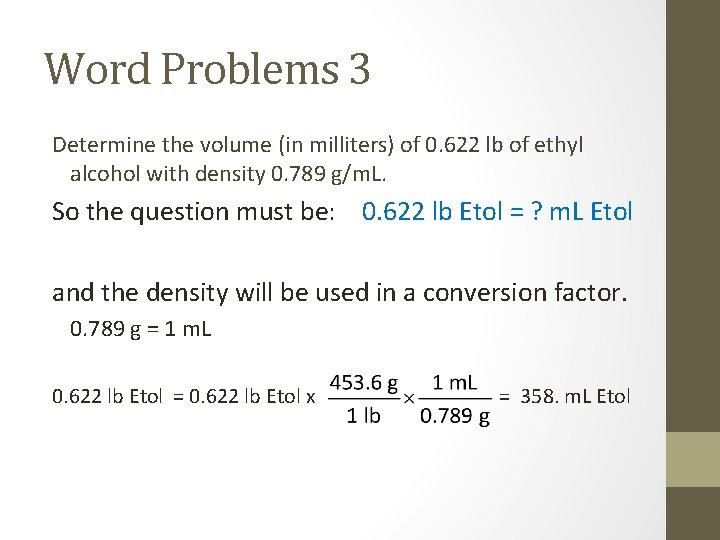
Word Problems 3 Determine the volume (in milliters) of 0. 622 lb of ethyl alcohol with density 0. 789 g/m. L. So the question must be: 0. 622 lb Etol = ? m. L Etol and the density will be used in a conversion factor. 0. 789 g = 1 m. L 0. 622 lb Etol = 0. 622 lb Etol x = 358. m. L Etol
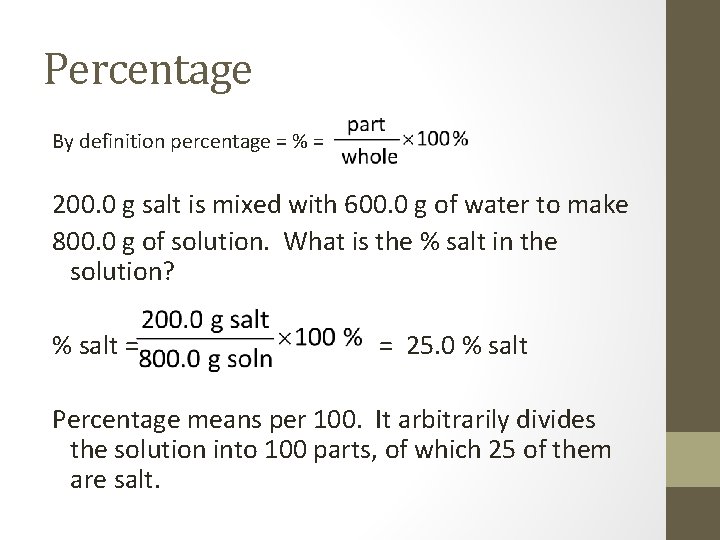
Percentage By definition percentage = % = 200. 0 g salt is mixed with 600. 0 g of water to make 800. 0 g of solution. What is the % salt in the solution? % salt = = 25. 0 % salt Percentage means per 100. It arbitrarily divides the solution into 100 parts, of which 25 of them are salt.
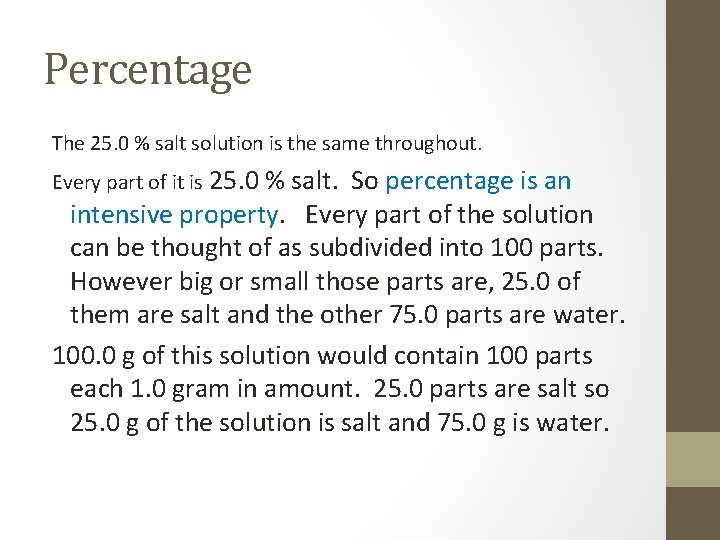
Percentage The 25. 0 % salt solution is the same throughout. Every part of it is 25. 0 % salt. So percentage is an intensive property. Every part of the solution can be thought of as subdivided into 100 parts. However big or small those parts are, 25. 0 of them are salt and the other 75. 0 parts are water. 100. 0 g of this solution would contain 100 parts each 1. 0 gram in amount. 25. 0 parts are salt so 25. 0 g of the solution is salt and 75. 0 g is water.
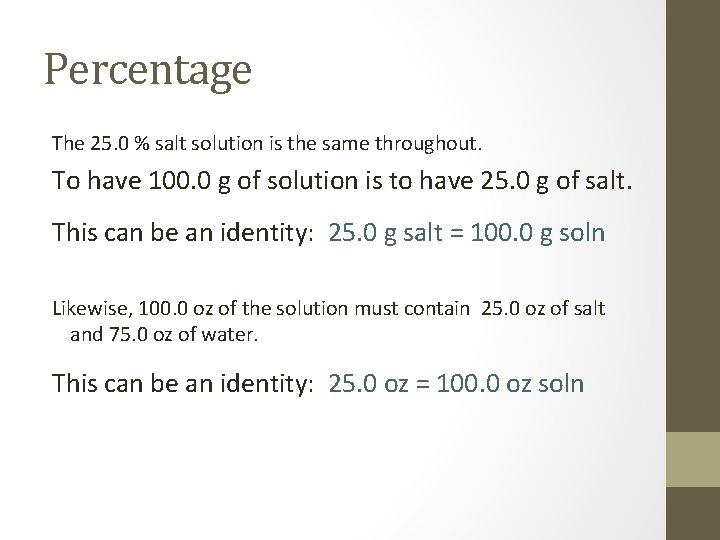
Percentage The 25. 0 % salt solution is the same throughout. To have 100. 0 g of solution is to have 25. 0 g of salt. This can be an identity: 25. 0 g salt = 100. 0 g soln Likewise, 100. 0 oz of the solution must contain 25. 0 oz of salt and 75. 0 oz of water. This can be an identity: 25. 0 oz = 100. 0 oz soln
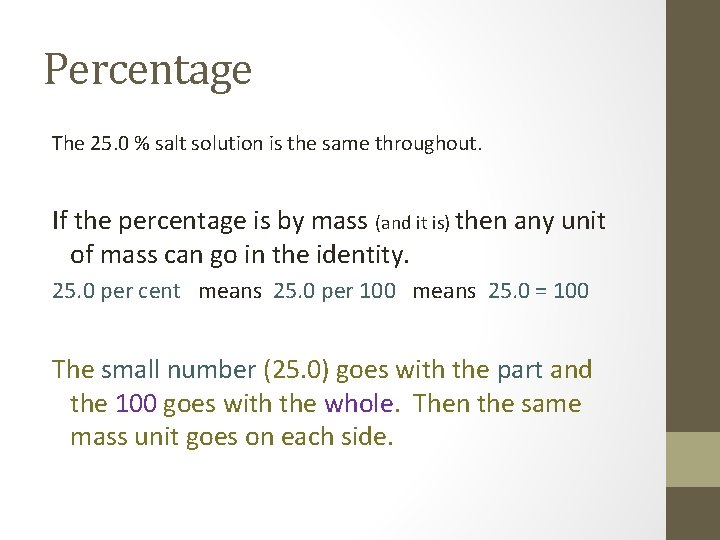
Percentage The 25. 0 % salt solution is the same throughout. If the percentage is by mass (and it is) then any unit of mass can go in the identity. 25. 0 per cent means 25. 0 per 100 means 25. 0 = 100 The small number (25. 0) goes with the part and the 100 goes with the whole. Then the same mass unit goes on each side.
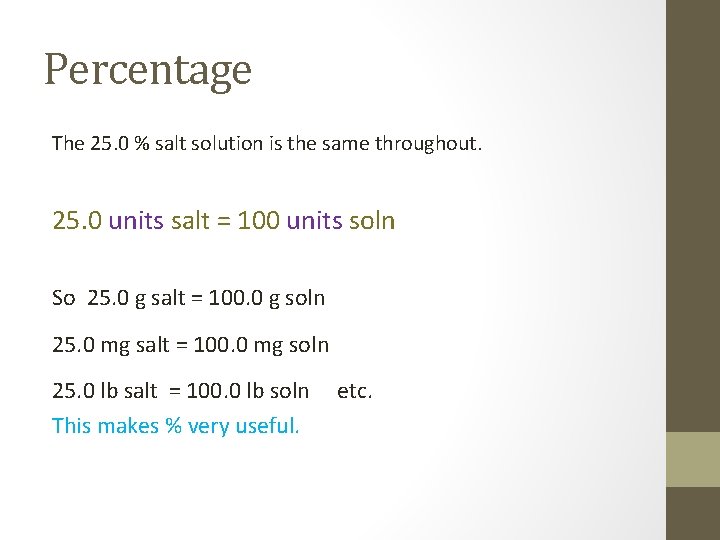
Percentage The 25. 0 % salt solution is the same throughout. 25. 0 units salt = 100 units soln So 25. 0 g salt = 100. 0 g soln 25. 0 mg salt = 100. 0 mg soln 25. 0 lb salt = 100. 0 lb soln This makes % very useful. etc.
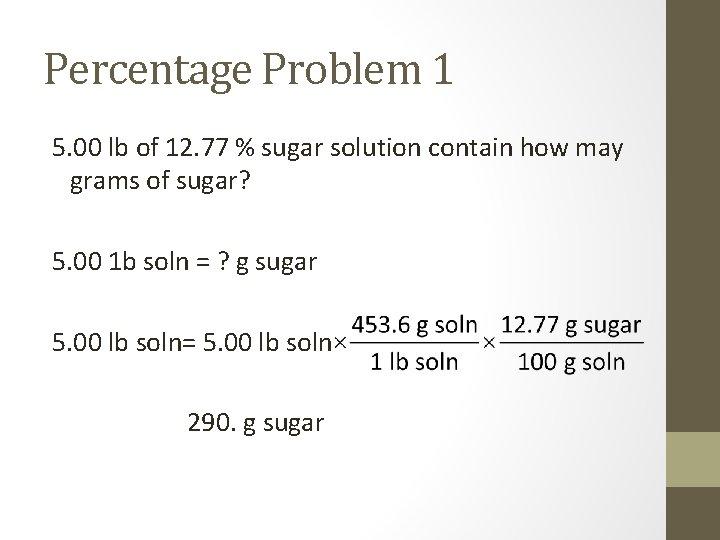
Percentage Problem 1 5. 00 lb of 12. 77 % sugar solution contain how may grams of sugar? 5. 00 1 b soln = ? g sugar 5. 00 lb soln= 5. 00 lb soln 290. g sugar
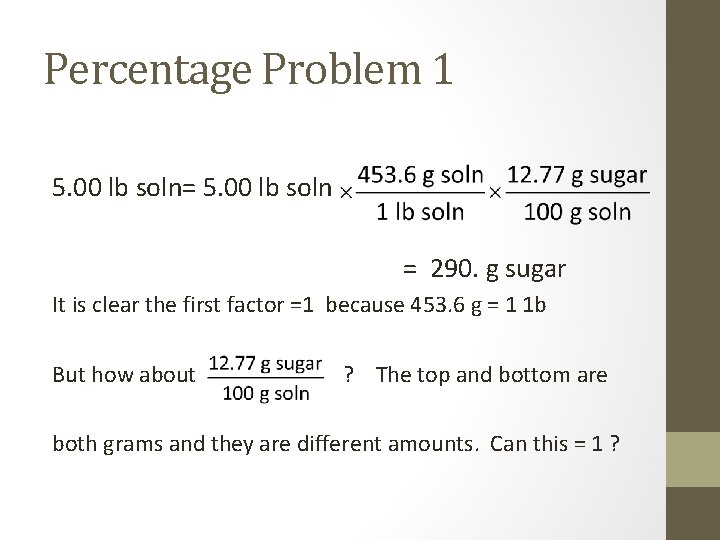
Percentage Problem 1 5. 00 lb soln= 5. 00 lb soln = 290. g sugar It is clear the first factor =1 because 453. 6 g = 1 1 b But how about ? The top and bottom are both grams and they are different amounts. Can this = 1 ?
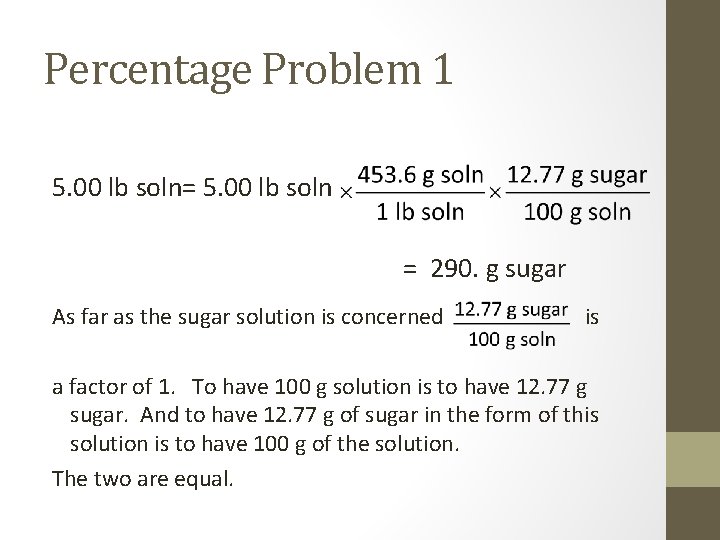
Percentage Problem 1 5. 00 lb soln= 5. 00 lb soln = 290. g sugar As far as the sugar solution is concerned is a factor of 1. To have 100 g solution is to have 12. 77 g sugar. And to have 12. 77 g of sugar in the form of this solution is to have 100 g of the solution. The two are equal.
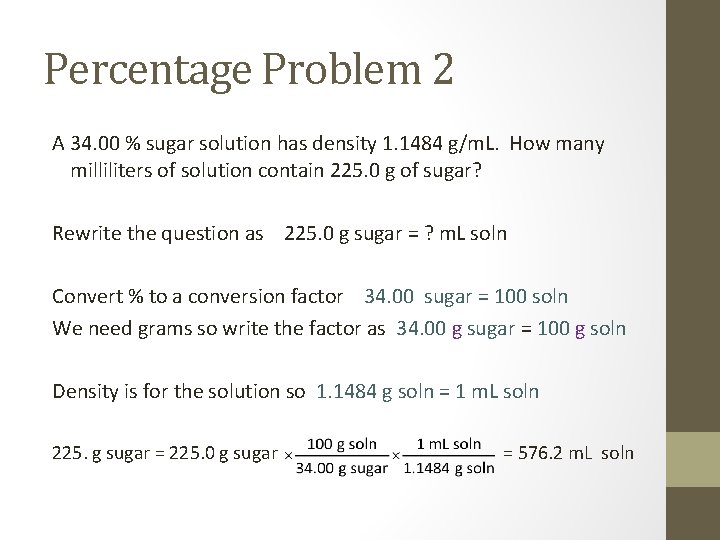
Percentage Problem 2 A 34. 00 % sugar solution has density 1. 1484 g/m. L. How many milliliters of solution contain 225. 0 g of sugar? Rewrite the question as 225. 0 g sugar = ? m. L soln Convert % to a conversion factor 34. 00 sugar = 100 soln We need grams so write the factor as 34. 00 g sugar = 100 g soln Density is for the solution so 1. 1484 g soln = 1 m. L soln 225. g sugar = 225. 0 g sugar = 576. 2 m. L soln
- Slides: 38