
DIMENSIONAL ANALYSIS Dimensional Analysis What happens when you

- Slides: 10
DIMENSIONAL ANALYSIS
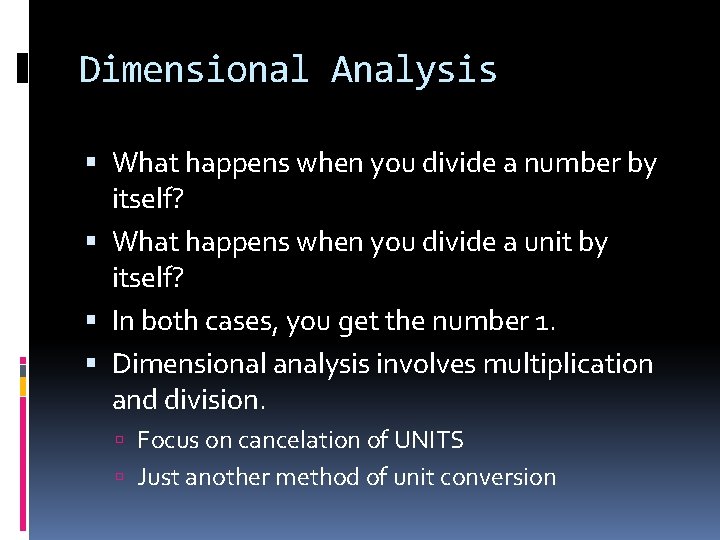
Dimensional Analysis What happens when you divide a number by itself? What happens when you divide a unit by itself? In both cases, you get the number 1. Dimensional analysis involves multiplication and division. Focus on cancelation of UNITS Just another method of unit conversion
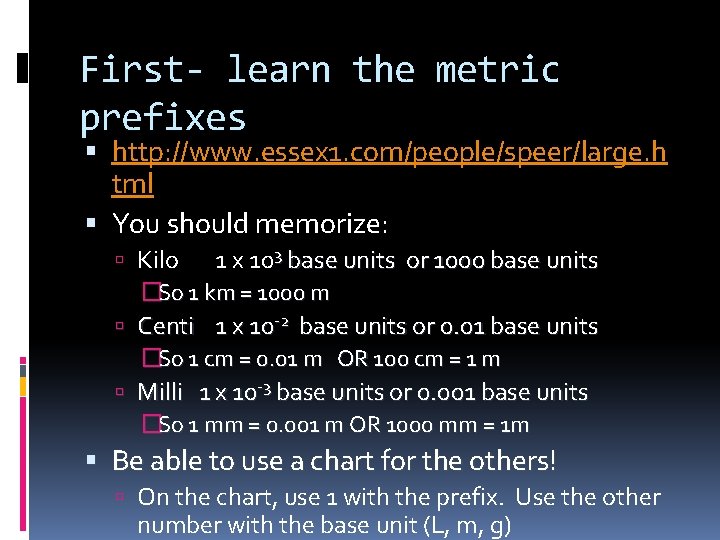
First- learn the metric prefixes http: //www. essex 1. com/people/speer/large. h tml You should memorize: Kilo 1 x 10³ base units or 1000 base units �So 1 km = 1000 m Centi 1 x 10 -2 base units or 0. 01 base units �So 1 cm = 0. 01 m OR 100 cm = 1 m Milli 1 x 10 -3 base units or 0. 001 base units �So 1 mm = 0. 001 m OR 1000 mm = 1 m Be able to use a chart for the others! On the chart, use 1 with the prefix. Use the other number with the base unit (L, m, g)
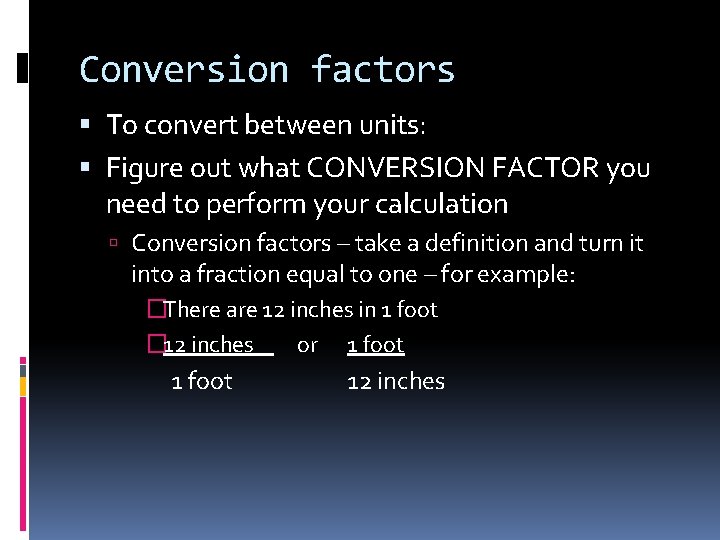
Conversion factors To convert between units: Figure out what CONVERSION FACTOR you need to perform your calculation Conversion factors – take a definition and turn it into a fraction equal to one – for example: �There are 12 inches in 1 foot � 12 inches or 1 foot 12 inches
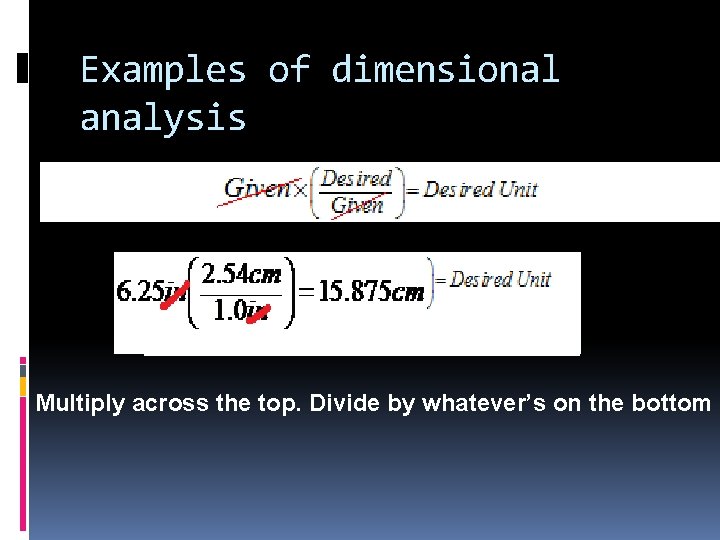
Examples of dimensional analysis Multiply across the top. Divide by whatever’s on the bottom
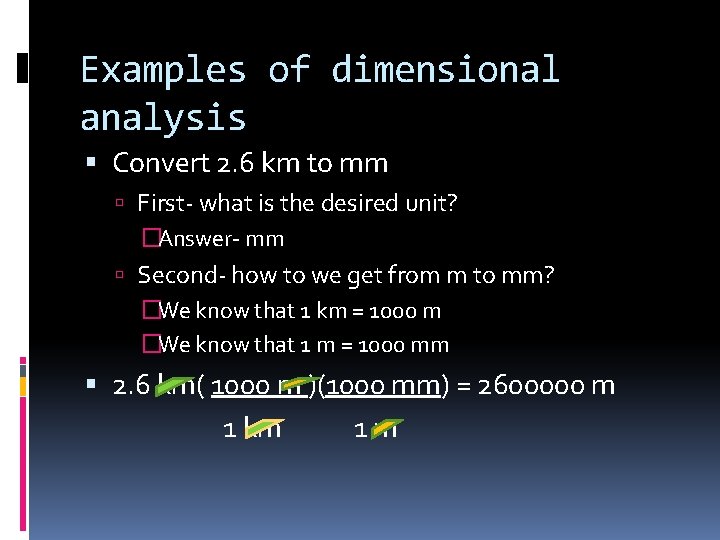
Examples of dimensional analysis Convert 2. 6 km to mm First- what is the desired unit? �Answer- mm Second- how to we get from m to mm? �We know that 1 km = 1000 m �We know that 1 m = 1000 mm 2. 6 km( 1000 m )(1000 mm) = 2600000 m 1 km 1 m
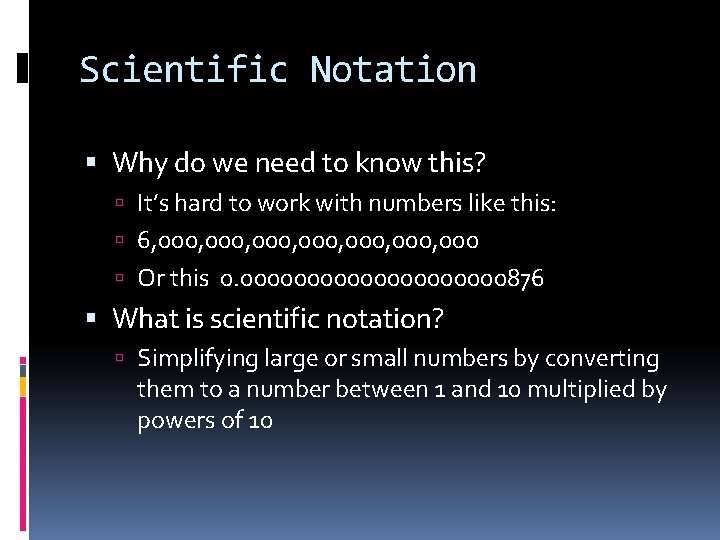
Scientific Notation Why do we need to know this? It’s hard to work with numbers like this: 6, 000, 000, 000 Or this 0. 0000000000876 What is scientific notation? Simplifying large or small numbers by converting them to a number between 1 and 10 multiplied by powers of 10
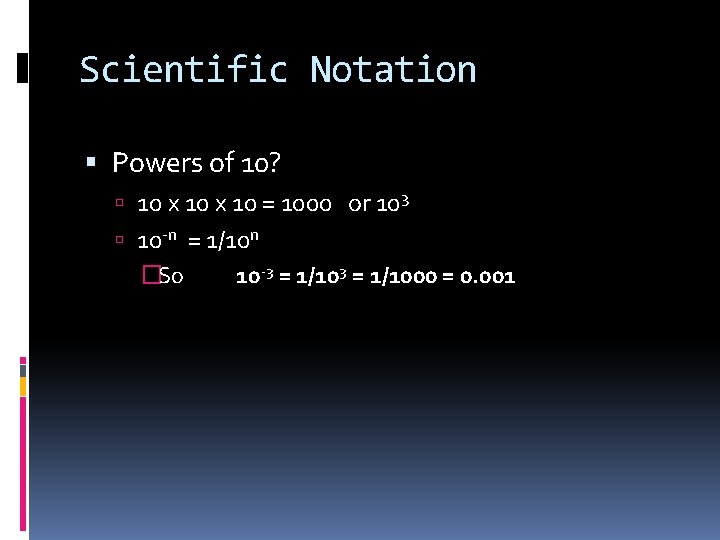
Scientific Notation Powers of 10? 10 x 10 = 1000 or 103 10 -n = 1/10 n �So 10 -3 = 1/1000 = 0. 001
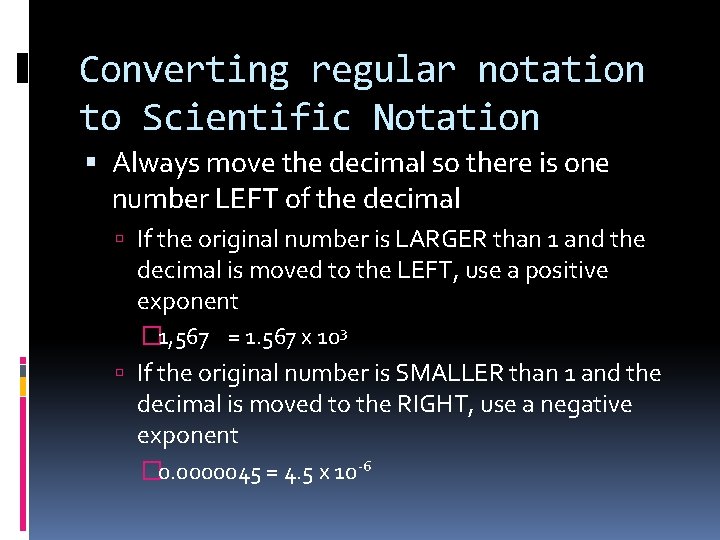
Converting regular notation to Scientific Notation Always move the decimal so there is one number LEFT of the decimal If the original number is LARGER than 1 and the decimal is moved to the LEFT, use a positive exponent � 1, 567 = 1. 567 x 103 If the original number is SMALLER than 1 and the decimal is moved to the RIGHT, use a negative exponent � 0. 0000045 = 4. 5 x 10 -6
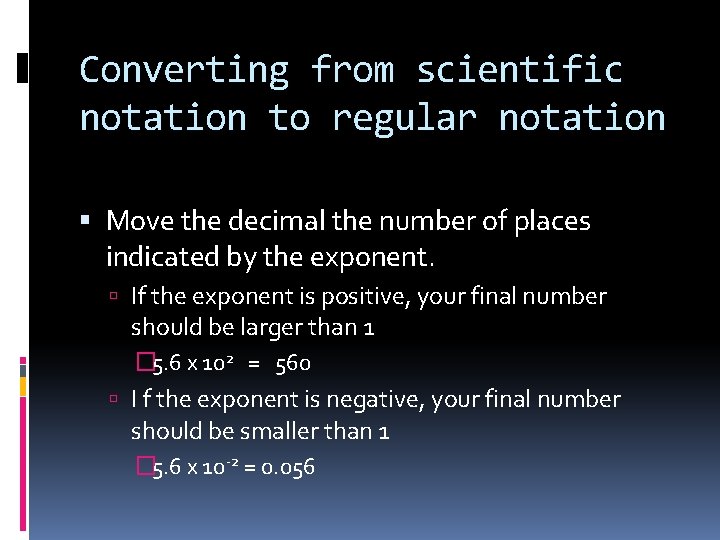
Converting from scientific notation to regular notation Move the decimal the number of places indicated by the exponent. If the exponent is positive, your final number should be larger than 1 � 5. 6 x 102 = 560 I f the exponent is negative, your final number should be smaller than 1 � 5. 6 x 10 -2 = 0. 056