
Dimensional Analysis and Density Warm Up Which side
- Slides: 17
Dimensional Analysis and Density
Warm - Up Which side of a ruler should you use to measure – English or metric? Why? How many decimals places past the decimal point can you read a ruler? How do you read a graduated cylinder? How many decimal places can be in your measurement of a beaker or a flask? In general, what is an acceptable percent error for a lab?
Objective v Today I will be able to: v Apply dimensional analysis to real – life situations v Calculate density be completing a lab
Homework v Study for metric system/ dimensional analysis and accuracy and precision quiz v Dimensional analysis practice
Agenda v Warm – Up v Density Notes v Density Lab v Baking and Dimensional Analysis Scenario v Exit ticket
Density
Density v Mass – quantity of matter a body possess (constant) v Weight – force of attraction of the earth for a body (gravitational attraction) (variable)
Introduction v Matter occupies space, and therefore, has volume v Density = mass/volume - Units are g/ml (liquids) and g/cm 3 (solids)
What is Density? v Density reveals how tightly the molecules composing the matter are packed and how heavy the molecules are v Compared to the liquid they are in, less dense materials float, more dense sink v Substances are often IDed by their density, as it is rare for two substances to have the same density
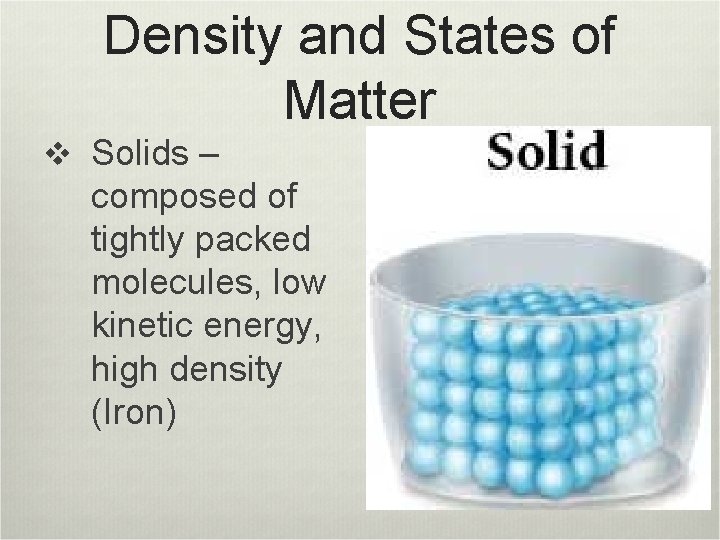
Density and States of Matter v Solids – composed of tightly packed molecules, low kinetic energy, high density (Iron)
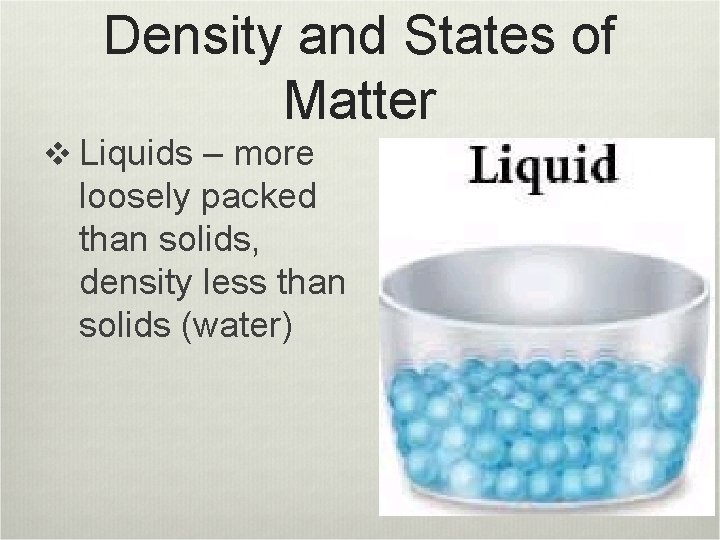
Density and States of Matter v Liquids – more loosely packed than solids, density less than solids (water)
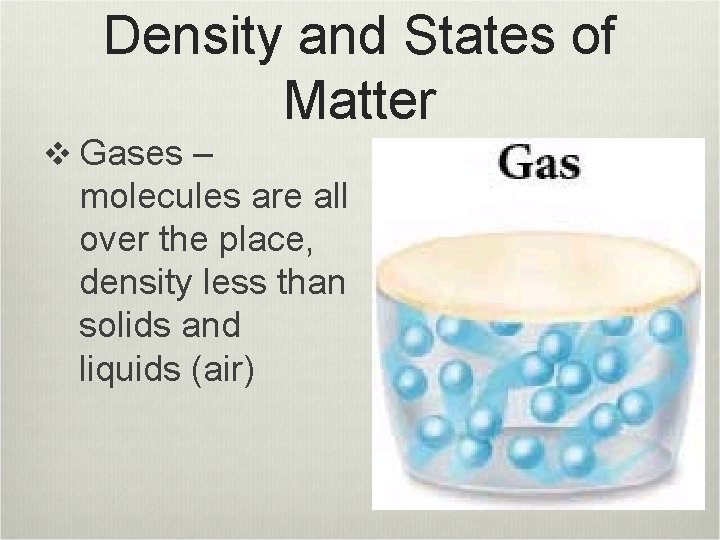
Density and States of Matter v Gases – molecules are all over the place, density less than solids and liquids (air)
Calculating Density v Remember, Density = mass/volume v Mass is determined using a scale v Volume is calculated several different ways
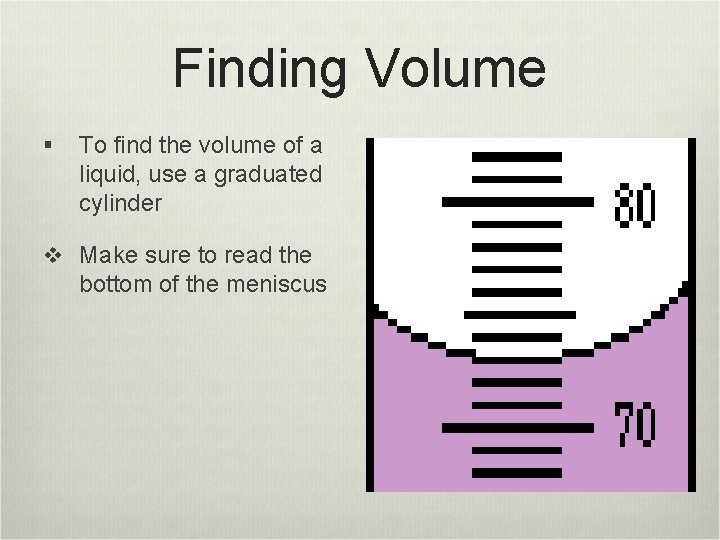
Finding Volume § To find the volume of a liquid, use a graduated cylinder v Make sure to read the bottom of the meniscus
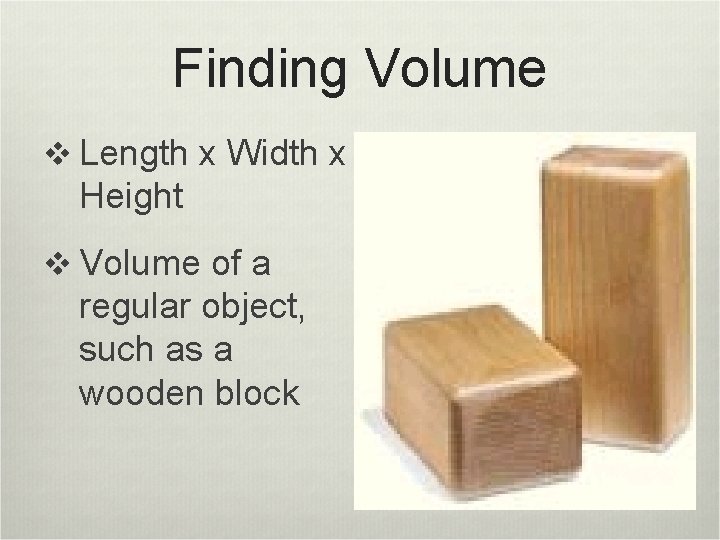
Finding Volume v Length x Width x Height v Volume of a regular object, such as a wooden block
Finding Volume v Water Displacement Method - Read the initial volume of water in a graduated cylinder - Place object into cylinder - Read the final volume of water - Final – Initial = Volume of the object
Exit Ticket v Which has a greater mass, 6. 00 g of lead or 7. 00 g of styrofoam? v Which occupies a greater volume, 5. 00 cm 3 of lead or 5. 00 cm 3 of styrofoam? v Which occupies a greater volume, 5. 00 g of lead or 5. 00 g of styrofoam? v Which occupies a greater volume, 9. 00 g of lead or 50. 0 g of styrofoam? v Which occupies a greater volume, 50. 0 g of lead or 9. 00 g of styrofoam?