
Dimension Reduction PCA t SNE UMAP v 2020
- Slides: 35
Dimension Reduction PCA, t. SNE, UMAP v 2020 -11 Simon Andrews simon. andrews@babraham. ac. uk
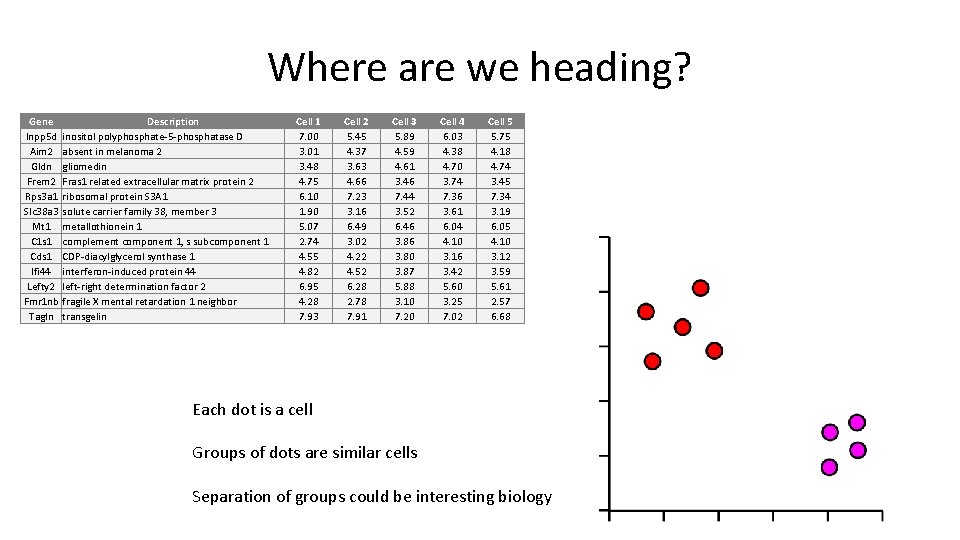
Where are we heading? Gene Inpp 5 d Aim 2 Gldn Frem 2 Rps 3 a 1 Slc 38 a 3 Mt 1 C 1 s 1 Cds 1 Ifi 44 Lefty 2 Fmr 1 nb Tagln Description inositol polyphosphate-5 -phosphatase D absent in melanoma 2 gliomedin Fras 1 related extracellular matrix protein 2 ribosomal protein S 3 A 1 solute carrier family 38, member 3 metallothionein 1 complement component 1, s subcomponent 1 CDP-diacylglycerol synthase 1 interferon-induced protein 44 left-right determination factor 2 fragile X mental retardation 1 neighbor transgelin Cell 1 7. 00 3. 01 3. 48 4. 75 6. 10 1. 90 5. 07 2. 74 4. 55 4. 82 6. 95 4. 28 7. 93 Cell 2 5. 45 4. 37 3. 63 4. 66 7. 23 3. 16 6. 49 3. 02 4. 22 4. 52 6. 28 2. 78 7. 91 Cell 3 5. 89 4. 59 4. 61 3. 46 7. 44 3. 52 6. 46 3. 80 3. 87 5. 88 3. 10 7. 20 Cell 4 6. 03 4. 38 4. 70 3. 74 7. 36 3. 61 6. 04 4. 10 3. 16 3. 42 5. 60 3. 25 7. 02 Cell 5 5. 75 4. 18 4. 74 3. 45 7. 34 3. 19 6. 05 4. 10 3. 12 3. 59 5. 61 2. 57 6. 68 Each dot is a cell Groups of dots are similar cells Separation of groups could be interesting biology
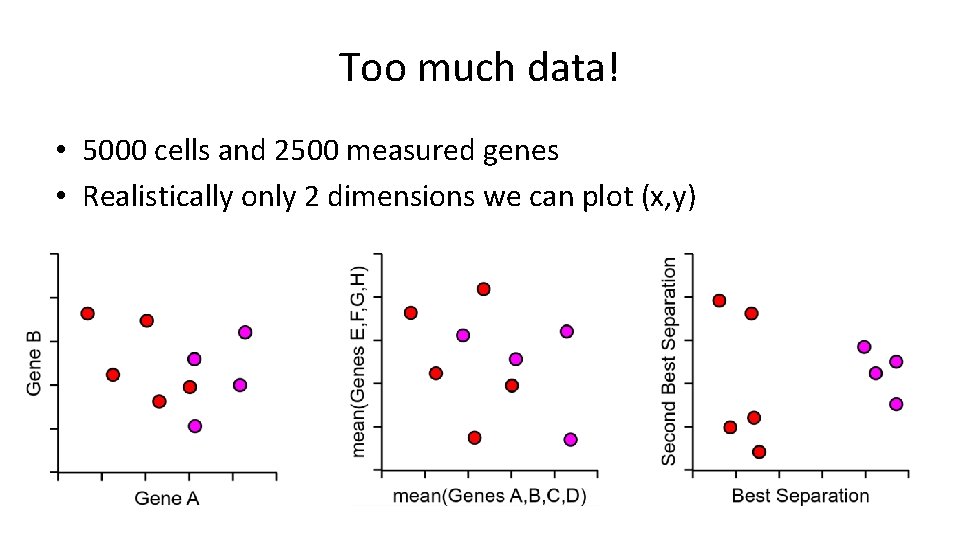
Too much data! • 5000 cells and 2500 measured genes • Realistically only 2 dimensions we can plot (x, y)
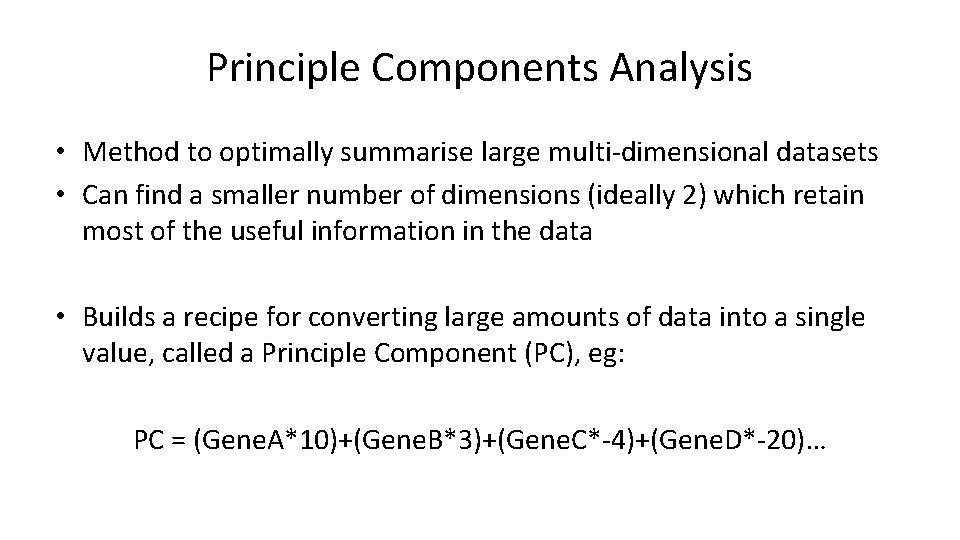
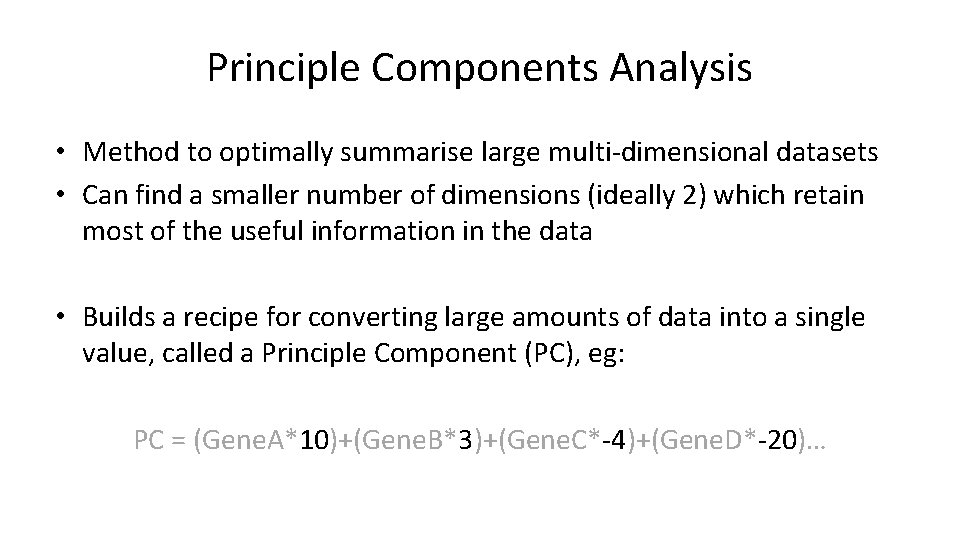
Principle Components Analysis • Method to optimally summarise large multi-dimensional datasets • Can find a smaller number of dimensions (ideally 2) which retain most of the useful information in the data • Builds a recipe for converting large amounts of data into a single value, called a Principle Component (PC), eg: PC = (Gene. A*10)+(Gene. B*3)+(Gene. C*-4)+(Gene. D*-20)…
Principle Components Analysis • Method to optimally summarise large multi-dimensional datasets • Can find a smaller number of dimensions (ideally 2) which retain most of the useful information in the data • Builds a recipe for converting large amounts of data into a single value, called a Principle Component (PC), eg: PC = (Gene. A*10)+(Gene. B*3)+(Gene. C*-4)+(Gene. D*-20)…
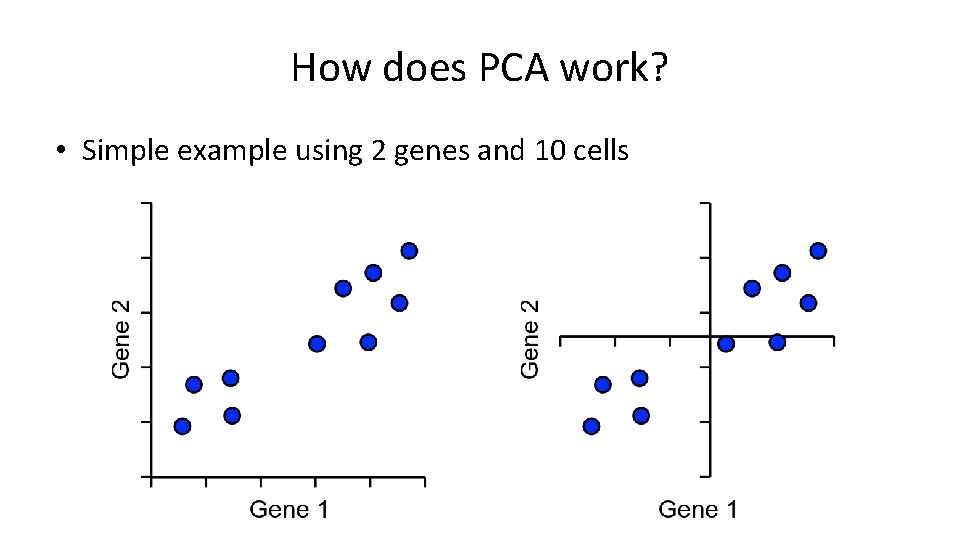
How does PCA work? • Simple example using 2 genes and 10 cells
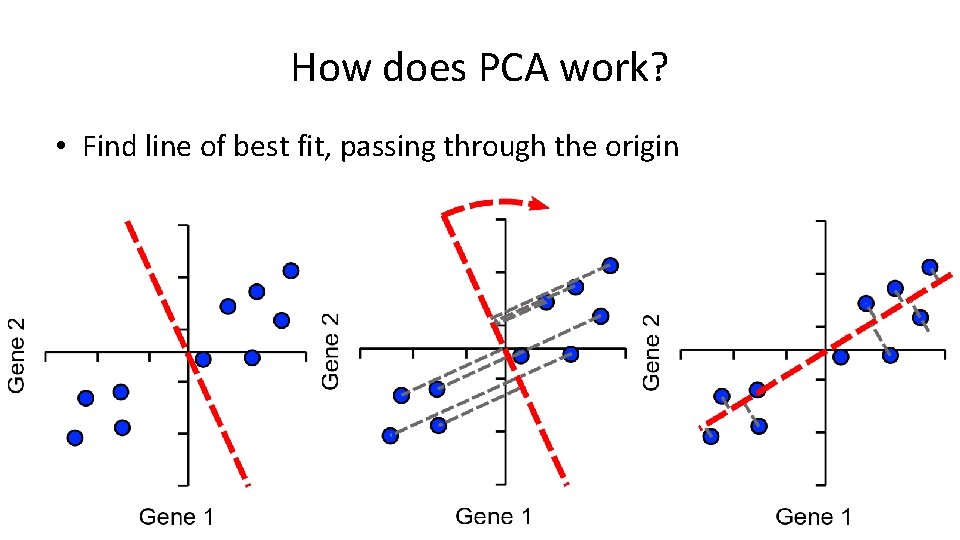
How does PCA work? • Find line of best fit, passing through the origin
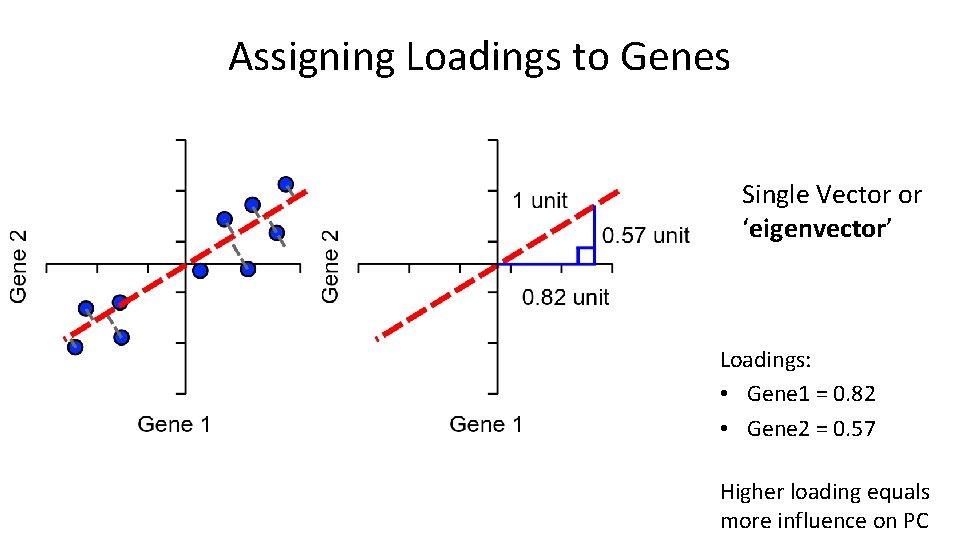
Assigning Loadings to Genes Single Vector or ‘eigenvector’ Loadings: • Gene 1 = 0. 82 • Gene 2 = 0. 57 Higher loading equals more influence on PC
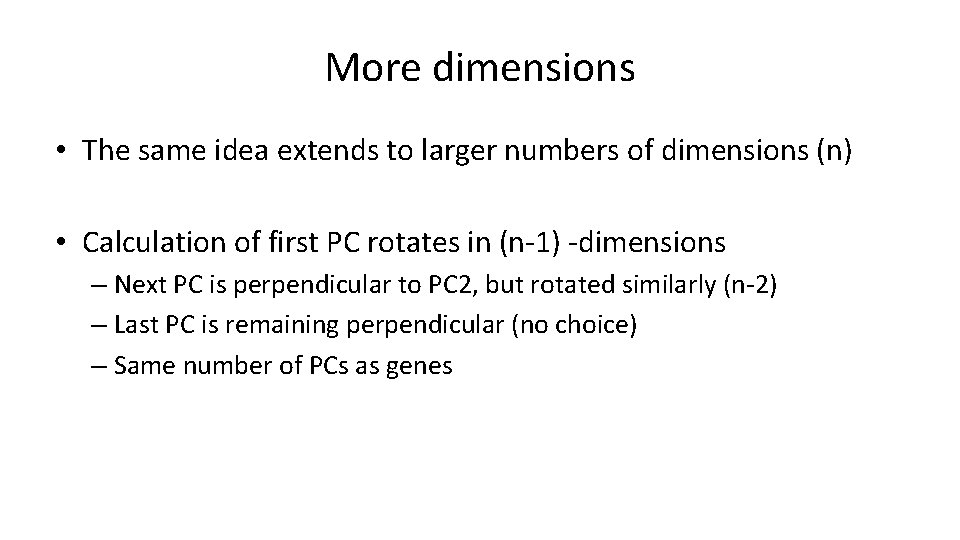
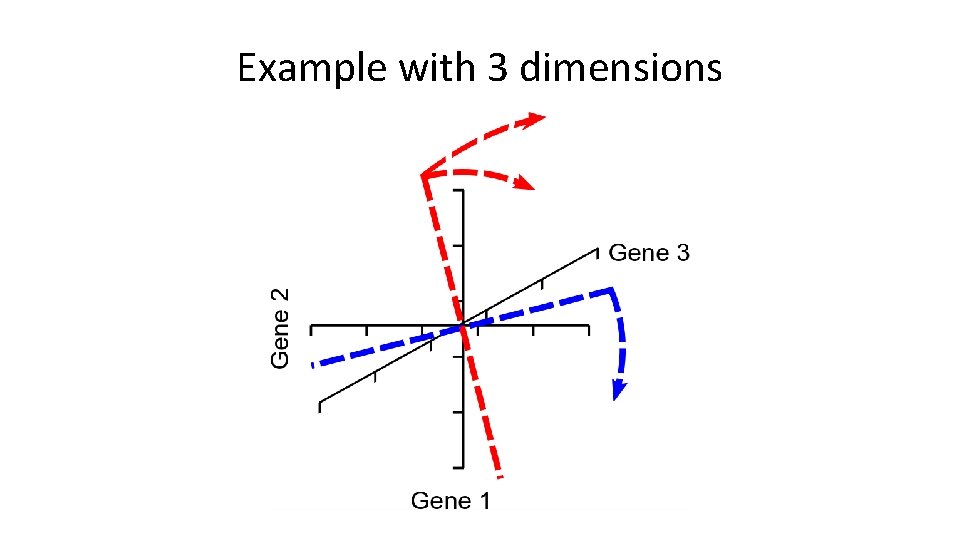
More dimensions • The same idea extends to larger numbers of dimensions (n) • Calculation of first PC rotates in (n-1) -dimensions – Next PC is perpendicular to PC 2, but rotated similarly (n-2) – Last PC is remaining perpendicular (no choice) – Same number of PCs as genes
Example with 3 dimensions
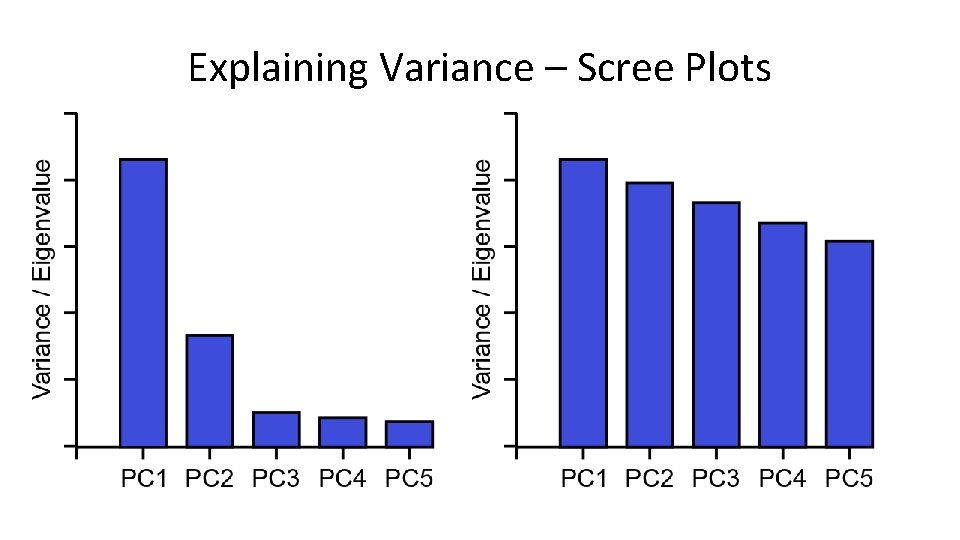
Explaining Variance • Each PC always explains some proportion of the total variance in the data. Between them they explain everything – PC 1 always explains the most – PC 2 is the next highest etc. • Since we only plot 2 dimensions we’d like to know that these are a good explanation • How do we calculate this?
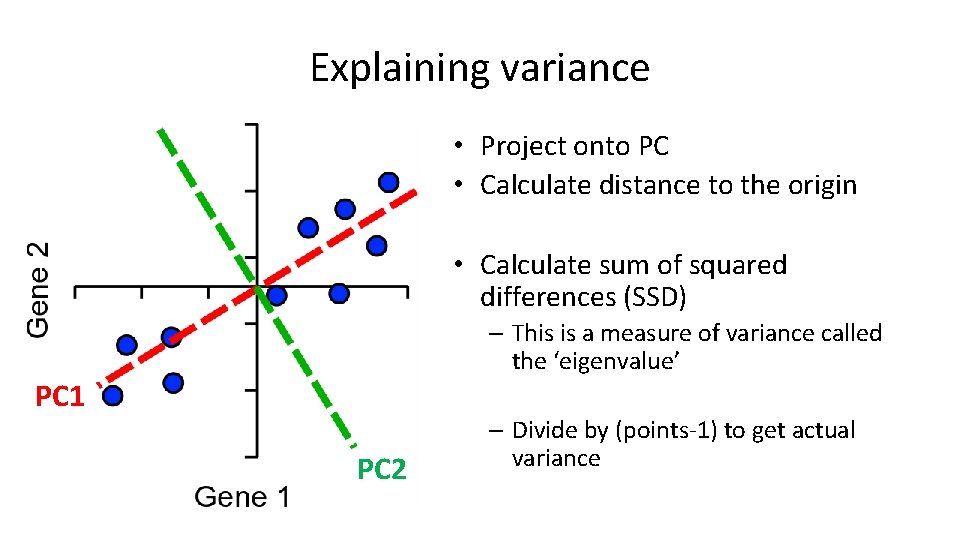
Explaining variance • Project onto PC • Calculate distance to the origin • Calculate sum of squared differences (SSD) – This is a measure of variance called the ‘eigenvalue’ PC 1 PC 2 – Divide by (points-1) to get actual variance
Explaining Variance – Scree Plots
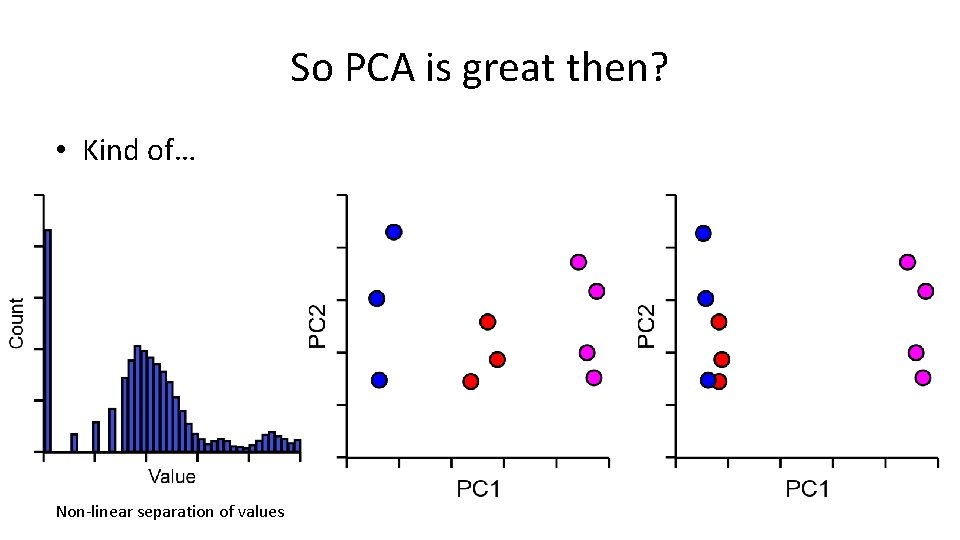
So PCA is great then? • Kind of… Non-linear separation of values
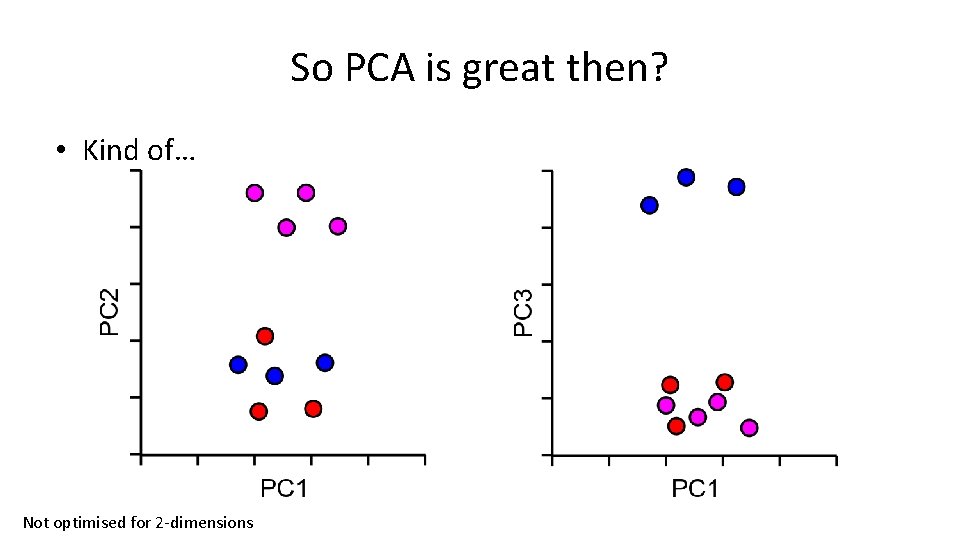
So PCA is great then? • Kind of… Not optimised for 2 -dimensions
t. SNE to the rescue… • T-Distributed Stochastic Neighbour Embedding • Aims to solve the problems of PCA – Non-linear scaling to represent changes at different levels – Optimal separation in 2 -dimensions
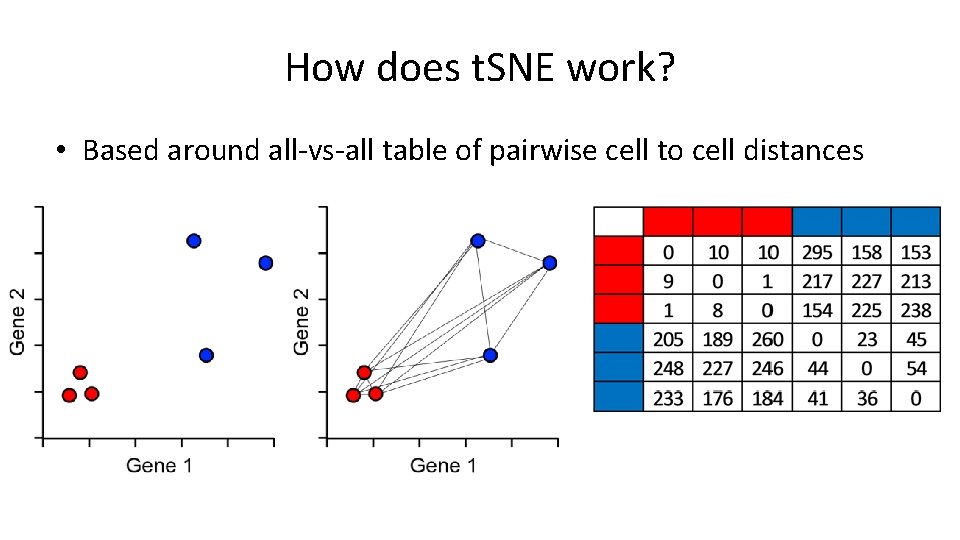
How does t. SNE work? • Based around all-vs-all table of pairwise cell to cell distances
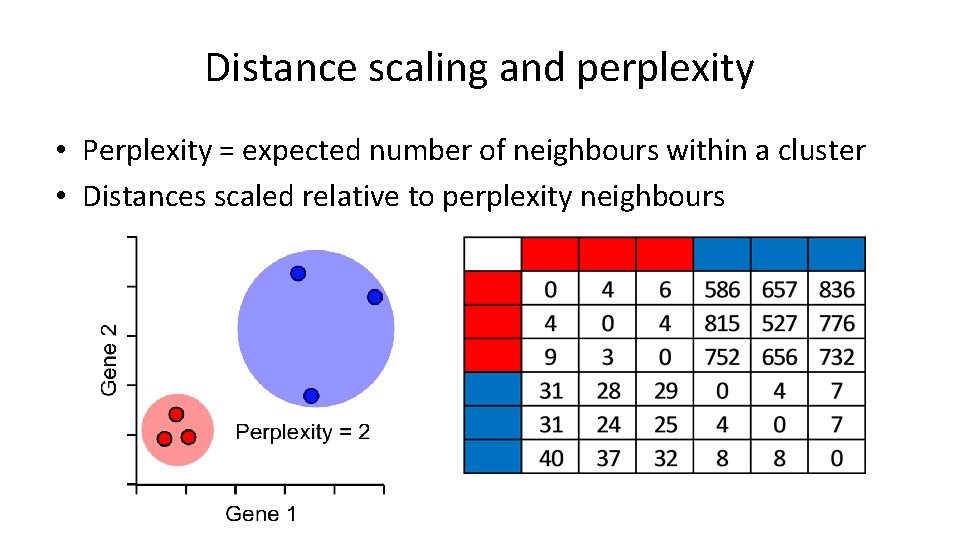
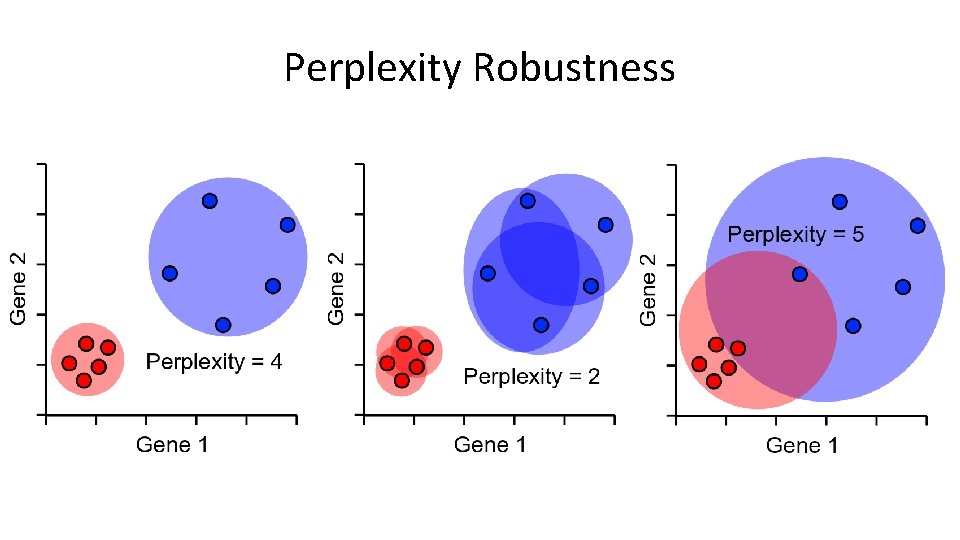
Distance scaling and perplexity • Perplexity = expected number of neighbours within a cluster • Distances scaled relative to perplexity neighbours
Perplexity Robustness
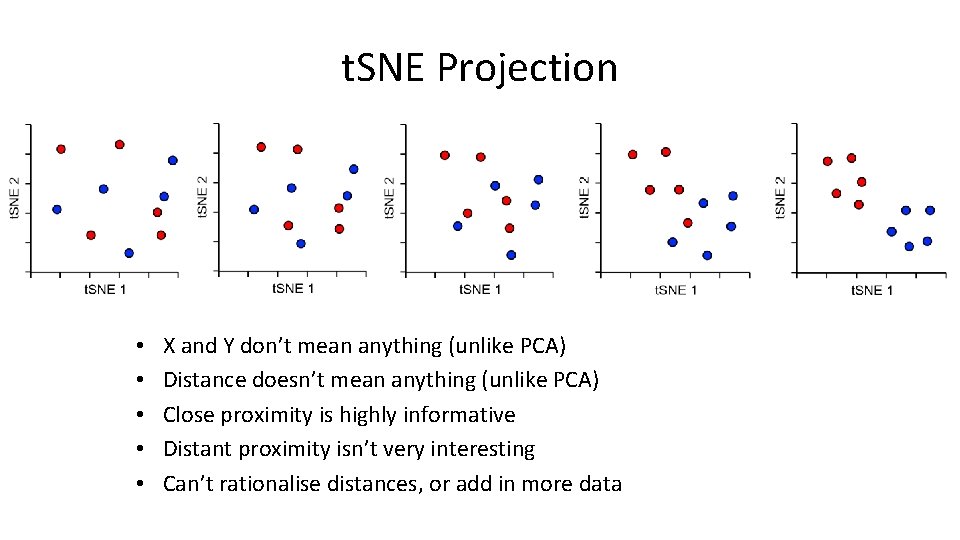
t. SNE Projection • Normally 2 D, but can be any number of dimensions • Randomly scatter all points within the space • Start a simulation – Aim is to make the point distances match the distance matrix – Shuffle points based on how well they match – Stop after fixed number of iterations, or – Stop after distances have converged
t. SNE Projection • • • X and Y don’t mean anything (unlike PCA) Distance doesn’t mean anything (unlike PCA) Close proximity is highly informative Distant proximity isn’t very interesting Can’t rationalise distances, or add in more data
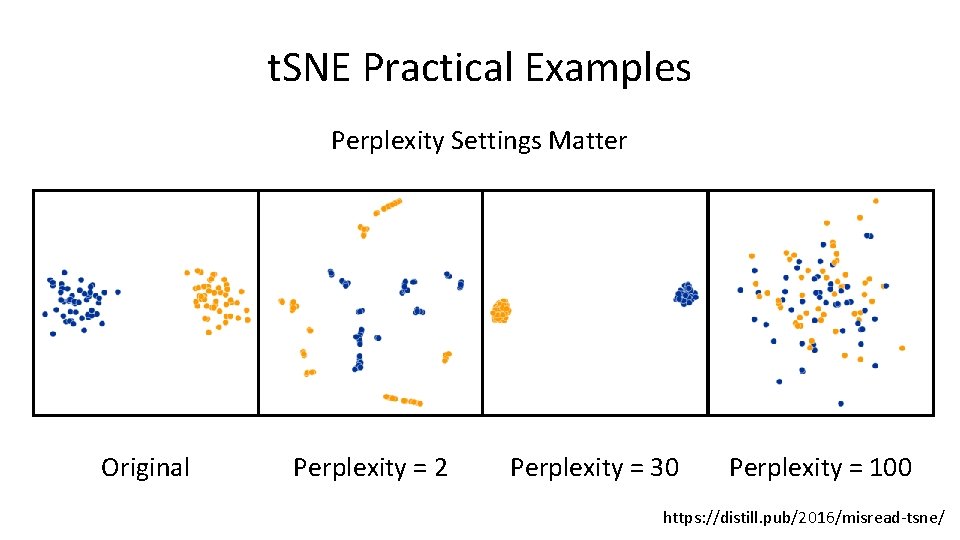
t. SNE Practical Examples Perplexity Settings Matter Original Perplexity = 2 Perplexity = 30 Perplexity = 100 https: //distill. pub/2016/misread-tsne/
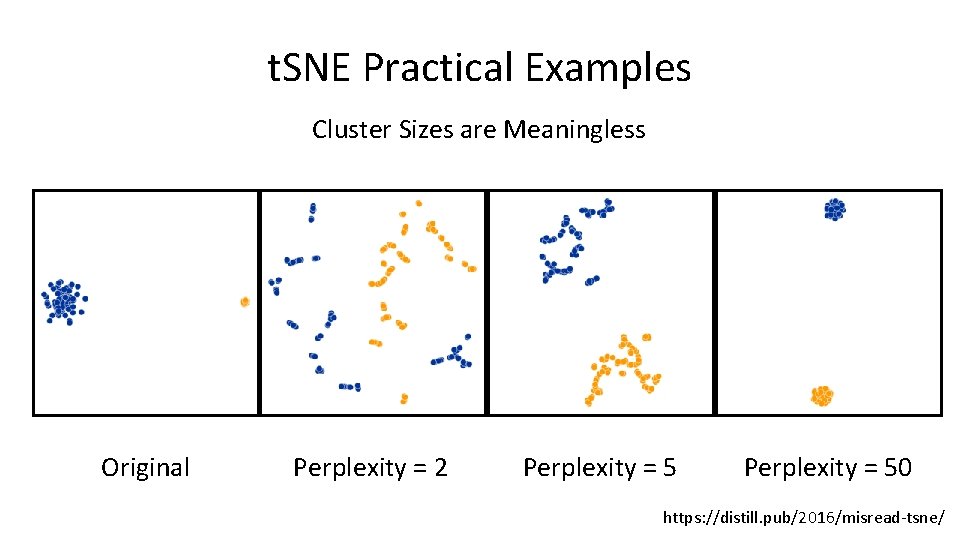
t. SNE Practical Examples Cluster Sizes are Meaningless Original Perplexity = 2 Perplexity = 50 https: //distill. pub/2016/misread-tsne/
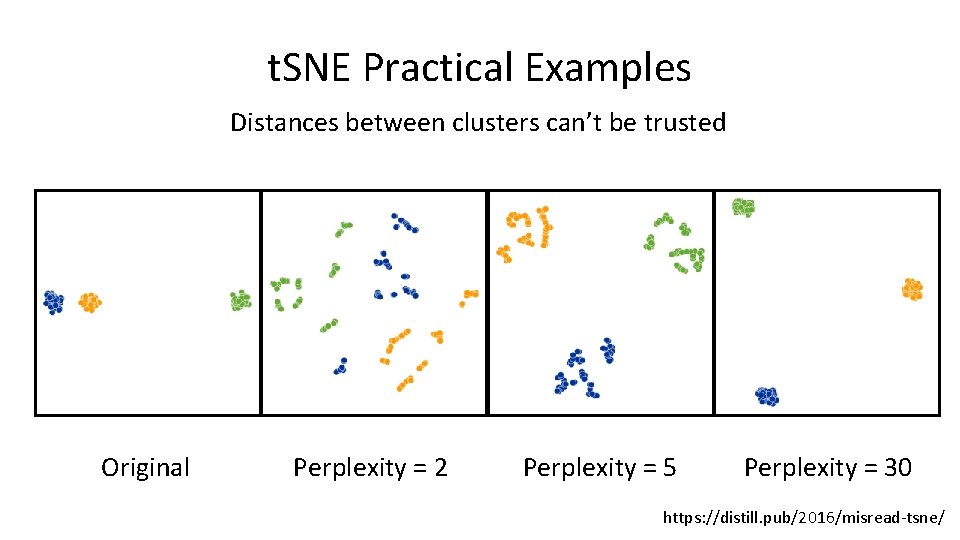
t. SNE Practical Examples Distances between clusters can’t be trusted Original Perplexity = 2 Perplexity = 5 Perplexity = 30 https: //distill. pub/2016/misread-tsne/
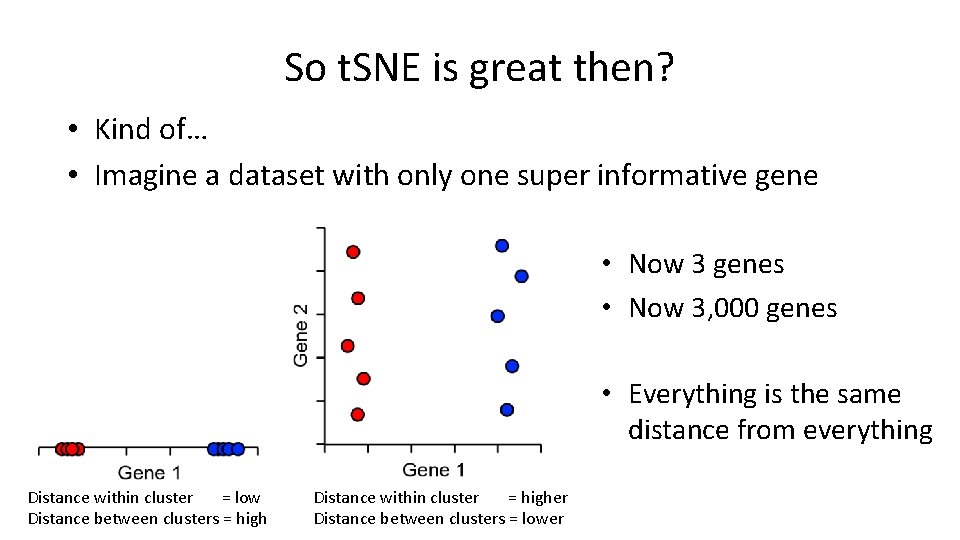
So t. SNE is great then? • Kind of… • Imagine a dataset with only one super informative gene • Now 3 genes • Now 3, 000 genes • Everything is the same distance from everything Distance within cluster = low Distance between clusters = high Distance within cluster = higher Distance between clusters = lower
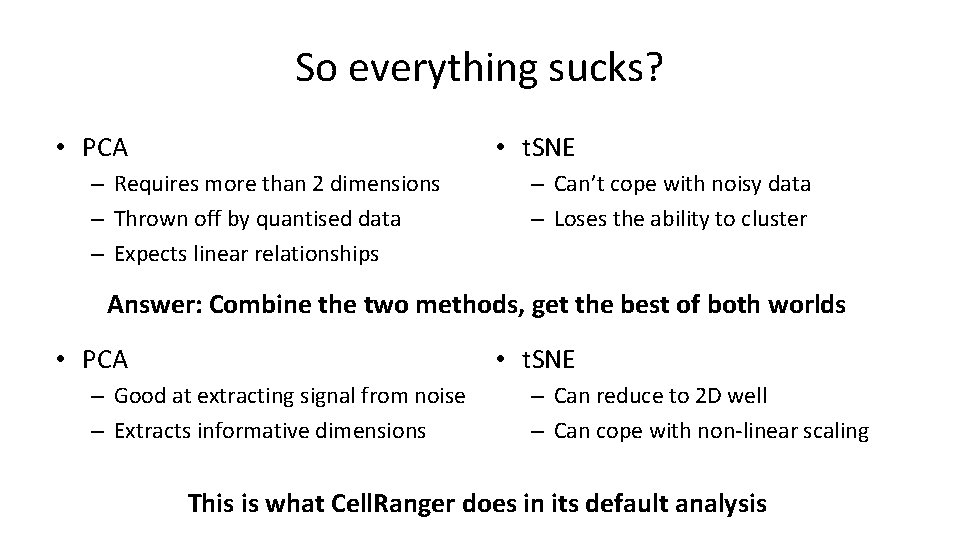
So everything sucks? • PCA • t. SNE – Requires more than 2 dimensions – Thrown off by quantised data – Expects linear relationships – Can’t cope with noisy data – Loses the ability to cluster Answer: Combine the two methods, get the best of both worlds • PCA • t. SNE – Good at extracting signal from noise – Extracts informative dimensions – Can reduce to 2 D well – Can cope with non-linear scaling This is what Cell. Ranger does in its default analysis
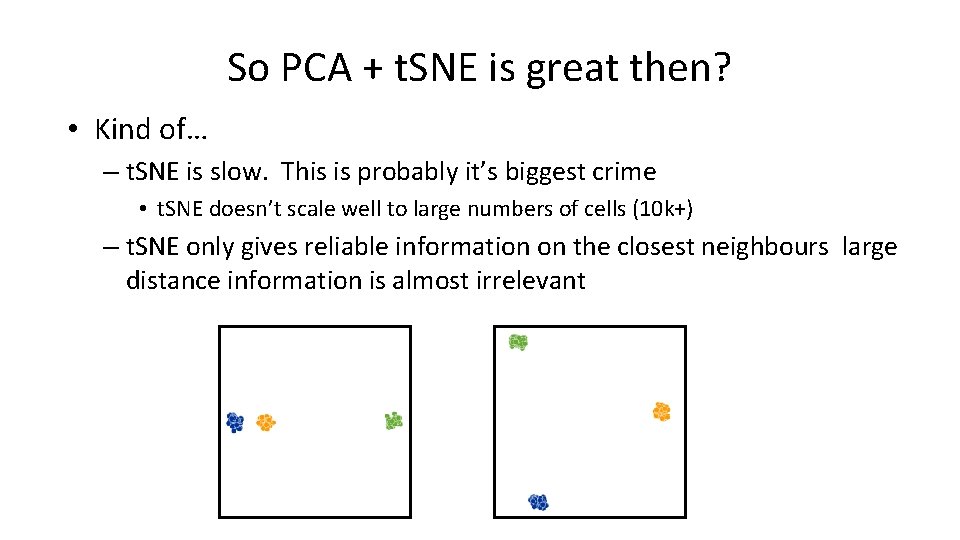
So PCA + t. SNE is great then? • Kind of… – t. SNE is slow. This is probably it’s biggest crime • t. SNE doesn’t scale well to large numbers of cells (10 k+) – t. SNE only gives reliable information on the closest neighbours large distance information is almost irrelevant
UMAP to the rescue! • UMAP is a replacement for t. SNE to fulfil the same role • Conceptually very similar to t. SNE, but with a couple of relevant (and somewhat technical) changes • Practical outcome is: – UMAP is quite a bit quicker than t. SNE – UMAP can preserve more global structure than t. SNE* – UMAP can run on raw data without PCA preprocessing* – UMAP can allow new data to be added to an existing projection * In theory, but possibly not in practice
UMAP differences • Instead of the single perplexity value in t. SNE, UMAP defines – Nearest neighbours: the number of expected nearest neighbours – basically the same concept as perplexity – Minimum distance: how tightly UMAP packs points which are close together • Nearest neighbours will affect the influence given to global vs local information. Min dist will affect how compactly packed the local parts of the plot are.
UMAP differences • Speed – mostly a level of maths I’m not going to get into! – UMAP skips a normalisation step in the calculation of high dimensional distances which speeds it up – In the 2 D projection UMAP uses a more efficient method to shuffle the cells into their final position • Doesn’t have to measure every cell to decide on what to move • Uses an algorithm which can be multi-threaded • Algorithm is more deterministic, allowing more data to be projected later
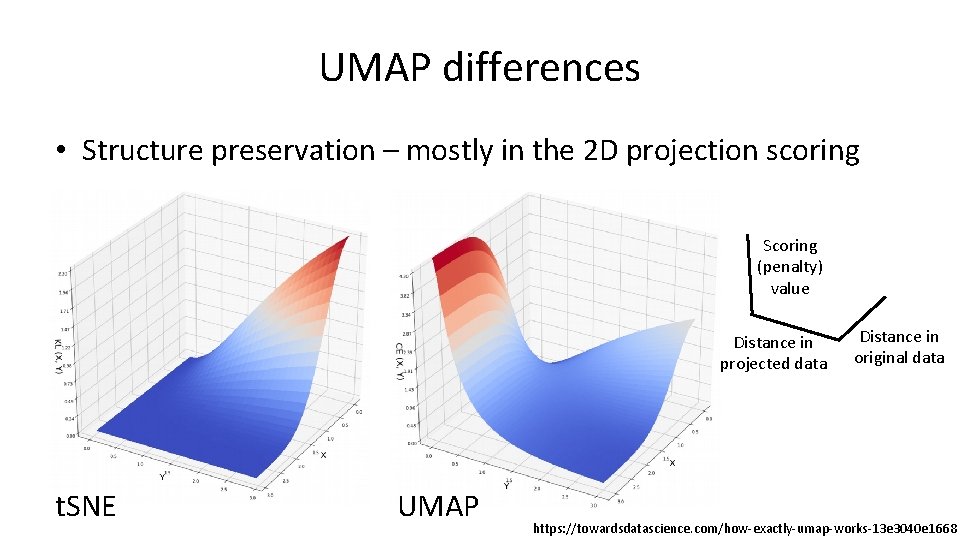
UMAP differences • Structure preservation – mostly in the 2 D projection scoring Scoring (penalty) value Distance in projected data t. SNE UMAP Distance in original data https: //towardsdatascience. com/how-exactly-umap-works-13 e 3040 e 1668
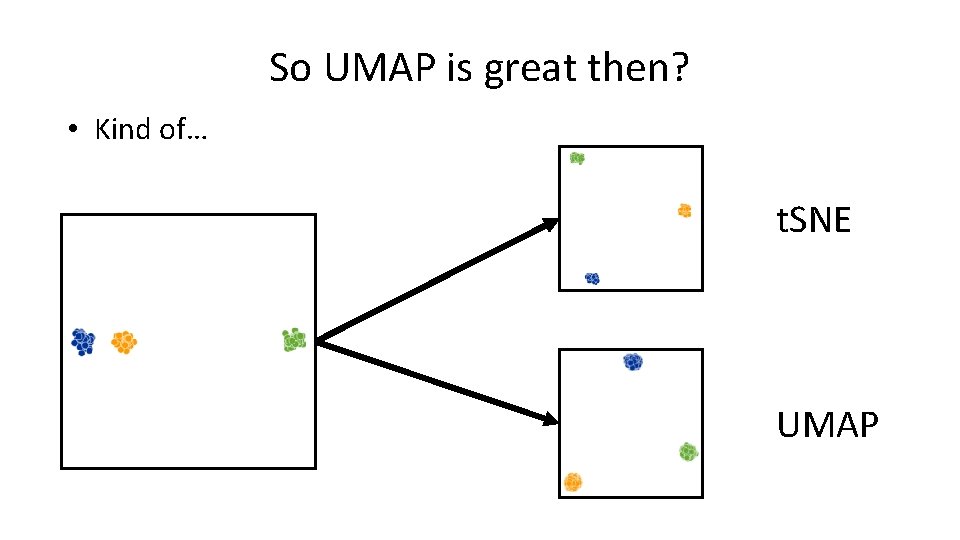
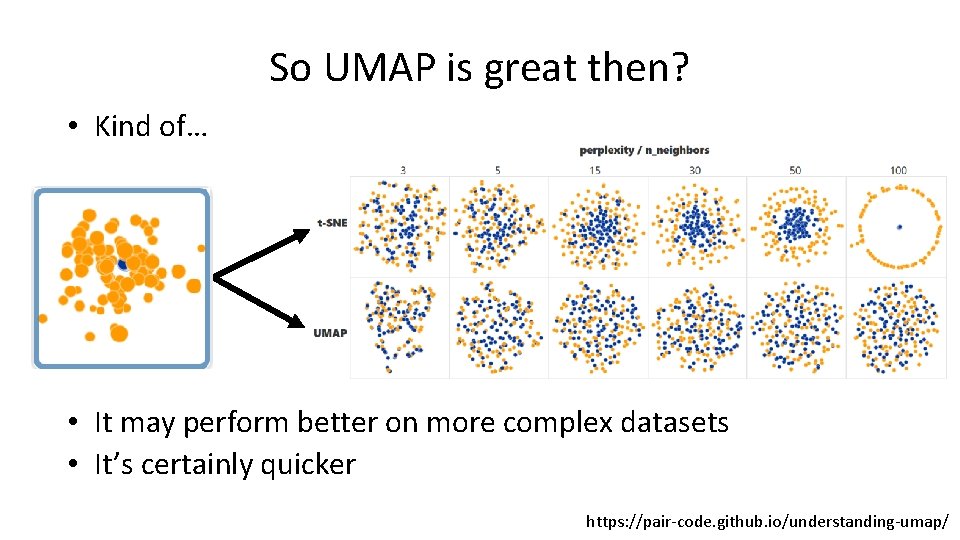
So UMAP is great then? • Kind of… t. SNE UMAP
So UMAP is great then? • Kind of… • It may perform better on more complex datasets • It’s certainly quicker https: //pair-code. github. io/understanding-umap/
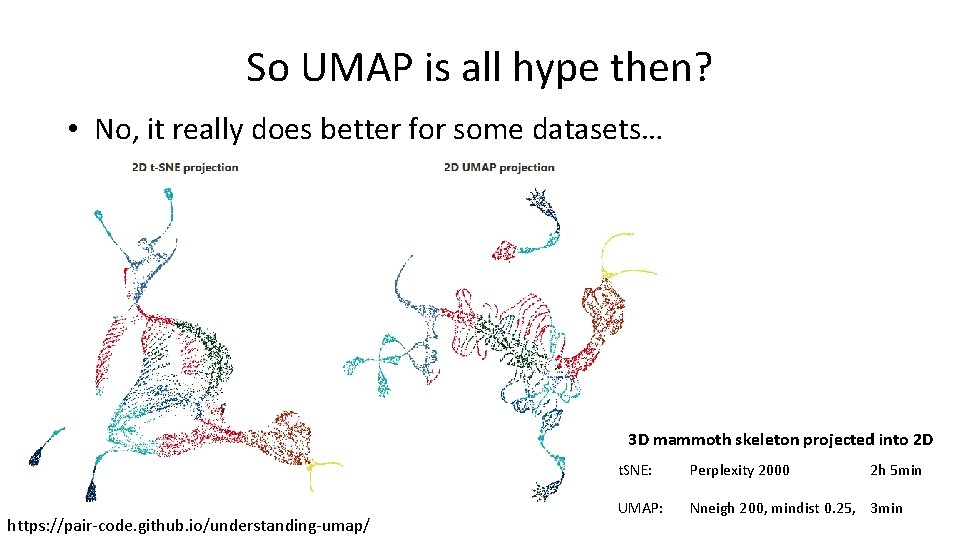
So UMAP is all hype then? • No, it really does better for some datasets… 3 D mammoth skeleton projected into 2 D https: //pair-code. github. io/understanding-umap/ t. SNE: Perplexity 2000 2 h 5 min UMAP: Nneigh 200, mindist 0. 25, 3 min
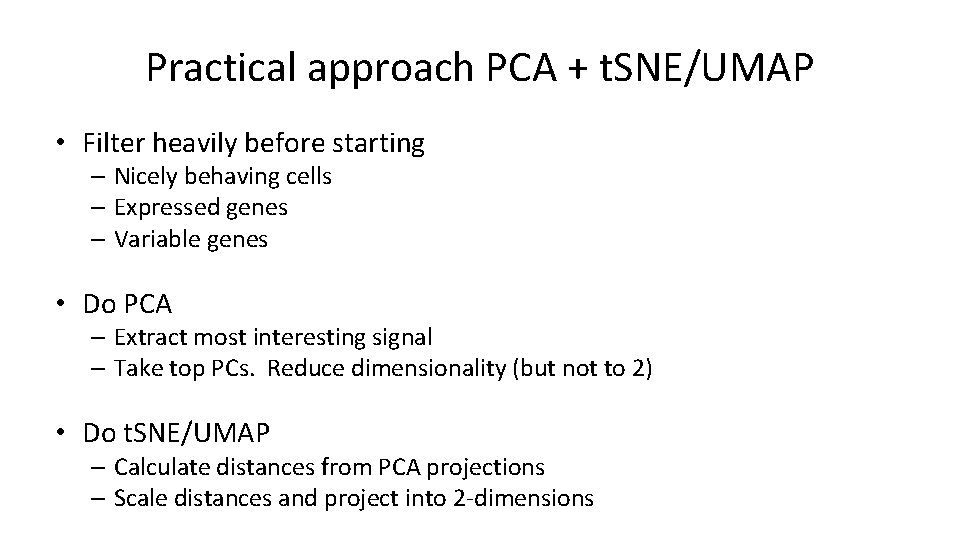
Practical approach PCA + t. SNE/UMAP • Filter heavily before starting – Nicely behaving cells – Expressed genes – Variable genes • Do PCA – Extract most interesting signal – Take top PCs. Reduce dimensionality (but not to 2) • Do t. SNE/UMAP – Calculate distances from PCA projections – Scale distances and project into 2 -dimensions