
Dimension Reduction Calculation Method of Toroidal Magnet MonAfPo
- Slides: 1
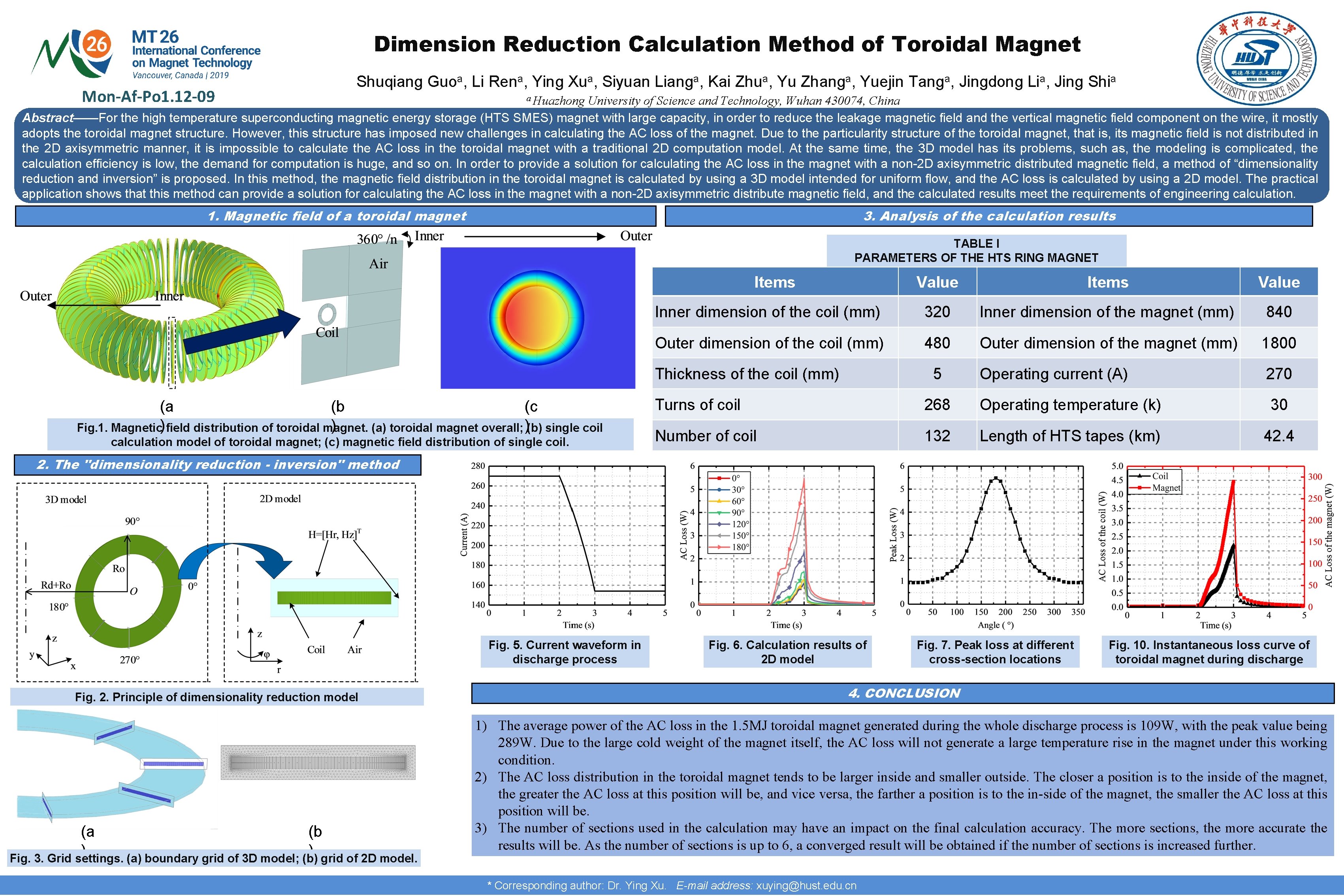
Dimension Reduction Calculation Method of Toroidal Magnet Mon-Af-Po 1. 12 -09 Shuqiang Guoa, Li Rena, Ying Xua, Siyuan Lianga, Kai Zhua, Yu Zhanga, Yuejin Tanga, Jingdong Lia, Jing Shia a Huazhong University of Science and Technology, Wuhan 430074, China Abstract——For the high temperature superconducting magnetic energy storage (HTS SMES) magnet with large capacity, in order to reduce the leakage magnetic field and the vertical magnetic field component on the wire, it mostly adopts the toroidal magnet structure. However, this structure has imposed new challenges in calculating the AC loss of the magnet. Due to the particularity structure of the toroidal magnet, that is, its magnetic field is not distributed in the 2 D axisymmetric manner, it is impossible to calculate the AC loss in the toroidal magnet with a traditional 2 D computation model. At the same time, the 3 D model has its problems, such as, the modeling is complicated, the calculation efficiency is low, the demand for computation is huge, and so on. In order to provide a solution for calculating the AC loss in the magnet with a non-2 D axisymmetric distributed magnetic field, a method of “dimensionality reduction and inversion” is proposed. In this method, the magnetic field distribution in the toroidal magnet is calculated by using a 3 D model intended for uniform flow, and the AC loss is calculated by using a 2 D model. The practical application shows that this method can provide a solution for calculating the AC loss in the magnet with a non-2 D axisymmetric distribute magnetic field, and the calculated results meet the requirements of engineering calculation. 1. Magnetic field of a toroidal magnet 3. Analysis of the calculation results TABLE I PARAMETERS OF THE HTS RING MAGNET Items Value Inner dimension of the coil (mm) 320 Inner dimension of the magnet (mm) 840 Outer dimension of the coil (mm) 480 Outer dimension of the magnet (mm) 1800 Operating current (A) 270 Thickness of the coil (mm) (a (b (c ) Fig. 1. Magnetic) field distribution of toroidal magnet. (a) toroidal magnet overall; )(b) single coil calculation model of toroidal magnet; (c) magnetic field distribution of single coil. 5 Turns of coil 268 Operating temperature (k) 30 Number of coil 132 Length of HTS tapes (km) 42. 4 2. The "dimensionality reduction - inversion" method Fig. 5. Current waveform in discharge process Fig. 2. Principle of dimensionality reduction model (a (b ) ) Fig. 3. Grid settings. (a) boundary grid of 3 D model; (b) grid of 2 D model. Fig. 6. Calculation results of 2 D model Fig. 7. Peak loss at different cross-section locations Fig. 10. Instantaneous loss curve of toroidal magnet during discharge 4. CONCLUSION 1) The average power of the AC loss in the 1. 5 MJ toroidal magnet generated during the whole discharge process is 109 W, with the peak value being 289 W. Due to the large cold weight of the magnet itself, the AC loss will not generate a large temperature rise in the magnet under this working condition. 2) The AC loss distribution in the toroidal magnet tends to be larger inside and smaller outside. The closer a position is to the inside of the magnet, the greater the AC loss at this position will be, and vice versa, the farther a position is to the in-side of the magnet, the smaller the AC loss at this position will be. 3) The number of sections used in the calculation may have an impact on the final calculation accuracy. The more sections, the more accurate the results will be. As the number of sections is up to 6, a converged result will be obtained if the number of sections is increased further. * Corresponding author: Dr. Ying Xu. E-mail address: xuying@hust. edu. cn