
Dilution Dissolution and Evaporation SOLUTIONS Dilution Dissolution Evaporation
- Slides: 11
Dilution, Dissolution and Evaporation SOLUTIONS
Dilution, Dissolution & Evaporation � The concentration of a solution __________in different ways � Ex: If water is added to a bowl of soup, the taste ____________ � The soup is _______; the concentration of the chicken soup is lower
Dilution, Dissolution & Evaporation � Ex: If chicken bouillon powder is added , the flavour becomes more intense. � The concentration increased because of the addition of extra solute (___________)
Dilution, Dissolution and Evaporation � If evaporation takes place the amount of ___________therefore it will _______the concentration
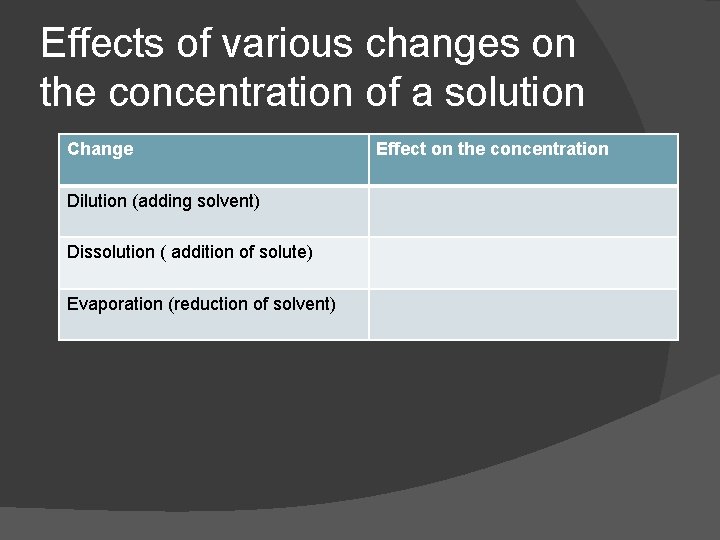
Effects of various changes on the concentration of a solution Change Dilution (adding solvent) Dissolution ( addition of solute) Evaporation (reduction of solvent) Effect on the concentration
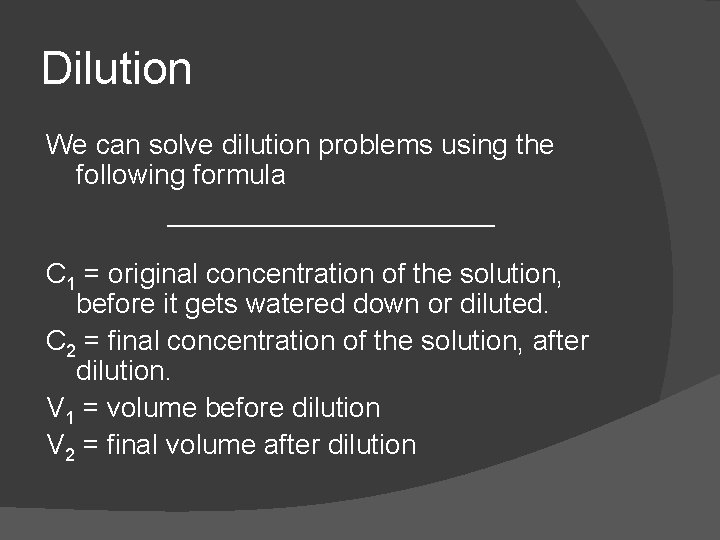
Dilution We can solve dilution problems using the following formula ___________ C 1 = original concentration of the solution, before it gets watered down or diluted. C 2 = final concentration of the solution, after dilution. V 1 = volume before dilution V 2 = final volume after dilution
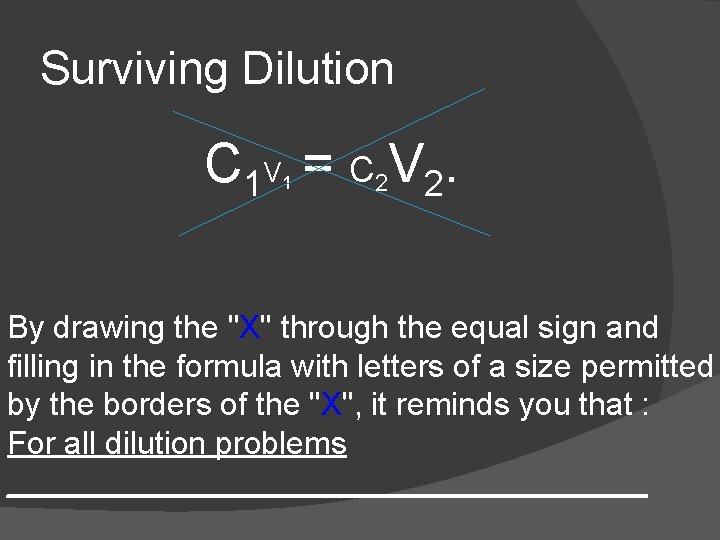
Surviving Dilution C 1 V = C 2 V 2. 1 By drawing the "X" through the equal sign and filling in the formula with letters of a size permitted by the borders of the "X", it reminds you that : For all dilution problems __________________
� This makes sense because when we dilute we add more solvent. � This ________the volume but _______the concentration
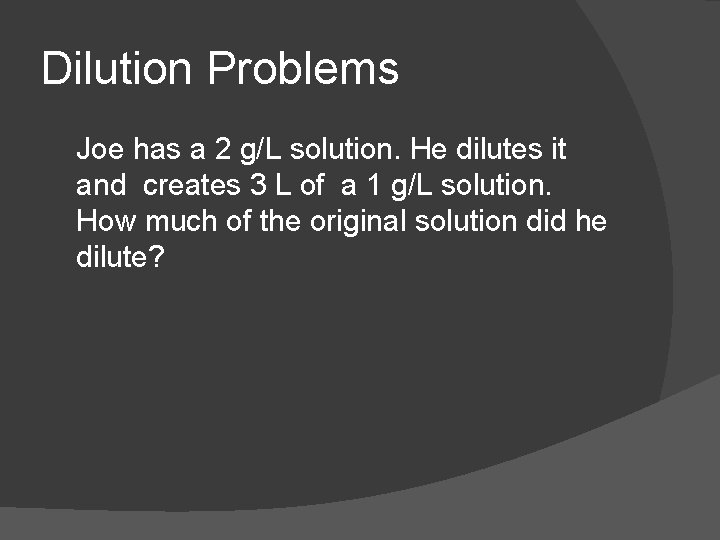
Dilution Problems Joe has a 2 g/L solution. He dilutes it and creates 3 L of a 1 g/L solution. How much of the original solution did he dilute?
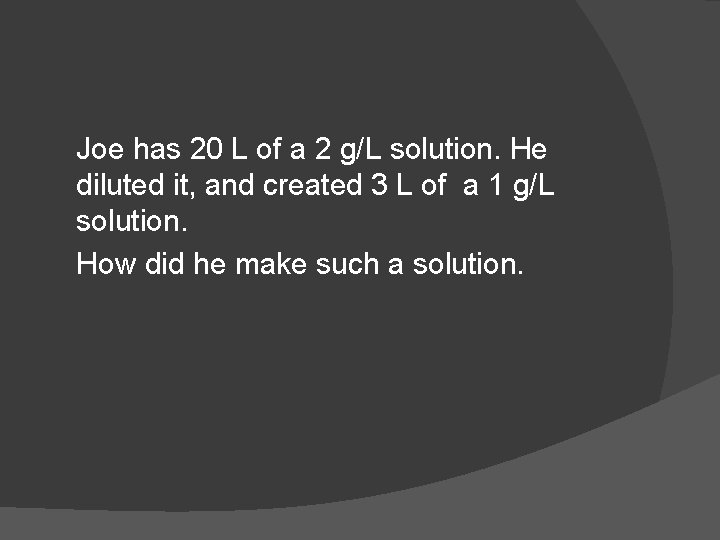
Joe has 20 L of a 2 g/L solution. He diluted it, and created 3 L of a 1 g/L solution. How did he make such a solution.
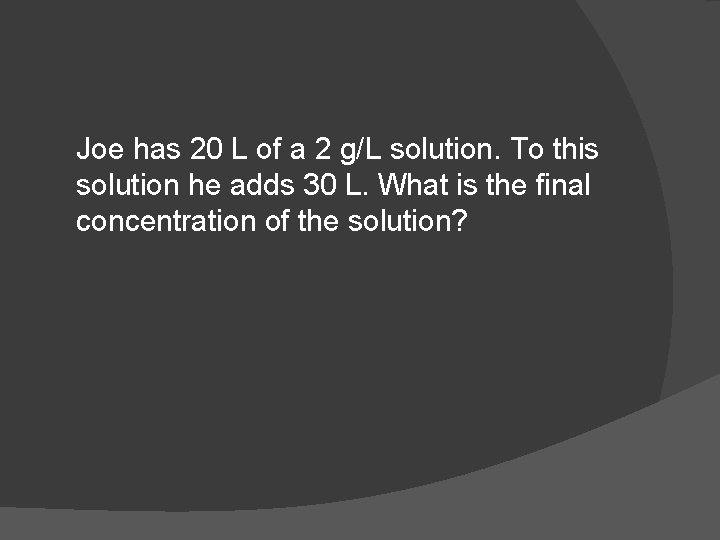
Joe has 20 L of a 2 g/L solution. To this solution he adds 30 L. What is the final concentration of the solution?