
Dilution Calculations Background Process of reducing the concentration
Dilution Calculations
Background • Process of reducing the concentration of a product by adding more solvent • Information needed for calculation – Volume (active ingredient and/or solvent) – Concentration (percent concentration or strength in grams) • % concentration is equivalent to X grams/100 m. L – Volume of final solution
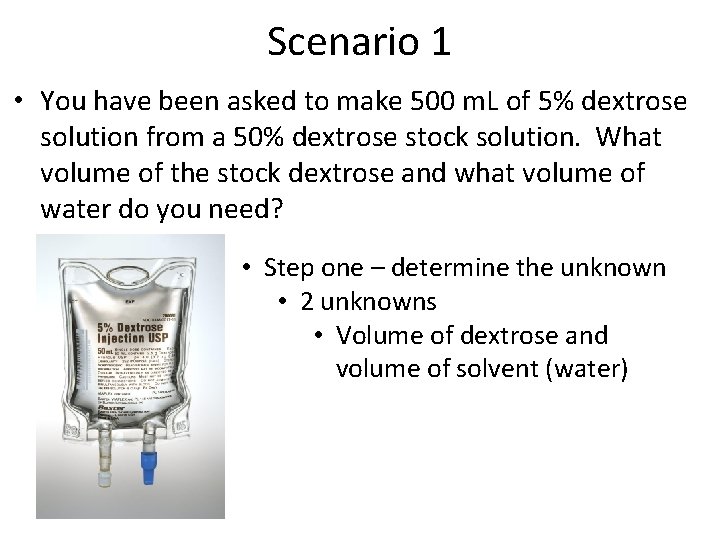
Scenario 1 • You have been asked to make 500 m. L of 5% dextrose solution from a 50% dextrose stock solution. What volume of the stock dextrose and what volume of water do you need? • Step one – determine the unknown • 2 unknowns • Volume of dextrose and volume of solvent (water)
Solution • Set up your equation – this problem does not require conversions – C 1 V 1 = C 2 V 2 • C is concentration and V is volume • 1 is starting materials and 2 is final • Let’s look at the problem again!
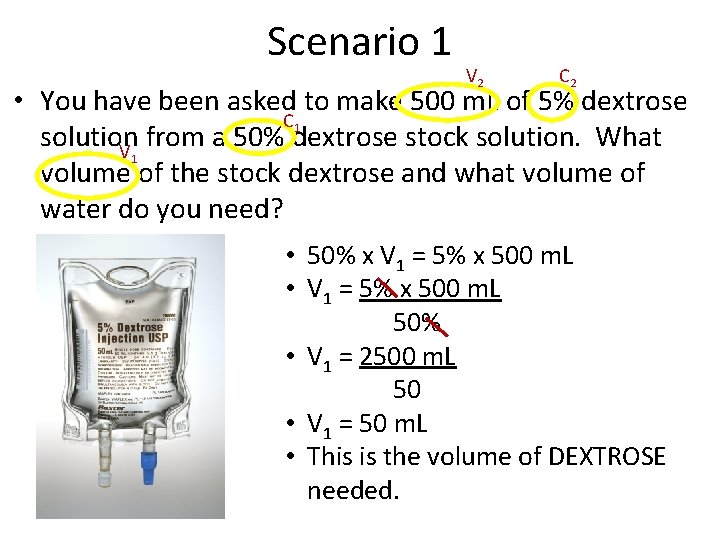
Scenario 1 V 2 C 2 • You have been asked to make 500 m. L of 5% dextrose C 1 solution from a 50% dextrose stock solution. What V 1 volume of the stock dextrose and what volume of water do you need? • 50% x V 1 = 5% x 500 m. L • V 1 = 5% x 500 m. L 50% • V 1 = 2500 m. L 50 • V 1 = 50 m. L • This is the volume of DEXTROSE needed.
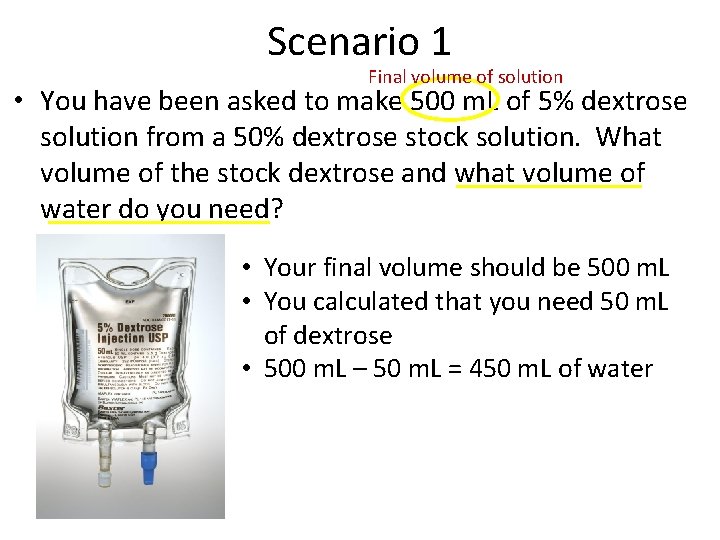
Scenario 1 Final volume of solution • You have been asked to make 500 m. L of 5% dextrose solution from a 50% dextrose stock solution. What volume of the stock dextrose and what volume of water do you need? • Your final volume should be 500 m. L • You calculated that you need 50 m. L of dextrose • 500 m. L – 50 m. L = 450 m. L of water
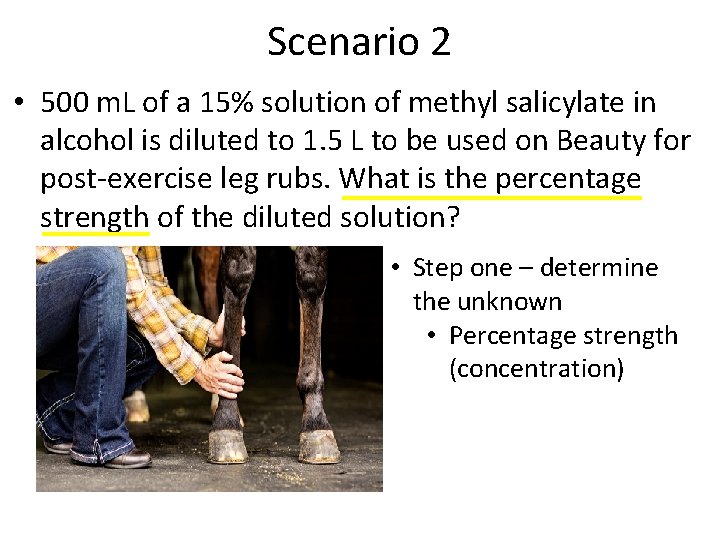
Scenario 2 • 500 m. L of a 15% solution of methyl salicylate in alcohol is diluted to 1. 5 L to be used on Beauty for post-exercise leg rubs. What is the percentage strength of the diluted solution? • Step one – determine the unknown • Percentage strength (concentration)
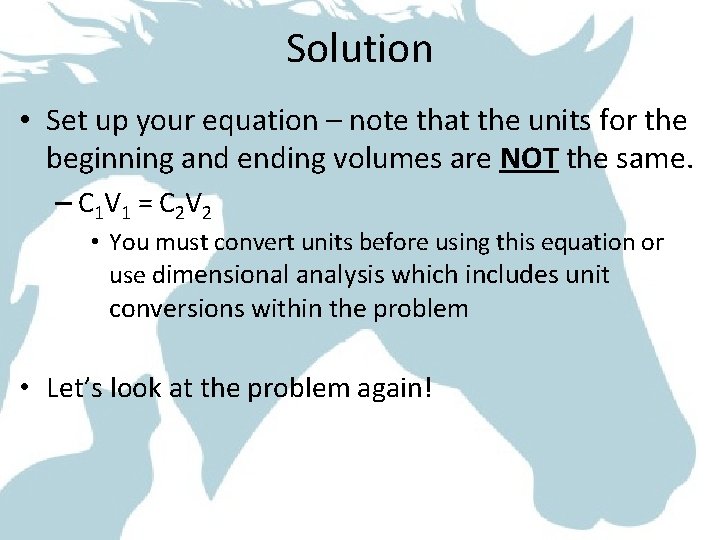
Solution • Set up your equation – note that the units for the beginning and ending volumes are NOT the same. – C 1 V 1 = C 2 V 2 • You must convert units before using this equation or use dimensional analysis which includes unit conversions within the problem • Let’s look at the problem again!
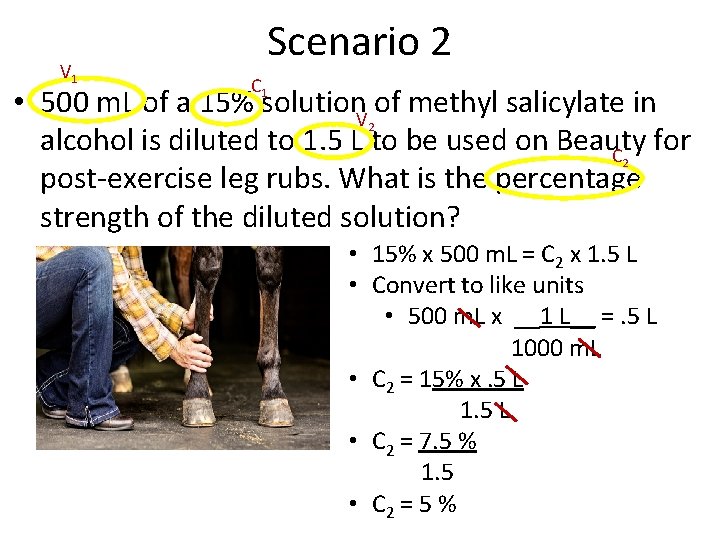
V 1 Scenario 2 C 1 • 500 m. L of a 15% solution. V of methyl salicylate in 2 alcohol is diluted to 1. 5 L to be used on Beauty for C 2 post-exercise leg rubs. What is the percentage strength of the diluted solution? • 15% x 500 m. L = C 2 x 1. 5 L • Convert to like units • 500 m. L x __1 L__ =. 5 L 1000 m. L • C 2 = 15% x. 5 L 1. 5 L • C 2 = 7. 5 % 1. 5 • C 2 = 5 %
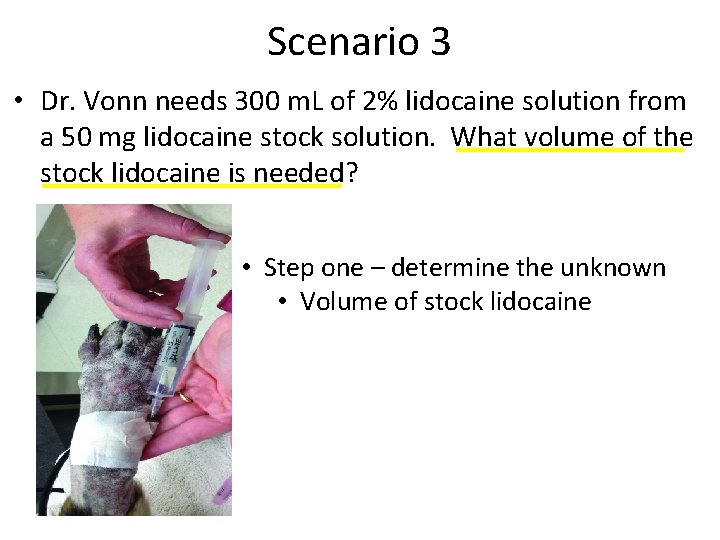
Scenario 3 • Dr. Vonn needs 300 m. L of 2% lidocaine solution from a 50 mg lidocaine stock solution. What volume of the stock lidocaine is needed? • Step one – determine the unknown • Volume of stock lidocaine
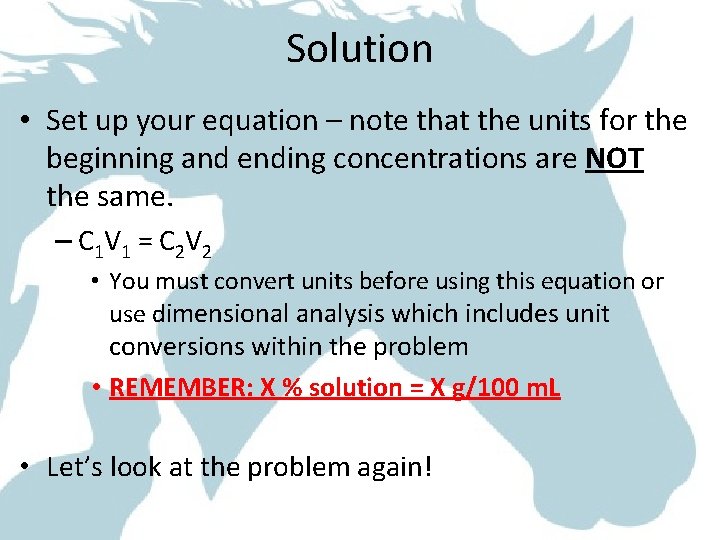
Solution • Set up your equation – note that the units for the beginning and ending concentrations are NOT the same. – C 1 V 1 = C 2 V 2 • You must convert units before using this equation or use dimensional analysis which includes unit conversions within the problem • REMEMBER: X % solution = X g/100 m. L • Let’s look at the problem again!
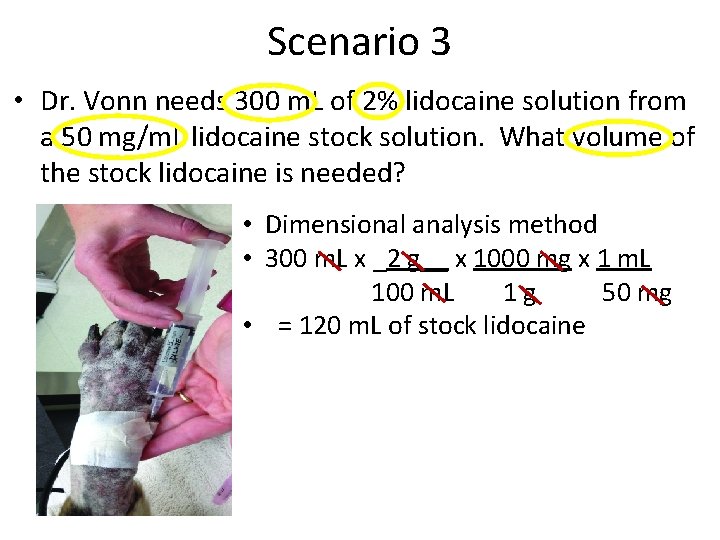
Scenario 3 • Dr. Vonn needs 300 m. L of 2% lidocaine solution from a 50 mg/m. L lidocaine stock solution. What volume of the stock lidocaine is needed? • Dimensional analysis method • 300 m. L x _2 g__ x 1000 mg x 1 m. L 100 m. L 1 g 50 mg • = 120 m. L of stock lidocaine
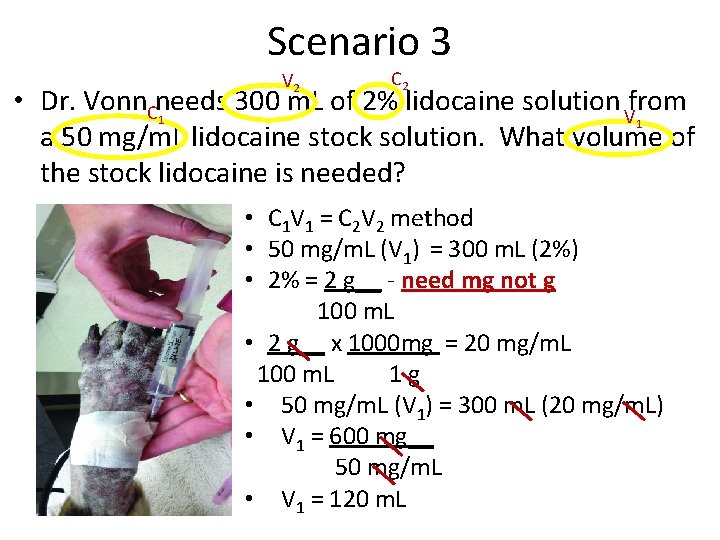
Scenario 3 V 2 C 2 • Dr. Vonn. Cneeds 300 m. L of 2% lidocaine solution from V 1 1 a 50 mg/m. L lidocaine stock solution. What volume of the stock lidocaine is needed? • C 1 V 1 = C 2 V 2 method • 50 mg/m. L (V 1) = 300 m. L (2%) • 2% = 2 g__ - need mg not g 100 m. L • 2 g__ x 1000 mg = 20 mg/m. L 100 m. L 1 g • 50 mg/m. L (V 1) = 300 m. L (20 mg/m. L) • V 1 = 600 mg__ 50 mg/m. L • V 1 = 120 m. L
Questions?
- Slides: 14