
DILACERATION AND ACCESSORY ROOTS By Jorge Robles DILACERATION
DILACERATION AND ACCESSORY ROOTS By Jorge Robles
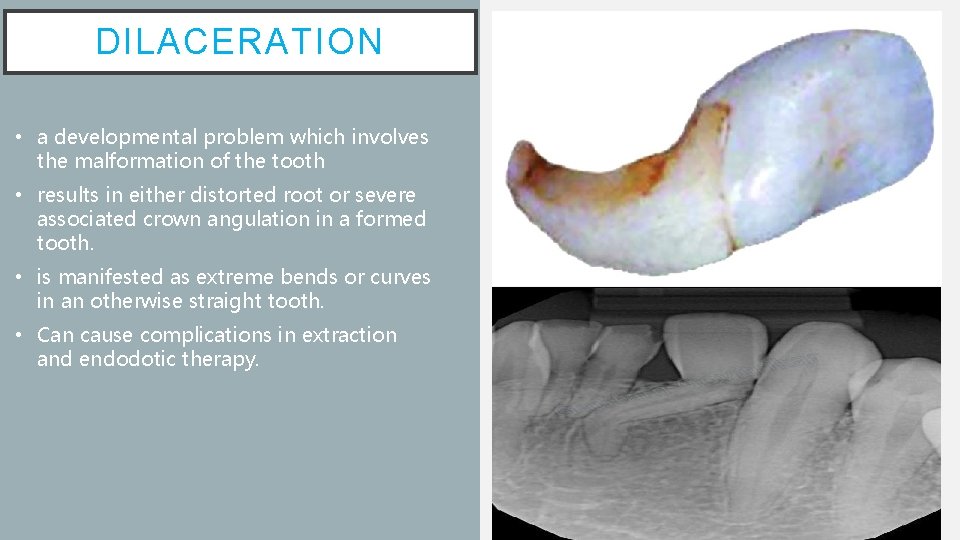
DILACERATION • a developmental problem which involves the malformation of the tooth • results in either distorted root or severe associated crown angulation in a formed tooth. • is manifested as extreme bends or curves in an otherwise straight tooth. • Can cause complications in extraction and endodotic therapy.

ACCESSORY ROOTS • also known as supernumerary roots. • a condition which refers to the development of an increased number of roots on a tooth compared with that described in a normal dental anatomy.
WHAT ARE THE CAUSES? DILACERATION • Can be caused by a distortion of Hertwig epithelial root sheath roots and induction of root dentin), due to pressure or injury. (responsible for the shape of the • Injury can displace the calcified portion of the tooth germ, resulting in the remainder of the tooth forming at an abnormal angle. • Damage usually follows avulsion or intrusion of the overlying primary predecessor. • The bend can also occur due to the presence of an adjacent cyst or tumor. • Common causes include crowding, trauma, adjacent bony lesions, and Orthodontic traction • Can occur in any tooth or group of teeth during development. • Very pronounced bend can prevent tooth eruption.

CAUSES CONT’D ACCESSORY ROOTS • Extra roots may be due to trauma, pressure, or metabolic disease that affects Hertwig epithelial root sheath. • most common teeth affected are mandibular canines, premolars, and molars, especially third molars. • Can affect any tooth • Rarely affects incisors
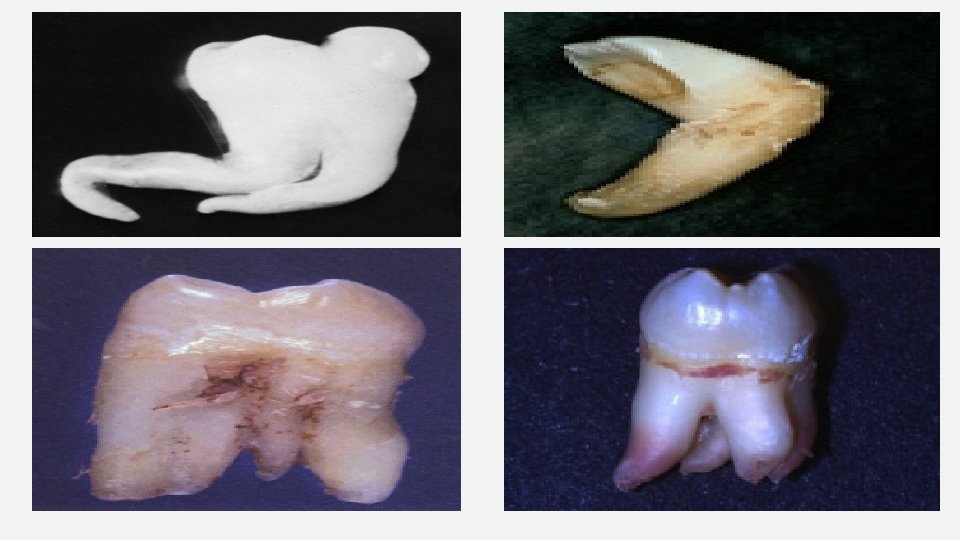

DENTAL TREATMENT DILACERATION • Extraction is necessary of primary deciduous teeth, if they demonstrate undesired resorption, which can result in delayed eruption. • Surgical Extraction is required of grossly deformed teeth due to the repositioning and perforation of the buccal alveolar ridge by the mispositioned root. • No treatment required for mild cases. ACCESSORY ROOT • No treatment necessary, but detection of the extra root is critical for endodontic therapy and tooth extraction.
ROLE OF THE HYGIENIST • Thorough intraoral examination is necessary as dilacerations are usually accidental findings during routine oral examination. • Radiograph examination is necessary before treatment to detect dilaceration or accessory roots. • Document and report any findings on the patient’s chart. • Educate patient on radiograph findings.
- Slides: 8