
Dihybrid Punnett Squares What exactly is a dihybrid

Dihybrid Punnett Squares What exactly is a dihybrid cross? Predicting the outcomes from crossing 2 traits. Why do we use them? Instead of doing to monohybrid crosses, you can combine them to see all the possible combinations from that particular mother and father.

Dihybrid Cross Traits: Seed shape & Seed color Alleles: R round r wrinkled Y yellow y green Rr. Yy RY Ry r. Y ry x Rr. Yy RY Ry r. Y ry All possible gamete combinations

Dihybrid Cross RY RY Ry r. Y ry

Dihybrid Cross RY Ry r. Y RY RRYy Rr. YY Rr. Yy Ry RRYy RRyy Rr. Yy Rryy r. Y Rr. YY ry Rr. Yy Rryy rr. YY rr. Yy ry rr. Yy rryy Round/Yellow: 9 Round/green: 3 wrinkled/Yellow: 3 wrinkled/green: 1 9: 3: 3: 1 phenotypic ratio
Incomplete Dominance When the heterozygous condition is intermediate between dominant and recessive Happens because one allele is defective, example: R=red flowers, R’= white flowers so RR’ = pink flowers (R codes for enzyme to produce red pigment, R’=no enzyme)
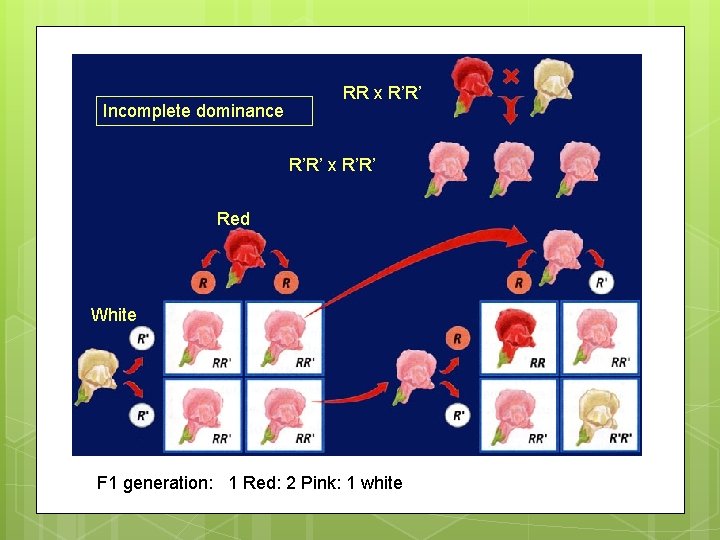
Incomplete dominance RR x R’R’ Red White F 1 generation: 1 Red: 2 Pink: 1 white
Codominance Heterozygote expresses both alleles’ conditions Ex. A black rooster bred with a white hen produces a black and white checkered chicken. Usually uses both capital letters (black= B, white=W , checkered = BW)

Codominance practice: cross a black rooster with a white hen Key: W B = black W = white B W BW BW BW = checkered Results: B 100% checkered (BW) BW BW
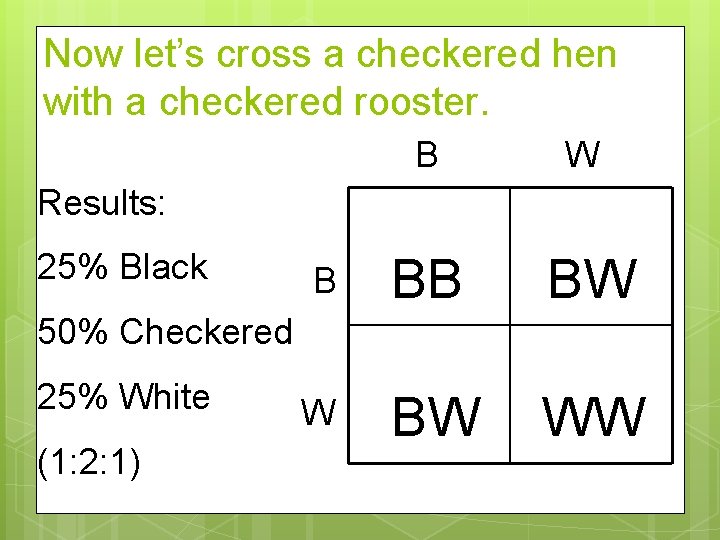
Now let’s cross a checkered hen with a checkered rooster. B W B BB BW WW Results: 25% Black 50% Checkered 25% White (1: 2: 1)

Codominance Two alleles are expressed (multiple alleles) in heterozygous individuals. Example: blood type 1. 2. 3. 4. type A B AB O = = IAIA or IAi IBIB or IBi I AI B ii
Blood type quick facts Red blood cells are called erythrocytes Proteins on their surfaces are called antigens, controlled by genes Antigens make antibodies to foreign substances, which includes RBCs with different antigens on their surface 4 phenotypes: A, B, AB, O 3 alleles: IA, IB, i
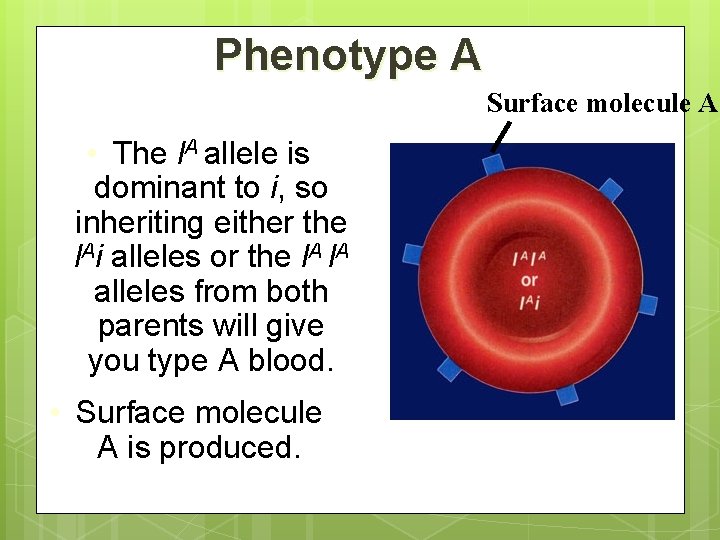
Phenotype A Surface molecule A • The l. A allele is dominant to i, so inheriting either the l. Ai alleles or the l. A alleles from both parents will give you type A blood. • Surface molecule A is produced.
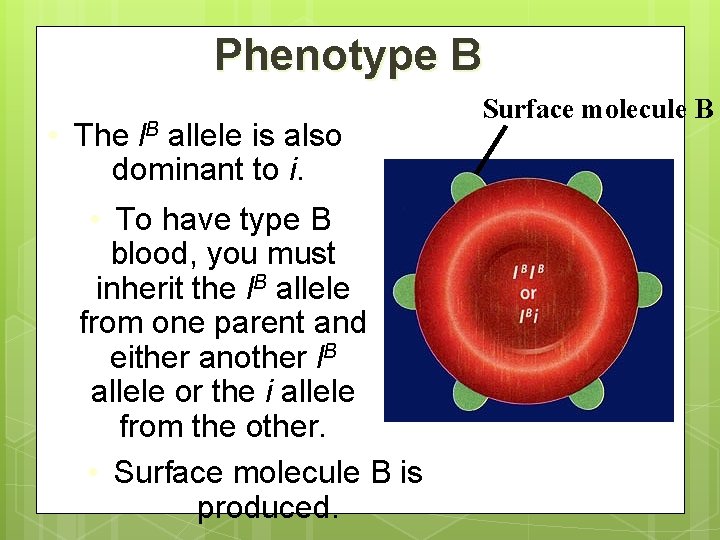
Phenotype B • The l. B allele is also dominant to i. • To have type B blood, you must inherit the l. B allele from one parent and either another l. B allele or the i allele from the other. • Surface molecule B is produced. Surface molecule B
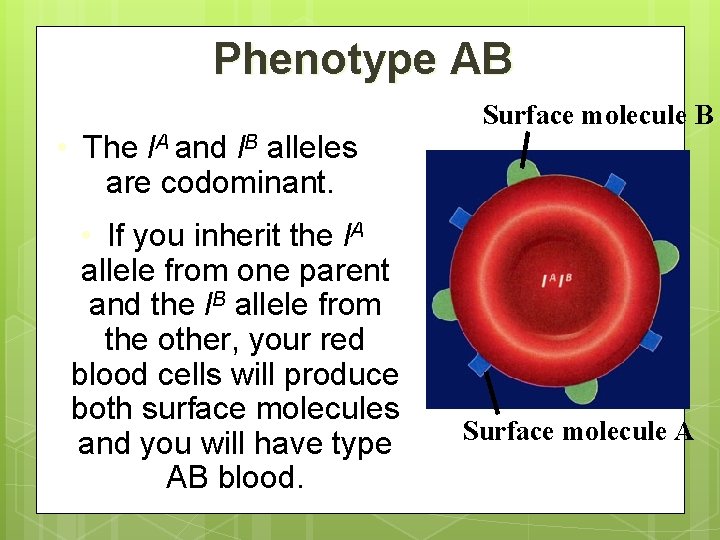
Phenotype AB • The l. A and l. B alleles are codominant. • If you inherit the l. A allele from one parent and the l. B allele from the other, your red blood cells will produce both surface molecules and you will have type AB blood. Surface molecule B Surface molecule A
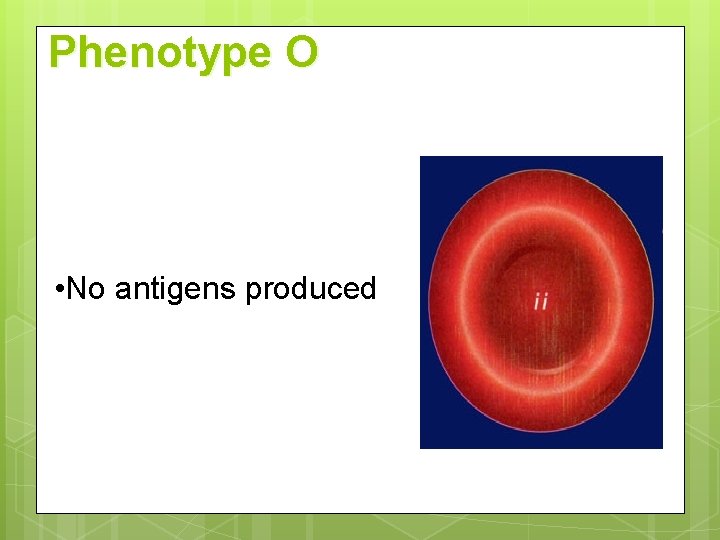
Phenotype O • No antigens produced

Blood Group Antigens Antibodies Can receive from Can give to A A B A or O B B A B or O AB A and B None O None both A, B, AB, O O A or AB B or AB AB A, B, AB, O
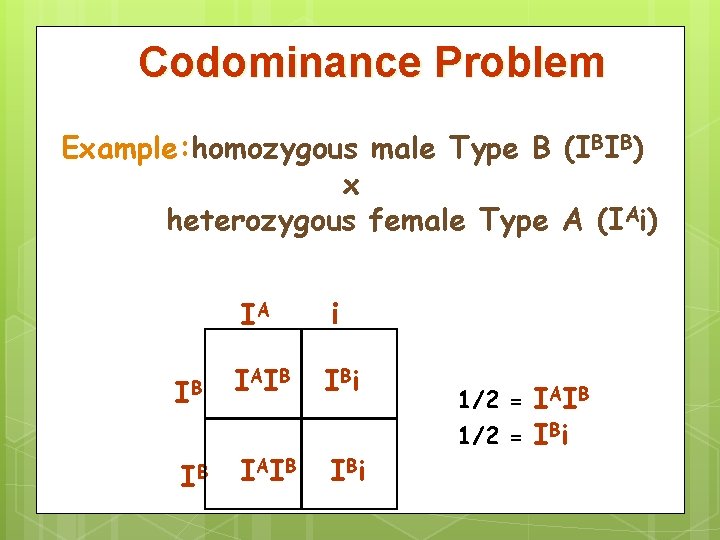
Codominance Problem Example: homozygous male Type B (IBIB) x heterozygous female Type A (IAi) IA i IB I AI B I Bi 1/2 = IAIB 1/2 = IBi
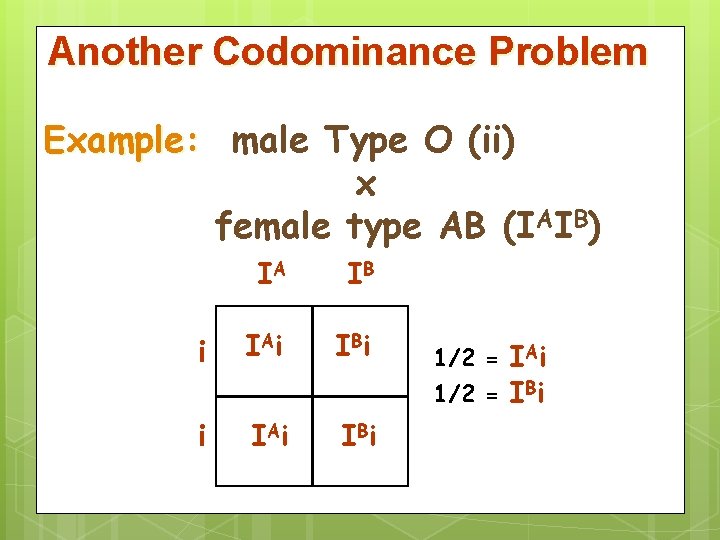
Another Codominance Problem Example: male Type O (ii) x female type AB (IAIB) IA IB i I Ai I Bi 1/2 = IAi 1/2 = IBi
- Slides: 18