
Dihybrid Crosses and Other Patterns of Inheritance Dihybrid
Dihybrid Crosses and Other Patterns of Inheritance
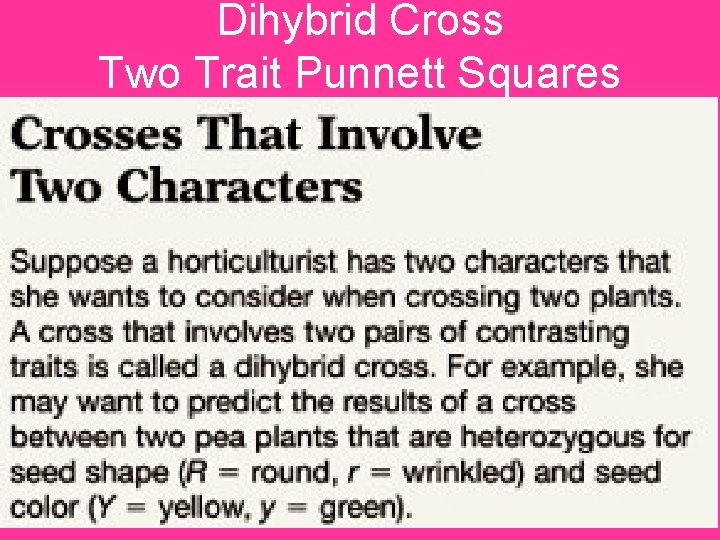
Dihybrid Cross • a mating of two organisms that are different in two observable traits – must use a two-gene Punnett Square to solve (16 total boxes)
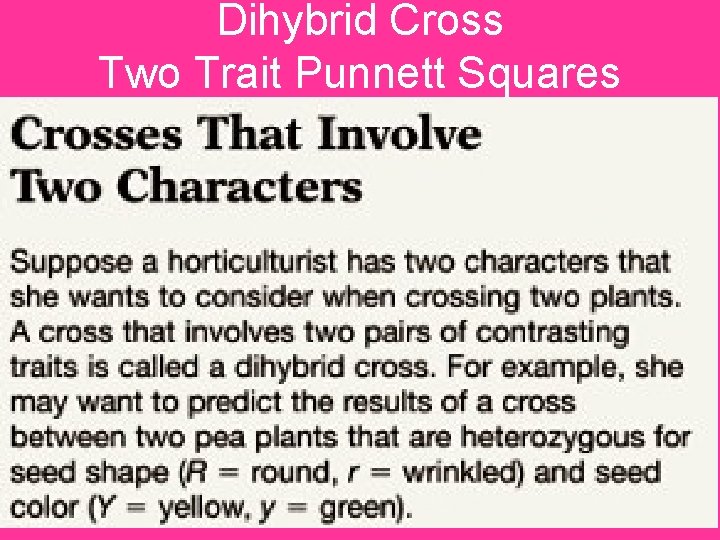
Dihybrid Cross Two Trait Punnett Squares
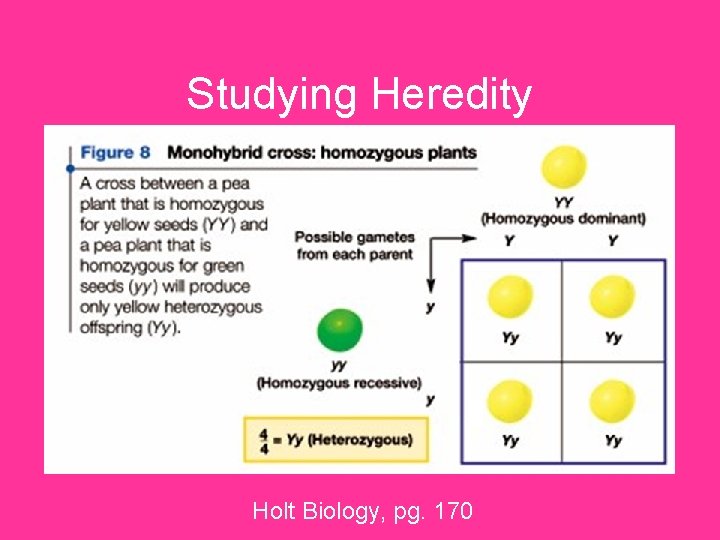
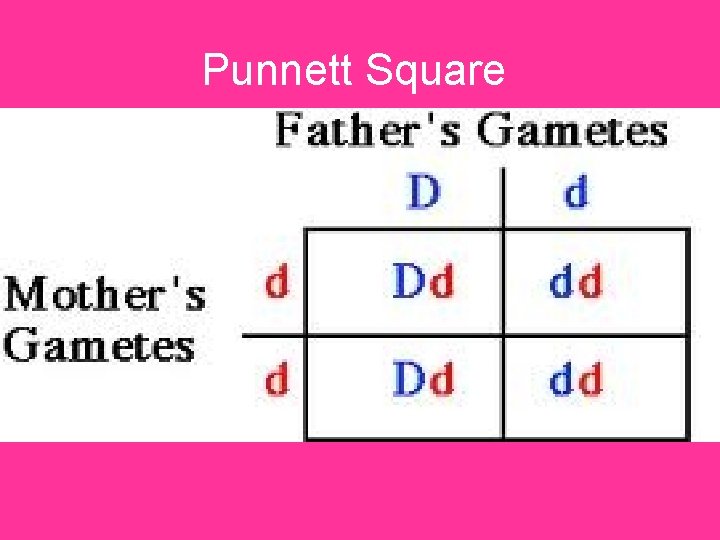
One Trait Punnett Squares and the Law of Segregation • Punnett Squares show two alleles from one parent splitting up – demonstrates Mendel’s Law of Segregation – homologous chromosomes that carry the same genes split during Meiosis 1 • allows offspring created to have one allele for each gene from each parent
Studying Heredity Holt Biology, pg. 170
Punnett Square
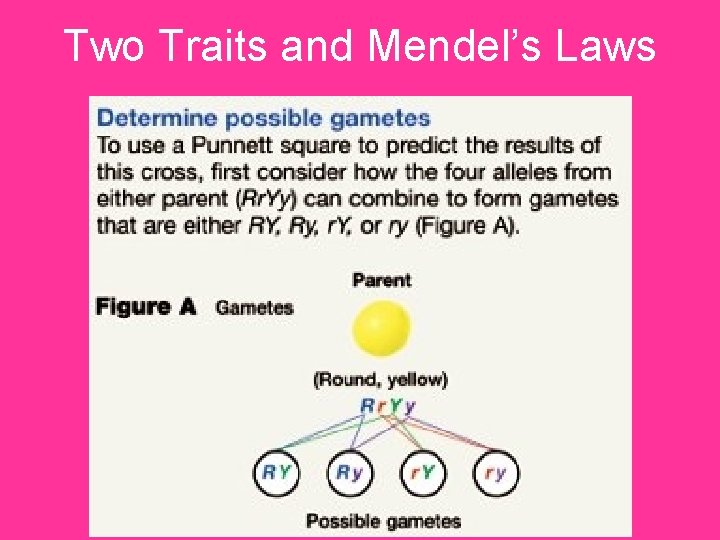
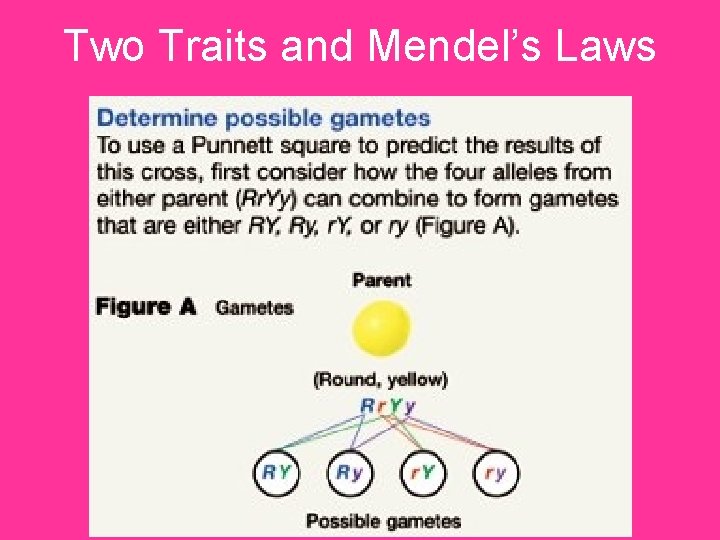
Two Traits and Mendel’s Laws • when creating possible gametes in dihybrid cross Punnett Squares, each allele may combine with dissimilar gene alleles but not with similar gene alleles
Dihybrid Cross Two Trait Punnett Squares
Two Traits and Mendel’s Laws
Two Traits and Mendel’s Laws • when creating possible gametes in dihybrid cross Punnett Squares, each allele may combine with dissimilar gene alleles but not with similar gene alleles – “R” may combine with “Y” or “y” but not with “r”
Two Traits and Mendel’s Laws
Two Traits and Mendel’s Laws • when creating possible gametes in dihybrid cross Punnett Squares, each allele may combine with dissimilar gene alleles but not with similar gene alleles – “R” may combine with “Y” or “y” but not with “r” – demonstrates Mendel’s Laws of Segregation and Independent Assortment
Dihybrid Cross Example • A plant that is heterozygous for seed shape (Rr) and heterozygous for seed color (Yy) is self-pollinated. What will the genotypic and phenotypic ratios be of the offspring?
Dihybrid Cross Example A plant that is heterozygous for seed shape (Rr) and heterozygous for seed color (Yy) is self-pollinated. What will the genotypic and phenotypic ratios be of the offspring? • Allele Identification: – Seed Shape: R = round, r = wrinkled – Seed Color: Y = yellow, y = green
Dihybrid Cross Example A plant that is heterozygous for seed shape (Rr) and heterozygous for seed color (Yy) is self-pollinated. What will the genotypic and phenotypic ratios be of the offspring? • Parent Genotype Identification: – Parent #1: Rr. Yy – Parent #2: Rr. Yy
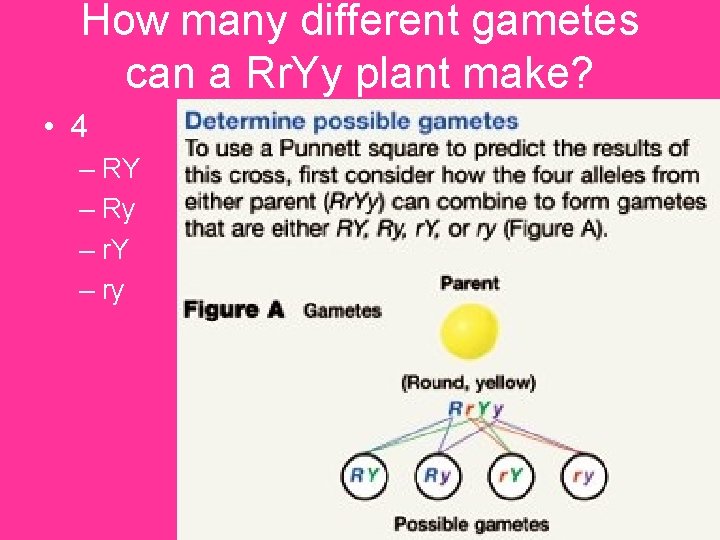
How many different gametes can a Rr. Yy plant make? • 4 – RY – Ry – r. Y – ry
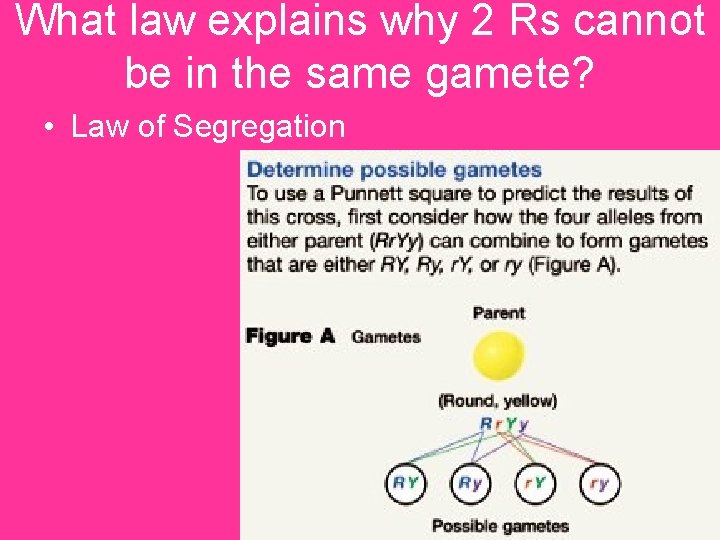
What law explains why 2 Rs cannot be in the same gamete? • Law of Segregation
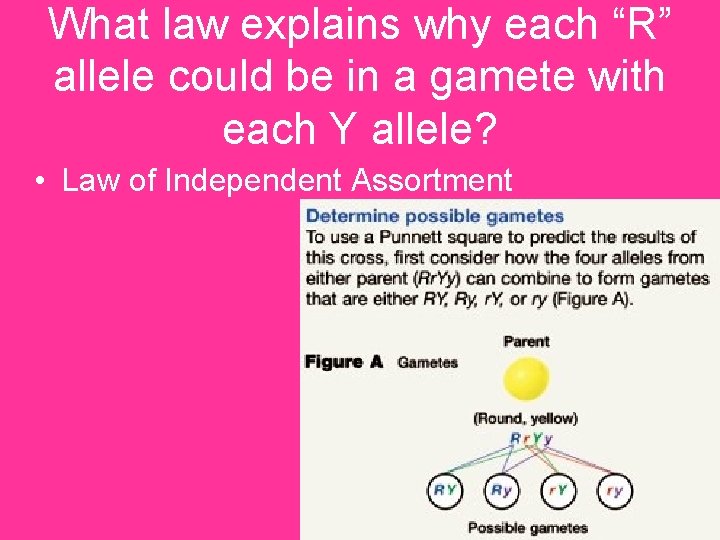
What law explains why each “R” allele could be in a gamete with each Y allele? • Law of Independent Assortment
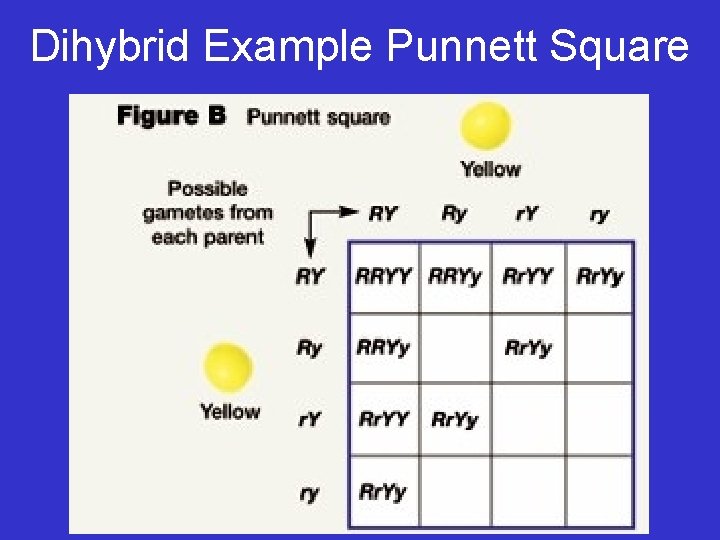
Dihybrid Example Punnett Square
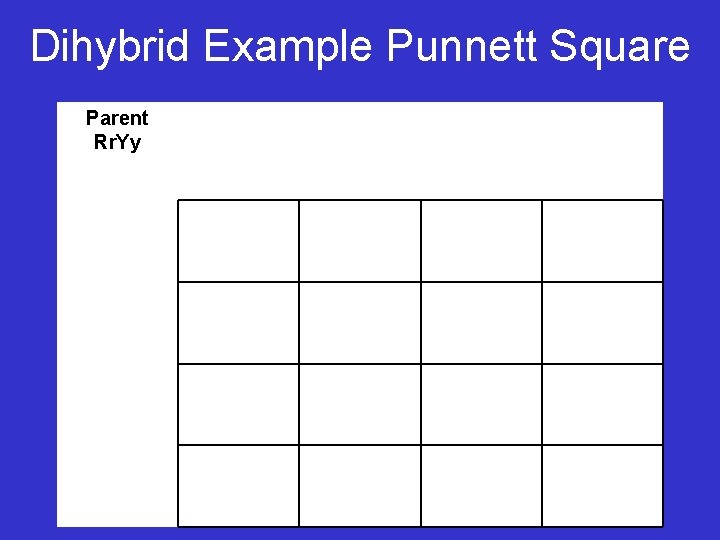
Dihybrid Example Punnett Square Parent Rr. Yy
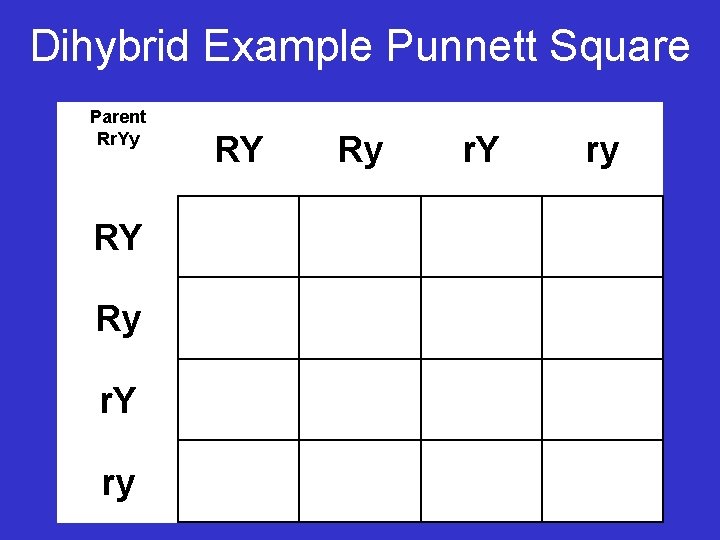
Dihybrid Example Punnett Square Parent Rr. Yy RY Ry r. Y ry
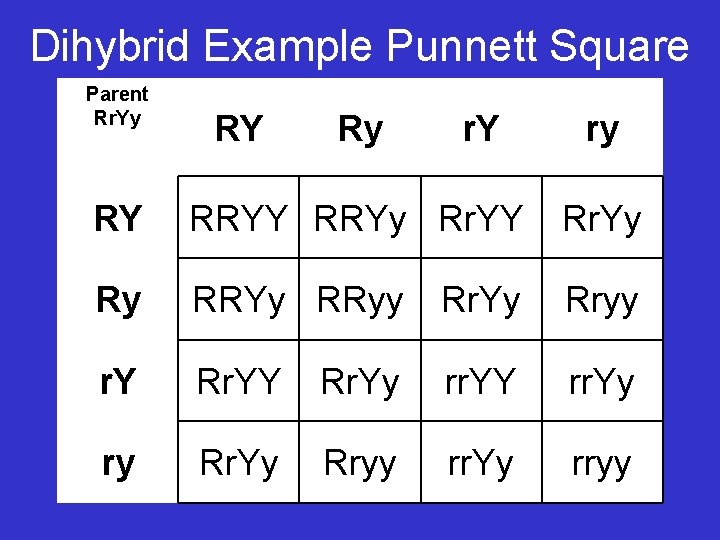
Dihybrid Example Punnett Square Parent Rr. Yy RY Ry r. Y ry RY RRYy Rr. YY Rr. Yy Ry RRYy RRyy Rr. Yy Rryy r. Y Rr. Yy rr. YY rr. Yy ry Rr. Yy Rryy rr. Yy rryy
Dihybrid Cross Example • Phenotypic Ratio:
Begin by listing all of the possible phenotype combinations.
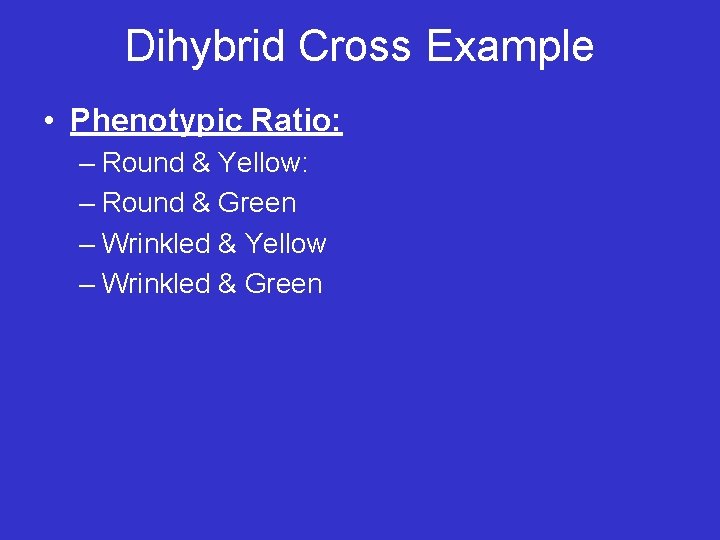
Dihybrid Cross Example • Phenotypic Ratio: – Round & Yellow: – Round & Green – Wrinkled & Yellow – Wrinkled & Green
Then count them in the Punnett Square.
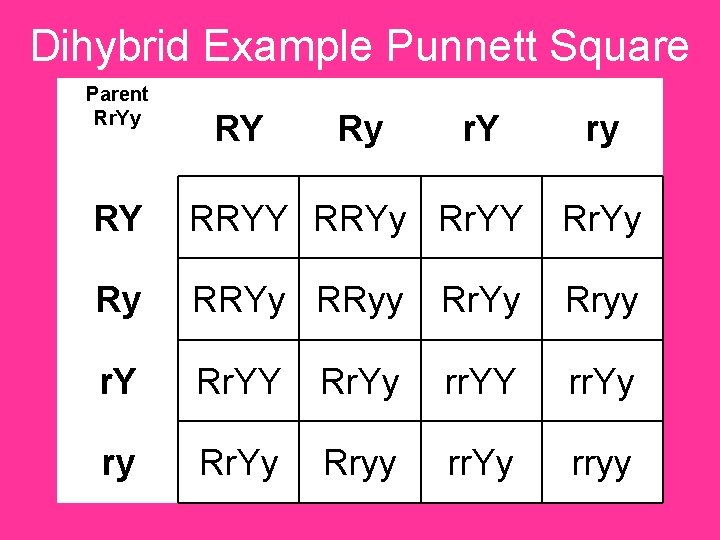
Dihybrid Example Punnett Square Parent Rr. Yy RY Ry r. Y ry RY RRYy Rr. YY Rr. Yy Ry RRYy RRyy Rr. Yy Rryy r. Y Rr. Yy rr. YY rr. Yy ry Rr. Yy Rryy rr. Yy rryy
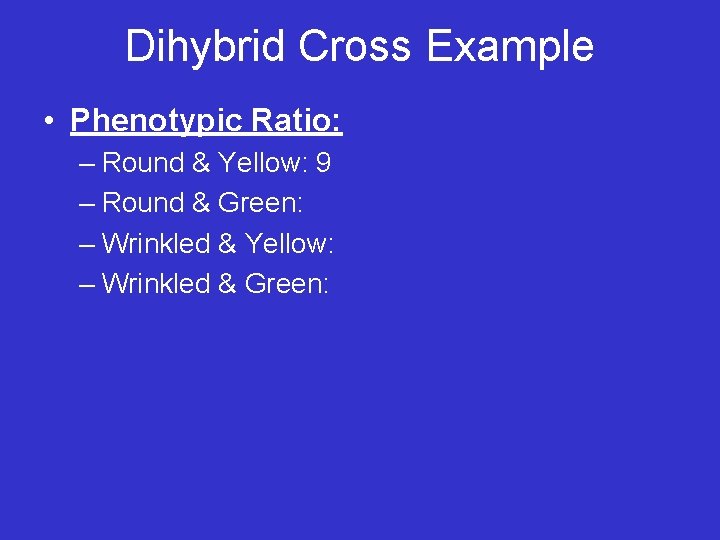
Dihybrid Cross Example • Phenotypic Ratio: – Round & Yellow: 9 – Round & Green: – Wrinkled & Yellow: – Wrinkled & Green:
Dihybrid Cross Example • Phenotypic Ratio: – Round & Yellow: 9 – Round & Green: 3 – Wrinkled & Yellow: – Wrinkled & Green:
Dihybrid Cross Example • Phenotypic Ratio: – Round & Yellow: 9 – Round & Green: 3 – Wrinkled & Yellow: 3 – Wrinkled & Green:
Dihybrid Cross Example • Phenotypic Ratio: – Round & Yellow: 9 – Round & Green: 3 – Wrinkled & Yellow: 3 – Wrinkled & Green: 1
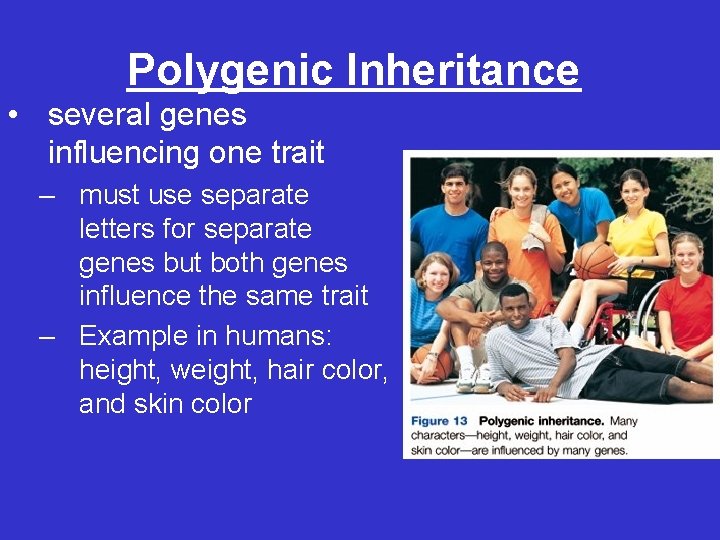
Polygenic Inheritance • several genes influencing one trait – must use separate letters for separate genes but both genes influence the same trait – Example in humans: height, weight, hair color, and skin color
We won’t use a Punnett Square with this type of inheritance.
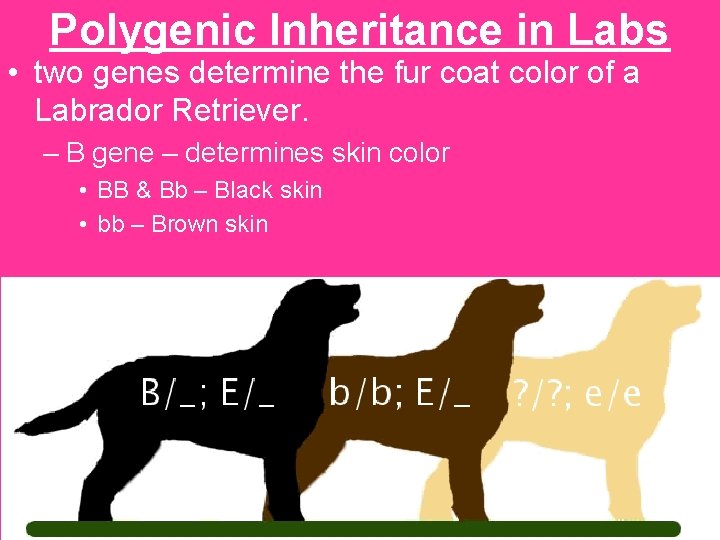
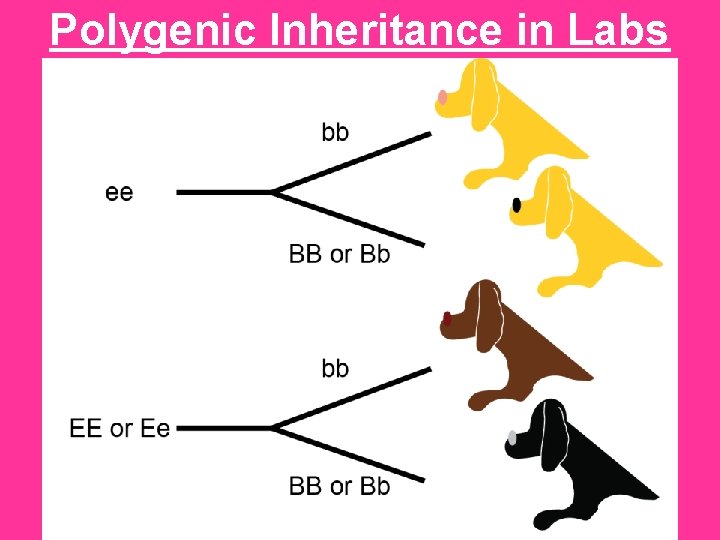
Polygenic Inheritance in Labs • two genes determine the fur coat color of a Labrador Retriever. – B gene – determines skin color • BB & Bb – Black skin • bb – Brown skin
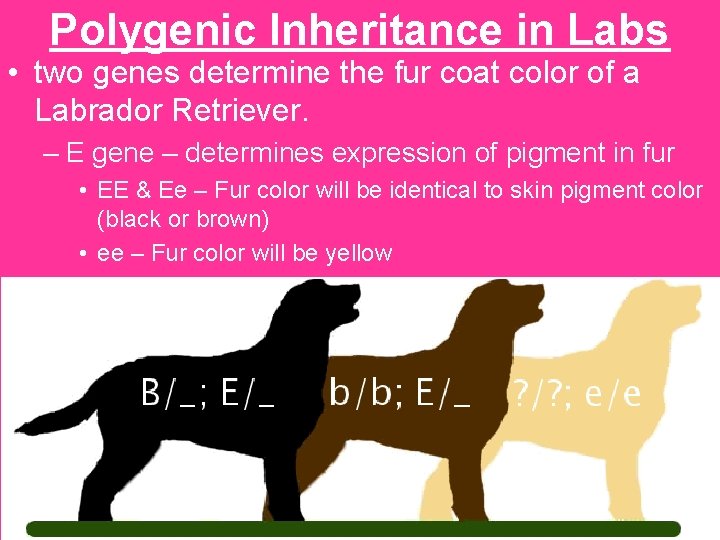
Polygenic Inheritance in Labs • two genes determine the fur coat color of a Labrador Retriever. – E gene – determines expression of pigment in fur • EE & Ee – Fur color will be identical to skin pigment color (black or brown) • ee – Fur color will be yellow • BB & Bb – Black skin • bb – Brown skin
Polygenic Inheritance in Labs
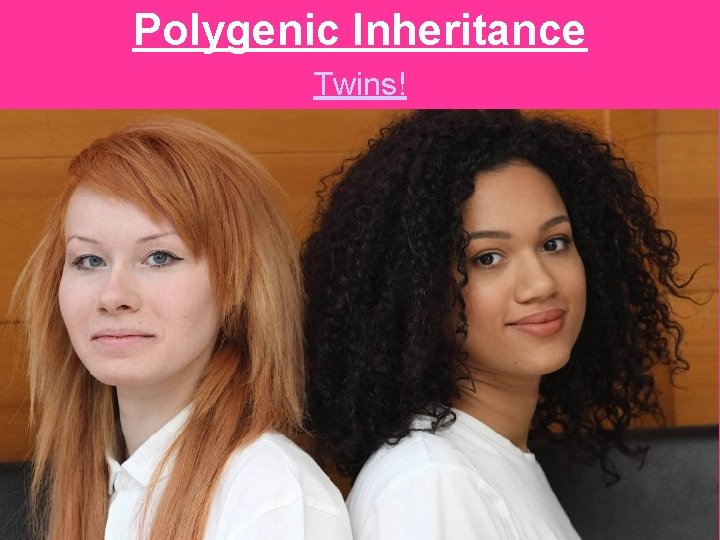
Polygenic Inheritance Twins!
Polygenic Inheritance in Horses • “B” gene for hair color – brown coat color (B) is dominant over tan (b) • “C” gene for pigment production in hair – pigment production (C) is dominant gene (C) over the absence of pigment (c) – a homozygous recessive for the second gene (cc), it will have a white coat regardless of the genetically programmed coat color (B gene) because pigment is not deposited in the hair
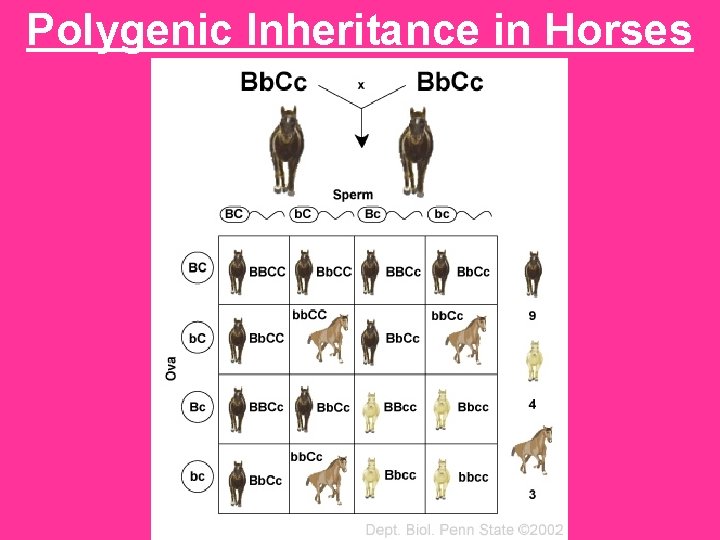
Polygenic Inheritance in Horses
Environmental influences • conditions around organisms also influence their phenotype
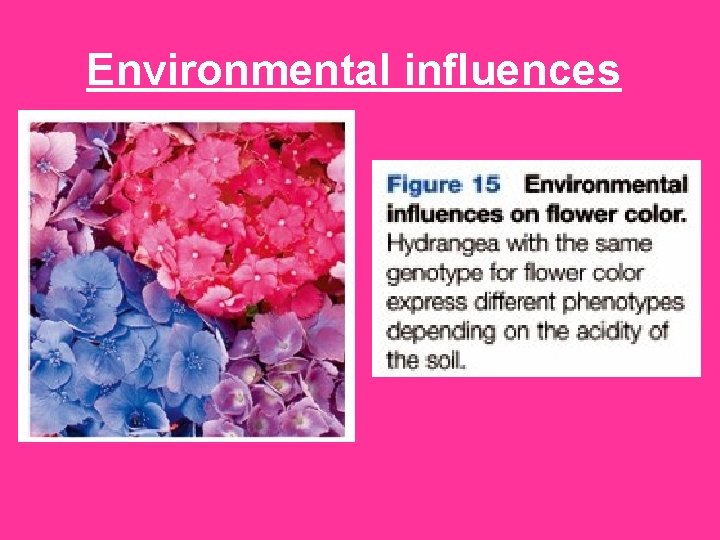
Environmental influences
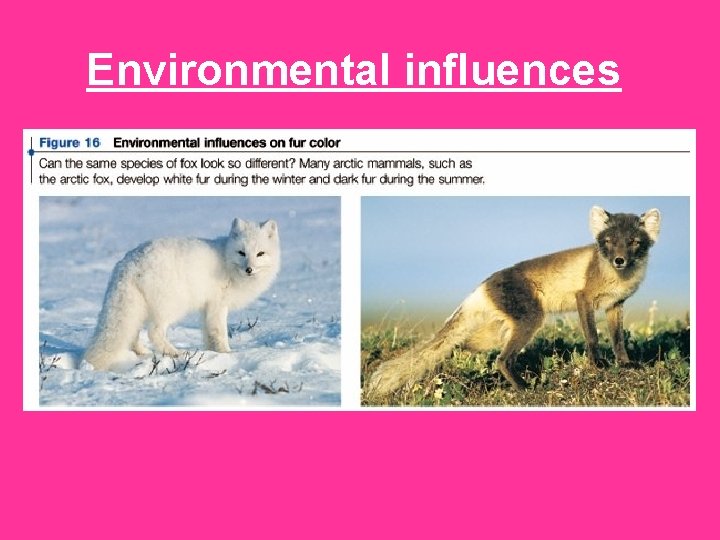
Environmental influences
Environmental influences • conditions around organisms also influence their phenotype – Examples in humans: height and weight are influenced by nutrition, skin and hair color are influenced by exposure to UV radiation
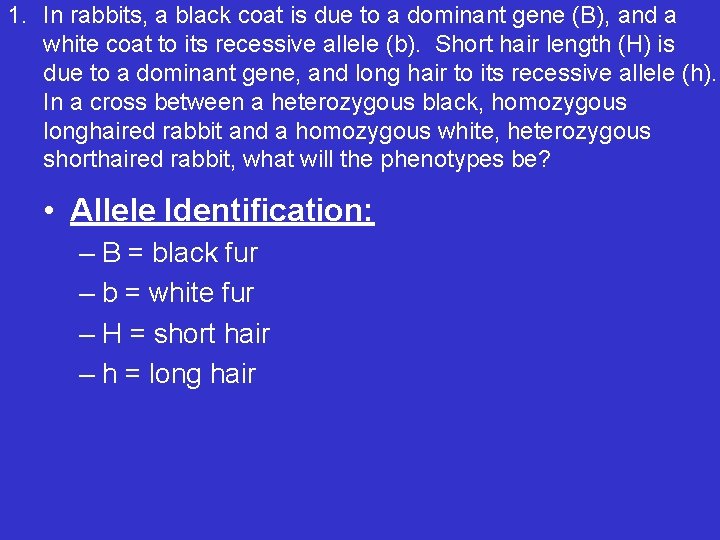
1. In rabbits, a black coat is due to a dominant gene (B), and a white coat to its recessive allele (b). Short hair length (H) is due to a dominant gene, and long hair to its recessive allele (h). In a cross between a heterozygous black, homozygous longhaired rabbit and a homozygous white, heterozygous shorthaired rabbit, what will the phenotypes be? • Allele Identification: – B = black fur – b = white fur – H = short hair – h = long hair
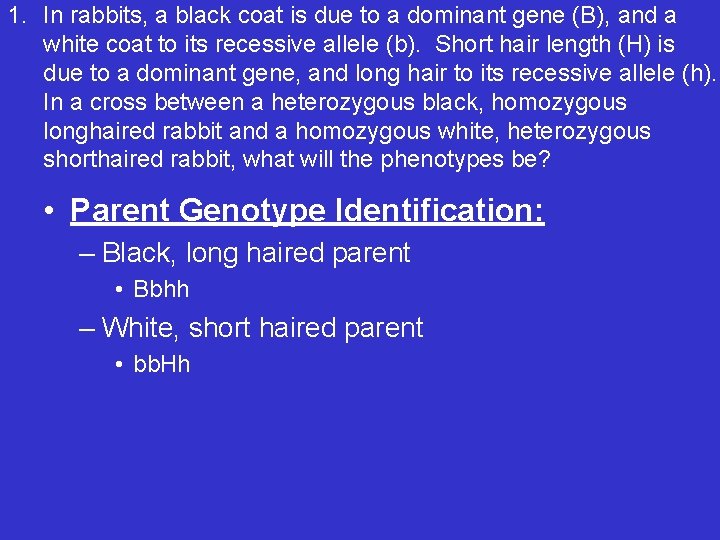
1. In rabbits, a black coat is due to a dominant gene (B), and a white coat to its recessive allele (b). Short hair length (H) is due to a dominant gene, and long hair to its recessive allele (h). In a cross between a heterozygous black, homozygous longhaired rabbit and a homozygous white, heterozygous shorthaired rabbit, what will the phenotypes be? • Parent Genotype Identification: – Black, long haired parent • Bbhh – White, short haired parent • bb. Hh
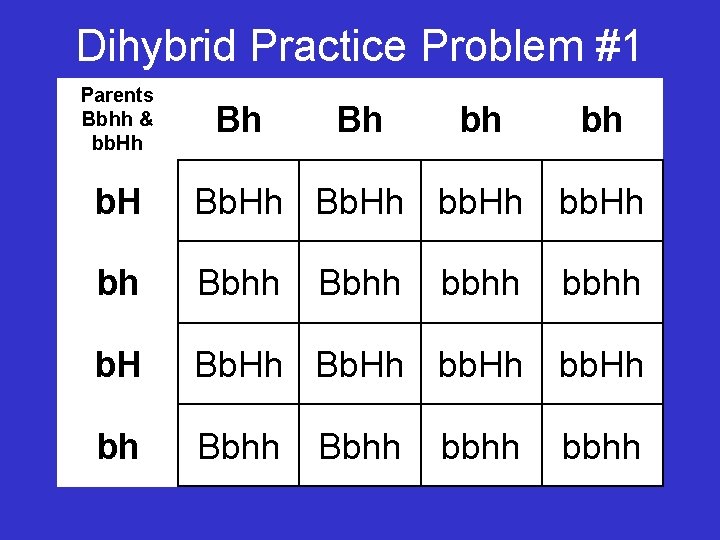
Dihybrid Practice Problem #1 Parents Bbhh & bb. Hh Bh Bh bh bh b. H Bb. Hh bb. Hh bh Bbhh bbhh
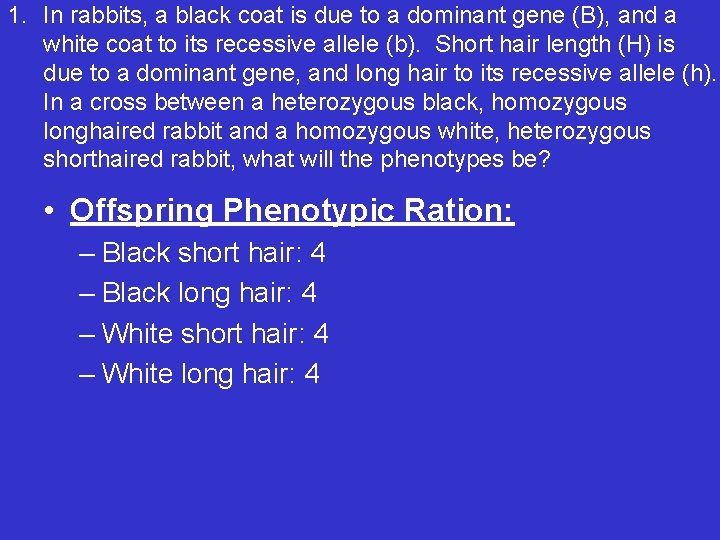
1. In rabbits, a black coat is due to a dominant gene (B), and a white coat to its recessive allele (b). Short hair length (H) is due to a dominant gene, and long hair to its recessive allele (h). In a cross between a heterozygous black, homozygous longhaired rabbit and a homozygous white, heterozygous shorthaired rabbit, what will the phenotypes be? • Offspring Phenotypic Ration: – Black short hair: 4 – Black long hair: 4 – White short hair: 4 – White long hair: 4
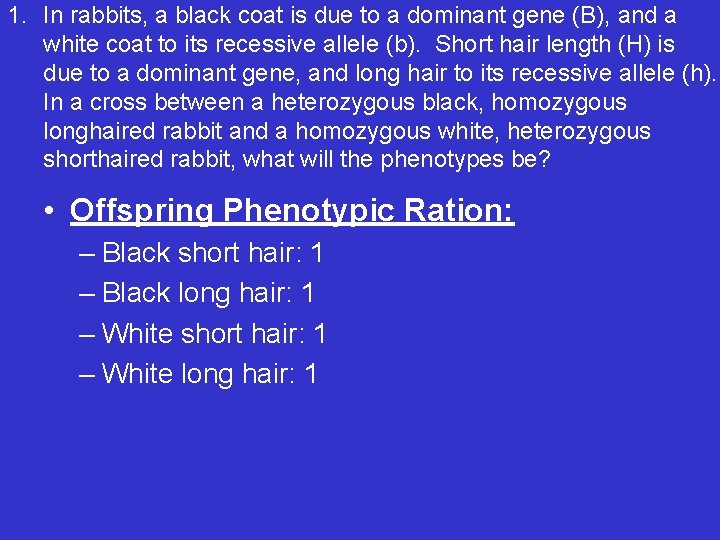
1. In rabbits, a black coat is due to a dominant gene (B), and a white coat to its recessive allele (b). Short hair length (H) is due to a dominant gene, and long hair to its recessive allele (h). In a cross between a heterozygous black, homozygous longhaired rabbit and a homozygous white, heterozygous shorthaired rabbit, what will the phenotypes be? • Offspring Phenotypic Ration: – Black short hair: 1 – Black long hair: 1 – White short hair: 1 – White long hair: 1
2. In tomatoes, red fruit color (R) is dominant to yellow (r). Round shaped fruit (F) is dominant to pear shaped fruit (f). A gardener crosses a heterozygous red fruit, homozygous round fruit plant with a yellow fruit, heterozygous round fruit plant. Record the phenotypic ratios of the offspring. • Allele Identification: – R = red fruit – r = yellow fruit – F = round fruit – f = pear shaped fruit
2. In tomatoes, red fruit color (R) is dominant to yellow (r). Round shaped fruit (F) is dominant to pear shaped fruit (f). A gardener crosses a heterozygous red fruit, homozygous round fruit plant with a yellow fruit, heterozygous round fruit plant. Record the phenotypic ratios of the offspring. • Parent Genotype Identification: – Red Round Parent • Rr. FF – Yellow Round Parent • rr. Ff
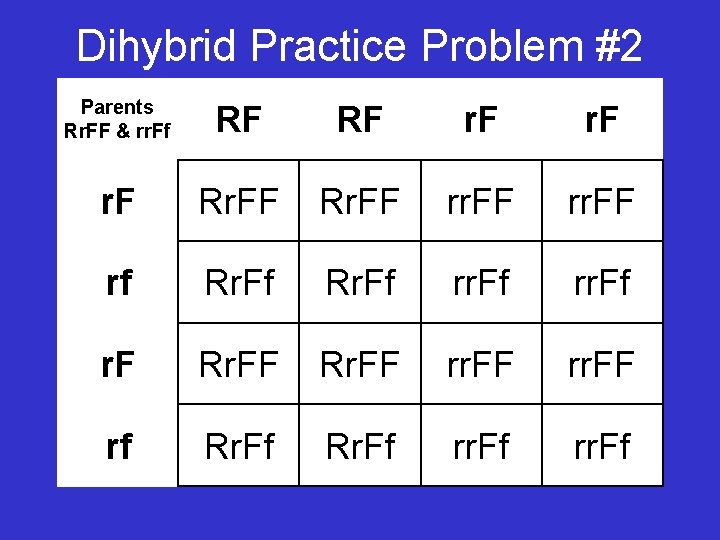
Dihybrid Practice Problem #2 Parents Rr. FF & rr. Ff RF RF r. F Rr. FF rr. FF rf Rr. Ff rr. Ff
2. In tomatoes, red fruit color (R) is dominant to yellow (r). Round shaped fruit (F) is dominant to pear shaped fruit (f). A gardener crosses a heterozygous red fruit, homozygous round fruit plant with a yellow fruit, heterozygous round fruit plant. Record the phenotypic ratios of the offspring. • Offspring Phenotypic Ration: – Red round: – Red pear: – Yellow round: – Yellow pear:
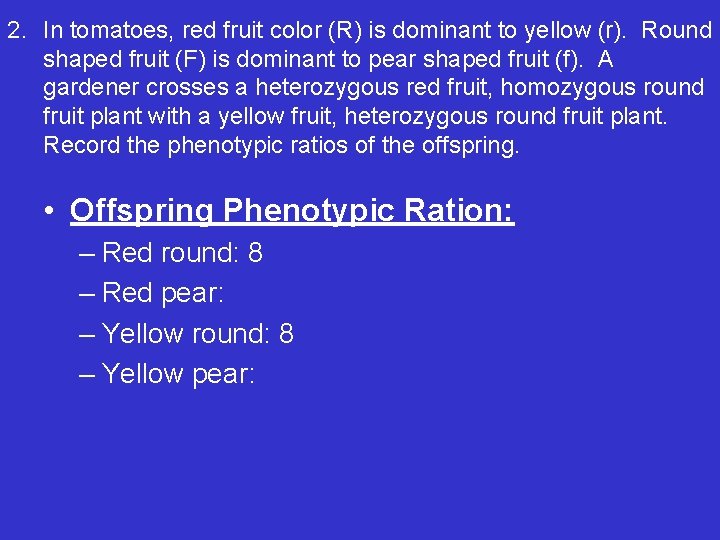
2. In tomatoes, red fruit color (R) is dominant to yellow (r). Round shaped fruit (F) is dominant to pear shaped fruit (f). A gardener crosses a heterozygous red fruit, homozygous round fruit plant with a yellow fruit, heterozygous round fruit plant. Record the phenotypic ratios of the offspring. • Offspring Phenotypic Ration: – Red round: 8 – Red pear: – Yellow round: 8 – Yellow pear:
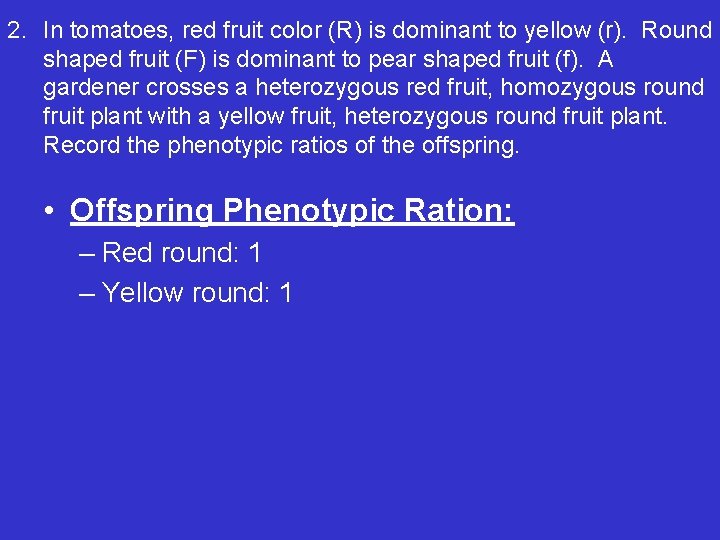
2. In tomatoes, red fruit color (R) is dominant to yellow (r). Round shaped fruit (F) is dominant to pear shaped fruit (f). A gardener crosses a heterozygous red fruit, homozygous round fruit plant with a yellow fruit, heterozygous round fruit plant. Record the phenotypic ratios of the offspring. • Offspring Phenotypic Ration: – Red round: 1 – Yellow round: 1
- Slides: 54