
Digoxin And Mortality in Patients With Atrial Fibrillation
Digoxin And Mortality in Patients With Atrial Fibrillation With and Without Heart Failure: Does Serum Digoxin Concentration Matter? Renato D. Lopes, MD, Ph. D, FACC on behalf of the ARISTOTLE Investigators
Disclosures • The ARISTOTLE trial was sponsored by Bristol-Myers Squibb and Pfizer. • The present analysis was sponsored by the Duke Clinical Research Institute. • The serum digoxin measurements were performed in blood samples stored in the Uppsala Biobank (UCR, Uppsala).

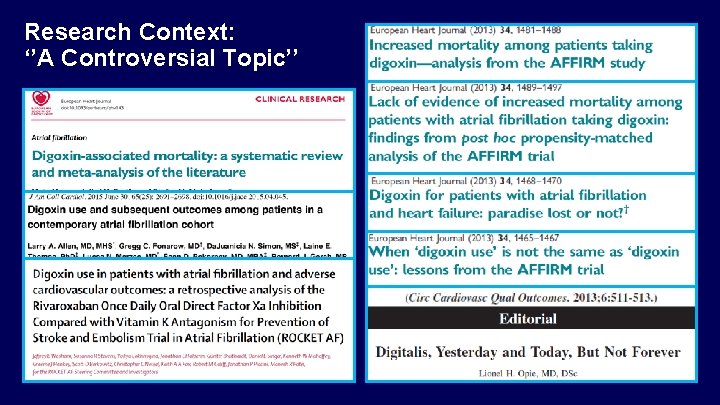
Background • Digoxin is used in ≈ 30% of patients with atrial fibrillation (AF) worldwide, despite the lack of randomized clinical trials to assess its efficacy and safety in this setting. 1– 3 • Current AF guidelines recommend digoxin for rate control in patients with AF with and without heart failure (HF). 4, 5 • There are no specific recommendations about serum digoxin concentration monitoring in the AF guidelines. 1 Allen LA, et al. J Am Coll Cardiol 2015; 65: 2691 -8. 2 Washam JB, et al. Lancet 2015; 385: 2363 -70. 3 Granger CB, et al. N Engl J Med 2011; 365: 981 -92. 4 January CT, et al. Circulation 2014; 130: 2071 -104. 5 Kirchof P, et al. Eur Heart J 2016; 37: 2893 -962.
Research Context: ‘’A Controversial Topic’’
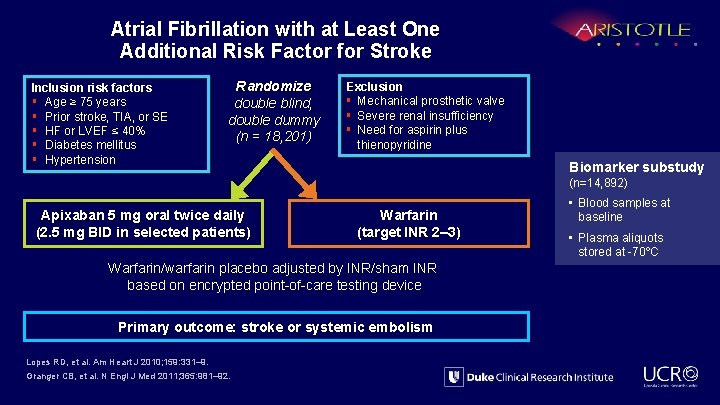
Atrial Fibrillation with at Least One Additional Risk Factor for Stroke Inclusion risk factors § Age ≥ 75 years § Prior stroke, TIA, or SE § HF or LVEF ≤ 40% § Diabetes mellitus § Hypertension Randomize double blind, double dummy (n = 18, 201) Exclusion § Mechanical prosthetic valve § Severe renal insufficiency § Need for aspirin plus thienopyridine Biomarker substudy (n=14, 892) Apixaban 5 mg oral twice daily (2. 5 mg BID in selected patients) Warfarin (target INR 2– 3) Warfarin/warfarin placebo adjusted by INR/sham INR based on encrypted point-of-care testing device Primary outcome: stroke or systemic embolism Lopes RD, et al. Am Heart J 2010; 159: 331– 9. Granger CB, et al. N Engl J Med 2011; 365: 981– 92. • Blood samples at baseline • Plasma aliquots stored at -70ºC
Objectives Using data from the ARISTOTLE trial, we aimed to: • Explore the association between digoxin use and mortality – According to serum digoxin concentration – In patients with and without HF • Assess the efficacy and safety of apixaban versus warfarin in patients taking and not taking digoxin.
Unique Features of Our Study • Detailed serial assessment of concomitant medications, including digoxin. • Two types of analyses: prevalence (baseline digoxin) and incidence (new digoxin users). • Measurement of serum digoxin concentration at baseline. • Comprehensive covariate adjustment, including for biomarker levels (NT-pro. BNP, troponin, GDF-15).

Digoxin Use at Baseline (Prevalence analysis) • Mortality in patients taking or not taking digoxin at baseline was compared using a Cox model with propensity weighting. • The propensity model included sociodemographic characteristics, medical history, vital signs, AF characteristics, concomitant medications, labs, and biomarkers. • The association between baseline digoxin concentration and mortality after multivariable adjustment was explored.

Digoxin Started During the Study (Incidence analysis: “new digoxin users”) • Risk-set matching was used to identify controls for each patient who started digoxin (3: 1). • Matches were based on a time-dependent propensity score including baseline and post-baseline covariates measured prior to the time of matching. • Baseline covariates were updated during follow-up. • Matching was performed within region, clinical setting, and HF status.
Digoxin and Mortality MAIN RESULTS
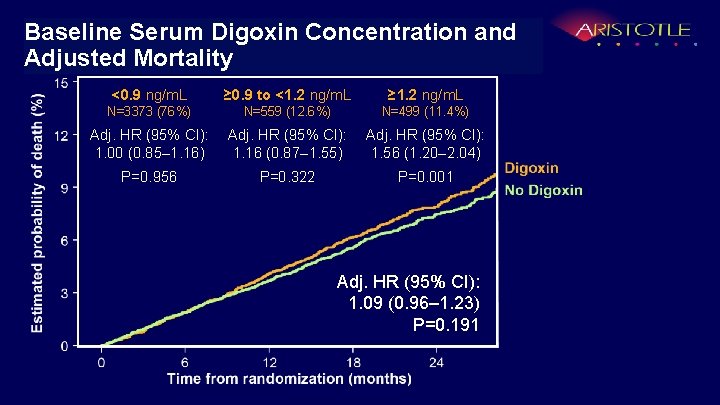
Digoxin and Adjusted Mortalityand Baseline Serum Concentration Adjusted Mortality <0. 9 ng/m. L ≥ 0. 9 to <1. 2 ng/m. L ≥ 1. 2 ng/m. L N=3373 (76%) N=559 (12. 6%) N=499 (11. 4%) Adj. HR (95% CI): 1. 00 (0. 85– 1. 16) Adj. HR (95% CI): 1. 16 (0. 87– 1. 55) Adj. HR (95% CI): 1. 56 (1. 20– 2. 04) P=0. 956 P=0. 322 P=0. 001 Adj. HR (95% CI): 1. 09 (0. 96– 1. 23) P=0. 191
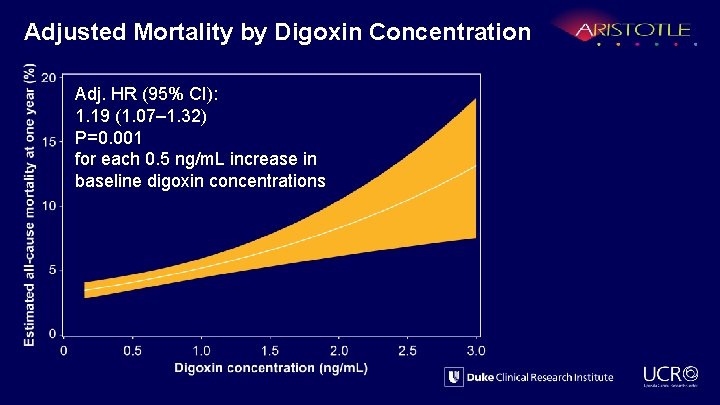
Adjusted Mortality by Digoxin Concentration Adj. HR (95% CI): 1. 19 (1. 07– 1. 32) P=0. 001 for each 0. 5 ng/m. L increase in baseline digoxin concentrations

Characteristics of New Digoxin Users and Matched Controls Characteristic Age, median (25 th, 75 th), yrs Female sex (%) Prior stroke, TIA, or SE (%) Heart failure/Left ventricular dysfunction (%) LVEF, median (25 th, 75 th), % NYHA class (%): I II IV Type of AF (%): Paroxysmal Persistent / Permanent Digoxin (N=781) 70 (63, 76) 40. 3 23. 9 42. 9 55 (47, 64) 46. 3 42. 1 11. 4 0. 8 15. 9 84. 1 Matched Control (N=2, 343) 70 (63, 76) 40. 5 23. 0 42. 9 56 (45, 63) 50. 5 39. 4 9. 7 0. 3 14. 5 85. 5
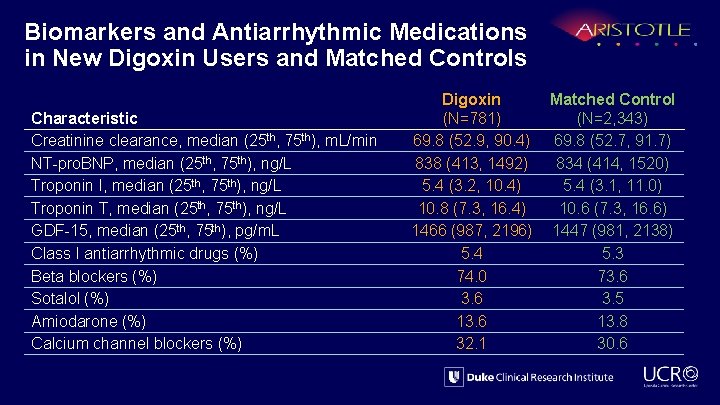
Biomarkers and Antiarrhythmic Medications in New Digoxin Users and Matched Controls Characteristic Creatinine clearance, median (25 th, 75 th), m. L/min NT-pro. BNP, median (25 th, 75 th), ng/L Troponin I, median (25 th, 75 th), ng/L Troponin T, median (25 th, 75 th), ng/L GDF-15, median (25 th, 75 th), pg/m. L Class I antiarrhythmic drugs (%) Beta blockers (%) Sotalol (%) Amiodarone (%) Calcium channel blockers (%) Digoxin (N=781) 69. 8 (52. 9, 90. 4) 838 (413, 1492) 5. 4 (3. 2, 10. 4) 10. 8 (7. 3, 16. 4) 1466 (987, 2196) 5. 4 74. 0 3. 6 13. 6 32. 1 Matched Control (N=2, 343) 69. 8 (52. 7, 91. 7) 834 (414, 1520) 5. 4 (3. 1, 11. 0) 10. 6 (7. 3, 16. 6) 1447 (981, 2138) 5. 3 73. 6 3. 5 13. 8 30. 6
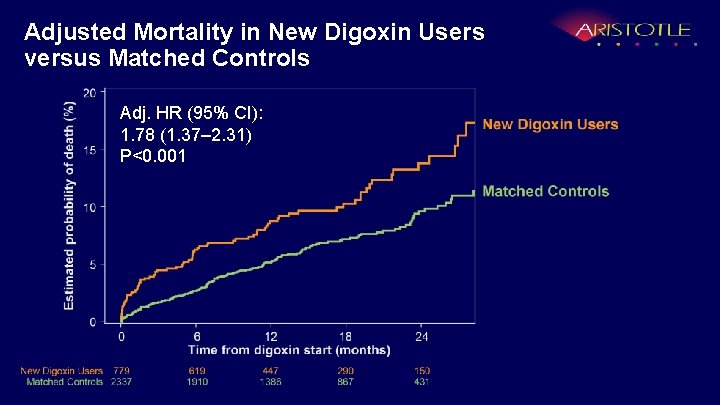
Adjusted Mortality in New Digoxin Users versus Matched Controls Adj. HR (95% CI): 1. 78 (1. 37– 2. 31) P<0. 001
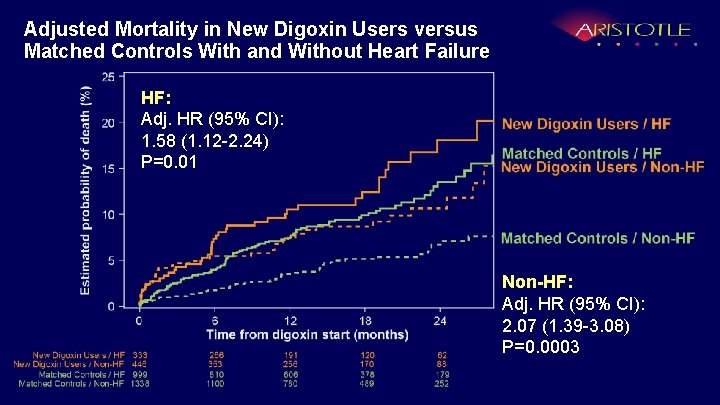
Adjusted Mortality in New Digoxin Users versus Matched Controls With and Without Heart Failure HF: Adj. HR (95% CI): 1. 58 (1. 12 -2. 24) P=0. 01 Non-HF: Adj. HR (95% CI): 2. 07 (1. 39 -3. 08) P=0. 0003
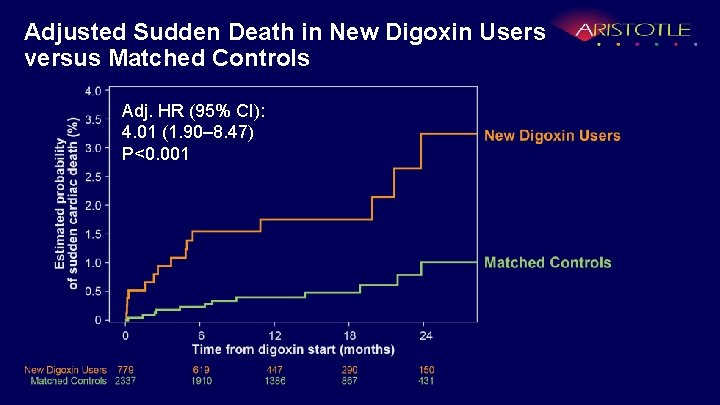
Adjusted Sudden Death in New Digoxin Users versus Matched Controls Adj. HR (95% CI): 4. 01 (1. 90– 8. 47) P<0. 001
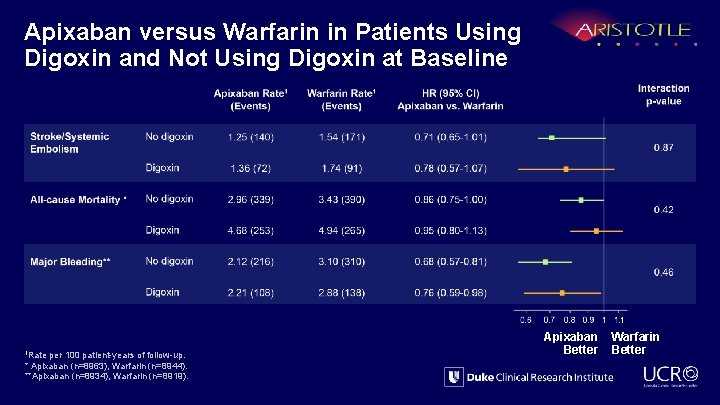
Apixaban versus Warfarin in Patients Using Digoxin and Not Using Digoxin at Baseline 1 Rate per 100 patient-years of follow-up. * Apixaban (n=8963), Warfarin (n=8944). **Apixaban (n=8934), Warfarin (n=8919). Apixaban Better Warfarin Better
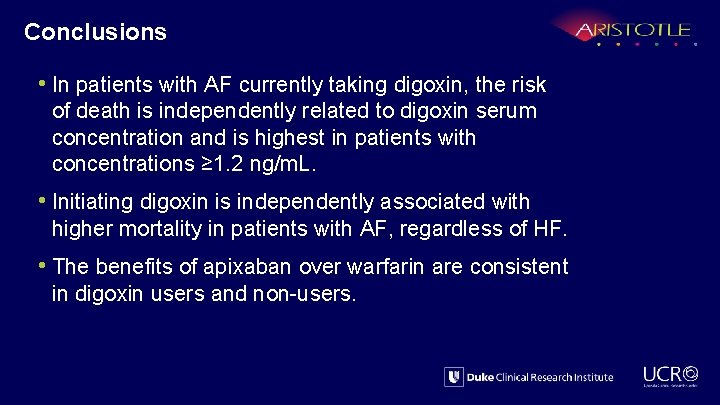
Conclusions • In patients with AF currently taking digoxin, the risk of death is independently related to digoxin serum concentration and is highest in patients with concentrations ≥ 1. 2 ng/m. L. • Initiating digoxin is independently associated with higher mortality in patients with AF, regardless of HF. • The benefits of apixaban over warfarin are consistent in digoxin users and non-users.
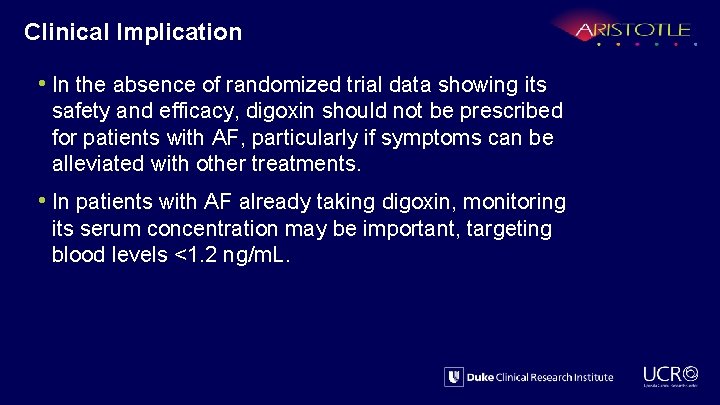
Clinical Implication • In the absence of randomized trial data showing its safety and efficacy, digoxin should not be prescribed for patients with AF, particularly if symptoms can be alleviated with other treatments. • In patients with AF already taking digoxin, monitoring its serum concentration may be important, targeting blood levels <1. 2 ng/m. L.

THANKS TO ALL ARISTOTLE Investigators and Patients
- Slides: 21