
Dignity at Work your responsibility as a Manager
Dignity at Work- your responsibility as a Manager
Dignity at Work • The Dignity at Work policy wraps its arms around what were formerly the grievance, harassment and bullying policies • The ACAS definition is; Bullying and harassment means any unwanted behaviour that makes someone feel intimidated, degraded, humiliated or offended. It is not necessarily always obvious or apparent to others, and may happen in the workplace without an employer's awareness • Under the Equality Act 2010, harassment is unwanted conduct which is related to one of the following: age, disability, gender reassignment, race, religion or belief, sex and sexual orientation and is therefore unlawful.
Dignity at Work – what does RBKC say? RBKC’s employees are committed to respecting and treating one another with integrity; adopting a fair and involving approach regardless of any way in which an individual is different to us. That being the case, RBKC will not knowingly overlook or tolerate any inappropriate behaviour
An employee grievance is a concern, problem or complaint that an employee has about their work, the workplace, or someone they work with—this includes management. Something has made them feel dissatisfied, and they believe it is unfair and/or unjust on them. Grievances • • Training request denied Perceived favouritism within the office Perceived heave workload Pereceived bullying/harassment
Examples of bullying / harassing behaviour could include: Dignity at Work – what does bullying/harassment look like? • spreading malicious rumours, or insulting someone • exclusion or victimisation • unfair treatment • deliberately undermining a competent worker by constant criticism • Cyber-bullying
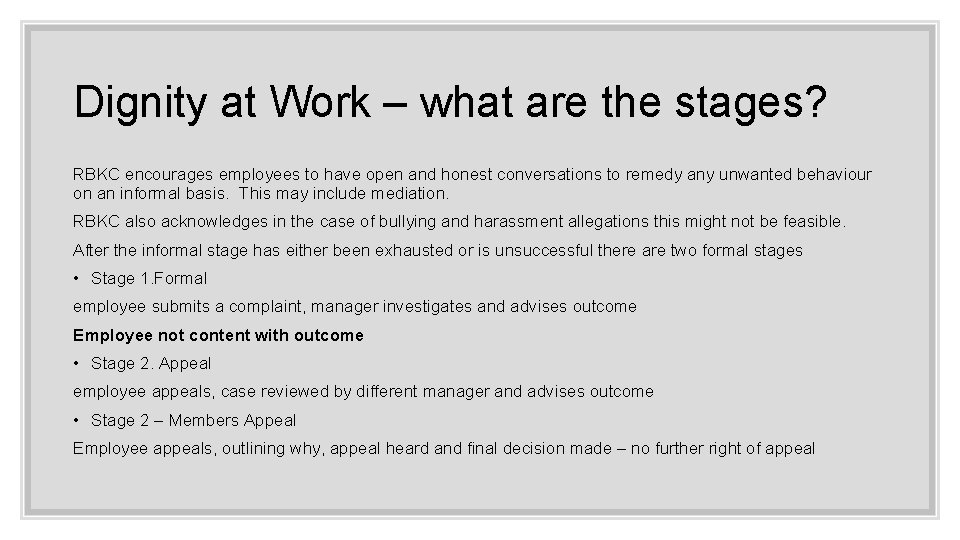
Dignity at Work – what are the stages? RBKC encourages employees to have open and honest conversations to remedy any unwanted behaviour on an informal basis. This may include mediation. RBKC also acknowledges in the case of bullying and harassment allegations this might not be feasible. After the informal stage has either been exhausted or is unsuccessful there are two formal stages • Stage 1. Formal employee submits a complaint, manager investigates and advises outcome Employee not content with outcome • Stage 2. Appeal employee appeals, case reviewed by different manager and advises outcome • Stage 2 – Members Appeal Employee appeals, outlining why, appeal heard and final decision made – no further right of appeal
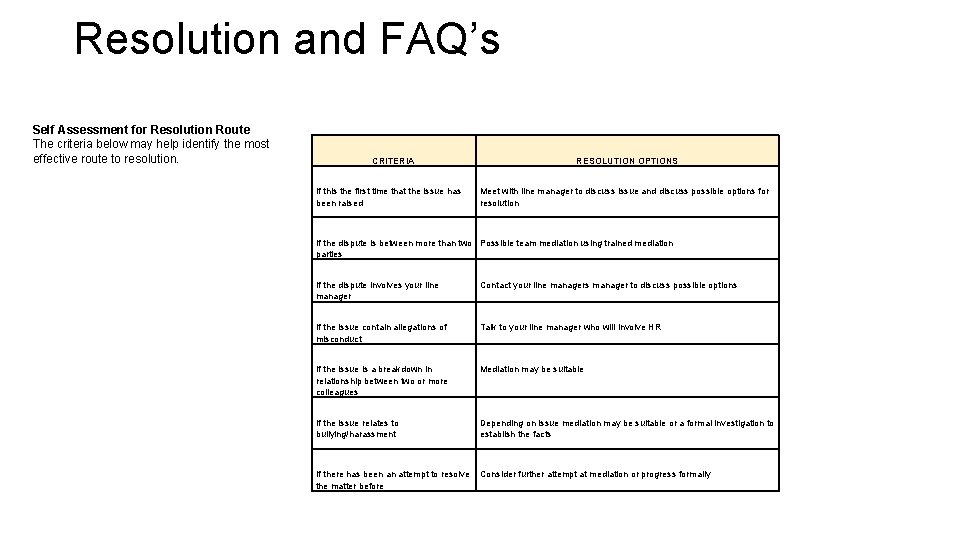
Resolution and FAQ’s Self Assessment for Resolution Route The criteria below may help identify the most effective route to resolution. CRITERIA RESOLUTION OPTIONS If this the first time that the issue has been raised Meet with line manager to discuss issue and discuss possible options for resolution If the dispute is between more than two Possible team mediation using trained mediation parties If the dispute involves your line manager Contact your line managers manager to discuss possible options If the issue contain allegations of misconduct Talk to your line manager who will involve HR If the issue is a breakdown in relationship between two or more colleagues Mediation may be suitable If the issue relates to bullying/harassment Depending on issue mediation may be suitable or a formal investigation to establish the facts If there has been an attempt to resolve Consider further attempt at mediation or progress formally the matter before
Resolution and FAQ’s Q Should I try to resolve the issue informally & what if it is about my line manager? A We always encourage employees to attempt to informally resolve any issues in the first instance. Where a complaint relates to matters that could constitute harassment or bullying, you should raise this with your manager who should discuss the issue with you sensitively. Your manager will ask if you have advised the person causing offense that their behaviour is giving offence and is not acceptable and that it should be stopped. If you have not, the manager will ask the reason, and encourage you, where possible, to advise the offender that their behaviour is causing distress and should be stopped. If, however, you feel uncomfortable approaching the person causing offense directly, their manager will seek permission to speak to the person causing offence on your behalf to let them know their behaviour is unacceptable and is causing offence. If your complaint is against your direct line manager, you will need to address your concerns to the line manager's manager who will respond in line with the policy. Q If I raise a formal complaint when I am not at work, what happens? A The manager considering the complaint may still want you to come into work to attend meetings, or to send a companion to represent you, or to give the manager written information instead. The manager will make a decision on your complaint based on the information available to them. You may also request access to information held at your workplace, and this request should be made in writing to the manager considering the complaint. If you are on holiday then it can await your return.
Resolution and FAQ’s Q What is cyberbullying? A The National Crime Prevention Council's definition of cyber-bullying is "when the Internet, mobile phones or other devices are used to send or post text or images intended to hurt or embarrass another person". Cyberbullying is just as destructive as bullying in the physical world. Managers and staff should therefore be aware that mobile phones, emails, chat rooms, social networking sites, gaming, and sending viruses can become instruments of bullying or harassment directed against council employees, pupils and teachers. Misuse of or breaches of the Council's Email & Internet Acceptable Use Policy and Guidelines and other information technology systems is considered a Disciplinary Offense and should be dealt with under the Council's Disciplinary Code. Q Who can the employees representative be, and in what capacity can they act? A The representative may be a trade union representative, a work colleague, or an official employed by a trade union, all of whom are entitled to paid time off to attend the meeting. - The representative will be allowed to address the hearing to put forward and sum up the employee's case, should not respond on behalf of the employee to any views expressed at the meeting, nor confer with the employee during the hearing. - The representative is not to act in a legal capacity, is not to answer questions on the employee's behalf, nor to address the hearing if the employee does not wish it.
Resolution and FAQ’s Q What are typical examples of harassment and bullying? A There is not an exhaustive list of examples, but frequently cited reasons are; unwanted physical contact unwelcome remarks about a person’s age, dress, appearance, race or marital status, jokes at personal expense, offensive language, gossip, slander, sectarian songs and letters posters, graffiti, obscene gestures, flags, bunting and emblems isolation or non-cooperation and exclusion from social activities coercion for sexual favours pressure to participate in political/religious groups personal intrusion from pestering, spying and stalking failure to safeguard confidential information shouting and bawling setting impossible deadlines persistent unwarranted criticism or personal insults
Resolution and FAQ’s Q Can anyone support me to fill the form in for me if I wish to make a complaint? A The person that you are reporting the issue to should be able to help you to fill the form out, or, do it on your behalf after an initial discussion Q Who can I speak to for support? A You may speak to your manager, trade union representative, and the council's confidential Employee Assistance Programme (details on KCnet). If your concerns relate to alleged bullying and/or harassment employees can speak to a Dignity At Work Adviser.
Resolution and FAQ’s Q. What information will be given to the person who is accused of bullying/harassment? A. The person accused of bullying/harassment will be provided with information about the allegation/s against them. Additionally, the recommendations at the conclusion of the hearing and appeal should include how to update the person accused of bullying/harassment appropriately, bearing in mind the need to maintain confidentiality. Q. What happens if someone has raised a complaint during a disciplinary process? A. With help from HR, the line manager will have to decide whether a complaint raised while an employee is subject to disciplinary proceedings is heard only when the disciplinary process has been completed or heard concurrently. If a complaint has any bearing on the disciplinary proceedings, it is expected this will be raised as a relevant issue in the course of those proceedings. Q. Is an employer required to deal with a formal complaint raised by an ex-employee? A. No. Dignity at Work should focus on resolving disputes with employees. A former employee might have a dispute with the council that could form the basis of tribunal or court proceedings, and the council may feel that it is appropriate to engage in dialogue with the individual in the hope of resolving the issue. However, this does not require the use of a formal procedure with a right of appeal.
Resolution and FAQ’s Q. Do I have to work with a colleague with whom I have made a complaint against whilst the investigation is taking place? A. Unless the complaint is so serious, in the interest of trying to form effective relationships we would ask colleagues to continue to work together. If the reasons for the complaint are so serious then it might be considered appropriate to temporarily redeploy one of the parties until the conclusion of the investigation. Q. What happens if the companion is not available at the time chosen for a formal complaint meeting? A. If the companion is not available at the proposed meeting time the line manager may propose one further meeting date. Q. Who are the bullying and harassment advisers? A. They are advertised on the intranet. The role of the Bullying and Harassment Advisers is to act as support and a 'sounding board' for employees. The advisers will assist employees to think, reflect and explore options and possible approaches. They will be able to advise on policy and provide information on support available to an individual. They will not attempt to resolve issues on behalf of the employee and do not investigate any allegations or complaints, nor do they accompany employees during formal proceedings should they be required. It is not their role to provide counselling to an employee but provide advice on where counselling might be accessed.
Resolution and FAQ’s Q. If I opt for mediation how does it work, and who will the mediator be? A. Mediation may be appropriate, depending on the nature of the complaint. Mediation involves the appointment of an impartial, third-party mediator who will discuss the issues raised by an employee's complaint with all of those involved and seek to facilitate a resolution. Mediation will be used only where all parties involved in the complaint agree and can be used at any stage in the process should all parties agree to it. If either side does not wish to participate in mediation this will not be considered to be an indication of either blame or intent. The Council has access to trained in-house mediators who can make themselves available to resolve disputes – details are obtainable from the workplace mediation factsheet & form (please click here). Q. What is meant by ‘recommended’ timescales? A. We want issues dealt with as quickly as practically possible, so we recommend timescales to enable a swift conclusion. We also recognise that there may external factors that can impact upon timescales, such as holidays, availability of witnesses, employee representatives etc. ,
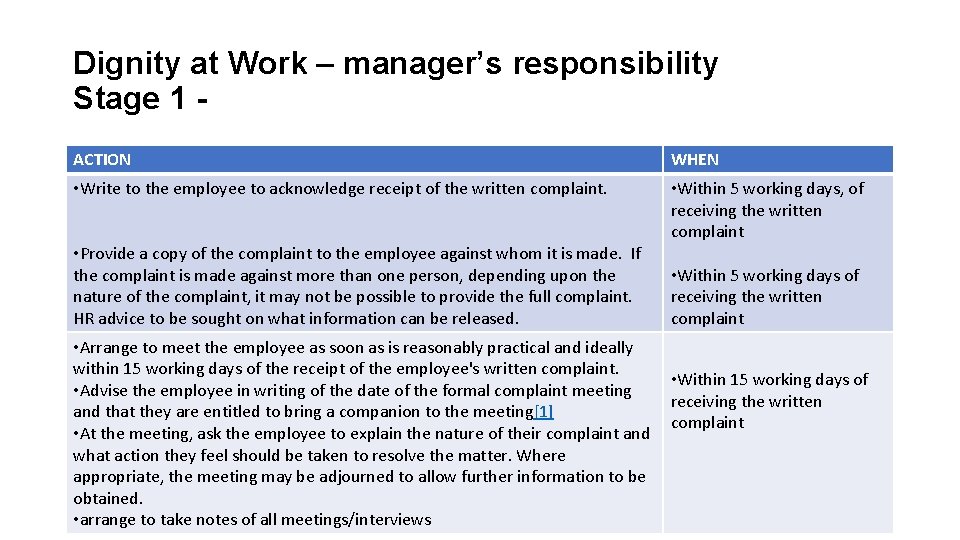
Dignity at Work – manager’s responsibility Stage 1 - ACTION WHEN • Write to the employee to acknowledge receipt of the written complaint. • Within 5 working days, of receiving the written complaint • Within 5 working days of receiving the written complaint • Provide a copy of the complaint to the employee against whom it is made. If the complaint is made against more than one person, depending upon the nature of the complaint, it may not be possible to provide the full complaint. HR advice to be sought on what information can be released. • Arrange to meet the employee as soon as is reasonably practical and ideally within 15 working days of the receipt of the employee's written complaint. • Advise the employee in writing of the date of the formal complaint meeting and that they are entitled to bring a companion to the meeting[1] • At the meeting, ask the employee to explain the nature of their complaint and what action they feel should be taken to resolve the matter. Where appropriate, the meeting may be adjourned to allow further information to be obtained. • arrange to take notes of all meetings/interviews • Within 15 working days of receiving the written complaint
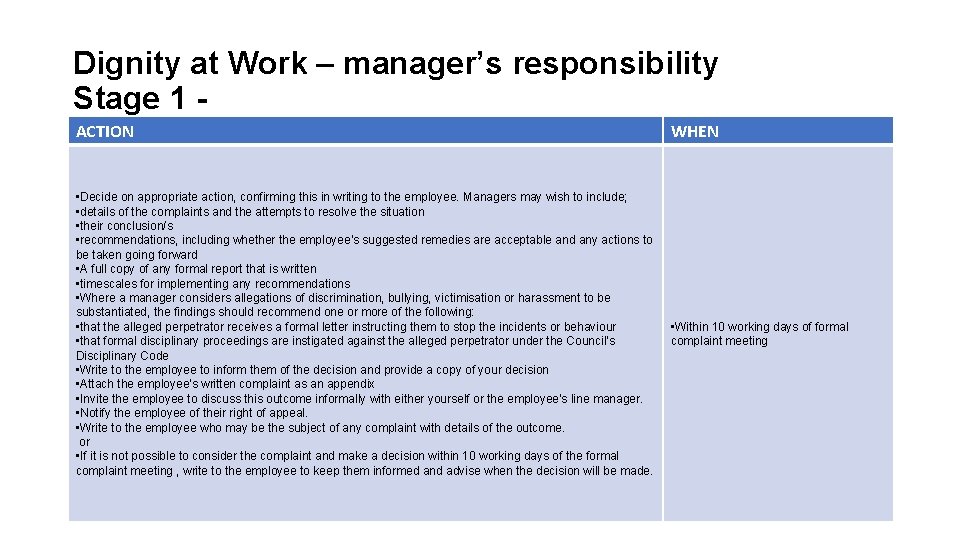
Dignity at Work – manager’s responsibility Stage 1 - ACTION WHEN • Decide on appropriate action, confirming this in writing to the employee. Managers may wish to include; • details of the complaints and the attempts to resolve the situation • their conclusion/s • recommendations, including whether the employee's suggested remedies are acceptable and any actions to be taken going forward • A full copy of any formal report that is written • timescales for implementing any recommendations • Where a manager considers allegations of discrimination, bullying, victimisation or harassment to be substantiated, the findings should recommend one or more of the following: • that the alleged perpetrator receives a formal letter instructing them to stop the incidents or behaviour • that formal disciplinary proceedings are instigated against the alleged perpetrator under the Council's Disciplinary Code • Write to the employee to inform them of the decision and provide a copy of your decision • Attach the employee's written complaint as an appendix • Invite the employee to discuss this outcome informally with either yourself or the employee's line manager. • Notify the employee of their right of appeal. • Write to the employee who may be the subject of any complaint with details of the outcome. or • If it is not possible to consider the complaint and make a decision within 10 working days of the formal complaint meeting , write to the employee to keep them informed and advise when the decision will be made. • Within 10 working days of formal complaint meeting
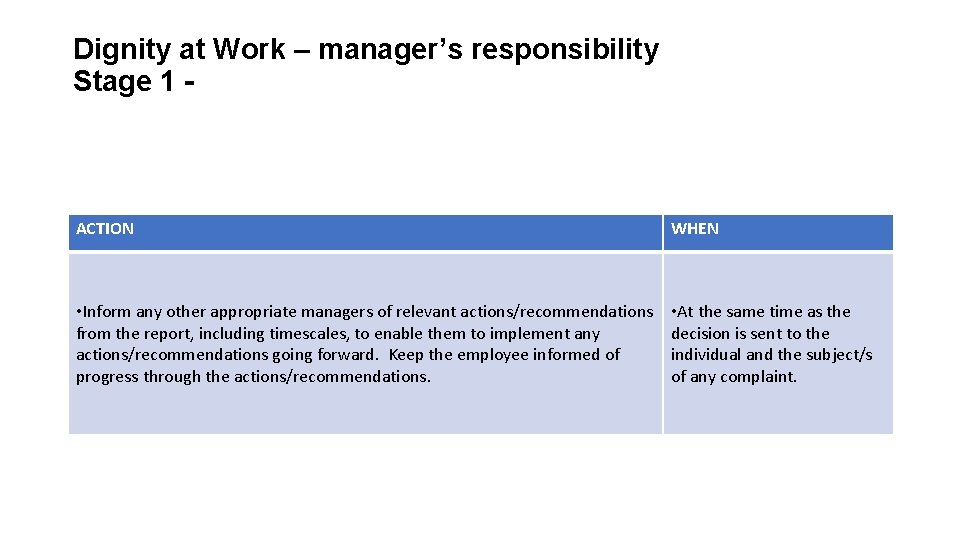
Dignity at Work – manager’s responsibility Stage 1 - ACTION WHEN • Inform any other appropriate managers of relevant actions/recommendations from the report, including timescales, to enable them to implement any actions/recommendations going forward. Keep the employee informed of progress through the actions/recommendations. • At the same time as the decision is sent to the individual and the subject/s of any complaint.
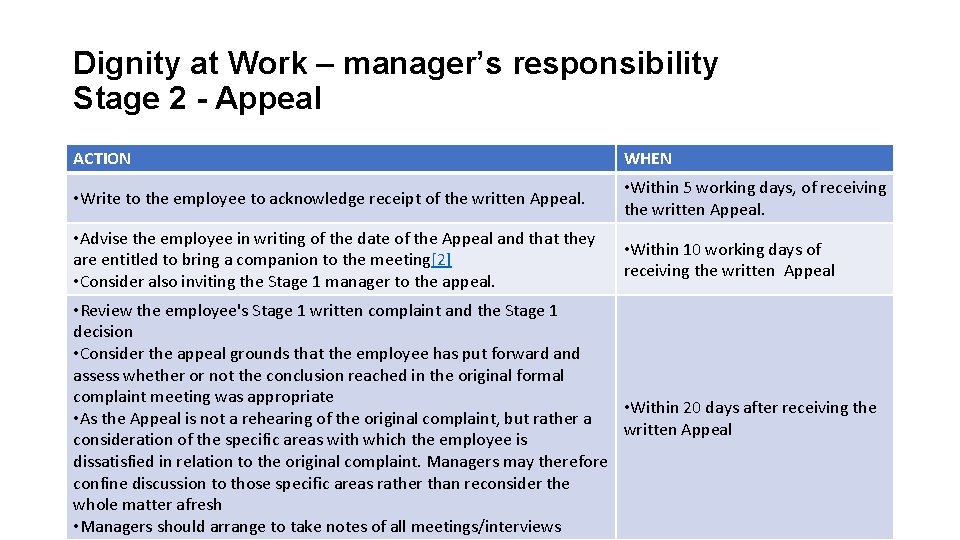
Dignity at Work – manager’s responsibility Stage 2 - Appeal ACTION WHEN • Write to the employee to acknowledge receipt of the written Appeal. • Within 5 working days, of receiving the written Appeal. • Advise the employee in writing of the date of the Appeal and that they are entitled to bring a companion to the meeting[2] • Consider also inviting the Stage 1 manager to the appeal. • Within 10 working days of receiving the written Appeal • Review the employee's Stage 1 written complaint and the Stage 1 decision • Consider the appeal grounds that the employee has put forward and assess whether or not the conclusion reached in the original formal complaint meeting was appropriate • Within 20 days after receiving the • As the Appeal is not a rehearing of the original complaint, but rather a written Appeal consideration of the specific areas with which the employee is dissatisfied in relation to the original complaint. Managers may therefore confine discussion to those specific areas rather than reconsider the whole matter afresh • Managers should arrange to take notes of all meetings/interviews

Dignity at Work – manager’s responsibility Stage 2 - Appeal ACTION WHEN • Write to the employee to confirm their decision and any recommendations, including timescales for implementing any recommendations • Where you consider allegations of discrimination, bullying, victimisation or harassment to be substantiated, the appeal decision should recommend one or more of the following: • that the alleged perpetrator receives a formal letter instructing them to stop the incidents or behaviour • Within 10 working days of hearing • that formal disciplinary proceedings are instigated against the alleged an appeal perpetrator under the Council's Disciplinary Code • Inform the employee that the outcome of this appeal meeting will be final • Send a copy to the Retained HR Service OR • If it is not possible to consider the complaint within 10 working days of the Appeal Hearing, write to the employee to keep them informed and advise them when the decision will be made
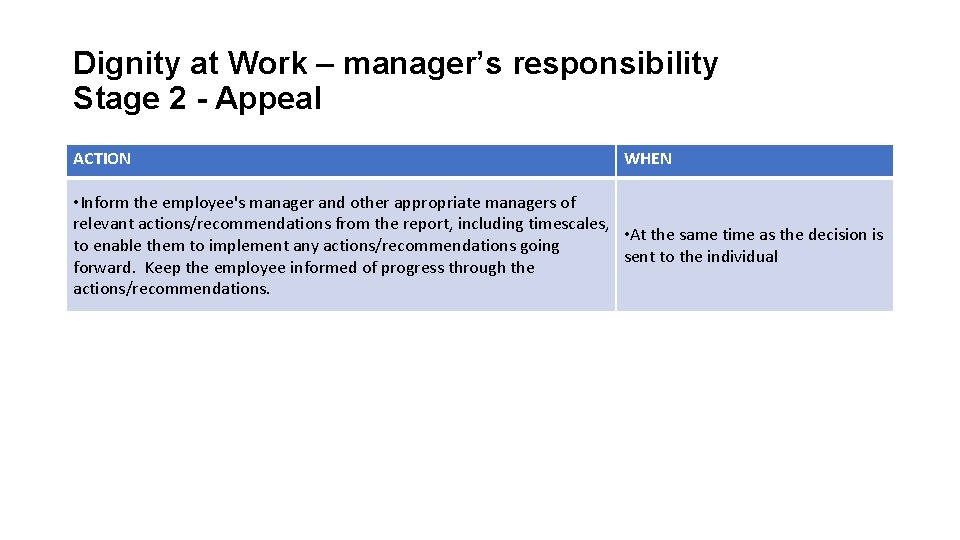
Dignity at Work – manager’s responsibility Stage 2 - Appeal ACTION WHEN • Inform the employee's manager and other appropriate managers of relevant actions/recommendations from the report, including timescales, • At the same time as the decision is to enable them to implement any actions/recommendations going sent to the individual forward. Keep the employee informed of progress through the actions/recommendations.
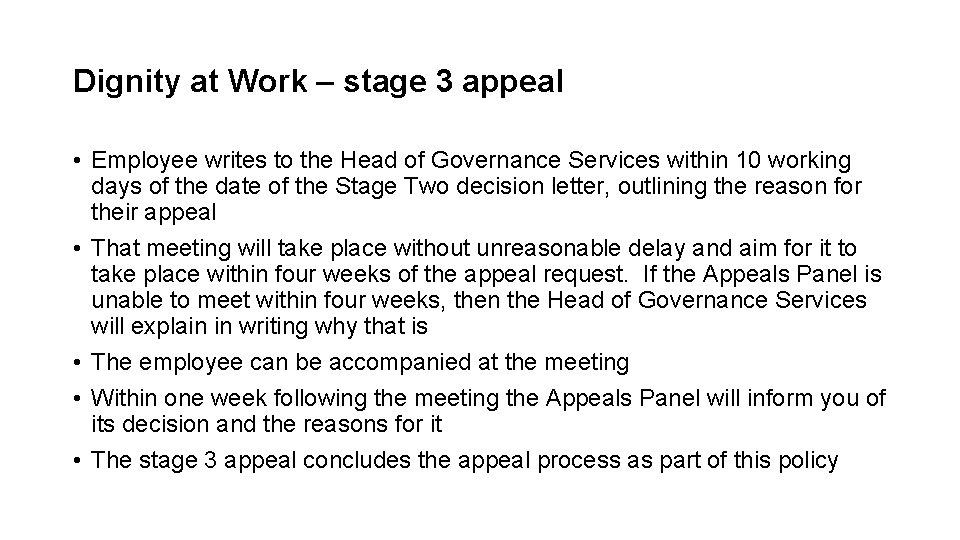
Dignity at Work – stage 3 appeal • Employee writes to the Head of Governance Services within 10 working days of the date of the Stage Two decision letter, outlining the reason for their appeal • That meeting will take place without unreasonable delay and aim for it to take place within four weeks of the appeal request. If the Appeals Panel is unable to meet within four weeks, then the Head of Governance Services will explain in writing why that is • The employee can be accompanied at the meeting • Within one week following the meeting the Appeals Panel will inform you of its decision and the reasons for it • The stage 3 appeal concludes the appeal process as part of this policy
- Slides: 21